Mai An Tiêm: The Watermelon Island
A servant who said his wealth was his own was left on a sandbank to starve, until a white bird from the west dropped the seeds of an unknown melon. In the oldest text he never carves his name on a melon or sends one out to sea: the king simply remembers him.
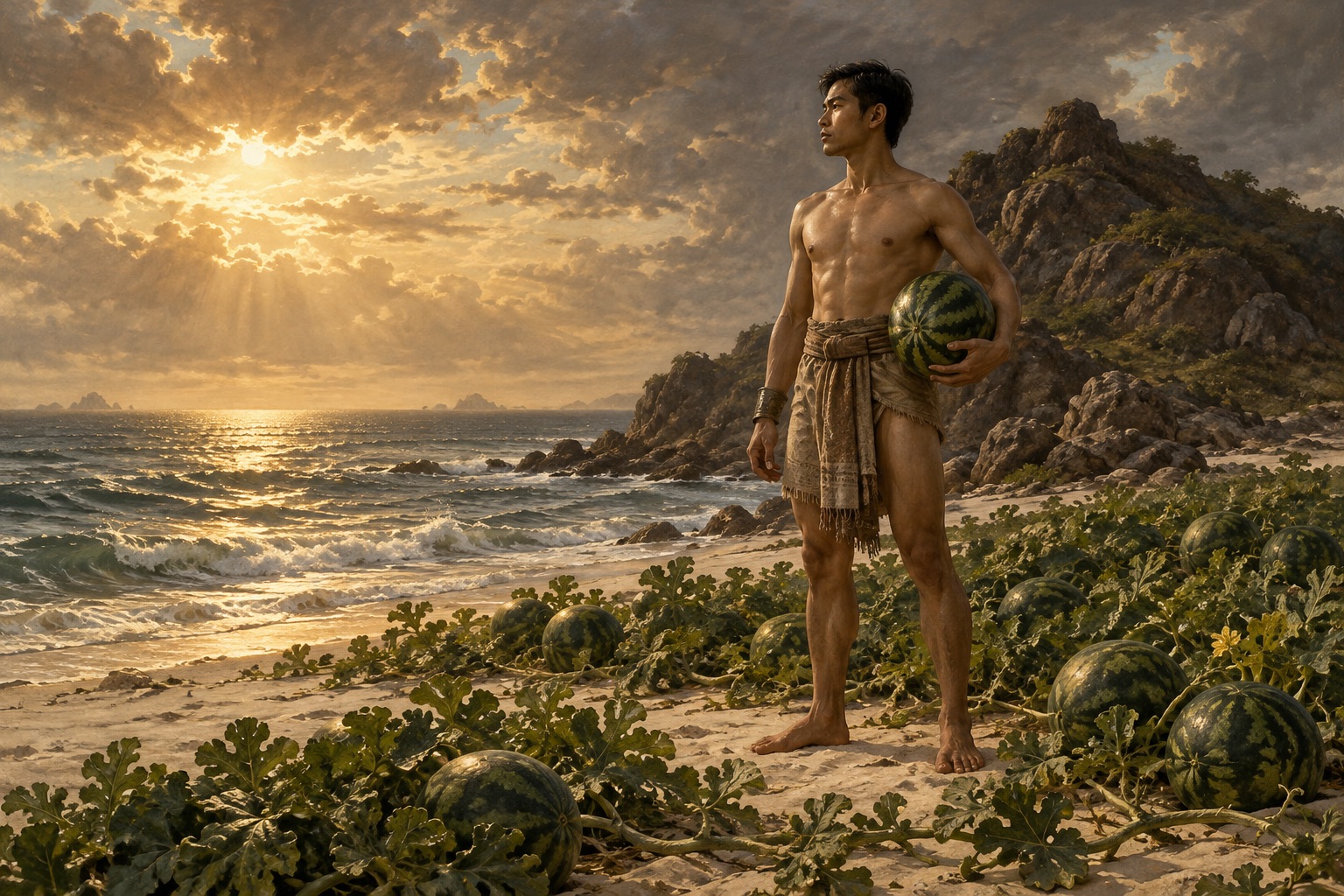
- Type: legend, the origin of a fruit, of its name and of a place
- Culture: Việt; Nga Sơn, on the coast of Thanh Hóa province
- Earliest text: the “Tây qua truyện” (西瓜傳, “Story of the Watermelon”) in the Lĩnh Nam chích quái, in its 15th-century form
- Key figures: Mai An Tiêm (Mai Yển), his wife, the Hùng king, a white bird from the west
Every year, from the 12th to the 14th of the third lunar month, a temple in Nga Sơn, on the coast of Thanh Hóa, holds its festival, and royal decrees of the early 20th century are read aloud there. They honour Mai Yển, styled An Tiêm, the elders who keep the temple say, as the man who first opened up this stretch of coast. His story is far older than the decrees: a servant left on a sandbank to die, saved by a fruit no one had seen before.
Did An Tiêm carve his name on the melons and send them out to sea? Not in the oldest text. In the Lĩnh Nam chích quái the king thinks of him on his own, sends a man to see whether he is still alive, and calls him home. The melon that floats to the mainland with his name on it, to be fished out and taken to the king, belongs to later tellings, among them the one Vietnamese children read at school.
1 The Telling
This is the version of the Lĩnh Nam chích quái (Strange Tales from South of the Passes), in the copy on Chinese Wikisource that carries the names of its 15th-century editors, Vũ Quỳnh and Kiều Phú. Where Eric Henry’s English translation, made from another copy, tells it differently, section 3 says so.
1-1 The Boy from the Merchant Ship
In the time of the Hùng kings, the text begins, the king had a servant named Mai Tiêm (枚暹), who was foreign by birth. When he was seven or eight years old, the king had bought him from a merchant ship as a slave. He grew up good-looking and upright, with a sharp memory for things, and the king gave him a new name, Mai Yển (枚偃), and the style An Tiêm (安暹).
The king gave him a wife, and they had sons and daughters. He trusted An Tiêm and handed him affairs to run, and little by little An Tiêm became rich and honoured. Gifts piled up at his gate, and he grew proud. He would often say: “All of this is what I had in a previous life. I never owed any of it to my lord’s favour.”
1-2 The Sandbank
The words reached the king, who flew into a rage. A subject, he said, who grows proud, forgets his lord’s favour and calls it all things from a previous life! “I will put you beyond the sea, where no one lives. Let us see whether you still have your things from a previous life there.”
So Mai Yển was set down on a sandbank outside the river mouth of Nga Sơn district (one copy, the text notes, reads Giáp Sơn), where no footprint led. He was left food for four or five months, so that when it ran out he would starve. His wife wept bitterly. An Tiêm laughed: “Heaven gave me life, so Heaven can feed me. Life and death lie with Heaven. Why should I worry?”

1-3 The Bird from the West
Then a white bird came flying from the west. It settled on a corner of the hill, cried out three or four times, and spat six or seven melon seeds onto the sand. They sprouted, spread thick across the sand and bore fruit. “This is no evil omen,” An Tiêm said with joy. “This is how Heaven feeds me.”

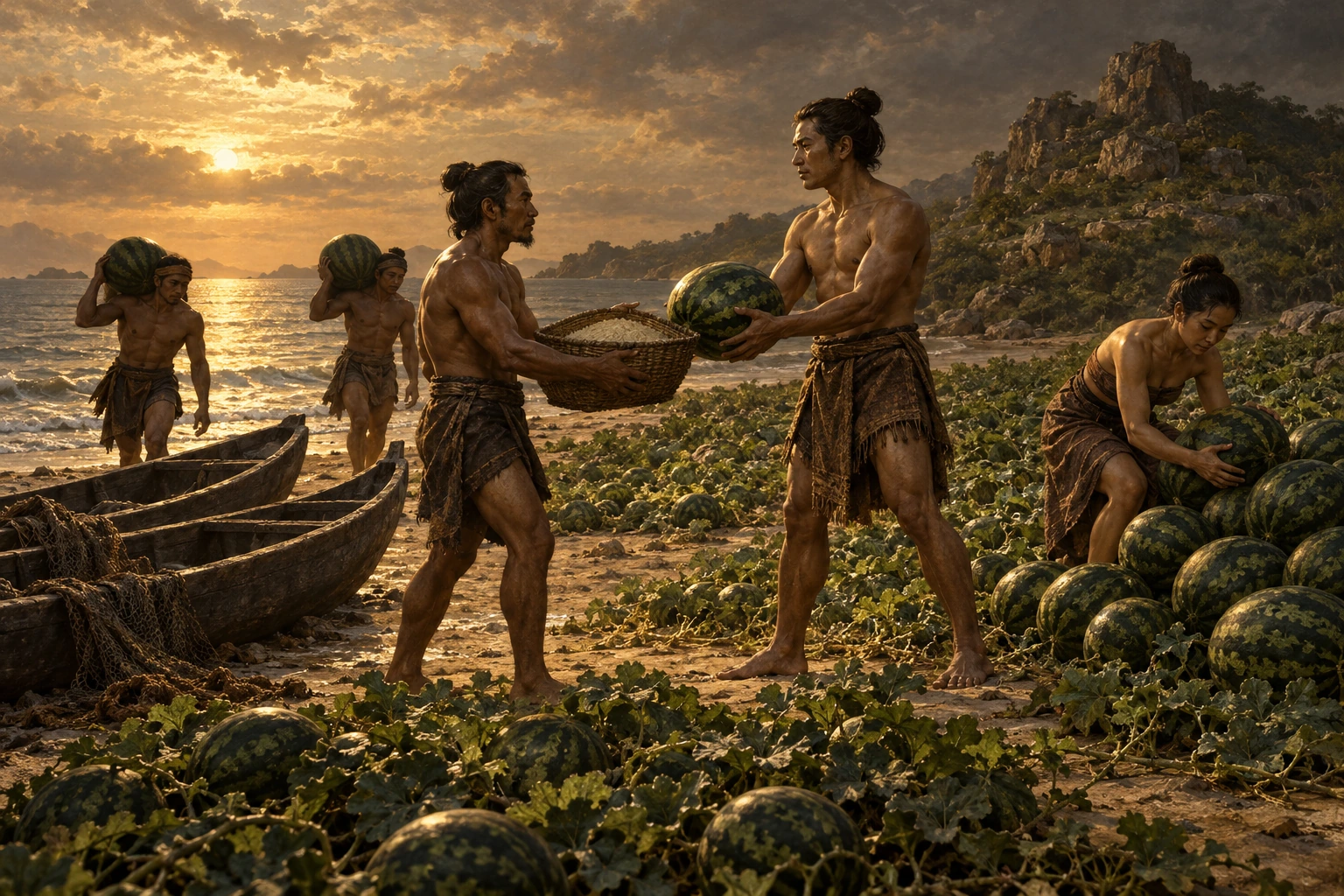
He cut one open and ate it. The taste was clean and sweet, and it cleared the head. He kept the seeds and sowed them again the next year, until there were more melons than the family could eat. The rest he traded for rice and millet to feed his wife and children.
He did not know what the fruit was called. Because a bird had brought it from the west, he called it tây qua (西瓜), “western melon”. Fishermen and merchants who tasted it loved it, and people from villages near and far bought the melons and spread the seed.
1-4 The Recall
Some time later the king thought of him, and sent a man to the sandbank to ask whether he was still alive. When the man came back and reported, the king sighed: “He said his things came from a previous life. That was no idle talk.” He called An Tiêm back, gave him back his post, and gave him servants.
The sandbank where he had lived was named An Tiêm châu (安暹洲), “An Tiêm’s sandbank”, and its village Mai thôn (枚村), “the Mai village”. The chapter ends by pointing to the map: this is “the An Tiêm sandbank of today, in Nga Sơn district, Thanh Hóa”.
2 Where the Story Is Written Down
- Lĩnh Nam chích quái, the only old source we found. In the Wikisource copy the “Tây qua truyện” is the ninth of the ten stories in book 1, just after the story of the rice cakes. In his preface of 1492, Vũ Quỳnh says he copied and corrected an old text; Kiều Phú revised it again in 1493. The copies differ: Eric Henry counts fourteen manuscripts in Hanoi libraries. His English translation, published in the Rising Asia Journal, follows chiefly the text Lê Hữu Mục printed in Saigon in 1959, which reproduces a hand copy made in the 1920s for the scholar Phạm Quỳnh. Neither copy says which Hùng king it was.
- Đại Việt sử ký toàn thư (Complete Annals of Đại Việt). In the Outer Annals he compiled in 1479, Ngô Sĩ Liên tells the stories of Thánh Gióng and Sơn Tinh under the Hùng kings. In the book of the Outer Annals that covers them we found no An Tiêm and no melon.
- Nam Hải dị nhân liệt truyện (Lives of Extraordinary People of the South). Phan Kế Bính’s collection, in its fifth edition of 1930, has lives of the gods of Phù Đổng and Tản Viên, but none of An Tiêm.
- Modern retellings.
- Nguyễn Trọng Thuật turned the legend into a novel, Quả dưa đỏ (The Red Watermelon), published in 1925. Eric Henry calls it prize-winning.
- An anonymous retelling, “Sự tích trái dưa hấu” (“The Story of the Watermelon”), is on Vietnamese Wikisource with no author or date, filed under folk tales (cổ tích).
- The version most Vietnamese know is lesson 21, “Mai An Tiêm”, in the second-grade reader Tiếng Việt 2 of the Kết nối tri thức với cuộc sống series. We have not seen the book itself, only the passages quoted in a lesson plan and in a workbook key.
3 Competing Versions
- Slave, foster son or prince?
- In the Wikisource copy, a foreign boy of seven or eight, bought as a slave. In Henry’s copy, a foreigner brought by a merchant ship “when he had just turned seven”.
- In the anonymous retelling, a clever child raised by the eighteenth Hùng king. In the school reader, a man the Hùng king loved and “took as his foster son” (nhận làm con nuôi).
- In the tradition reported by the sociologist Trần Cao Sơn in 2012, a son of the fourth Hùng king.
- What did he say?
- “Things from a previous life” (前身之物), in the Wikisource copy. Henry renders the boast as possessions “given me by my former relations”, and has the king repeat that they “all came from his Ancestors”.
- In the tradition Trần Cao Sơn reports, the offending words are a proverb: Của biếu là của lo, của cho là của nợ, “a gift brings worry, a present brings debt”.
- In the anonymous retelling, he boasts that he built his career by his own talent. In the school reader, the king simply “misunderstood his words”.
- How long were they meant to last? Food for four or five months in the Wikisource copy; for four years in Henry’s.
- The bird. A white bird from the west, on a corner of the hill (Wikisource). A white crane from the west, in what Henry translates as “the month of April”, on a high mountain (Henry). “A strange bird” from the west, in summer (anonymous retelling). In the school reader An Tiêm sows seeds that birds drop, reasoning that what birds can eat, people can eat too. In Trần Cao Sơn’s account the bird drops a half-eaten piece of melon.
- How the king found out. In both old copies the king remembers him on his own and sends a man to look. The school reader has An Tiêm carve his name on the fruit and drop it into the sea, so that the waves carry it to the mainland; a villager fishes out the strange fruit and offers it to the king, who regrets what he has done. In Trần Cao Sơn’s account, too, a melon with a mark on it reaches the king through local people.
- The ending.
- Wikisource: his post back, servants, and the sandbank and the village named after him.
- Henry: concubines as well, the place named “An Tiêm Sa Châu”, the island called Mai An. An Tiêm came to be known as “The Parent of Watermelons”, and watermelons are still offered to the ancestors there, a practice that “began with An Tiêm”.
- The anonymous retelling: he brings the seed to the king and has it given out to be grown on sandy land.
- Why dưa hấu? The old text explains only tây qua. The anonymous retelling adds that Chinese traders praised the fruit as hẩu, “good”, and so it came to be called dưa hấu. The word was in use by 1651, when Alexandre de Rhodes entered “dưa hấu” in his Vietnamese–Portuguese–Latin dictionary, glossed pateca in Portuguese and pepo aqueus, “watery melon”, in Latin.
4 History and Tradition
- The temple. The temple of Mai An Tiêm stands in the village of Văn Đức in Nga Sơn, and is a provincial-level historical and cultural monument. The elders who keep it hold four royal decrees (sắc phong) from the reigns of Duy Tân and Khải Định, in the early 20th century, granted to Mai Yển, styled An Tiêm, as the first man to clear and settle the coastal land of Nga Sơn. The decrees are read out at the temple festival on the 12th, 13th and 14th of the third lunar month. The provincial newspaper Báo Thanh Hóa, reporting the incense offered there on the 12th, calls him “the Holy Mai An Tiêm” (Đức Thánh Mai An Tiêm).
- A coast won from the sea. Much of Nga Sơn, the sociologist Trần Cao Sơn writes, is land left behind by the retreating sea, and its newest coast was built by river silt only in the last four or five hundred years. In his reading the legend explains three things people there know: why a hill bears the name of Mai An Tiêm, why Nga Sơn is famous for its red-fleshed melons, and why so many of its families are called Mai. The Lĩnh Nam chích quái already names a “Mai village”.
- A name from the west. In China the name 西瓜, xigua, is on record by the 10th century. Hu Qiao, an official who spent seven years among the Khitan and escaped home in 953, wrote that it was there that he “first ate xigua”. The Khitan, he was told, had got the seed by defeating the Uyghurs; the fruit was “as big as the Chinese winter melon, and sweet”. His account survives in Ouyang Xiu’s New History of the Five Dynasties. Tây qua is the Sino-Vietnamese reading of the same two characters, and Huỳnh Tịnh Của’s dictionary of 1895–1896 still glosses tây qua as “dưa hấu, a melon with large fruit, full of juice and sweet”.
Was the watermelon first grown in Vietnam, on An Tiêm’s island? The story itself says the seeds came from the west. Botanists trace the fruit to northeast Africa. A 2021 genome study found its closest wild relative in the Kordofan melon of Sudan, a melon with whitish flesh that is not bitter, and read Egyptian tomb paintings as showing watermelon eaten as a dessert in the Nile Valley more than 4,300 years ago. Older reference books, among them the Japanese encyclopedia Nipponica, place its home in the Kalahari. The study traces that idea to a taxonomic mistake of the 1930s.
5 Related Stories
- Lang Liêu and the Bánh Chưng: The Cakes of Tết: in the Wikisource copy of the Lĩnh Nam chích quái, the story of the rice cakes comes just before this one, and Eric Henry puts both among the tales of the origins of names and customs. In his copy, An Tiêm’s melons, like Lang Liêu’s cakes, end as offerings to the ancestors.
- Thánh Gióng: The Boy Who Grew into a Giant: another story of the Hùng age from the first book of the Lĩnh Nam chích quái. The Toàn thư retold Gióng’s victory as history; An Tiêm’s sandbank never entered the annals.
- Từ Thức: The Man Who Married a Fairy: Nga Sơn’s other famous legend. The cave that bears Từ Thức’s name is in the same district.
6 Sources
- Lĩnh Nam chích quái, book 1, “Tây qua truyện”, text corrected by Vũ Quỳnh and Kiều Phú, with Vũ Quỳnh’s preface (1492): Wikisource (Classical Chinese), preface
- Eric Henry, trans., “The Legend of the Watermelon”, Lĩnh Nam chích quái, narrative 9, mainly from the text published by Lê Hữu Mục (Saigon, 1959), and his introduction, Rising Asia Journal 6.2 (2026): Book Eight, Introduction
- Ngô Sĩ Liên et al., Đại Việt sử ký toàn thư, Outer Annals, book 1: Wikisource (Classical Chinese)
- Phan Kế Bính, Nam Hải dị nhân liệt truyện, 5th ed., revised by Lê Văn Phúc (Hanoi, 1930), table of contents: Vietnamese Wikisource
- “Sự tích trái dưa hấu”, a modern retelling with no author or date: Vietnamese Wikisource
- Tiếng Việt 2, vol. 2, Kết nối tri thức với cuộc sống series, lesson 21, “Mai An Tiêm”, as quoted in a lesson plan and a workbook key: VietJack, Lời giải hay
- Trần Cao Sơn, “Truyền thuyết quả dưa hấu – Mai An Tiêm từ góc nhìn xã hội học lịch sử”, Khoa học xã hội Việt Nam 2 (2012): 37–44: VJOL
- Hà Đồng, “Thanh Hóa: lưu giữ sắc phong về Mai An Tiêm”, Tuổi Trẻ, 3 October 2009: tuoitre.vn
- Mạnh Cường and Phan Thắng, “Dâng hương tưởng nhớ Đức Thánh Mai An Tiêm”, Báo Thanh Hóa, 23 April 2021: baothanhhoa.vn
- Susanne S. Renner et al., “A chromosome-level genome of a Kordofan melon illuminates the origin of domesticated watermelons”, PNAS 118, no. 23 (2021): e2101486118: PubMed Central
- Ouyang Xiu, New History of the Five Dynasties, chapter 73, with Hu Qiao’s account of the Khitan: Wikisource (Classical Chinese)
- Huỳnh Tịnh Của, Đại Nam quấc âm tự vị, vol. 2, entry “Qua”: Vietnamese Wikisource
- Alexandre de Rhodes, Dictionarium Annamiticum Lusitanum et Latinum (Rome, 1651), entry “hấu”: Vietnamese Wikisource
- “スイカ”, Nipponica and Sekai daihyakka jiten: Kotobank
- “Từ Thức - hang động bậc nhất xứ Thanh”, VnExpress, 9 June 2023: vnexpress.net
Cover and illustrations: AI-generated images made for Arcana. They are interpretations, not historical artworks.