Từ Thức: The Man Who Married a Fairy
A district magistrate pays for a broken peony with his coat, walks into a mountain in the sea and marries a fairy. A year later he comes home to find that more than eighty years have passed on earth, or sixty, by the dates his own story gives.

- Type: legend, a literary tale of a mortal’s stay among the immortals, tied to a real cave
- Culture: Việt; Đại Việt under the Trần and the early Lê. The cave that bears the hero’s name is in Nga Sơn, Thanh Hóa
- Earliest text: Từ Thức tiên hôn lục (徐式仙婚錄, “The Fairy Marriage of Từ Thức”), the ninth tale of Nguyễn Dữ’s Truyền kỳ mạn lục (Casual Records of Strange Tales), 16th century
- Key figures: Từ Thức (徐式), Giáng Hương (絳香), her mother Lady Wei, the earth-immortal of the Southern Peak (魏夫人), the Golden Immortal, an old man of Từ Thức’s village
In the limestone hills of Nga Sơn, on the coast of Thanh Hóa, a cave carries the name of a man who, the story says, walked into a mountain, married a fairy, and came home a year later to find that an old man of his village knew his name only as that of an ancestor, three generations back, who had vanished into the mountains.
How long was Từ Thức away? One year in the fairy mountain. On earth, the old woodblock text says “more than eighty years”. The story’s own dates give less: he meets the fairy in the spring of 1396 and comes home in the fifth year of Diên Ninh, 1458, sixty-two years later. Trúc Khê Ngô Văn Triện’s Vietnamese translation says “more than sixty”.
1 The Telling
This is Nguyễn Dữ’s version, read in an undated woodblock print of the Truyền kỳ mạn lục with a commentary in small characters, now in the National Library of China, and in Trúc Khê’s translation. Where the two differ, we say so.
1-1 The Peony at the Temple
In the Quang Thái era of the Trần dynasty, Từ Thức of Hóa Châu was given office on the strength of his father’s rank and made magistrate of Tiên Du. Beside the district stood an old Buddhist temple with a peony. When it flowered, carts and horses crowded in from everywhere, and the viewing became a festival.
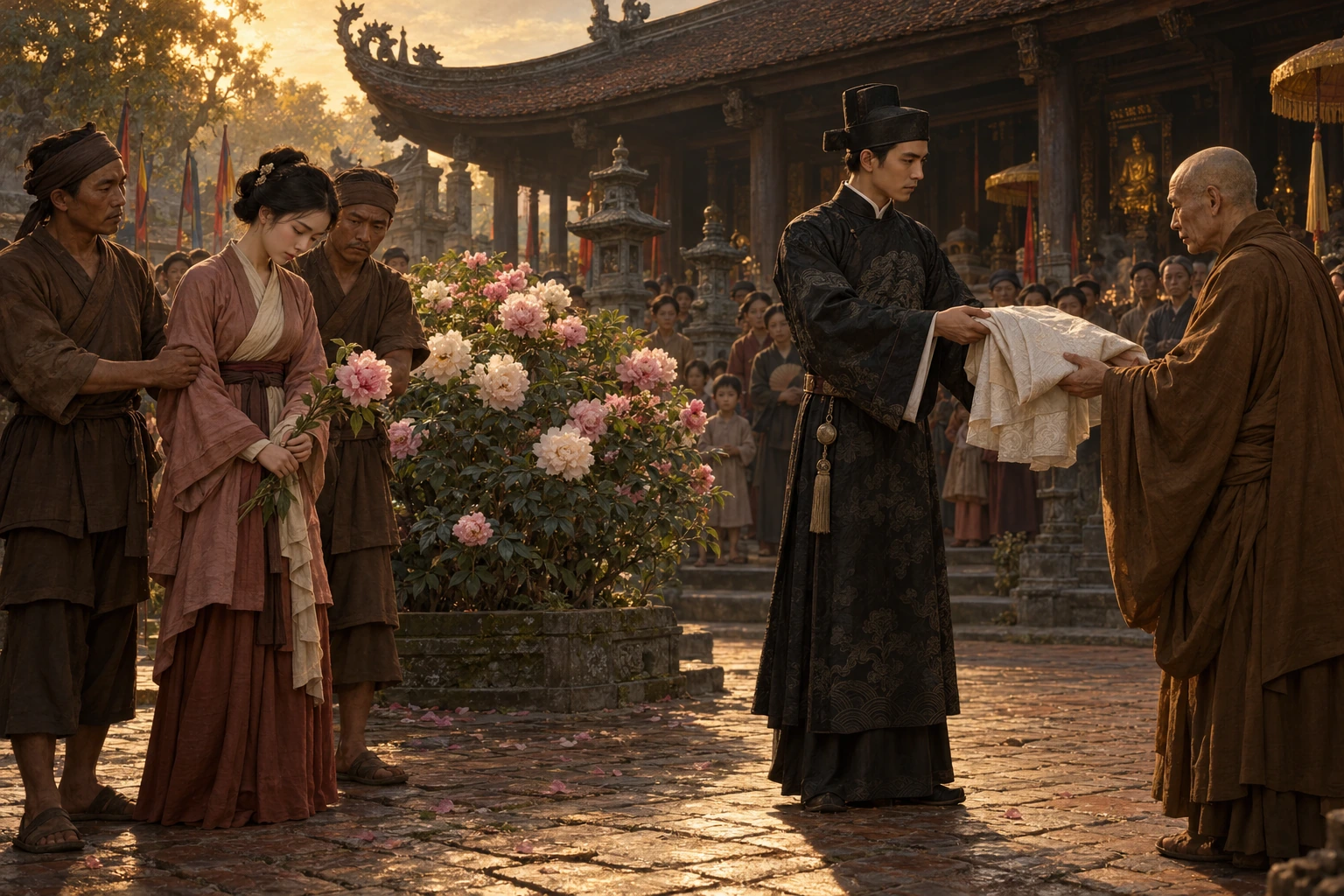
In the second month of the bính tý year, the ninth of Quang Thái (1396, in Trúc Khê’s note), a girl of fifteen or sixteen came to see the flowers, lightly powdered and strikingly beautiful. She pulled a branch toward her, it was brittle and snapped, and the flower’s keepers held her. Evening came and no one claimed her. Từ Thức took pity on her, took off the white silk coat he was wearing and handed it in at the monks’ quarters to pay for the branch, and she was let go. People praised the kind magistrate.
1-2 Five Pecks of Rice
He loved wine, the zither, poetry and fine scenery, and the district’s papers piled up. His superiors scolded him: his father had been a minister, and he could not even run a district? Từ Thức sighed that he would not tie himself to the market of fame for “five pecks of red rice”. The commentary points to the source: the poet Tao Yuanming, who gave up his post rather than bow for five pecks of rice.
He handed back his seal and left. He loved the grottoes of Tống Sơn, built a house there, and went about with a servant boy carrying a gourd of wine and a zither, a few volumes of Tao Yuanming’s poems in his sleeve. He wrote poems on every famous sight: Mount Chích Trợ, the Lục Vân grotto, the Lãi river, the Nga estuary.
1-3 The Mountain That Was Not There Before
One morning he looked out from the sea gate of Thần Phù and saw, several dozen dặm offshore, a cloud of five colours massing like a lotus rising from the water. He rowed out and found a beautiful mountain. “I have seen every famous sight of the south-east,” he told the boatman, “and this was never here. Has an immortal peak fallen from the sky?”
The cliffs rose “a thousand trượng”, too high to climb without wings. He wrote a poem that ends by asking the fisherman of Wuling the way to the peach-tree village, and lingered as if waiting. Then a round opening, one trượng across, split open in the rock. He lifted his robe and stepped in, and after a few paces it closed behind him.
In the pitch dark he thought he would die. Feeling along the moss, he found a narrow passage, twisting like a sheep’s gut, and crept on for more than a dặm until it climbed and widened. At the summit the sky was bright, and palaces stood among red clouds and strange flowers. Two girls in blue saw him and said to each other: “Our young master has come!”
1-4 The Lady of the Southern Peak
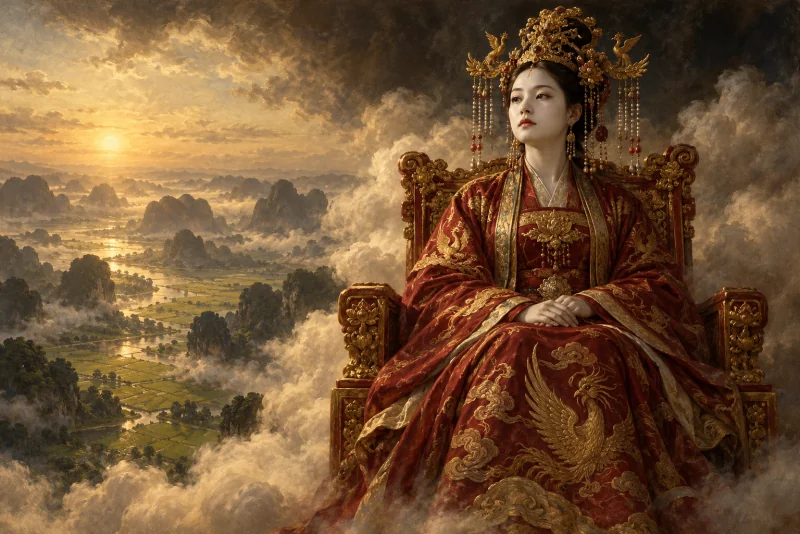
In a palace of silver, on a couch of the seven jewels, sat a fairy in white silk. This, she told him, was Phù Lai, the sixth of the thirty-six grotto-heavens. It floats on the sea with no root, gathering and parting with the wind and rain like the two peaks of Luofu, rising and sinking with the waves like Penglai. “And I am the earth-immortal of the Southern Peak, Lady Wei.” She had invited him because he was a man who helped others in trouble.
She sent for her daughter, and Từ Thức saw the girl who had broken the peony. “This is my child, Giáng Hương,” said the Lady. “She met misfortune at the flower viewing and you saved her. I want her to marry you, to repay that kindness.” The wedding was held that night.
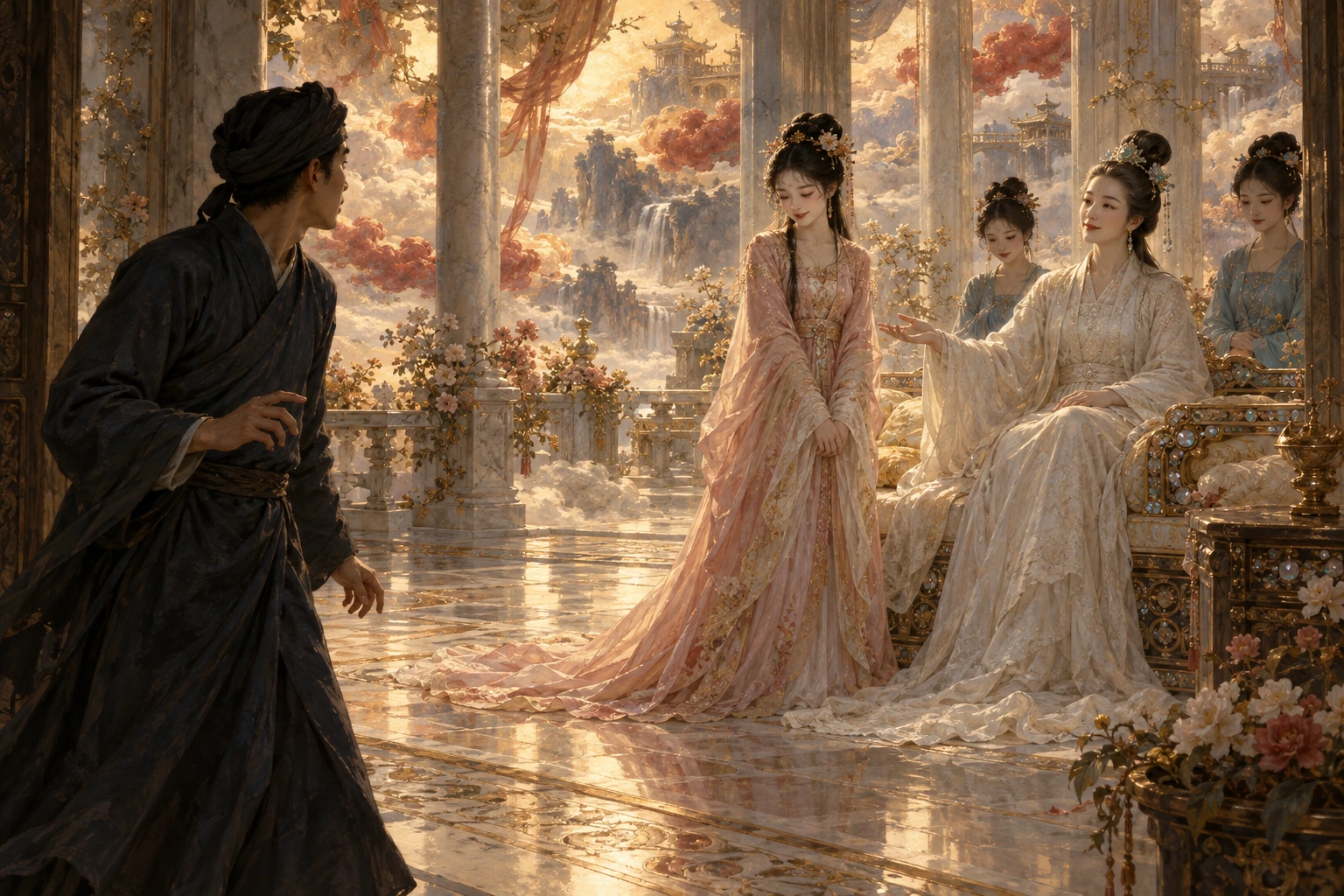
The next day the immortals came to the feast on dragons, jade litters and carriages of wind. One in white brocade said: “We have played here only eighty thousand years, and the southern sea has turned to dust three times.” One in blue worried that a fairy married into the world of dust would shame them all. The guest of honour, the Golden Immortal, answered that she lived in the city of heaven at the side of the Emperor on High and had never set foot in the sea of dust, yet gossips said she had feasted a king of Zhou at the Jasper Pool and sent a blue bird to a Han emperor. If they said that of her, what would they not say of the others? Lady Wei listed the old stories of immortals who had loved mortals, and everyone laughed.
1-5 A Year in the Floating Mountain
Từ Thức wrote ten poems on Giáng Hương’s white screen. The last laughs at “Liu Lang”, who was too quick to leave his cave on Mount Tiantai.
The stars went round their circle once, and the lotus pond turned green again. On nights of wind and frost, with the moon at the window and the waves at his pillow, he could not sleep. One day he saw a merchant ship sailing south. “My home is that way,” he said, “but the sky is far and the waves are long.” He asked to go back for a while, to see his friends and settle his affairs, and promised to return and grow old with her.
Giáng Hương wept. She would not use their marriage to hold him, she said, but the world of dust is small and its lives are short, and she feared he would find nothing as it had been. The Lady was surprised he still had a heart of dust, but she gave him a carriage of brocade cloud. Giáng Hương gave him a letter written on silk.
1-6 The Way Home
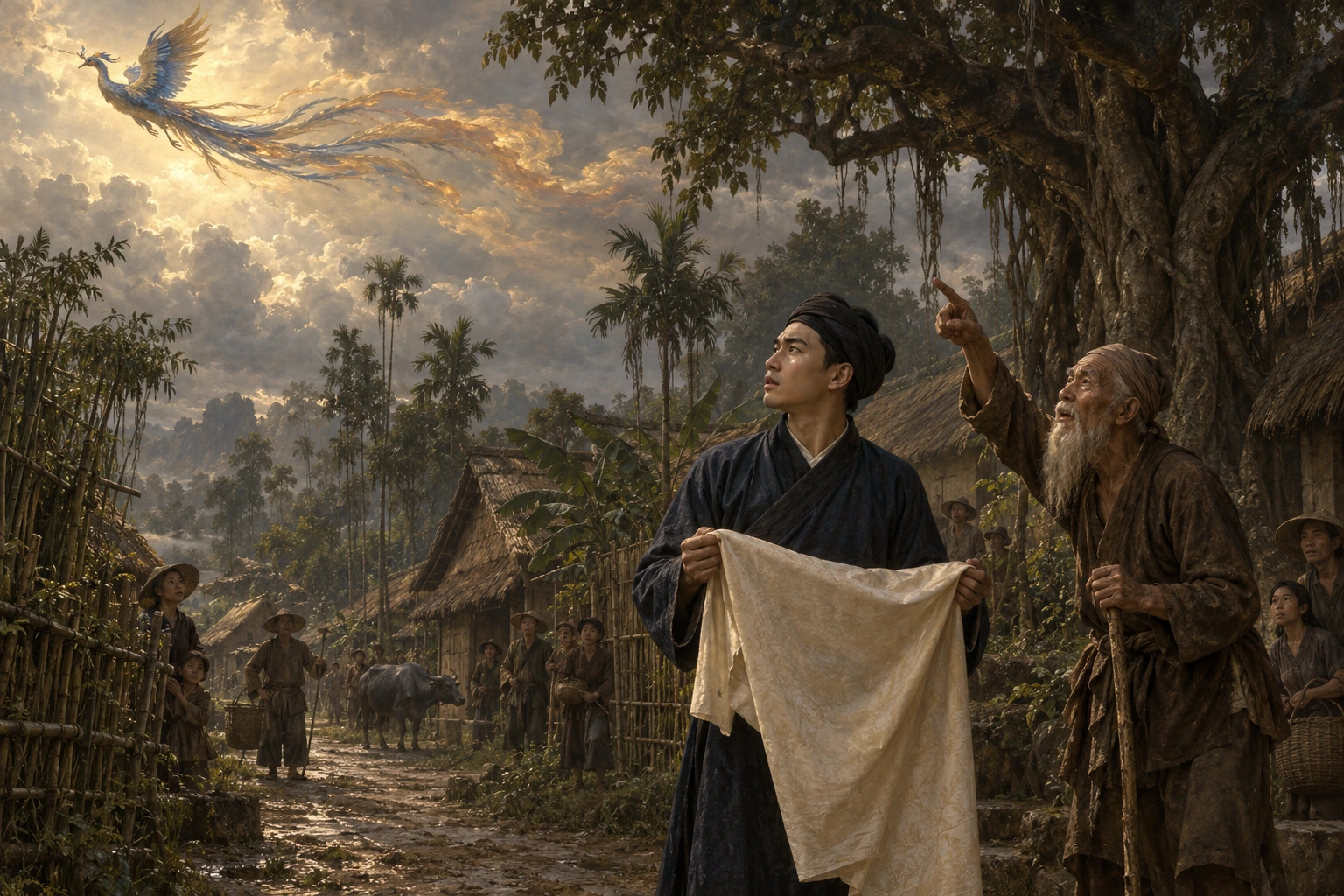
In the blink of an eye he was home. The people and the town walls were no longer the ones he knew; only the streams and hills kept their old green. He asked the old men about his own name. One said that as a boy he had heard of an ancestor three generations back with that name, who had gone into the mountains more than eighty years before. Now it was the fifth year of Diên Ninh, under the third ruler of the Lê.
He wanted to go back, but the carriage had turned into a loan bird and flown away. He opened the letter: “Phoenix mates in the clouds, our old bond is broken; seek the immortal mountain on the sea, and there will be no meeting again.” Only then did he understand that she had said goodbye. He put on a light fur coat and a short hat, went into the Hoàng Sơn mountains, and no one knows where he ended.
The tale closes with a comment. Talk of the strange disturbs the normal, and the sages did not speak of it. Was it true? Not certainly. Was it false? Not certainly. But “whoever has hidden virtue will have a visible reward”: that, at least, is the normal order of things.
2 Where the Story Is Written Down
- Truyền kỳ mạn lục, by Nguyễn Dữ (阮嶼), is a collection of twenty tales in four books, written in Classical Chinese in the 16th century. Từ Thức tiên hôn lục is the ninth, in book 2. Nguyễn Dữ’s dates are unknown. He studied under the scholar Nguyễn Bỉnh Khiêm and, like his hero, is said to have left a district magistracy after a year, in his case to care for his mother.
- The woodblock print we read is the second of four volumes in the National Library of China, scanned on Wikimedia Commons. Its commentary explains the allusions in small characters and records where another copy reads differently.
- Trúc Khê Ngô Văn Triện’s translation, in the Tân Việt printing (Saigon, 1952) on Vietnamese Wikisource, translates the poems, explains the allusions in footnotes and gives dates in Western years. In his essay on the book, Trúc Khê writes that Nguyễn Dữ wrote in the manner of the Chinese Jiandeng xinhua.
- Nam Hải dị nhân liệt truyện (Lives of Remarkable People of the Southern Sea) by Phan Kế Bính, first published in 1909, retells the tale more briefly as no. 46, “Từ-Thức”, in its chapter on the immortals. It keeps only the first poem, and drops the poems on the screen and the wedding guests’ talk. We read the 5th edition, revised by Lê Văn Phúc (Hanoi, 1930).
3 Competing Versions
- How long was he gone? “More than eighty years” in the woodblock print and in Phan Kế Bính. “More than sixty” in Trúc Khê, which fits the story’s own dates: 1396, and the fifth year of Diên Ninh, which the commentary calls a mậu dần year (1458).
- Which year, which king? The woodblock and Trúc Khê have the bính tý year, the ninth of Quang Thái, and the commentary names the era as Trần Thuận Tông’s. Phan Kế Bính writes “Đinh tị (1396)” and puts Quang Thái under Trần Thánh Tông, though 1396 was a bính tý year.
- The mountains at either end. The fairy mountain is Phù Lai (浮萊) in the woodblock and in Trúc Khê, Phi Lai in Phan Kế Bính. At the end Từ Thức goes into Hoàng Sơn (黃山) in the woodblock, and the commentary notes that one copy adds “to gather herbs”. Trúc Khê has Hoành Sơn. Phan Kế Bính has Hoàng Sơn, which he places in Nông Cống, Thanh Hóa.
- The coat. A coat of white silk in the woodblock, whose note gives “silk floss” (綿) from another copy. A coat of white brocade in Trúc Khê, a brocade robe in Phan Kế Bính.
- A temple in Bắc Ninh. The text names no temple, only “an old temple beside the district”. At Phật Tích pagoda in Bắc Ninh, the National Assembly’s newspaper reports, the peony-viewing festival held every year on the 4th and 5th days of Tết is said to come from this legend. In the telling there, Giáng Hương later leads Từ Thức through a wood of peonies to a cave on the hillside: no sea, no floating mountain.
4 History and Tradition
- A real man? Some modern retellings, the provincial newspaper’s among them, call Từ Thức a historical figure of the 14th century. We did not find him in the Đại Việt sử ký toàn thư; the earliest text that names him is Nguyễn Dữ’s, and it leaves the question open.
- Built from Chinese books. Kawamoto Kunie, writing for the Heibonsha World Encyclopedia, describes the Truyền kỳ mạn lục as strongly influenced by Qu You’s Jiandeng xinhua (剪燈新話), a Ming collection, and by the tales of the Tang and Song. A book-length comparison of the two collections by Chen Yiyuan (陳益源) appeared in Taipei in 1990.
- The story names its own models. Từ Thức carries Tao Yuanming’s poems and resigns with Tao Yuanming’s words. His first poem asks the way of the fisherman of Wuling, whose story the commentary quotes: following a stream lined with peach trees, he found a narrow opening in a hill that suddenly widened into a hidden village, and he could never find it again. Từ Thức’s own way in, narrow and then suddenly bright, follows it. His last poem laughs at Liu Lang of Mount Tiantai.
- Liu Chen and Ruan Zhao. In the Youming lu (幽明錄), attributed to Liu Yiqing, a prince of the Southern Dynasties, Liu Chen (the “Liu Lang” of Từ Thức’s last poem) and Ruan Zhao go into Mount Tiantai in 62 CE to gather bark, lose their way and live on peaches. Two women by a stream greet them by name and marry them. After half a year the men grow homesick and are let go. At home their kin are gone; they find only a descendant of the seventh generation. In 383 they leave again, “no one knows where”. Nguyễn Dữ ends Từ Thức’s story the same way. Lost time is an old theme in China: in the Shuyi ji, the woodcutter Wang Zhi stops on a mountain to watch boys play a board game, and when they tell him to go, his axe handle has rotted away and none of the people of his time are left.
- Who is Lady Wei? The woodblock’s commentary identifies her as Wei Huacun, a daughter of the Jin minister Wei Shu, who loved the arts of the immortals and was made Lady of the Southern Peak. Trúc Khê’s notes explain that the Jasper Pool and the blue bird, which the Golden Immortal complains about, are told of the Queen Mother of the West.
- The cave at Nga Sơn. Động Từ Thức lies inside a mountain of the Tam Điệp range, in the Nga Sơn district of Thanh Hóa. The provincial newspaper Báo Thanh Hóa writes that it was ranked a national scenic monument in 1992, and that an old vine looped across its entrance is said to be where the fairies came down to play in the afternoons. Nga Sơn has a second legend: the Lĩnh Nam chích quái puts Mai An Tiêm’s watermelon sandbank off its coast.
Từ Thức is often called “the Vietnamese Urashima Tarō” or “the Vietnamese Rip Van Winkle”. Rip is an American story, written by Washington Irving in 1819: Rip drinks the liquor of a ghostly crew in the Catskills and sleeps for twenty years, with no fairy and no other world. Urashima is closer. In Japanese texts of the 8th century a fisherman marries a divine woman and goes with her to a land beyond the sea, grows homesick, and comes home to find his time long gone. But Nguyễn Dữ names his own models, and they are Chinese. The folklorist Ōshima Hiroshi notes that tales of the Urashima type are found across East and Southeast Asia, and calls a Chinese one from around Lake Dongting, built from a tale of a dragon woman and a tale of a stay among the immortals, important in the search for Urashima’s origins. We have found no scholar who derives Từ Thức from Urashima, or the reverse: they are relatives, not copies.
5 Related Stories
- Mai An Tiêm: The Watermelon Island: Nga Sơn’s other legend. The Lĩnh Nam chích quái sets Mai An Tiêm’s sandbank off the coast of Nga Sơn district, not far from the cave that now bears Từ Thức’s name.
- Hou Yi and Chang’e: The Archer Who Shot the Suns and the Woman in the Moon: the Queen Mother of the West, who gives Yi the medicine of immortality, stands behind the Golden Immortal’s complaint at Từ Thức’s wedding: the feast at the Jasper Pool and the blue bird are her stories.
- Lạc Long Quân and Âu Cơ: The Dragon, the Fairy and the Hundred Eggs: another marriage between a fairy and someone not of her kind, and another parting. We have found no scholar who compares the two stories; we link them for the theme.
- Oisín and Tír na nÓg: The Land of Youth: an Irish hero who comes home from the Land of Youth to find three hundred years gone. In The Science of Fairy Tales (1891), E. S. Hartland grouped his story with the Chinese tale of the two friends in the Tiantai mountains, one of the models Nguyễn Dữ names. We have found no scholar who compares Oisín with Từ Thức himself.
- The Peri: From Demons to Fairies: in Persian romance, too, a mortal king is taken into the world of fairy women and, once he leaves it, can never go back. In English the Persian parī and the Vietnamese tiên are both “fairies”. We link them for the theme.
6 Sources
- Nguyễn Dữ, Truyền kỳ mạn lục, book 2, “Từ Thức tiên hôn lục”, undated woodblock print with commentary, National Library of China, volume 2 of 4, PDF pages 29–42: Wikimedia Commons
- Nguyễn Dữ, Truyền kỳ mạn lục, trans. Trúc Khê Ngô Văn Triện, Tân Việt (Saigon, 1952): “Chuyện Từ-Thức lấy vợ tiên”, the translator’s essay “Văn-chương và tư-tưởng” and his life of Nguyễn Dữ: Vietnamese Wikisource, Wikisource, Wikisource
- Phan Kế Bính, Nam Hải dị nhân liệt truyện, no. 46, “Từ-Thức”, 5th edition, revised by Lê Văn Phúc (Hanoi, 1930): Vietnamese Wikisource
- Lĩnh Nam chích quái, “Tây qua truyện”: Wikisource (Classical Chinese)
- Youming lu, attributed to Liu Yiqing, book 1, Liu Chen and Ruan Zhao: Wikisource (Classical Chinese)
- Shuyi ji, on Wang Zhi, as quoted in the Gujin tushu jicheng, Bowu huibian, Yishu dian, juan 801: Wikisource (Classical Chinese)
- Kawamoto Kunie, “伝奇漫録”, Heibonsha World Encyclopedia: Kotobank
- Chen Yiyuan, Jiandeng xinhua yu Chuanqi manlu zhi bijiao yanjiu (Taipei: Xuesheng shuju, 1990): CiNii Books
- Ōshima Hiroshi, “浦島太郎”, Heibonsha World Encyclopedia, with the other entries on the same page: Kotobank
- Washington Irving, “Rip Van Winkle”, The Sketch Book of Geoffrey Crayon (1819): Wikisource
- Thục Anh, “Động Từ Thức - hang động bậc nhất xứ Thanh”, Báo Thanh Hóa, 18 June 2026: baothanhhoa.vn
- “Từ Thức - hang động bậc nhất xứ Thanh”, VnExpress, 9 June 2023: vnexpress.net
- Thanh Hà, “Chùa Phật Tích và huyền thoại Từ Thức gặp Tiên”, Đại biểu Nhân dân, 1 February 2008: daibieunhandan.vn
Cover and illustrations: AI-generated images made for Arcana. They are interpretations, not historical artworks.