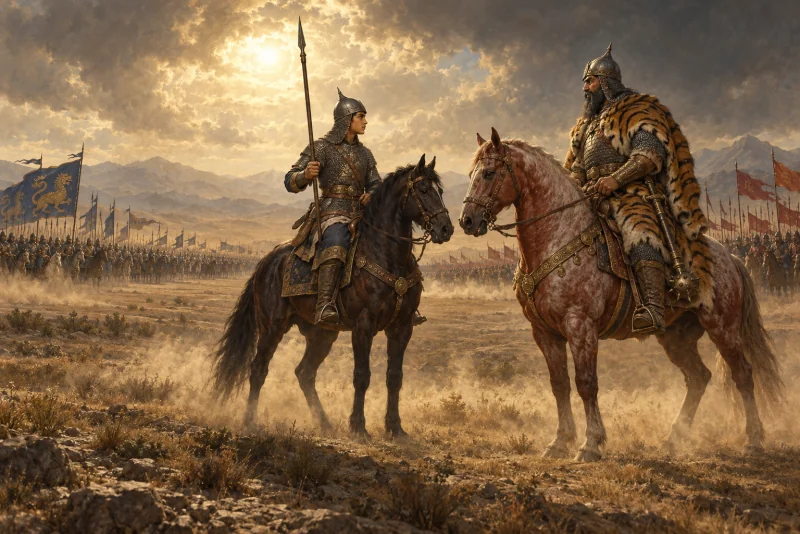
The Peri: From Demons to Fairies
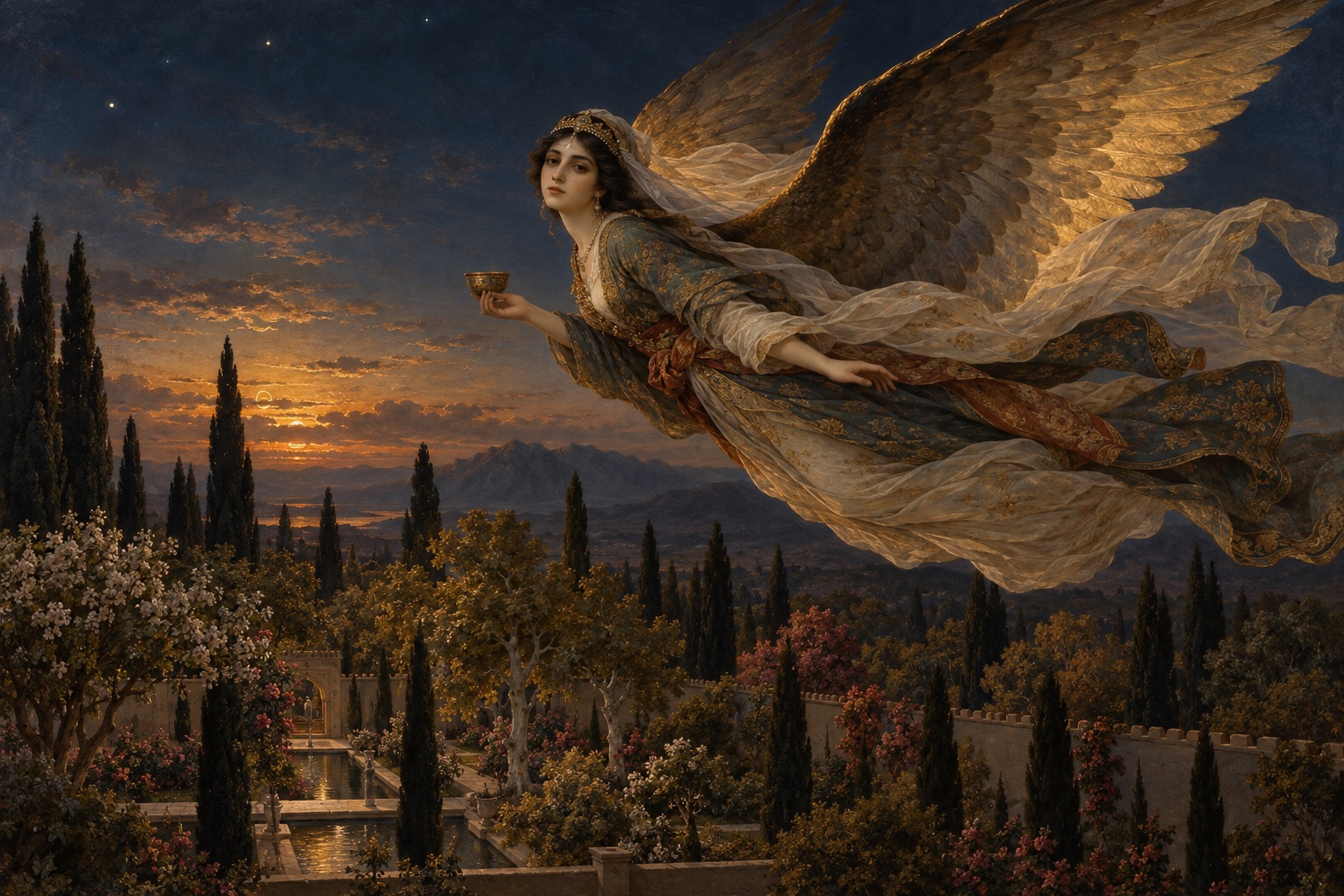
In the Avesta the pairikā is a demoness who flies between earth and sky until the star Tishtrya binds her; in Persian poetry the parī is the measure of all beauty. Europe met her through Galland's Arabian Nights and Thomas Moore's Peri at the gate of Eden, and her name sounds like "fairy", though the English word does not come from it.
- Type: supernatural beings: demonesses in the oldest texts, winged beauties in later poetry and tales
- Culture: Iran, from the Zoroastrian Avesta to Persian literature of the Islamic period; in Europe from the 18th century
- Earliest texts: the Avesta, the scripture of Zoroastrianism (the hymn to the star Tishtrya, Yasht 8; the Vendidad); later Ferdowsi’s Shahnameh (finished in 1010) and Nezami’s Haft Paykar (1198, by its translator’s reckoning)
- Key figures: the pairikās Knathaiti and Duzyairya, the star Tishtrya, the hero Keresaspa, the angel Sorush, the fairy queen of Nezami’s Black Pavilion, Prince Ahmed and Pari-Banou, Thomas Moore’s Peri
Persian has one word for two opposite creatures. In the Avesta a pairikā is a demoness, named in one breath with sorcerers, who comes upon the fire, the water and the cattle and has to be driven off with spells. In the poetry of the Islamic period a parī is the most beautiful being there is, and a king who wants to praise a girl’s face says it is like a peri’s. The texts show both creatures without explaining how the one became the other. Then, in the 18th century, the peri flew west.
Was the peri once a demon? In the Avesta, yes. There she stands on the side of Angra Mainyu, the Evil Spirit: in the Vendidad he makes one, and in the hymn to the star Tishtrya the pairikās try to keep back the rain. In Ferdowsi’s Shahnameh peris serve the first kings, and the angel Sorush takes a peri’s shape to warn one of them. James Darmesteter, who translated the Avesta for the Sacred Books of the East, called the old pairikās “demoniac nymphs”.
1 The Telling
The peri has no single story. These are the scenes in which she appears, in the order of the texts: the Avesta in Darmesteter’s translation (Sacred Books of the East 4 and 23, 1880 and 1883), Ferdowsi in Arthur and Edmond Warner’s (1905–1906), Nezami in C. E. Wilson’s (1924) and the Arabian Nights in Antoine Galland’s French. The Avesta is Zoroastrian scripture; the poems are literature of the Islamic period.
1-1 The Star and the Pairikās
The Avesta’s hymn to Tishtrya, the star Sirius, who brings the rain, praises him because he “afflicts the Pairikas” and “vexes the Pairikas”. They fly “in the shape of worm-stars” between the earth and the heavens, over Vouru-kasha, the great sea of salt water (Yasht 8.8). Darmesteter thought shooting stars were meant, and passed on Geiger’s remark that a swarm of them falls every year around 10 August, when Tishtrya was thought to be most active.
Tishtrya goes down to the sea in the shape of a horse and makes its waters boil over. He blows the pairikās away from Vouru-kasha, and the wind drives the clouds out over the seven regions of the earth, “bearing the waters of fertility” (8.8, 8.39–40).

One pairikā has a name. Ahura Mazda says he made the star as worthy of worship as himself to drive back “the malice of that Pairika Duzyairya, whom evil-speaking people call Huyairya”: “bad year”, that is, drought, Darmesteter explains, and “good year” is her flattering name. Without Tishtrya she would make war on the world all day and all night. He keeps her in bonds, “as if there were a thousand men keeping one man in bonds” (8.51–55).
1-2 Knathaiti and Keresaspa
The Vendidad, the Zoroastrian law against the demons, opens with the good lands Ahura Mazda made and the plague Angra Mainyu, “who is all death”, set against each. Against the seventh, Vaekereta “of the evil shadows”, he made “the Pairika Knathaiti, who clave unto Keresaspa” (1.10).
Keresaspa was one of the great dragon-slayers of the old tradition. In the later Zoroastrian books, as Darmesteter and the Warners summarize them, he despised the religion, neglected the sacred fire and was cast into hell. The pairikā had won him, and Darmesteter read the old myth as a pairikā who “delivered him asleep to the fiend”. She will not last forever. In Vendidad 19 Zarathustra tells Angra Mainyu that he will smite her “till the fiend-smiter Saoshyant come up to life”, the saviour of the end of time (19.5).
1-3 Sorush in a Peri’s Shape
In Ferdowsi’s Shahnameh, finished in 1010, the peris have changed sides. When the son of Ahriman (Angra Mainyu) plots against Kayumars, the first king, it is the angel Sorush who warns him, “in a peri’s likeness, dressed in leopard skin” (be sān-e parī palangina-push). To avenge his son, Kayumars raises “a host of fairies, lions, pards” and wolves, and his grandson leads it against the Black Div (vol. 1, pp. 119–121). Under Jamshid, divs, birds and peris obey the king. Sorush comes again to Fereydun “like a fairy”, with musky hair to the feet, and teaches him magic (p. 159).
The peris serve whoever rules: Zahhak, too, asks for “a larger host — men, divs, and fairies too” (p. 154). And the word measures beauty. When Kay Kavus meets the girl who will be Siyavash’s mother, he asks her lineage, “for thou art fairy-like in countenance” (vol. 2, p. 195). Ferdowsi wrote parī; the Warners wrote “fairy”.
1-4 The Queen of the Black Pavilion
In Nezami’s Haft Paykar, “The Seven Beauties”, King Bahram Gur visits a princess in each of seven pavilions, and each tells him a story. On Saturday, in the black one, the Indian princess tells of a king who always dressed in black. A traveller had told him of a city in China where everyone wore black and no one would say why. He went there. A man of the city led him by night to a ruin and sat him in a basket on a rope, and the basket rose and left him hanging from a tower. A huge bird landed on it, and at cock-crow, as it stirred to fly, he seized its foot. It carried him to a garden like paradise.
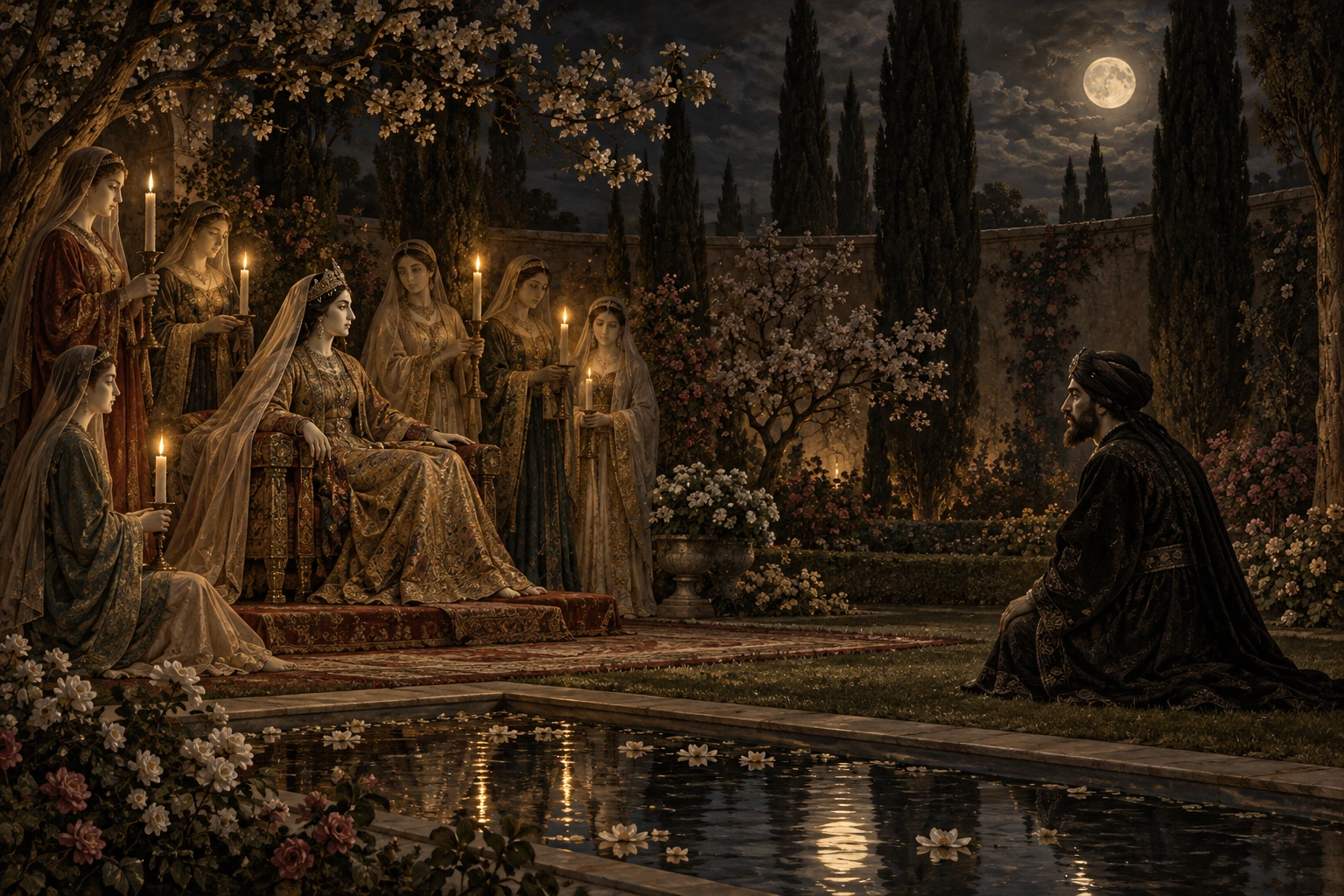
That night maidens came with candles and set up a throne, and a queen sat down on it. She had him brought to her, seated him beside her and gave him wine, and night after night she let him kiss her but no more. “You are of earth, I also am of earth,” he pleads in Wilson’s translation; “a fairy if you are, a man am I.” On the night he would not wait, she asked him to close his eyes for a moment. When he opened them, he was in the basket. He went home and wore black for the rest of his life (Wilson, vol. 1, pp. 117–143).
1-5 Prince Ahmed and Pari-Banou
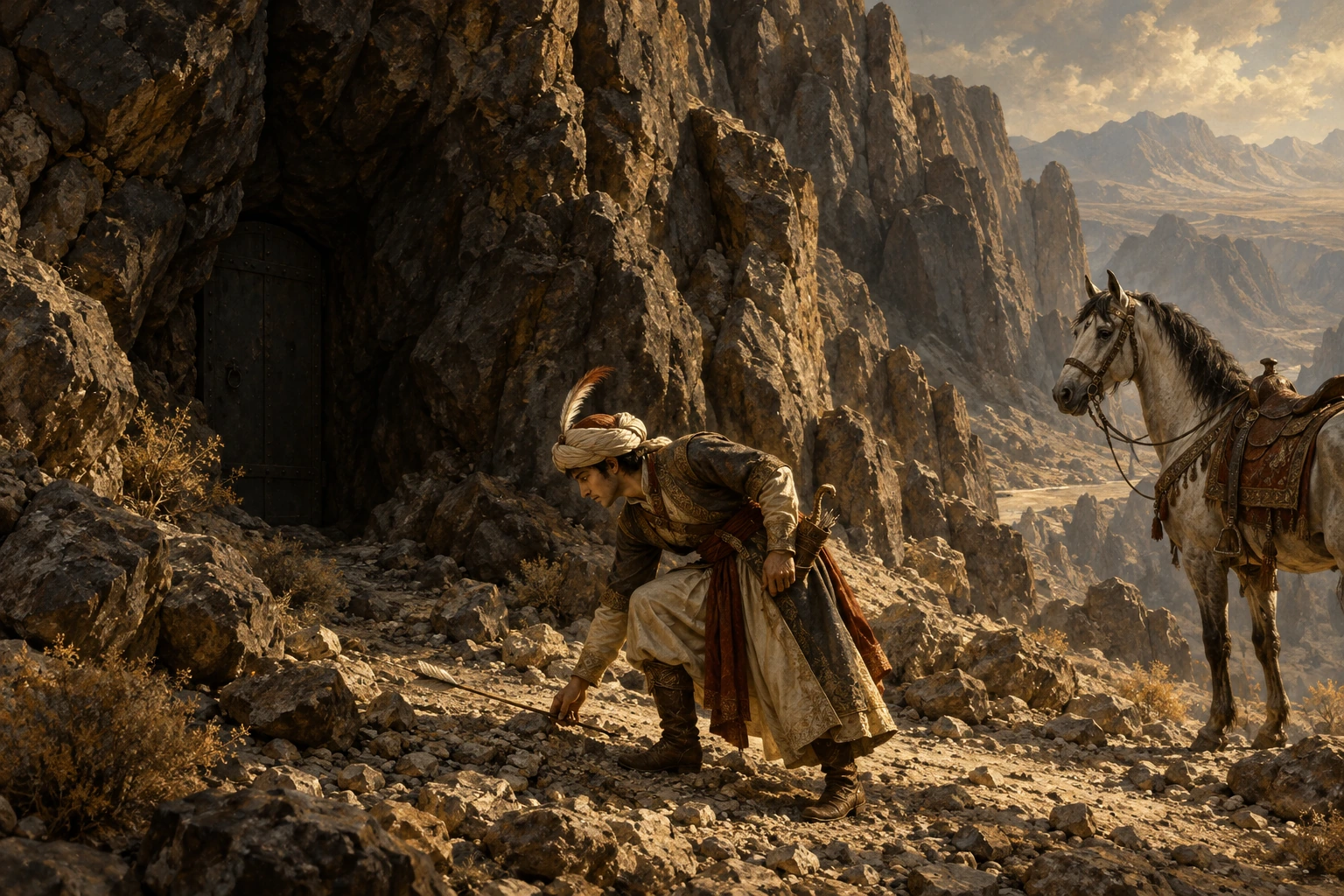
In Galland’s Les Mille et Une Nuits, a sultan of the Indies has three sons, Houssain, Ali and Ahmed, all in love with their cousin Nourounnihar. He promises her to whoever shoots an arrow farthest. Ahmed’s arrow vanishes, and Ali wins her. Ahmed searches until, four leagues away, he finds his arrow at the foot of steep rocks: “neither I nor any mortal in the world has the strength to shoot an arrow so far.” In a hollow of the rock an iron door opens on a slope down to a palace. Its lady tells him: “I am the daughter of one of these genies, among the most powerful, and my name is Pari-Banou.” They marry.
His father’s favourites and a sorceress turn the sultan against him, and he sets impossible tasks: a pavilion that fits in the hand yet shelters the whole army, water from the Fountain of Lions, and a man a foot and a half tall with a beard thirty feet long and an iron bar of five hundred pounds. That man is Pari-Banou’s brother, Schaïbar. When the sultan turns his face away in horror, Schaïbar kills him with the bar, then the viziers who had flattered the sultan and the sorceress, and has Ahmed proclaimed sultan of the Indies.
2 Where the Story Is Written Down
- The Avesta. The pairikā is usually paired with the yātu, the sorcerer: Tishtrya’s hymn also calls on the stars Haptoiringa “to oppose the Yatus and Pairikas” (Yasht 8.12). A spell in the Vendidad drives away “the Pairika that comes upon the fire, upon the water, upon the earth, upon the cow, upon the tree” (11.9). Darmesteter called the pairikās “demoniac nymphs, who rob the gods and men of the heavenly waters”.
- Middle Persian. The word became parīg and then parī in New Persian; dictionaries gloss the Avestan and the Middle Persian words as “witch”. The Pahlavi commentary on the Vendidad, Darmesteter writes, took the pairikā to stand for idolatry, and once read the word as pari-kam, “love of the Paris”.
- The Shahnameh. Thomas Keightley noted in his Fairy Mythology that the peris “are very rarely spoken of in this poem”: they “merely appear in it with the birds and beasts among the subjects of the first Iranian monarchs”.
- Lyric poetry. The poet Hafez sets the peri against the div: “The peri hides her face, and the div parades his charms; / my eyes burn with wonder: what marvel is this?” (Ganjoor’s ghazal 64, our translation).
- Haft Paykar. Wilson notes that whoever sees a peri becomes parī-dār, “possessed” and “fascinated”, the mind clouded as by any great beauty, while whoever sees a div becomes dīv-dār, insane (commentary, note 1,342).
- The Arabian Nights. Galland did not translate this tale from a manuscript: he wrote it down as Hannā Diyāb of Aleppo told it to him in 1709, as Ruth Bottigheimer and the Collège de France both describe. It was printed in 1717, in one of the last two volumes, which appeared after Galland’s death.
- Bahār-i dānish. In a tale from this Persian collection by ʿInāyat Allāh, the “Garden of Knowledge” in Keightley’s rendering, written in India in 1650 and translated by Jonathan Scott in 1799, a merchant’s son watches four doves land by a pond and take off their robes, “for they were Peries” (Keightley’s retelling).
3 Competing Versions
- Demon or friend? In the Avesta the pairikā is Angra Mainyu’s creature. John Richardson, describing Persian belief in 1777, says the divs rebelled against God but the peris obeyed and “became from that time the friends of mankind”. Wilson counts the peri among the good jinn and the div among the evil.
- Female or male? Pairikā is a feminine word, and the peri of poetry is a woman. But Keightley reminds his readers that “the Peries are of both sexes”: the romances have peri kings, and the captive peri Merjan has brothers.
- Wings or a robe? Moore’s Peri has wings. In the Bahār-i dānish the merchant’s son hides one peri’s robe and marries her. Ten years later she persuades an old nurse to fetch it, puts it on and flies away, and he becomes “Peri-stricken”: possessed, insane, Keightley’s note explains.
- Where did the pairikā come from? Darmesteter thought she corresponded “in her origin (and perhaps as to her name)” to the Indian apsaras. Describing the pairikās who seduce heroes to their ruin, he borrowed a line from Thomas Moore: “nymphs of a fair, but erring line”.
- What to call her in translation. Galland explains Pari-Banou as Persian for “female genie, fairy” (génie femelle, fée). The Warners chose “fairy” and “fay”. Keightley regretted that Duncan Forbes’s English Hatim Tai “employed the terms Fairies and Demons instead of Peries and Deevs”.
4 History and Tradition
- Richardson, 1777. In the Dissertation that opens his Persian, Arabic and English dictionary (Oxford, 1777), John Richardson described the peris’ kingdom in the mountains of Kaf, with cities called Shadukam and Amberabad. When the divs capture peris, he wrote, they shut them in iron cages and hang them from the highest trees, and their friends feed them on perfume, “the only food of the Peris”. He saw “a wonderful resemblance” to “the Faeries of the European nations”. Dictionaries date the English word peri to the 1770s.
- Lalla Rookh, 1817. Thomas Moore’s book of Oriental tales came out in London in May 1817 and was in its sixth edition by December. In “Paradise and the Peri”, “One morn a Peri at the gate / Of Eden stood, disconsolate”. The angel tells her she may be forgiven if she brings “the Gift that is most dear to Heaven”. She brings the last drop of blood of a young Indian warrior who dies fighting Mahmud of Ghazni, then the last sigh of a girl who chose to die with her plague-stricken lover in Egypt, and the gates stay shut. The third gift opens them: the tear of a hardened man who repents at the sight of a child praying at sunset near Baalbek. Moore’s notes quote Richardson, and the Peri’s farewell names two of the peri cities Richardson had listed, “SHADUKIAM” and “AMBERABAD”.
- Schumann, 1843. Robert Schumann set the poem as the oratorio Das Paradies und die Peri, Op. 50, from a German translation by Emil Flechsig. He conducted the first performance in Leipzig on 4 December 1843, and it had to be repeated a week later.
- Beyond Iran. The word travelled with Persian: dictionaries list it in Turkish, Kurdish, Urdu, Hindi, Kazakh, Uzbek and Kyrgyz, and English took peri from Persian, perhaps by way of Ottoman Turkish.
“The English word fairy comes from the Persian peri” is an old guess. Thomas Keightley set it out in his Fairy Mythology: Arabic has no p, so the crusaders were supposed to have heard feri in the East. “All that is wanting to this so very plausible theory is something like proof, and some slight agreement with the ordinary rules of etymology,” he answered. Fairy is recorded in English from the 14th century. It comes from Old French faerie, from fae, fée, and at the root the Latin fata, the Fates. Peri reached English only in the 1770s. The Warners agreed in 1905: “It is hard to realise that this word, which in Arab lips would become ‘Fari,’ is not connected with ‘fairy,’” but the etymology of fairy, they wrote, leads to the Latin fata.
5 Related Stories
- Ahura Mazda and Angra Mainyu: The Two Spirits: the pairikā belongs to the Evil Spirit’s creation. In the Vendidad, Angra Mainyu sets the pairikā Knathaiti against one of Ahura Mazda’s good lands.
- The Churning of the Ocean: Gods, Demons and the Nectar of Immortality: Darmesteter compared the pairikā with the Indian apsaras, and in the Rāmāyaṇa’s telling the apsaras rise from the churned sea.
- The Tuatha Dé Danann: The Gods Who Went into the Hills: Irish country people, Yeats recorded, said the fairies were fallen angels, much as Moore’s Peri is shut out of Eden. We have not found a scholar who compares the two; we link them for the theme.
- Từ Thức: The Man Who Married a Fairy: a mortal who marries a fairy and, once he leaves her world, can never go back, like the king of Nezami’s Black Pavilion. In English the Vietnamese tiên is a “fairy” too. We link them for the theme.
6 Sources
- The Zend-Avesta, trans. James Darmesteter, part 1, The Vendîdâd, Sacred Books of the East 4 (Oxford, 1880): Introduction IV, §21 (pp. lxvi–lxvii); Vendidad 1.10, 11.9, 19.5: archive.org; and part 2, The Sîrôzahs, Yasts and Nyâyis, SBE 23 (1883), Yasht 8, with notes (pp. 95, 107): archive.org; Yasht 8 and Vendidad 1 in the 1898 American edition: avesta.org, avesta.org
- Ferdowsi, Shahnameh, Persian text: Ganjoor; The Shahnama of Firdausi, trans. Arthur George Warner and Edmond Warner, vol. 1 (Kegan Paul, 1905), pp. 23, 83–84, 119–121, 154, 159, 171, and vol. 2 (1906), p. 195: archive.org, archive.org
- Hafez, Divan, ghazal 64: Ganjoor
- Nizami, The Haft Paikar (The Seven Beauties), trans. C. E. Wilson, vol. 1, translation, and vol. 2, commentary (Probsthain, 1924): archive.org, archive.org
- “Histoire du prince Ahmed, et de la fée Pari-Banou”, Les Mille et Une Nuits, trans. Antoine Galland, vol. 7 (Le Normant, 1806), pp. 125–276: Wikisource
- Ruth B. Bottigheimer, “East Meets West: Hannā Diyāb and The Thousand and One Nights”, Marvels & Tales 28.2 (2014), abstract: Wayne State University; Janine Miquel-Ravenel, “À la rencontre d’Antoine Galland”, La Lettre du Collège de France: Collège de France
- John Richardson, A Dissertation on the Languages, Literature, and Manners of Eastern Nations (Oxford: Clarendon Press, 1777), pp. 142–147: archive.org
- Thomas Moore, Lalla Rookh: An Oriental Romance (Longman, 1861 edition), “Paradise and the Peri”, with Moore’s notes: Project Gutenberg; Sarah McCleave, “Lalla Rookh in Europe: the first twenty years” (2016), and Conor Browne, “Robert Schumann’s Das Paradies und die Peri and its early Performances” (2017), Thomas Moore in Europe: Queen’s University Belfast, Queen’s University Belfast
- Yale University Library, Gilmore Music Library, “Schumann. Paradies und die Peri, Op. 50”: Yale
- Thomas Keightley, The Fairy Mythology (first published 1828; new edition, George Bell, 1892), “Origin of the Word Fairy” and “Persia”: Project Gutenberg
- “peri”, “fairy” and “fay”, Random House Unabridged Dictionary: Dictionary.com, Dictionary.com, Dictionary.com; “fairy”, “peri” and “پری”: Wiktionary, Wiktionary, Wiktionary
Cover and illustrations: AI-generated images made for Arcana. They are interpretations, not historical artworks.