The Simurgh: The Great Bird of the Alborz
She raised an abandoned child in her nest on the Alborz, saved his wife and newborn son with her advice, and showed that son the branch that would kill a prince. Behind the Simurgh of Ferdowsi's epic stands an older bird of the Avesta, perched on a tree that holds the seeds of every plant.
- Type: myth and epic, a giant bird who protects a family of heroes
- Culture: Iran, from the Zoroastrian scripture to the Persian epic and Sufi poetry
- Earliest texts: the Avesta names the bird Saena (Yasht 12.17 and 14.41); Middle Persian books such as the Bundahishn describe its tree; Ferdowsi’s Shahnameh, finished in 1010, tells the stories of Zal and Rostam; Attar’s Conference of the Birds (1177) makes the Simurgh an image of God
- Key figures: the Simurgh, Sam, Zal, Rudabeh, Rostam and his horse Rakhsh, Esfandiyar
Twice in the Shahnameh a hero burns a piece of a feather in a censer, and each time the sky goes dark with wings. The bird who comes is the Simurgh: in Ferdowsi’s epic a foster-mother, a physician and a keeper of fate’s secrets. Her name is much older than the poem. In the Zoroastrian scripture it belongs to the bird Saena, whose tree stands in the middle of the world’s sea, and less than two centuries after Ferdowsi the poet Attar made the Simurgh the king whom all the birds set out to find.
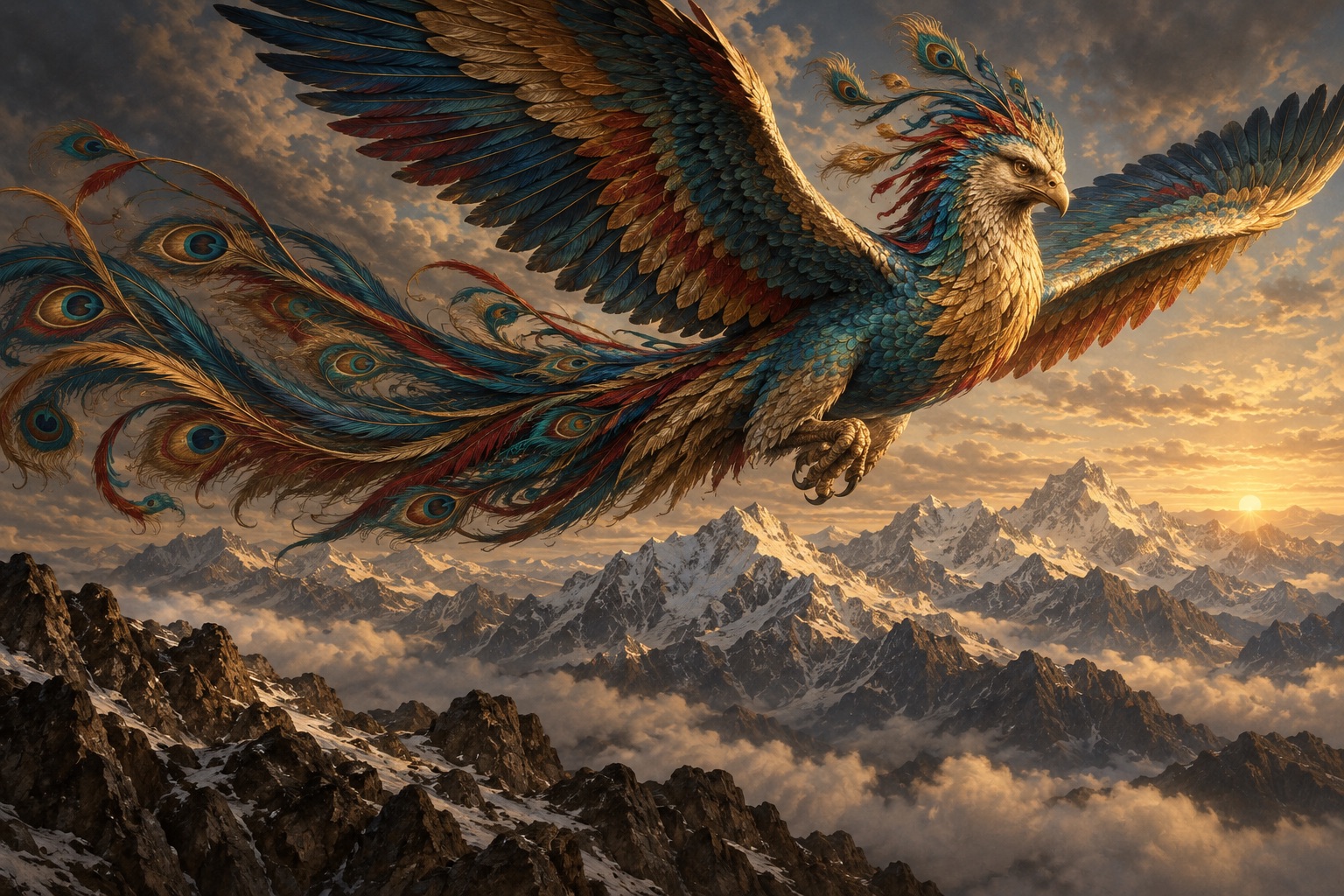
What did the Simurgh look like? No text tells us. Ferdowsi calls her a cloud and speaks of her plumes, but gives no portrait, and Encyclopaedia Iranica says plainly that we do not know how Ferdowsi or Attar pictured her. The dog-headed creature with a peacock’s tail on Sasanian silver and silk is called a senmurv by modern scholars, but, as the Victoria and Albert Museum notes, no evidence links that word with the image. The long-tailed bird of Persian painting came later, from Chinese art under the Mongols (section 4).
1 The Telling
This is the story as Ferdowsi tells it in the Shahnameh, in the English of Arthur and Edmond Warner (1905–1910), who translated mainly from J. A. Vullers’ edition of the Persian text.
1-1 The White-Haired Child
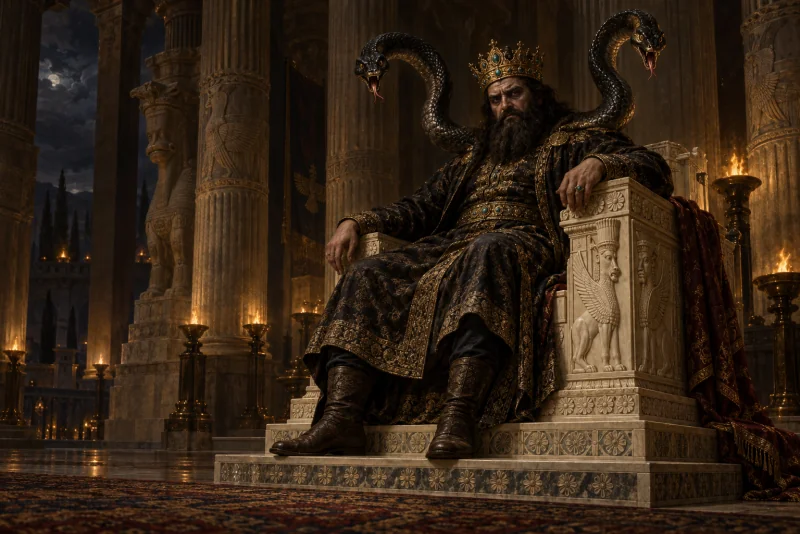
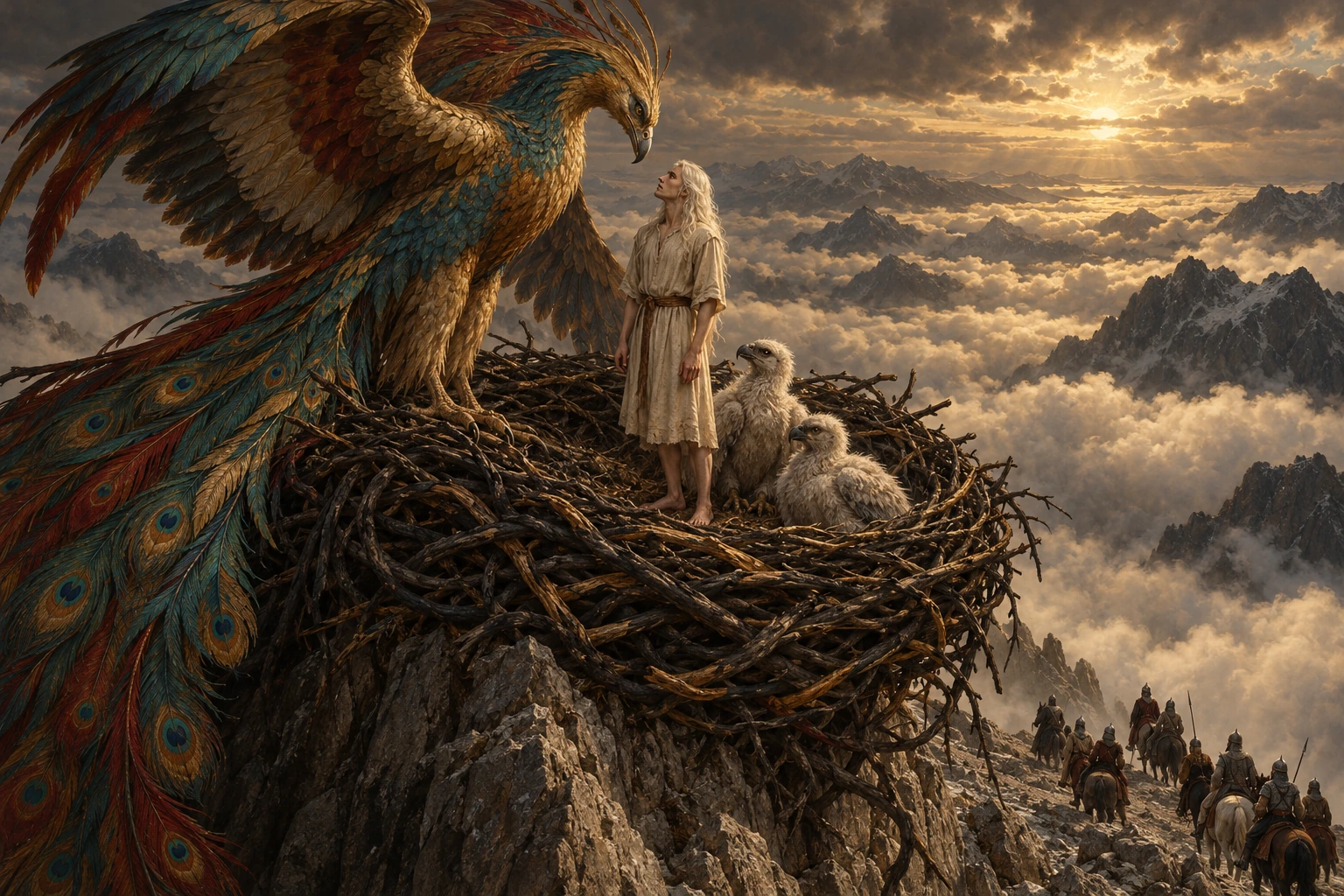
Sam, the foremost hero of Iran under King Manuchehr, had no child. When at last a son was born to him, the boy was flawless but for one thing: his hair was as white as snow. Sam despaired. What would the nobles say of “this brat like a brat of Ahriman”, the evil spirit? He had the baby carried off and left on Mount Alborz, “nigh to the sun and far removed from men”, where the Simurgh had her nest.
The child lay on the rocks day and night, sucking his fingers and crying. The Simurgh, flying out to find food for her hungry young, saw him. God, says the poet, “gave loving instincts to that fowl”. She did not eat him herself; she carried him to her nest for her chicks. But when the mother and her brood saw the weeping child, they lavished love on him. She chose the tenderest prey for him, and he grew up in the nest. Years later a caravan passed the mountain, and the travellers saw a young man “like a noble cypress-tree”.
1-2 The Feather
Sam dreamed that a rider came from India with news of his son. His wise men told him he had broken faith with God by casting out an innocent child. In a second dream a youth came with an army, a priest on one side and a sage on the other, and rebuked him: “If white hair be a blemish in a man”, what of Sam’s own white beard? Sam rode to the Alborz and found the nest on a peak that seemed to reach the Pleiades, but no path led up. He prayed for forgiveness.
The Simurgh told the young man that his father had come for him. She had named him Dastan, which Warner glosses “much defrauded”, for the way his father had treated him. He did not want to go: her nest was his throne, he said, her wings his crown. She told him to try the world of men, and gave him one of her feathers. If ever he was in trouble, she said, “burn the feather and behold my might”. Then she carried him down “like a black cloud” and set him before his father. Sam named him Zal, “the old”, for his white hair.
1-3 Rostam’s Birth
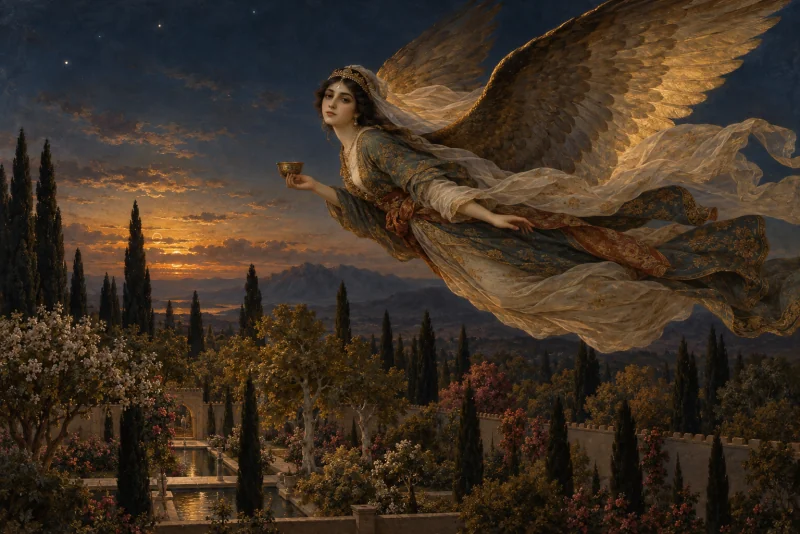
Zal became lord of Zabulistan in his father’s place and married Rudabeh, daughter of the king of Kabul. When her child was due, the labour would not end. She could neither rest nor sleep, and at last she fainted; her mother Sindokht tore her hair, and the palace filled with cries. Then Zal remembered the feather. He lit a censer and burned a little of it. The air grew dark, and the Simurgh came down.
The child would be a hero, she said, but “his birth will not be natural”. Zal was to bring a steel dagger and a man of skill. First Rudabeh was to be made senseless with wine, so that she felt neither pain nor fear. Then the man was to cut open her side, lift the child out and stitch up the wound. A herb that the Simurgh would show them was to be pounded with milk and musk, dried in the shade and laid on the wound, and the wound stroked with one of her feathers. She plucked a feather, let it fall and flew away.
A priest (mobad) with skilled hands made Rudabeh drunk with wine, opened her side, turned the child the right way and brought him out unharmed. They sewed up the wound and dressed it. Rudabeh slept for a day and a night. When she woke and saw her son, as big as a child of one year, she said “I am delivered, the grief is over” (barastam), and so they named him Rostam. It is a caesarean birth, told plainly in a poem finished in 1010; Warner already called it that in 1905.
1-4 The Tamarisk Arrow
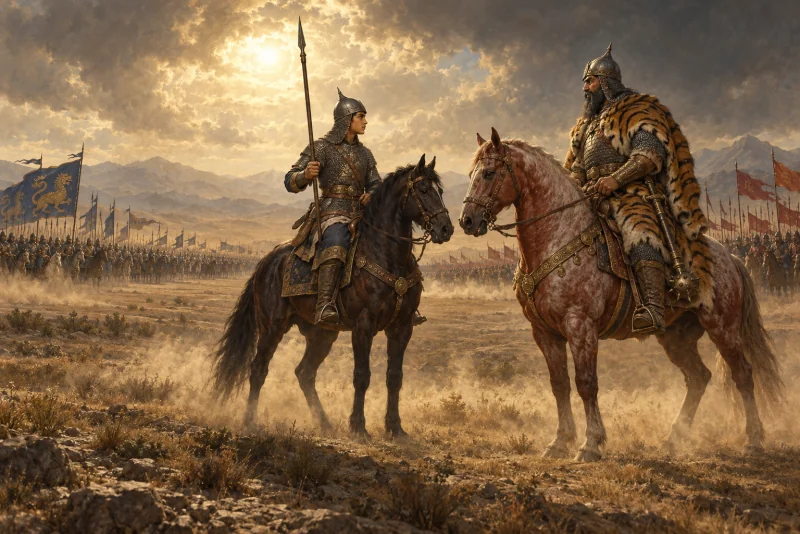
Years later King Goshtasp sent his son Esfandiyar, in the poem a hero of the faith of Zoroaster, against Rostam, and Esfandiyar demanded that Rostam come to court in chains. Rostam would not be bound, and they fought. Esfandiyar’s arrows wounded Rostam and his horse Rakhsh so badly that Rostam spoke of fleeing. That night Zal climbed a height with three censers of fire and burned part of the feather.
The Simurgh came out of the dark. She drew eight arrowheads from Rostam and six from Rakhsh’s neck and stroked the wounds with her feathers; for a week, she said, he should rub them with one of her feathers dipped in milk. Then she asked why he had fought Esfandiyar at all, a prince “who hath the Grace of God”. He should humble himself; if Esfandiyar still refused, she would give him the means to win. But first she told him “the secret of the sky”: whoever shed that hero’s blood would be pursued by misfortune all his life, and after it.
Rostam accepted. He rode to the shore of a sea, and the Simurgh came down on a tamarisk. She told him to cut its straightest, longest, slenderest branch, straighten it over a fire and make an arrow with three feathers and two points. If Esfandiyar would not make peace, he was to aim it at his eyes.
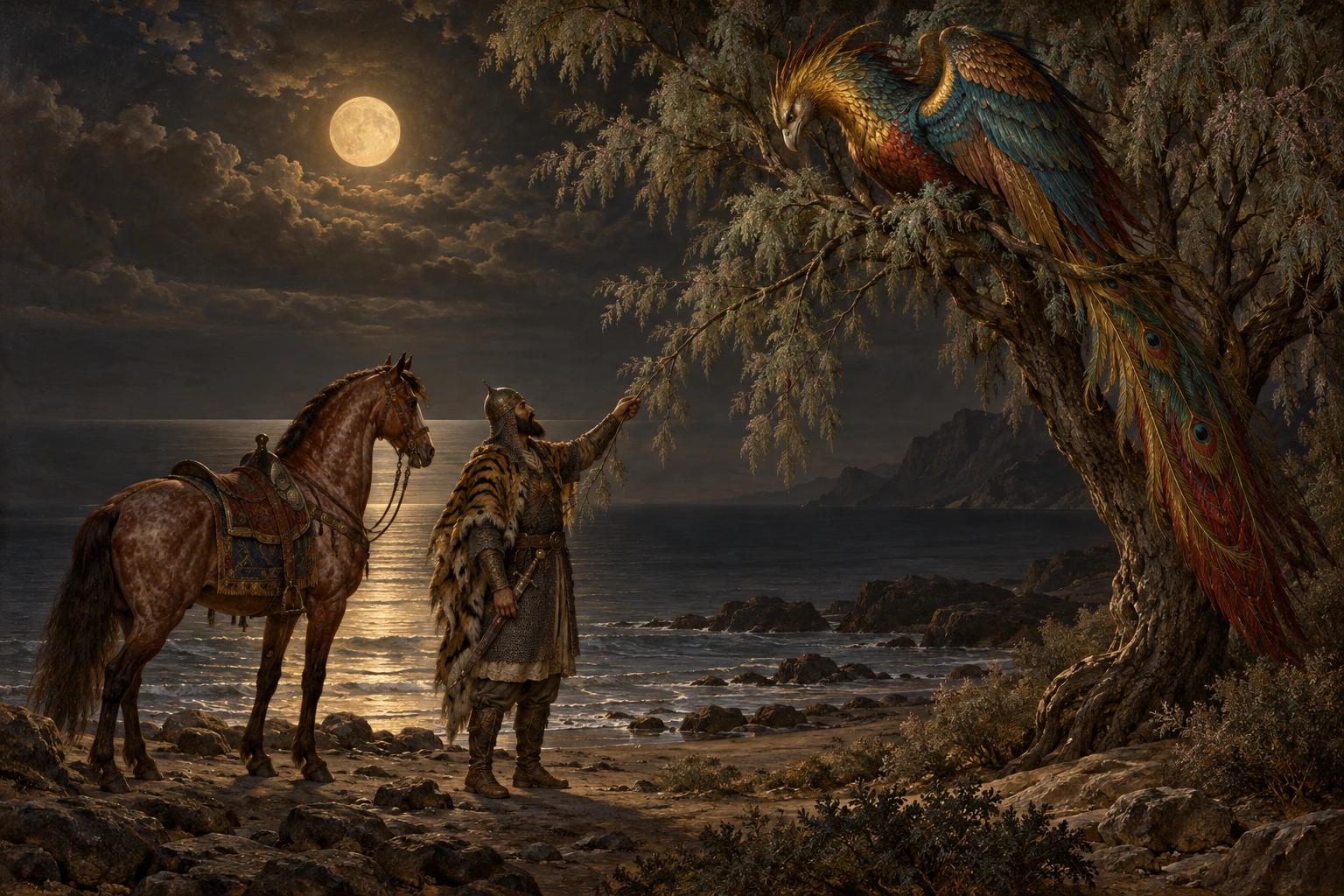
At dawn Rostam begged Esfandiyar for peace, and Esfandiyar refused. Rostam shot the tamarisk arrow into his eyes. Dying, Esfandiyar said that the arrow was the work of the Simurgh and of Zal’s sorcery, but that his true killer was his own father, Goshtasp, who had sent him to Sistan. The next story in the poem is Rostam’s own death, in a pit dug for him by his half-brother Shaghad.
2 Where the Story Is Written Down
The Avesta, the scripture of Zoroastrianism, still recited by Zoroastrians today, names the bird twice in its hymns, the Yashts:
- in Yasht 14.41, Verethraghna, the deity of victory, wraps fortune round the worshipper’s house “like the great bird Saena”, as rain clouds cover the mountains. That is Hanns-Peter Schmidt’s reading in Encyclopaedia Iranica; James Darmesteter’s translation of 1883 has “He is like that great bird, the Saena”;
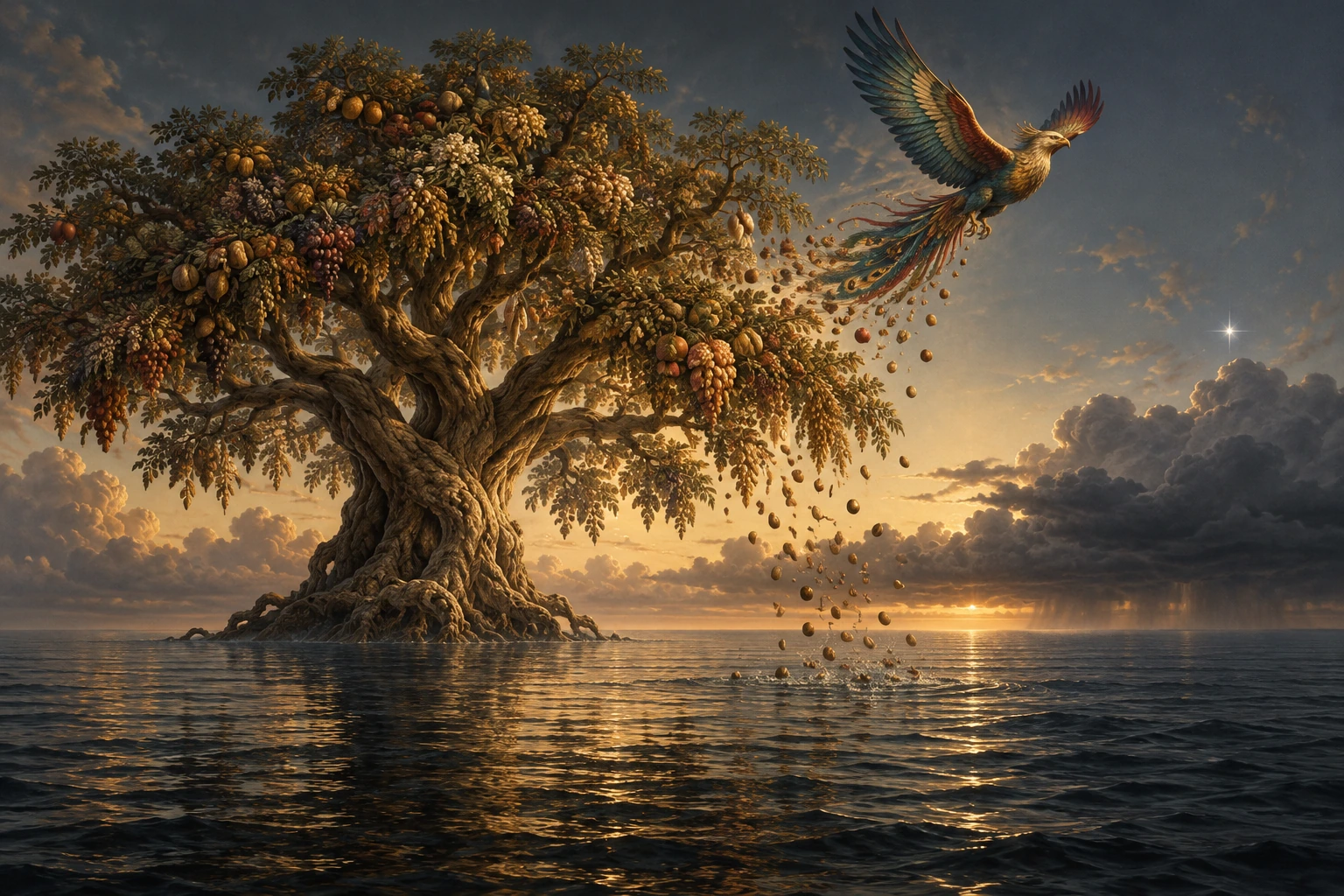
- in Yasht 12.17, the Saena’s tree stands “in the middle of the sea Vouru-Kasha”, “the tree of all remedies, and on which rest the seeds of all plants”. Darmesteter calls it “the tree of the eagle”.
The name is Avestan mərəγō saēnō, “the bird Saena”, once a bird of prey, eagle or falcon, like the Sanskrit śyena (Schmidt). It became sēnmurw in Middle Persian and simorgh in Persian.
Middle Persian (Pahlavi) books fill in the picture. In the Menog-i Khrad (chapter 62, in E. W. West’s translation) the bird’s nest is on “the tree opposed to harm, the many-seeded”. When it rises, a thousand twigs shoot out; when it alights, it breaks a thousand twigs and the seeds fall. Another bird, Chamrosh, gathers them and scatters them where Tishtar, the star Sirius, takes up the water, so that the seeds come down to the world with the rain. The Bundahishn, whose last redaction dates to the late 9th century (D. N. MacKenzie, Encyclopaedia Iranica), calls the bird “the griffin of three natures”, the largest of flying creatures.
- The Shahnameh (Book of Kings), Ferdowsi’s epic, finished on 25 February 1010 by Warner’s reckoning. It is literature of the Islamic era drawing on older tradition, not Zoroastrian scripture. Encyclopaedia Iranica notes that the Arabic history of al-Tha’alibi tells Zal’s story so closely as to suggest a common source, the prose Shahnameh of Abu Mansur. The critical edition is Djalal Khaleghi-Motlagh’s.
- The Conference of the Birds (Manteq al-tayr) by Farid al-Din Attar. Led by the hoopoe, the birds of the world set out to find their king, the Simurgh, whose feather once fell over China at midnight. They cross seven valleys, and most die on the way. Only thirty reach his court, and there they see the Simurgh and themselves at once: “without doubt, these thirty birds (si morgh) were that Simurgh.” The court is a mirror, a voice tells them: thirty came, so thirty appear in it. At the end they are lost in him, “the shadow lost in the sun”. Attar gives the year he finished the poem as 573 of the Hijra (1177 CE), but, as Benedikt Reinert notes in Encyclopaedia Iranica, that verse is not in all the manuscripts.
3 Competing Versions
- Where does the bird live? In the Avesta and the Pahlavi books, on a tree in the middle of the sea Vourukasha. In the Shahnameh, on a peak of the Alborz; for the tamarisk she leads Rostam to a sea, which Turner Macan’s edition calls the sea of China and Warner thought might be the lake of Sistan. In Attar, beyond the mountains of Qaf.
- One Simurgh or two? On his own seven labours, Esfandiyar kills a Simurgh “like a flying mountain” that carries off elephants and crocodiles, using a chariot set with swords. Warner saw in it “a malicious hit at Rustam”. Schmidt thinks the two may once have been a single, ambivalent bird; later in the poem, a scornful account of Zal’s birth says the Simurgh spared the baby only because she could not stomach him. The Pahlavi books have an evil bird of their own, Kamak, who spread his wings over the world so that the rain fell back into the sea.
- Bird or bat? The Bundahishn counts the bird among the birds, yet says that it and the bat both suckle their young, the bat being made of “the dog, the bird, and the musk animal”, and elsewhere calls it “the griffin bird, which is a bat” (West). Schmidt reads this as two versions confused by the compiler: an older one, in which the Senmurv was simply a bird, and a later one, in which it was a bat, and female.
- She or he? Persian has no grammatical gender. In the Shahnameh the Simurgh is a mother with chicks; Attar’s king of the birds, Schmidt thinks, is probably meant as male.
- What does the name mean? For Schmidt, “the bird Saena”. Warner in 1905 explained it as sih “three”, ayina “kind” and murgh “bird”, after the Bundahishn’s “griffin of three natures”. Attar’s “thirty birds” is a pun, not an etymology.
- Is the dog-bird the Senmurv? Camilla Trever gave the name senmurv to the Sasanian creature with a dog’s head, wings and a peacock’s tail in 1938, reasoning from the three-natured bat of the Bundahishn. Schmidt accepts it, and takes the bat of the Bundahishn for a later attempt to explain the image. The V&A says that “we simply do not know how Iranians of the Sasanian period … depicted the sēnmurw, if at all”. Matteo Compareti’s book of 2021 names a “pseudo-Simurgh” in its title. We know the book only from its description on the blog Bibliographia Iranica, which ties the creature to the royal glory, farr.
4 History and Tradition
- Taq-e Bostan. The dog-headed creature decorates the robes of King Khosrow II (r. 591–628) on the rock reliefs of Taq-e Bostan, near Kermanshah.
- From Iran to Paris. A silk in the Victoria and Albert Museum (8579-1863), woven in Iran or Central Asia in the 7th or 8th century, shows the creature in a pearl-bordered roundel. It is said to come from the reliquary of the head of St Helena, kept in the church of Saint-Leu in Paris until the French Revolution. Schmidt traces the motif to early Islamic buildings in Syria and Jordan and to churches in Georgia, Armenia and Byzantium.
- The Mongol bird. A star-shaped tile of 1292–93 in the Asian Art Museum, San Francisco (B60P2148), shows a Chinese phoenix. The Mongols brought the motif to Iran, the museum says, where it “lost its original associations and was merged with the Persian mythical bird the simurgh”. The Heibonsha World Encyclopedia likewise counts dragons and phoenixes among the Chinese motifs that reached Iranian painting in this period. The Fitzwilliam Museum says the Simurgh in a Shahnameh made at Herat around 1444 “derives from Chinese versions of the Asiatic pheasant”.
- Royal manuscripts. A page of Shah Tahmasp’s Shahnameh of about 1530, in Berlin’s Museum für Islamische Kunst (I. 5/77), shows Sam bringing Zal back from the Alborz. In a page of Shah Ismail II’s Shahnameh (Qazvin, 1576–77), attributed to the painter Siyavush, Esfandiyar kills the Simurgh; the Aga Khan Museum (AKM103) notes that the painter turns the viewer’s sympathy to the bird and her chicks.
- Folk tales. In a Kurdish tale quoted by Trever, a hero kills a snake climbing to eat the bird’s young, and she gives him three feathers to burn when he needs her; in another she carries the hero out of the underworld. In an Armenian tale the hero feeds the bird a piece of his own leg on the way, and she puts it back whole (Schmidt).
- Other languages. Judeo-Persian translations of the Bible use simorgh for the Hebrew word for “eagle”, and Sogdian synmrγ translates garuḍa, the bird of Vishnu (Schmidt).
- A royal ancestor raised by an eagle. Both Iranica articles compare Zal’s childhood with the story, preserved by the Roman-era writer Aelian (On Animals 12.21), that Achaemenes, ancestor of the Persian kings, was brought up by an eagle.
The Simurgh is often called “the Persian phoenix”, and a story repeated online says she lives 1,700 years and then throws herself into the flames. We have found it in no Persian source. In the Avesta, the Pahlavi books, the Shahnameh and Attar, the Simurgh never burns and is never reborn: what burns is her feather, to call her. Persian has a phoenix of its own, the qoqnus, and Attar tells its story in the same poem: a bird of India that lives about a thousand years, sings its lament on a pyre of firewood, burns to ash, and from the ash a young qoqnus rises.
5 Related Stories
- The Seven Labours of Rostam: The Short Road to the White Div: the hero whose birth the Simurgh guided. The post also tells, in a paragraph, Esfandiyar’s own seven labours, among them the killing of the other Simurgh.
- Rostam and Sohrab: The Father Who Killed His Son: the boy born on the Simurgh’s advice grows up to fight his own son without knowing him.
- Etana: The King Who Flew on an Eagle: in Encyclopaedia Iranica, Schmidt sets the Simurgh beside the great birds of Mesopotamia: the eagle that carries Etana to heaven, and the Anzu bird whose young the hero Lugalbanda frees. Following J. Aro, he sees in them a “common Near Eastern heritage”.
- Ahura Mazda and Angra Mainyu: The Two Spirits: the Bundahishn, in which the Senmurv’s tree grows in the sea, is above all a book of creation. Its account of Ohrmazd’s creation and Ahriman’s attack is told there.
6 Sources
- Yasht 12.17 and Yasht 14.35–41, trans. James Darmesteter, The Zend-Avesta, part II (Sacred Books of the East 23, 1883; American edition, 1898), with his notes: avesta.org, avesta.org
- Menog-i Khrad, chapter 62, and Bundahishn, chapters 14, 18 and 19, trans. E. W. West (Sacred Books of the East 24 and 5): avesta.org, avesta.org
- Ferdowsi, The Shahnama of Firdausi, trans. Arthur George Warner and Edmond Warner, vol. 1 (Kegan Paul, 1905), pp. 234–248 and 320–323, and vol. 5 (1910), pp. 117, 131–134 and 235–248: archive.org, archive.org; Persian text of the Moscow edition: Ganjoor, Ganjoor
- Ferdowsi, Shahnameh: The Persian Book of Kings, trans. Dick Davis (Penguin Classics): penguin.co.uk
- Attar, Manteq al-tayr, “The story of the Simurgh”, “The death of the qoqnus” and “The thirty birds before the Simurgh”, Persian text with page images of the editions of Mohammad-Reza Shafiei-Kadkani and Hamid Hamid, our translation: Ganjoor, Ganjoor, Ganjoor; in English, The Conference of the Birds, trans. Afkham Darbandi and Dick Davis (Penguin Classics): penguin.co.uk
- Encyclopaedia Iranica: Hanns-Peter Schmidt, “SIMORḠ” (2002); Alireza Shapur Shahbazi and Simone Cristoforetti, “ZĀL” (2009); Benedikt Reinert, “ʿAṬṬĀR, FARĪD-AL-DĪN” (1987); David Neil MacKenzie, “BUNDAHIŠN” (1989): iranicaonline.org, iranicaonline.org, iranicaonline.org, iranicaonline.org
- Victoria and Albert Museum, woven silk, 8579-1863: vam.ac.uk
- Asian Art Museum, San Francisco, “Star-shaped tile with phoenix design” (B60P2148): Google Arts & Culture
- Fitzwilliam Museum, The Shahnameh: a Persian Cultural Emblem and a Timeless Masterpiece, no. 45, “The Simorgh restores Zal to Sam” (Royal Asiatic Society, Persian MS 239): fitzmuseum.cam.ac.uk
- Museum für Islamische Kunst, Berlin, “Father Sam brings back his son Zal from Mount Alborz” (I. 5/77); Aga Khan Museum, “Isfandiyar kills the Simurgh” (AKM103): smb.museum, agakhanmuseum.org
- Matteo Compareti, The Elusive Persian Phoenix: Simurgh and Pseudo-Simurgh in Iranian Arts (Studia Persica 3, 2021), the book’s description as given by Bibliographia Iranica: Bibliographia Iranica
- William Smith (ed.), A Dictionary of Greek and Roman Biography and Mythology (1890), “Achaemenes”: Perseus
- “王書” (Britannica International Encyclopedia; Heibonsha World Encyclopedia): Kotobank
- Japanese translations: Kuroyanagi Tsuneo, Ōsho (Heibonsha, Tōyō Bunko 150, 1969); Okada Emiko, Ōsho: Kodai Perusha no shinwa, densetsu (Iwanami Bunko, 1999); Attar, Tori no kotoba, trans. Kuroyanagi Tsuneo (Heibonsha, Tōyō Bunko 821, 2012): NDL, NDL, NDL
Cover and illustrations: AI-generated images made for Arcana. They are interpretations, not historical artworks.