Ahura Mazda and Angra Mainyu: The Two Spirits
At the beginning, says a hymn of Zarathustra, two spirits made their choice: one chose the truth, the other the lie. Later books tell how the evil one broke into the world, and how it will end in a river of molten metal and a world made new.
- Type: myth, the creation of the world, the struggle of good and evil, and the end of time
- Culture: ancient Iran; Zoroastrianism, a living religion, in Iran, in India (the Parsis) and around the world
- Earliest texts: the Gathas, hymns of the Avesta attributed to Zarathustra himself (date much debated), above all Yasna 30; the Middle Persian Bundahishn, whose last important redaction belongs to about the 9th century CE
- Key figures: Zarathustra (Zoroaster), Ahura Mazda (Ohrmazd), Spenta Mainyu, Angra Mainyu (Ahriman), the Amesha Spentas, Gayomard and the first ox, the Saoshyant, Zurvan
Most creation stories start with a world. This one starts with a choice. Before there was a sky, says a hymn that tradition gives to the prophet Zarathustra, two spirits met, and each chose a side: one the truth, the other the lie. The world was made as the field of their battle, and every human being is still asked to choose.
Are Ahura Mazda and Angra Mainyu twin brothers? Not in the Gathas. Yasna 30 calls the two primal spirits “Twins”, but the good one is Spenta Mainyu, and in Yasna 47 Zarathustra calls Ahura Mazda “the holy Father of this Spirit”. Kamioka Kōji writes in the Heibonsha World Encyclopedia that it was the dualist doctrine of the Sasanian era that identified Ahura Mazda with the good spirit and set him directly against Ahriman. Ohrmazd and Ahriman as twin sons of one father, Zurvan, belong to a still later teaching (section 3).
1 The Telling
The story comes from two kinds of text written down far apart: the Gathas, quoted here in James Hope Moulton’s translation (1913), and the Bundahishn (“Creation”), quoted in E. W. West’s translation of the shorter, Indian recension (Sacred Books of the East 5) and checked against B. T. Anklesaria’s translation of the Greater Bundahishn (1956).
1-1 The Choice at the Beginning
“Now the two primal Spirits, who revealed themselves in vision as Twins, are the Better and the Bad in thought and word and action,” Zarathustra sings in Yasna 30. “And between these two the wise once chose aright, the foolish not so.” When the two came together in the beginning, “they established Life and Not-Life”.
The one “that followed the Lie chose doing the worst things”. The holiest spirit chose Right, asha, the true order of things, “he that clothes him with the massy heavens as a garment”. The daevas, the old gods, chose wrongly too, “for infatuation came upon them as they took counsel together”, and they rushed to violence “that they might enfeeble the world of man” (Yasna 30.3–6).
In another hymn the good spirit speaks to the other: “Neither thought nor teachings nor wills nor beliefs nor words nor deeds nor selves nor souls of us twain agree” (Yasna 45.2). Above them both stands Ahura Mazda, the “Lord of Wisdom”, the father of the holy spirit (Yasna 47.3).
1-2 Light Above, Darkness Below
The Bundahishn gives the same choice the shape of a story. Ohrmazd, Ahura Mazda in Middle Persian, dwells on high in the “endless light”, supreme in knowledge and goodness. Ahriman, the later name of Angra Mainyu, lies in the abyss, in the “endlessly dark”, “with backward understanding and desire for destruction”. Between them is empty space (1.2–4).
Ahriman does not even know that Ohrmazd exists. When he rises from the abyss and sees the light, he rushes to destroy it, finds it stronger than himself and flees back to make demons. Ohrmazd offers him peace: help my creatures and praise them, and you will become “immortal and undecaying, hungerless and thirstless”. Ahriman refuses: “I will destroy thy creatures for ever and everlasting” (1.9–14).
So Ohrmazd proposes a time limit, nine thousand years of mingled battle, knowing it will be the end of his enemy. Ahriman, through ignorance, agrees, “just like two men quarreling together, who propose a time thus: Let us appoint such-and-such a day for a fight”. Then Ohrmazd recites the Ahunwar, the prayer Yatha ahu vairyo, and shows Ahriman his own defeat at the end of time. Ahriman falls back into the dark, stunned, for three thousand years (1.18–22).

1-3 Seven Creations
While Ahriman lies stunned, Ohrmazd creates. The Greater Bundahishn lists the material creations: the sky, water, earth, plants, the beneficent animal, man, and seventh, fire, “whose radiance is from the Endless Light” (3.7). The Amesha Spentas, the “Beneficent Immortals”, six holy beings whose names are also virtues, each take a part of it into their care: Vohu Manah (Good Thought) keeps the animals, Asha Vahishta (Best Right) the fire, Khshathra Vairya (Dominion) the metals, Spenta Armaiti (Piety) the earth, Haurvatat (Welfare) the water and Ameretat (Immortality) the plants. Ohrmazd himself keeps man (3.12–19).
The first animal is a single ox, the first man is Gayomard, and for three thousand years the two live in a world without harm (34.1).
1-4 The Attack
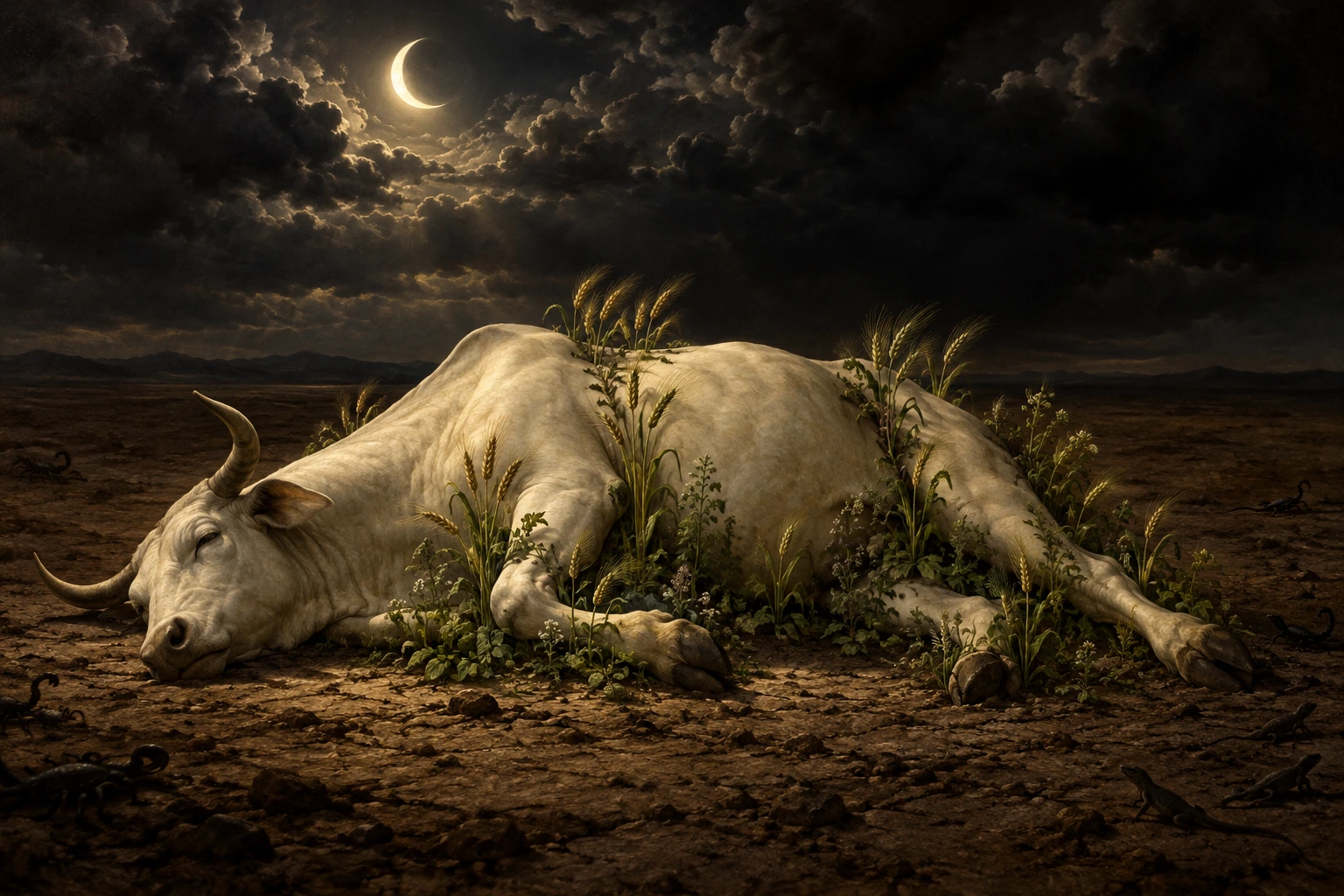
After three thousand years a female demon, Jeh, rouses Ahriman with promises of the harm she will do. He breaks through the sky and springs “like a snake” down to the earth, at noon, on the day Ohrmazd of the month Frawardin. He pierces the earth, withers the plants and, “just like a fly”, rushes over the whole creation, making it as dark at midday “as though it were in dark night”. Snakes, scorpions and lizards swarm until “not so much as the point of a needle” is free of them (3.10–15).
The ox sickens and dies. From its limbs grow fifty-five kinds of grain and twelve healing plants, and its seed, purified by the light of the moon, gives rise to the animals (10.1–3). Gayomard lives thirty years more and dies too (3.22–23). His body was made of metal, says the Greater Bundahishn, and seven kinds of metal came out of it (6F.8). From his seed, purified by the sun, a one-stemmed rivas plant grows after forty years, and from it the first human couple, Mashye and Mashyane (15.1–2).
The heavenly beings fight Ahriman’s demons for ninety days and nights and hurl them into hell, and the sky is made a rampart against him. Hell lies in the middle of the earth, where he broke through (3.26–27).
1-5 The Renewal
At the end of time comes the Saoshyant, the future deliverer. The dead rise, Gayomard first, then the first couple, then everyone else, and in a great assembly “a wicked man becomes as conspicuous as a white sheep among those which are black” (30.7–10).
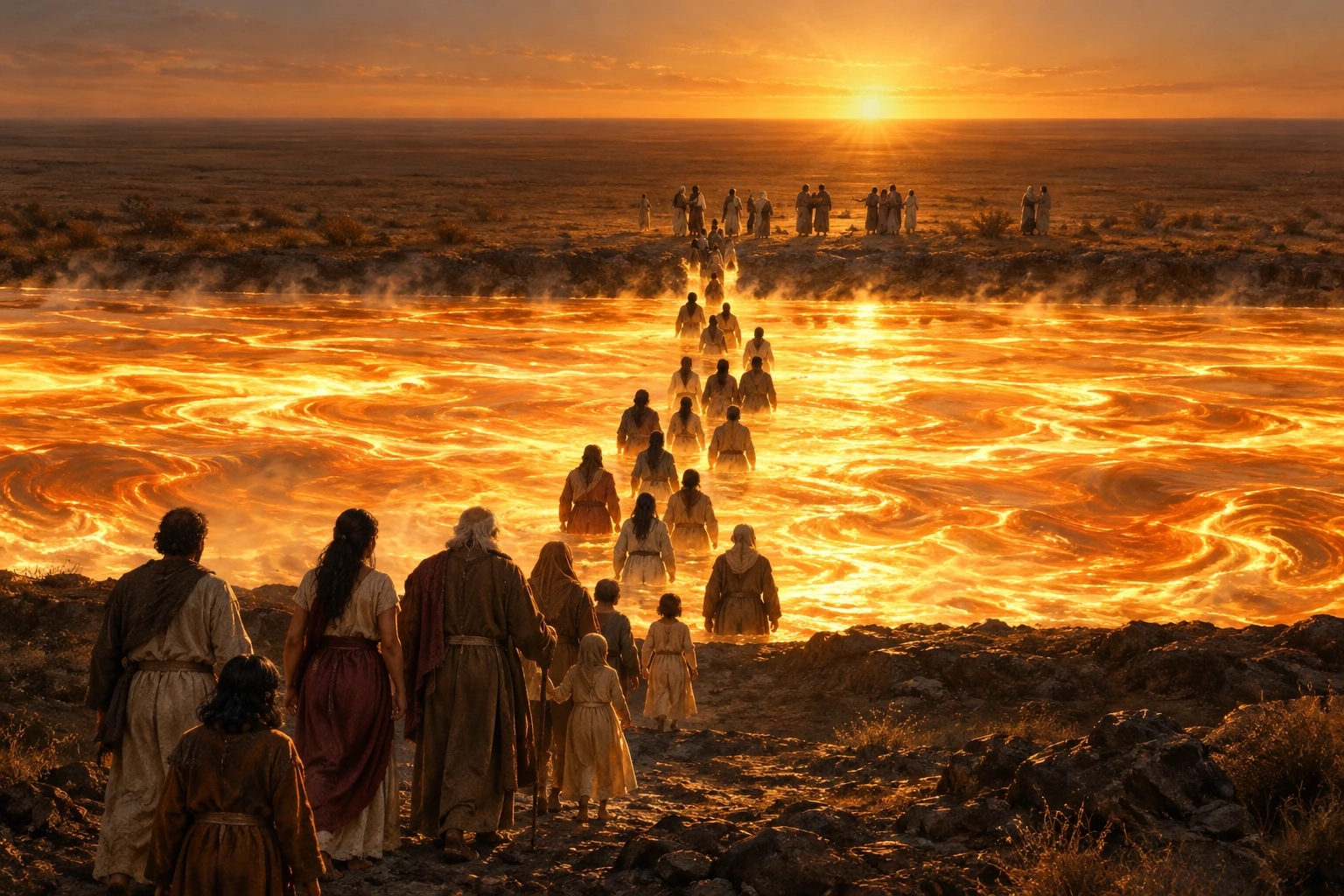
Then the metal in the hills and mountains melts “and it remains on this earth like a river”. Everyone must pass through it. “When one is righteous, then it seems to him just as though he walks continually in warm milk; but when wicked, then it seems to him in such manner as though, in the world, he walks continually in melted metal” (30.19–20). All come out pure. In a last ceremony the Saoshyant and his helpers sacrifice the ox Hadhayosh, and from its fat and the white haoma they make a drink that renders everyone immortal (30.25).
Ahriman, defeated, runs back to the darkness “by the passage through which he rushed into the sky”, and Ohrmazd seals it with the metal. Hell is purified and added to the world, the earth becomes “an iceless, slopeless plain”, and the world is “immortal for ever and everlasting” (30.30–33). This is the frashokereti (Middle Persian Frashegird), the renewal of the world. The noun is later than the Gathas, Moulton notes, but the hope is already there: “So may we be those that make this world advance!” (Yasna 30.9).
2 Where the Story Is Written Down
- The Gathas: seventeen hymns, Yasna 28–34, 43–51 and 53, the oldest part of the Avesta, the Zoroastrian scripture, and attributed to Zarathustra himself. They are hard poems. Moulton thought Yasna 30 had “the appearance of being a Lehrgedicht”, a teaching poem in verse, and one hymn shows a prophet in trouble: “To what land shall I go to flee, whither to flee?” (Yasna 46.1). Yasna 30.7 already speaks of retribution “through the (molten) metal”, as Moulton translates it.
- When did Zarathustra live? No one knows. Plutarch heard that he lived “five thousand years before the Trojan War”. Modern estimates run from the middle of the 2nd millennium BCE to the 7th or 6th century BCE, and the Heibonsha World Encyclopedia says no consensus has been reached.
- The Avesta was handed down by word of mouth and put into its final form under the Sasanian kings, around the 6th century CE. About a quarter of the Sasanian Avesta survives.
- Greek reports. Plutarch (Isis and Osiris 46–47) describes “Horomazes”, like light, and “Areimanios”, like darkness and ignorance, and cites the historian Theopompus (4th century BCE).
- The Bundahishn, a Middle Persian compilation of Zoroastrian learning. Mary Boyce wrote that it grew through several redactions after the Arab conquest and that “the last important redaction belongs to about the end of the 9th century”, but that its material is ancient. It survives in two recensions, a shorter Indian one and the longer Iranian or Greater Bundahishn.
- The Denkard, a Middle Persian encyclopaedia of the religion, summarizes in its ninth book the twenty-one books of the Sasanian Avesta, most of them now lost, among them the Warshtmansr Nask (section 3).
- Eznik of Kolb, an Armenian Christian writer of the 5th century, preserves the story of Zurvan in a book written against the religions of his day (section 3).
3 Competing Versions
- Who are the twins? In the Gathas, the two spirits; Ahura Mazda is the father of the good one (Yasna 47.3). Moulton thought Zarathustra meant only that good and evil “were co-eternal in the past, or arose together ‘in the beginning’”. In the Sasanian doctrine, Ohrmazd and the good spirit are one, and he faces Ahriman directly. The Denkard even puts the idea that “Ohrmazd and Ahriman have been two brothers in one womb” in the mouth of a demon, Aresh, and calls it false (9.30.4–5).
- Chosen or born? In Yasna 30 the spirits, and the daevas after them, choose. In the Bundahishn, Ahriman’s “malicious nature” is there from the start.
- Zurvan. In the version Eznik reports, before anything existed there was Zurvan, whose name means Time. He made offerings for a thousand years to have a son, Ohrmazd, who would create the world, and then he doubted. Two sons were conceived, Ohrmazd from the offerings and Ahriman from the doubt. Zurvan vowed to make king whichever came to him first, and Ahriman broke out of the womb and came first. “My son is odoriferous and of light, and thou art of darkness and of disagreeable scent,” said Zurvan. To keep his vow, he gave Ahriman nine thousand years of rule, with Ohrmazd as king over him, and after that Ohrmazd would reign. The story is known only from outsiders, Greek, Armenian and Syriac writers, the Christian ones attacking it. The Parsi high priest Maneckji Dhalla (1938) wrote that it “has left no traces whatever in the extant Pahlavi works”, while Kamioka writes that “Zurvanism” gained ground in the Sasanian period.
- How long is the world? The Bundahishn counts twelve thousand years in four periods: three thousand in which the creation is spiritual only, then the nine thousand Ohrmazd proposed, three thousand by his will alone, three thousand in which his will and Ahriman’s are mingled, and three thousand in which the evil spirit is disabled (1.8, 1.20, 34.1). Theopompus, in Plutarch, gives three thousand years in which one god rules and the other is ruled, and three thousand of war, before “Hades is to fail”.
- What becomes of Ahriman? The Bundahishn calls him “he who will not be” (1.3), yet in its last chapter he is beaten back into the dark and shut in (30.30–32). Plutarch says Areimanios will be “utterly destroyed” and “made to vanish away”.
- Between them. Plutarch places Mithres between the two, “wherefore also the Persians call Mithres the Mediator” (46).
Zoroastrianism is often described as a religion of two equal gods, one good and one evil. The texts do not make them equal. Kamioka describes Zarathustra’s own teaching as an attempt to unite the gods of his time into an “ethical monotheism”, with Ahura Mazda as the supreme god. Even in the dualist Bundahishn, Ohrmazd and his realm “were and are and ever will be”; he knows the end from the start and sets the terms of the fight, while Ahriman is “backward” in knowledge, agrees to the terms “through ignorance” and is doomed to lose.
4 History and Tradition
- The Persian kings. Darius I, who took the throne in 522 BCE, had his victories carved on the cliff of Behistun in Iran: “By the grace of Ahuramazda am I king; Ahuramazda has granted me the kingdom.” He blames the revolts against him on “lies”, and tells the kings after him to “punish the liars well” (§§5, 54–55, trans. L. W. King and R. C. Thompson). The inscription does not name Zarathustra.
- Gods and demons. The daevas who chose wrongly in Yasna 30 are, Moulton writes, “the old nature-gods”. In the Greater Bundahishn, Ahriman “miscreated many Devs”, and in Ferdowsi’s Shahnameh the divs are the demons the heroes fight. In India the names went the other way: the Heibonsha World Encyclopedia notes that asura, not always a bad word in the Rigveda, came to mean a demon fighting the devas, the gods, while in Iran its counterpart ahura became the supreme god and the daeva fell to a demon.
- Fire temples. Zoroastrians do not worship fire. In the prayer before the sacred fire, J. J. Modi explains, the worshipper takes it “as the symbol of God’s refulgence and purity” (1922). Dhalla records that Ferdowsi told his readers not to call the old Iranians fire-worshippers, “because they were the worshippers of one holy God”, and that the 13th-century writer Qazwini said Zoroaster made fire a qibla, a direction of prayer, “and not a god”. The highest grade of sacred fire, the Atash Bahram, is consecrated from sixteen kinds of fire, among them those of a potter, a goldsmith, a baker and a shepherd, and is spoken of as “Atash Bahram Padshah”, the king.
- The Parsis. Finding it hard to keep their faith under the new Muslim rulers, a group of Zoroastrians left Khorasan and landed on the coast of Gujarat, by Parsi tradition in the 8th to 10th century (the Nipponica gives 936). The Qissa-i Sanjan, finished in 1600, tells how their priests asked the local raja for land to install a fire of the highest grade, which they named Iranshah, “the Prince or Lord of Iran”. Moved more than once, that fire is kept at Udvada, where, Hodivala noted in 1920, it still bears the name. Most Parsis now live in Mumbai. The revised edition of the Heibonsha World Encyclopedia (2007) counts, without giving the year of its figures, about 80,000 Zoroastrians in India, about 25,000 in Iran, centred on Yazd and Kerman, and about 5,000 in Pakistan.
- Nietzsche’s Zarathustra. The prophet of Nietzsche’s Thus Spake Zarathustra is named after him. In Ecce Homo Nietzsche explains why: “Zarathustra was the first to see in the struggle between good and evil the essential wheel in the working of things”, so he must be the first to expose that “error” (trans. A. M. Ludovici, 1911).
5 Related Stories
- Mithra: The God of the Covenant: in Plutarch, Mithres stands between Horomazes and Areimanios as “the Mediator”. The Persian god of the contract has his own hymn in the Avesta.
- The Seven Labours of Rostam: The Short Road to the White Div: the daevas who chose the lie in Yasna 30 return in the epic as the divs, and Rostam’s last labour is against the White Div in his cave.
- The Churning of the Ocean: Gods, Demons and the Nectar of Immortality: India’s devas and asuras, the counterparts of Iran’s daevas and ahuras, with the sides reversed.
- Ragnarök: The End of the World, and What Comes After: another world that ends in fire and comes back new. Moulton reports Professor Söderblom’s argument, in La Vie future, that the flood of molten metal is an old Indo-European myth “paralleled in Norse and Greek saga”.
6 Sources
- The Gathas (Yasna 30, 45, 46, 47), trans. James Hope Moulton, Early Zoroastrianism (Constable, 1913), pp. 131–133, 157–160, 349–350, 370–377, with his translation of Plutarch, Isis and Osiris 46–47, pp. 399–405: archive.org; the list of the Gathas: avesta.org
- Bundahishn, chapters 1, 3, 10, 15, 30 and 34, trans. E. W. West (Sacred Books of the East 5), with Mary Boyce’s note: avesta.org
- Zand-Akasih: Iranian or Greater Bundahishn, trans. Behramgore Tehmuras Anklesaria (Bombay, 1956), chapters 1, 3 and 6F: avesta.org
- Denkard 9.30 (the Warshtmansr Nask, fargard 7), trans. E. W. West (Sacred Books of the East 37): avesta.org
- Eznik of Kolb on Zurvan, trans. from the Armenian by Aviet Aganoor, in John Wilson, The Pársí Religion (American Mission Press, Bombay, 1843), appendix D, pp. 542–544: archive.org
- Maneckji Nusservanji Dhalla, History of Zoroastrianism (Oxford University Press, New York, 1938), pp. 330–333 and 442: archive.org
- Darius I, the Behistun inscription, Persian text, trans. L. W. King and R. C. Thompson (1907): Wikisource
- Jivanji Jamshedji Modi, The Religious Ceremonies and Customs of the Parsees (Bombay, 1922), pp. 211, 232–233 and 238: avesta.org
- Qissa-i Sanjan, trans. Shahpurshah Hormasji Hodivala, Studies in Parsi History (Bombay, 1920), pp. 94–117: avesta.org
- Friedrich Nietzsche, Ecce Homo, “Why I am a Fatality” 3, trans. Anthony M. Ludovici (T. N. Foulis, 1911): Project Gutenberg
- Kamioka Kōji, “アフラ・マズダ” and “ゾロアスター教”, Heibonsha World Encyclopedia, revised edition (2007); Yamamoto Yumiko, “ゾロアスター教” and “パールシー”, Nipponica; Tanizawa Junzō, “パールシー”, Heibonsha World Encyclopedia, revised edition; with the other dictionary entries on the same pages: Kotobank, Kotobank, Kotobank, Kotobank
- Japanese translations: Itō Gikyō, “Avesutā”, in Sekai koten bungaku zenshū 3, Vēda, Avesutā (Chikuma Shobō, 1967); Mary Boyce, Zoroasutā kyō: 3500 nen no rekishi, trans. Yamamoto Yumiko (Chikuma Shobō, 1983; Kōdansha, 2010): NDL, NDL
Cover and illustrations: AI-generated images made for Arcana. They are interpretations, not historical artworks.