Ragnarök: The End of the World, and What Comes After
The wolf breaks loose, the serpent rises from the sea and Surtr's fire burns the world. Then the earth comes up green from the waves a second time. Two old poems tell it in glimpses; a Christian Icelander of the 1220s joined them into one story.
- Type: myth, the end of the world and its rebirth
- Culture: Norse; Iceland and Norway, and the Norse settlements in Britain
- Earliest texts: the poems Völuspá and Vafþrúðnismál, in the Codex Regius (c. 1270); a second Völuspá in the 14th-century Hauksbók; Snorri Sturluson’s Edda (1220s). The Gosforth Cross in Cumbria carved scenes of it in the first half of the 10th century
- Key figures: Odin, Thor, Loki, Fenrir, the Midgard Serpent, Heimdallr, Surtr, Freyr, Víðarr, Baldr, Líf and Lífþrasir
Most myths look back to the beginning. Völuspá, “the prophecy of the seeress”, also looks ahead. A wise woman tells Odin how the world was made, and then how it will end: the gods go out one by one against their old enemies, and die. But she does not stop at the fire. She sees the earth rise again out of the sea, green.
Does everything end at Ragnarök? No. Odin, Thor and Freyr fall, the sun turns black and the earth sinks into the sea. But Völuspá goes on: the earth comes up “a second time”, and Baldr returns from the dead. Vafþrúðnismál names more survivors: Odin’s sons Víðarr and Váli, Thor’s sons Móði and Magni, who inherit his hammer, and a human pair, Líf and Lífþrasir, who hide in a wood and live on the morning dew.
1 The Telling
This retelling follows Völuspá in the Codex Regius. Stanza numbers are those of Gustav Neckel’s edition (1914); where Henry Adams Bellows’s translation (1923), quoted here, numbers a stanza differently, we give both. Where Vafþrúðnismál or Snorri adds a detail, we say so.
1-1 The Signs
Her account of the end begins with wolves. In the east, in Járnviðr, the Iron Wood, an old giantess bears the brood of Fenrir, and one of them, in the shape of a troll, is to steal the sun from the sky, in Bellows’s reading; the Old Norse words are obscure (Völuspá 40). The summers after turn dark and every wind turns treacherous (41). The wolves that chase the sun and moon have a story of their own; here they are only a sign.
Three cocks crow: red Fjalarr among the giants, Gullinkambi, “Gold-comb”, who wakes the warriors in Odin’s hall, and a soot-red one beneath the earth, in the halls of Hel, the realm of the dead (42–43). Then comes the refrain the seeress repeats like a drumbeat: the hound Garmr howls before the cave Gnipahellir, “the fetters will burst, and the wolf run free” (44, 49, 58).
Kin turn on kin. “Brothers shall fight and fell each other”, sisters’ sons break the bonds of family, and the seeress names the age: “Axe-time, sword-time, shields are sundered, / Wind-time, wolf-time, ere the world falls” (45). Vafþrúðnismál (44) gives the last winter a name, Fimbulvetr, the “Mighty Winter”. Snorri adds that there will be three such winters in a row with no summer between, after three winters of war across the world.
1-2 Heimdallr’s Horn
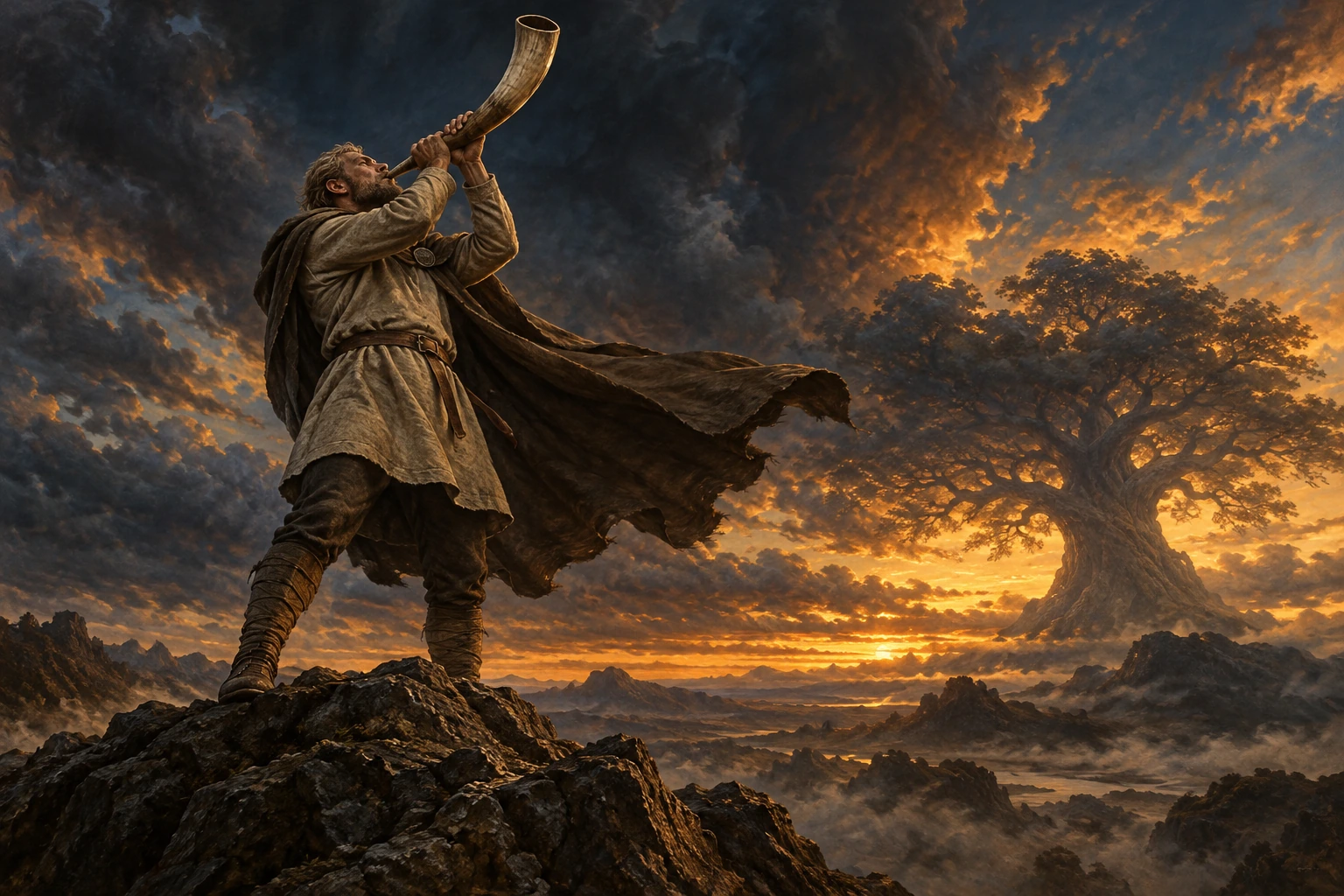
Heimdallr, the watchman of the gods, raises the Gjallarhorn: “Loud blows Heimdallr, the horn is aloft” (46). Odin speaks with Mím’s head. The ash Yggdrasil shakes, the old tree groans, and the giant breaks loose (46–47). “How fare the gods? how fare the elves?” All Jötunheimr roars, the gods meet in council, and the dwarves groan before their doors of stone (48).
1-3 From the East and the South
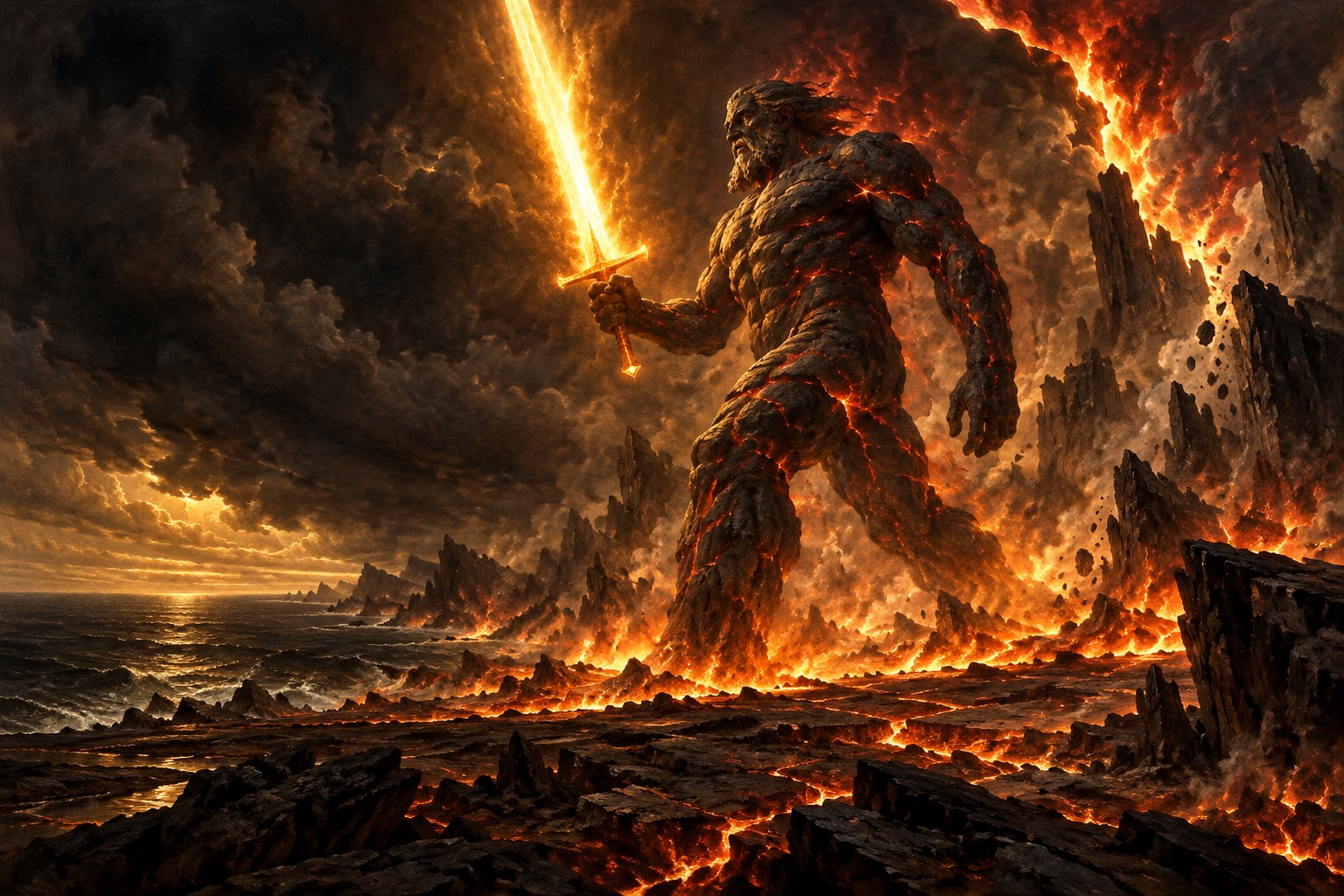
The enemies come from every side. The giant Hrymr drives from the east with his shield held high, the serpent writhes “in giant-wrath” and lashes the waves, an eagle shrieks and tears corpses, and Naglfar breaks loose (50). A ship sails from the east carrying the people of Muspell, “and Loki steers”; a wild host goes with the wolf (51). From the south comes Surtr, the fire giant, “with the scourge of branches”, that is, with fire, and “the sun of the battle-gods shone from his sword”. Cliffs crash down, troll-women stumble, the dead tread the road to Hel, and the sky splits open (52).
1-4 The Duels and the Fire
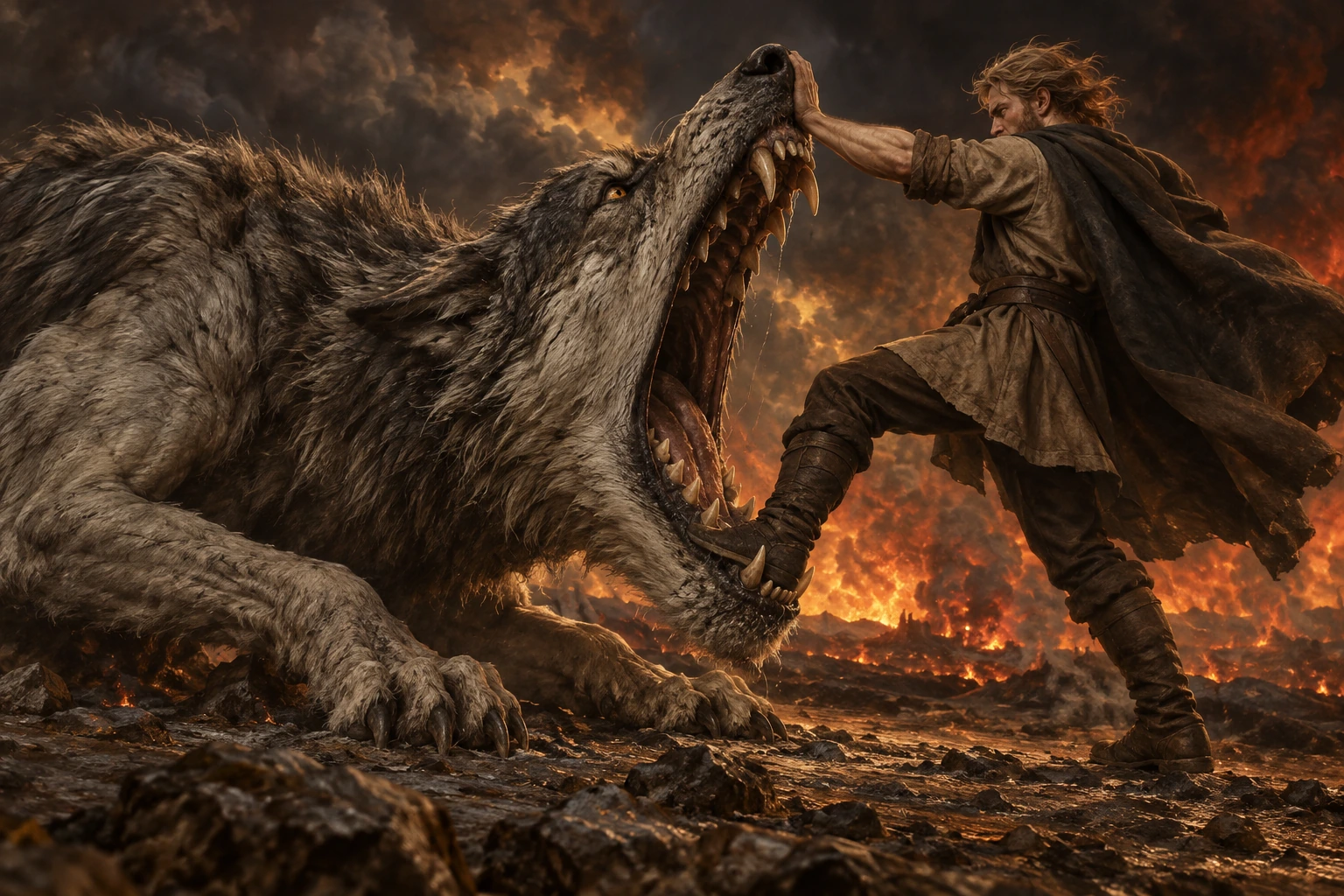
Now comes “Hlín’s second grief”. Hlín is probably Frigg, whose first grief was the death of her son Baldr. Odin goes out to fight the wolf, and Freyr, “Beli’s fair slayer”, goes against Surtr. “There must fall the joy of Frigg” (53): Odin dies. Snorri adds that Freyr fell because he had given away his good sword. Then Víðarr, Odin’s son, comes against the beast and drives his sword into the wolf’s heart: “his father is avenged” (55; 54 in Bellows). In Vafþrúðnismál (53) he tears the wolf’s cold jaws apart instead.
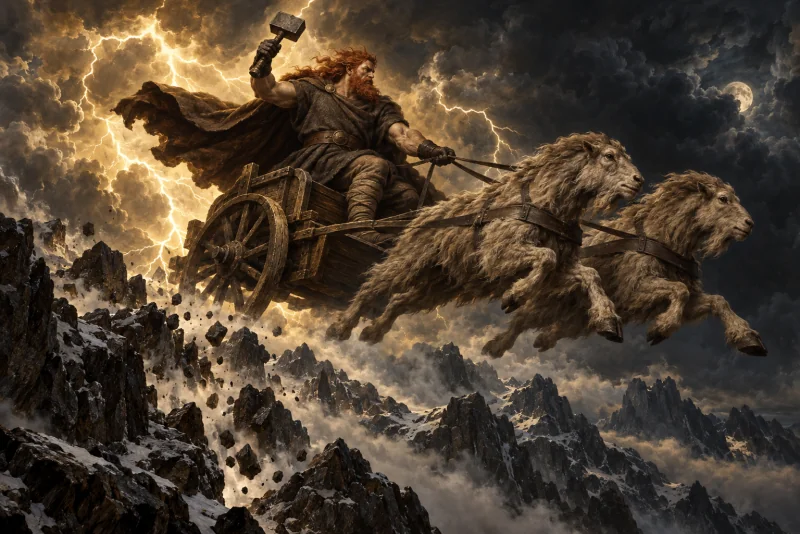
Thor, “the son of Hlothyn”, goes against the serpent and strikes it in his anger, while all men flee their homes. He walks nine paces away from it, and falls (56; 55–56 in Bellows). Snorri says he dies of the venom the serpent has blown over him.
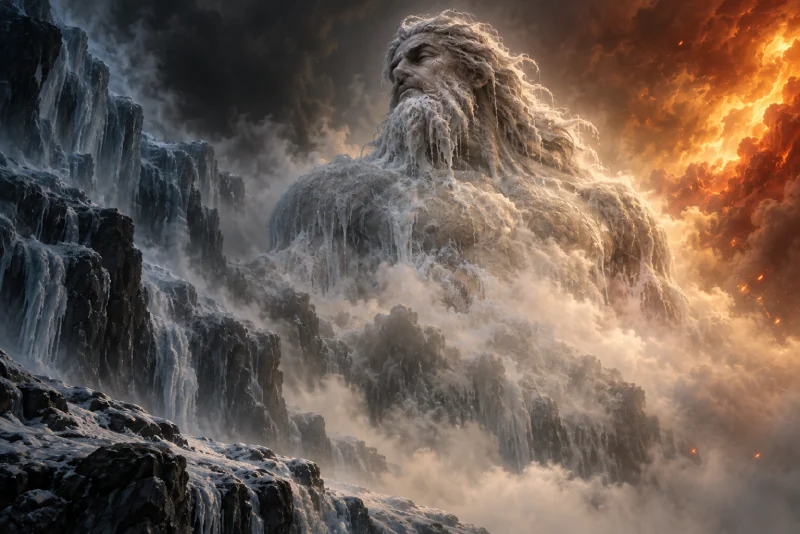
“The sun turns black, earth sinks in the sea”, the bright stars vanish from the sky, steam and flame rage, and the fire “leaps high about heaven itself” (57). Snorri puts it plainly: Surtr will “cast fire over the earth and burn all the world”.
1-5 The Green Earth
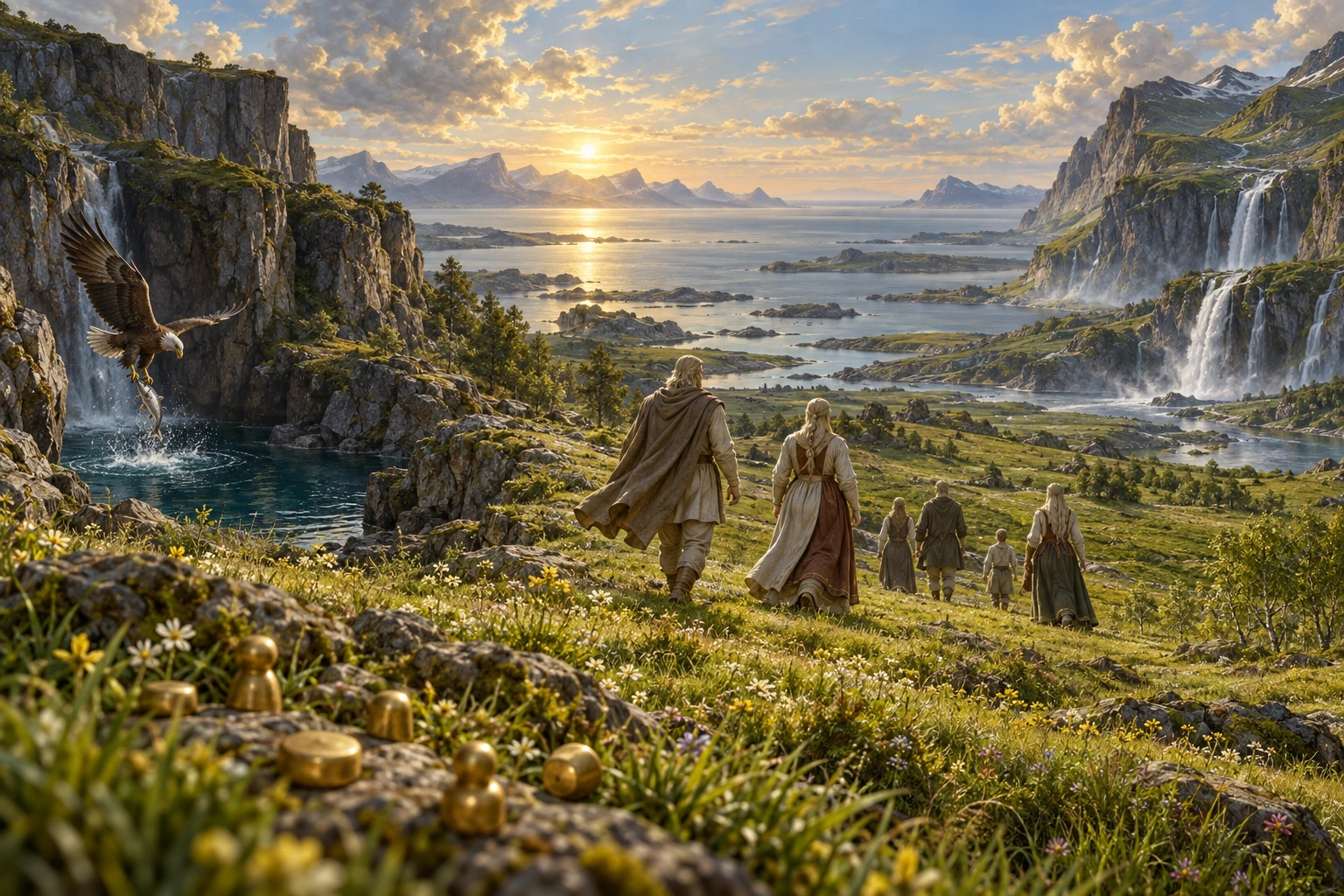
Then the seeress looks again: “Now do I see the earth anew / Rise all green from the waves again” (59). Waterfalls tumble, and an eagle flies over the fells, hunting fish. The gods meet on Iðavöllr and talk of the great serpent and of Odin’s ancient runes (60), and in the grass they find the golden gaming pieces they owned in the days of old (61).
Fields bear grain no one sowed, “all ills grow better, and Baldr comes back”, together with Höðr, the brother who killed him (62). Hœnir takes up the lot-twig to read the future (63). The seeress sees a hall “more fair than the sun”, thatched with gold, on Gimlé, where the worthy will live in joy for ever (64).
Vafþrúðnismál fills in the rest. Víðarr and Váli will live in the gods’ sanctuaries “when the fires of Surt have sunk”, and Móði and Magni will have Thor’s hammer, Mjölnir (51). Líf and Lífþrasir, hidden in Hoddmímir’s wood, will live on the morning dew, and new generations will come from them (45). And the sun, before the wolf takes her, will bear a daughter: “Her mother’s paths shall the maiden tread” (47).
The poem does not end in calm. A dark dragon, Níðhöggr, flies up from below with corpses in his wings, and the last words in both manuscripts are “now she will sink” (66). Bellows explains that “she” is the seeress herself, going back down into the earth; Neckel’s edition changes the word to “he”, the dragon.
2 Where the Story Is Written Down
Völuspá in the Codex Regius, the first poem of the manuscript, written about 1270, that preserves most of the Poetic Edda. When the poem was composed is unknown; Pettit notes that Iceland around its conversion to Christianity in 999/1000 has often been favoured. A stanza of Þorfinnsdrápa, by the Christian Icelander Arnórr jarlaskáld, perhaps from about 1065, opens “The bright sun will turn to black, earth sink into the dark sea”, which may echo Völuspá 57.
Völuspá in the Hauksbók, a 14th-century manuscript. The stanzas come in another order, Baldr’s death is not told outright, and there are lines the Codex Regius lacks, among them a serpent gaping across the sky and the “mighty one” (section 3).
Vafþrúðnismál, also in the Codex Regius. Odin, in disguise, matches wits with the giant Vafþrúðnir, and in stanzas 44–55 asks what comes after the end. His last question is what Odin said into his son’s ear at the pyre. Only Odin can know, and the giant realizes whom he has been talking to.
Lokasenna 39, where the god Týr says the bound wolf will wait for ragna røkkr: the only old poem with that form of the word (see the bubble below).
Snorri Sturluson’s Gylfaginning, chapters 51–53, written in Christian Iceland in the 1220s. Snorri quotes most of Völuspá 45–57 and several stanzas of Vafþrúðnismál, and joins them into one continuous story. Only Snorri has:
- three winters of Fimbulvetr after three winters of war, and Naglfar made “of dead men’s nails”, so that anyone who dies “with unshorn nails” adds to it, with the giant Hrymr at its helm;
- the wolf’s jaws stretching from earth to sky, and the sons of Muspell riding over the rainbow bridge Bifröst, which breaks;
- Týr and the hound Garmr killing each other, Loki and Heimdallr killing each other, and Víðarr’s shoe, made of the scraps of leather people cut from their own shoes;
- after the end, the halls Völuspá names earlier: Gimlé, Brimir and Sindri for the good, Náströnd for oath-breakers and murderers.
Arthur Brodeur, his translator, found that Snorri, “though a Christian, tells the old pagan tales with obvious relish”. Pettit warns that his reading of Völuspá “should not be assumed to be wholly correct, complete or unbiased”.
3 Competing Versions
- Who steers the ship? Völuspá: a ship from the east with the people of Muspell, “and Loki steers” (51); Naglfar breaks loose in the stanza before. Snorri: Hrymr steers Naglfar, Loki leads “all the champions of Hel”, and the sons of Muspell ride over Bifröst. Bellows bent the poem toward Snorri: his translation has a ship “from the north” with “the people of Hel”, and his note admits that the manuscripts have “east” and “Muspell”.
- How does Víðarr kill the wolf? Völuspá 55: a sword to the heart. Vafþrúðnismál 53: he cleaves its jaws. Snorri tells the jaw version, one foot on the lower jaw, one hand on the upper, and then quotes the sword stanza anyway.
- Wolf or serpent? In the Codex Regius, Thor goes “against the wolf”; the Hauksbók reads “serpent”. Bellows took the Hauksbók reading. Pettit thinks the Regius “wolf” may be a slip of the scribe, but notes that the Gosforth Cross carves a snake with a wolf’s head.
- Who survives? Völuspá: Baldr and Höðr, Hœnir, and “the sons of two brothers”. Vafþrúðnismál: Víðarr, Váli, Móði, Magni, Líf and Lífþrasir, and the sun’s daughter. Snorri puts both lists together, and has Líf and Lífþrasir hide “during the Fire of Surtr” rather than through the winter.
- The mighty one. After the hall on Gimlé, only the Hauksbók has: Þá kemr inn ríki at regindómi, öflugr, ofan, sá er öllu ræðr, “Then the mighty one comes to the great judgement(?), strong, from above, he who rules all”. Neckel prints it only in his notes; Bellows numbers it 65. Late paper manuscripts add two lines on the laws he will set. Bellows called the stanza “probably spurious” and the suggestion of Christianity “unavoidable”, yet “it is not certain” that it refers to Christianity at all. Pettit says the figure suggests Christ, or Heimdallr, Odin or Baldr as foreshadowings of Christ, that the meaning of regindómr is unclear, and that “scholars disagree about whether it is a late Christian addition”.
- A Christian poem? Bellows judged the poet a believer in the old gods, but found the signs of Christian influence strong enough to outweigh Finnur Jónsson, Müllenhoff “and others” who held the poem to be purely heathen. Pettit compares the sun turning black and the stars vanishing (57) with the Gospel of Mark (13:24–25).
4 History and Tradition
- The Gosforth Cross. In the churchyard of St Mary’s, Gosforth, in Cumbria, stands a slender cross of red sandstone, 4.42 m tall, carved in Viking-age Cumbria in the first half of the 10th century. Its only clear Christian scene is a Crucifixion on the east face. Around it are three scenes long linked with Ragnarök: a man with one foot on a beast’s lower jaw and a hand against the upper, Víðarr as in Vafþrúðnismál and Snorri; a man holding a horn, Heimdallr; and a bound man with a woman holding out a bowl, Loki and his wife Sigyn, first identified by Calverley in 1883. Other identifications, such as Surtr or Odin, are in R. N. Bailey’s words “a credit to scholarly ingenuity (and may be right)”, but are not generally accepted.
- One end beside another. Bailey reads the cross as a deliberate pairing: the Crucifixion, “the end of one world and the beginning of a new”, is set beside the end of the world in Norse myth. Víðarr, on the same face as Christ, survives the end; the woman at the Crucifixion, whom Bailey takes for Mary Magdalene, holds a jar as Sigyn holds her bowl. Pettit finds it “very likely that poetry such as Vsp. inspired much of the carving”.
- “Twilight of the gods”. Snorri’s form, ragnarøkkr, is the one modern works took up, as Cleasby and Vigfússon noted in 1874. Richard Wagner’s music drama Götterdämmerung (1876), the last part of The Ring of the Nibelung, takes its title from the German translation of it.
- York, 2014. Danielle Daglan, director of the Jorvik Viking Festival in York, announced “the 100 days of Ragnarok”, ending on 22 February 2014, the last day of the 30th festival. NPR asked Gísli Sigurðsson, whom it introduced as head of the folklore department at the University of Iceland: “There is nothing in our sources to indicate that any of this is upon us now. This seems to be the result of marketing policy in the Viking center in York.”
Ragnarök is often translated “twilight of the gods”. The old poems say ragna rök, “the fate” or “doom of the powers”, as in the refrain of Völuspá. “Twilight”, ragna røkkr, appears in one poem only, Lokasenna 39, and then throughout Snorri’s Edda. Cleasby and Vigfússon’s dictionary (1874) called it “no doubt merely a corruption” of rök; Pettit (2023) thinks it “might well derive by folk etymology” from it. Wagner’s title comes from the later form.
5 Related Stories
- Baldr: The Death of the Shining God: Frigg’s first grief. In Völuspá his death comes before the end, and his return from Hel opens the new world (62).
- Fenrir: The Wolf the Gods Bound: how the wolf came to be fettered. At Ragnarök the fetter bursts, he swallows Odin, and Víðarr avenges his father.
- Ymir: The Frost Giant Whose Body Became the World: the same poem tells the beginning. In Völuspá 4 the sons of Burr lift the land up; in 59 it comes up from the sea “a second time”.
- Ra and Apophis: The Serpent the Sun Must Defeat Every Night: in Egypt the serpent that threatens the sun is beaten every night and never killed. In Völuspá, Thor and the serpent kill each other once, at the end of everything. We have not found a scholar who compares the two; we link them for the theme.
- The Legend of the Suns: Five Worlds and How Each Ended: in Mexica tradition this world is the fifth, and it too will end, in earthquakes. We have not found a scholar who compares the two myths; we link them for the theme.
6 Sources
- Völuspá, Vafþrúðnismál and Lokasenna, Old Norse text: Gustav Neckel (ed.), Edda: Die Lieder des Codex Regius nebst verwandten Denkmälern, I: Text (1914): archive.org
- Henry Adams Bellows (trans.), The Poetic Edda (1923), with his notes: Voluspo, Vafthruthnismol, Lokasenna (Wikisource)
- Edward Pettit (ed. and trans.), The Poetic Edda: A Dual-Language Edition (Open Book Publishers, 2023): Vǫluspá (Codex Regius), Vǫluspá (Hauksbók), Vafþrúðnismál, Lokasenna
- Snorri Sturluson, Gylfaginning, chapters 4 and 51–53, trans. Arthur Gilchrist Brodeur, The Prose Edda (1916), with his introduction: Wikisource
- Richard Cleasby and Gudbrand Vigfusson, An Icelandic-English Dictionary (1874), “rök” and “rökr”, p. 507: archive.org
- R. N. Bailey, “Gosforth 01”, in R. N. Bailey and R. Cramp, Corpus of Anglo-Saxon Stone Sculpture, vol. 2 (1988), pp. 100–104: Corpus of Anglo-Saxon Stone Sculpture
- NPR, “Vikings Of The World, Unite In Battle: The Apocalypse Is Upon Us”, 16 February 2014: npr.org; ABC News, “World Ends Saturday, But Don’t Quit Your Job”, 21 February 2014: abcnews.go.com
- “ラグナレク” (Taniguchi Yukio, Heibonsha World Encyclopedia; Mypedia; Britannica Japan) and “神々の黄昏” (Digital Daijisen Plus): Kotobank, Kotobank
Cover and illustrations: AI-generated images made for Arcana. They are interpretations, not historical artworks.