The Legend of the Suns: Five Worlds and How Each Ended
Four worlds came before ours, and each was destroyed: by jaguars, by wind, by a rain of fire and by a flood, though the old texts disagree on the order. Then at Teotihuacan a god covered in sores leapt into a fire to become the Fifth Sun, the sun that, the elders said, will end in earthquakes.
- Type: myth, the ages of the world and the making of the present sun
- Culture: the Nahuatl-speaking peoples of central Mexico, the Mexica of Tenochtitlan among them
- Earliest texts: the Spanish Historia de los mexicanos por sus pinturas (1530s); the Nahuatl Legend of the Suns, which dates itself 22 May 1558; Book 7 of the Florentine Codex (1577). The Sun Stone, carved before 1521, already names the four earlier Suns
- Key figures: Tezcatlipoca, Quetzalcoatl, Tlaloc, Chalchiuhtlicue, Nanahuatzin, Tecuciztecatl, Xolotl
In the Museo Nacional de Antropología in Mexico City lies a basalt disc 3.6 metres across and weighing 24.5 tonnes. At its centre is the sign 4 Movement, the name of the sun that shines today. In the four arms of that sign are the names of four suns that shone before it, each in a world that was destroyed. The people who carved it called themselves the Mexica. “Aztec”, from Aztlan, the homeland of their migration story, is the name most readers know, and we use it for the wider tradition.
Were there always five Suns, in the same order? Five, yes: four destroyed worlds and our own. The order is another matter. The Legend of the Suns goes jaguar, wind, fire, water. The Annals of Cuauhtitlan, copied into the same manuscript, goes water, jaguar, fire, wind. The Historia de los mexicanos por sus pinturas keeps the Legend’s order of destructions, but makes each Sun a god and gives the ages different lengths.
1 The Telling
The four earlier Suns follow the Legend of the Suns, a Nahuatl text in the Codex Chimalpopoca, read in the Spanish translation of Primo Feliciano Velázquez (1945). The making of the Fifth Sun follows Book 7 of the Florentine Codex: its Nahuatl column in the English of Arthur J. O. Anderson and Charles E. Dibble, and its Spanish column, which we quote in our own translation.
1-1 Four Suns, Four Ends
The Legend names each Sun after a day of the 260-day count, a number and a sign, and each world ends on the day that named it.
The first Sun was 4 Jaguar. Its people lived for 676 years, and then they were devoured by jaguars, and the Sun came to an end. The second, 4 Wind, lasted 364 years. A wind carried everything off, the people, their houses, their trees and the Sun itself, and the people became monkeys.
The third, 4 Rain, lasted 312 years. Fire rained down, the Sun burned with their houses, and the people became birds: Velázquez translates gallinas, “fowl”, and the Nahuatl word, as far as we can read it in the photograph of the manuscript, is totolme, “turkeys”. The text adds a pun: they had been pipiltin, “children”, which is why small children are still called pipil-pipil. The fourth, 4 Water, lasted 676 years. Water covered the world for fifty-two years. The sky came down, the mountains vanished, and the people became fish.
1-2 The Cypress Log
Before the flood, Titlacahuan, one of the names of Tezcatlipoca, called a man named Tata and his wife Nene. He told them to hollow out a great ahuehuetl, a cypress, and to get inside when the sky came down. He sealed them in and gave them one ear of maize each to eat.
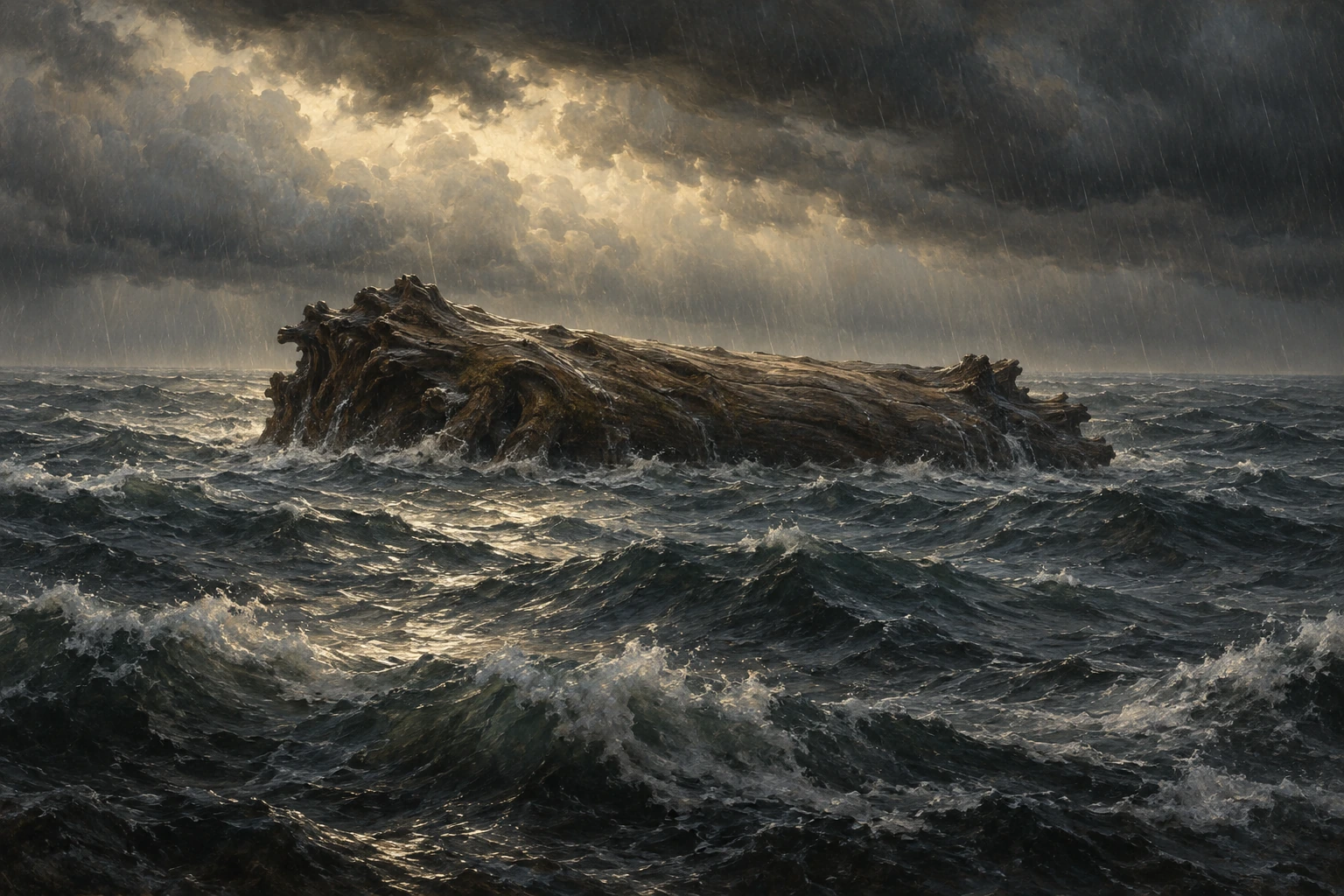
When they had eaten the last grains, the water was going down. They came out, saw a fish, drilled fire and roasted it. The gods Citlalinicue and Citlallatonac looked down: who has made fire, who has smoked the sky? Tezcatlipoca came down and scolded the couple. He cut off their heads and stuck them on at their rumps, and they became dogs. The world had been dark for twenty-five years. Then the gods asked who would live on the earth. Quetzalcoatl went down to the land of the dead for the bones from which the new people were made: that journey is told in its own post (section 5).
1-3 The Hearth at Teotihuacan
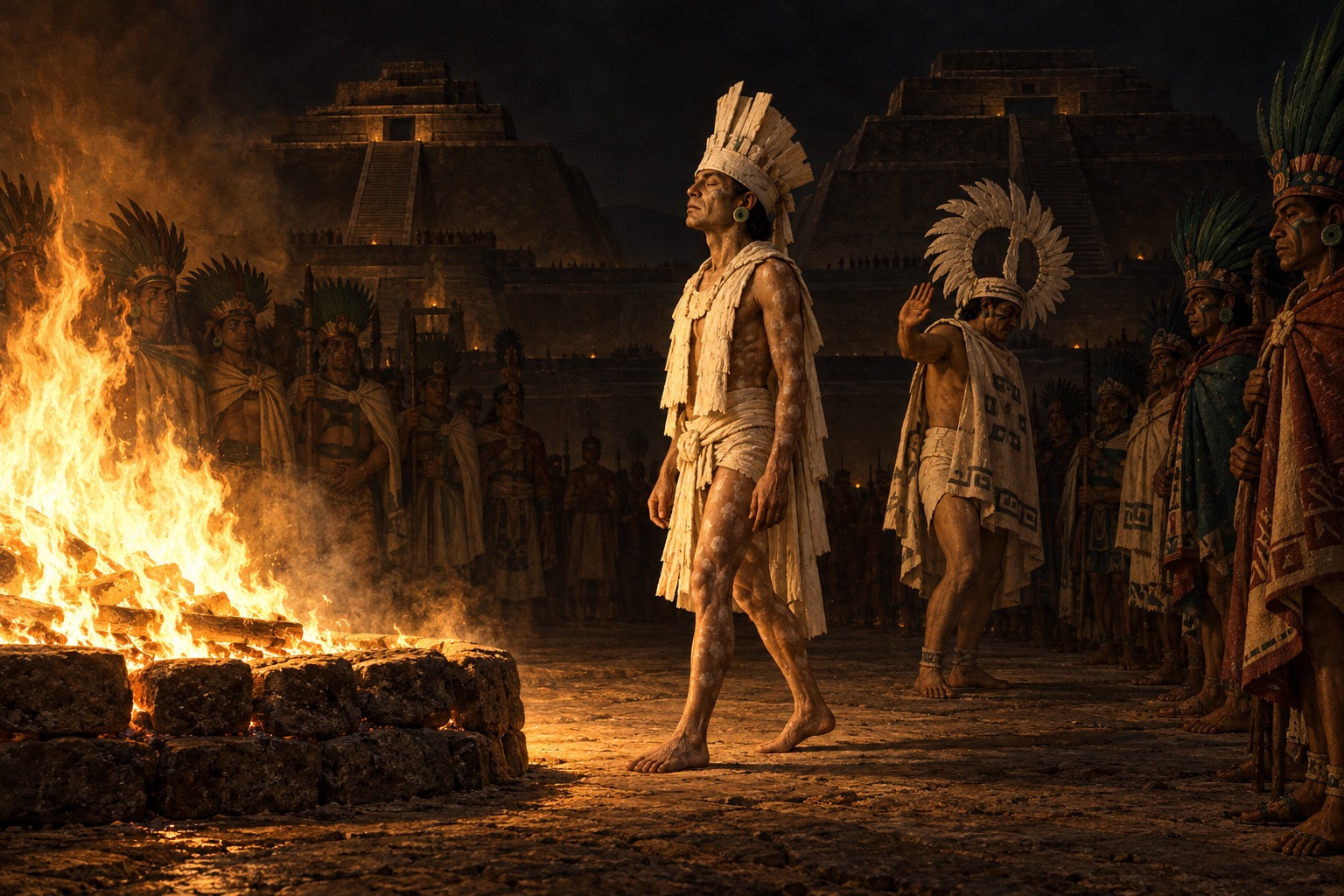
“Before there was day in the world”, the Florentine Codex says, the gods gathered at Teotihuacan and asked who would carry the burden and become the sun. Tecuciztecatl stepped forward: “I take on the task of lighting the world.” No one else dared. Then the gods turned to Nanahuatzin, a god covered in sores who had stood listening and said nothing. He accepted gladly: “I receive as a favour what you command; so be it.”
Both fasted for four days while a fire burned in the hearth called teotexcalli. Tecuciztecatl’s offerings were all costly: quetzal feathers instead of fir branches, balls of gold instead of grass, spines of greenstone and coral instead of maguey thorns, and the finest incense. Nanahuatzin offered green reeds tied in threes, real maguey thorns wet with his own blood, and, for incense, the scabs of his sores. A hill was built for each of them to do penance on.
At midnight the gods dressed them. Tecuciztecatl got a heron-feather headdress and a sleeveless jacket, Nanahuatzin a headdress, a stole and a loincloth of paper. The gods stood in two rows around the hearth and told Tecuciztecatl to throw himself in. He ran at the fire, felt the heat and turned back. He tried four times, and four tries were all that were allowed. Then the gods called Nanahuatzin. He shut his eyes, did not stop, and threw himself into the fire, where his body crackled. When Tecuciztecatl saw him burning, he leapt in after him.
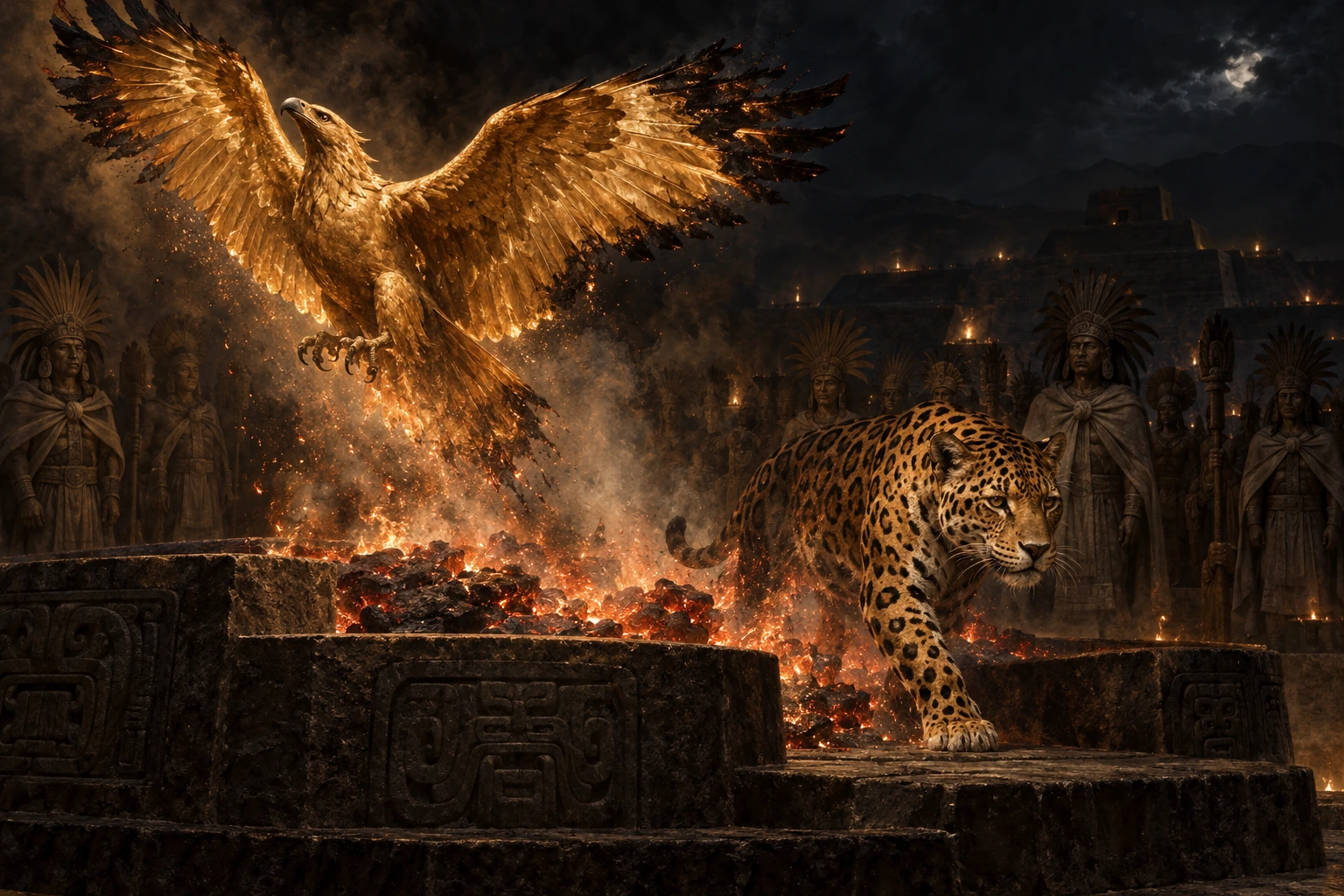
An eagle followed them into the flames, and its feathers came out scorched and dark. A jaguar went in when the fire had died down, and came out only singed, spotted with black. That, the text says, is why a brave warrior was called quauhtlocelotl, “eagle-jaguar”, with the eagle first because it went in first.
1-4 Two Suns and a Rabbit
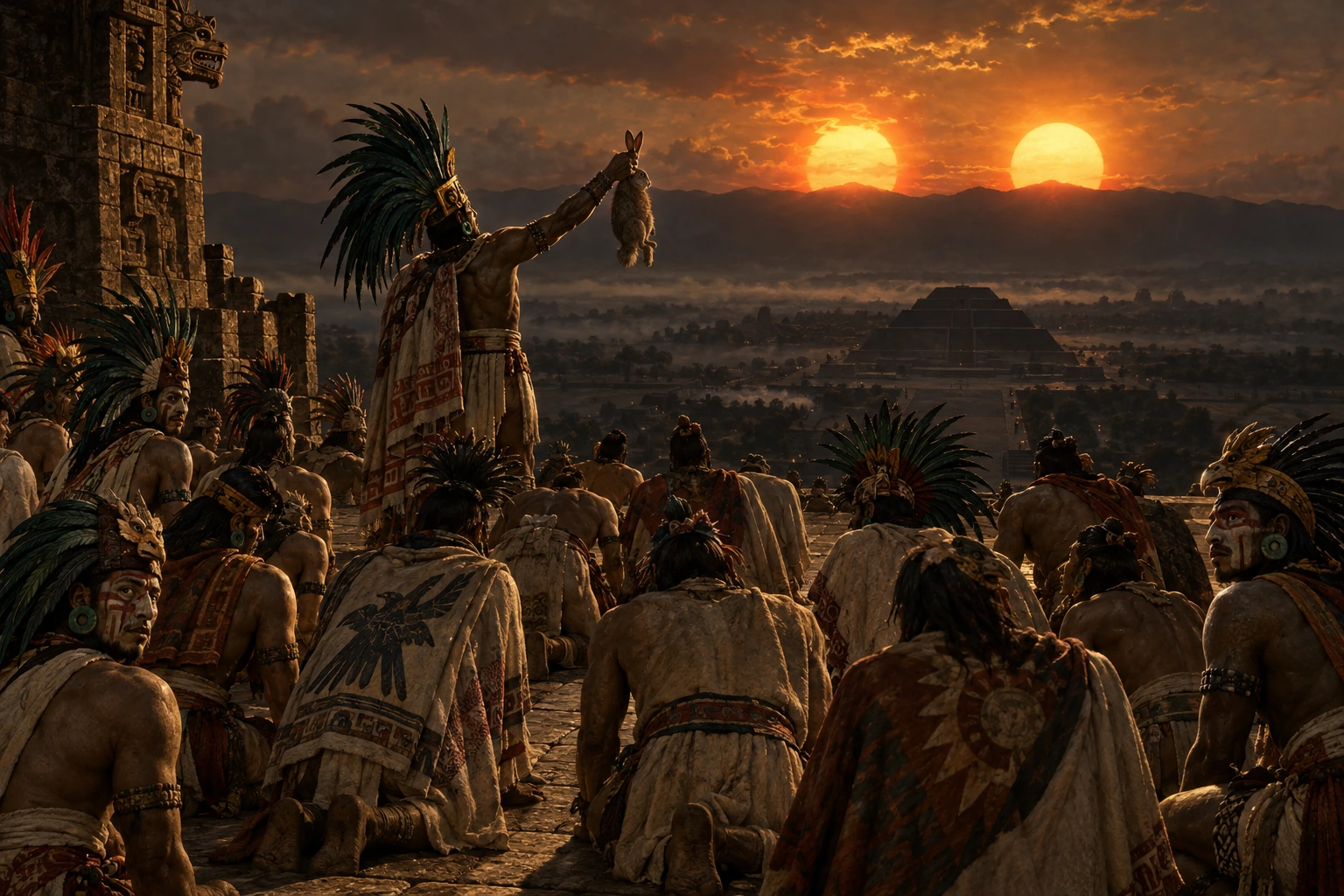
The gods sat and waited. The sky began to redden on every side, and they knelt, not knowing where the new sun would come up. Some faced north, some west, some south. Some faced east and said it would rise there: among them Quetzalcoatl, Totec, the red Tezcatlipoca, the Mimixcoa and four women. They were right. The sun came up in the east, red, swaying from side to side, too bright to look at.
Then Tecuciztecatl rose behind him from the same place, shining just as brightly. “Will they both shine like this?” the gods asked. One of them ran and struck Tecuciztecatl in the face with a rabbit and dimmed his light. That is the rabbit still seen on the moon.
1-5 The Death of the Gods
But neither the sun nor the moon would move. “How can we live? The sun does not move,” the gods said. “Let us all die, and make him come to life through our death.” Ehecatl, the wind, was given the task of killing them. Xolotl did not want to die. “O gods, let me not die,” he said, and wept until his eyes swelled. He fled into a maize field and became a double maize stalk, then into a maguey field and became a double maguey, then into the water and became the water creature called axolotl. There he was caught and killed.
Even then the sun did not move, until the wind blew with all its force and pushed him on his way. The moon stayed behind and set off later, and so they rise at different times. The tale ends with a moral: Tecuciztecatl would have been the sun if he had leapt first. This Sun is 4 Movement. In the Annals of Cuauhtitlan, the elders say that under it there will be earthquakes and famine, and with them we shall perish.
2 Where the Story Is Written Down
- Historia de los mexicanos por sus pinturas (“History of the Mexicans from Their Paintings”): a Spanish account of the 1530s, which says it was drawn from the old books and paintings and from the old men and former priests. The manuscript is at the University of Texas at Austin, and its author may have been the Franciscan Andrés de Olmos. Joaquín García Icazbalceta printed it in 1882; Henry Phillips Jr. translated it into English in 1883.
- The Legend of the Suns: a Nahuatl text that dates itself 22 May 1558 and counts 2,513 years since the Sun began all things. Velázquez noted that it reads as an explanation of paintings laid in front of the speaker: “this Sun”, “here it is”. Its title is modern: Francisco del Paso y Troncoso called it Leyenda de los Soles when he published it in Florence in 1903.
- The Codex Chimalpopoca: the manuscript that holds the Legend after the Annals of Cuauhtitlan. The Annals carry the date August 1570 and give their own short list of Suns. Velázquez thought the two texts came from different sources. The abbé Brasseur de Bourbourg named the volume after his teacher, Faustino Galicia Chimalpopoca.
- The Florentine Codex (General History of the Things of New Spain): made by the Franciscan Bernardino de Sahagún with Nahua scholars at the Colegio de Santa Cruz in Tlatelolco, finished in 1577, in two columns, Nahuatl and Spanish, with some 2,500 pictures. It is now in the Biblioteca Medicea Laurenziana in Florence. Book 7, on the sun, the moon and the stars, tells the story of Teotihuacan in chapter 2 and the New Fire in chapters 9 to 12. The Getty’s editors warn that the Spanish column is “an interpretation” of the Nahuatl, not a translation.
- The Sun Stone: carved in stone before the Spanish conquest, the only witness here that is not a colonial text (section 4).
3 Competing Versions
- The order of the Suns.
- Legend of the Suns: 4 Jaguar, 4 Wind, 4 Rain (fire), 4 Water.
- Annals of Cuauhtitlan: Water (people become fish), Jaguar (the sky caves in, the sun stops at midday, people are eaten, giants live), Rain (fire and a shower of pebbles), Wind (people become monkeys).
- Historia de los mexicanos: jaguars, wind, fire, flood, the Legend’s order, but each Sun is a god.
- Who was the Sun? In the Historia, Tezcatlipoca made himself the first Sun, while giants lived on acorns. After 676 years Quetzalcoatl struck him with a great staff and knocked him into the water, “and there he became a jaguar” and came out to kill the giants; the Great Bear, sinking to the water, is Tezcatlipoca. Quetzalcoatl was the second Sun until Tezcatlipoca kicked him down and a wind carried off the people, some of whom became monkeys. Tlaloc was the third, until Quetzalcoatl rained fire from the sky. Tlaloc’s wife Chalchiuhtlicue was the fourth, until so much rain fell that the sky collapsed and the people became fish.
- How long? The Legend gives 676, 364, 312 and 676 years. The Historia gives 676, 676, 364 and 312. Every figure, in both, is a multiple of fifty-two.
- What people ate. The Historia gives acorns, pine nuts, a water seed called acicintli and a maize-like seed; the Legend names each food by a day of the calendar.
- Who became the sun and the moon? In the Florentine Codex, Nanahuatzin and Tecuciztecatl volunteer. In the Legend, the gods Tonacatecuhtli and Xiuhtecuhtli summon Nanahuatzin, who answers sadly that he is only a poor sick man; the moon is a god called 4 Flint, summoned by Tlalocantecuhtli, the lord of Tlalocan. In the Historia, no names: Quetzalcoatl throws his own son into a great fire and he comes out as the sun; Tlaloc throws his son into the ashes, and he comes out as the moon, “ashen and dark”. In the Nahuatl of the Florentine Codex the moon god is male; Sahagún’s Spanish writes la luna, a feminine noun, as the Getty’s translator of the Spanish points out.
- The animals. In the Florentine Codex, the eagle and the jaguar follow the gods into the fire. In the Legend, the eagle carries Nanahuatzin up out of it, the jaguar is stained by the fire, the hawk is smoked and the wolf singed.
- The rabbit. The Florentine Codex: a god throws a rabbit in the moon’s face. The Legend: Papaztac, a god of pulque, smashes the moon’s face with a rabbit-shaped cup.
- Why the gods die. In the Florentine Codex, they choose to die so that the sun will move. In the Legend, the sun stands still for four days and says, through an obsidian hawk sent to ask him, that he wants their blood and their rule. The god Tlahuizcalpantecuhtli, whom the text calls the frost, shoots at him and misses; the sun shoots back, and the gods die at Teotihuacan.
4 History and Tradition
- Teotihuacan. The city flourished from about the 2nd century BCE to the mid-7th century CE, centuries before the Mexica, who knew it in ruins. The Florentine Codex says the two hills of Nanahuatzin and Tecuciztecatl are “now called” the pyramids of the sun and of the moon.
- The New Fire. Every fifty-two years, when the calendar came back to the year 2 Reed, the years were “bound”. All fires were put out, the images of the gods kept at home were thrown into the water, hearthstones and pestles were thrown out, and the houses were swept clean. At midnight, on the hill the Florentine Codex calls Uixachtlan (the Historia puts it near Iztapalapa), a priest drilled a new fire on the chest of a captive, who was then killed. The Florentine Codex says that if no fire could be drawn, the sun would be destroyed for ever, night would last for ever, and the demons of darkness, the tzitzimime, would come down to eat people. Pregnant women wore masks of maguey leaves and were shut in granaries, and children were kept awake so that they would not turn into mice. When the flame appeared, runners carried it to every temple and house.
- The Sun Stone’s travels. The Museo Nacional de Antropología dates the stone to about 1512. After the conquest it lay face up in the main square, until Archbishop Alonso de Montúfar had it turned over and buried. It was found on 17 December 1790, when the square was being levelled, and set into the west tower of the cathedral, where it stayed for almost a century. In 1885 it went to the old Museo Nacional, and in 1964 to the new museum in Chapultepec.
- The face at the centre. The museum calls it Tonatiuh, the sun. In 1974 Carlos Navarrete and Doris Heyden argued that it is the earth, Tlaltecuhtli; Cecelia Klein (1976) proposed the night sun. In 2016 the epigrapher David Stuart suggested, as “a working hypothesis”, a deified portrait of the ruler Moctezuma II, whose name glyph Emily Umberger identified beside it, dating the stone between 1503 and 1519. At the top, where the tails of the two fire serpents meet, is the date 13 Reed: the Annals of Cuauhtitlan give 13 Reed as the year the present sun was born.
“The Aztec calendar” is the stone’s popular name, but it is not a calendar. It carries the twenty day signs of the 260-day count, yet, in the words of the Getty Research Institute, “it is not a calendar”, and the Museo Nacional de Antropología, where it is shown, says it “did not work as a calendar”. The idea goes back to Antonio de León y Gama, who in 1792 read it as a record of the festivals and even as a sundial for the priests. Read today as a monument to the Fifth Sun, it was made to lie flat. The Getty calls it a sacrificial altar, a cuauhxicalli or “eagle vessel”; the museum mentions another reading, a temalacatl, the round platform of a ritual combat.
5 Related Stories
- Quetzalcoatl: The Feathered Serpent: between the flood and the Fifth Sun, the Legend sends Quetzalcoatl to the land of the dead for the bones of the new people. The Legend also says the Fifth Sun was the sun of Topiltzin Quetzalcoatl of Tollan.
- Tezcatlipoca: The Smoking Mirror: the first Sun of the Historia, struck into the water by Quetzalcoatl; in the Legend, the god who saves Tata and Nene from the flood and turns them into dogs.
- The Popol Vuh: The Gods Make People from Maize: the K’iche’ Maya book also makes and destroys earlier peoples, one of them by a flood, before the people of maize. We link the two Mesoamerican traditions for the shared theme, without claiming one borrowed from the other.
- Ragnarök: The End of the World, and What Comes After: the Norse world, too, will end, and a new one will rise after it. We have not found a scholar who compares the two myths; we link them for the theme.
- The Dashavatara: The Ten Avatars of Vishnu: ages of the world, one after another. The Indian ages run down and begin again, where the Aztec ages each end in a catastrophe. We have not found a scholar who compares the two; we link them for the theme.
6 Sources
- Leyenda de los Soles and Anales de Cuauhtitlán, in Códice Chimalpopoca, Spanish translation by Primo Feliciano Velázquez (UNAM, 1945; 3rd ed., preface by Miguel León-Portilla, 1992), pp. 3–5, 119–122, with Velázquez’s introduction, notes and the photographic facsimile: UNAM
- Historia de los mexicanos por sus pinturas, chapters 1–7, ed. Joaquín García Icazbalceta, Nueva colección de documentos para la historia de México, vol. 3 (Mexico, 1891), pp. 228–236; English translation by Henry Phillips Jr., Proceedings of the American Philosophical Society 21 (1883), ed. Alec Christensen: archive.org, FAMSI
- Bernardino de Sahagún and Nahua scholars, Florentine Codex, Book 7, chapters 2 and 9–12 (fols. 2v–7r, 16v–21r): Nahuatl text and English translation by Arthur J. O. Anderson and Charles E. Dibble (1950–82), Spanish text ed. Alfredo López Austin and Josefina García Quintana (2000), in the Digital Florentine Codex, ed. Kim N. Richter and Alicia Maria Houtrouw (Getty Research Institute, 2023); Spanish text also in the edition of Carlos María de Bustamante, vol. 2 (Mexico, 1829), pp. 245–250: Getty, Getty, archive.org
- Kim N. Richter and Alicia Maria Houtrouw, “Introducing the Florentine Codex (1575–77) and Its Three Narratives”, Digital Florentine Codex: Getty
- Antonio de León y Gama, Descripción histórica y cronológica de las dos piedras (Mexico, 1792), pp. 11–12 and § 59: archive.org
- Museo Nacional de Antropología, “Piedra del Sol”, text by Hugo García Capistrán; Getty Research Institute, “The Aztec Calendar Stone”: Google Arts & Culture, getty.edu
- David Stuart, “The Face of the Calendar Stone: A New Interpretation”, Maya Decipherment (2016): mayadecipherment.com
- Eduardo Matos Moctezuma, Las andanzas de un calendario y los trotes de un caballito… (El Colegio Nacional, 2020), pp. 13–17, excerpt in La Crónica de Hoy (2021): cronica.com.mx
- Masuda Yoshio, “アステカ文化”, Nipponica, and Ōi Kuniaki, “アステカ文化”, Heibonsha World Encyclopedia; “暦の石”, Britannica International Encyclopedia; “古代都市テオティワカン”, Kodansha World Heritage: Kotobank, Kotobank, Kotobank
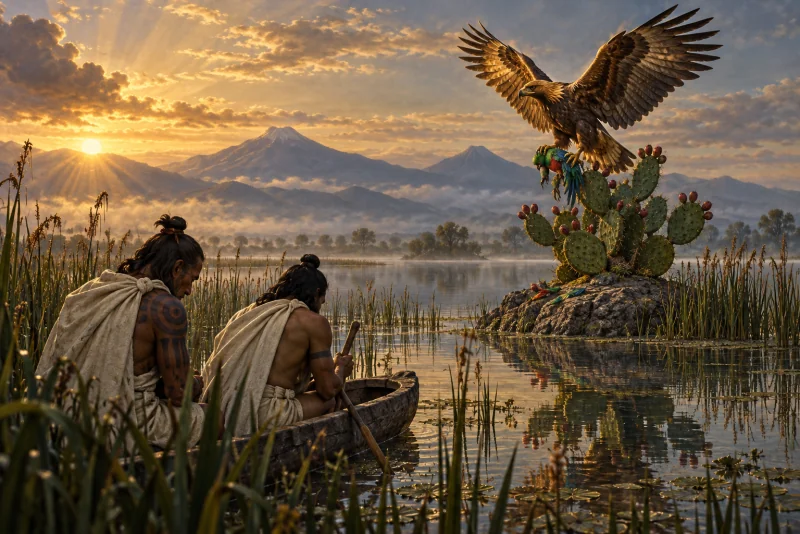
Cover and illustrations: AI-generated images made for Arcana. They are interpretations, not historical artworks.