Coatlicue: The Mother in the Serpent Skirt
Huitzilopochtli's mother waits on a hill of sand for a son who never came back, and a Mexica king sent sixty sorcerers to find her. Her great statue was dug up in 1790, buried again more than once, and still divides scholars over whom it shows.
- Type: myth and cult of a mother goddess; a colossal statue
- Culture: the Mexica (Aztecs) of Tenochtitlan, 15th and early 16th century
- Earliest texts: Bernardino de Sahagún’s Florentine Codex (1570s) and Diego Durán’s History of the Indies of New Spain (1579–1581); the statue was carved before the conquest of 1521
- Key figures: Coatlicue, Huitzilopochtli, Moctezuma I, Tlacaelel, Cihuacoatl, Tonantzin, Toci
Her name means “Serpent Skirt” in Nahuatl. The Mexica, the people who built Tenochtitlan, remembered Coatlicue as the mother of their god Huitzilopochtli. (“Aztec”, the name most readers know, came later, after Aztlan, the homeland they had left.) Two pictures of her survive: in a friar’s chronicle, an old woman who has not washed her face since her son went away; in the Museo Nacional de Antropología in Mexico City, a stone giant with no head of her own.
Is the great statue Coatlicue? Nothing on the stone names her. Antonio de León y Gama, who studied it first, in 1792, read its skirt of serpents as Coatlicue’s emblem but called the statue Teoyaomiqui, a goddess of warriors who die in battle. Calling the whole figure Coatlicue goes back to Alfredo Chavero in the 1880s and to Eduard Seler around 1900, and scholars still disagree (section 3).
1 The Telling
Coatlicue’s best-known story is her son’s birth. In Book 3 of the Florentine Codex she does penance by sweeping on Coatepec, the Serpent Hill near Tula, and a ball of feathers makes her pregnant with Huitzilopochtli; that story is told in Huitzilopochtli. Here we follow another, from chapter 27 of the History of the Dominican friar Diego Durán, which he finished in 1581.
1-1 A King Who Wanted to Know
Moctezuma, the first king of that name, found himself rich and glorious. He decided to learn where his ancestors had lived and what the seven caves of their stories looked like. He had also heard that the mother of Huitzilopochtli had stayed behind alive: perhaps she still was.
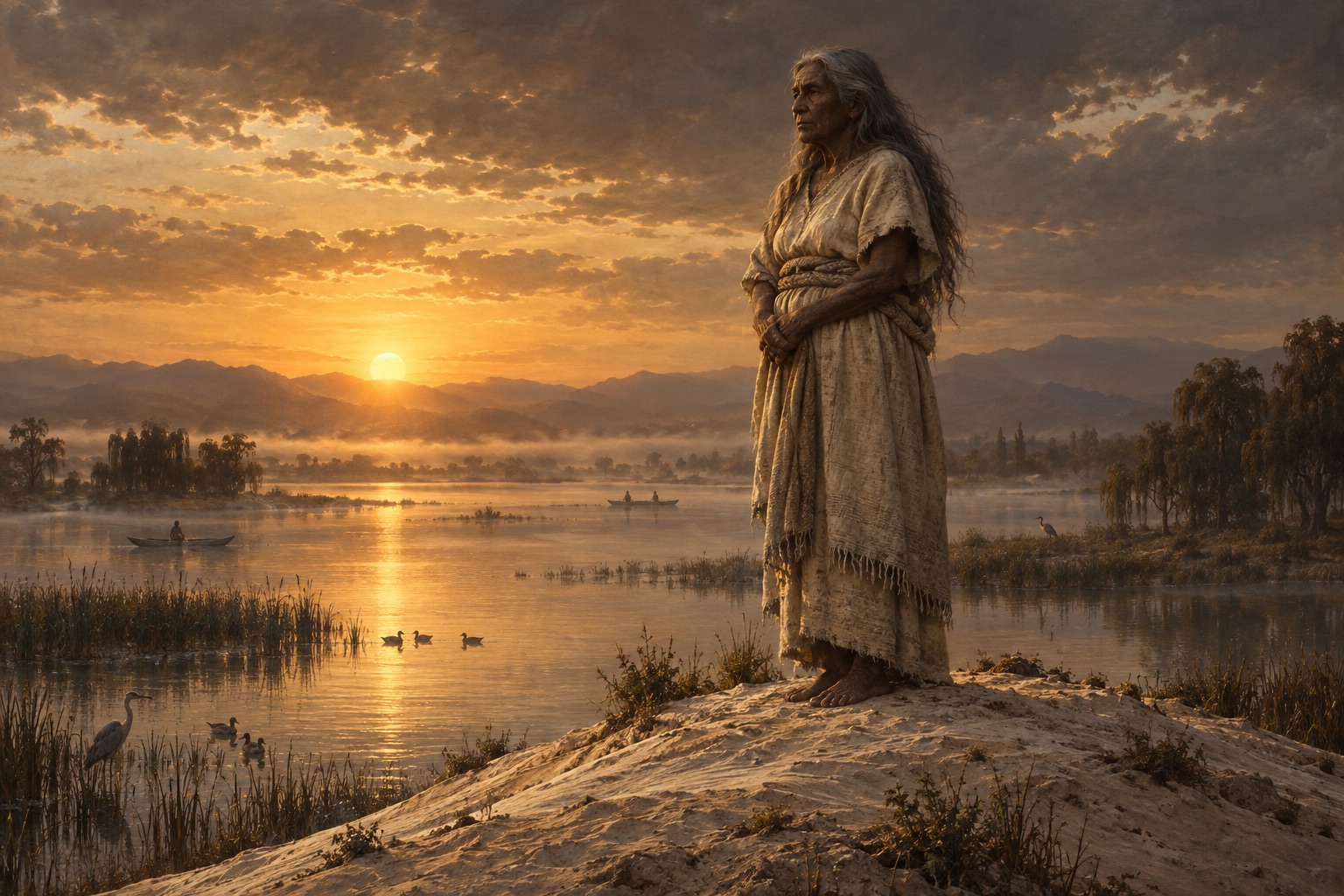
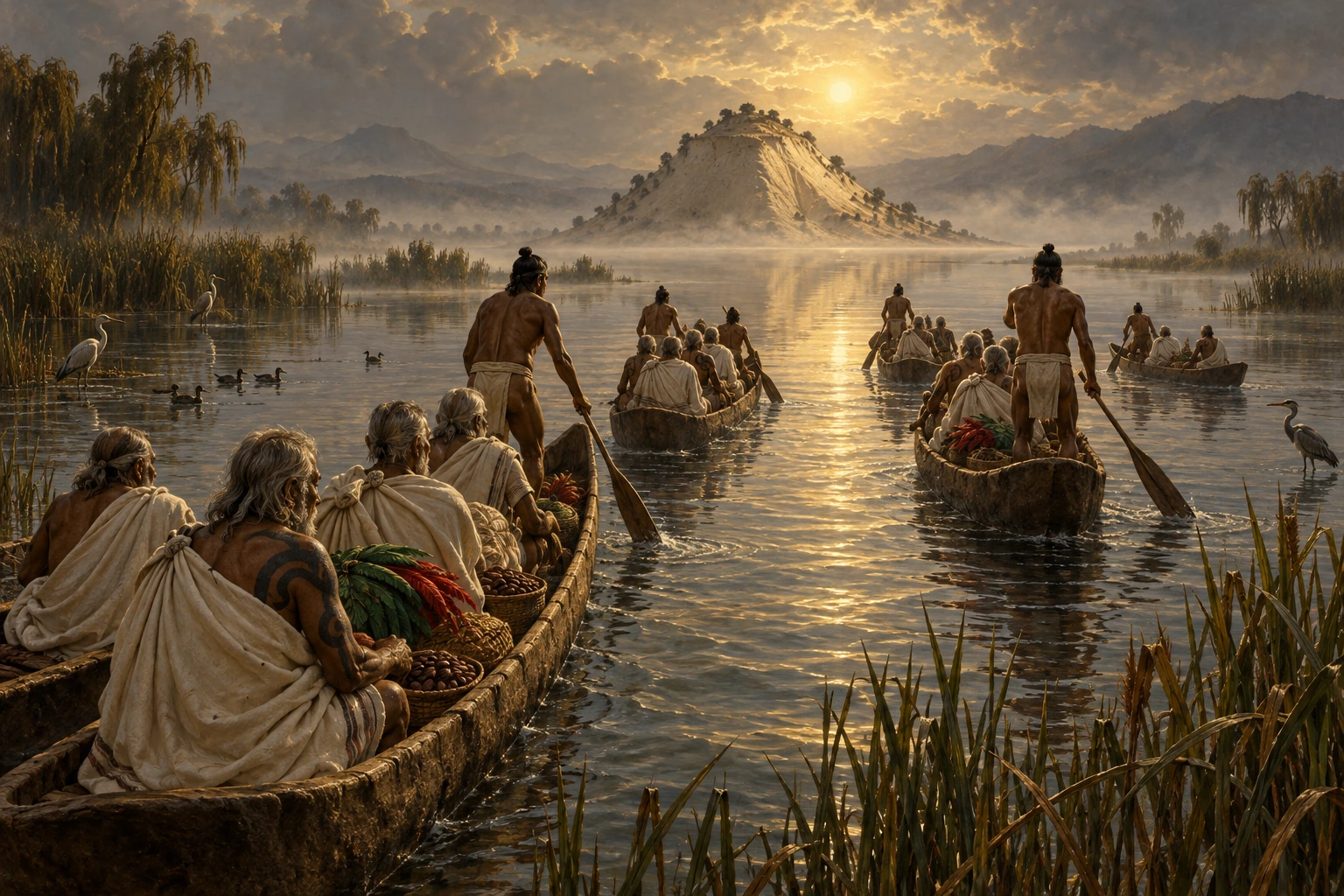
His adviser Tlacaelel said this was no task for warriors. Send sorcerers, he advised, for the old land was now hidden by thorns, dunes, lagoons and reed beds. The royal historian, an old man named Cuauhcoatl, told the king what his histories remembered: the ancestors had lived at Aztlan, “whiteness”, where a hill called Culhuacan rose from the water. There were ducks and herons, fish, willows and alders, canoes, and raised fields of maize, chili, tomatoes, amaranth and beans. Once the people left it, everything turned against them: the plants bit, the stones pricked.
1-2 Sixty Sorcerers
Moctezuma had sixty old men who knew the magic arts brought before him. He gave them cloaks, women’s clothing, gold, precious stones, cacao, vanilla and the finest feathers, as gifts for the mother of the god.
They went to a hill called Coatepec, in the province of Tula. There they drew their circles, rubbed themselves with ointments and called on the powers they served, which Durán, a missionary, calls the devil. Some turned into birds, others into jaguars and other wild beasts, and so they were carried to the land of their ancestors.
At the shore of a great lake, with the hill of Culhuacan in its middle, they took human shape again. People fishing from canoes spoke to them in their own language. The envoys said they had come to find the place called Chicomoztoc and the mother of Huitzilopochtli, “who was called Coatlicue”, with a present for her if she was alive.
1-3 The Hill of Sand
The fishermen took them across to an old man who served the mother of the god. He did not know the names Moctezuma and Tlacaelel. He remembered the seven chiefs who had left, and four guardians of Huitzilopochtli. “What killed them?” he asked, for here, he said, no one who had stayed behind had ever died. Their god had promised his mother he would come back, “and the poor woman is waiting to this day, so sad and tearful that no one can console her.”
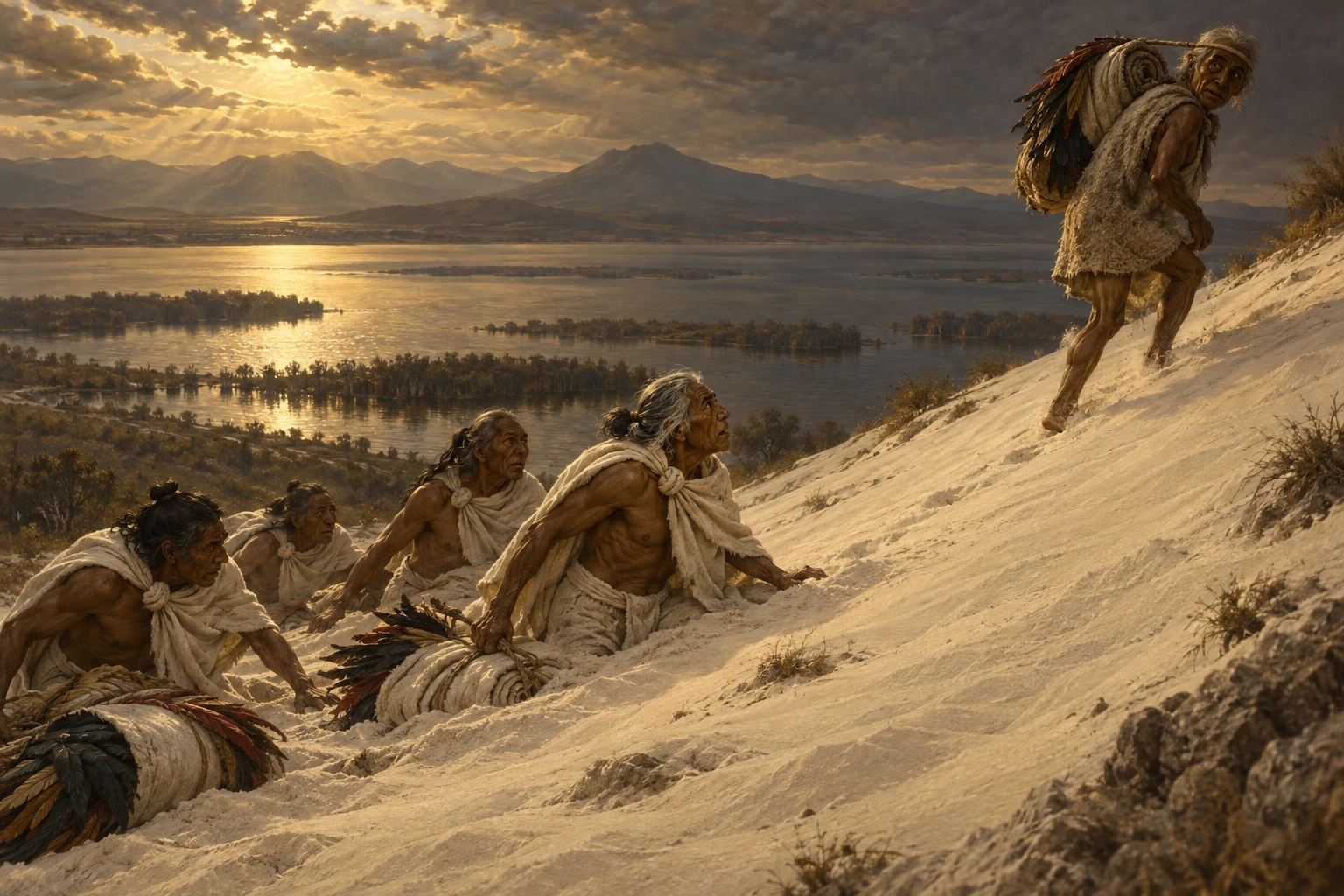
The hill was made of fine sand from halfway up. The old man went up lightly; the envoys sank to their knees, then to their waists. “What has made you so heavy?” he asked. “What do you eat?” They answered that they ate the food of their land and drank cacao. That food, he said, had made them heavy and had brought them death; here people lived in poverty and plainness. Then he carried their loads up the hill as if each were a straw.
1-4 The Mother in Mourning
An old woman came out, her face black with grime, weeping bitterly. Since her son left, she said, she had not washed her face, combed her hair or changed her clothes, and she would mourn until he came back. The envoys told her that Moctezuma was the fifth king of Mexico, that the city was now free and rich, and that these gifts were her son’s wealth. She asked whether the old men who had left with him were alive. They were dead, and she wept again.
She was quieted when she heard that her son dressed in such cloaks and feathers. Then she told them what he had said when he left: he would settle the seven clans, make war and conquer, but in the same order as he won the peoples, strangers would take them from him. Those he had conquered would throw him down head first, “and I and my weapons will go rolling on the ground”; then he would come “fleeing back to your lap”. He had asked her for two pairs of sandals, one for going and one for coming back, and then for four. “Tell him the time is fulfilled,” she said, and she sent him a cloak and a loincloth of maguey fibre, so that he would remember he had a mother.
1-5 The Return
As they went down, she called them to watch: the old servant walked down the hill and grew younger with every step, reaching them as a youth of twenty; he climbed halfway and came back a man of forty. On this hill, he said, people choose their age, and no one dies. Their cacao and their rich food had spoiled them.
They were sent home with water birds and fish from the lake, vegetables, garlands of flowers, and maguey-fibre cloaks for Moctezuma and Tlacaelel. The sorcerers changed into animals again and came back to Coatepec, but twenty of the sixty were missing: some said beasts and birds of prey had eaten them, Durán that the devil had taken them as his fee. Moctezuma and Tlacaelel wept for their ancestors and sent the cloak and loincloth to the temple, for Huitzilopochtli, “since his mother sent it”. The next chapter begins with the two men fearful of what she had foretold: that the Mexica would one day be driven from their land.
2 Where the Story Is Written Down
- Diego Durán, History of the Indies of New Spain, chapter 27. Durán, a Dominican, wrote the books on the gods, the rites and the calendar in 1579 and the History in 1581. Again and again he writes “the history tells”, following an older account he does not name. His manuscript is in the Biblioteca Nacional in Madrid; José Fernando Ramírez first printed it, from 1867. Durán sets the envoys’ departure at Coatepec “in the province of Tula”, the hill where, in Sahagún, Coatlicue gave birth.
- Bernardino de Sahagún, General History of the Things of New Spain, written with Nahua scholars; its finished copy, in Nahuatl and Spanish with pictures, is the Florentine Codex.
- Book 3, chapter 1: Coatlicue sweeps on Coatepec as penance, mother of the Centzon Huitznahua and of Coyolxauhqui.
- Book 1, chapter 6: the goddess Cihuacoatl, “woman of the serpent”, “also called Tonantzin, which means our mother”. She appeared dressed like a lady of the palace and cried out in the air at night; she left a cradle in the market, and the women found in it a flint blade.
- Book 1, chapter 8: “the mother of the gods, heart of the earth and our grandmother”, goddess of medicine, honoured by physicians, midwives and the keepers of sweat baths, who held a broom. Book 2, on the month Ochpaniztli, names her Teteoinnan or Toci, “which means our grandmother”.
- Book 2, chapter 33: on the feast of Quecholli two slaves were killed in honour of the god Mixcoatl “and of his wife, called Coatlicue”.
- Book 11: an addition on the hill of Tepeyac (section 4).
- The statue. Antonio de León y Gama, Historical and Chronological Description of the Two Stones (1792), measured, drew and interpreted it, together with the Sun Stone found the same year.
3 Competing Versions
- Where does she live? In Sahagún’s Book 3 Coatlicue lives on Coatepec near Tula, where her son is born. In Durán she stayed behind in Aztlan when he led the people away, and she is still there.
- Whose wife and mother? Mother of Huitzilopochtli, of Coyolxauhqui and the four hundred Huitznahua in Book 3; wife of Mixcoatl in Book 2. Michel Graulich notes that the Annals of Cuauhtitlan call the mother of Quetzalcoatl Coatlicue or Coacueye too.
- One goddess or many names? Sahagún joins Cihuacoatl and Tonantzin (Book 1, and again in Book 11), and the mother of the gods with Toci. Chavero, in the 1880s, joined Cihuacoatl and Coatlicue in one goddess. In Durán’s chapter Tlacaelel himself bears the title Cihuacoatl, the title of the second man of the kingdom, who, Graulich writes, had to embody the goddess. For Graulich all these names are aspects of the Earth, and “the Aztec goddesses were little differentiated”.
- Whom does the statue show?
- León y Gama: Teoyaomiqui joined to Huitzilopochtli, with the emblems of other gods: Coatlicue’s serpent skirt, the two great serpents of Cihuacoatl, and Mictlantecuhtli, lord of the dead, on the underside. A critic writing as Ocelotl Tecuilhuitzintli answered in 1791 that it was a “god without feet or head”.
- Chavero and Seler: Coatlicue, the earth goddess. Seler saw the head as cut off: two serpents spring from the neck “like two streams of blood” and meet face to face, making a new face, and the hands are severed in the same way.
- Elizabeth Boone (1999), as the abstract of her article sums it up: at least three nearly identical statues once existed, so this is one of a set, and they show Tzitzimime, celestial demons who would descend to devour people if the sun failed.
- Cecelia Klein (2008), again in her article’s abstract: several 16th-century accounts tell that at the creation Coatlicue and four sisters were sacrificed to set the sun moving, leaving only the cloths of their skirts; the statue may be the goddess come back to life as her personified skirt.
- Graulich (1991): all these names fit only part of it; the statue shows the Earth itself, Tlaltecuhtli, and may be called Coatlicue “not as the heroine of Coatepec”.
- Hearts or bags? León y Gama and Humboldt read the objects between the hands on the necklace as bags of copal incense; later readers see hearts. A second, badly damaged statue, with a skirt of hearts instead of serpents, was found in the 20th century and is called Yollotlicue, “Heart Skirt”.
4 History and Tradition
- Found on an anniversary. On 13 August 1790 workmen laying a water channel in the main square of Mexico City struck the statue. León y Gama noted the date: 269 years to the day since the city had been taken. The master builder José Damián Ortiz testified that it lay face down, “as if they had thrown it”. It was raised on 4 September, at night, and set before the viceroy’s palace on 25 September. The city’s intendant proposed giving it to the Royal and Pontifical University, the viceroy Revillagigedo agreed, and by 1792 it stood in a corner of the university’s courtyard. A halberdier wrote in his diary of an “idol without feet or head”.
- Two stones, two fates. The Sun Stone, found in December 1790, was set against the new tower of the cathedral, on public view until 1885. Leonardo López Luján suggests why the two were treated so differently: the Sun Stone showed Mexica learning, the Coatlicue what the colonial elite saw as their monstrous, idolatrous side.
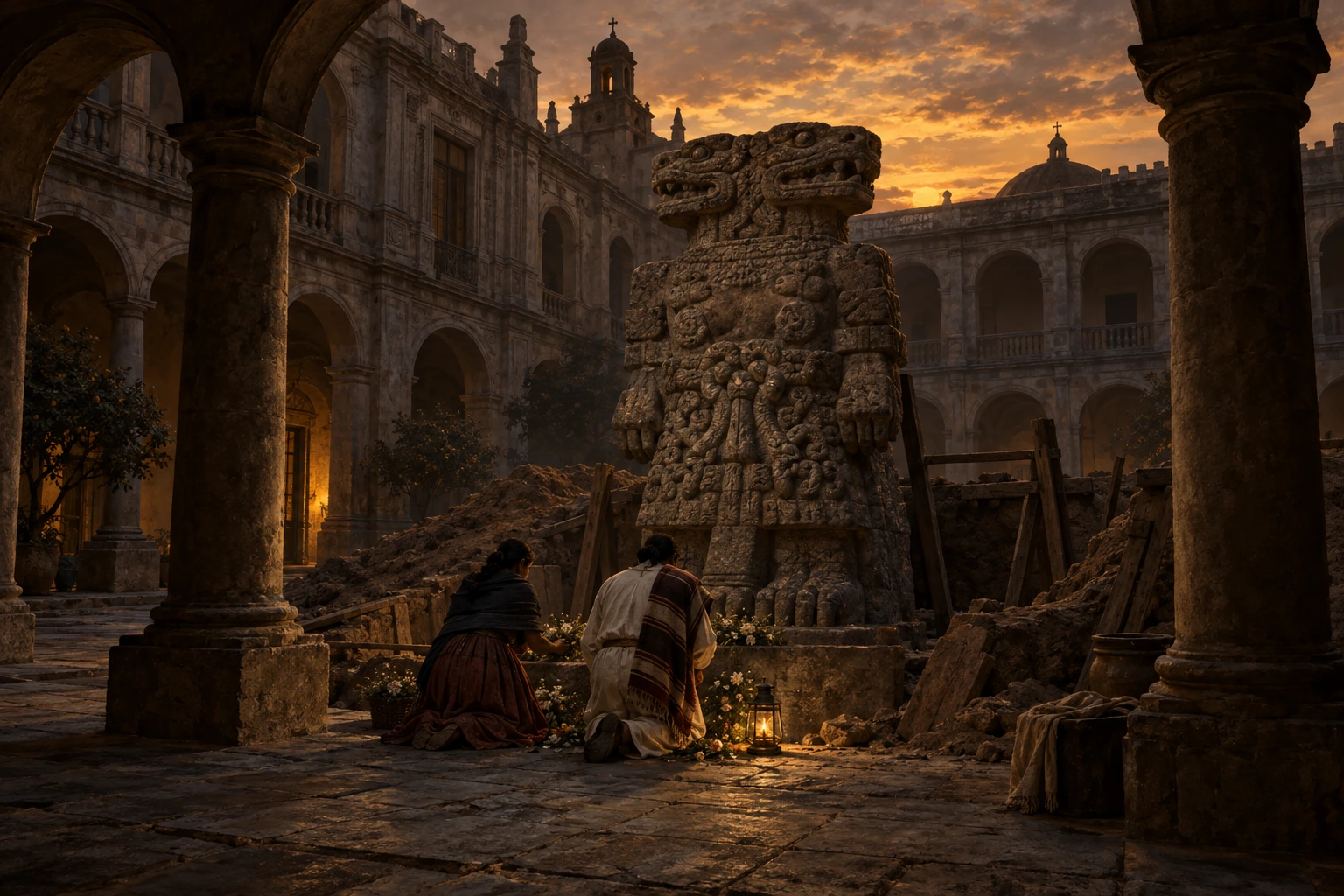
- Buried and dug up. Humboldt writes that the professors buried the statue again in a passage of the college, two feet down, and that the bishop of Monterrey persuaded the rector to unbury it for him. In 1823 the London museum owner William Bullock had it dug up once more to take a plaster cast. In a week the cast was done and the goddess was “again committed to her place of interment”. When Brantz Mayer, of the United States legation, saw it in 1841–1842, it stood behind wooden panels in a corner of the university courtyard, among old stones and lumber, below the rooms of the National Museum. Today it stands in the Museo Nacional de Antropología.
- Tonantzin on Tepeyac. In an addition to Book 11, written in 1576, Sahagún says that on the hill of Tepeyac, now called Our Lady of Guadalupe, there had been a temple of “the mother of the gods, whom they called Tonantzin”, drawing pilgrims from more than twenty leagues away. Now that the church stood there, he wrote, people called the Virgin Tonantzin too, because preachers called the Mother of God by that name, and he thought “it should be remedied”. He saw the same at Tlaxcala, where Toci had become Saint Anne. This is the suspicion of a friar, not the voice of the pilgrims. In the Catholic tradition the Virgin appeared to Juan Diego on Tepeyac in December 1531, and her image is kept in the Basilica of Our Lady of Guadalupe.
It is often said that the statue was buried again because Indigenous people kept coming to worship it. The earliest account we found gives another reason: Humboldt wrote that the professors would not “expose this idol to the sight of the Mexican youth”. The garlands come later, from Bullock’s visit in 1823, and the fear of worship from Brantz Mayer’s book of 1844, as something “said by the priests”.
5 Related Stories
- Huitzilopochtli: The War God Born on Coatepec: her son, born armed on the Serpent Hill when his sister Coyolxauhqui and the four hundred Huitznahua came to kill their mother. In Durán’s chapter he left her behind and never came back.
- The Founding of Tenochtitlan: The Eagle on the Cactus: the migration from Aztlan and Chicomoztoc that the sixty envoys travelled backwards, to the lake where the journey began.
- La Llorona: The Woman Who Weeps for Her Children: Sahagún’s Cihuacoatl, also called Tonantzin, cried out in the air at night. That post looks at who links the weeping woman of Mexico with her.
- The Legend of the Suns: Five Worlds and How Each Ended: the gods’ sacrifice that set the Fifth Sun moving. Cecelia Klein reads the statue through the accounts in which Coatlicue and her sisters died for it.
6 Sources
- Diego Durán, Historia de las Indias de Nueva España e islas de Tierra Firme, ed. José F. Ramírez, vol. 1 (Mexico, 1867), chapter 27, pp. 218–228, with Ramírez’s introduction: archive.org. Quotations are our own translation from the Spanish
- Bernardino de Sahagún, Historia general de las cosas de Nueva España, ed. Carlos María de Bustamante, vol. 1 (Mexico, 1829), Book 1 chapters 6 and 8, Book 2 (Ochpaniztli) and chapter 33, Book 3 chapter 1; vol. 3 (Mexico, 1830), Book 11, the author’s addition after chapter 12, pp. 320–324: archive.org, archive.org
- Antonio de León y Gama, Descripción histórica y cronológica de las dos piedras (Mexico, 1792), and the second edition by Carlos María de Bustamante (Mexico, 1832), pp. 9–11 and 34–39: Spanish Wikisource, archive.org
- Alexander von Humboldt, Researches concerning the Institutions & Monuments of the Ancient Inhabitants of America, trans. Helen Maria Williams, vol. 2 (London, 1814), pp. 45–48 and plate 29: archive.org
- William Bullock, Six Months’ Residence and Travels in Mexico (London: John Murray, 1824), pp. 337–342 and 375: archive.org
- Brantz Mayer, Mexico as It Was and as It Is (New York, 1844), pp. 109–114: archive.org
- Alfredo Chavero, México a través de los siglos, vol. 1, Historia antigua y de la conquista (Mexico and Barcelona, 1880s), pp. 644–650 and 791: archive.org
- Leonardo López Luján, “El ídolo sin pies ni cabeza: la Coatlicue a fines del siglo XVIII”, Estudios de Cultura Náhuatl 42 (2011), pp. 203–232: UNAM
- Michel Graulich, “Las grandes estatuas aztecas de Coatlicue y de Yollotlicue” (French original 1991), Estudios de Cultura Náhuatl 60 (2020), pp. 227–272, quoting Eduard Seler: UNAM
- Elizabeth H. Boone, “The ‘Coatlicues’ at the Templo Mayor”, Ancient Mesoamerica 10 (1999), pp. 189–206, and Cecelia F. Klein, “A New Interpretation of the Aztec Statue Called Coatlicue, ‘Snakes-Her-Skirt’”, Ethnohistory 55 (2008), pp. 229–250, abstracts: doi.org, doi.org
- Holy See, “Juan Diego Cuauhtlatoatzin: biography”: vatican.va
Cover and illustrations: AI-generated images made for Arcana. They are interpretations, not historical artworks.