Huitzilopochtli: The War God Born on Coatepec
A ball of feathers fell on Coatlicue as she swept a hilltop, and her daughter Coyolxauhqui led four hundred brothers up the hill to kill her. The god was born armed and cut his sister down, and the Mexica built their great temple as the hill where it happened.
- Type: myth, the birth of the Mexica god of war
- Culture: the Mexica of Tenochtitlan (the “Aztecs”), central Mexico
- Earliest texts: the Nahuatl account in Book 3 of the Florentine Codex, written down by Nahua scholars with the Franciscan Bernardino de Sahagún and finished in 1577; Diego Durán’s History of the Indies of New Spain (1581) tells Coatepec as a stop on the migration
- Key figures: Huitzilopochtli, his mother Coatlicue, his sister Coyolxauhqui, the Centzon Huitznahua (the Four Hundred Southerners), Cuahuitlicac
The people who founded Tenochtitlan called themselves the Mexica. “Aztecs”, after Aztlan, the homeland they said they had left, became the usual name only in the 19th century. Their own god was Huitzilopochtli. The great temple at the heart of their city carried two shrines, one for the rain god Tlaloc and one for him, and the chronicles call the temple by the name of the hill where he was born: Coatepetl, Serpent Hill. At the foot of its stair, carved in stone, lay his sister, cut to pieces.
What does “Huitzilopochtli” mean? The name joins huitzilin, “hummingbird”, and opochtli, “left”: the left hand, or a left-handed person. Arthur Anderson and Charles Dibble translate it “Hummingbird from the Left”. The familiar “Hummingbird of the South” is an interpretation: Ángel María Garibay explained that the god stood in the south, “the left of the world”, because the sun travels from east to west. An early Spanish account, the Historia de los mexicanos por sus pinturas, gives a plainer reason: the Mexica called him so “because he was left-handed”. And in the Florentine Codex he is born with a thin left foot, its sole pasted with feathers.
1 The Telling
This is the version in Book 3, chapter 1, of the Florentine Codex, told in Nahuatl with Sahagún’s shorter Spanish beside it. Quotations follow Anderson and Dibble’s English translation of the Nahuatl, unless the Spanish is named.
1-1 The Ball of Feathers
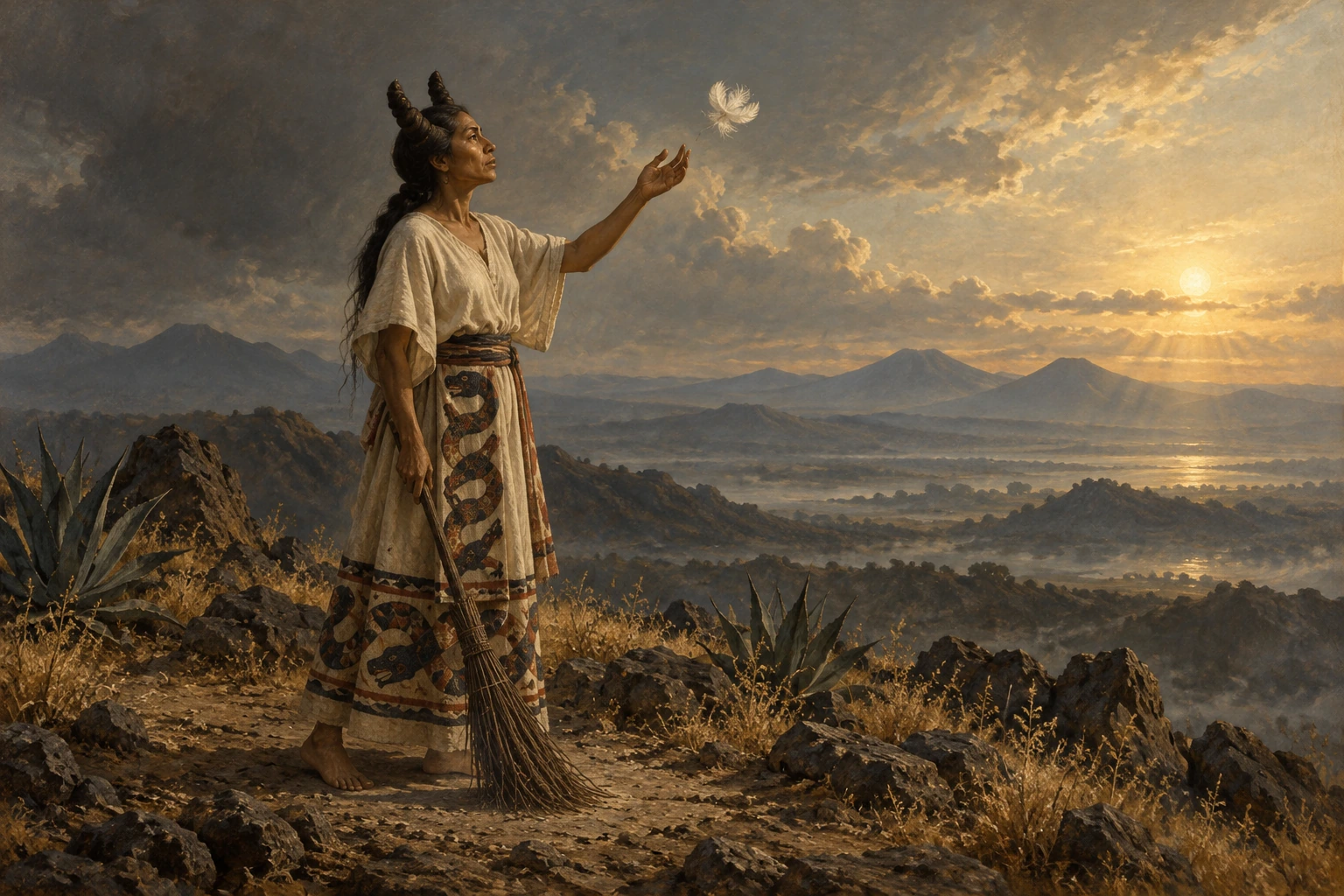
On Coatepec, near Tollan, lived a woman named Coatlicue. She was the mother of the Centzon Huitznahua, the four hundred, and of their elder sister Coyolxauhqui. Every day Coatlicue did penance there by sweeping.
Once, as she swept, feathers came down on her, “what was like a ball of feathers”. She snatched it up and put it at her waist; the Spanish says she placed it “on her bosom near her belly and under her skirts”. When she had finished sweeping, she looked for it and found nothing. From it she had conceived.
1-2 The Four Hundred
When her sons saw that their mother was with child, they were furious: “Who got her with child? She hath dishonored us; she hath shamed us.” Coyolxauhqui went further: “We [can] only kill our mother.”
Coatlicue was terrified. But the child in her womb spoke to her: “Have no fear. Already I know [what I shall do].” And she was comforted.
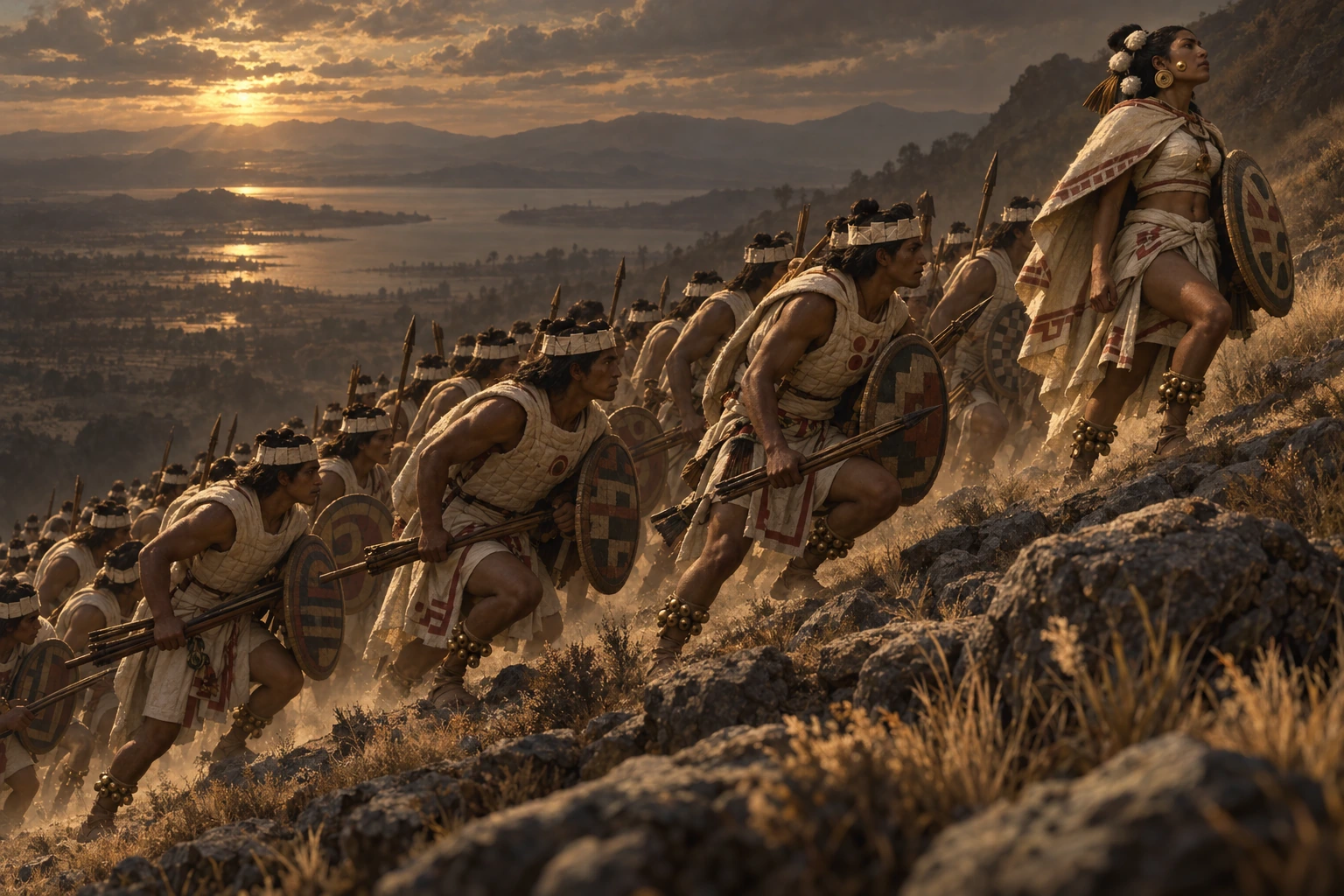
Coyolxauhqui kept urging her brothers on, and they armed for war like seasoned warriors. They twisted their hair and wound it about their heads, put on paper crowns and painted papers, tied little bells to their calves and took arrows with notched heads. One of them, Cuahuitlicac, “delivered information to both sides”: whatever the four hundred said, he went and told the unborn god, who answered him, “my dear uncle”, that he already knew what he would do.
1-3 The Birth on the Hill
The four hundred set out in ranks, crouching, weapons in hand, with Coyolxauhqui at their head. Cuahuitlicac ran up the hill and called out each stage of their climb: Tzompantitlan, Coaxalpan, Apetlac, the slope. When he cried that they had reached the top, with Coyolxauhqui leading them, Huitzilopochtli was born.
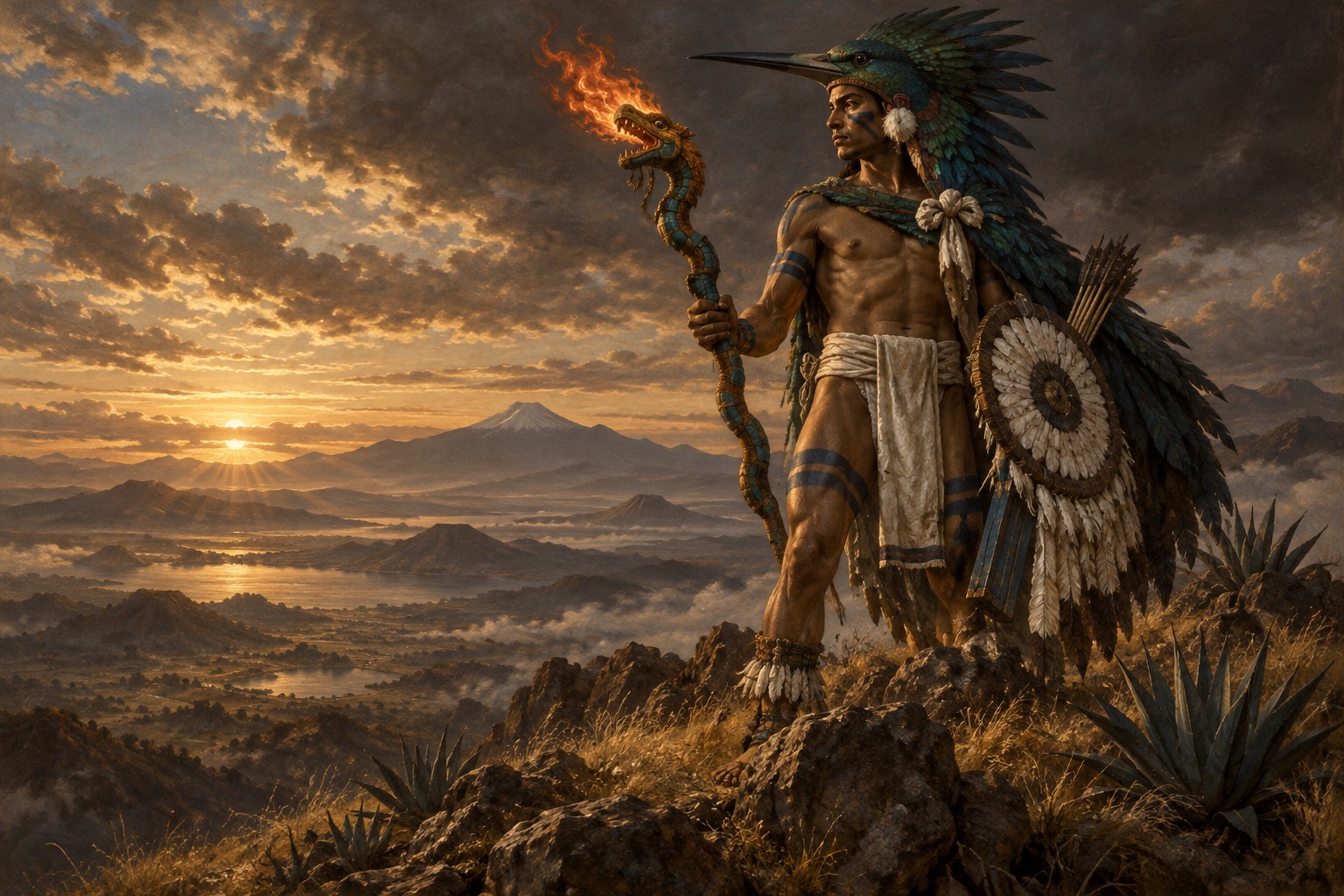
He came with his array: a shield, darts and a blue dart thrower. His face was painted in diagonal stripes, feathers were pasted at his forehead and ears, his one thin foot, the left, had its sole pasted with feathers, and his thighs and upper arms were striped with blue.
A man named Tochancalqui lit the xiuhcoatl, the fire serpent; the Spanish calls it “a snake that was made out of torches”. With it Huitzilopochtli pierced Coyolxauhqui and struck off her head. “It stopped there at the edge of Coatepetl.” Her body fell down the slope and broke apart, and her arms, her legs and her trunk came to rest in different places.
1-4 The Chase
Then he drove the four hundred from the top of Coatepec down to the ground and chased them around the hill four times. In vain they cried out against him and struck their shields. They begged him, “Let this be enough!”, but he did not stop. Only a few escaped, toward Huitztlampa, the south. He took their paper crowns and made them his own insignia.
He was also called tetzahuitl, “omen”, because he was conceived from a feather and no one appeared as his father. The Mexica honoured him, and “this veneration was taken from there, Coatepec”. The Spanish adds that they held him to be the god of war, “because they said that this Huitzilopochtli greatly favored them in battle”.
1-5 The God Who Was Eaten
The chapter goes on to his feast. At Panquetzaliztli the god’s body was shaped from a dough of amaranth seed. The next day a priest called Quetzalcoatl shot a flint-tipped dart into its heart, before Moctezuma, the keeper of the god, four high priests and four leaders of the youths. The dough body was broken up. The heart went to Moctezuma; the rest, made like his bones, was shared between Tenochtitlan and Tlatelolco and eaten in tiny pieces by young men. It was said, “The god is eaten”, and of those who ate, “They keep the god”. The Spanish puts it plainly: “they said that it was the god’s body”. For a year afterwards those young men served the god at heavy cost, burning more than two thousand pieces of wood every night.
2 Where the Story Is Written Down
- The Florentine Codex, Book 3, chapter 1. The General History of the Things of New Spain was made by Sahagún with Nahua elders, scholars and painters, finished in 1577 at the Colegio de Santa Cruz in Tlatelolco, and sent to Europe, where it entered the Medici library in Florence. Its pages carry Nahuatl and Spanish in parallel columns. The Spanish calls the god “the devil who was called Huitzilopochtli”. Two pictures go with the story, the birth and the fight on the hill. In the second, as Gerardo Pedraza Rubio, Leonardo López Luján and Nicolás Fuentes Hoyos point out, the headless body at the foot of the hill is plainly a man’s, in a loincloth, without Coyolxauhqui’s insignia.
- Book 1, chapter 1, describes the god: “Uitzilopochtli was only a common man, just a man, a sorcerer, an omen of evil”. Sahagún’s Spanish makes him “another Hercules”, a mighty warrior who was worshipped as a god after his death.
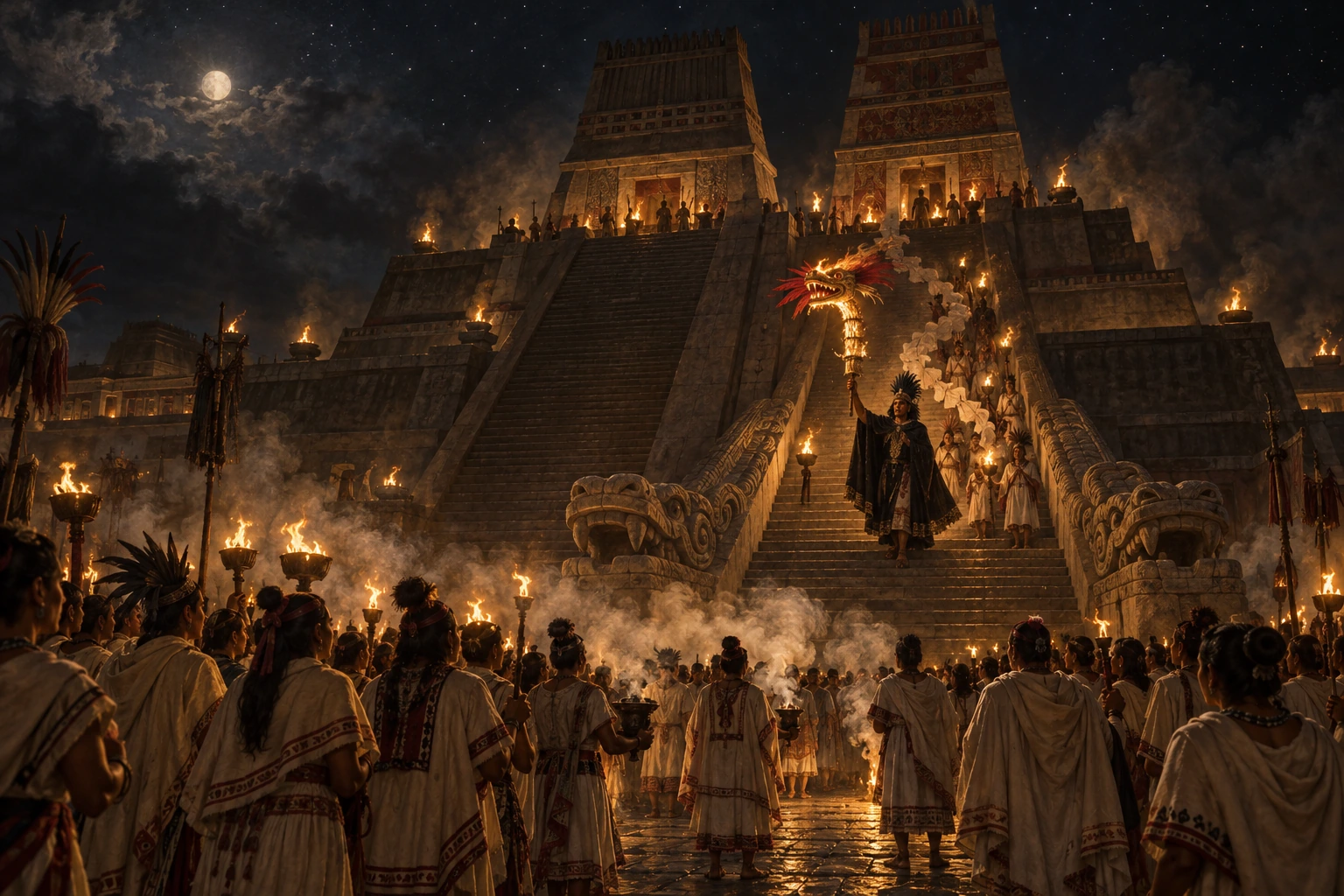
- Book 2, chapter 34, on the feast of Panquetzaliztli. A priest carried a fire serpent of pine torches, with red feathers in its mouth for flames and a paper tail, down the temple stairs, and set papers alight with it at the foot. Captives and bathed slaves were then killed at the top, “in honor of Huitznahuah”, and their bodies rolled down the steps. Here the amaranth image of the god is carried off by two young warriors and eaten with their kin and neighbours.
- Diego Durán, a Dominican, finished the first part of his History of the Indies of New Spain in 1581, according to his 1867 editor José F. Ramírez. He tells Coatepec as an episode of the migration (section 3). In his book on the rites he describes the god’s wooden statue: seated on a sky-blue bench, a blue band across the face, and a headdress shaped like the beak of the huitzitzilin, the hummingbird, in burnished gold.
- The Historia de los mexicanos por sus pinturas, an anonymous Spanish account whose last entries reach the early 1530s, makes Huitzilopochtli one of four divine brothers (section 3). It says that the feast of Panquetzaliztli “was when Uchilobi was born of the feather”.
3 Competing Versions
- Born there, or already their guide? In the Florentine Codex the god is born at Coatepec. In Durán he is already the Mexica’s god when they reach the hill. There they dammed a river into a lake so pleasant that a faction wanted to stay; its leaders were Huitznahua and “a lady they called Coyolxauh”. At midnight a great noise was heard at Teotlachco, and in the morning the leaders of the revolt and Coyolxauh lay dead, “opened through the chest”, with only their hearts taken out. Durán says that this was the origin of the belief that Huitzilopochtli ate nothing but hearts. Then the god had the dam broken and the river sent back to its old course.
- Sister, mother or rebel? In the Florentine Codex Coyolxauhqui is Coatlicue’s daughter and the elder sister of the four hundred. In Durán she leads a faction. In Fernando Alvarado Tezozómoc’s Crónica mexicáyotl, as Eduardo Matos Moctezuma quotes it, the four hundred are Huitzilopochtli’s uncles and Coyolxauhcihuatl a woman “whom he had taken as his mother”; at Teotlachco he beheads her and eats her heart.
- Four brothers. In the Historia de los mexicanos por sus pinturas, Tonacatecuhtli and Tonacacihuatl of the thirteenth heaven have four sons: the red Tezcatlipoca, the black Tezcatlipoca, Quetzalcoatl, and the youngest, Omitecitl or Maquizcoatl, “and the Mexica called him Uchilobi, because he was left-handed”. He was born without flesh, only bones, and stayed so for six hundred years. Then he and Quetzalcoatl were charged with setting the world in order, and made fire, half a sun and the first man and woman.
- God or man? Besides Book 1’s “only a common man”, Cristóbal del Castillo, as Matos Moctezuma quotes him, tells of a leader named Huitzilopochtli whose god was Tetzauhteotl: when the man died, the god would settle in his bones, and he would be called Huitzilopochtli-Tetzauhteotl. Matos Moctezuma reads Coatepec as a real struggle between factions of the migrating Mexica, later turned into myth.
- Sun, moon and stars? This is an interpretation, not something the sources say. Eduard Seler, the German Americanist, read Huitzilopochtli as “the newborn sun, or the son of the sun, the morning star, who tears the moon to pieces and drives the army of stars before him”, as Yolotl González Torres quotes him. Alfonso Caso wrote of Coatlicue that “the sun, Huitzilopochtli, sprang forth from her womb armed with a ray of light and killed the moon and the stars”. Matos Moctezuma holds that the political and the astral readings both stand. González Torres thinks, with most of Seler’s successors, that he pushed such readings too far; Pedraza Rubio, López Luján and Fuentes Hoyos accept this one, and see in Coatepec every day’s sunrise.
4 History and Tradition
- The guide. In the migration stories the god leads the Mexica out of Aztlan; Durán has them take the road toward Tula, “where their god was guiding them”. In the Códice Aubin, as Miguel León-Portilla quotes it, the god even changes their name: “Now your name shall no longer be Aztecs; you will be Mexica.” The rest of the journey belongs to The Founding of Tenochtitlan.
- The temple as the hill. At dawn on 21 February 1978, workers of the Mexico City electricity company, digging at the corner of Argentina and Guatemala streets, struck a carved stone of some eight tonnes: Coyolxauhqui, beheaded and dismembered. The find started the Templo Mayor Project, which Matos Moctezuma founded and directed until 2000. The stone lay at the foot of the stair that led up to Huitzilopochtli’s shrine, on the temple’s south side. For Matos Moctezuma, Coyolxauhqui “lies at the foot of the hill, the temple itself, from whose summit Huitzilopochtli rules the destiny of a people”, and he sees Serpent Hill in the serpent heads at the foot of the balustrades.
- The myth re-enacted. Sahagún writes that in the month of Panquetzaliztli “Huitzilopochtli was born”, as Pedraza Rubio and his colleagues quote him. According to Matos Moctezuma, captives standing for the four hundred were killed at the top of the temple and their bodies thrown down onto the goddess’s sculpture. Seler noticed that Tzompantitlan, Coaxalpan and Apetlac were also the names of the skull rack in front of the temple, the base of the pyramid and its platform.
- How many died? Durán writes that at the dedication of the temple under Ahuitzotl in 1487, 80,400 people were sacrificed over four days, and adds that he found it “so incredible” that he would not have written it down had his sources not obliged him to.
- The skull rack. Since 2015, INAH’s Urban Archaeology Program has excavated part of the Huei Tzompantli, the great skull rack of Tenochtitlan. In 2023 it reported 655 skulls identified: 60% men, 38% women and 2% children. The program’s head, Raúl Barrera Rodríguez, offered a hypothesis that the women’s skulls recall the fight with Coyolxauhqui.
- Durán’s comment. In Durán’s account of the dough image, everyone ate it, “small and great, men and women, old and children”, saying that they ate “the flesh and bones of god”. He told his readers to note how closely “this devilish ceremony” counterfeited the Christian communion. In Sahagún’s Book 3 only young men ate it.
“Huitzilopochtli threw his sister’s head into the sky, where it became the moon” is a popular retelling. In the Florentine Codex the head stays “at the edge of Coatepetl”, and the Spanish agrees: “her head remained on that mountain”. Neither text calls Coyolxauhqui the moon. Seler proposed that reading more than a century ago, and many archaeologists accept it today, but it is an interpretation, not part of the 16th-century telling.
5 Related Stories
- Coatlicue: The Mother in the Serpent Skirt: the woman sweeping on Coatepec, her names and the great statue of her.
- The Founding of Tenochtitlan: The Eagle on the Cactus: the journey from Aztlan on which Huitzilopochtli guided the Mexica, and the place he chose for their city.
- The Legend of the Suns: Five Worlds and How Each Ended: Book 3 of the Florentine Codex opens with the gods who died at Teotihuacan when the sun came forth, just before the birth on Coatepec. Pedraza Rubio, López Luján and Fuentes Hoyos read them as two different myths: the first sunrise there, every day’s sunrise here.
- Quetzalcoatl: The Feathered Serpent: in the Historia de los mexicanos por sus pinturas the two gods are brothers who set the world in order together; and at Panquetzaliztli it was a priest called Quetzalcoatl who “killed” the god’s dough body.
6 Sources
- Florentine Codex, Book 3, chapter 1, Book 1, chapter 1, and Book 2, chapter 34: Nahuatl text and English translation by Arthur J. O. Anderson and Charles E. Dibble (2nd rev. ed., 1950–1982), Spanish text and English translation by León García Garagarza, in the Digital Florentine Codex, ed. Kim N. Richter and Alicia Maria Houtrouw (Getty Research Institute), with Anderson and Dibble’s notes quoting Garibay and Caso: Getty, Getty, Getty
- Diego Durán, Historia de las Indias de Nueva-España y islas de Tierra Firme, ed. José F. Ramírez, vol. 1 (México, 1867), chapters 3, 43 and 44, and vol. 2 (1880), chapter 80: archive.org, archive.org
- Historia de los mexicanos por sus pinturas, ed. Joaquín García Icazbalceta, Nueva colección de documentos para la historia de México, vol. 3 (México, 1891), pp. 228–263: archive.org
- Eduardo Matos Moctezuma, “Las seis Coyolxauhqui: variaciones sobre un mismo tema”, Estudios de Cultura Náhuatl 21 (1991), pp. 15–29, and Miguel León-Portilla, “Los aztecas, disquisiciones sobre un gentilicio”, Estudios de Cultura Náhuatl 31 (2000), pp. 307–313: UNAM, UNAM
- Gerardo Pedraza Rubio, Leonardo López Luján and Nicolás Fuentes Hoyos, “Huesos cruzados y corazones torcidos”, Arqueología Mexicana 144 (2017), pp. 44–50: Mesoweb
- Yolotl González Torres, “Seler y Huitzilopochtli”, in Renata von Hanffstengel and Cecilia Tercero Vasconcelos (eds.), Eduard y Caecilie Seler (UNAM and INAH, 2003), pp. 127–136: UNAM
- INAH, bulletins 84 and 98 (2023) and 84 and 323 (2024): inah.gob.mx, inah.gob.mx, inah.gob.mx, inah.gob.mx
- Gran Diccionario Náhuatl (UNAM), “huitzilin”, “opochtli”, “huitzilopochtli”: GDN, GDN, GDN
Cover and illustrations: AI-generated images made for Arcana. They are interpretations, not historical artworks.