Tezcatlipoca: The Smoking Mirror
The Mexica called him Titlacauan, "we are his slaves": an invisible god of night and fate who gave riches and took them back, and whose living image, a young captive, was honoured for a year and then sacrificed. He was neither the devil the friars made of him nor simply the evil twin of Quetzalcoatl, with whom he tore the earth goddess in two to make the world.
- Type: god of night, fate, sorcery and kingship
- Culture: the Mexica (“Aztecs”) of Tenochtitlan and the Nahua peoples of central Mexico
- Earliest texts: his images in painted books made before the Spanish conquest, such as the Codex Fejérváry-Mayer; in writing, the Historia de los mexicanos por sus pinturas (1530s), the Histoyre du Mechique (a 16th-century French translation of a lost Spanish text) and the Florentine Codex of Bernardino de Sahagún and his Nahua collaborators (finished around 1577)
- Key figures: Tezcatlipoca (also Titlacauan, Yaotl, Moyocoyatzin), Quetzalcoatl (Ehecatl), the earth goddess Tlaltecuhtli, the young man who became the god’s image at the feast of Toxcatl
The people who built Tenochtitlan called themselves the Mexica. “Aztec”, from Aztlan, the homeland their legends left behind, is a later name, used here for the wider tradition of central Mexico. Among their gods, the one whom Sahagún’s Spanish text calls “a true god, and invisible” was Tezcatlipoca. He went everywhere, in the sky, on earth and in the land of the dead. He stirred up wars, and he alone gave riches, fame and lordship, and took them away when he pleased. The same text calls him “another Jupiter” (Book 1, chapter 3).
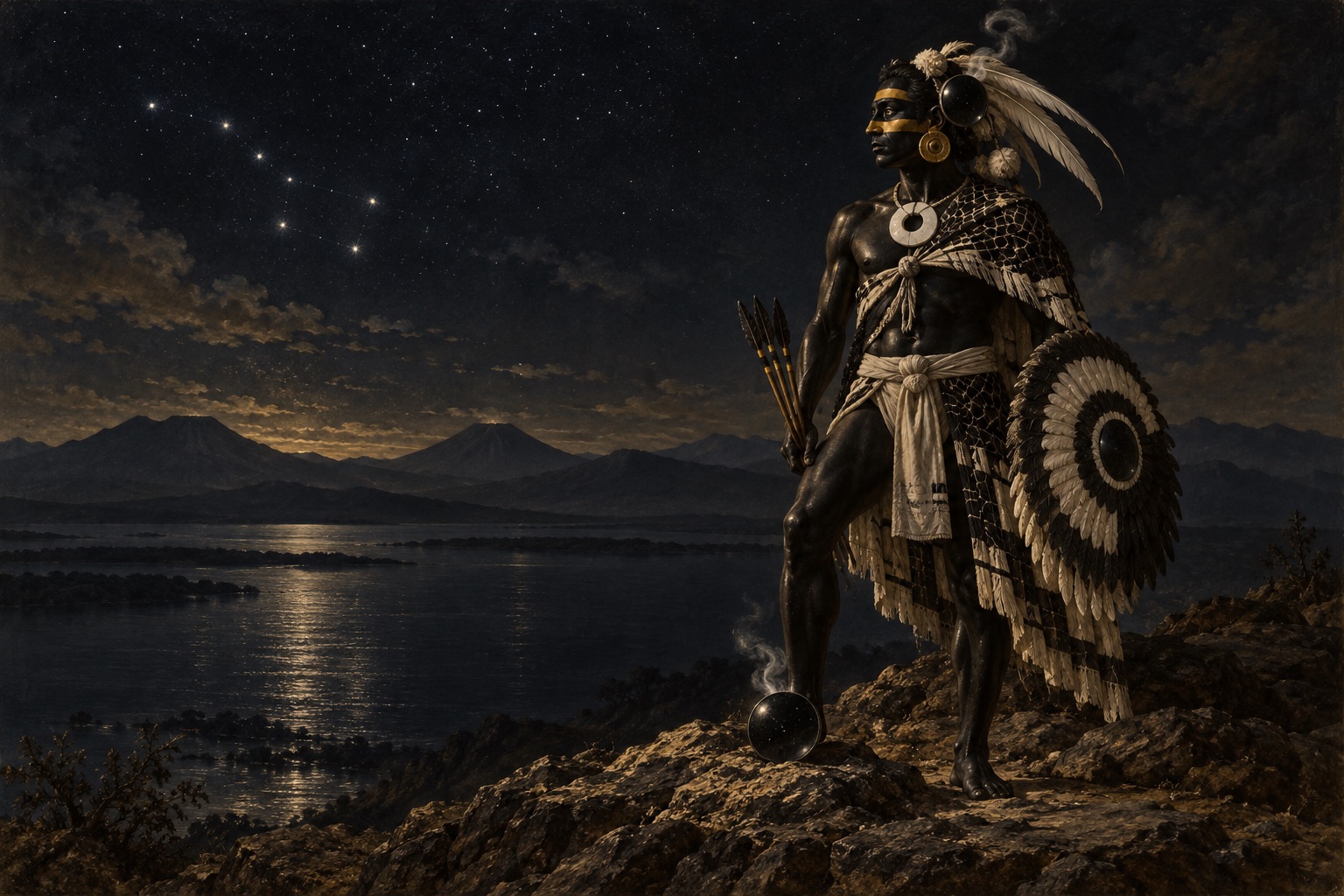
Why a “smoking mirror”? The name joins tezcatl, “mirror”, and popoca, “to give off smoke”; the Online Nahuatl Dictionary renders it “Mirror’s Smoke”. The Histoyre du Mechique explains that he “always carried a very shining mirror with him”, which smoked from the incense and sweet-smelling things he carried. The Dominican Diego Durán, writing in the 1570s, describes his statue holding a fan of precious feathers that rose from a round plate of gold “burnished like a mirror”: in it the god saw everything that was done in the world, and it was called itlachiayan, “his lookout”. The mirrors he wears in the painted books are obsidian mirrors, of the black volcanic glass the Mexica also used for blades.
1 The Telling
Tezcatlipoca has no single story. He turns up in many of them, usually when something is about to change. Told here are four: the god as the Nahua described him to Sahagún, the making of the earth in the Histoyre du Mechique, his tricks at night, and the feast of Toxcatl, when a young man lived for a year as the god.
1-1 The Invisible One
In Book 3 of the Florentine Codex, Titlacauan was said to be the creator of heaven and earth and all-powerful. He gave the living their food, their drink and their riches. He was invisible, “like darkness and air”, and when he appeared and spoke to someone he was like a shadow. He knew the secrets of the heart. The same god sent poverty and incurable diseases on those who broke their vows of fasting, and a sick man who could not get well would scold him: “O Titlacauan, since you are mocking me, why don’t you kill me?” (Book 3, chapter 2).
Titlacauan, “we are his slaves”, was only one of his names. “Titlacauan was also called Tezcatlipoca, and Moyocoyatzin, and Yaotzin, and Necoc Yaotl, and Nezahualpilli.” Moyocoyatzin, because he did whatever he wished and thought, and no one could oppose him, in heaven or in this world; on the day he chose to bring down the sky, he would do it, and the living would come to an end. Yaotl means “enemy”, and Sahagún’s Spanish translates Necoc Yaotl as “sower of discord on both sides”, because he set peoples against one another (Book 1, chapter 3). Stone seats were built for him at the crossroads, and branches were laid on them every five days.
The Historia de los mexicanos por sus pinturas gives him a family. The creator couple Tonacatecuhtli and Tonacacihuatl, in the thirteenth heaven, had four sons: a red Tezcatlipoca; a black Tezcatlipoca, “the greatest and the worst”, who could do more than the other three because he was born in the middle of them; Quetzalcoatl; and Huitzilopochtli, the youngest. Tezcatlipoca knew every thought and was in every place, and so he was called Moyocoya, which the text explains as “he who does all things without anyone staying his hand”. They could not paint him, it adds, “except as air” (chapter 1).
1-2 The Earth Torn in Two
“Some others say that the earth was created in this way,” the Histoyre du Mechique begins. Two gods, Quetzalcoatl and Tezcatlipoca, brought the earth goddess Tlaltecuhtli down from the heavens. At every joint she was full of eyes and mouths, and she bit with them like a wild beast. Below there was already water, though no one knew who had made it, and she walked on it. The gods said to each other: “The earth must be made.” They turned themselves into two great serpents. One seized her from the right hand to the left foot, the other from the left hand to the right foot, and they squeezed until she broke in half. From the half toward the shoulders they made the earth; the other half they carried up to the sky. The other gods were angry.
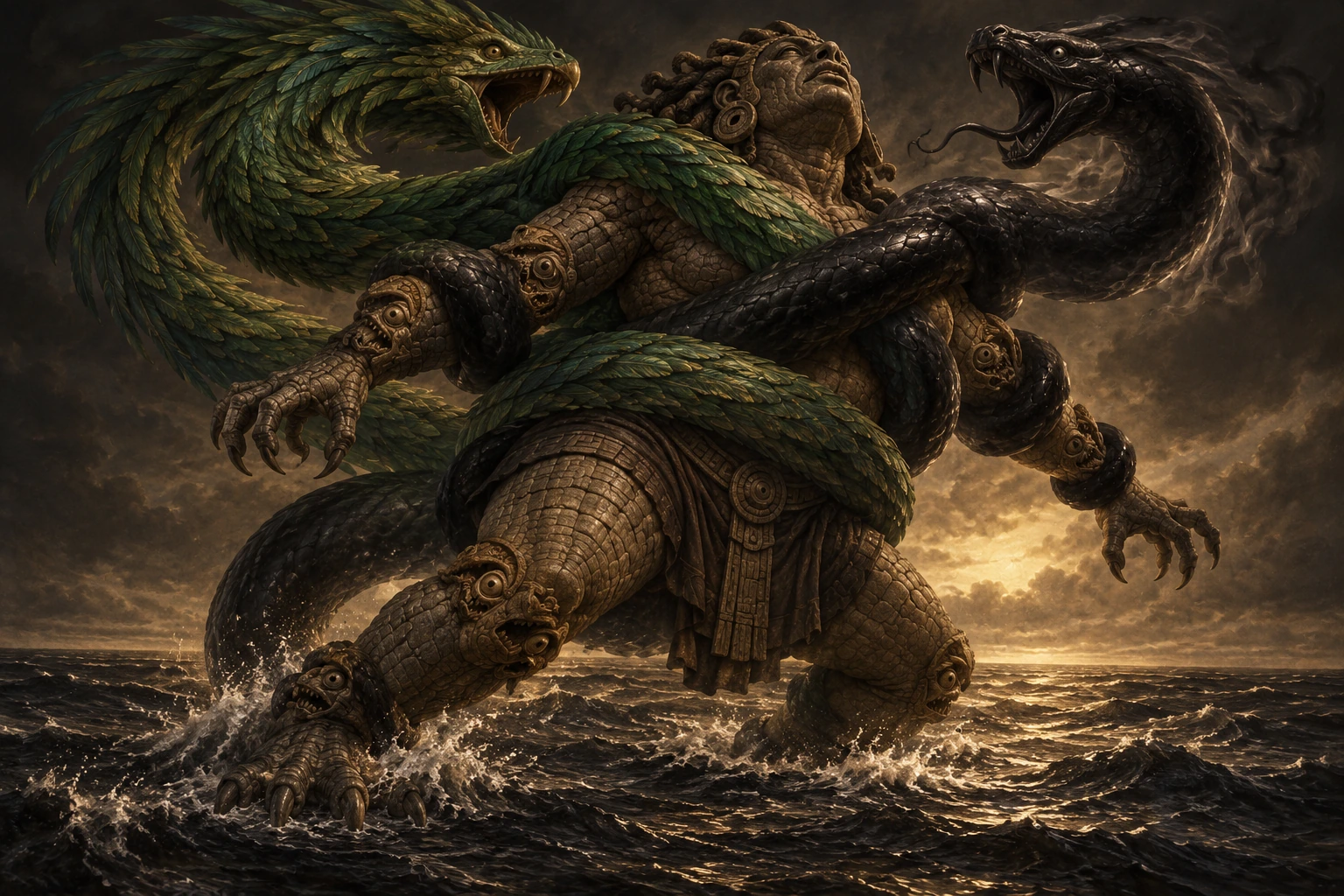
To make amends, all the gods came down to console her, and they ordained that every fruit people need to live should come from her. Her hair became trees, flowers and herbs; her skin, fine grass and small flowers; her eyes, wells, springs and little caves; her mouth, rivers and great caverns; her nose, valleys; her shoulders, mountains. But sometimes at night the goddess wept, wanting to eat human hearts. She would not be quiet until she was given them, and she would not bear fruit unless she was watered with human blood (chapter 7).
The Historia de los mexicanos makes Tezcatlipoca the first Sun as well. After 676 years Quetzalcoatl struck him with a great staff and knocked him into the water, and he came out as a jaguar and killed the giants of that age. That, the text says, is why the Great Bear sinks into the water: it is Tezcatlipoca, set there in memory of him (chapters 3–4). The other Suns and their ends belong to another story (section 5).
1-3 The Night Axe
Book 5 of the Florentine Codex, on omens, tells what happened to the priests who went into the hills at night to offer reeds and pine branches. Sometimes they heard blows far off, like someone splitting wood. This was the yohualtepuztli, the “night axe”, an illusion of Tezcatlipoca, with which he frightened and mocked people who walked about at night. A brave warrior did not run away. He chased the sound until he caught the figure: a man without a head, whose chest opened and closed like two little doors, and the closing made the noise. If the warrior seized the heart through the opening, he could ask for riches, or the strength to take many captives in war. The phantom offered maguey thorns to be let go, and a brave man held on until he had three or four, one for each captive he would take. But the phantom might give the opposite, poverty and misery instead, “for they said that it was in the hand of Tezcatlipoca to give whatever he wished, adverse or prosperous” (chapter 3 in Bustamante’s edition).
He also owned a day. One Death, Ce Miquiztli, was his sign. Before it began, masters took the collars off their slaves, washed them and feasted them “as if they were very beloved children of Titlacauan”, because whoever ill-treated a slave on those days might end as a slave himself. “They said that Tezcatlipoca was no one’s faithful friend”, always looking for a reason to take back what he had given. When a slave rose to wealth and his master fell into slavery, they put it down to him (Book 4, chapter 9).
1-4 A Year as the God
The fifth month of the year was Toxcatl. Its feast, Sahagún writes, was “the principal of all the feasts”, and fell near Easter. It honoured “the principal god, called Tezcatlipoca”, who was also called Titlacauan, Yaotl, Telpochtli (“youth”) and Tlamatzincatl (Book 2, chapter 24).
Every year a young man was chosen from among the captives: the best-looking, without any blemish on his body. The stewards taught him to play the flute, to carry flowers and a smoking reed and to draw on the smoke and smell the flowers as lords did, and to speak well and greet the people he met. Once he was named, he walked the streets day and night playing his flute, with eight attendants dressed as palace pages, and people bowed and kissed the earth before him. The ruler himself dressed him, “for he already held him as in the place of a god”: white feathers on his head, hair grown down to his waist, garlands of flowers, gold ear ornaments, a lip plug of shell and gold bells on his legs that rang wherever he went. He was, the texts say, “the image” of Tezcatlipoca. The Nahuatl word is ixiptla, a stand-in who virtually becomes what he stands for.
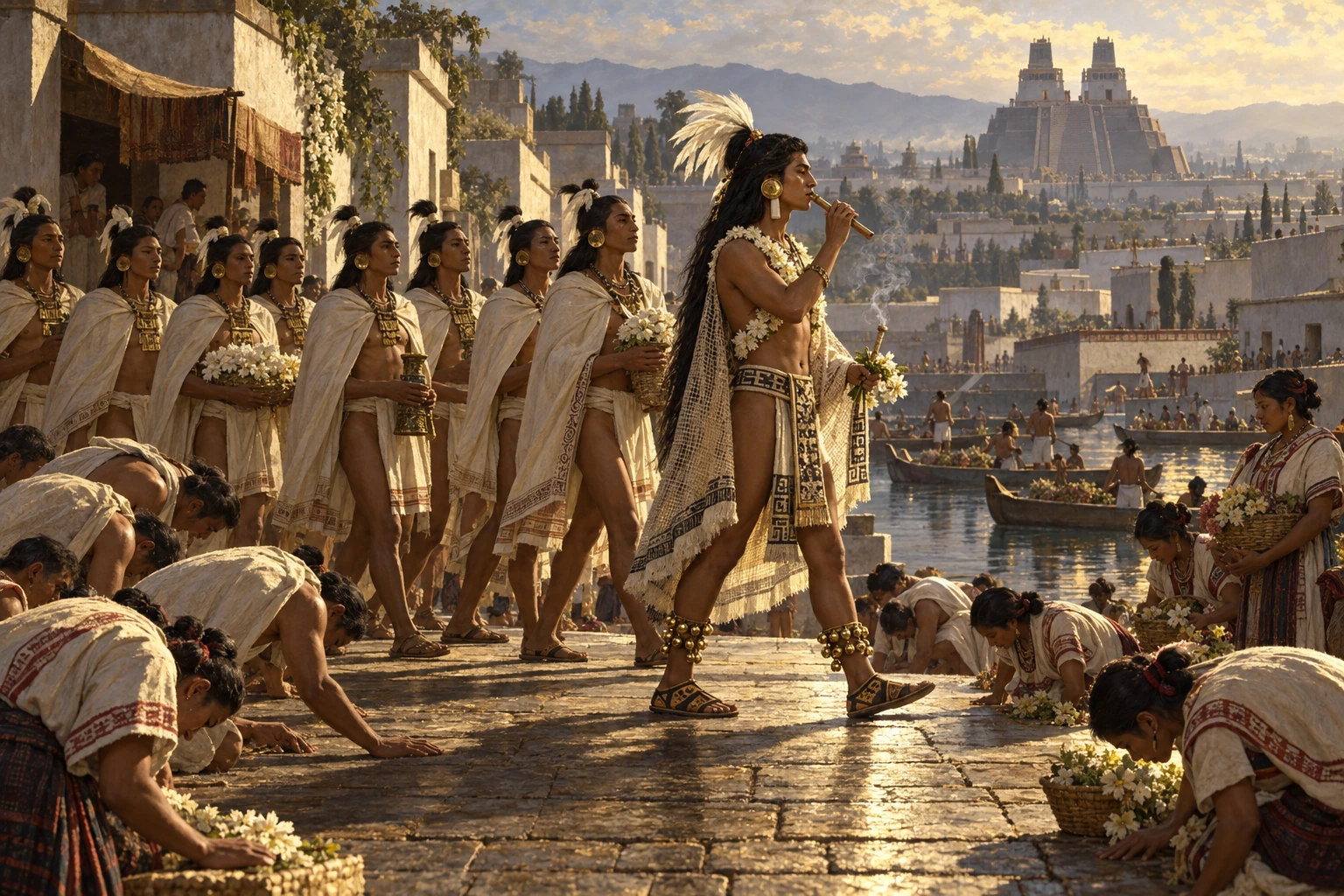
Twenty days before the feast his clothes were changed and his hair was cut like a war captain’s, and he was married to four young women raised for this, who were given the names of four goddesses: Xochiquetzal, Xilonen, Atlatonan and Huixtocihuatl. For the last five days the ruler stayed alone in his palace, while the court followed the young man to banquets and dances in four places of the city and the lake. Then he was put with his wives, who comforted him, in the ruler’s own canoe and taken across the lake toward Iztapalapa. There the women and everyone else left him. Only the eight pages stayed.
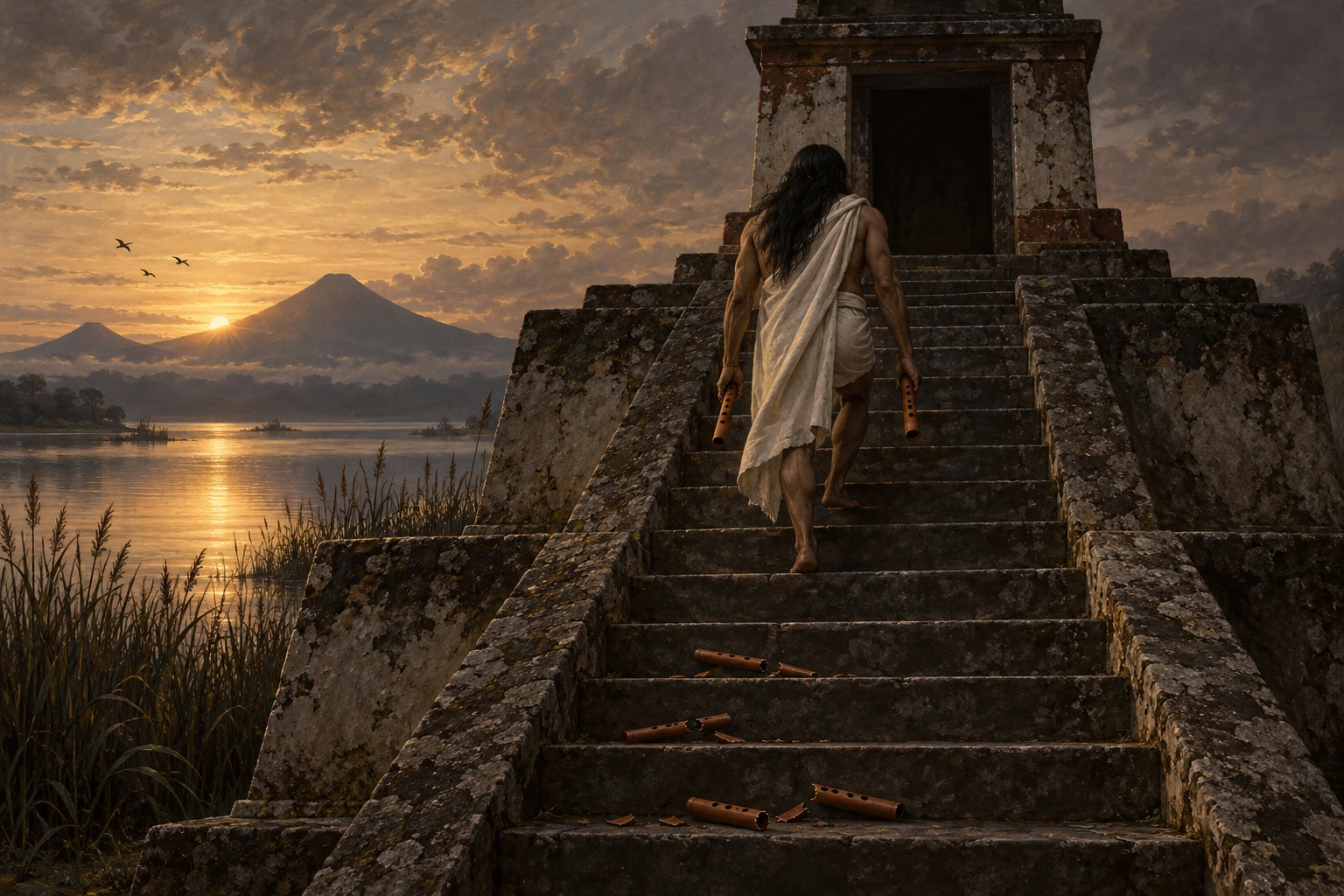
They brought him to a small, poorly kept temple by the road, out of town. He climbed its steps by himself, and on each step he broke one of the flutes he had played in his time of plenty. At the top the priests were waiting, and they sacrificed him as they did all their victims, taking out his heart. His body was not thrown down the steps, as others were, but carried down. At once another young man took his place for the next year. The text gives the meaning: those who have riches and pleasures in life will come at the end to poverty and sorrow.
2 Where the Story Is Written Down
- The Florentine Codex (General History of the Things of New Spain), compiled by the Franciscan Bernardino de Sahagún with Nahua scholars, in Nahuatl with a Spanish version beside it. The Spanish of Book 6 ends by saying it was translated in 1577, thirty years after the Nahuatl was written. The manuscript is in the Biblioteca Medicea Laurenziana, Florence. For Tezcatlipoca it has Book 1, chapter 3; Toxcatl in Book 2, chapter 24; Titlacauan and his names in Book 3, chapter 2; the day One Death in Book 4, chapter 9; the night axe in Book 5; and the first five prayers of Book 6, addressed to him in time of plague, poverty and war, and at the election and the death of a ruler. Quotations here are our translations from the Spanish text in Carlos María de Bustamante’s edition (Mexico, 1829), and, where that edition shortens the text, from Alfredo López Austin and Josefina García Quintana’s transcription of the manuscript’s Spanish column (2000).
- The Historia de los mexicanos por sus pinturas, in Spanish, says it was drawn from the Nahua “characters and writings”, from old men and from those who had been priests. It is probably the work of the Franciscan Andrés de Olmos, and was finished, according to Georges Baudot, in 1536. The manuscript is at the University of Texas at Austin; Joaquín García Icazbalceta published it in 1882, and again in 1891, the text read here.
- The Histoyre du Mechique is a 16th-century French manuscript in the Bibliothèque nationale de France (MS français 19031, folios 79–88), in the hand of the cosmographer André Thevet. Its title first read “translated from Spanish”, words that were then struck out. Édouard de Jonghe, who published it in 1905, identified the lost Spanish original with Olmos’s lost treatise on Mexican antiquities.
- Diego Durán, Historia de las Indias de Nueva España: the chapter “On the idol called Tezcatlipoca” (chapter 82 in the edition of 1880) describes his statue, his temple and the feast of Toxcatl.
- The painted books. In the Codex Borgia (Vatican Library, Borg.mess.1), a black Tezcatlipoca wears the smoking mirror at his temple and is, in Eduard Seler’s words of 1901, “‘one-legged’ … with rended foot and smoking stump”. The Codex Fejérváry-Mayer (World Museum, Liverpool, M12014), which Seler called pre-Columbian, is now also named by the museum Amoxtli Tezcatlipoca, “The Book of the Smoking Mirror”. Seler calls the yellow and black lines across the god’s face “Tezcatlipoca’s facial painting”.
3 Competing Versions
- How was the earth made? The Histoyre du Mechique gives two versions in the same chapter. In the first, Tezcatlipoca entered Tlaltecuhtli through her mouth and Ehecatl through her navel; they met in her heart and formed the sky, so heavy that other gods had to help lift it. Here the goddess, “who is the earth itself”, had “the figure of a man”, though “others say of a woman”. Then comes the tearing by the two serpents. In the Historia de los mexicanos, all four brothers made the earth from a great fish, cipactli, “like a caiman”, and called it Tlaltecuhtli, painted as an earth god lying on a fish (chapter 2).
- Where did his foot go? The pictures show the missing foot, and the Antiquity study of 2021 notes that an obsidian mirror “characteristically” replaces it. On the first page of the Codex Fejérváry-Mayer, Seler saw “the stump leg of the god Tezcatlipoca” and a head with his face paint at the ends of streams of blood. But no 16th-century text we have read says how he lost it. The Histoyre’s tearing of Tlaltecuhtli says nothing of a foot, and the version in many modern books, in which he used his foot as bait and the earth monster bit it off, we have not found in any colonial source. Durán’s statue had no missing foot: a deer’s hoof was tied to its right foot, for swiftness and agility. Guilhem Olivier, in his study of the god, linked the mutilation with his sexual transgression and with the lighting of fire and the start of new ages, as Federico Navarrete’s review sums it up.
- Which names are his own? Sahagún’s lists are the core: Titlacauan, Tezcatlipoca, Moyocoyatzin, Yaotl, Necoc Yaotl, Nezahualpilli, Telpochtli. Boys born on One Death were named Yaotl, Ce Yaotl, Necoc Yaotl, Chicoyaotl or Yaomahuitl, “all names of Tezcatlipoca” (Book 4, chapter 9). Others were shared. The prayers of Book 6 address him as Yohualli Ehecatl, “night and wind”, but in the same book the invisible god of the Chichimecs is also Yohualli Ehecatl, and the Online Nahuatl Dictionary files that name among the creator gods. Tloque Nahuaque, “lord of the near”, was said of powerful gods in general, and later of the Christian God. And in the Historia de los mexicanos, after the flood, Tezcatlipoca “left his name” and became Mixcoatl (chapter 6).
- Four Tezcatlipocas? Modern accounts often speak of four Tezcatlipocas, Xipe, Quetzalcoatl, Huitzilopochtli and Tezcatlipoca himself, each tied to a direction and a colour. The Historia de los mexicanos names only two of the four brothers Tezcatlipoca; the red one, it says, was Camaxtli, the god of Huexotzinco and Tlaxcala. Olivier, according to Berenice Amador Saavedra’s review, broke with this “quadrupled” Tezcatlipoca.
- Toxcatl in Durán. For Durán the feast was a prayer for rain, and toxcatl meant “dry thing”. For ten days before it, a priest called Titlacahuan, dressed like the god, played a small clay flute toward the four directions. Everyone who heard it took a pinch of earth on a finger and ate it, and wept, calling on “the darkness of the night and the wind”. Thieves, adulterers and killers feared their sins would come to light. People were divided, he adds, over whether the figure carried out on a litter was the wooden statue or a living man.
4 History and Tradition
- The god of kings. When a ruler died, the high priest’s prayer in Book 6 told Tezcatlipoca: you are “the universal lord and emperor, by whose will the whole universe is ruled, and who need the counsel of no other” (chapter 5). The dead ruler had gone where his predecessors had gone, Acamapichtli, Tizoc, Ahuitzotl and the Moctezumas. Olivier, as Navarrete’s review sets out, argued that the young man of Toxcatl stood in for the ruler: the ruler dressed him as “his precious god” and hid in his palace during the last days, and the ruler himself was called the flute of Tezcatlipoca, so the broken flutes renewed royal power.
- The statue in Tenochtitlan. Durán describes it: in Mexico it was of a black stone, shining “like jet”, the stone from which blades and knives were made; elsewhere it was carved of wood. It held four arrows for the punishment of sins, and it was the idol they feared most, lest it reveal their sins. Its temple had eighty steps, and its chamber was always kept closed and dark.
- The massacre of 1520. In Tenochtitlan the feast of Toxcatl honoured Huitzilopochtli too: a dough image of him was made at the same time (Book 2, chapter 24). In 1520, while Hernán Cortés was away on the coast, Pedro de Alvarado and the Spaniards left in the city closed the gates of the temple courtyard on the Mexica dancing at that feast and killed great numbers of them (Book 12, chapters 19–20). “From here began the war between the Spaniards and the Mexica,” Sahagún writes in Book 8.
- John Dee’s mirror. The British Museum holds an obsidian mirror, 195 × 185 mm, with a small perforated tab, long linked to John Dee, the Elizabethan scholar who sought to speak with angels through scryers. Horace Walpole’s label on its case calls it “The Black Stone into which Dr Dee used to call his Spirits”. The museum acquired it in 1966 and, Stuart Campbell and his co-authors note, catalogues it by its link with Dee, in its Department of Britain, Europe and Prehistory, rather than by its origin. Their analysis in 2021 matched the obsidian to the Pachuca source in central Mexico, and they call it “an Aztec artefact brought to Europe soon after the Spanish conquest”. How and when Dee got it is not known.
Tezcatlipoca is often called the evil god, the dark enemy of a good Quetzalcoatl. The sources do not draw that line. In the Histoyre du Mechique the two make the earth together and decide together to make people; in the Historia de los mexicanos they turn into trees and raise the fallen sky together. Book 6 prays to Tezcatlipoca as “most humane, most merciful, protector and defender”, even while it fears him. The good-and-evil reading came later. Sahagún’s appendix to Book 1 calls him “the wicked Lucifer, father of all wickedness and lies”, and in 1880 Alfredo Chavero wrote of “Tezcatlipoca, the terrible and bloodthirsty deity”. Olivier, as Amador Saavedra’s review notes, set aside the picture of Tezcatlipoca as Quetzalcoatl’s “evil twin”.
5 Related Stories
- Quetzalcoatl: The Feathered Serpent: Tezcatlipoca’s partner in making the world, and his opponent at Tollan, where Tezcatlipoca drove the city’s ruler out. That story is told there.
- The Legend of the Suns: Five Worlds and How Each Ended: in the Historia de los mexicanos, Tezcatlipoca is the first Sun and his jaguars end its age. The order of the Suns and their ends differ from source to source.
- Huitzilopochtli: The War God Born on Coatepec: the youngest of the four brothers in the Historia de los mexicanos, honoured at the same feast of Toxcatl, and the god whose dancers were killed in 1520.
- The Popol Vuh: The Gods Make People from Maize: Eduard Seler called the one-legged Tezcatlipoca of the Codex Borgia “Hurakan, as he is called in the Quiché myths preserved in the Popol Vuh”. Huracan, Heart of Sky, is one of the makers in that book.
6 Sources
- Bernardino de Sahagún, Historia general de las cosas de Nueva España, ed. Carlos María de Bustamante, vols. 1 and 2 (Mexico, 1829): book 1, chapter 3; book 2, chapters 5 and 24; book 3, chapter 2; book 4, chapter 9; book 5, chapter 3; book 6, chapters 1–5; book 8, chapter 1: archive.org, archive.org
- Florentine Codex, book 1, chapter 3 (fol. 2r) and appendix (fol. 34v), book 4, chapter 9 (fol. 23v), and end of book 6 (fol. 215v): Spanish transcription by Alfredo López Austin and Josefina García Quintana (2000), in Digital Florentine Codex, ed. Kim N. Richter, Alicia Maria Houtrouw et al. (Getty Research Institute, 2023): Getty, Getty, Getty, Getty
- Florentine Codex, book 12, chapters 19–20, Nahuatl transcription and English translation by James Lockhart, Early Nahuatl Library: enl.wired-humanities.org, enl.wired-humanities.org
- Historia de los mexicanos por sus pinturas, ed. Joaquín García Icazbalceta, Nueva colección de documentos para la historia de México, vol. 3 (Mexico, 1891), pp. 228–263: archive.org
- Histoyre du Mechique, ed. Édouard de Jonghe, Journal de la Société des Américanistes de Paris 2 (1905), pp. 1–41: archive.org, Persée
- Diego Durán, Historia de las Indias de Nueva España y islas de Tierra Firme, vol. 2 (Mexico, 1880), chapter 82, with Alfredo Chavero, “Explicación del Códice Geroglífico de Mr. Aubin”, in the appendix: archive.org
- Eduard Seler, Codex Fejérváry-Mayer: An Old Mexican Picture Manuscript in the Liverpool Free Public Museums (12014/M), trans. A. H. Keane (Berlin and London, 1901): archive.org
- Codex Borgia, Vatican Library, Borg.mess.1: DigiVatLib; National Museums Liverpool, “Codex Fejérváry Mayer (Amoxtli Tezcatlipoca)”, M12014: liverpoolmuseums.org.uk
- Stuart Campbell, Elizabeth Healey, Yaroslav Kuzmin and Michael D. Glascock, “The mirror, the magus and more: reflections on John Dee’s obsidian mirror”, Antiquity 95 (2021), pp. 1547–1564: Cambridge Core
- Federico Navarrete Linares, review of Guilhem Olivier, Moqueries et métamorphoses d’un dieu aztèque (1997), Estudios de Cultura Náhuatl 28 (1998), pp. 436–441; Berenice Amador Saavedra, review of Olivier, Tezcatlipoca. Burlas y metamorfosis de un dios azteca, Graffylia 6, no. 11 (2021), pp. 132–137: UNAM, BUAP
- Jaime Marroquín Arredondo and José Luis Nogales Baena, introduction to Juan de Tovar, Historia mexicana, on the date of the Historia de los mexicanos: iberoweb
- Online Nahuatl Dictionary, ed. Stephanie Wood (Wired Humanities Projects, University of Oregon): Tezcatlipoca, Titlacahuan, yaotl, Yohualli Ehecatl, tloque nahuaque, ixiptlatl
Cover and illustrations: AI-generated images made for Arcana. They are interpretations, not historical artworks.