Quetzalcoatl: The Feathered Serpent
He went down to the land of the dead for the bones of the first people, and he was the wind, the morning star and a king of Tollan who left his city in shame. The feathered serpent is far older than the Mexica, and the story that they took Cortés for him is younger than the conquest.
- Type: myth; a creator god, the wind and the morning star, and a legendary priest-king
- Culture: the Nahua peoples of central Mexico, the Mexica (“Aztecs”) among them; the feathered serpent goes back to Teotihuacan, and Maya peoples knew it as Kukulkan and Q’ukumatz
- Earliest texts: feathered serpents carved on a temple at Teotihuacan around 150 CE; in writing, the Nahuatl Legend of the Suns (dated 1558) and Annals of Cuauhtitlan (1570), both in the Codex Chimalpopoca, and the Florentine Codex (1577)
- Key figures: Quetzalcoatl (also Ehecatl, the wind, and Topiltzin Quetzalcoatl, king of Tollan), Mictlantecuhtli and Mictecacihuatl, Cihuacoatl (Quilaztli), Tezcatlipoca, Quetzalpetlatl
The people who built Tenochtitlan called themselves the Mexica. “Aztec”, from Aztlan, the homeland of their migration story, is a name that came into use after the conquest, and we use it for the wider tradition. Among their gods was one whose name joins a bird and a snake: Quetzalcoatl. He was old long before them. Feathered serpents glide across a temple at Teotihuacan built some twelve centuries before Tenochtitlan. In the texts written down after the Spanish conquest he is many things at once: the god who fetched the bones of the first people from the land of the dead, the wind that sweeps the road for the rain, the morning star, and a king of Tollan who left his city in shame and went east.
Why a feathered serpent? The name joins two Nahuatl words: quetzalli, the precious green feathers of the quetzal bird, and coatl, “serpent”. “Quetzal serpent” is closer than the usual “feathered serpent”, and the K’iche’ Maya name Q’ukumatz means the same. Allen J. Christenson, translator of the K’iche’ Popol Vuh, explains the pairing: a bird, lord of the sky, and a serpent, which sheds its skin and is renewed, lord of the earth and the underworld, together give the god power over “all levels of the Maya universe”. Since coatl can also mean “twin”, Japan’s Heibonsha encyclopedia gives “noble twin” as a second reading.
1 The Telling
The making of people follows the Legend of the Suns, and the king of Tollan the Annals of Cuauhtitlan: two Nahuatl texts written down in 1558 and 1570 and later copied into one manuscript. We read them in the Spanish translation of Primo Feliciano Velázquez (1945); the quotations are our own translations of his Spanish.
1-1 The Precious Bones
The fourth world had ended in a flood, and the sky had been dark for twenty-five years. The gods took counsel: who will live on the earth now? Among them were Citlalinicue, Citlallatonac, Apantecuhtli, Tepanquizqui, Tlallamanqui, Huictlolinqui, Quetzalcoatl and Titlacauan, one of the names of Tezcatlipoca.
Quetzalcoatl went down to Mictlan, the land of the dead, to its lord Mictlantecuhtli and its lady Mictecacihuatl. “I have come for the precious bones that you keep,” he said. “What will you do with them, Quetzalcoatl?” “The gods want to make with them someone to live on the earth.” “Very well,” said the lord of the dead. “Blow my conch shell and carry it four times around my seat of precious stones.” But the conch had no holes. Quetzalcoatl called the worms, and they bored holes in it; the big bees and the wild bees went inside and made it sound. Mictlantecuhtli heard it and said: “Very well, take them.”
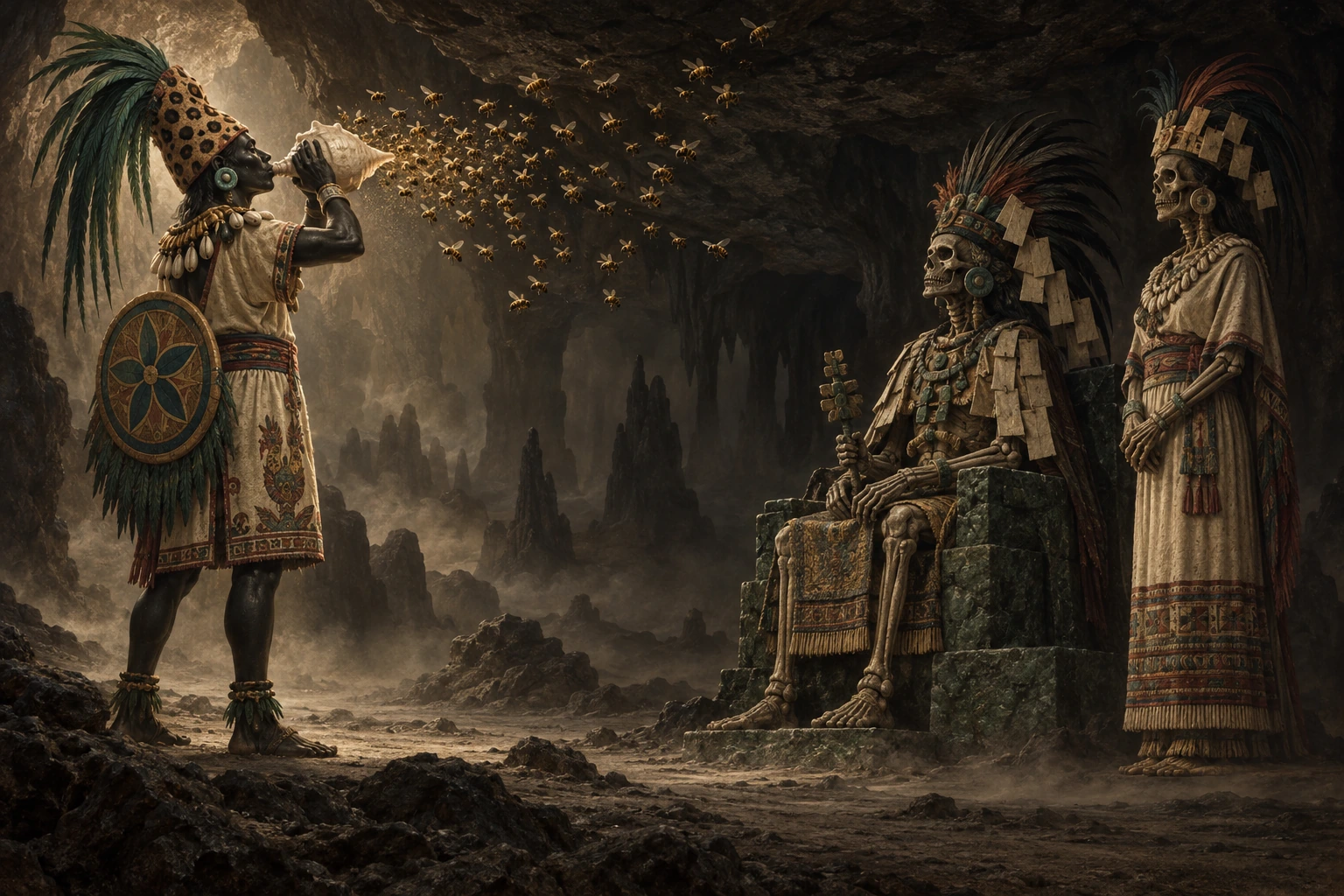
Then he told his messengers, the people of Mictlan, to tell Quetzalcoatl that he must come back and leave the bones. “No, I am taking them for ever,” said Quetzalcoatl, but he sent his nahual, his double, to shout back: “I will come and leave them.” He hurried up with the bones, the bones of men in one bundle and the bones of women in another.
1-2 The Quail and the Bowl
The lord of the dead was not fooled. “Gods, he really is taking the precious bones,” he told his messengers. “Go and dig a pit.” Quetzalcoatl fell into it and struck himself, and the quail startled him. He fell dead, and the bones scattered over the ground, where the quail bit and gnawed them. Soon he came back to life and wept. “How will this be, my double?” The thing had gone badly, came the answer, and so it must be. He gathered the bones, tied them up again and took them to Tamoanchan.
There the goddess Quilaztli, who is Cihuacoatl, ground them and put the meal into a precious bowl. Quetzalcoatl drew blood from his penis over it, and the other gods did penance too: Apantecuhtli, Huictlolinqui, Tepanquizqui, Tlallamanac, Tzontemoc and Quetzalcoatl, the sixth. Then they said: “The vassals of the gods are born,” because the gods had done penance for us. The verb for that penance, macehua, also means “to deserve”, Velázquez notes.
1-3 The Ant and the Mountain of Food
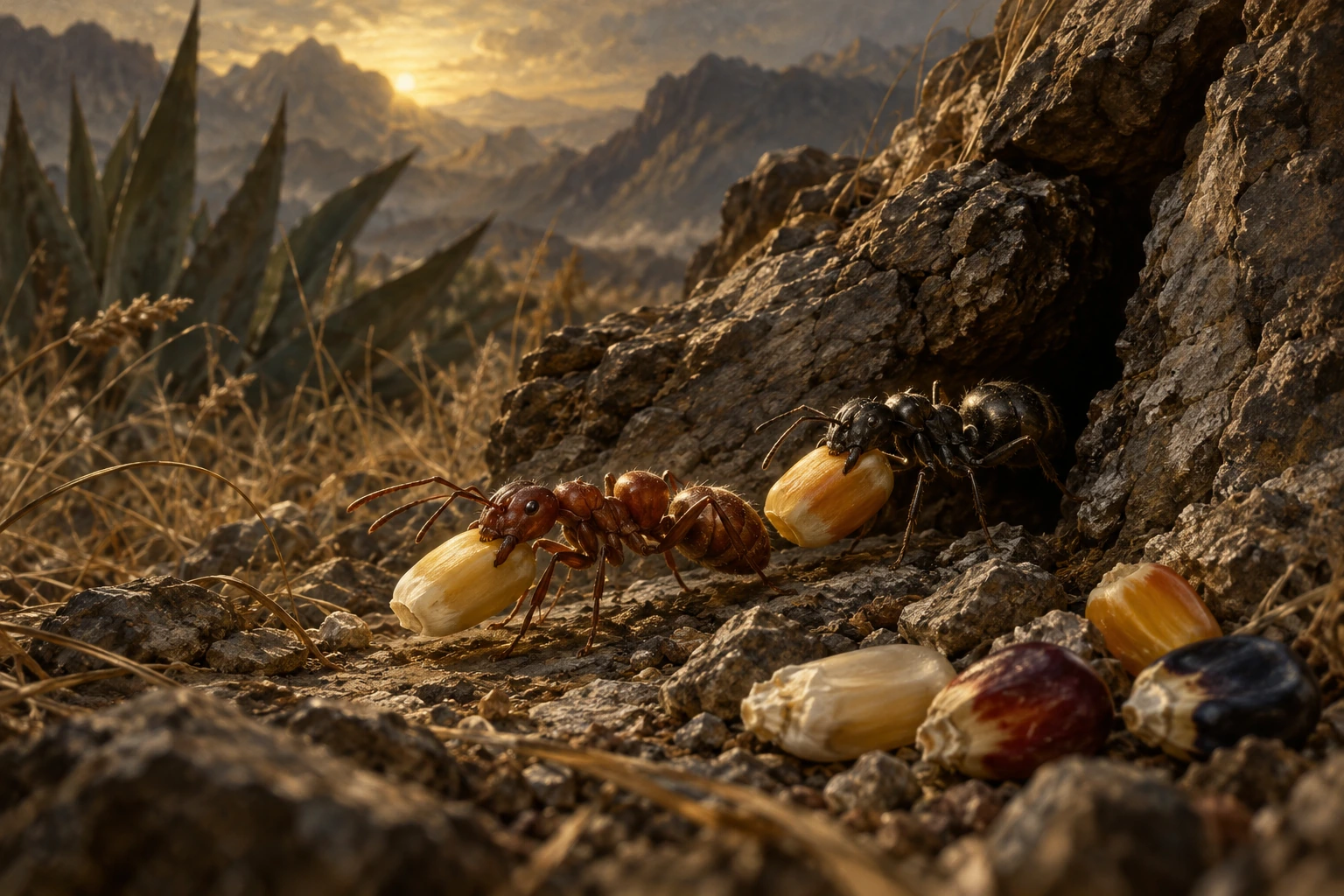
“What will they eat, gods?” Everyone went looking for food. An ant was fetching shelled maize from inside Tonacatepetl, the Mountain of Sustenance. Quetzalcoatl met it and asked where it had found the grain. He asked many times, and it would not say; at last it showed him the place. Quetzalcoatl turned himself into a black ant and went with the red ant into the mountain, to the store, and together they carried the maize out. He took it to Tamoanchan, and the gods chewed it and put it in our mouths to make us strong.
Then the gods asked what to do with the mountain itself. Quetzalcoatl went alone, tied it with ropes and tried to carry it on his back, but he could not lift it. Oxomoco and his wife Cipactonal cast lots with maize and said that only Nanahuatzin, “the one covered in sores”, could beat the grain out of Tonacatepetl. The rain gods were made ready, the blue, white, yellow and red tlaloque, and Nanahuatzin threshed the mountain. Then the rain gods snatched the food away: white, black, yellow and red maize, beans, amaranth, chia. All of it was carried off.
1-4 The King of Tollan
The Annals of Cuauhtitlan tell of a man who bore the god’s name. He was born in a year 1 Reed and was called Topiltzin, and the priest Ce Acatl, “One Reed”, Quetzalcoatl. His mother, it was said, conceived him by swallowing a greenstone. At nine he asked what his father’s face had been like; told that his father was dead and buried, he dug up the bones and buried them again in a royal house. The Toltecs brought him to Tollan to be their king, and he was their priest as well. He built four houses for his fasting, of green boards, of coral, of shells and of quetzal feathers. He went down to the water at midnight, drew his own blood with thorns he made of greenstone, and offered snakes, birds and butterflies. He discovered greenstone, turquoise, gold, silver, shells, precious feathers, cacao of many colours and cotton. The demons wanted him to offer people, killing men. He never would, “because he loved his vassals, the Toltecs”, and so they resolved to mock him until he fled.
1-5 The Mirror and the Pulque
Three of them plotted: Tezcatlipoca, Ihuimecatl and Toltecatl. “Let us make pulque and give it to him, so that he loses his judgment and does no more penance.” Tezcatlipoca went first, with a double mirror a span long, wrapped up. “A young man has come to show you your body,” he told the pages, and he was let in. “Look at yourself and know yourself, my son.” Quetzalcoatl saw his warty eyelids, his sunken eyes, his whole face swollen and misshapen. “If my vassals saw me, they would run away,” he said, and resolved to stay hidden.
Then the featherworker Coyotlinahual dressed him: a quetzal-feather headdress, a green mask, red lips, yellow paint, fangs and a beard of feathers. Quetzalcoatl looked in the mirror, was pleased, and came out. Next came Ihuimecatl and Toltecatl with greens, chiles and pulque they had brewed in four days. “I will not drink it; I am fasting.” “Taste it with your little finger.” He tasted it, liked it, and drank four measures and a fifth, his libation; his pages drank until they were drunk. Merry now, he sent for his elder sister Quetzalpetlatl, who did penance on the mountain Nonohualcatepec, and she drank five measures too. They did not go down to the water or draw blood with thorns; at dawn they did nothing. When morning came they were full of sorrow, and Quetzalcoatl sang a lament. “Enough,” he told his pages. “I am leaving the city.” He lay four days in a stone chest, had his treasures hidden, and set out weeping. Tezcatlipoca’s own story is told in Tezcatlipoca: The Smoking Mirror.
1-6 The Morning Star
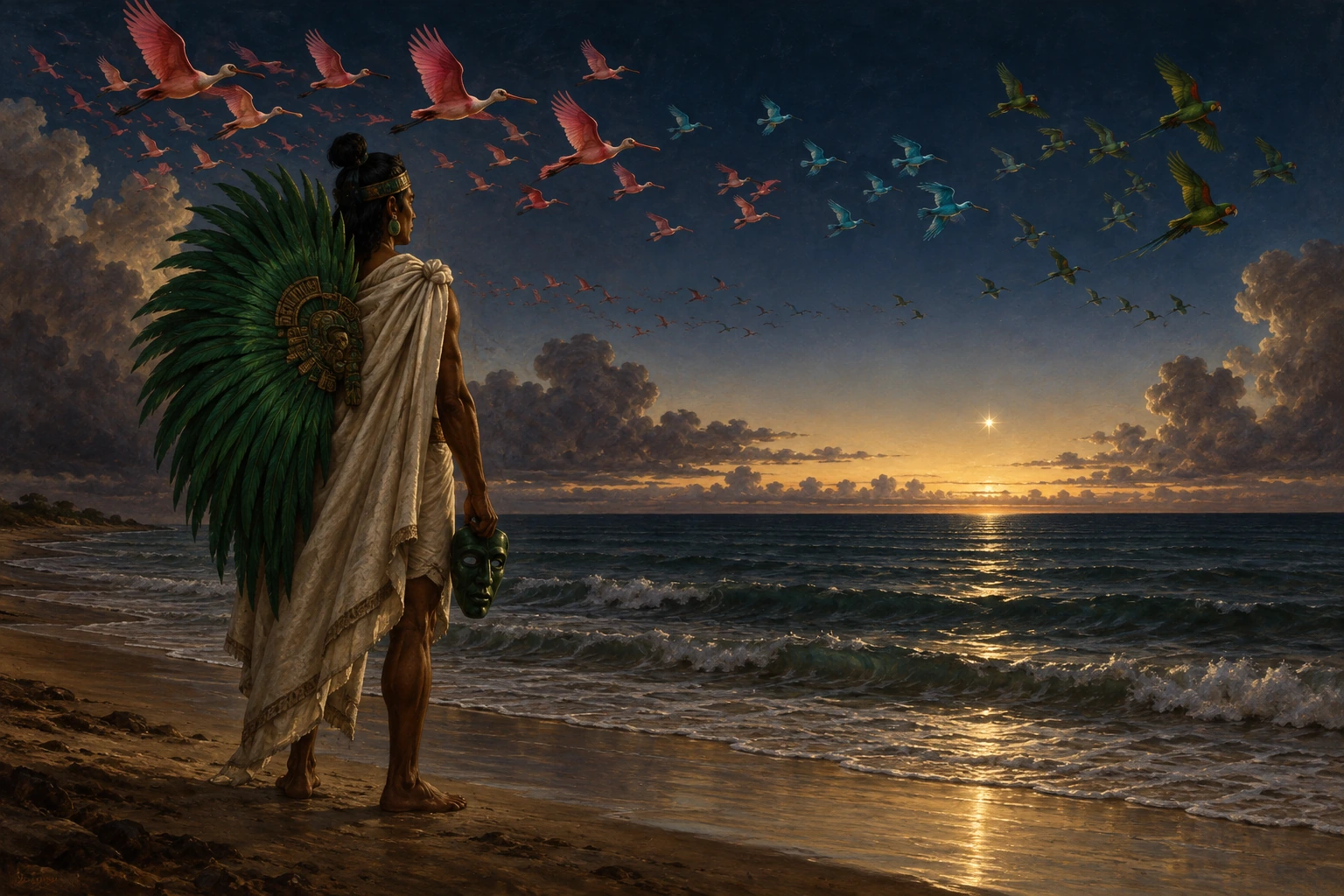
He went to Tlillan Tlapallan, “the burning place”. No place along the way pleased him. On the shore of the “heavenly water”, the sea, he stopped, wept, and put on his feather insignia and his green mask. Then he set himself on fire. His ashes rose, and all the precious birds came to see them, the tlauhquechol, the xiuhtototl, parrots of every kind. When the ashes were gone, his heart rose into the sky. The old men said it became the star that comes out at dawn, and called him Lord of the Dawn, Tlahuizcalpantecuhtli. For four days after his death the star did not appear, because he had gone to dwell among the dead; for four more he made himself arrows; on the eighth day the great star rose, and he took his throne as lord. He had been born in a year 1 Reed, and in a year 1 Reed he died.
2 Where the Story Is Written Down
- The Codex Chimalpopoca holds three texts: the Annals of Cuauhtitlan in Nahuatl, dated 1570; a short Spanish account of the old gods by Pedro Ponce; and the Legend of the Suns in Nahuatl, which dates itself 22 May 1558. The manuscript was itself a copy, in the hand of the 17th-century historian Fernando de Alva Ixtlilxochitl, and the abbé Brasseur de Bourbourg named it after his teacher Faustino Galicia Chimalpopoca. Velázquez published his translation with photographs of the pages in 1945. Soon after, the historian Salvador Toscano mislaid the manuscript, in circumstances never explained; he died in September 1949 without saying where it was, and it has not been found. Photographs taken in 1907 and Velázquez’s survive.
- The Florentine Codex (General History of the Things of New Spain) was made by the Franciscan Bernardino de Sahagún with Nahua elders, authors and artists, in parallel columns of Nahuatl and Spanish with nearly 2,500 paintings. It was completed in 1577 at the Colegio de Santa Cruz in Tlatelolco and went to the Medici library in Florence. Three of its twelve books matter here:
- Book 1, chapter 5: Quetzalcoatl, “god of the winds”;
- Book 3, chapters 3 to 14: Quetzalcoatl in Tula, the tricks of Titlacauan and the flight to Tlapallan;
- Book 12: the conquest, with the envoys who took the newcomers for Quetzalcoatl (section 4).
- Spanish writers add more: Francisco López de Gómara, chaplain and secretary to Cortés in his last years, in his Conquest of Mexico (1552), and the Franciscan Diego de Landa, writing on Yucatán around 1566.
3 Competing Versions
- How did he leave? In the Annals, he burns himself on the shore and his heart becomes the morning star. In the Florentine Codex (Book 3, chapter 14), he reaches the sea, has a raft of serpents made, coatlapechtli, sits in it as in a canoe and sails away: “no one knows how he reached Tlapallan”.
- Who drove him out? In the Annals, Tezcatlipoca, Ihuimecatl and Toltecatl. In the Florentine Codex, three sorcerers: Huitzilopochtli, Titlacauan, which is Tezcatlipoca, and Tlacahuepan.
- The drink and the mirror. In the Florentine Codex Titlacauan comes as a white-haired old man with a “medicine” for the sick king, the white wine of the maguey. Drink, he says, and go to Tlapallan, where another old man waits; you will come back young, a boy again. Quetzalcoatl drinks, weeps and makes up his mind to go. The mirror comes later, on the road: at Cuauhtitlan he asks his pages for a mirror, looks at his face, says “I am old now”, and names the place Huehuecuauhtitlan, “Old Cuauhtitlan”.
- The road east is told only in the Florentine Codex. He burns his houses of silver and shell, buries his treasures, turns the cacao trees into mesquite and sends the birds ahead. He leaves the prints of his hands on a stone where he sits weeping, sorcerers take from him the crafts of silver, stone, painting and featherwork, and his pages, dwarfs and hunchbacks, die of cold in the pass between the volcano and the snowy mountain.
- Man or god? The Legend of the Suns calls the present Sun “the Sun of Topiltzin of Tollan, of Quetzalcoatl”, and the Annals count the king’s years. Sahagún writes that “though he was a man, they held him for a god”.
4 History and Tradition
- Teotihuacan. Around 150 CE, according to Alfredo López Austin, Leonardo López Luján and Saburo Sugiyama, a platform of seven tiers was raised at Teotihuacan, its stairway to the west and all four sides carved with feathered serpents gliding among shells. Sugiyama read the second kind of great head, long taken for a rain god, as a headdress carried by the serpents, and the temple as the feathered serpent’s alone. The image lasted until the Spaniards came, they write; “in the 16th century this deity is known as Quetzalcoatl”.
- Ehecatl, the wind. In the Florentine Codex he “swept the road for the gods of the rains”, because great winds and dust come before the rains. His image wore a tall cap spotted like jaguar skin with quetzal plumes, a blackened face and a shield with “the jewel of the wind”. Gómara describes his temple in Tenochtitlan: among the forty or more around the great temple “one was round, dedicated to the god of the air, Quetzalcoatl; for as the air goes around the sky, so they made his temple round”. Its door was a serpent’s mouth with carved fangs. Gómara also calls him the chief god and founder of Cholula, a city of pilgrims, who taught fasting and that people should sacrifice “only quail, doves and game”.
- Kukulkan. Landa heard in Yucatán that a great lord named Cuculcan had ruled at Chichen Itza with the Itza, “as the main building, which is called Cuculcan, shows”, and that after his return he was held in Mexico “for one of their gods, and called Cezalcouati”. Christenson adds that the city’s principal buildings were finished well before 1000 CE, and that central Mexican influence among the Maya ran back to the 3rd or 4th century. At the spring and autumn equinoxes, the setting sun plays light and shadow on the stepped Temple of Kukulkan in the shape of a serpent.
- Q’ukumatz. In the K’iche’ Popol Vuh, before the world, the makers lie in the water, luminous, “covered in quetzal feathers”, and one of them is Q’ukumatz, the Quetzal Serpent. Christenson calls him “undoubtedly related” to Quetzalcoatl.
- The returning god. The earliest account is Cortés’s own Second Letter, dated 30 October 1520. His Moctezuma says that a lord brought their ancestors and went home, that “we have always held that those who descended from him would come to subjugate this country”, and that the king who sent the Spaniards from where the sun rises must be their rightful sovereign. The lord is neither named nor called a god, and Moctezuma lifts his robes: “see that I am flesh and bones, the same as you”. Later texts go further:
- Gómara (1552) has the crowds on the road say “These are gods”. Camilla Townsend, as JSTOR Daily summarizes her 2003 article, makes him the first to explain the conquest by Spaniards taken for gods.
- The Annals (1570) date the Spaniards’ coming to 1519, a year 1 Reed, and say the coast officials “held them for gods”. Guilhem Olivier points out that 1 Reed was Quetzalcoatl’s birth year.
- The Florentine Codex (1577) has the envoys kiss the prows of the ships, “thinking it was the god Quetzalcoatl who was returning”, and Moctezuma greet Cortés: “you have come to sit on your throne”.
- Then and now. William Prescott wrote in 1843 that the Mexica “looked confidently to the return of the benevolent deity”, which “prepared the way” for the Spaniards; in 1908 Francis MacNutt, translating Cortés, noted that “Montezuma here refers to Quetzalcoatl”. Heibonsha’s Japanese encyclopedia still calls the story “famous”. Townsend, in the passage JSTOR Daily quotes, found “little evidence that indigenous people ever seriously believed the newcomers were gods”. Matthew Restall, quoting his 2018 book in a short essay about it, writes that “so much was invented by Europeans” about Quetzalcoatl that the original god is “difficult to discern”. Olivier, at UNAM, still traces the identification to the Toltec king’s promise to return, and thinks it may have shaped Moctezuma’s welcome; but seeing the Spaniards as gods, he adds, never meant submitting to them.
“The Aztecs thought Cortés was Quetzalcoatl come back” is one of the best-known stories of the conquest. It is not in the letters Cortés sent from Mexico. It appears in books written thirty to sixty years after Tenochtitlan fell, and Townsend, as JSTOR Daily quotes her, found “no meaningful evidence that any story about Quetzalcoatl’s returning from the east ever existed before the conquest”.
5 Related Stories
- The Legend of the Suns: Five Worlds and How Each Ended: the same Nahuatl text places the bones between the flood that ended the fourth Sun and the making of the fifth at Teotihuacan, and calls the fifth “the Sun of Topiltzin of Tollan”.
- Tezcatlipoca: The Smoking Mirror: the god of the mirror who drove Quetzalcoatl out of Tollan.
- Mictlan: The Nine Places of the Dead: the land of the dead Quetzalcoatl went down to for the bones, and where, in the Annals, he stayed four days before rising as the morning star.
- The Popol Vuh: The Gods Make People from Maize: the K’iche’ makers include Q’ukumatz, the Quetzal Serpent. Writing on Paxil, the mountain where the K’iche’ gods find maize, Christenson recalls that in the Codex Chimalpopoca Quetzalcoatl brings the first maize out of Tonacatepetl.
6 Sources
- Leyenda de los Soles and Anales de Cuauhtitlán, in Códice Chimalpopoca, Spanish translation by Primo Feliciano Velázquez (UNAM, 1945; 3rd ed., preface by Miguel León-Portilla, 1992), pp. IX, 7–11, 67–68, 120–121, 132–133: UNAM
- Bernardino de Sahagún, Historia general de las cosas de Nueva España, Spanish text, ed. Carlos María de Bustamante, vol. 1 (Mexico, 1829), Book 1, chapter 5, and Book 3, chapters 3–14; Book 12, ed. Bustamante as Historia de la conquista de México (Mexico, 1829), chapters 2–4 and 16: archive.org, archive.org. The manuscript: Digital Florentine Codex, Getty
- Hernán Cortés, Second Letter (30 October 1520), in Fernando Cortes: His Five Letters of Relation to the Emperor Charles V, trans. Francis Augustus MacNutt, vol. 1 (Cleveland, 1908), with his Appendix IV: archive.org
- Francisco López de Gómara, Conquista de México (1552; Mexico, 1870), chapters on Cholula, on the road from Cholula to Mexico, and “El templo de México”: archive.org
- Diego de Landa, Relación de las cosas de Yucatán, § VI, Spanish text with French translation, ed. Brasseur de Bourbourg (Paris, 1864): archive.org
- Allen J. Christenson, Popol Vuh: Sacred Book of the Quiché Maya People (2003; Mesoweb, 2007), introduction and notes 20, 454 and 688, and Popol Vuh: Literal Translation (2004; Mesoweb, 2007), lines 137–148: Mesoweb, Mesoweb
- Alfredo López Austin, Leonardo López Luján and Saburo Sugiyama, “El Templo de Quetzalcóatl en Teotihuacan: su posible significado ideológico”, Anales del Instituto de Investigaciones Estéticas 62 (1991), pp. 35–52: Mesoweb
- Rodrigo Martínez Baracs, review of Anales de Cuauhtitlan, trans. Rafael Tena, Relaciones 140 (2014), pp. 335–341: Redalyc
- William H. Prescott, History of the Conquest of Mexico (1843), vol. 1, book 1, chapter 3: Project Gutenberg
- Matthew Wills, “The Mexica Didn’t Believe the Conquistadors Were Gods”, JSTOR Daily (2020), on Camilla Townsend, “Burying the White Gods: New Perspectives on the Conquest of Mexico”, American Historical Review 108 (2003), pp. 659–687: JSTOR Daily
- Matthew Restall on his When Montezuma Met Cortés (Ecco, 2018), in “The Page 99 Test” (2018), and NPR, “500 Years Later, The Spanish Conquest Of Mexico Is Still Being Debated” (2019): page99test, NPR
- “Hernán Cortés y el regreso de Quetzalcóatl”, Gaceta UNAM (2019), on a lecture by Guilhem Olivier: gaceta.unam.mx
- National Geographic en español, “4 datos que no conocías sobre la pirámide de Chichén Itzá” (2023): nationalgeographicla.com
- Online Nahuatl Dictionary, ed. Stephanie Wood (Wired Humanities Projects, University of Oregon), “coatl”: nahuatl.wired-humanities.org
- Takayama Tomohiro, “ケツァルコアトル”, Heibonsha World Encyclopedia, and Masuda Yoshirō, Nipponica: Kotobank
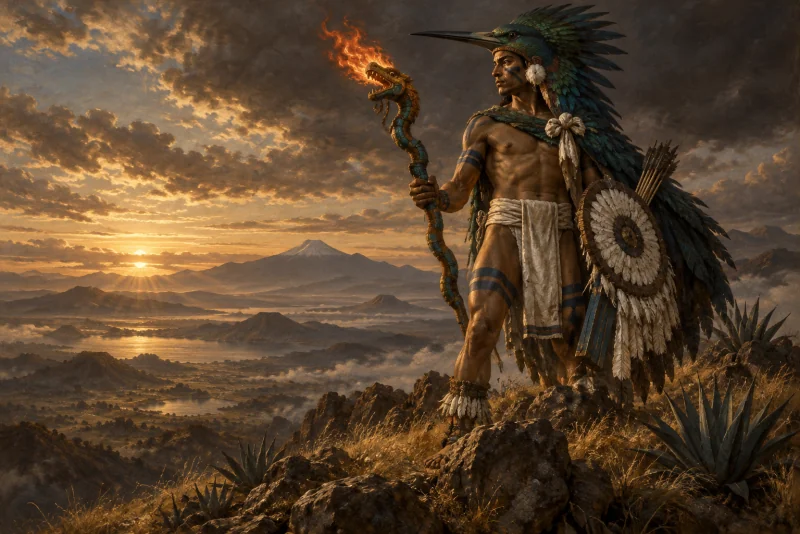
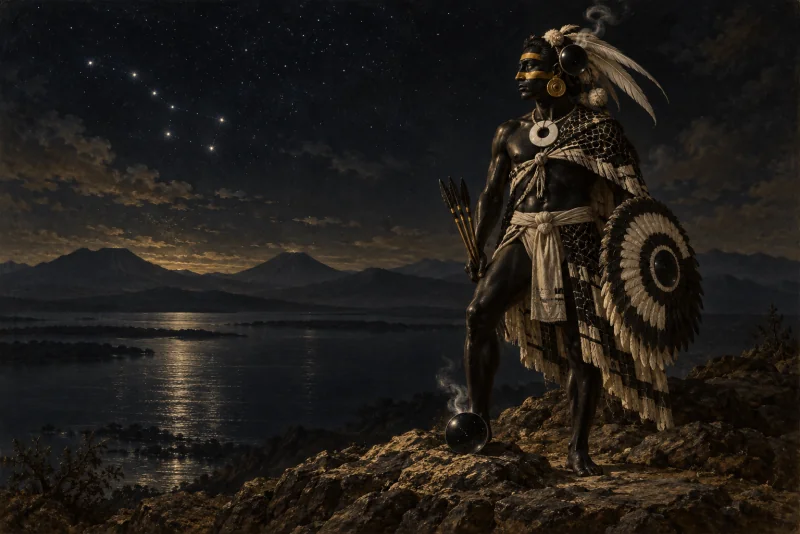
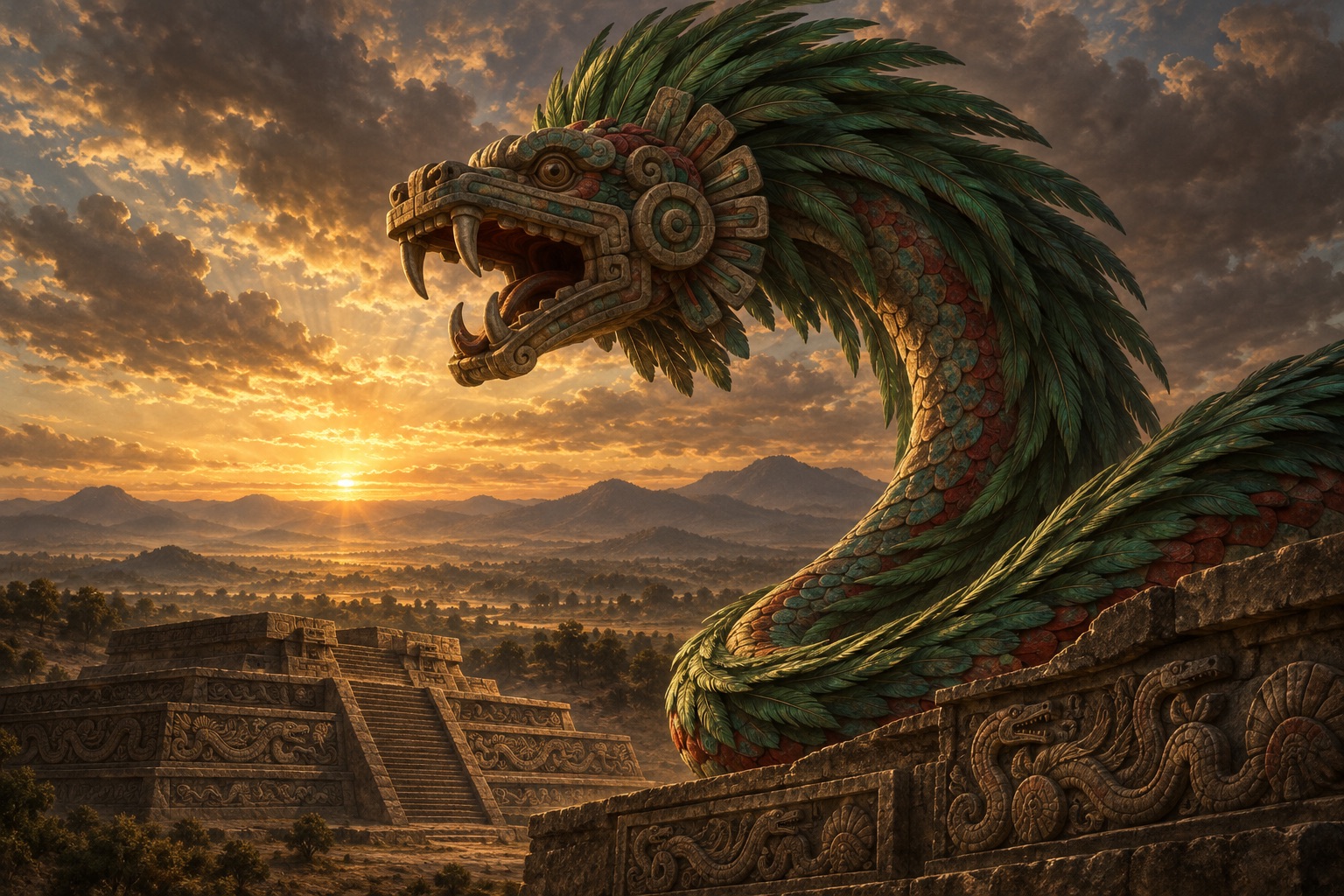
Cover and illustrations: AI-generated images made for Arcana. They are interpretations, not historical artworks.