Mictlan: The Nine Places of the Dead
Most of the Mexica dead set out on a four-year road, past clashing mountains and a wind of obsidian blades, across a river on the back of a yellow dog, to the lord of Mictlan. Sahagún says the road ended in "the nine hells", but the famous list of nine levels comes from a single colonial codex.
- Type: a place of myth: the land of the dead, and the road to it
- Culture: the Mexica of Tenochtitlan and their Nahuatl-speaking neighbours in central Mexico
- Earliest texts: the Legend of the Suns (in Nahuatl, dated 1558 in the text) and Book 3 of the Florentine Codex (finished 1577); a list of nine places in the Codex Vaticanus A, from the later 16th century. Older than all of them: two clay statues of the lord of the dead from Tenochtitlan, 15th century
- Key figures: Mictlantecuhtli and Mictecacihuatl, lord and lady of Mictlan; the dead and their dog; Tlalocan and the House of the Sun, where other dead went
The people who built Tenochtitlan called themselves the Mexica; “Aztec”, from their legendary homeland Aztlan, is a later name, used here for the wider tradition. When one of them died of an illness, old men dressed the body in cut paper and gave it what it would need for a journey: papers to pass the mountains that crush, a jar of water, a little dog. The journey led to Mictlan, “the place of the dead”, and the rites that went with it lasted four years.
Did Mictlan have nine levels? It had nine of something. Sahagún’s Spanish says that after four years the dead “goes to the nine hells”, and his Nahuatl text names the place Chicunauhmictlan, “Nine Mictlan”. But he never lists the nine. A numbered list, one place under another, appears in only one source, the Codex Vaticanus A, and some scholars doubt that the Mexica pictured them as floors stacked under the earth at all.
1 The Telling
This is the account in the appendix to Book 3 of the Florentine Codex, which Bernardino de Sahagún compiled with Nahua scholars at Tlatelolco and finished in 1577. The book runs in two columns, Nahuatl and Spanish, which do not always agree; where they differ, both are given. Quotations are our own translations from Sahagún’s Spanish.
1-1 Three Places for the Dead
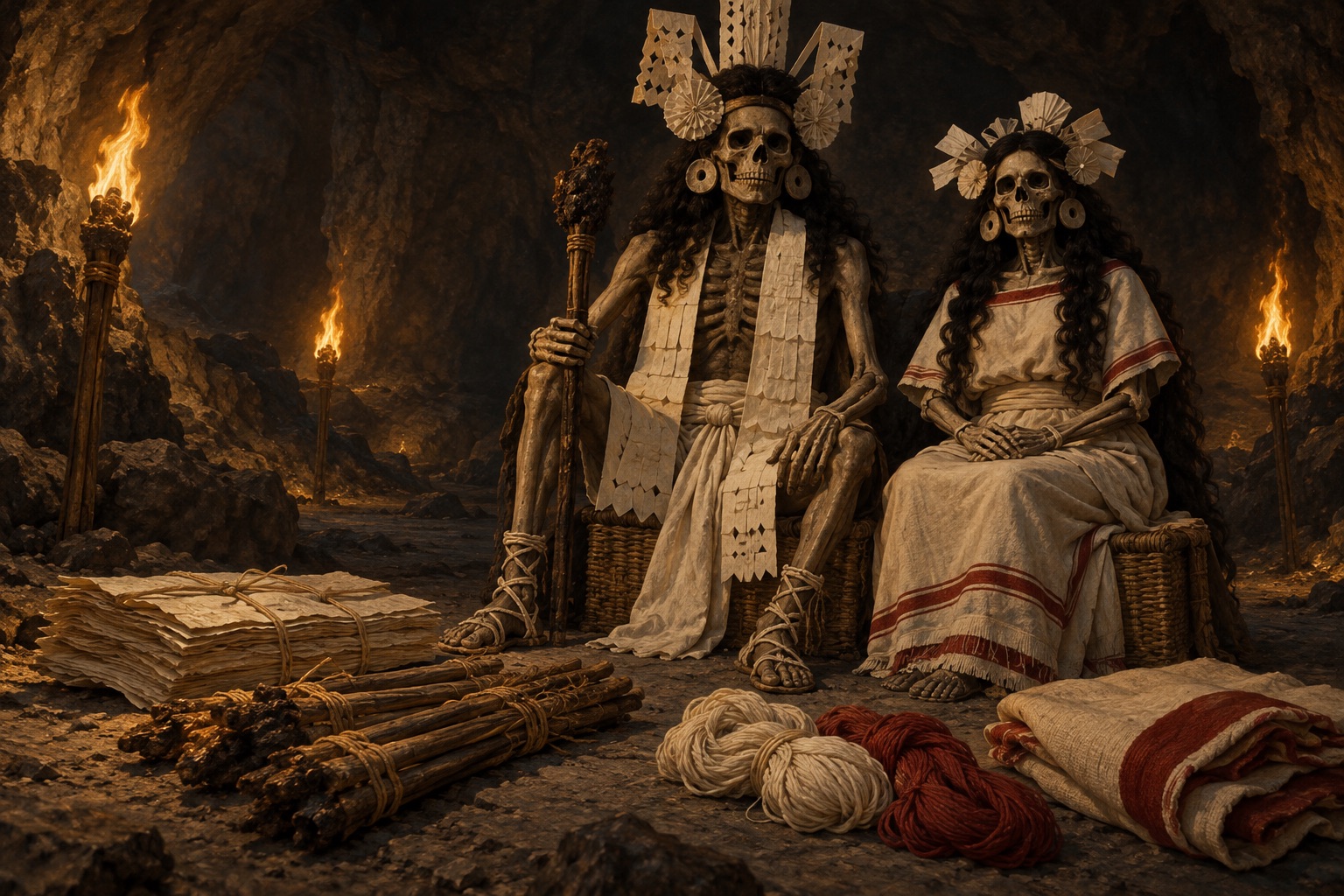
The old men said that the dead went to one of three places, and the text sorts them by the way they died. Mictlan received those who died of illness, “whether they were lords or nobles or common people”. It was ruled by Mictlantecuhtli, also called Tzontemoc, and his wife Mictecacihuatl.
Before the burial, someone spoke to the dead person still lying on the bed. Our life is short, the speech says, “like one who warms himself in the sun”. Now Mictlantecuhtli has taken you, and Mictecacihuatl has given you a seat, “for we will all go there, and that place is for everyone, and it is very wide”. You have gone to “the darkest place, which has neither light nor windows”, and you will never come back. The Nahuatl column calls it a place with no smoke hole and no hearth.
1-2 Papers for the Road
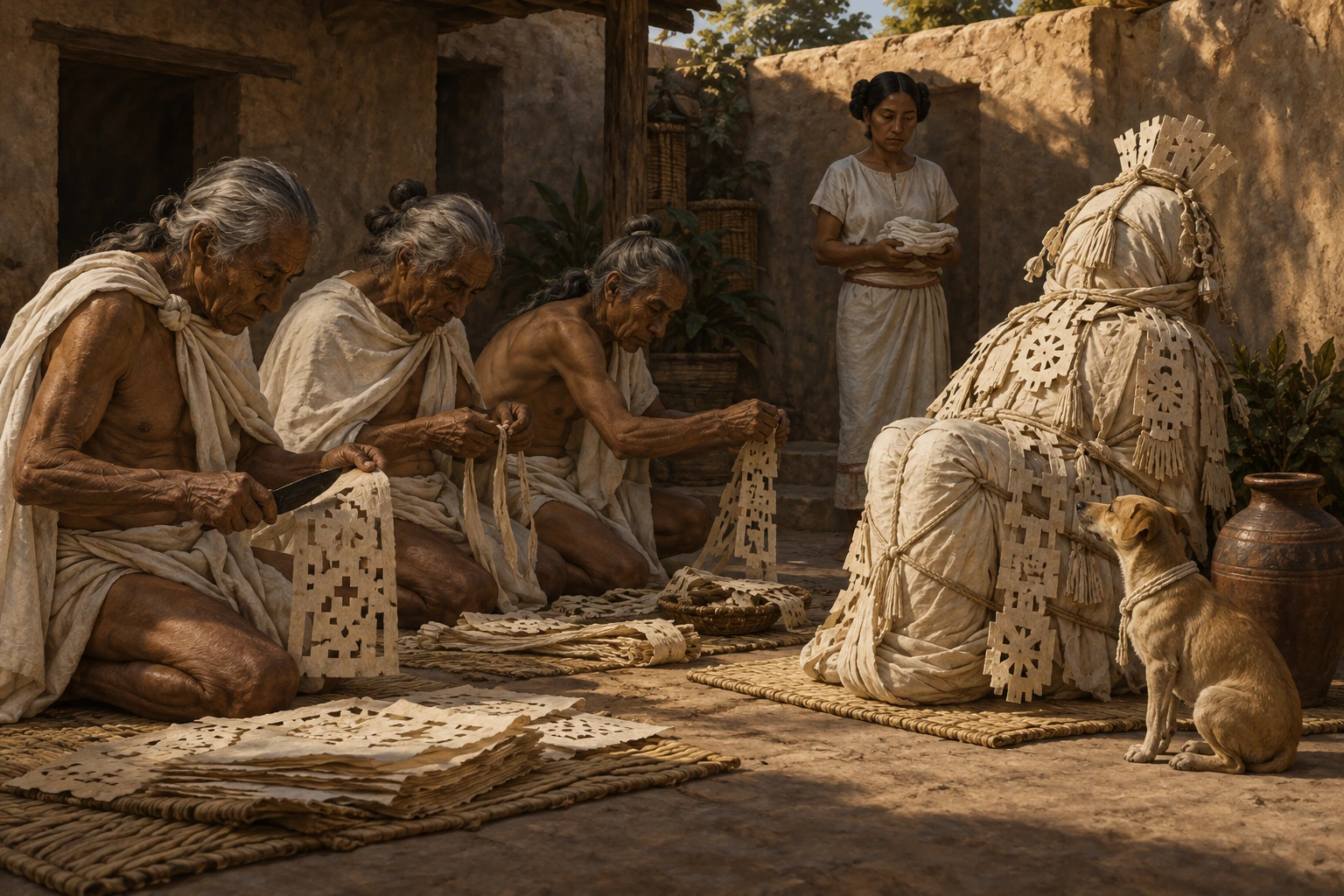
Then the old men who were skilled with paper cut and tied paper vestments, and dressed the body, its legs drawn up. They poured a little water on its head: “This is the water you enjoyed while you lived in the world.” They gave it a little jar of water, “to travel with”, and wrapped it in the shroud. Then they laid out the papers before the dead, one bundle for each danger on the road:
- to pass between two mountains “that keep striking against each other”;
- to pass the road that a serpent guards;
- to pass the green lizard called Xochitonal (in Anderson and Dibble’s translation of the Nahuatl, a blue lizard);
- to cross eight wastelands, and then eight hills;
- to pass through the wind of knives, Itzehecayan, a wind so strong that it carried stones and blades of obsidian.
For that wind, the family burned the dead man’s shields and weapons, his baskets, the spoils of the captives he had taken and all the clothes he had worn. For a woman they burned her tools for weaving and spinning and all her clothes. All this went with the dead and sheltered them in the pass, “and anyone who had no bundle suffered greatly from the wind”.
1-3 The Yellow Dog
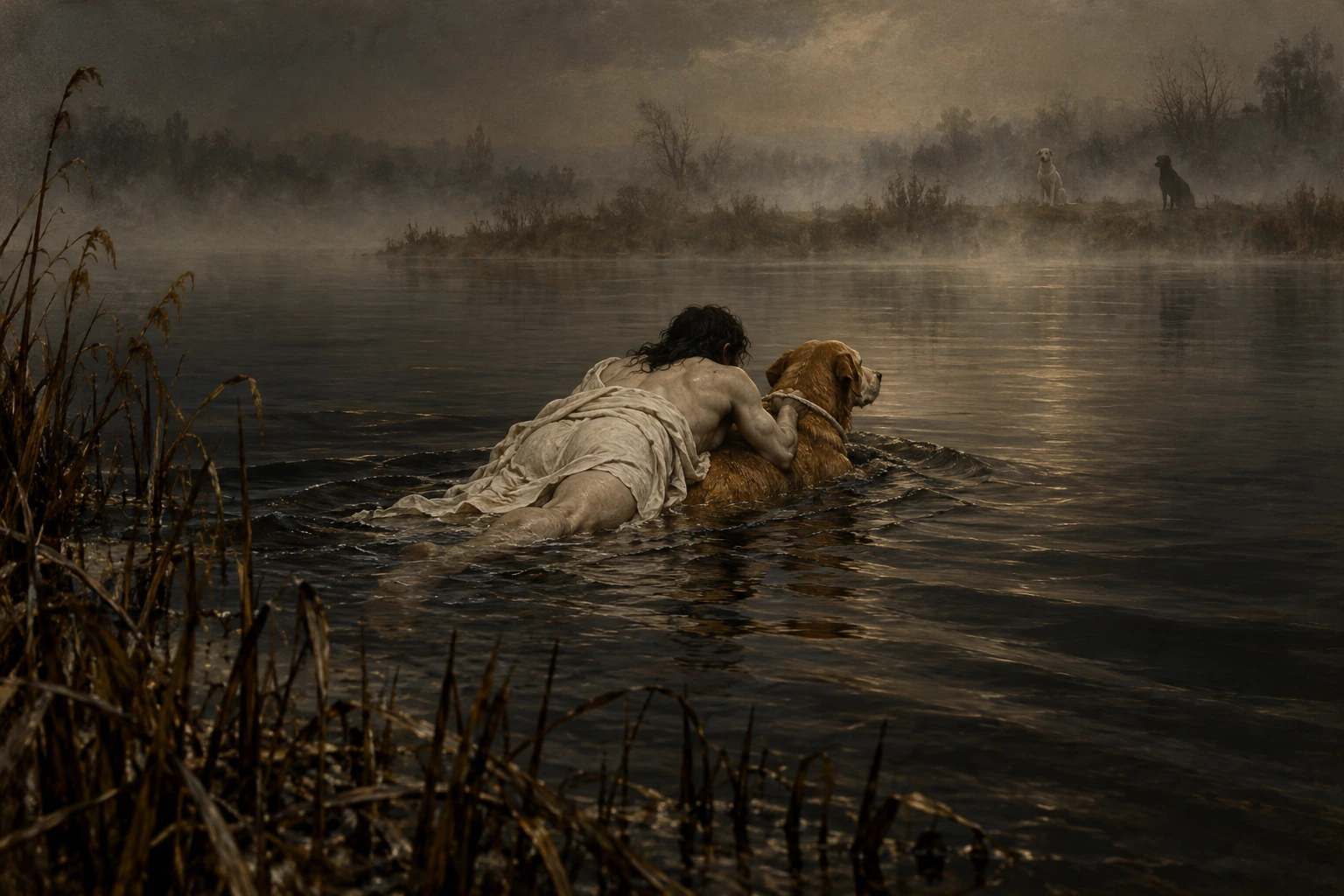
The dead also took a little dog with a loose cotton thread around its neck. In the Spanish its coat is bermejo, reddish; in the Nahuatl it is coztic, yellow. On it the dead swam across a river of the land of the dead called Chiconahuapan.
At last the dead came before Mictlantecuhtli and gave him what they had brought: the papers, bundles of pine torches, tubes for smoking, loose cotton thread and red thread, a cape and a loincloth; a woman gave her skirts and blouses.
1-4 Four Years
At home, the dead person’s belongings were burned eighty days after the death, and again after one year, two, three and four. Only then were the rites complete, for everything offered in this world, they said, reached Mictlantecuhtli.
“And after four years have passed, the dead leaves and goes to the nine hells, where a very wide river runs.” Dogs live on its bank. The dead looks at a dog, and if the dog knows its master, it jumps into the water, swims across and carries him over on its back. That, says the text, is why the people kept and bred little dogs.
Not every dog would do it. A white dog said, “I have washed myself.” A black dog said, “I have stained myself dark, and so I cannot carry you across.” Only the reddish dog could carry the dead. “And so, in this place of hell called Chicunamictla, the dead came to their end.” The Nahuatl column, which calls the place Chicunauhmictlan, says that there they vanished completely.
1-5 Fire and Earth
The dog was killed and burned with its master. Two old men tended the pyre while others sang. Then they washed the ashes and bones with water, put them in a jar with a greenstone, chalchihuitl, and buried it in a room of the house, where offerings were made every day. In the mouth of a dead lord they placed a greenstone, in a commoner’s a lesser stone, “as the heart of the dead”.
For a lord there was more: a paper banner four fathoms long, hung with feathers. And twenty men and twenty women from among his slaves were killed with arrows, to serve him in Mictlan as they had served him on earth. They were buried apart from him.
1-6 The Other Roads
The second place was Tlalocan, the paradise of the rain gods, the tlaloque. There it was always summer, and green maize, squash, amaranth, chillies, tomatoes, beans and flowers never failed. It took those killed by lightning, the drowned, and those who died of leprosy, sores, gout or dropsy. They were not burned but buried, with amaranth seeds on their cheeks, blue on their foreheads, paper on their bodies and a staff in their hands.
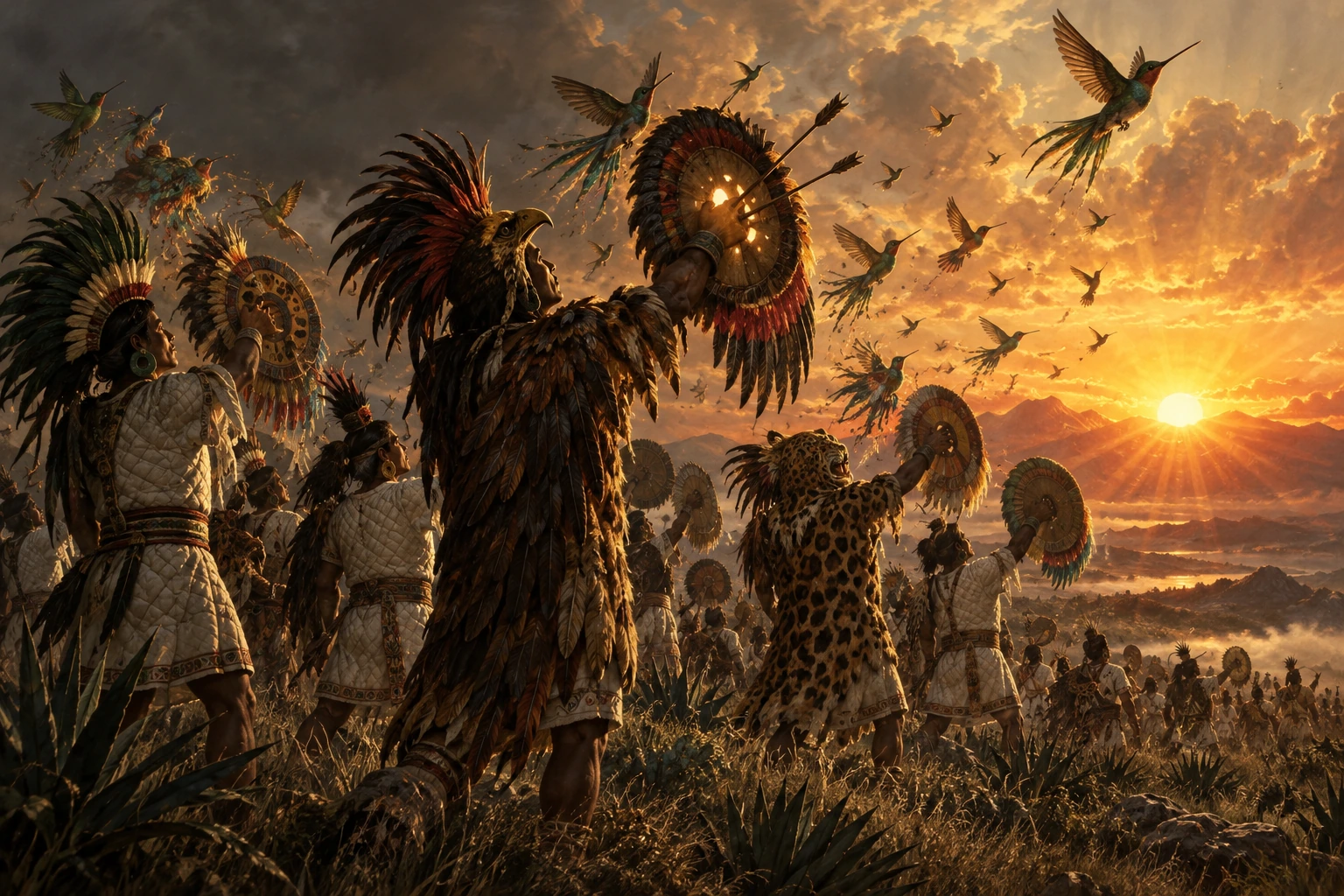
The third place was the House of the Sun, for those killed in war and captives killed by their enemies. They lived on a plain, and when the sun rose they shouted and beat their shields; a warrior whose shield had been pierced by arrows could look at the sun through the holes. After four years they turned into birds of rich plumage and went about sipping the flowers of the sky and of the earth, like hummingbirds.
Book 6 adds two more. Women who died in childbirth also went to the House of the Sun: they lived in the west, which was named Cihuatlampa after them, and every day they carried the sun down from noon to sunset (chapter 29). And small children, who were “like precious stones”, did not go to the fearful place: they went to the orchard of the god Tonacatecuhtli, where they lived like hummingbirds among the flowers. That, the text says, is why children were buried beside the maize bins (chapter 21).
2 Where the Story Is Written Down
- The Florentine Codex, Book 3, appendix, chapters 1–3 (Biblioteca Medicea Laurenziana, Florence): the three places and the funeral, as told in section 1. The Nahuatl and Spanish columns tell the same story at different lengths, and both name the last stage: Chicunauhmictlan in the Nahuatl, Chicunamictla in the Spanish. Book 6, chapters 21 and 29, adds the children and the women who died in childbirth. The Getty Research Institute’s Digital Florentine Codex puts the manuscript beside Arthur J. O. Anderson and Charles E. Dibble’s translation of the Nahuatl and León García Garagarza’s translation of the Spanish (2023).
- The Codex Vaticanus A (Vatican Library, Vat. lat. 3738), also called the Codex Ríos, a book of paintings with Nahuatl glosses and a commentary in Italian. Its calendar tables begin in 1558. On folio 2r the earth, Tlalticpac, sits above eight more places, each with a small picture. Lord Kingsborough’s edition of 1831 reads their names as Apano Huaya, Tepetli Monanamycia, Yztepetl, Yee Hecaya, Pacoecoe Tlacaya, Temimina Loya, Teocoylqualoya and Yzmictlan Apochcaloca. Four carry an Italian gloss in the manuscript: “the passage of the water”, “mountains that come together”, “mountains of razors”, “the place where one is shot with arrows”. Earth and eight make nine. Folio 3r describes hell and its lords, and folio 3v the place of dead children.
- The Legend of the Suns (Codex Chimalpopoca), dated 1558 in its own text. Quetzalcoatl goes down to Mictlan and asks Mictlantecuhtli and his wife, here called Mictlancihuatl, for the bones from which the gods will make people. The lord of the dead sets him a task and then tries to keep the bones; the story belongs to Quetzalcoatl.
3 Competing Versions
- Who goes to Mictlan? In Sahagún, those who die of illness; the drowned and those struck by lightning go to Tlalocan; the war dead and sacrificed captives go to the sun. The Codex Vaticanus A sends to hell “the souls of those who died by the hands of justice, or by disease, or by any other kind of natural or violent death”, except the war dead (Kingsborough’s translation).
- Who rules it? For Sahagún, Mictlantecuhtli, also called Tzontemoc and Acolnahuacatl, with Mictecacihuatl. In the Legend of the Suns, Tzontemoc is a separate god, one of those who do penance over the bones. The Codex Vaticanus A names four lords of hell: the chief, Tzitzimitl, “the same as Miquitlamtecotl, the great god of hell”; Itzpuztec, a lame demon with the feet of a cock; Nextepehua, “the scatterer of ashes”; and Tzontemoc, “he who descends head foremost”. Each had a goddess as a companion, and the Italian commentator likened the four goddesses to “the four Fates, or goddesses of hell, that the poets feign”, naming three Furies and Proserpina.
- What were the four years? Modern retellings often make them a four-year walk through nine levels. In Sahagún they are the years of the funeral offerings, and only after them does the dead go on to the nine hells. The text also places a river crossing twice: once on the way to Mictlantecuhtli, at Chiconahuapan, and again at the end.
- What colour was the dog? Reddish in the Spanish, yellow in the Nahuatl. Anderson and Dibble note that the German scholar Eduard Seler read it as red in one study and as yellow in another.
- Floors, or places? Ana Díaz Álvarez (2009) points out that in the Codex Vaticanus A the heavens are drawn as neat boxes but the places below as “actions or moments of a narrative sequence”, trials the dead must pass, and argues that the Christian, scholastic setting in which the codex was made led its painters to draw the cosmos as stacked levels. Jesper Nielsen and Toke Sellner Reunert, the same year, took apart the familiar model of a universe in layers, “not unlike the cosmic layers of Dante’s Comedy”; it rests, in the journal’s summary of their article, on “a post-conquest European-Aztec hybrid”.
- Where do children go? In the Codex Vaticanus A, to a tree “from which milk distilled”, the chichiualquauitl; and they will come back from there to repeople the world after its third destruction, which is still to come. In the Florentine Codex, to the orchard of Tonacatecuhtli. Modern historians, among them María del Carmen Vázquez Mantecón, call the children’s place Chichihualcuauhco (also spelled Chichihuacuauhco), the place of the nursing tree.
4 History and Tradition
- The clay lords of the dead. In 1994 archaeologists of the Templo Mayor project found two hollow clay statues of Mictlantecuhtli flanking the main door of the north wing of the House of the Eagles, beside the Templo Mayor. Each is 174 cm tall, with a skeletal chest, a liver hanging below the ribs, claws for hands and dozens of holes in the scalp, where curly hair was probably set. They were found broken into hundreds of pieces and restored for the Museo del Templo Mayor. Leonardo López Luján and Vida Mercado date the building to around 1469.
- The months of the dead. The Dominican Diego Durán, writing in the 16th century, calls the ninth month of the Mexica year Miccailhuitontli, “the feast of the little dead”, held for dead children, and the tenth the great feast of the dead. By his reckoning both fell in August.
- All Saints. Durán also writes that in some places people made an offering on All Saints’ Day “for the children, as was their old custom”, and another on All Souls’ Day for the grown dead: money, cacao, wax, birds, fruit and seeds. He suspected, though he would not affirm it, that they had moved the old August feasts to the Christian days.
- The Day of the Dead. UNESCO proclaimed the Indigenous festivity of the Day of the Dead a Masterpiece of the Oral and Intangible Heritage of Humanity on 7 November 2003, and it has been on the Representative List of the Intangible Cultural Heritage of Humanity since 2008. UNESCO’s own description calls it a fusion of pre-Hispanic religious rites and Catholic feasts.
- The dog today. The xoloitzcuintli dog is now widely called the guide of the dead to Mictlan; museums of Mexico’s National Institute of Anthropology and History (INAH) hold children’s workshops on the “Xoloitzcuintle: guía del Mictlan”. Sahagún’s text describes the dog only by the colour of its coat.
The Day of the Dead is often called an Aztec festival, and La Catrina an Aztec goddess of death. Neither is quite right. It is kept at the turn of October and November, on the Catholic feasts of All Saints and All Souls, while the Mexica feasts of the dead that Durán describes fell in August. La Catrina began as a skeleton drawn by José Guadalupe Posada in 1912 and printed in 1913 as a calavera garbancera, a word, the story goes, for people of Indigenous descent who passed themselves off as European. Who named her Catrina is not known, says the historian Agustín Sánchez González; Diego Rivera gave her a central place in his mural Dream of a Sunday Afternoon in the Alameda Central in 1947. López Luján and Mercado, following Carlos Navarrete, date the image of a death “celebrated, loved and always mocked” no earlier than the 1920s, and call projecting it onto the pre-Hispanic world “excessive”.
5 Related Stories
- Quetzalcoatl: The Feathered Serpent: in the Legend of the Suns, Quetzalcoatl goes down to Mictlan for the bones of the dead, and the lord of the dead tries to keep them.
- The Hero Twins: Hunahpu and Xbalanque in Xibalba: the K’iche’ Maya land of the dead. López Luján and Mercado set the two side by side: in the descent to Xibalba, they write, the reader will find “great analogies” with the road to Mictlan, and Xibalba means “place of fear” in K’iche’.
- Osiris: The Murdered King Who Rules the Dead: in the Egyptian Book of the Dead, the heart of the dead is weighed before Osiris. In Sahagún’s account it is the way people died, not a judgement, that decides where they go. We have not found a scholar who compares the two; we link them for the theme.
- The Weighing of the Heart: The Judgement of the Dead: in Sahagún’s account of the Aztec dead, it is the way a person died, not a trial of their life, that decides where they go; in Egypt the heart is weighed against the feather of Maat. We have not found a scholar who compares the two; we link them for the theme.
- Anubis: The Jackal God of Embalming: in Mexica belief a little dog carried the dead across a river, and in Egypt Anubis is the canine who goes with the dead. We have not found a scholar who compares them; we link them for the shared theme of the dog who goes with the dead.
6 Sources
- Bernardino de Sahagún, Florentine Codex, Book 3, appendix, chapters 1–3, and Book 6, chapters 21 and 29: Nahuatl text and English translation by Arthur J. O. Anderson and Charles E. Dibble (School of American Research and University of Utah, 1950–1982); Spanish text ed. Alfredo López Austin and Josefina García Quintana (2000), English translation by León García Garagarza (2023); in the Digital Florentine Codex, ed. Kim N. Richter and Alicia Maria Houtrouw (Getty Research Institute, 2023): Getty, Getty, Getty
- Codex Vaticanus A (Vat. lat. 3738), fols. 2r, 3r and 3v: Vatican Library; English translation of its Italian commentary in Lord Kingsborough, Antiquities of Mexico, vol. 6 (London, 1831), “Explanation of the Codex Vaticanus”, plates II–V: archive.org; contents of the codex: FAMSI
- Legend of the Suns, in Códice Chimalpopoca, Spanish translation by Primo Feliciano Velázquez, 3rd ed. (UNAM, 1992), pp. 119–128: UNAM
- Diego Durán, Historia de las Indias de Nueva España, vol. 2 (Mexico, 1880), “Calendario antiguo”, ninth and tenth months: archive.org
- Ana Guadalupe Díaz Álvarez, “La primera lámina del Códice Vaticano A”, Anales del Instituto de Investigaciones Estéticas 95 (2009), pp. 5–44: UNAM
- Jesper Nielsen and Toke Sellner Reunert, “Dante’s heritage: questioning the multi-layered model of the Mesoamerican universe”, Antiquity 83 (2009), pp. 399–413: Cambridge Core
- Leonardo López Luján and Vida Mercado, “Dos esculturas de Mictlantecuhtli encontradas en el recinto sagrado de México-Tenochtitlan”, Estudios de Cultura Náhuatl 26 (1996), pp. 41–68: UNAM
- María del Carmen Vázquez Mantecón, La muerte y los niños (UNAM, 2018), pp. 33–42: UNAM
- Maya Lorena Pérez Ruiz, “El Día de Muertos como patrimonio cultural inmaterial de la humanidad”, Diario de Campo 2 (2014), pp. 39–51, and INAH, Bulletin 739 (27 October 2023): INAH, INAH
- “El mito nacionalista que inventó La Catrina”, El Universal, 27 October 2021, on the research of the historian Agustín Sánchez González; Mexico City Tourism, “Museo Mural Diego Rivera”: eluniversal.com.mx, mexicocity.cdmx.gob.mx
Cover and illustrations: AI-generated images made for Arcana. They are interpretations, not historical artworks.