Anubis: The Jackal God of Embalming
Anubis kept watch over Egypt's cemeteries from the desert hill and wrapped the dead in linen, and Egyptians carved his name on their tombs in the prayer for a good burial. Yet few texts tell his deeds, and the only story that bears his name is a folk tale about two brothers.
- Type: god of embalming and of the cemetery, guardian of the dead
- Culture: ancient Egypt; later the Greek and Roman world, also as Hermanubis
- Earliest texts: the Palermo Stone’s annals of the 1st Dynasty record a feast of Anubis; he is named in the prayers carved in Old Kingdom tombs; the only story with his name is the Tale of Two Brothers (Papyrus D’Orbiney, about 1200 BCE)
- Key figures: Anubis (Egyptian Anpu), Osiris, Isis, Nephthys, Wepwawet; Anpu and Bata of the Tale of Two Brothers
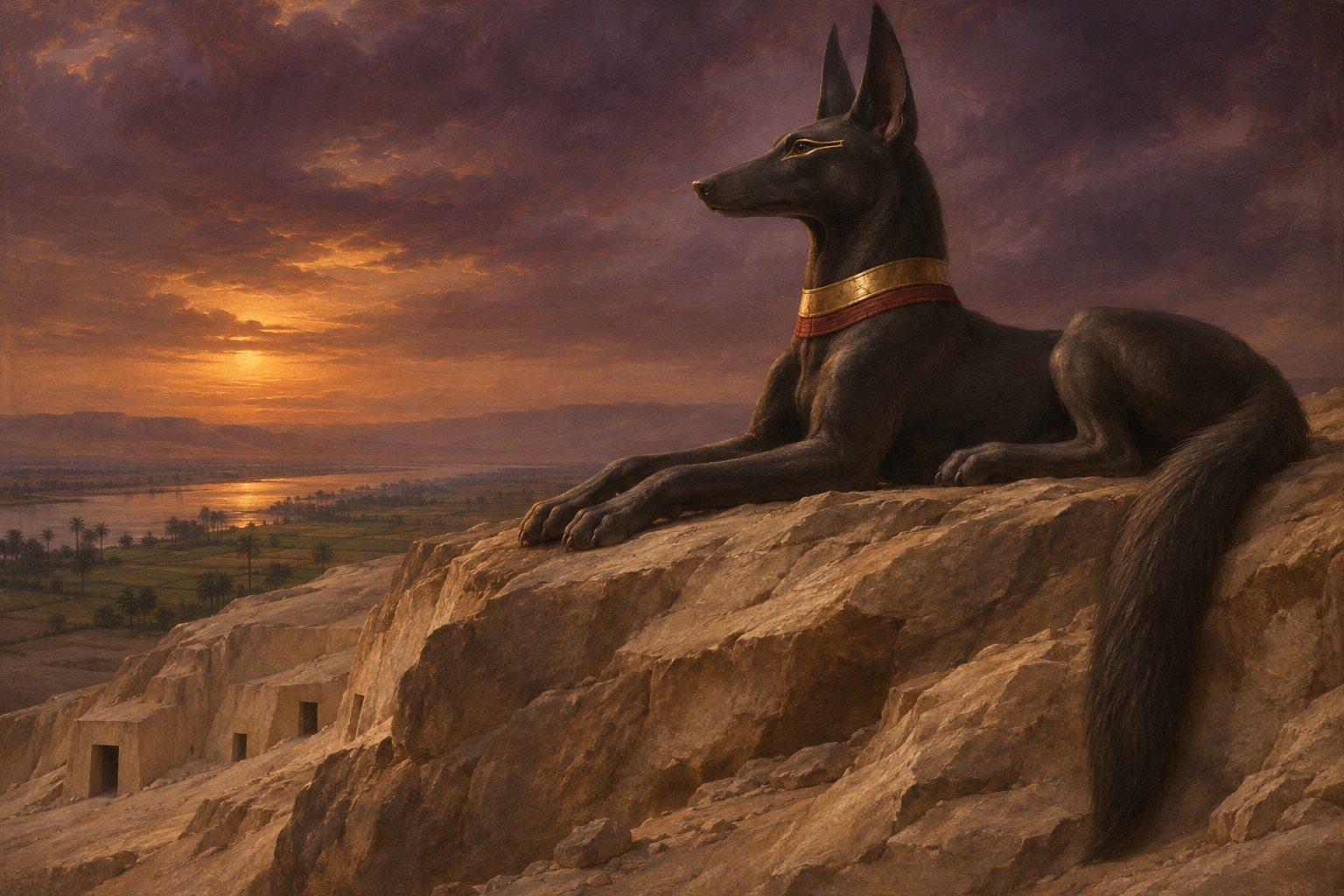
On the edge of the desert, above the cemeteries where wild canids prowled at night, the Egyptians placed a god who would stay on guard. They called him Anpu; the Greeks made it Anubis. He was painted black, he lay on top of tomb chests and shrines, and he stood over the dead in the embalming house. He is one of the gods the Egyptians drew most often. Yet his deeds come down to us as titles, pictures and asides in spells, and the only connected story in which his name appears is a folk tale about two brothers.
Was Anubis the god of death? Not a god who brings death. He was the god of the cemetery and of embalming, who guarded the body and saw it into the tomb. The king and judge of the dead was Osiris. In the judgement scenes Anubis has a smaller, careful job: as E. A. Wallis Budge put it in 1904, his duty was “to examine the tongue of the Great Balance” and see that the beam stayed level.
1 The Telling
No Egyptian text tells the life of Anubis from start to finish. His story has to be put together from Greek writers, from the spells and pictures of the Book of the Dead, from the rite performed at the tomb door, and from one Egyptian tale in which a man bears his name.
1-1 The Child Found by Dogs
Plutarch, the Greek writer and priest of Delphi, tells how Anubis was born (On Isis and Osiris 14). Osiris lay with his sister Nephthys, believing she was Isis, and left a garland of melilot with her, which gave him away. Nephthys, afraid of Seth (Plutarch’s Typhon), her husband, exposed the baby as soon as it was born. Isis went looking for the child, “after great toil and trouble, with the help of dogs which led Isis to it”. She brought him up, and he became her guardian and attendant under the name Anubis, and “it is said to protect the gods just as dogs protect men”.
Diodorus Siculus, a Greek historian of the 1st century BCE, gives him a warrior’s part instead. When Osiris set out to civilize the world, he took with him his two sons Anubis and Macedon, “Anubis wearing a dog’s skin and Macedon the fore-parts of a wolf”, and that, says Diodorus, is why the Egyptians honour these animals (1.18).
1-2 The First Embalmer
The Egyptian spells take for granted something Plutarch never says: that Anubis prepared the body of Osiris for burial, and so every body after him. In the Book of the Dead every dead person is “the Osiris” so-and-so, and the embalming of each one replays his.
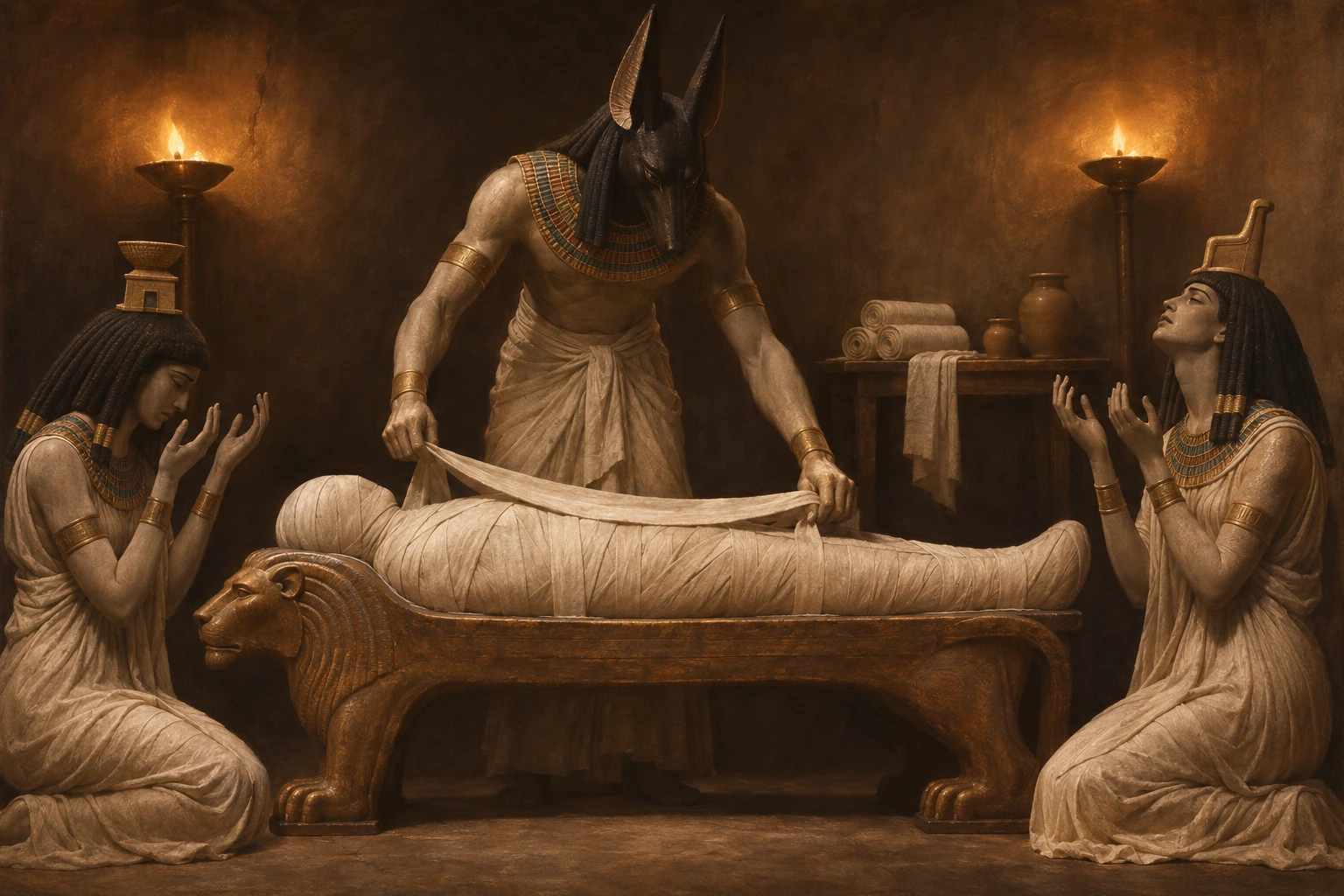
Spell 151 sets the scene in the embalming chamber. “The god Anpu, who dwelleth in the [city of] embalmment, the governor of the divine house, placeth his two hands upon” the body. Its picture shows him bending over the mummy on its bier, with Nephthys kneeling at the head and Isis at the foot. “Ptah-Seker hath bound thee up,” the text tells the dead, “Anpu hath exalted thee.” In spell 145 the dead claim to have washed “in the water wherein the god Anpu washed when he had performed the office of embalmer and bandager”. Budge, summing up the tradition in 1904, wrote that Anubis wrapped Osiris “in the linen swathings which were woven by Isis and Nephthys for their brother”. He cites no single text for it: the spells and pictures tell it piece by piece.
1-3 At the Door of the Tomb
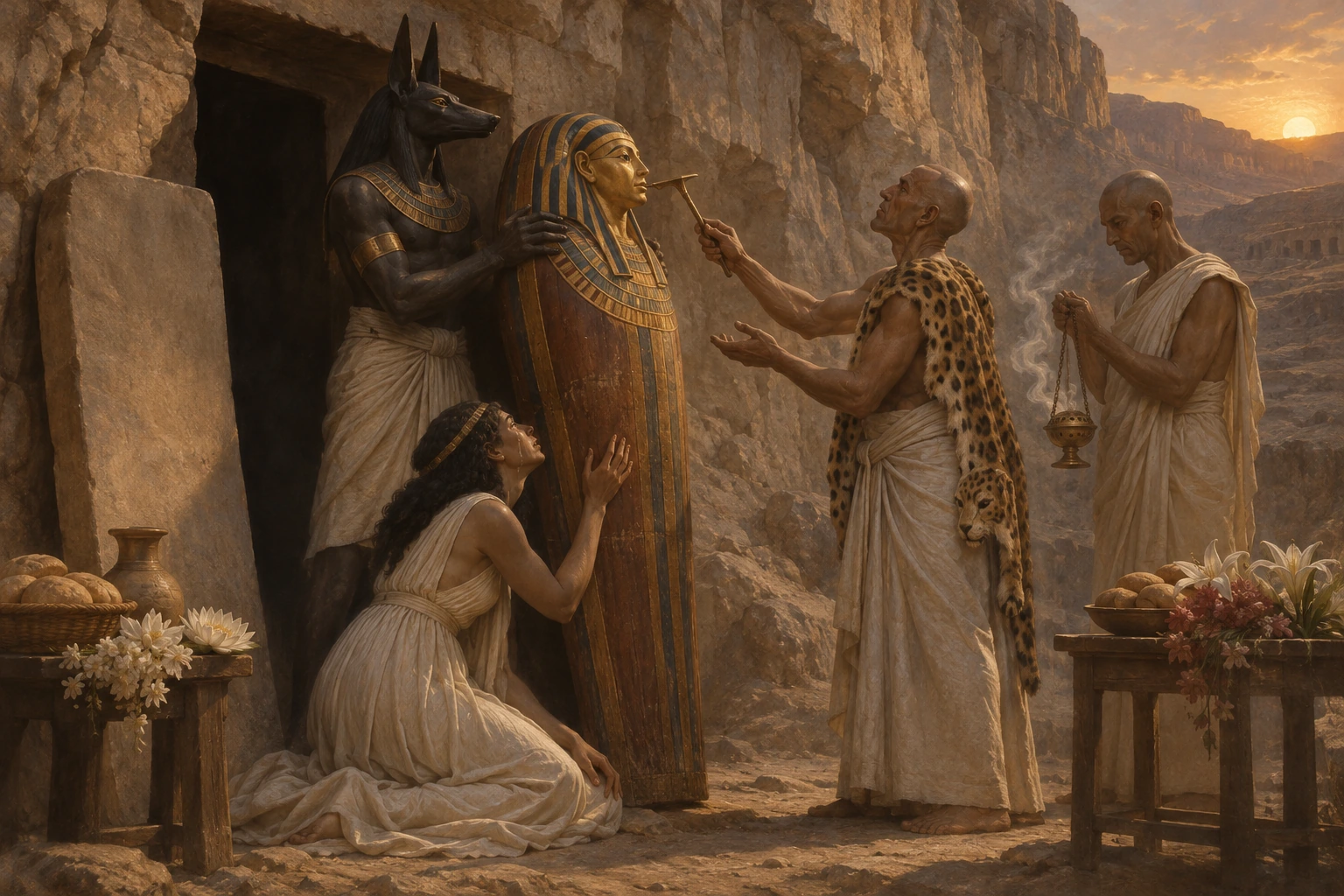
When the embalming was done, the body was carried to the tomb, and Anubis met it there. In the Book of the Dead papyrus of Hunefer, from the 19th Dynasty, “Anubis supports the mummy” upright before a tomb in the Theban hills, with Hunefer’s wife before it, while two priests perform the Opening of the Mouth (Budge’s description, 1909). In this rite, priests touched the mouth and eyes of the mummy or of a statue with tools, so that the dead would live and act again. In the version carved in the tomb of Seti I, the priest says: “I have opened for thee thy mouth with the instrument of Anpu (Anubis), with the Meskha of iron wherewith were opened the mouths of the gods.” Then the king “hath obtained the power of speech”.
1-4 Anpu and Bata
The one Egyptian story in which Anubis appears by name is a tale, not a myth: the Tale of Two Brothers, copied about 1200 BCE. Its elder brother is called Anpu. This retelling follows the translation that F. Ll. Griffith made “word for word” for Flinders Petrie’s Egyptian Tales (1895).
Anpu had a house and a wife, and his younger brother Bata lived with him like a son. Bata ploughed, reaped and herded, and the cattle spoke to him and told him where the best grass grew. One day Anpu sent him home for seed corn. Anpu’s wife, dressing her hair, admired his strength and asked him to lie with her. Bata grew “like a panther of the south with fury”: she was like a mother to him, his brother like a father. He promised to tell no one.
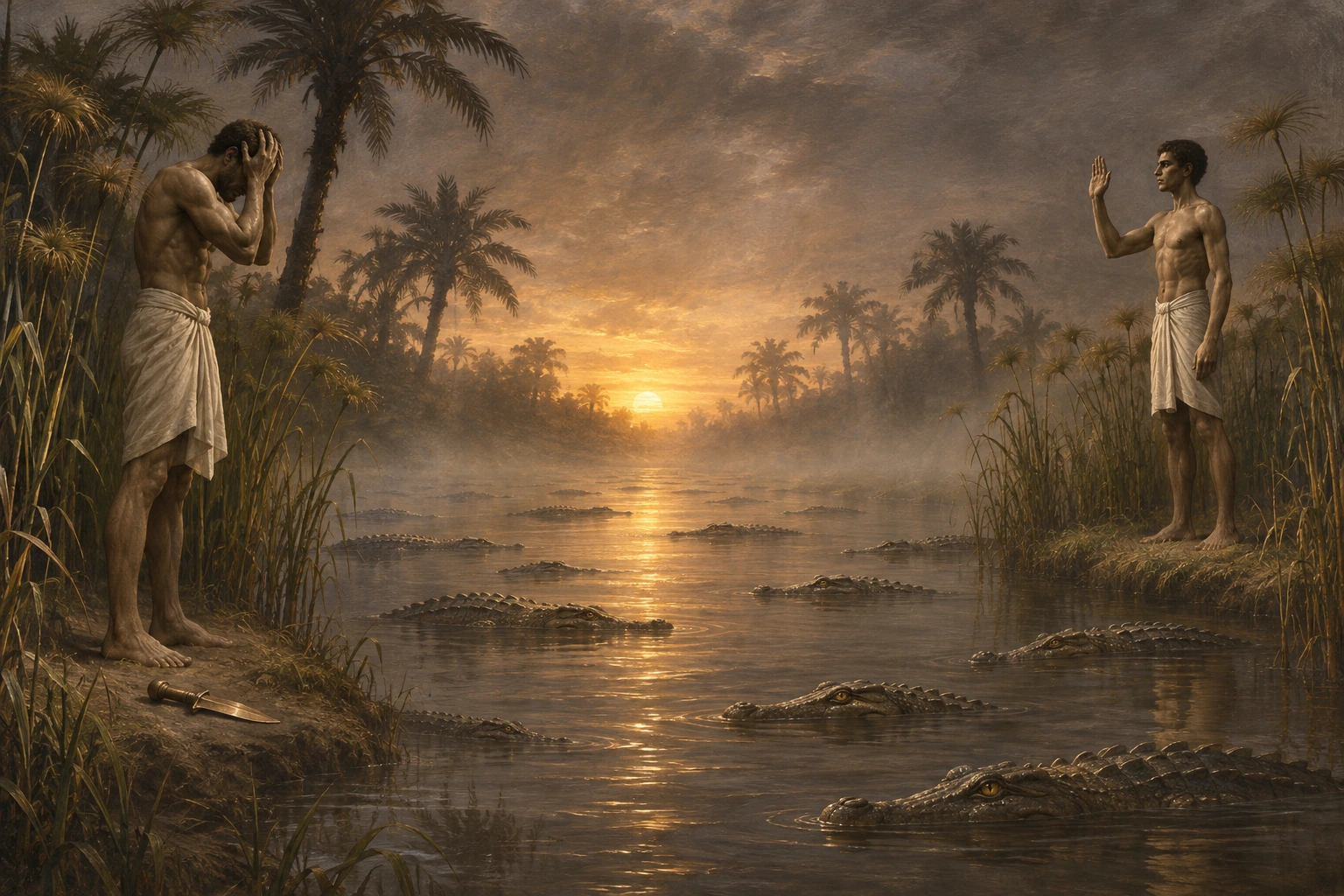
She was afraid. That evening she made herself look beaten and told Anpu that Bata had attacked her. Anpu sharpened his knife and waited behind the stable door. But the first cow to come in warned Bata, and the next did too. He saw his brother’s feet under the door and ran. He cried out to the sun god Ra-Harakhti, and the god put a wide water full of crocodiles between the brothers.
At dawn, across the water, Bata told the truth. To swear to it, he cut off part of his own flesh and threw it into the water, where a fish swallowed it. He said he would go to the Valley of the Acacia and set his heart on the top of its flower. If ever Anpu’s beer frothed in his cup, Bata would be dead, and Anpu must come and search for the heart. Anpu went home, killed his wife, threw her to the dogs, and mourned his brother.
1-5 The Heart on the Flower
In the valley the Nine Gods took pity on Bata, and the god Khnum made him a wife; the seven Hathors foretold that she would die “a sharp death”. The sea carried a lock of her hair to Egypt, and its scent got into Pharaoh’s linen. Pharaoh sent for her, made her his favourite, and at her word had the acacia cut down. Bata fell dead.
Anpu’s beer frothed. He went to the valley, found his brother lying dead, and searched for the heart for three years. In the fourth he found it as a seed, put it in a cup of cold water, and Bata drank and lived. Bata became a great bull, and Anpu rode him to Pharaoh’s court. The wife had the bull sacrificed, and two drops of its blood grew into two persea trees by the palace gate. She had the trees cut down for planks. A chip flew into her mouth, and she bore a son, who was Bata. Pharaoh made the boy his heir. When he became king, Bata judged his wife before the nobles, made Anpu crown prince, and reigned for thirty years. At his death Anpu took his place.
2 Where the Story Is Written Down
- The Palermo Stone, annals of the earliest kings. Under a king of the 1st Dynasty it records a feast that James Henry Breasted translated “Birth of Anubis” (1906).
- Old Kingdom tombs, about 2686–2160 BCE. The biography of Metjen, from the end of the 3rd Dynasty, makes him governor of “the Anubis nome”, the 17th province of Upper Egypt (Breasted). The prayer carved for the dead, the offering formula, asks the king and a god for offerings and a good burial. On the false door of the lady Khenit at Giza, from the late Old Kingdom, it begins: “An offering, which the king gives, an offering, which Anubis (gives), who is at the forefront of the divine hall, may she be buried in the west, after a good old age”. Only the next line turns to Osiris, lord of Busiris (translation of the Global Egyptian Museum).
- His titles. A Middle Kingdom stela from Abydos (Leiden V 3) prays to “Anubis, who is upon his mountain, who is in the embalming place, lord of the sacred land” (ORAEC translation). The mountain is the desert height above the cemetery, “the funeral mountain” in Budge’s words; the sacred land is the necropolis.
- The Pyramid Texts, from the pyramid of Unas, about 2350 BCE. Budge noted a passage in which the king’s face is said to be that of Anubis.
- The Book of the Dead, from the New Kingdom onward: spells 145 and 151 and the funeral pictures (sections 1-2 and 1-3); in spell 125, the judgement, he tends the scales (see The Weighing of the Heart). The rite of Opening the Mouth survives in copies of the 19th, 20th and 26th Dynasties, edited by Budge (1909), among them the tomb of Seti I.
- Papyrus D’Orbiney (British Museum EA 10183), the only copy of the Tale of Two Brothers. Petrie says the British Museum bought it in 1857 and that it had belonged to Seti II when he was crown prince. Adolf Erman names its copyist as “the young scribe Ennana”, about 1200 BCE.
- Greek and Latin writers: Herodotus (2.86), Diodorus (1.18, 1.87, 1.91), Strabo (17.1.40), Plutarch (chapters 14, 38, 44, 61, 72), Vergil (Aeneid 8.698), Apuleius (Metamorphoses 11.11) and Appian (Civil Wars 4.47).
3 Competing Versions
- Whose son? In Plutarch, the son of Nephthys and Osiris, brought up by Isis, who “treated the child as if it were her own” (44). In Diodorus, a son of Osiris who rides to war beside him. Budge reported Egyptian traditions in which his father was Osiris, or Seth, or Ra.
- Why a dog? Diodorus gives two answers: he was shown with a dog’s head because he was “the bodyguard of Osiris and Isis”; or because dogs guided Isis in her search and guarded her, which is why “at the Festival of Isis the procession is led by dogs” (1.87). Plutarch makes Anubis the horizon, shared by Nephthys below the earth and Isis above it, “represented in form like a dog; for the dog can see with his eyes both by night and by day alike” (44).
- Which animal? Howard Carter, studying the figure of Anubis from Tutankhamun’s tomb (section 4), saw the body of a dog with “the long, straight tail of the fox”, and guessed at a tamed jackal crossed with another canid. Two zoologists of Egypt’s wild mammals, Dale Osborn and Ibrahim Helmy, leaned to a fox (1980).
- Anubis or Wepwawet? Another canine god, Wepwawet, “Opener of the ways”, was lord of Asyut. Budge found the two “sometimes confused in the texts” but took them for distinct gods. Plutarch says the people of Lycopolis, Asyut’s Greek name, held the wolf to be a god (72).
- A god in a folk tale? Erman (1927) read the Tale of Two Brothers as a myth turned into a story: at Saka, in the New Kingdom, a god called Bata “was worshipped side by side with the chief local divinity Anubis”. Petrie compared Bata’s deaths and rebirths with those of Attis, and called the lock of hair sent to Pharaoh “plainly an early form of the story of the little slipper”.
- Acacia or cedar? Griffith’s translation has the Valley of the Acacia; Erman’s has the Valley of the Cedar, a name he thought came from tales of Lebanon, where Egypt got its timber. Petrie’s text says only that Bata cut off part of his flesh; Erman says plainly that it was his member, and notes that a fish swallowing it “is an incident in the Osiris legend”.
4 History and Tradition
- Cynopolis. The Greek geographer Strabo comes to “the Cynopolite Nome, and to Cynopolis”, the city of dogs, where “Anubis is held in honour” and “a form of worship and sacred feeding has been organised for all dogs” (17.1.40). Plutarch reports that in his own day the people of Oxyrhynchus, across the river, caught a dog and ate it, because the Cynopolites ate their sacred fish; the two towns went to war until the Romans punished both (72).
- The Catacombs of Anubis. Near the temple of Anubis at North Saqqara, tunnels thought to have been dug in the 4th century BCE held millions of animal mummies. Paul Nicholson, Salima Ikram and Steve Mills published a survey of them in 2015; Archaeology magazine, reporting it, says that “more than 90 percent” of the mummies were of dogs, many of them very young puppies. We have read the report, not the article’s own count.
- The embalmers. Herodotus, writing about 430 BCE, describes men “whose sole business this is”. They showed families wooden models of the three methods, the finest belonging to one “whose name it would be impious for me to mention”, kept the body in natron (Godley’s “saltpetre”) for seventy days, then wrapped it “in bandages of fine linen cloth” (2.86). Diodorus adds that the embalmers were “considered worthy of every honour”, even went in and out of the temples like priests, while the man who made the first cut was chased off with stones (1.91).
- The mask. A clay mask of Anubis in the Roemer- und Pelizaeus-Museum, Hildesheim (inv. 1585), 49 cm high, has two small holes for the eyes and two slits for the shoulders: it was made, it seems, to be worn. It dates from the Late Period (664–332 BCE). A cartonnage mask in Harrogate, England, was “likely worn by a priest playing the part of Anubis”.
- The colour. Anubis is black in almost every image. The Rosicrucian Egyptian Museum explains that black “represented the fertile soil of the Nile”, and so stood for “good fortune and rebirth”; the American Research Center in Egypt, for “regeneration”.
- Tutankhamun’s Anubis. In the tomb found in 1922, when Carter’s team turned at last, “after four years’ patient waiting”, to the room beyond the burial chamber, its doorway was blocked by “the black figure of the jackal-like dog Anubis, covered with linen”. Life-size, of wood “varnished with black resin”, with eyes of gold, calcite and obsidian, he lay on a gilded shrine with carrying poles, facing west “to guard against the intruder”. A linen shirt covered him, and under it a fine shawl, with a scarf and collars of flowers at his neck. He is registered in the Egyptian Museum, Cairo, as JE 61444.
- Rome. In Vergil’s picture of the battle of Actium, “barking Anubis” (latrator Anubis) fights for the queen of Egypt against Neptune, Venus and Minerva. In Apuleius’s novel he walks in the procession of Isis, “the dread go-between of the gods above and below, his face now black, now gold”, raising his dog’s neck, with a herald’s staff in his left hand and a green palm in his right. Appian tells how Volusius, an aedile on the triumvirs’ list of the proscribed, escaped by borrowing the linen robe of a friend who was a priest of Isis and putting on “the dog’s head” (Civil Wars 4.47).
- Hermanubis. The Greeks identified Anubis with their god Hermes, and Plutarch already knows the name Hermanubis (61). A marble statue from Alexandria, now in the Graeco-Roman Museum there (JE 25785), shows him with a palm branch, a dog at his side and a basket-shaped crown, and he appears on coins struck for the provinces of Egypt in the 2nd century CE.
“Anubis is a jackal” is how almost every book puts it, our title included. But the wild canid of Egypt, long filed as the golden jackal, is something else. In 2015 a genome-wide study (Koepfli and others) showed that Africa’s “golden jackal” had been apart from the Eurasian one for more than a million years, and named it the African golden wolf. Koepfli and others called it Canis anthus; Viranta and others (2017) argue that its valid scientific name is Canis lupaster, from specimens collected in the Fayum in the early 19th century. And most of the animals buried for Anubis at Saqqara were dogs, as Archaeology reported of the 2015 survey.
5 Related Stories
- The Weighing of the Heart: The Judgement of the Dead: the god who checks the balance there is, first of all, the embalmer who prepared the body for the hall.
- Osiris: The Murdered King Who Rules the Dead: Plutarch tells there how Seth killed his brother and Isis gathered the body, the body Anubis wrapped in linen.
- Tấm and Cám: The Girl Who Came Back: Emmanuel Cosquin opened his discussion of the heroine’s deaths and returns with the Tale of Two Brothers, whose hero comes back as a bull and as two trees. Petrie, for his part, saw in the lock of hair “an early form of the story of the little slipper”.
- Mictlan: The Nine Places of the Dead: in Mexica belief a little dog carried the dead across a river on the road to the lord of Mictlan. We have not found a scholar who compares it with Anubis; we link them for the shared theme of the dog who goes with the dead.
6 Sources
- Plutarch, On Isis and Osiris, chapters 14, 38, 44, 61 and 72, trans. Frank Cole Babbitt (Loeb, 1936): LacusCurtius
- Diodorus Siculus, Library of History 1.18, 1.87 and 1.91, trans. C. H. Oldfather (Loeb, 1933): LacusCurtius
- Strabo, Geography 17.1.40, trans. Horace Leonard Jones (Loeb, 1932): LacusCurtius
- Herodotus, Histories 2.86, trans. A. D. Godley (1920): Perseus
- Vergil, Aeneid 8.698, and Apuleius, Metamorphoses 11.11, Latin text: The Latin Library, The Latin Library; Apuleius, The Golden Asse, trans. William Adlington (1566): Project Gutenberg; Appian, Civil Wars 4.47 (Loeb, 1913): LacusCurtius
- Tale of Two Brothers (Papyrus D’Orbiney, British Museum EA 10183), trans. F. Ll. Griffith, in W. M. Flinders Petrie, Egyptian Tales, second series (1895; 2nd ed. 1913): Project Gutenberg; and in Adolf Erman, The Literature of the Ancient Egyptians, trans. Aylward M. Blackman (1927), pp. 150–161: archive.org
- Book of the Dead, spells 145 and 151, trans. E. A. Wallis Budge, The Book of the Dead: An English Translation of the Chapters, Hymns, etc., of the Theban Recension, vol. 2 (1901): archive.org
- E. A. Wallis Budge, The Book of Opening the Mouth, vol. 1 (1909): archive.org; and The Gods of the Egyptians, vol. 2 (1904), chapter 16, “Anpu, or Anubis”, pp. 261–266: archive.org
- James Henry Breasted, Ancient Records of Egypt, vol. 1 (1906), §§ 91, 100, 170–173: archive.org
- False door of Khenit, Giza: Global Egyptian Museum; stela of Antefiqer (Leiden V 3), offering formula: ORAEC; Anubis mask, Hildesheim, inv. 1585: Global Egyptian Museum; statue of Hermanubis, Alexandria, JE 25785: Global Egyptian Museum; Anubis mask, Harrogate: MyLearning
- Howard Carter, The Tomb of Tut.ankh.Amen, vol. 3 (1933), pp. 33–44: archive.org; Carter’s object cards for no. 261: Griffith Institute
- Paul T. Nicholson, Salima Ikram and Steve Mills, “The Catacombs of Anubis at North Saqqara”, Antiquity 89 (2015), pp. 645–661: Cambridge Core; “Dog Catacomb at Saqqara Surveyed”, Archaeology (2015): archaeology.org
- Klaus-Peter Koepfli and others, “Genome-wide Evidence Reveals that African and Eurasian Golden Jackals Are Distinct Species”, Current Biology 25 (2015), pp. 2158–2165: NSUWorks; Suvi Viranta and others, “Rediscovering a forgotten canid species”, BMC Zoology 2 (2017): doi.org; Dale J. Osborn and Ibrahim Helmy, The Contemporary Land Mammals of Egypt (including Sinai) (Field Museum, 1980), pp. 366–367: archive.org
- Rosicrucian Egyptian Museum, “Anubis”: egyptianmuseum.org; American Research Center in Egypt, “The Story of Anubis”: Google Arts & Culture
Cover and illustrations: AI-generated images made for Arcana. They are interpretations, not historical artworks.