Amun: The Hidden God of Thebes
His name meant "the hidden one", yet Amun of Thebes became king of the gods, the divine father of pharaohs and, for the Greeks, the Zeus Ammon whose desert oracle greeted Alexander as a son. One pharaoh had his name cut out of the temples, and a boy king put it back.
- Type: god, the local god of Thebes who became king of the gods
- Culture: ancient Egypt; honoured by the Greeks as Zeus Ammon, from the oasis of Siwa to Greek Thebes
- Earliest texts: named with his consort Amaunet in the pyramid of Unas (about 2350 BCE); hymns of the New Kingdom such as Papyrus Leiden I 350 (13th century BCE); Greek accounts from Herodotus (about 430 BCE) to Arrian (2nd century CE)
- Key figures: Amun (Amun-Ra), Amaunet, Mut, Khonsu, Khnum, Queen Ahmose, Hatshepsut, Akhenaten, Alexander the Great
Most Egyptian gods could be pointed at: a falcon, a cow, the disk of the sun. Amun’s name said that he could not be seen. He was a god of Waset, the city the Greeks called Thebes, and when Theban princes became kings of all Egypt, their god rose with them. By the New Kingdom he was Amun-Ra, “king of the gods”, and his temple at Karnak went on growing for more than 1,500 years.
What does “Amun” mean? “The hidden one”, as far as anyone can tell. Plutarch reports that the Egyptian priest Manetho took the name to mean “concealed” or “concealment”, and the Theban hymns play on it: Amun is the god “whose name is hidden from the gods” (Papyrus Leiden I 350, in Blackman’s translation of Erman). Another Greek writer, Hecataeus of Abdera, thought it was simply a word for calling out to someone.
1 The Telling
No Egyptian text tells Amun’s story from beginning to end. What follows are four scenes: how the Theban hymns describe him, how a queen claimed him as her father, how the Thebans explained his ram’s head to a Greek visitor, and how he greeted a Macedonian king in the desert.
1-1 The God No One Knew
The hymns of Papyrus Leiden I 350 say that Amun came into being first, “when as yet there was nought”. No god existed before him to tell him his shape. He had no mother to give him his name and no father to beget him: he “shaped his egg himself”. The Eight gods were “thy first form”. (How Egypt’s cities told the first days of the world, the Eight of Hermopolis among them, is the story of Atum.) When everything was silent, Amun broke into speech with a cry, as “the Great Cackler”, and Erman explains that he flew as a goose over the primeval water.
Yet he stayed hidden, even from the gods. “His image is not spread out in books”, the hymn says, and anyone who spoke his secret name aloud “falleth down dead on the spot for terror”. Chapter 300 of the hymns sums it up: “Three are all gods”, Amun, Re and Ptah, “and there is none like them. Hidden is his name as Amun, Re belongeth to him as face (?), and Ptah is his body.” Their three cities, Thebes, Heliopolis and Memphis, would last forever.
1-2 The Father of a Queen
On the walls of her temple at Deir el-Bahari, Hatshepsut, the queen who ruled as pharaoh (about 1473–1458 BCE), told how she was born. Amun sat enthroned before twelve gods, and the damaged text still lets us read his promise to give her “all lands, all countries”. Thoth told him whom to visit: Ahmose, the wife of King Thutmose I.
Amun took on the likeness of the king. He found the queen asleep in her palace, and she woke at the fragrance of the god, for “all his odors were from Punt”, the land of incense. Then he let her see him in his own form as a god, and he named the child: Khnemet-Amun-Hatshepsut, who “shall exercise the excellent kingship in this whole land”.
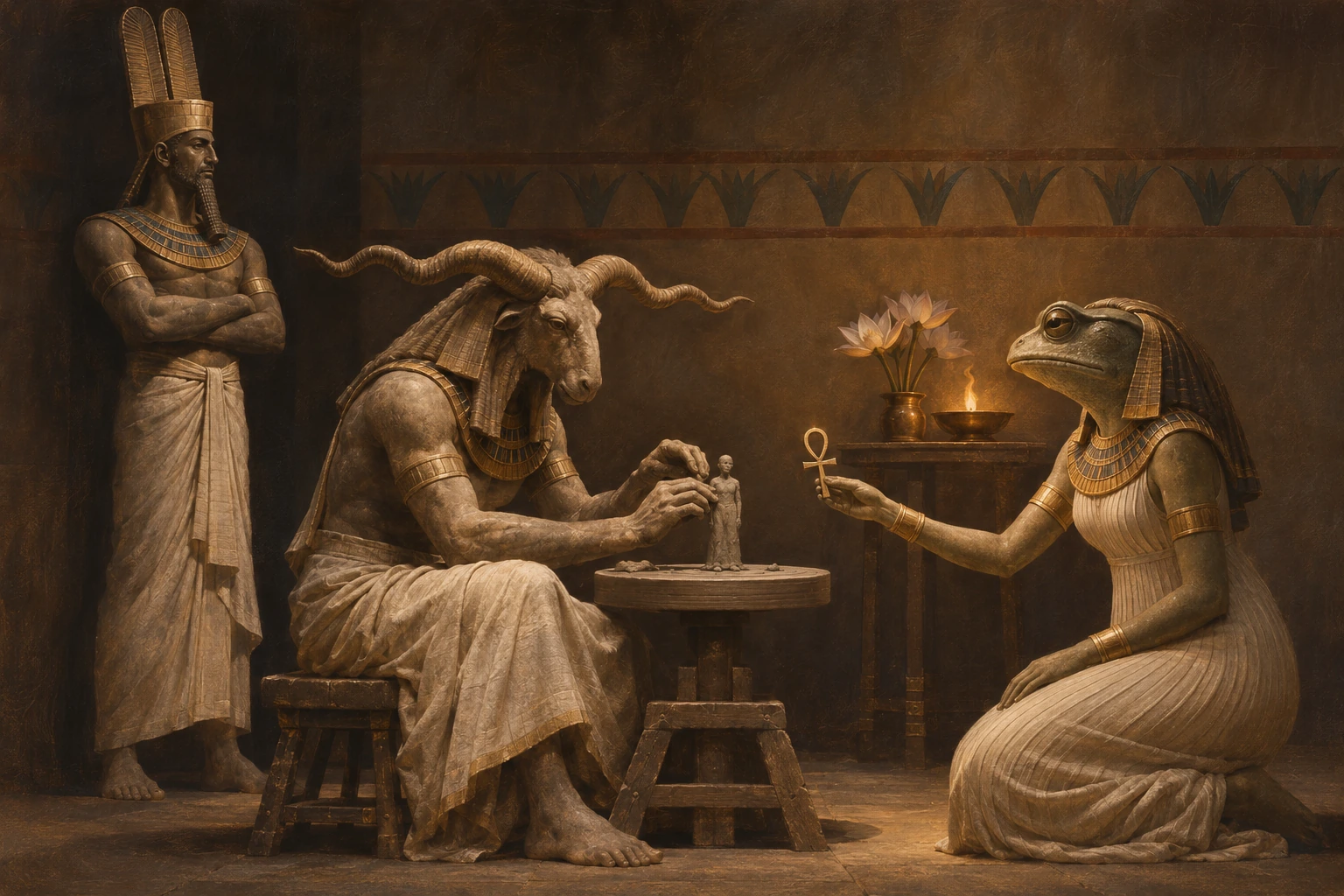
Amun then sent for Khnum, the potter god, to shape his daughter “better than all gods”. Khnum sat at his wheel and fashioned the child and her ka, the part of a being that holds its life force, while the frog-headed goddess Heket held out the sign of life. Goddesses attended the birth, and Hathor brought the child to her father. “Glorious part which has come forth from me”, Amun called her, a king “upon the Horus-throne forever”.
1-3 A Ram’s Fleece
Herodotus, writing about 430 BCE, gives the Thebans’ own reason why their god had a ram’s head. Heracles wanted very much to see Zeus, but Zeus did not want to be seen. At last, when Heracles prayed, Zeus flayed a ram, cut off its head and showed himself “displaying the head and wearing the fleece”. That is why Egyptian images of the god have a ram’s head, and why the Thebans would not sacrifice rams, “for the Egyptians call Zeus ‘Amon’”. Once a year, at the god’s festival, they killed one ram, put its fleece on the statue, brought an image of Heracles near it, mourned the ram and buried it in a sacred coffin (Histories 2.42).
1-4 The Oracle in the Desert
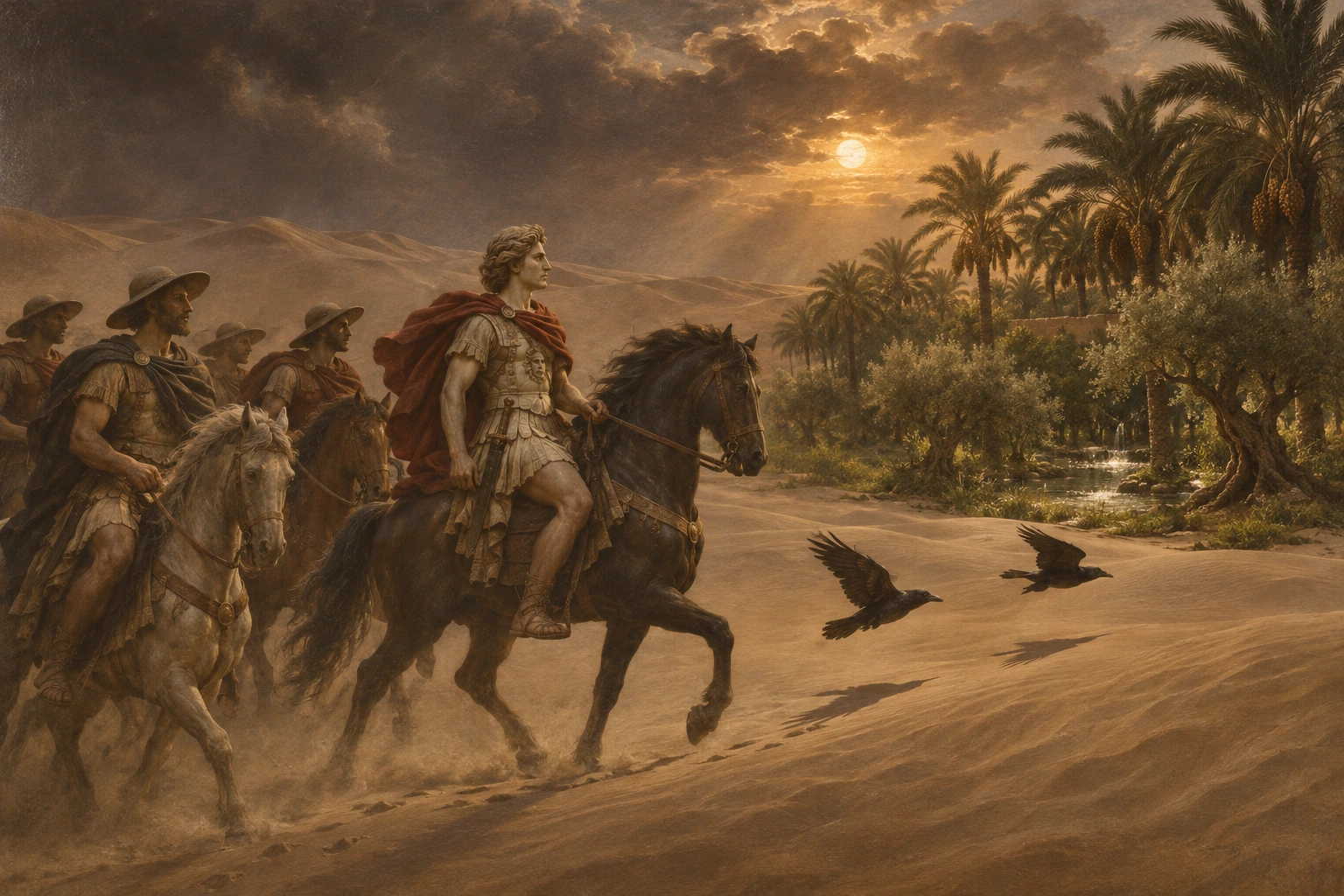
Alexander the Great, who had just taken Egypt from the Persians, decided to consult Ammon in Libya, as Perseus and Heracles were said to have done. He went west along the coast to Paraetonium and then turned inland, across sand without water or landmarks. Rain fell when the army needed it, but the south wind covered the tracks, and even the guides lost the way. Then guides of another kind appeared. Plutarch says ravens flew ahead, waiting when the men fell behind, and Callisthenes adds that their cries called back stragglers in the night.
The oasis was full of palms and olive trees, with a spring that ran cold at noon and warm at midnight (Arrian, Anabasis 3.3–4). There the prophet of Ammon greeted Alexander from the god “as from a father”. Alexander asked whether any of his father’s murderers had escaped him. The prophet told him to guard his speech, “since his was not a mortal father”. Alexander rephrased the question, and asked too whether he would rule all mankind. The god answered that Philip was fully avenged and that the rule was given to him (Plutarch, Alexander 27). Arrian, more guarded, says only that he heard “what was agreeable to his wishes, as he himself said”.
2 Where the Story Is Written Down
- The Pyramid Texts. Amun and his female counterpart are already named in the pyramid of Unas, right after a pair Budge calls Nau and Nen, gods of the watery abyss. Budge, in 1904, read this as proof that “even in the remote period of the Vth Dynasty” they were counted among the primeval gods.
- The temple at Karnak. The first firm evidence of Amun’s temple is a column inscribed by the 11th-Dynasty king Intef II for Amun-Ra. Senusret I of the 12th Dynasty rebuilt it in limestone and added the “White Chapel”, which Amenhotep III later used as fill for a pylon and which now stands in Karnak’s Open Air Museum (Digital Karnak).
- The birth reliefs of Hatshepsut, in the middle colonnade of her temple at Deir el-Bahari, uncovered by Naville’s excavations from 1894. Amenhotep III repeated the same scenes at Luxor. Breasted, who translated both in 1906, set the two copies side by side, because the Deir el-Bahari reliefs had been attacked twice: by Thutmose III, who erased the queen, and by Akhenaten, who erased Amun.
- Papyrus Leiden I 350, bought for the Leiden museum in 1829. Its back carries the report of an official’s voyage dated to year 52 of Ramesses II, and J. Zandee judged the hymn’s handwriting to be of the same time; Erman, in Blackman’s translation, instead places the papyrus in the time of Ramesses IX. We follow Zandee, whose edition is the museum’s own. Each poem has a number, and Erman suggested the work was called The Thousand Songs, though by counting units, tens and hundreds it reaches a thousand with only twenty-eight.
- The Restoration Stela of Tutankhamun, a red granite slab found at Karnak and now in Cairo. It records how the temples had fallen into ruin under Akhenaten.
- Greek and Roman writers: Herodotus 2.42 and 2.54–55; Plutarch’s On Isis and Osiris 9 on the name; Arrian’s Anabasis 3.3–4, Plutarch’s Alexander 26–27, Diodorus 17.49–51 and Strabo 17.1.43 on Alexander at Siwa.
3 Competing Versions
- What does the name mean? Manetho said “concealed”; Hecataeus said it was a form of address, used for the supreme god as if calling on him to show himself (both in Plutarch). Budge noted that late texts linked the name with men, “to abide”, and the Japanese encyclopedia Nipponica mentions a reading from a Libyan-Berber word aman, “water”.
- A daughter carved as a son. On Khnum’s wheel the sculptor carved two boys, the child and her ka, although every pronoun Khnum speaks is feminine. Breasted took this as proof that the scenes were copied from traditional models made for a male king.
- Serpents or ravens? Arrian gives both of his sources: Ptolemy, son of Lagus, who later ruled Egypt, says two serpents went before the army “uttering a voice”; Aristobulus says two ravens. Callisthenes, as Strabo reports him, also says two crows.
- What did the god say? Plutarch adds that Alexander wrote to his mother of “certain secret responses”. He also reports a story that the prophet meant to say O paidion, “O my son”, but, speaking Greek as a foreigner, said O paidios, which was taken for O pai Dios, “O son of Zeus”. In Diodorus the prophet says “Rejoice, son”. Strabo dismisses Callisthenes’ version as flattery: there, the god answered mostly “by nods and tokens”, not in words.
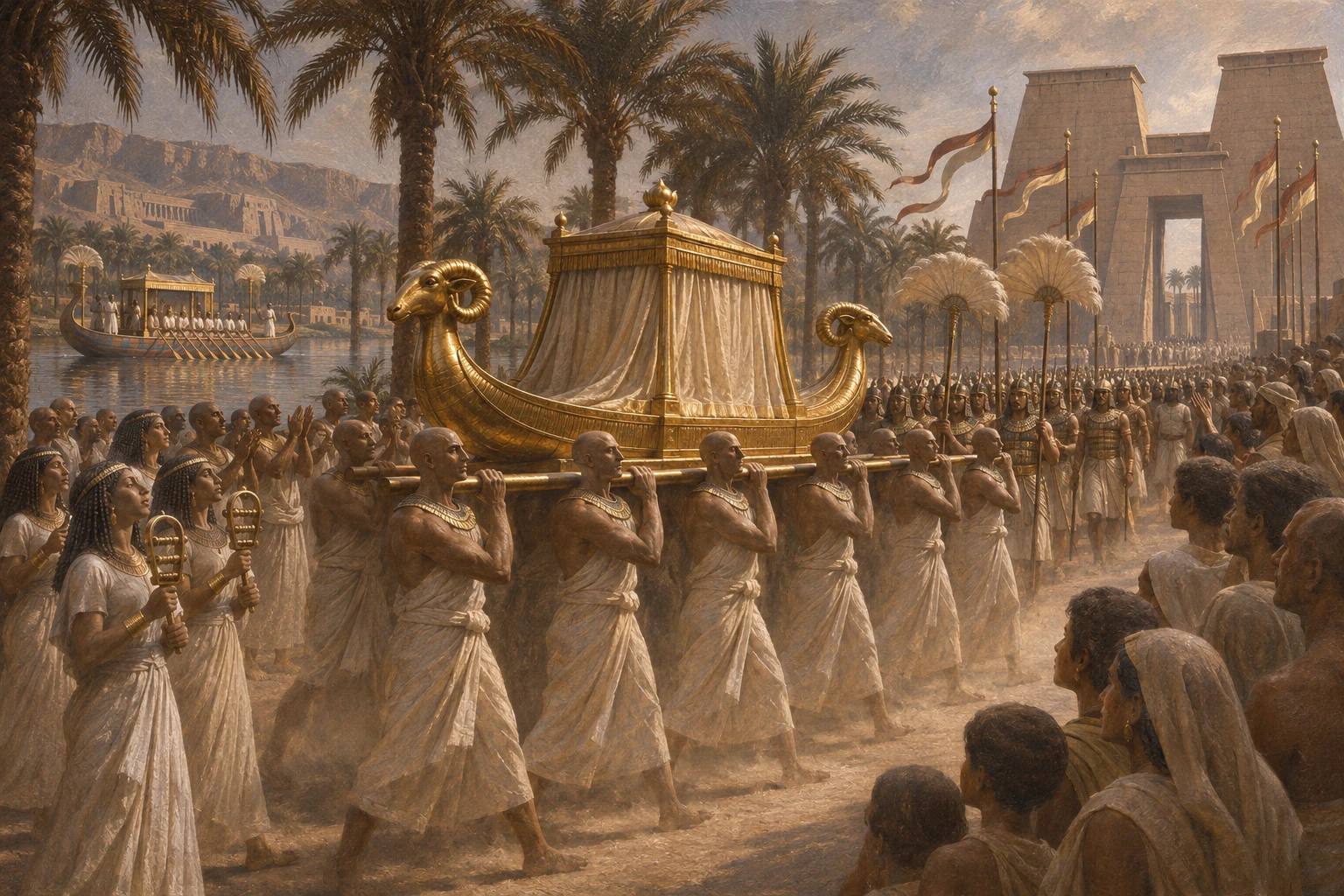
- A god in a boat. Diodorus describes the image at Siwa carried “upon a golden boat by eighty priests”, who went wherever the god steered them. His translator C. Bradford Welles noted that this was “quite typical of the Egyptian temples”.
4 History and Tradition
- From Thebes to all Egypt. The Theban kings of the 11th Dynasty reunited the country, and Karnak’s god shared their victory. The 12th Dynasty put him into royal names such as Amenemhat, and the 18th into Amenhotep and Tutankhamun.
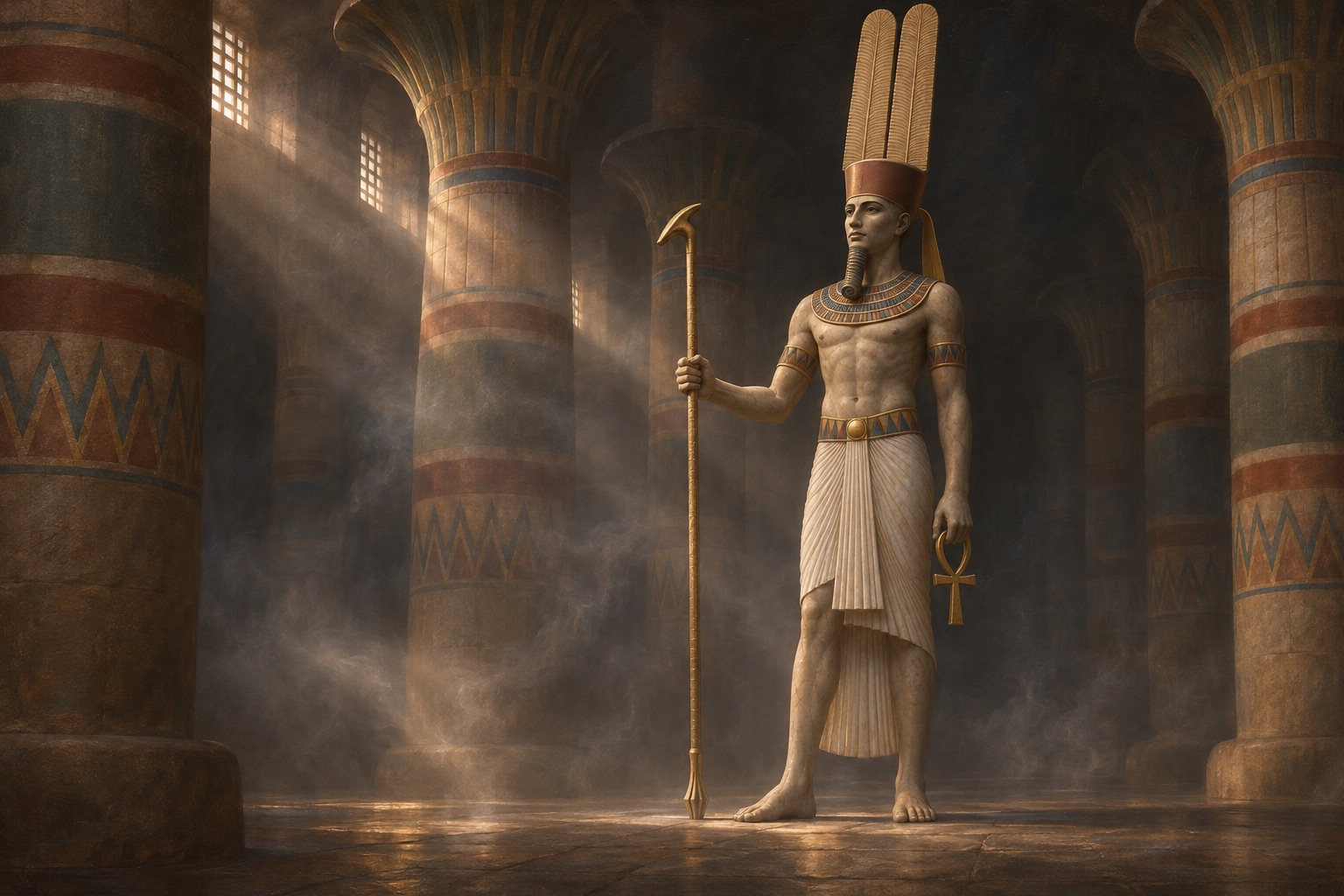
- The family of Karnak. Amun was worshipped with the goddess Mut, often shown in a vulture headdress or the double crown, and their son Khonsu, a moon god shown as a child with a side-lock or with a falcon’s head. Amun himself usually wears a flat crown with two tall plumes.
- The Opet Festival. Once a year, in the second month of the flood season, the images of Amun, Mut and Khonsu left their temples at Karnak in portable boat-shrines carried on priests’ shoulders and travelled to Luxor temple, about three kilometres south. Inside, the king renewed his royal power. Under Hatshepsut the festival lasted eleven days; under Ramesses II, more than three weeks.
- The Beautiful Festival of the Valley. Amun also crossed the river to the western cliffs, where Hatshepsut’s temple stood, and Theban families spent the festival at the tombs of their dead, bringing them food and drink and feasting there.
- The God’s Wife of Amun. This priestess was usually a king’s daughter. A scarab from the reign of Ahmose, now in the Metropolitan Museum, is inscribed for “the God’s Wife Nefertari”. In later centuries the God’s Wife held great estates at Thebes and passed them on by adoption: in the ninth year of Psamtik I, the reigning God’s Wife adopted his daughter Nitocris as her heir.
- Akhenaten. In about his fifth year Amenhotep IV changed his name to Akhenaten, and Amun’s name and figure were cut out of temples all over Egypt. Even the king’s own birth name was hacked out, “because it contained the name of Amon” (Breasted). After his death the boy king Tutankhaten changed his name to Tutankhamun and reopened the temples. His Restoration Stela says that they had become “foot paths”, and that a god who was prayed to “wouldn’t come”. He gave Amun a new image of electrum carried on thirteen poles, where the old one had had eleven.
- Zeus Ammon. Croesus of Lydia tested Ammon’s oracle along with Delphi’s. Greek Thebes had a temple of Ammon whose statue Pindar dedicated, and Pindar sent a hymn to the Ammonians, which Pausanias saw carved beside an altar dedicated to Ammon by Ptolemy son of Lagus. On silver coins struck in the name of Lysimachus, another of Alexander’s bodyguards, Alexander wears “the horn of Ammon”. By Strabo’s time, he wrote, the oracle had been almost abandoned.
- Horns and salt. Pliny lists Hammonis cornu, “Ammon’s horn”, a golden stone “like a ram’s horn in shape” said to bring prophetic dreams (37.167). His translators Bostock and Riley saw in it the fossil ammonites, whose name comes from the Latin cornu Ammonis. Ammonia has the same origin: Latin sal ammoniacus, salt from the region of Amun’s temple in Libya.
A popular claim online says that “amen” at the end of a prayer calls on Amun. The word is Hebrew: in Deuteronomy 27 the people answer “Amen” to a list of curses, the first on anyone who makes a carved or cast image. The American Heritage Dictionary derives amen from Hebrew ʾāmēn, “certainly, verily”, from ʾāman, “to be firm”, and the god’s name from Egyptian jmn. Asked by AFP, Andrew McGowan of Yale called the likeness of sound a coincidence.
5 Related Stories
- Atum: The Lone God Who Began the World at Heliopolis: the Leiden hymns call the Eight of Hermopolis Amun’s “first form” and say he “completed himself as Atum”. The creation at Heliopolis, and how Egypt’s creation stories stood side by side, are told there.
- Ra and Apophis: The Serpent the Sun Must Defeat Every Night: Amun-Ra is Amun joined with the sun god, and the rite against Apophis in the Papyrus Bremner-Rhind says it was performed daily in his temple at Karnak.
- Zeus: The Youngest Son Who Became King of the Gods: the priestesses of Dodona told Herodotus that two black doves flew from Egyptian Thebes, one to found Zeus’s oracle at Dodona and one to tell the Libyans “to make an oracle of Ammon” (2.55).
- Delphi: The Oracle and the Navel of the World: when Croesus tested the oracles, he sent envoys to Delphi, and others “to inquire of Ammon in Libya” (Herodotus 1.46).
6 Sources
- Papyrus Leiden I 350, from Adolf Erman, The Literature of the Ancient Egyptians, trans. Aylward M. Blackman (Methuen, 1927), pp. 293–300: archive.org; J. Zandee, De hymnen aan Amon van Papyrus Leiden I 350 (Rijksmuseum van Oudheden, 1947), introduction: Sidestone
- The birth reliefs of Hatshepsut and the reign of Tutankhamun, trans. James Henry Breasted, Ancient Records of Egypt, vol. II (1906), §§187–212, 934, 1019: archive.org; the adoption stela of Nitocris, vol. IV (1906), §§935–938: archive.org
- The Restoration Stela of Tutankhamun, trans. Mark-Jan Nederhof: University of St Andrews
- E. A. Wallis Budge, The Gods of the Egyptians, vol. II (1904), pp. 1–4: archive.org
- E. Sullivan, Digital Karnak (UCSC): “Introduction to the Temple of Karnak” (2008), “Processional Routes and Festivals” (2008), “The Development of the Temple of Karnak” (2010), “Restoration Stela of Tutankhamen”: digitalkarnak.ucsc.edu
- Herodotus, Histories 1.46, 2.42 and 2.54–55, trans. A. D. Godley (Loeb, 1920): Perseus
- Plutarch, On Isis and Osiris 9, trans. Frank Cole Babbitt (Loeb, 1936): LacusCurtius; Life of Alexander 26–28, trans. Bernadotte Perrin (Loeb, 1919): LacusCurtius
- Arrian, Anabasis of Alexander 3.3–4 and 6.28, trans. E. J. Chinnock (1884): Wikisource
- Diodorus Siculus, Library of History 17.49–51, trans. C. Bradford Welles (Loeb, 1963): LacusCurtius; Strabo, Geography 17.1.43 (Loeb, 1932): LacusCurtius
- Pausanias, Description of Greece 9.16.1, trans. W. H. S. Jones (Loeb, 1918): Perseus; Pliny the Elder, Natural History 37.167, trans. John Bostock and H. T. Riley (1855): Perseus
- American Numismatic Society, silver coin of Lysimachus (1966.225.2): numismatics.org; The Metropolitan Museum of Art, “Scarab Inscribed for the God’s Wife Nefertari” (10.130.42): metmuseum.org
- The American Heritage Dictionary of the English Language, 5th ed., “amen”, “ammonite” and “ammonia”: ahdictionary.com; Deuteronomy 27:15–26, JPS translation (1917): Sefaria
- AFP, “‘Amen’ Is Not Derived From The Egyptian God Amun Ra” (2021), republished by BOOM: boomlive.in
- “アモン”, Nipponica and Britannica Japan: Kotobank
Cover and illustrations: AI-generated images made for Arcana. They are interpretations, not historical artworks.