Delphi: The Oracle and the Navel of the World
Two eagles sent by Zeus were said to have met at Delphi, and there Apollo shot a she-dragon and took over an oracle that had belonged to Earth. For centuries a woman of Delphi gave his answers from a tripod, and whether a gas from the rock helped her is still argued.
- Type: sacred place, the oracle of Apollo and the “navel” of the earth
- Culture: ancient Greece; Delphi lies on the southern slope of Mount Parnassus, in Phocis, in central Greece
- Earliest texts: Homer’s Iliad already knows the riches of “rocky Pytho” (9.404–405); the story of how Apollo came there is told in the Homeric Hymn to Apollo, usually dated to the 7th or 6th century BCE
- Key figures: Apollo, Earth (Gaia), Themis, Phoebe, the she-dragon later called Python, the Pythia, Croesus, Themistocles
For the Greeks the centre of the world was a place you could visit. Two eagles let loose by Zeus from the two ends of the earth had met above a ledge of Mount Parnassus, and inside the temple of Apollo a stone marked the spot. Kings, cities and private people climbed there to put their questions to the god, and a woman of Delphi gave his answers.
Was the Oracle of Delphi a woman? Not in the Greek sense of the word. The oracle was the shrine and the answers given there; the woman who spoke them was the Pythia, Apollo’s prophetess. In Plutarch’s day there was only one, and she had been “reared in the house of small farmer folk” (On the Pythian Responses 405c). In busier times, he says, Delphi kept two prophetesses who went down in turn, and a third in reserve (On the Obsolescence of Oracles 414b).
1 The Telling
Delphi has no single story. This section follows how the Greeks told its beginnings, from Pindar as Strabo reports him to Aeschylus’s Eumenides and the Homeric Hymn to Apollo, and then two answers that Herodotus made famous. Quotations are from the Loeb translations named in the Sources, unless we say they are our own.
1-1 Two Eagles
Zeus, the story went, set two eagles free, and they met at Delphi, “one coming from the west and the other from the east”. The geographer Strabo, who tells it, says the myth was told by Pindar, and that some made the birds crows. Delphi, he adds, “was also believed to be in the center of the inhabited world, and people called it the navel of the earth” (Geography 9.3.6). In Plutarch, a priest at Delphi, they are “eagles or swans, flying from the uttermost parts of the earth towards its centre”, and they meet “at the omphalus, as it is called” (On the Obsolescence of Oracles 409e).
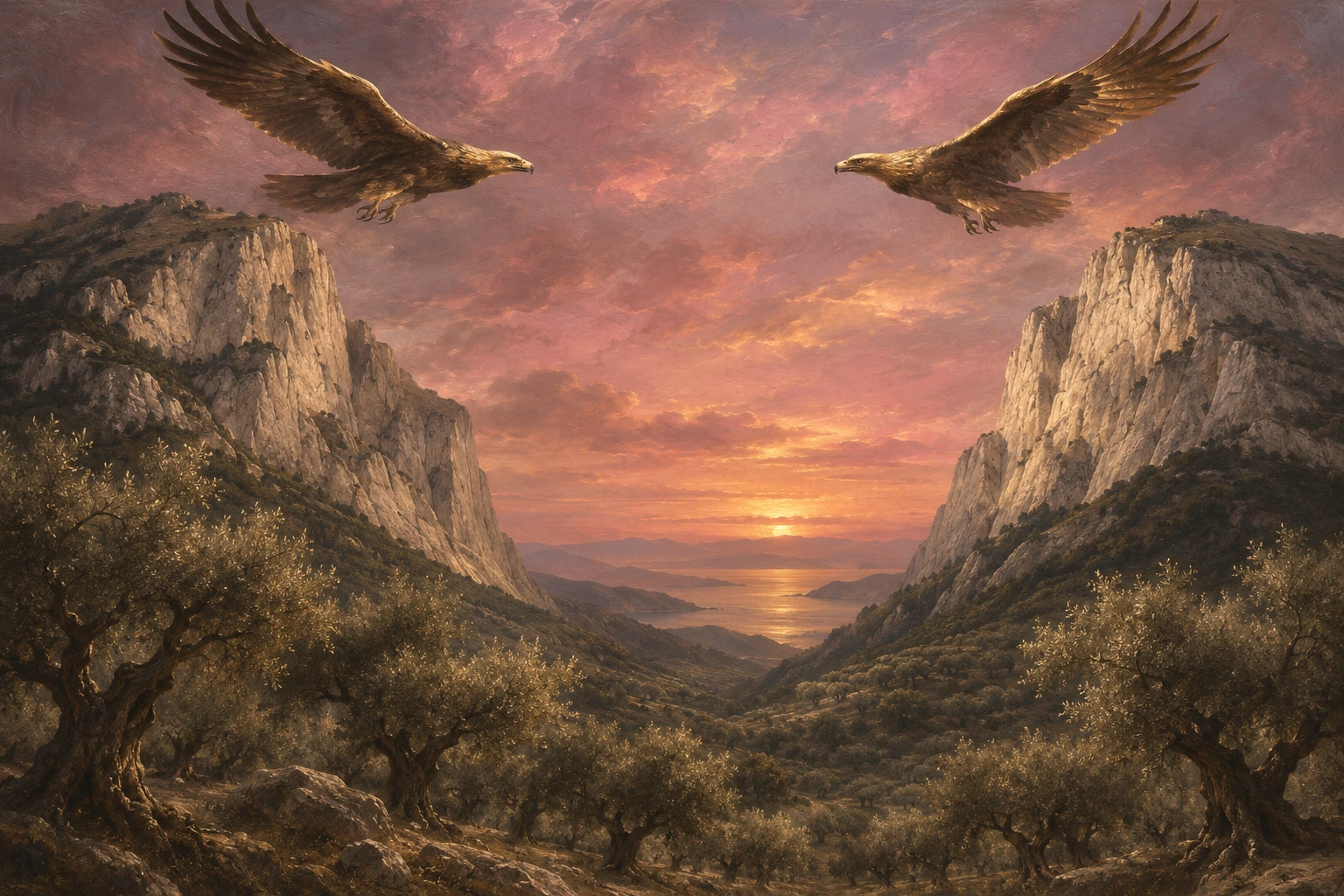
The navel was something you could see. Strabo describes one in the temple, “draped with fillets”, with the two birds of the myth on it. Pausanias, in the 2nd century CE, writes that the stone the Delphians call the Omphalus is of white marble and “is said by the Delphians to be the center of all the earth” (Description of Greece 10.16.3). Pindar, he says, supports them in one of his odes; his translators identify the passage as the fourth Pythian ode, where an oracle is spoken “by the central navel of the well-wooded mother” (4.74, our translation). One man, Plutarch adds, tried to check. Epimenides of Phaestus asked the god and was given an answer so vague that he concluded: “Now do we know that there is no mid-centre of earth or of ocean; / Yet if there be, it is known to the gods, but is hidden from mortals” (409e–f).
1-2 Earth, Themis, Phoebe and Apollo
Apollo was not the first to prophesy at Delphi. Aeschylus’s Eumenides opens with the Pythia praying before the temple. She honours first “the first prophet, Earth”; then Themis, the second “to take this oracular seat of her mother”; then a third, the Titan Phoebe, who took it “with Themis’ consent and not by force”. Phoebe gave it to Phoebus as a birthday gift, and he “has his name from Phoebe” (1–8). He came from Delos by way of Athens, and Zeus filled his heart with prophetic skill and made him “the fourth prophet on this throne; but Loxias is the spokesman of Zeus, his father” (9–19). Then the Pythia sits down on her throne and calls in the Greeks “in turn, by lot, as is the custom. For I prophesy as the god leads” (29–33).
1-3 The She-Dragon at the Spring
The Homeric Hymn to Apollo tells a rougher story. The young god goes “about the earth seeking a place of oracle for men” (214–215). The spring Telphusa, near Haliartus, talks him out of building beside her, where horses and mules would disturb him, and sends him to Crisa, below Parnassus, so that she can keep her own renown (244–276). There Apollo lays out the foundations, and the brothers Trophonius and Agamedes lay a footing of stone (294–299).
“But near by was a sweet flowing spring”, and there Apollo killed with his bow “the bloated, great she-dragon”, a plague to men and their sheep (300–304). She had once nursed Typhaon, the monster Hera bore alone in anger after Zeus gave birth to Athena from his own head (305–356). Struck by his arrow, she writhed through the wood and breathed out her life. “Now rot here upon the soil that feeds man!”, the god said, and the sun made her rot away: “wherefore the place is now called Pytho, and men call the lord Apollo by another name, Pythian” (357–374). Then he went back and buried Telphusa’s stream under a shower of rocks for deceiving him (375–387).
1-4 The Dolphin
Apollo still needed priests. He saw a ship of Cretans from Knossos sailing to Pylos to trade, sprang aboard “like a dolphin in shape”, and lay on the deck, shaking the timbers. The terrified crew could not steer. The ship ran on by itself, round the Peloponnese and up the long gulf to Crisa, where it grounded on the sand (388–439). The god leapt out “like a star at noonday”, lit a flame in his shrine that filled Crisa with light, and came back as a young man (440–451).
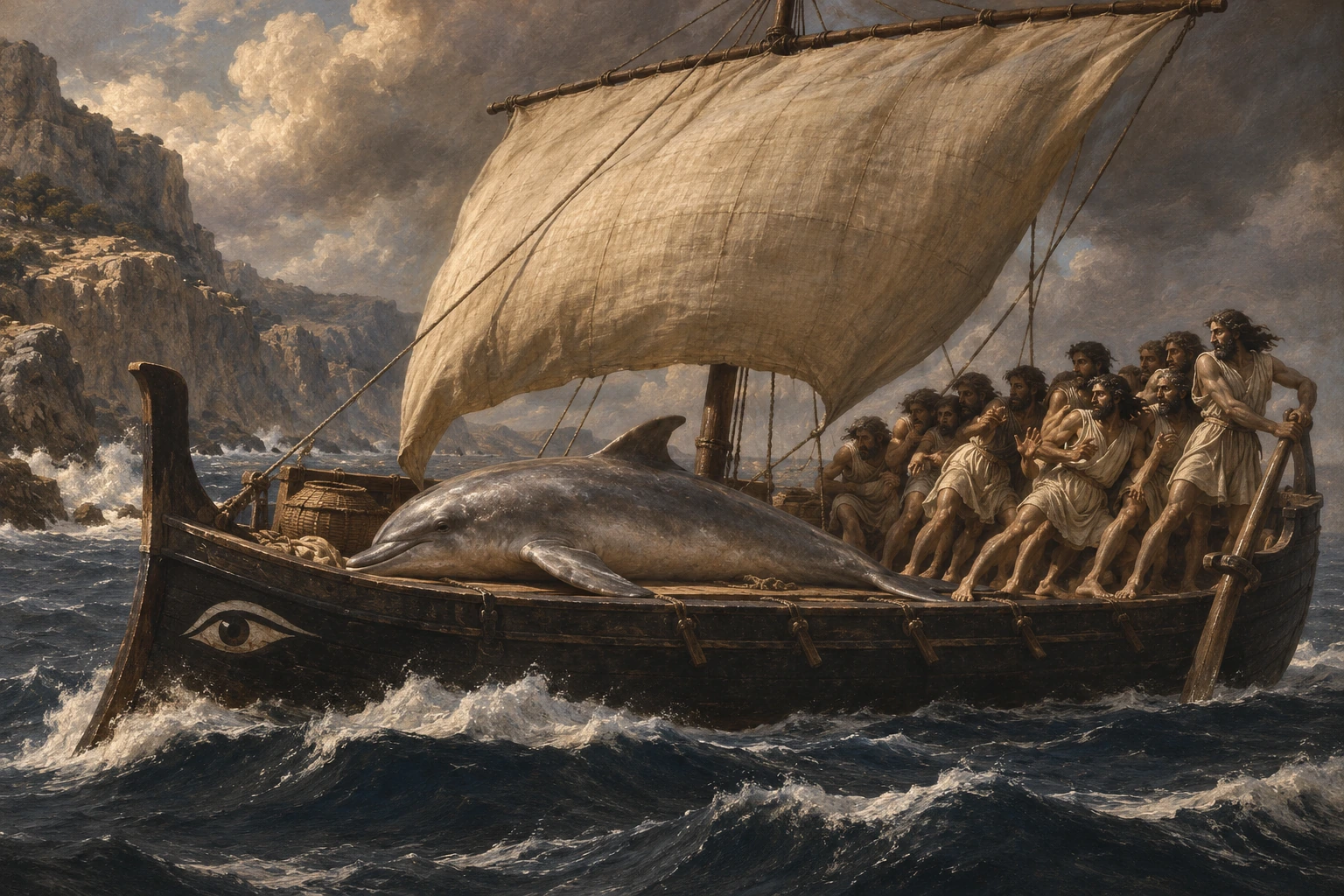
They would never see home again, he told them; they would keep his temple. They were to build an altar on the beach and, since he had come to them as a dolphin, pray to him as Apollo Delphinius (474–501). Then they climbed to Pytho behind him, singing the hymn Ie Paean, “Hail, Healer!” (502–523). The master of the Cretans asked how they would live, for “this land is not to be desired either for vineyards or for pastures”. Apollo smiled: the sacrifices people brought would feed them for ever. But they must keep righteousness in their hearts, or “other men shall be your masters” (524–544). The hymn never uses the name Delphi. The place is Pytho, and the dolphin gives its name only to Apollo Delphinius and his altar.
1-5 The Woman on the Tripod
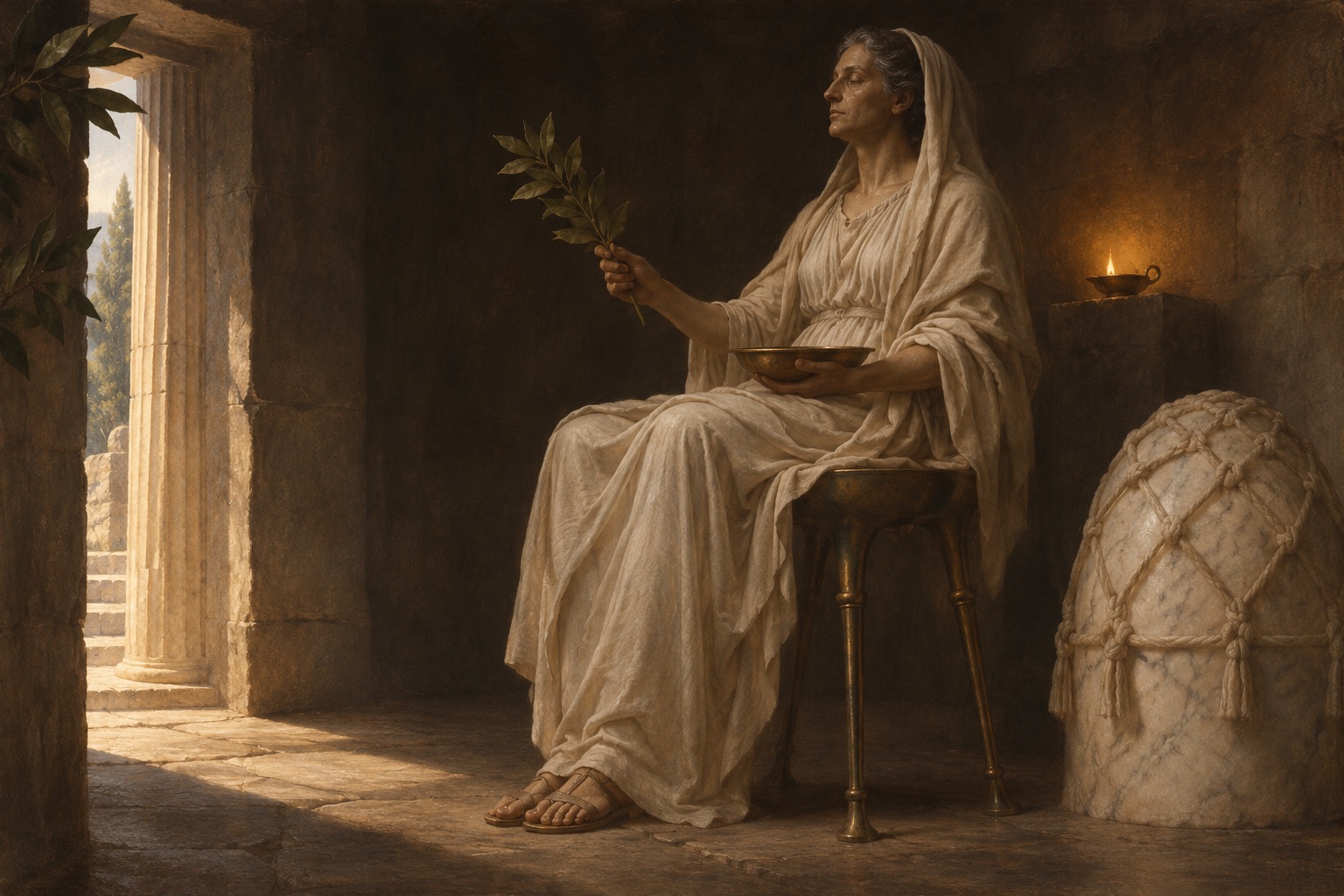
How the god spoke was told in more than one way. Strabo reports that the seat of the oracle was “a cave that is hollowed out deep down in the earth, with a rather narrow mouth, from which arises breath that inspires a divine frenzy”. A high tripod stood over the mouth; the Pythia sat on it, received the breath, and answered in verse or in prose, and poets in the temple’s service put the prose into verse (9.3.5). Diodorus tells how the place was found. Goats grazing by a chasm began to leap and bleat strangely, and their goatherd began to foretell the future. Others came, until so many had jumped into the chasm in their frenzy that one woman was set there to prophesy for all, on a seat with three legs (16.26.1–5). The first prophetesses were virgins; after a Thessalian, Echecrates, carried one off, the Delphians chose women over fifty, dressed as maidens (16.26.6).
Plutarch saw the god’s part differently. In On the Pythian Responses one of his speakers says the verse is not Apollo’s: the voice, the words and the metre are the woman’s, and the god only gives her the visions and puts light into her soul (397c). And Plutarch tells of a Pythia who had died not long before. The victim for the preliminary sacrifice did not stir at the first libations, and the priests, eager to please envoys from abroad, drenched it until it gave in. She went down “unwillingly, they say, and half-heartedly”; her voice was harsh from the first answer, and at last she rushed to the door with “a frightful shriek” and threw herself down. Everyone fled. She was carried out still conscious, and lived on for a few days (On the Obsolescence of Oracles 438a–c).
1-6 Two Famous Answers
Croesus, king of Lydia, began by testing the oracles. His envoys were to ask, on the hundredth day after leaving Sardis, what he was doing at that moment. At Delphi, as soon as they had asked, the Pythia answered in verse: “I know the number of the grains of sand and the extent of the sea”, and she could smell “a strong-shelled tortoise / Boiling in a cauldron together with a lamb’s flesh”. That was exactly what Croesus had done (Herodotus, Histories 1.46–48). Then he asked whether to march against the Persians. Delphi, and the oracle of Amphiaraus too, replied that if he did, “he would destroy a great empire” (1.53). He did, and the empire was his own. When he complained, the Pythia answered that he should have asked whose empire the god meant (1.91).
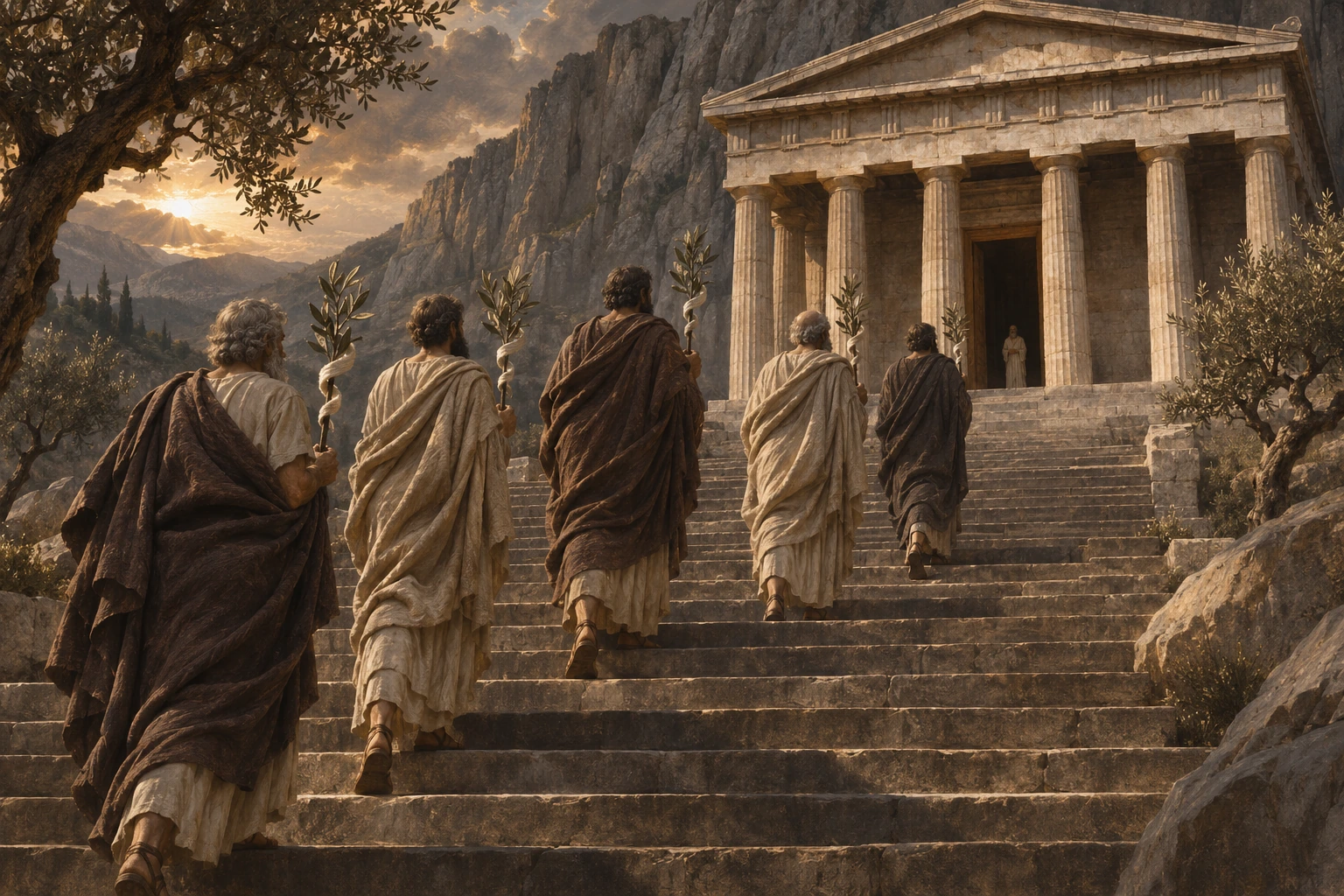
When the Persian king Xerxes marched on Greece, the Athenians sent to Delphi, and the Pythia, Aristonice, told them to flee “to the ends of the earth” (7.140). On the advice of a Delphian, Timon, they came back as suppliants with olive boughs and refused to leave. The second answer was gentler: “a wood-built wall will by Zeus all-seeing be granted / To the Trito-born, a stronghold for you and your children”, and “Divine Salamis, you will bring death to women’s sons” (7.141). Some of the older Athenians thought the wall was the old thorn hedge round the Acropolis. Others said it meant the ships, but the readers of oracles took the last lines to foretell a defeat at sea near Salamis. Themistocles answered that the god would have called Salamis “cruel”, not “divine”, if the deaths were to be Athenian, and the Athenians made ready to fight at sea (7.142–143).
2 Where the Story Is Written Down
- Homer. The Iliad knows the wealth inside “the marble threshold of the Archer Phoebus Apollo” in “rocky Pytho” (9.404–405), and in the Odyssey Agamemnon goes to consult the oracle “in sacred Pytho, when he passed over the threshold of stone” (8.79–81). Neither tells how the oracle began. In Hesiod’s Theogony Zeus sets up at Pytho, “under the glens of Parnassus”, the stone that Kronos swallowed in place of his son (498–500).
- The Homeric Hymn to Apollo. H. G. Evelyn-White prints it as two hymns, “To Delian Apollo” (1–178) and “To Pythian Apollo” (179–546). Theoi, which reproduces his translation, dates most of the collection to the 7th–6th century BCE and notes that ancient writers ascribed this hymn to Cynaethus of Chios.
- Pindar, the poet of the Pythian odes for victors at the games (5th century BCE). Strabo credits him with the eagles; the passage Pausanias cites, Pythian 4.74, names the navel but not the birds.
- Aeschylus, Eumenides 1–33, the last play of the Oresteia, staged in 458 BCE (Heibonsha World Encyclopedia); Euripides, Iphigenia in Tauris 1234–1283, a choral song on how Apollo won the oracle (section 3).
- Herodotus, Histories 1.46–55 and 1.91 (Croesus), 6.66 (a bribed Pythia) and 7.140–143 (the wooden wall); Plato, Protagoras 343a–b, on the maxims of the Seven Sages.
- Plutarch wrote three dialogues set at Delphi: On the E at Delphi, On the Pythian Responses and On the Obsolescence of Oracles. He says he had served Pythian Apollo “for many Pythiads”, that is, many four-year cycles of the games (Should Old Men Take Part in Affairs of State? 792f).
- Later writers: Strabo, Geography 9.3.5–12; Diodorus Siculus 16.26; Ovid, Metamorphoses 1.438–451; Apollodorus, Library 1.4.1; and Pausanias, whose Description of Greece, written in the 2nd century CE, walks through the sanctuary in book 10.
3 Competing Versions
- By gift or by force? In Aeschylus the oracle passes from Earth to Themis to Phoebe to Apollo, “not by force”. In Euripides, Apollo, still a baby in his mother’s arms, kills the serpent that guarded Earth’s oracle and drives Themis out. Earth, angry for her daughter, sends dreams that tell people the future and so robs him of his office; the child runs to Olympus and clings to Zeus’s throne, and Zeus, smiling, silences the dreams and gives the oracle back to him (Iphigenia in Tauris 1234–1283). Pausanias heard that the oracle first belonged to Earth, with a mountain nymph, Daphnis, as her prophetess; the poem Eumolpia gave it to Earth and Poseidon together, and Apollo was said to have paid Poseidon for his share with the island of Calaureia (10.5.5–6).
- A she-dragon, a serpent, a man? The Hymn never names its she-dragon. In Ovid, Earth bears the great serpent Python, unwillingly, after the flood, and Apollo kills it with a thousand arrows (Metamorphoses 1.438–444). In Apollodorus, Python guards the oracle and tries to stop Apollo reaching the chasm (1.4.1). Pausanias knew both the poets’ dragon, “posted by Earth to be a guard for the oracle”, and a story that Python was a violent son of Crius who plundered the sanctuary (10.6.6). The historian Ephorus made him “a cruel man named Python and known as the Dragon”. Strabo, who quotes him, asks what could be more mythical than that (9.3.12).
- To rot or to ask? The Hymn derives Pytho from the rotting of the she-dragon. Strabo derives it from pythesthai, “to inquire of the oracle”; his translator H. L. Jones notes that other writers, more plausibly, took it from the verb “to rot” (9.3.5).
- Laurel, wax and bronze. The Hymn has Apollo and the two brothers build the first temple. Pausanias was told of four temples before the one he saw: of laurel branches from Tempe, of beeswax and feathers made by bees, of bronze, and finally of stone by Trophonius and Agamedes, burnt in 548 BCE by his translators’ reckoning (10.5.9–13).
4 History and Tradition
- The site. The Greek Ministry of Culture describes a Mycenaean settlement under the sanctuary and dates the beginning of the cult of Apollo and the oracle to the 8th century BCE. The Delphi museum notes that the story of an older oracle of Earth was “adopted by the Delphic priesthood and propagated by the poets of the 5th century B.C.”, and that current scholarship questions it.
- The temple. By the Ministry’s account, the stone temple was rebuilt after 548 BCE and finished around 510 BCE with the help of the Athenian Alcmaeonid family; an earthquake destroyed it in 373 BCE, and the temple whose ruins stand today was completed in 330 BCE. The consultation took place in the adyton, the inner shrine, which also held a statue of Apollo and the omphalos.
- “Know thyself”. Plato writes that the Seven Sages dedicated their wisdom at the temple, inscribing “Know thyself” and “Nothing overmuch” (Protagoras 343b). Pausanias saw the maxims in the fore-temple and lists the sages, with Myson in place of Periander, following Plato (10.24.1). The Ministry adds the letter E, the subject of Plutarch’s dialogue.
- An answer for sale. The Spartan king Cleomenes had a Delphian, Cobon, persuade the Pythia Periallus to answer that Demaratus was not the son of Ariston, as Cleomenes wanted. When it came out, Cobon was exiled and Periallus removed from office (Herodotus 6.66).
- The Pythian Games. Pausanias says the oldest contest was a hymn sung to the god; in 586 BCE, by his translators’ reckoning, the Amphictyons, the league of neighbouring peoples that ran the sanctuary, added music for the pipes and athletics, and from the next festival the prize was a crown (10.7.2–5). The crown was of laurel, he thinks, because Apollo loved Daphne, the daughter of Ladon (10.7.8). Strabo describes a piece played on the pipes that told the god’s fight with the dragon, ending with its last hissing breaths (9.3.10). The games came every four years. The bronze Charioteer in the Delphi museum belonged to a group dedicated by Polyzalos, tyrant of Gela in Sicily, most likely for a chariot victory at the games of 478 or 474 BCE, the museum says.
- The last oracle. A Christian text of the 7th century, the Passion of Artemius, and the Byzantine historian Cedrenus say that the pagan emperor Julian sent his physician Oribasius to Delphi and received three lines of verse: “Tell the king: the well-wrought hall has fallen to the ground. Phoebus no longer has a hut, nor a prophetic laurel, nor a speaking spring; the speaking water too is quenched” (our translation). Timothy Gregory (1983) thought the pagan priests a likelier author than a Christian poet, though “we shall probably never be able to solve this question to everyone’s satisfaction”. Aude Busine (2023) argues that the lines were “written much later in the fifth or the sixth centuries”. The Delphi museum’s site still calls it “the last prediction ever pronounced by the oracle”.
- The end. Laws issued under Theodosius I in 391 and 392 forbade sacrifice and visits to temples (Theodosian Code 16.10.10 and 16.10.12); neither names Delphi. Reference works put the closing of the oracle in 390 (Nipponica), 392 (Heibonsha World Encyclopedia) or 394 (the Delphi museum). The town lived on as a bishopric and was abandoned around 620, the museum says, and the village of Kastri later grew over the ruins.
- The Great Excavation. In 1892 the French School at Athens began la Grande Fouille, under its director Th. Homolle, after the houses of Kastri were expropriated and pulled down; digging began in mid-October 1892, and the new village of Delphi was built about 0.8 kilometres to the west (Nipponica). The excavators uncovered the Treasury of the Athenians, the Sibyl’s Rock and the Charioteer. Delphi was added to the UNESCO World Heritage List in 1987 (Nipponica).
“The Pythia was high on gas from the ground” is often repeated as fact; even the Delphi museum’s website says that gas rose from cracks there and that “one fell in trance” on meeting it. The ancient writers speak of a breath (pneuma) rising from a cave (Strabo 9.3.5), of a chasm that set goats and people raving (Diodorus 16.26), and of an exhalation that Plutarch thought grew weaker and stronger and at times smelled of costly perfume (On the Obsolescence of Oracles 437c); none of them speaks of a drug. When the French excavators found no chasm, the Geological Society of America recalled in 2001, they dismissed the vapour. In the same release the Society reported a paper in Geology by the geologist Jelle de Boer, the archaeologist John Hale and the chemist J. Chanton: young faults meeting below the sanctuary, and ethylene, methane and ethane in a spring nearby. In 2002 the toxicologist Henry Spiller, with Hale and de Boer, argued that inhaling ethylene from a natural vent was “the probable cause of the trancelike state”. G. Etiope and colleagues found methane, ethane and carbon dioxide still escaping, but in a setting “not prone to biogenic production of ethylene in amounts inducing neurotoxic effects” (Geology 34, 2006). J. Foster and D. Lehoux called the ethylene hypothesis “implausible” (2007), and the team replied in 2008. Gas at Delphi is measured; that it put the Pythia in a trance is a hypothesis.
5 Related Stories
- The Sibyl of Cumae: The Prophetess and the Nine Books: Apollo’s other famous prophetess, who sang his answers from a cave in Italy. At Delphi itself, the speakers in Plutarch’s dialogue stop by the rock where “the first Sibyl is said to have been seated” (On the Pythian Responses 398c), and the French excavators uncovered the Sibyl’s Rock in 1893.
- Zeus: The Youngest Son Who Became King of the Gods: the stone that Kronos swallowed instead of his son, which Zeus set up at Pytho. At Delphi, Pausanias saw a stone anointed every day with oil that some said was that stone.
- Jason and the Argonauts: The Voyage for the Golden Fleece: Pelias’s warning against a man with one sandal is the oracle that Pindar has spoken “by the central navel”, the line Pausanias’s translators give as his source for the omphalos (Pythian 4.74).
- Heracles: The Twelve Labours and the Pyre on Mount Oeta: in Apollodorus it is the Pythia who first calls the hero Heracles and sends him to serve Eurystheus for twelve years and perform ten labours (2.4.12).
- Amun: The Hidden God of Thebes: when Croesus tested the oracles, he sent envoys to Delphi, and others “to inquire of Ammon in Libya” (Herodotus 1.46); Ammon is the Greek name of Amun.
6 Sources
- Homeric Hymn to Apollo, trans. Hugh G. Evelyn-White (Loeb, 1914), lines 179–546: Theoi, Perseus
- Aeschylus, Eumenides 1–33, trans. Herbert Weir Smyth (Loeb, 1926): Perseus
- Homer, Iliad 9.404–405, trans. A. T. Murray (Loeb, 1924), and Odyssey 8.79–81, trans. A. T. Murray (Loeb, 1919); Hesiod, Theogony 492–500, trans. Hugh G. Evelyn-White (Loeb, 1914): Perseus, Perseus, Perseus
- Pindar, Pythian 4.74, Greek text, with the translation of Diane Arnson Svarlien (1990); the quotation is our own translation: Perseus
- Herodotus, Histories 1.46–55, 1.91, 6.66 and 7.140–143, trans. A. D. Godley (Loeb, 1920): Perseus, Perseus
- Euripides, Iphigenia in Tauris 1234–1283, Greek text ed. Gilbert Murray (1913), with the English translation on Perseus; Plato, Protagoras 343a–b, trans. W. R. M. Lamb (Loeb): Perseus, Perseus
- Strabo, Geography 9.3.5–12, trans. H. L. Jones (Loeb, 1924); Pausanias, Description of Greece 10.5–10.7, 10.16.3 and 10.24, trans. W. H. S. Jones and H. A. Ormerod (Loeb, 1918): Perseus, Perseus
- Diodorus Siculus, Library of History 16.26 (Loeb, vol. VII, 1952): LacusCurtius; Ovid, Metamorphoses 1.438–451, Latin text and trans. Brookes More (1922): The Latin Library, Perseus; Apollodorus, Library 1.4.1 and 2.4.12, trans. J. G. Frazer (Loeb, 1921): Perseus
- Plutarch, On the Obsolescence of Oracles, trans. Frank Cole Babbitt (Loeb, Moralia V, 1936), and Should Old Men Take Part in Affairs of State?, trans. H. N. Fowler (Loeb, Moralia X, 1936): LacusCurtius, LacusCurtius; On the Pythian Responses, after the translation of A. O. Prickard (1918): University of Chicago
- Theodosian Code 16.10.10–12, Latin text: The Latin Library; Timothy E. Gregory, “Julian and the Last Oracle at Delphi”, Greek, Roman and Byzantine Studies 24 (1983) 355–366: GRBS; Aude Busine, “‘No Longer Does Phoebus Have a Cabin’: Emperor Julian and the Fall of the Temple of Apollo in Delphi”, in E. G. Simonetti and C. Hall (eds.), Divination and Revelation in Later Antiquity (Cambridge, 2023) 208–221: Université libre de Bruxelles
- Hellenic Ministry of Culture, “Delphi” (E. Partida) and “Temple of Apollo at Delphi” (A. Tsaroucha): Odysseus, Odysseus; Archaeological Museum of Delphi, “History of Delphi”, “The historical evolution of Delphi”, “Excavations” and “Selected Exhibits”: delphi.culture.gr, delphi.culture.gr, delphi.culture.gr, delphi.culture.gr
- J. Z. de Boer, J. R. Hale and J. Chanton, “New evidence for the geological origins of the ancient Delphic oracle (Greece)”, Geology 29 (2001) 707–710, and the Geological Society of America’s release on it: doi.org, EurekAlert!; H. A. Spiller, J. R. Hale and J. Z. de Boer, “The Delphic oracle: a multidisciplinary defense of the gaseous vent theory”, Journal of Toxicology: Clinical Toxicology 40 (2002) 189–196: doi.org
- G. Etiope et al., “The geological links of the ancient Delphic Oracle (Greece): a reappraisal of natural gas occurrence and origin”, Geology 34 (2006) 821–824: doi.org; J. Foster and D. Lehoux, “The Delphic oracle and the ethylene-intoxication hypothesis”, Clinical Toxicology 45 (2007) 85–89, and the reply by H. Spiller et al. (2008): doi.org, doi.org
- Kiyonaga Akitsugu, “デルフォイ”, Nipponica; Matsushima Michiya, “デルフォイ”, and “オレステイア三部作”, Heibonsha World Encyclopedia: Kotobank, Kotobank
Cover and illustrations: AI-generated images made for Arcana. They are interpretations, not historical artworks.