Mount Olympus: The Real Mountain Where the Gods Lived
Homer's gods feast on a real mountain, snowy and many-ridged, between Thessaly and Macedonia, yet the Odyssey already pictures an Olympus that no wind, rain or snow can reach. In 1961, on one of its peaks, builders found the remains of sacrifices to Zeus.
- Type: sacred mountain, the home of the gods
- Culture: ancient Greece; the mountain stands in northern Greece, between Thessaly and Macedonia
- Earliest texts: Homer’s Iliad and Odyssey, and Hesiod’s Theogony
- Key figures: Zeus, Hera, Hephaestus, Thetis, the Muses, the Hours (Horai)
Most homes of the gods lie somewhere no map can show. The Greek one has a height above sea level. When Homer calls Olympus “snowy”, he is describing a real summit, the highest in Greece, which keeps its snow from September to April.
Is Mount Olympus a real place? Yes. It is the highest mountain in Greece, and its top, Mytikas, stands about 2,918 metres high. In the Iliad the gods live on that mountain, on its peaks and in its folds. But the Greeks also used “Olympus” to mean the sky, and the Odyssey already describes a home of the gods that no weather can touch, which no real mountain is.
1 The Telling
There is no single story of Olympus. This section follows the oldest poems, Homer’s Iliad and Hesiod’s Theogony, through what they say happens there.
1-1 A Snowy Mountain with Many Ridges
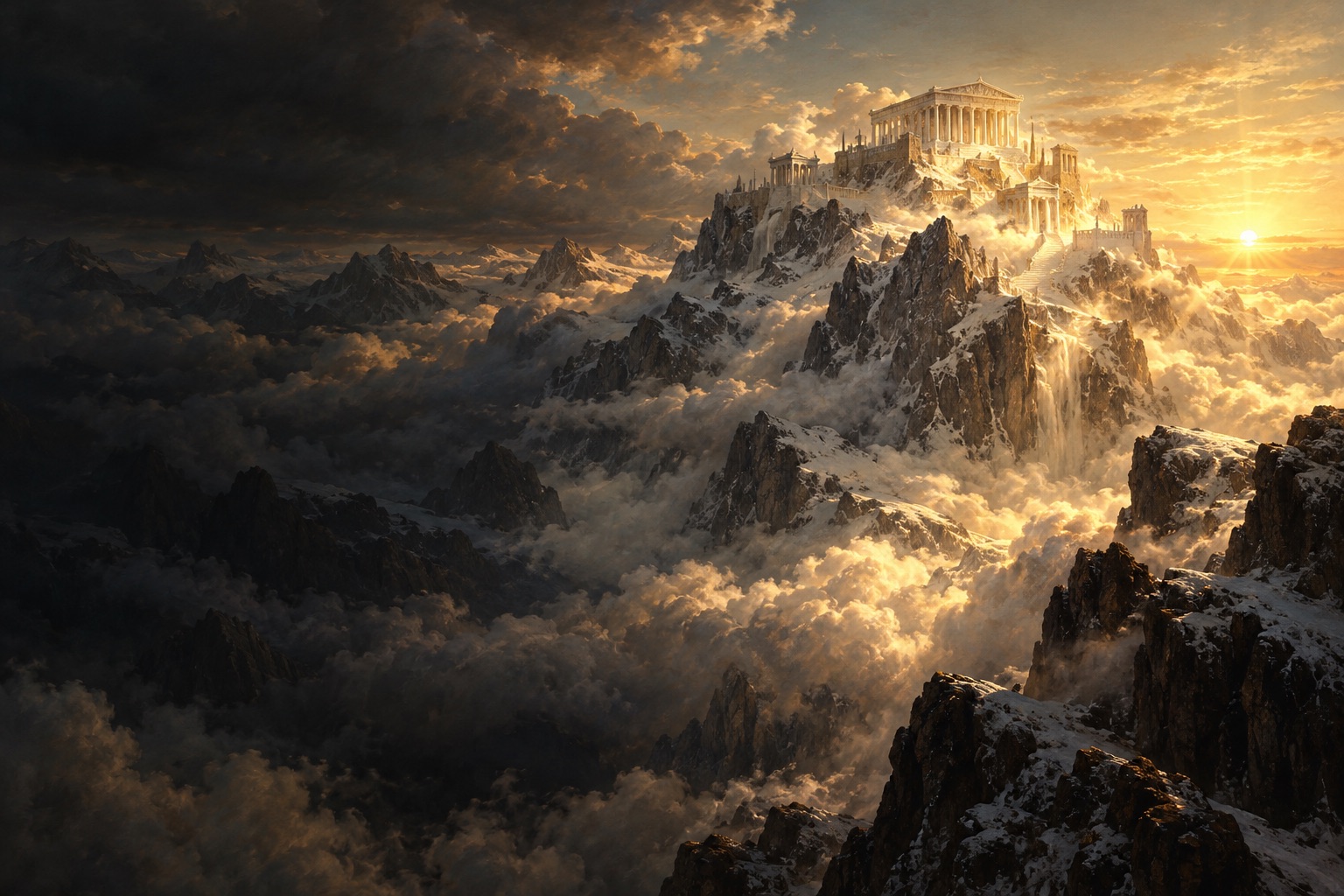
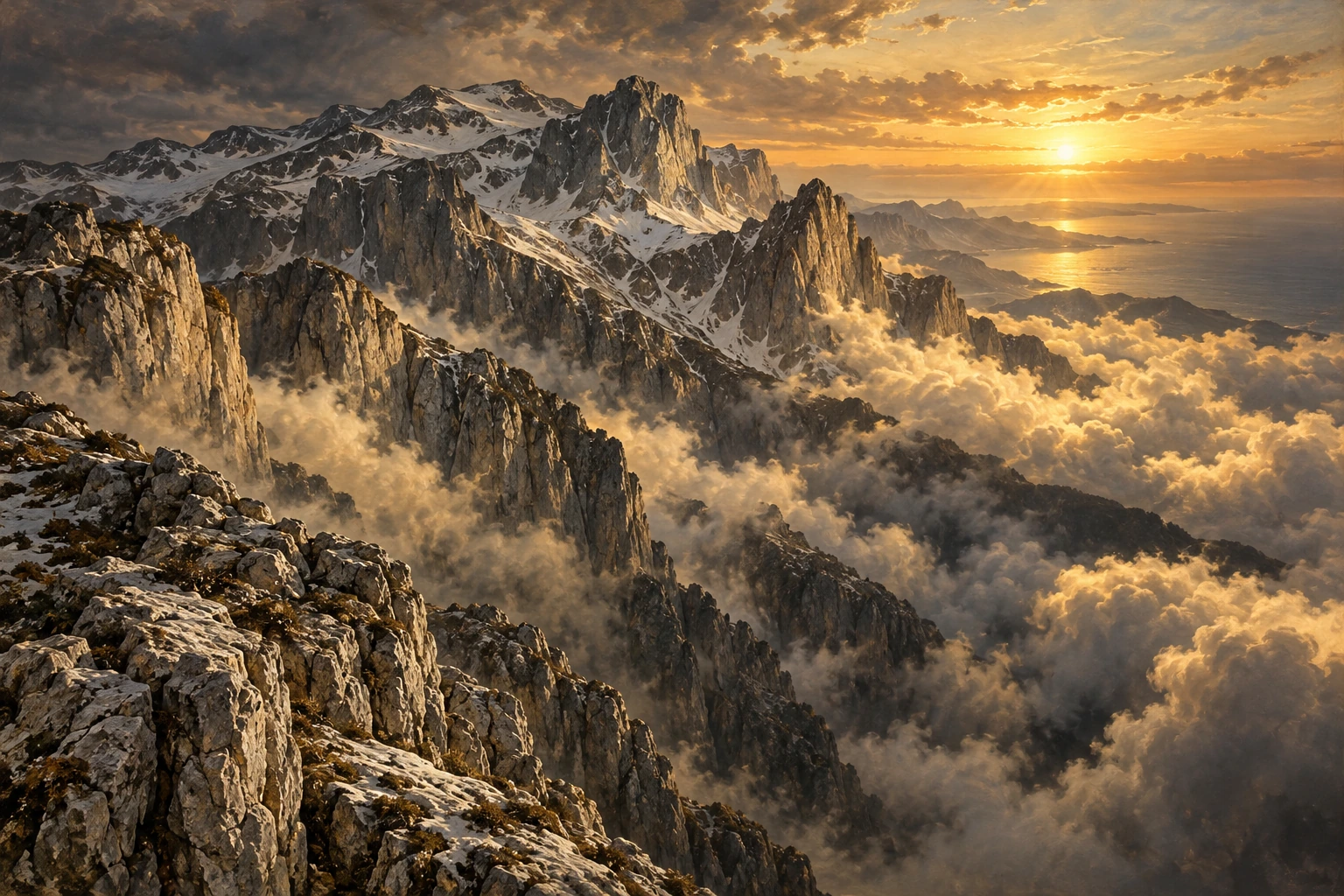
In the Iliad, Olympus is a mountain. It is “snowy” (1.420) and “many-ridged”, and it has a “topmost peak” (1.499). When Achilles asks his mother, the sea goddess Thetis, to plead with Zeus, she has to wait: Zeus and all the gods have gone to the far-off Ethiopians for a feast, and will be back on the twelfth day (1.423–425). On the twelfth morning she rises from the sea, goes up “to great heaven and Olympus”, and finds Zeus “sitting apart from the rest upon the topmost peak” (1.496–499). When he nods his promise to her, “he made great Olympus quake” (1.528–530).
On that same peak Zeus calls the gods to assembly (8.2–3). He tells them that all of them together could not drag him down from heaven on a golden chain, but that he could haul them up, earth and sea with them, and tie the rope round a peak of Olympus so that everything hung in mid-air (8.18–26). And when Hera sets out to trick him, she leaves Olympus by a route that is on the map: over Pieria and Emathia, over the snowy mountains of Thrace, to Athos, and across the sea to Lemnos (14.225–230).
1-2 Houses, Gates and Clouds
Each god has a house on the mountain, built “with cunning skill by the famed Hephaestus, the limping god” (1.606–608). Book 11 places the houses “amid the folds of Olympus” (11.76–77). The gods sit in council beside Zeus on a golden floor, while the goddess Hebe pours them nectar (4.1–3).
The way in is a gate of cloud. When Hera and Athena drive out to the war at Troy, “self-bidden groaned upon their hinges the gates of heaven which the Hours had in their keeping”. The Hours (Horai) are entrusted with “great heaven and Olympus”, and it is they who open the thick cloud or shut it (5.749–751).
1-3 The Feast
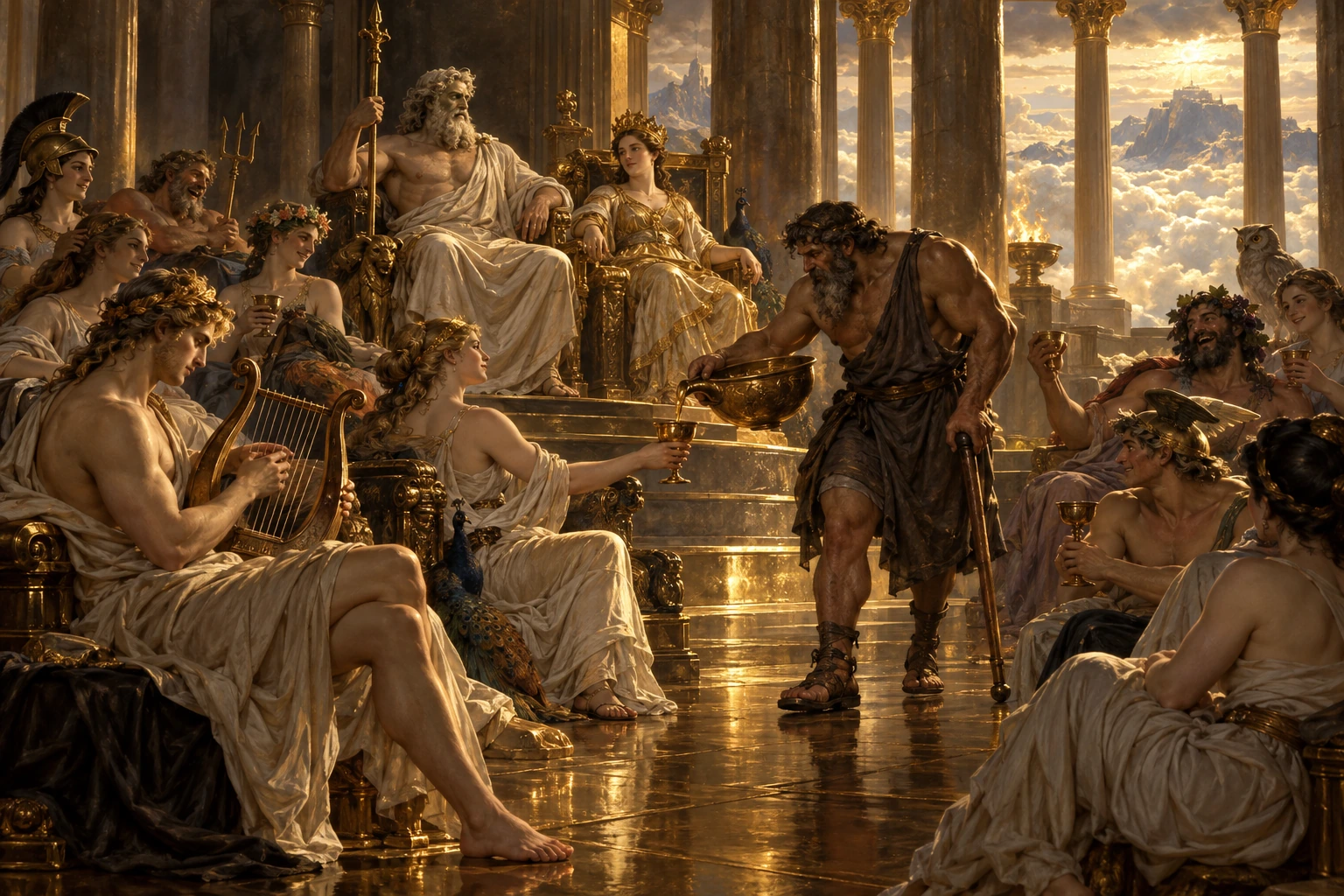
Book 1 ends with the gods at dinner, and a family quarrel. Hera has seen Thetis with Zeus and taunts him, and Zeus orders her to sit in silence (1.536–567). Their son Hephaestus begs his mother to give way. Once before, he reminds her, when he tried to help her, Zeus caught him by the foot and threw him from the threshold of heaven. He fell all day and landed at sunset on Lemnos, with little life left in him (1.586–594).
Hera smiled and took the cup from him. Then Hephaestus went round all the gods “from left to right”, drawing sweet nectar from the mixing bowl, and “unquenchable laughter arose among the blessed gods” as they watched him puffing through the hall (1.595–600). They feasted until sunset, with Apollo’s lyre and the Muses singing “replying one to the other”. At nightfall each went to the house Hephaestus had built, and Zeus to his bed, with Hera beside him (1.601–611).
This is not human food. The gods “eat not bread neither drink flaming wine”, says the Iliad, and so they are bloodless: what flows in them is ichor (5.339–342). In Hesiod they eat nectar and ambrosia (Theogony 640).
1-4 How the Gods Took Olympus
Hesiod asks the Muses to tell “how at the first they took many-folded Olympus” (Theogony 113). His answer is a war. For ten full years the Titans fought “from high Othrys” and Zeus’s side “from Olympus”, until Zeus won (629–636).
The Muses themselves were born in Pieria, “a little way from the top-most peak of snowy Olympus”, where they have “their bright dancing places and beautiful homes” (53–63). When they sing, “the peaks of snowy Olympus resound” (42).
A place at Olympus could also be lost. A god who swears falsely by the water of the Styx lies breathless for a year without nectar or ambrosia, then is shut out of the gods’ councils and feasts for nine more years, and returns only in the tenth (793–804).
2 Where the Story Is Written Down
- Homer’s Iliad gives most of the picture: the snowy, many-ridged mountain (1.420, 1.499), assemblies on the topmost peak (8.3), houses built by Hephaestus (1.606–608) and the cloud gates kept by the Hours (5.749–751).
- Homer’s Odyssey gives the other picture: an Olympus “neither shaken by winds nor ever wet with rain” (6.41–46, section 3). It also uses the name for the sky: Zeus thunders “from gleaming Olympus, from on high from out the clouds” (20.103).
- Hesiod’s Theogony tells how the gods won Olympus, and calls them “the deathless ones who hold the peaks of snowy Olympus” (118).
- The Homeric Hymn to Hermes has the newborn Hermes cut up a sacrifice into “twelve portions distributed by lot” (128–129). The poem does not say for whom.
- Herodotus writes that the Egyptians “first used the names of twelve gods (which the Greeks afterwards borrowed from them)” (2.4).
- Plato’s Phaedrus sets the gods in motion across the heavens. Zeus drives out first in a winged chariot, followed by gods and spirits in eleven squadrons, and “Hestia alone remains in the house of the gods”. The others “who are included among the twelve great gods” ride as leaders, each in his place (246e–247a).
3 Competing Versions
- Mountain or heaven? In the Iliad, Olympus has snow, ridges and peaks. In the Odyssey, Athena goes “to Olympus, where, they say, is the abode of the gods that stands fast forever”: no wind shakes it, no rain wets it, no snow falls on it, and the air above it is “clear and cloudless” (6.41–46). The Liddell–Scott–Jones lexicon notes that Olympus is kept apart from heaven in Iliad 15.192–193, but means the sky in Odyssey 20.103, and that in Attic Greek it can stand for heaven, as in an oath in Sophocles.
- Who were the twelve? Homer never lists twelve Olympians. Athens had an altar “to the twelve gods in the market-place”, dedicated by Pisistratus, grandson of the tyrant of that name (Thucydides 6.54.6). Plato’s twelve leave Hestia at home. The seated gods on the east frieze of the Parthenon, probably carved between 449 and 440 BCE, include Dionysus and not Hestia (University of Kansas, Wilcox Collection).
- Did Hestia give her seat to Dionysus? The story is in Robert Graves’s The Greek Myths (1955), where Hestia “resigned her seat at the high table in his favour” (§27.k). The two ancient passages Graves cites for that paragraph, Apollodorus 3.5.3 and Pausanias 2.31.2, tell of Dionysus bringing his mother Semele up from the dead. Neither mentions Hestia, and we have not found the story in any ancient text.
- Is Hades an Olympian? He lives below. In the Iliad, Poseidon says the three sons of Cronos drew lots: he won the sea, Hades “the murky darkness”, Zeus “the broad heaven”, “but the earth and high Olympus remain yet common to us all” (15.187–193).
- Above the weather? The Odyssey’s windless summit had a long life. Augustine reported that no wind is felt on Olympus, and that people who climbed it each year to sacrifice wrote letters in the dust and found them unchanged a year later. The two scientists of the Meteorological Institute at Thessaloniki who quote him in 1967 add that strong winds in fact often blow on those peaks.
4 History and Tradition
- The mountain. Olympus is the highest mountain in Greece, on the border of Thessaly and Macedonia. A GNSS survey of its highest peak, Mytikas, in 2022 put it at 2,917.727 metres above Greece’s official mean sea level (2,918.390 metres on the global datum), within 12.8 centimetres of the Swiss surveyor Marcel Kurz’s figure of 1921. The neighbouring peak of Stefani is known as the “Throne of Zeus”.
- An ancient measurement. Plutarch, describing a Roman army camped below the shrine of Apollo at Pythium, quotes an inscription by the man who measured the mountain, Xenagoras: “the sacred peak of Olympus” rose “ten full furlongs, and besides, a hundred feet lacking only four” above that point (Aemilius Paulus 15).
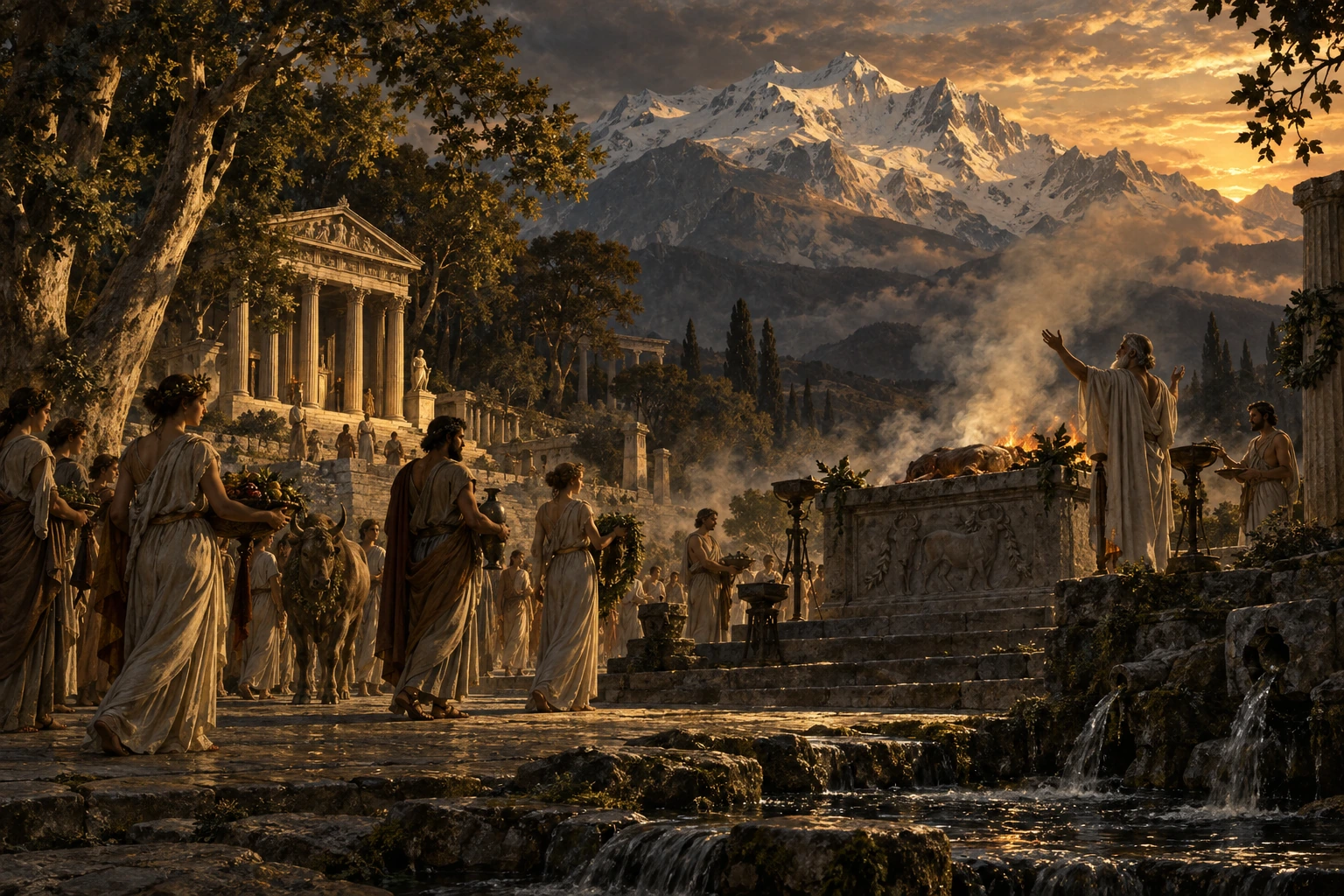
- Sacrifices on a summit. In 1961 the Meteorological Institute of the University of Thessaloniki began building a weather station on the Agios Antonios peak (2,817 m). Between 1961 and 1965 the workers collected stone stelae, pottery, coins and iron nails from a layer of charcoal and the bones of many sheep and goats. The few letters that could be read suggested dedications to Olympian Zeus, and the two scientists who published the finds, B. Kyriazopoulos and G. Livadas, concluded that his worship was organized there “at least during the hellenistic and early Christian years”. Some of the finds are on show in the Archaeological Museum of Dion.
- Dion. At the northern foot of the mountain stood the most important sacred city of the Macedonians. King Archelaus I held festivals there at the end of the 5th century BCE, with sacrifices to Olympian Zeus and the Pierian Muses. Before he set out for Asia, Alexander the Great made “lavish sacrifices to the gods at Dium” and held a nine-day festival, naming each day after one of the Muses (Diodorus 17.16.3–4). Arrian agrees on the sacrifice to Olympian Zeus but places Alexander’s Olympic games at Aegae (Anabasis 1.11.1).
- The first recorded ascent of Mytikas was on 2 August 1913, by a local guide, Christos Kakkalos, and two Swiss, Frédéric Boissonnas and Daniel Baud-Bovy.
- Protection. Olympus became Greece’s first national park in 1938, by royal decree, and a UNESCO Biosphere Reserve in 1981. In July 2026 the World Heritage Committee, meeting in Busan, added the wider area of Mount Olympus to the World Heritage List.
The Olympic Games were not held on Mount Olympus. They were held at Olympia, a sanctuary of Zeus in the Peloponnese, by the river Alpheius (Strabo 8.3.30). What links the two places is Zeus: Strabo says Pheidias modelled the great statue of Zeus at Olympia on Homer’s lines in which Zeus nods and “caused great Olympus to quake”. The name was not unique, either: there was an Olympus in Mysia, in Asia Minor (Herodotus 1.36), and two on Cyprus (Strabo 14.6.3).
5 Related Stories
- Zeus: The Youngest Son Who Became King of the Gods: the war against the Titans that, in Hesiod, the gods fought from Olympus.
- The Odyssey: Ten Years on the Way Home from Troy: the poem in which Olympus becomes a place untouched by wind, rain and snow (6.41–46).
- The Churning of the Ocean: Gods, Demons and the Nectar of Immortality: the Indian gods meet on Mount Meru and churn the sea for amṛta. The name of the Olympians’ food is related: the American Heritage Dictionary traces both Greek ambrotos, “immortal” (the source of ambrosia), and Sanskrit amṛta back to one Indo-European word for “undying”. The mountain of the gods is a shared theme; we have not found a scholar who compares Meru and Olympus.
- Dangun: The Bear, the Tiger and the First Korean Kingdom: Hwanung comes down from heaven onto the summit of Mount Taebaek and founds a City of the Gods. We link them for the theme of a holy mountain between heaven and earth; we have not found a scholar who compares them.
- Vesta: The Hearth Goddess and Her Virgins: Rome’s goddess of the hearth. In Cicero, the Stoic Balbus takes her name from the Greek Hestia (On the Nature of the Gods 2.67), the goddess who, in the Phaedrus, “alone remains in the house of the gods”.
6 Sources
- Homer, Iliad, trans. A. T. Murray (Loeb, 1924), books 1, 4, 5, 8, 11, 14, 15: Perseus
- Homer, Odyssey 6.41–47 and 20.103, trans. A. T. Murray (Loeb, 1919): Perseus
- Hesiod, Theogony, and the Homeric Hymn to Hermes, trans. Hugh G. Evelyn-White (Loeb, 1914): Perseus, Perseus
- Herodotus, Histories 1.36 and 2.4, trans. A. D. Godley (Loeb, 1920); Thucydides 6.54.6, trans. Richard Crawley (1910); Plato, Phaedrus 246e–247a, trans. Harold N. Fowler (Loeb, 1925): Perseus, Perseus, Perseus
- Strabo, Geography 8.3.30 and 14.6.3, trans. H. L. Jones (Loeb, 1924); Apollodorus, Library 3.5.3, trans. J. G. Frazer; Pausanias 2.31.2, trans. W. H. S. Jones and H. A. Ormerod (Loeb, 1918): Perseus, Perseus, Perseus
- Diodorus Siculus 17.16.3–4 (Loeb, vol. VIII, 1963) and Plutarch, Aemilius Paulus 15 (Loeb, 1918): LacusCurtius, LacusCurtius
- Arrian, Anabasis of Alexander 1.11.1, trans. E. J. Chinnock: Wikisource
- Liddell, Scott and Jones, A Greek-English Lexicon, “Ὄλυμπος”: Perseus
- B. Kyriazopoulos and G. Livadas, “Αρχαιολογικά ευρήματα επί της κορυφής του Ολύμπου Άγιος Αντώνιος”, Archaiologikon Deltion 22 (1967), Meletai A, pp. 6–14: University of Thessaly
- D. Ampatzidis et al., “Revisiting the determination of Mount Olympus Height (Greece)”, Journal of Mountain Science 20 (2023): doi.org
- Hellenic Ministry of Culture, “Dion”: Odysseus; Effie Poulaki-Pantermali, “Olympus”, Archaeological Park of Leivithra: Web Archive
- University of Kansas, Wilcox Collection, “The Parthenon Frieze”: ku.edu
- Robert Graves, The Greek Myths, vol. 1 (1955), §27: Internet Archive
- “Olympus: the first ascent in 1913”: Anavasi; “Mount Olympus and D-Day beaches added to UNESCO World Heritage List”: Euronews
- The American Heritage Dictionary, Indo-European roots, “mer-”: ahdictionary.com
- Kiyonaga Akitsugu, “オリンポス山”, Nipponica: Kotobank
Cover and illustrations: AI-generated images made for Arcana. They are interpretations, not historical artworks.