Athena: Born from Her Father's Head
Zeus swallowed her mother, and Athena came out of his head in full armour while Olympus shook. She went on to win Athens from Poseidon with an olive tree, and to punish a girl in Lydia who wove as well as she did.
- Type: myth, the birth of a goddess and how she won her city
- Culture: ancient Greece; Athena was the goddess of Athens and was worshipped across the Greek world; the Romans called her Minerva
- Earliest texts: a Bronze Age tablet from Knossos may already name her; Homer’s Iliad and Odyssey know her as the daughter of Zeus; Hesiod’s Theogony (8th–7th century BCE) tells her birth; the Homeric Hymn to her is of uncertain date
- Key figures: Athena (Pallas), Zeus, Metis, Hephaestus, Poseidon, Cecrops, Erichthonius, Arachne
Over the front of the Parthenon, the Athenians carved the birth of their goddess. Over the back, they carved the day she won their land from Poseidon. Pausanias, who saw both in the 2nd century CE, says so in a single sentence and moves on to the statue inside, of ivory and gold. The goddess had come out of her father’s head, and the city she won kept her olive tree on its rock for centuries.
Did Athena have a mother? In the oldest account she did. Hesiod’s Theogony names her: Metis, the first wife of Zeus and the wisest of gods and mortals, whom Zeus swallowed when she was about to give birth. Athena then came out of her father’s head. The one who says she had no mother is Athena herself, in Aeschylus’s Eumenides, as she casts her vote at a murder trial: “there was no mother who gave me birth”.
1 The Telling
The birth is told by Hesiod, a poet of Boeotia, in his Theogony, by the Homeric Hymn to Athena and by the poet Pindar. For the rest, the main source is the Library, a handbook of myths that goes under the name of Apollodorus (1st or 2nd century CE); for Arachne, it is the Roman poet Ovid.
1-1 The Wisest Wife
Zeus’s first wife, says Hesiod, was Metis, “wisest among gods and mortal men”. Her name is the Greek word for wisdom, or thought. Apollodorus adds that she turned into many shapes to escape him. Earth and starry Heaven warned Zeus that she would bear very wise children: first a daughter, “equal to her father in strength and in wise understanding”, and then a son who would be “king of gods and men”. So when she was about to give birth to Athena, Zeus “craftily deceived her with cunning words” and put her in his own belly, “that the goddess might devise for him both good and evil”. How Zeus came to be king, and why no son ever took the throne from him, is told in Zeus.
1-2 Out of the Head
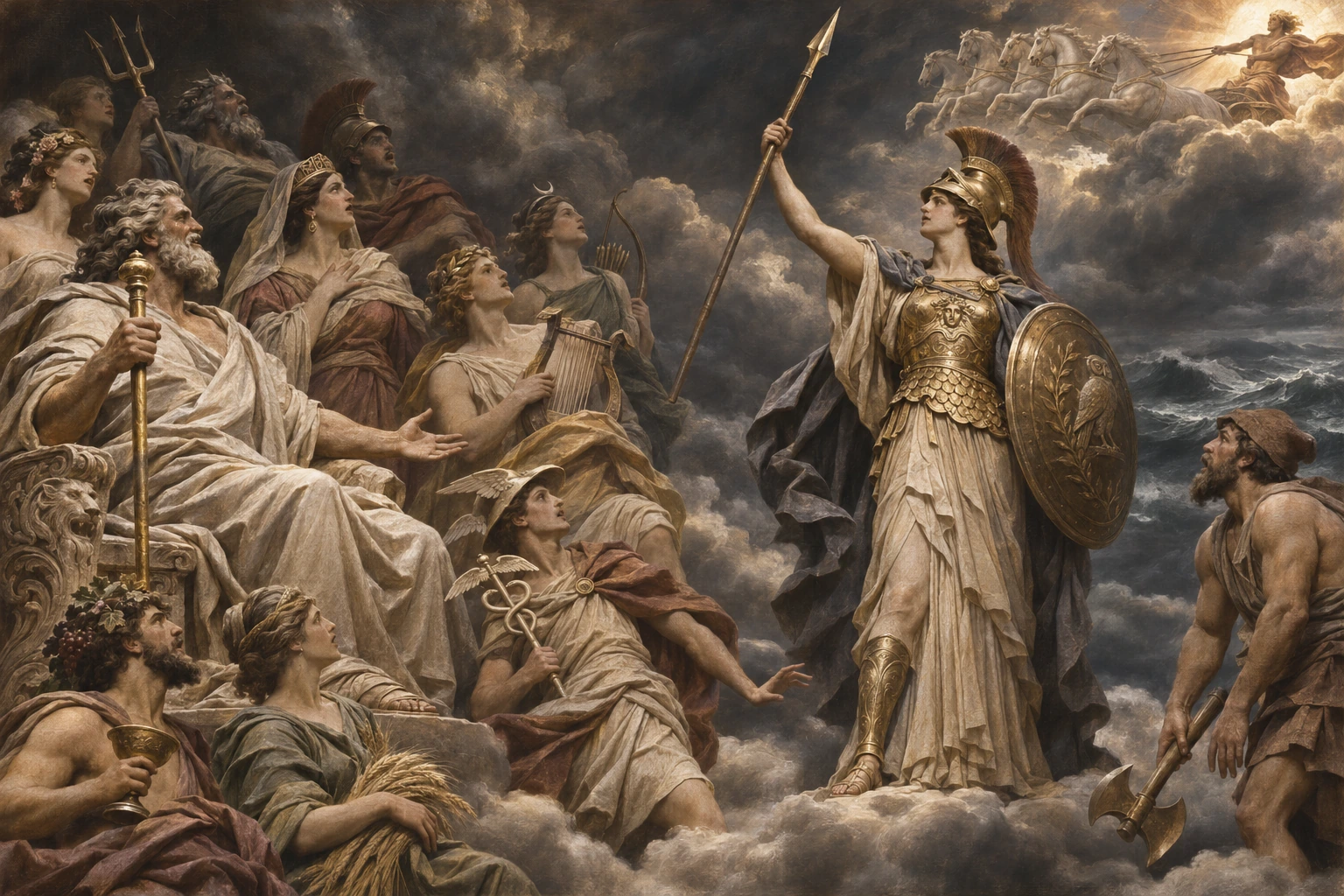
Then, says Hesiod, “Zeus himself gave birth from his own head to bright-eyed Tritogeneia, the awful, the strife-stirring, the host-leader, the unwearying, the queen, who delights in tumults and wars and battles”. Hera, very angry with her husband, bore Hephaestus without him. The Homeric Hymn to Athena shows the moment. She came out “arrayed in warlike arms of flashing gold”, and awe seized all the gods as they gazed. She sprang from the immortal head and stood before Zeus, shaking a sharp spear. Great Olympus reeled, the earth cried out, the sea heaved with dark waves, and the Sun stopped his horses “until the maiden Pallas Athene had stripped the heavenly armour from her immortal shoulders. And wise Zeus was glad.”
Pindar, in an ode for a boxer from Rhodes, names the one who opened the way: “by the cunning craft of Hephaestus, at the stroke of the brazen hatchet”, Athena “leapt forth from the crest of her father’s head, and cried aloud with a mighty shout”. Apollodorus is less sure. “Prometheus or, as others say, Hephaestus” struck the head with an axe, and Athena, fully armed, leapt out “at the river Triton”.
1-3 Pallas
Apollodorus tells a story of her girlhood, as the story of an image, the Palladium. Athena was brought up by Triton, who had a daughter named Pallas, and the two girls practised the arts of war together. Once they quarrelled. As Pallas was about to strike, Zeus, in fear, held out the aegis between them; Pallas looked up, startled, and fell to Athena’s blow. Grieving, Athena made a wooden image in her likeness, wrapped the aegis around its breast, and set it up beside Zeus. Zeus later threw it down into the land of Troy, where King Ilus, who had prayed for a sign, found it lying before his tent: three cubits high, its feet together, a spear raised in its right hand and a distaff and spindle in its left. The Romans said it ended up in the temple of Vesta.
1-4 The Olive and the Salt Spring
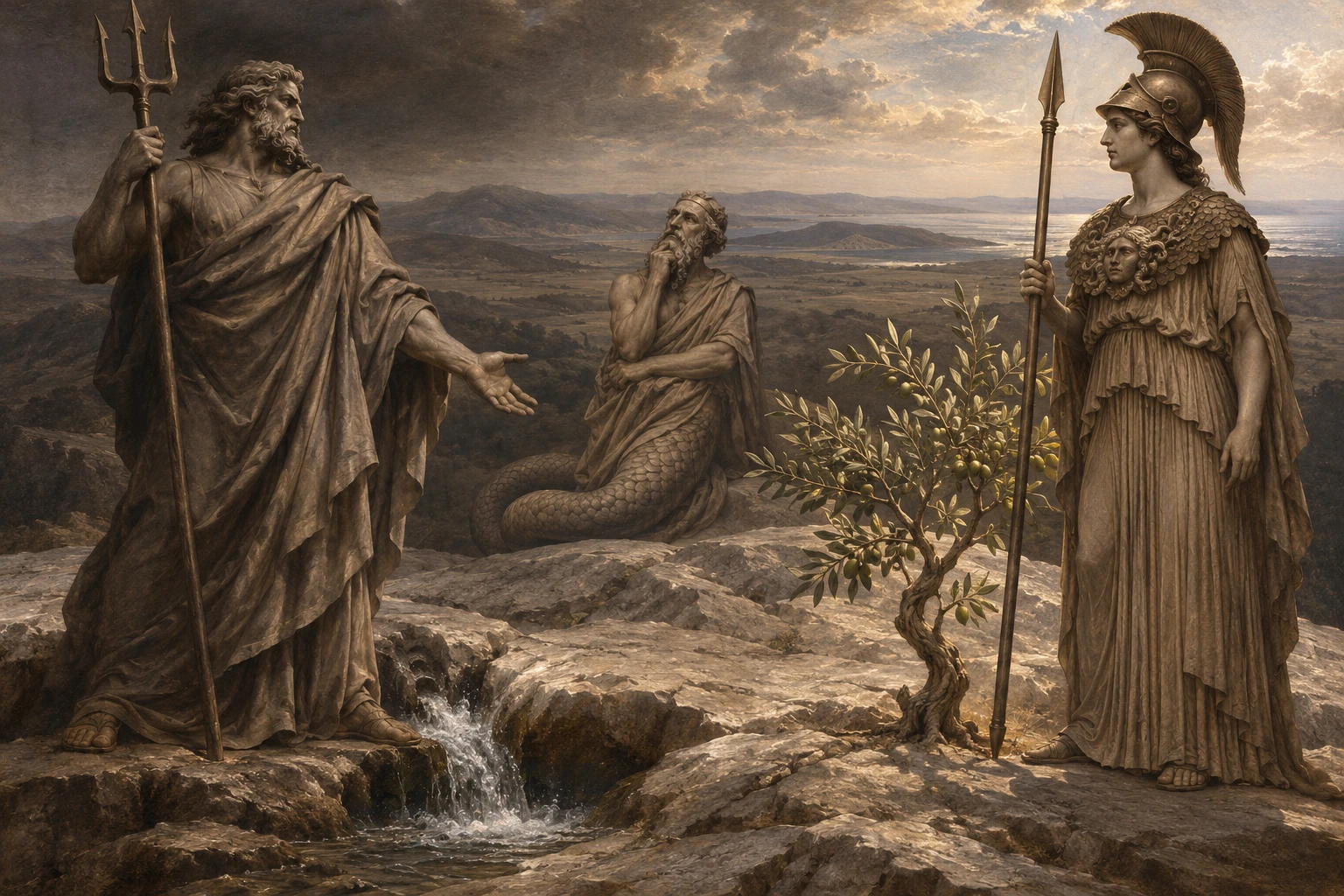
In the time of Cecrops, the first king of Attica, born of the soil, half man and half serpent, the gods decided to take possession of cities where each of them would have a worship of their own. Poseidon came first. With a blow of his trident in the middle of the Acropolis he brought forth a sea: a spring of salt water. Then Athena came, called on Cecrops to witness, and planted an olive tree. The two fought over the land until Zeus parted them and appointed judges: the twelve gods. Because Cecrops testified that she had planted her olive first, they gave the country to Athena. She named the city Athens after herself, and Poseidon, in a rage, flooded the Thriasian plain and put Attica under the sea.
1-5 The Chest
Hephaestus tried to take Athena by force; she escaped him, and from his seed, which fell on the ground, a child was born: Erichthonius. Athena raised him in secret, meaning to make him immortal. She shut him in a chest and gave it to Pandrosus, a daughter of Cecrops, forbidding her to open it. Her sisters opened it out of curiosity and saw a serpent coiled around the baby. Some say the serpent killed them; others, that Athena’s anger drove them mad and they threw themselves from the Acropolis. Raised by the goddess in her sanctuary, Erichthonius became king of Athens. He set up the wooden image of Athena on the Acropolis and founded her festival, the Panathenaea.
1-6 Arachne
This is Ovid’s story, from the Metamorphoses. In the little Lydian town of Hypaepa lived Arachne, daughter of Idmon of Colophon, who dyed wool with Phocaean purple. She was famous for nothing but her skill: nymphs left the vineyards of Mount Tmolus and the river Pactolus to watch her spin and weave. Anyone could see that Minerva had taught her, but she denied it. “Let her contend with me,” she said. The goddess came to her as an old woman, grey-haired and leaning on a staff, and told her to ask Minerva’s pardon. Arachne told her to go home and let her goddess come in person. “Minerva comes!” said the old woman, and showed herself. The nymphs bowed down. Arachne flushed, went pale, and stood her ground.
They set up two looms. Pallas wove the Acropolis and the old quarrel over the land: twelve gods enthroned with Jupiter in their midst, Neptune striking the rock, herself in helmet and aegis with the olive springing from the earth. In the four corners she put mortals whom the gods had punished for their daring, and she framed it all with olive. Arachne wove the gods’ deceptions: Jupiter as the bull who carried off Europa, as the swan with Leda, as the shower of gold for Danaë; Neptune, among his other shapes, as the bird around snake-haired Medusa; Apollo, Bacchus and Saturn in their disguises. She edged her cloth with flowers and ivy.
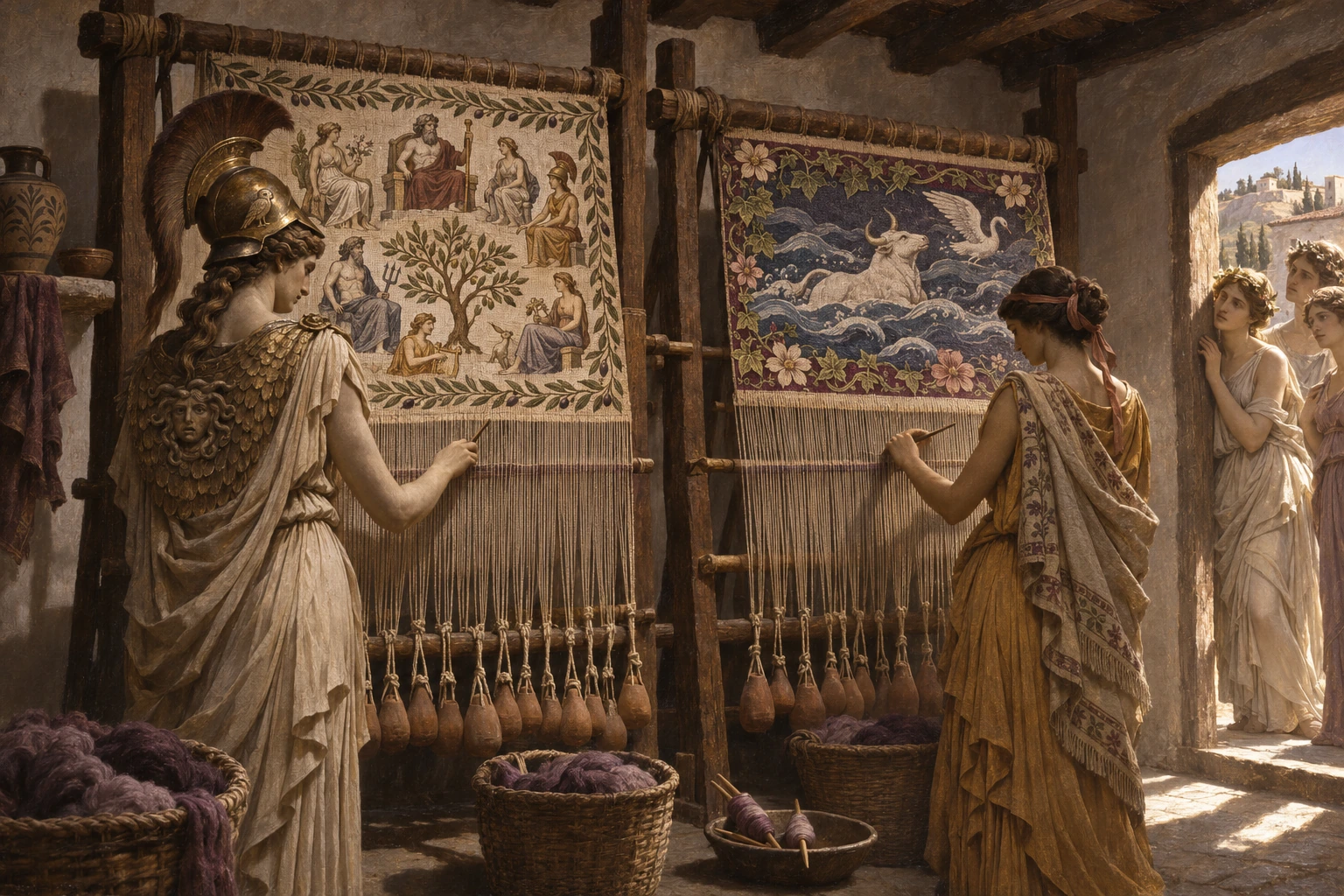
Neither Pallas nor Envy could find a fault in it. Stung by the girl’s success, the goddess tore up the tapestry, with its crimes of the gods, and struck Arachne on the forehead with her boxwood shuttle, three or four times. Arachne could not bear it and hanged herself. Pallas, moved to pity, lifted her: “Live, then, but hang, wicked one”, and the same punishment was to pass to all her descendants. She sprinkled her with the juice of Hecate’s herb. Arachne’s hair fell out, and her nose and ears with it; her head and body shrank, her fingers became legs, and from her belly she still draws out thread: a spider, at her old weaving.
2 Where the Story Is Written Down
- A tablet from Knossos. On a Linear B tablet from Crete (V 52) stand the words a-ta-na-po-ti-ni-ja, which can be read as “Athana Potnia”, Lady Athena. Another scholar, Palmer, suggested that a-ta-na is a place, “the Lady of Atana”. In 1957 John Chadwick warned that the phrase occurs only once, “a shaky foundation upon which to build”.
- Homer. In the Iliad Zeus calls her “Tritogeneia, dear child” (8.39), and Ares complains to him: “thou art father to that mad and baneful maid” (5.875–876). Homer never tells her birth. In the Odyssey she is the goddess who brings Odysseus home (The Odyssey).
- Hesiod, Theogony 886–900 and 924–926: Metis swallowed, and the birth from the head. A second version of the same lines survives because the philosopher Chrysippus quoted it, in a passage preserved by the physician Galen (section 3).
- The Homeric Hymn to Athena (Hymn 28), a short poem of uncertain date: the armed goddess and the shaking of the world.
- Pindar, Olympian 7, for Diagoras of Rhodes, winner of the boxing at Olympia in 464 BCE: Hephaestus and the hatchet. The Sun god tells his children on Rhodes to be the first to build her an altar, but they climb the citadel without fire and lay out her precinct with “fireless sacrifices”.
- Herodotus, Histories 8.55 (5th century BCE): the olive and the salt water, still on the Acropolis in his day.
- Ovid, Metamorphoses 6.1–145, finished around 8 CE: Arachne. Virgil, writing before him, already calls the spider “hateful to Minerva” (Georgics 4.246–247).
- Apollodorus, Library 1.3.6, 3.12.3, 3.14.1 and 3.14.6: the fullest prose account, retold in section 1. Pausanias, Description of Greece (2nd century CE): what he saw on the Acropolis (section 4).
3 Competing Versions
- A mother, or none? Hesiod names Metis. The second version of his lines keeps her “hidden beneath the inward parts of Zeus”, “Athena’s mother”, and has Athena receive inside him what made her stronger than all the gods (the translator glosses it as the aegis), so that Zeus gave her birth “arrayed in arms of war”. In the Eumenides Athena says she had no mother and is “entirely on the father’s side”. In the Ion she was “born without the pains of childbirth”. In Rome, Ovid’s Fasti has Juno hurt that Jupiter needed no wife for Minerva, “born without a mother” (5.231–232).
- Who opened the head? Pindar: Hephaestus, with a bronze hatchet. Euripides: “the Titan Prometheus”. Apollodorus: “Prometheus or, as others say, Hephaestus”. His translator J. G. Frazer notes that Hephaestus was “the usual account, followed by the vase-painters”, and that others named Palamaon or Hermes. Where? The Hymn sets the birth before Zeus on Olympus. Apollodorus and the second version of Hesiod set it by the river Triton, and the translator Evelyn-White explains her title Tritogeneia by that river.
- Why “Pallas”? In Plato’s Cratylus (406d–407a) Socrates derives it from pallein, “to shake”, because of her armed dances, and “Athena” from “the mind of God”. Apollodorus gives no reason, but he knows two others called Pallas, both killed by Athena: Triton’s daughter, and a giant whom she flayed in the war against the giants, using his skin “to shield her own body in the fight” (1.6.2).
- Who judged, and how? Apollodorus: the twelve gods, “not, as some have affirmed, Cecrops and Cranaus, nor yet Erysichthon”. Ovid’s Minerva weaves twelve gods with Jupiter in their midst. The Roman scholar Varro, as Augustine reports him in The City of God (18.9), had the people vote: the men for Neptune, the women for Minerva, who won by one vote. To calm the god, the women lost their vote, their children could no longer take their mothers’ names, and they were no longer to be called Athenians.
- Salt water or a horse? Herodotus speaks of “a pool of salt water”, Pausanias of sea water in a cistern that sounds like waves when the south wind blows, Apollodorus of a sea. In Hugo Magnus’s Latin text of Ovid (1892), sea water (fretum) leaps from the rock; Brookes More’s translation of 1922 gives Neptune “a wild horse” instead. The manuscripts differ: the notes to Magnus’s edition of 1914 give fretum from a few of them and ferum, “a wild creature”, from the rest, and More’s horse renders ferum. Frazer finds the horse in the late Latin mythographers, and perhaps in Virgil, and says it “is not countenanced by Greek writers”.
- How fast did the olive grow back? When the Persians burned the Acropolis, says Herodotus, the olive burned with it, and the next day a shoot “about a cubit’s length” had sprung from the stump. Pausanias heard that it grew two cubits on the very day it was burned.
4 History and Tradition
- Older than the city. In the revised edition of Heibonsha’s World Encyclopedia, which we read on Kotobank, Mizutani Tomohiro writes that Athena was probably a goddess of the people who lived in Greece before the Greeks, the guardian of the acropolis where the Mycenaean rulers had their palaces, and later of the city itself. Pausanias says the holiest image of Athens, honoured “many years before the unification of the parishes”, was said to have fallen from heaven.
- The Parthenon was built in 447–438 BCE. Its gables showed the birth and the contest (Pausanias 1.24.5). The centre of the birth scene was removed when the temple was made into a church, after the 6th century CE, and scholars still propose new ways to fill it, says the Parthenon in Nashville.
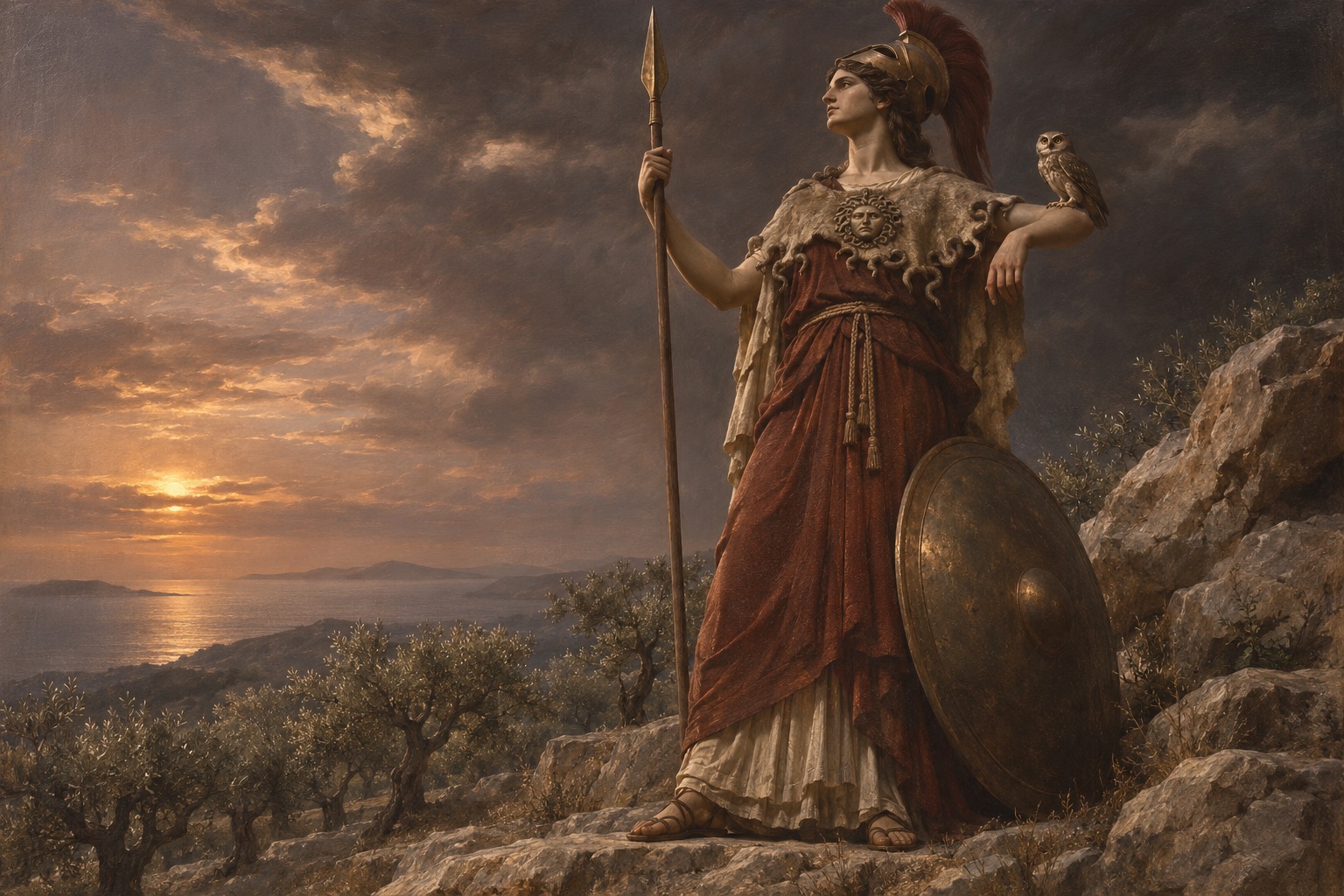
- The Athena Parthenos. Phidias “produced the great golden image of the goddess”, says Plutarch (Pericles 13.9). Pausanias saw her standing in a tunic to her feet, a sphinx and griffins on her helmet, the head of Medusa in ivory on her breast, a Victory about four cubits high in one hand and a spear in the other, a shield at her feet, and by the spear a serpent: “This serpent would be Erichthonius.” On the base was the birth of Pandora. Pliny the Elder gives her height as twenty-six cubits. Thucydides says she carried “forty talents of pure gold and it was all removable” (2.13.5); when Phidias was accused of stealing some, Plutarch says, Pericles had the accusers take it off and weigh it, and no theft was proven, though Phidias died in prison (31.3–5). The Parthenon in Nashville, citing the temple’s building accounts, dates her dedication to 438 or 437 BCE, and says she was lost by 400 CE. In Roman times small copies were made and sold; one, the Varvakeion Athena, a marble statuette 0.95 m high found in the ruins of a Roman house in Athens, is in the National Archaeological Museum.
- Nashville. In 1982 the city of Nashville, which has a full-size replica of the Parthenon, commissioned the sculptor Alan LeQuire to remake the statue. His Athena, 42 feet (about 12.8 m) tall, was unveiled on 20 May 1990 and gilded in 2002.
- The Panathenaea was held every year, and every fourth year as the Great Panathenaea. A new robe, the peplos, was brought for the ancient image of Athena Polias, hung like a sail from the mast of a ship. Plato’s Socrates mentions “the robe which is carried up to the Acropolis at the great Panathenaea”, covered with the gods’ battles (Euthyphro 6b–c). The winners of the athletic contests and horse races received olive oil from her sacred trees, and anyone who cut down one of those trees was once tried by the Areopagus and, if found guilty, put to death (Constitution of the Athenians 60).
- The owl. From about 520 BCE the silver coins of Athens carried the profile of Athena. On the back of one from about 490 BCE, in the Art Institute of Chicago, her owl perches on an olive branch beside the letters ΑΘΕ. The museum calls the profile “the most famous of all civic badges”: Athens kept the design so that its coins stayed trusted, and they became the standard throughout the Mediterranean for centuries.
“Arachne lost the contest” is how the story is often retold. In Ovid, our main source, she does not lose. His Latin says that neither Pallas nor Envy could find fault with her work (Metamorphoses 6.129–130), and that the goddess was stung by her success. Pallas tore up a flawless tapestry of the gods’ crimes, and beat the girl who wove it.
5 Related Stories
- Zeus: The Youngest Son Who Became King of the Gods: why Zeus swallowed Metis. His father had swallowed his children once they were born; Zeus swallowed the mother before the son could be born, and in Hesiod no one ever takes the throne from him.
- Medusa: The Gorgon Whose Story Kept Changing: how the Gorgon’s head came to be on Athena’s aegis. In the Metamorphoses Minerva’s anger falls on Medusa two books before it falls on Arachne.
- The Odyssey: Ten Years on the Way Home from Troy: when she reveals herself to Odysseus on Ithaca, Athena tells him that she is famed among all the gods “for wisdom and craft” (13.298–299). The Greek word for that wisdom is mētis, her mother’s name.
- Mars: The Father of Rome: in Hesiod, Hera, angry with her husband, bears Hephaestus without him. In Ovid’s Fasti, Juno, hurt that Jupiter produced Minerva without a mother, conceives Mars with the touch of Flora’s flower.
6 Sources
- Hesiod, Theogony, trans. Hugh G. Evelyn-White (Loeb, 1914), lines 886–900 and 924–929, with the variant lines 929a–t quoted by Chrysippus: Theoi
- Homeric Hymn 28, “To Athena”, trans. Hugh G. Evelyn-White (Loeb, 1914): Theoi
- Homer, Iliad 5.864–898 and 8.38–39, trans. A. T. Murray (Loeb, 1924), and Odyssey 13.287–302, trans. A. T. Murray (Loeb, 1919): Perseus, Perseus
- Pindar, Olympian 7, trans. Sir John Sandys (Loeb, 1915), with his introduction: archive.org
- Aeschylus, Eumenides 734–740, trans. Herbert Weir Smyth (Loeb, 1926), and Euripides, Ion 452–457, trans. Robert Potter: Perseus, Perseus
- Herodotus, Histories 8.55, trans. A. D. Godley: Perseus; Thucydides 2.13.5, trans. Richard Crawley (Dent, 1910): Perseus
- Plato, Cratylus 406d–407b, trans. Harold N. Fowler (Loeb, 1921), and Euthyphro 6b–c, trans. Harold North Fowler (Loeb): Perseus, Perseus; Aristotle (attributed), Constitution of the Athenians 60, trans. H. Rackham (Loeb, 1952): Perseus
- Ovid, Metamorphoses 6.1–145 (line numbers of Hugo Magnus’s Latin text, 1892), trans. Brookes More (1922), and Fasti 5.229–242, Latin text: Perseus, Latin text, The Latin Library; Hugo Magnus (ed.), P. Ovidi Nasonis Metamorphoseon libri XV (Berlin: Weidmann, 1914), critical notes to 6.77: Internet Archive; Virgil, Georgics 4.246–247, Latin text ed. J. B. Greenough (1900): Perseus
- Apollodorus, Library 1.3.6, 1.6.2, 3.12.3, 3.14.1–2 and 3.14.6, trans. Sir James George Frazer (Loeb, 1921), with Frazer’s notes: Perseus
- Pausanias, Description of Greece 1.18.2, 1.24.5–7, 1.26.5–6 and 1.27.2, trans. W. H. S. Jones and H. A. Ormerod (Loeb, 1918): Perseus
- Plutarch, Life of Pericles 13.9 and 31.3–5 (Loeb, vol. III, 1916): LacusCurtius; Pliny the Elder, Natural History, book 36, chapter 4, trans. John Bostock and H. T. Riley (1855): Perseus
- Augustine, The City of God 18.9, trans. Marcus Dods: New Advent
- John Chadwick, “Potnia”, Minos 5 (1957): Universidad de Salamanca
- Dictionary of Greek and Roman Antiquities, “Panathenaea”: Theoi
- The Art Institute of Chicago, tetradrachms of Athens 1923.1130 and 1938.1217: artic.edu, artic.edu; Museum of Classical Archaeology, University of Cambridge, “Varvakeion Athena Parthenos”: museum.classics.cam.ac.uk
- The Parthenon, Nashville, “Collections” and “History”: nashvilleparthenon.com, nashvilleparthenon.com
- Mizutani Tomohiro, “アテナ” (Athena), Kaitei shinban Sekai daihyakka jiten (Heibonsha World Encyclopedia, revised edition), as published on Kotobank: Kotobank
Cover and illustrations: AI-generated images made for Arcana. They are interpretations, not historical artworks.