Medusa: The Gorgon Whose Story Kept Changing
In the oldest account, Medusa is born a Gorgon, the only one of three sisters who can die. The beautiful girl punished by Athena arrives some seven hundred years later, in a Roman poem.
- Type: myth, a monster killed by a hero, whose origin changes from one telling to the next
- Culture: ancient Greece; retold in Rome
- Earliest texts: Homer (8th century BCE) knows “the Gorgon” but never names her; Hesiod’s Theogony (8th–7th century BCE) is the oldest surviving account of Medusa; the curse in Minerva’s temple is told by the Roman poet Ovid, around the turn of the era
- Key figures: Medusa, her sisters Stheno and Euryale, Perseus, Athena, Poseidon, Pegasus, Chrysaor
The Greeks put the Gorgon’s face on armour, on city walls and on temples to keep harm away. How Medusa came to have that face is another question, and the ancient writers did not agree on the answer. In Ovid’s poem a guest at Perseus’s wedding asks it outright: why, of three sisters, did Medusa alone have snakes in her hair?
Was Medusa cursed by Athena? Only in the later versions. In Hesiod’s Theogony, the oldest account of her, she is one of three Gorgon sisters, the only one who is mortal, and there is no curse. The curse is told by Ovid some seven centuries later: Neptune violated her in Minerva’s temple, and the goddess turned her hair into snakes. The Library of Apollodorus gives a third answer, “alleged by some”: Medusa was beheaded for Athena’s sake, because she had wanted to rival the goddess in beauty.
1 The Telling
This is the version of the Library, a Greek handbook of myths that goes under the name of Apollodorus and is placed in the 2nd century CE. Its translator, J. G. Frazer, notes that its story of Perseus “seems to be based on” an older writer, Pherecydes. For Medusa’s family it agrees with Hesiod, who is quoted here.
1-1 Three Sisters beyond Ocean
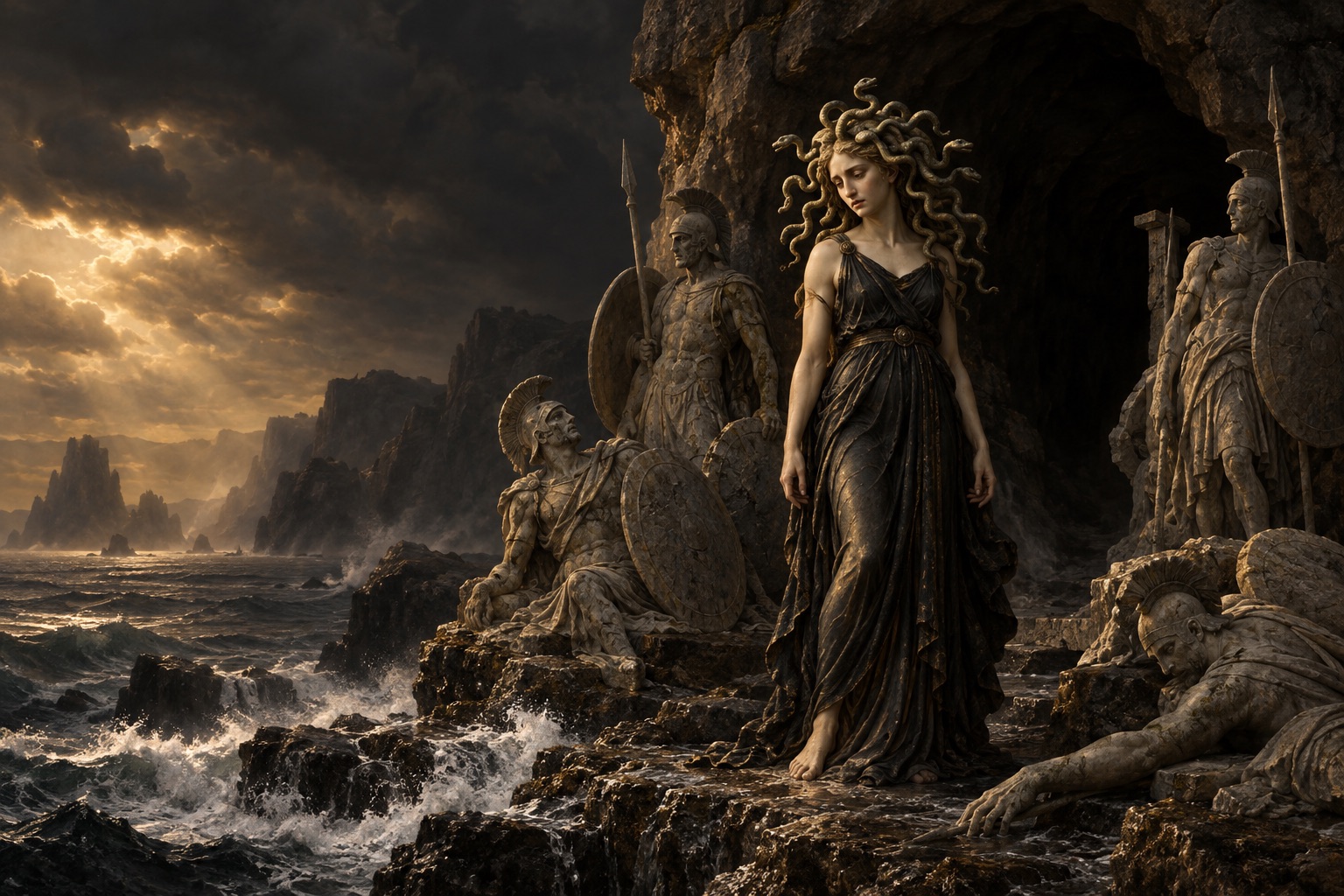
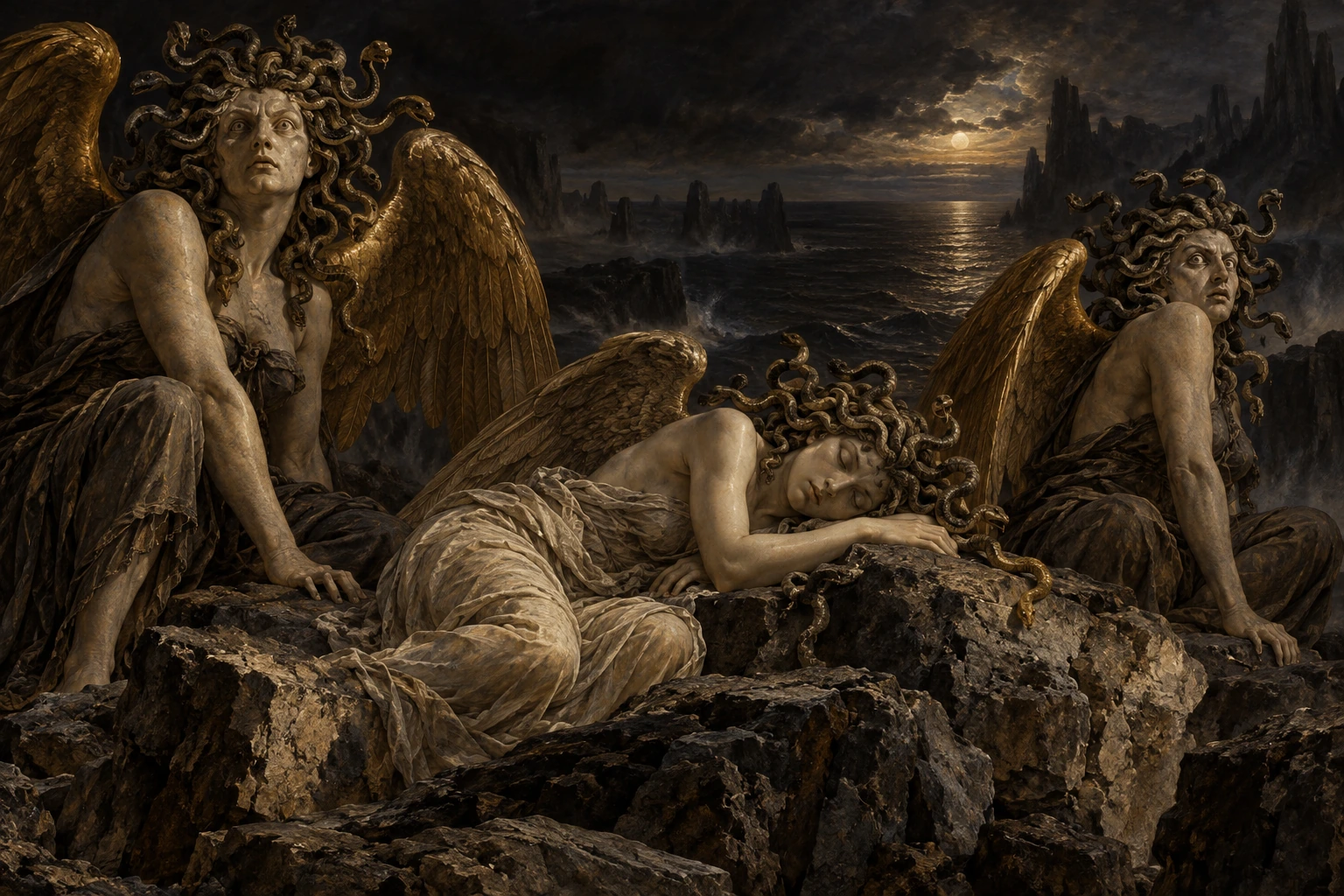
The sea god Phorcys and Ceto had two sets of daughters. The Graiae were “grey from their birth”. The Gorgons, says Hesiod, live “beyond glorious Ocean”, at the edge of the world towards Night, near the clear-voiced Hesperides. Their names are Stheno, Euryale and Medusa, “who suffered a woeful fate”: her two sisters are undying and never grow old, but she is mortal. With her, Poseidon lay “in a soft meadow amid spring flowers”.
Apollodorus describes what they looked like. Their heads were “twined about with the scales of dragons”, they had great tusks like a boar’s, hands of bronze and golden wings to fly with, and anyone who looked at them was turned to stone.
1-2 A Promise on Seriphos
An oracle told Acrisius that his daughter Danaë would bear a son who would kill him. He shut her in a bronze chamber underground, but Zeus reached her, some say, as a stream of gold through the roof, and she bore Perseus. Acrisius put mother and child in a chest and cast it into the sea. It washed ashore on the island of Seriphos, where a man named Dictys raised the boy.
Dictys’s brother Polydectes, king of the island, loved Danaë, but her son, now grown, stood in his way. So Polydectes called his friends together, Perseus among them, on the pretext of collecting gifts for a bride. Perseus said he would not stop even at the Gorgon’s head. The others gave horses. From Perseus, Polydectes demanded the head.
1-3 The Grey Sisters and the Nymphs
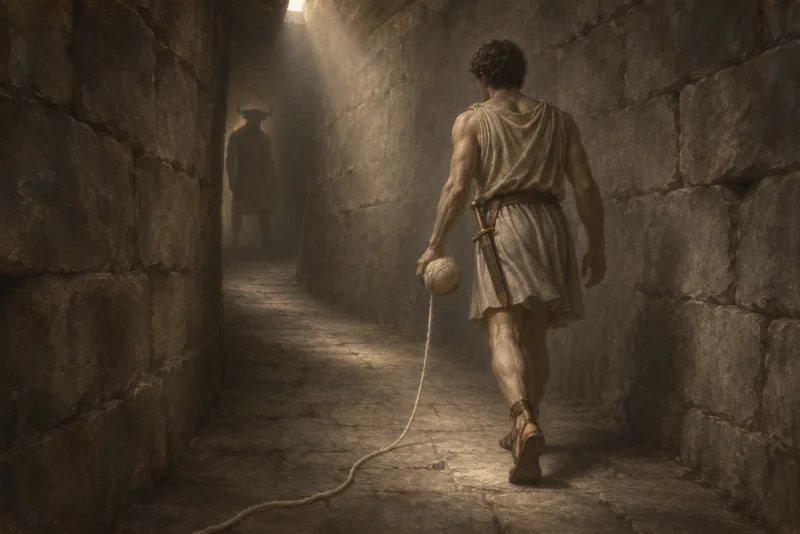
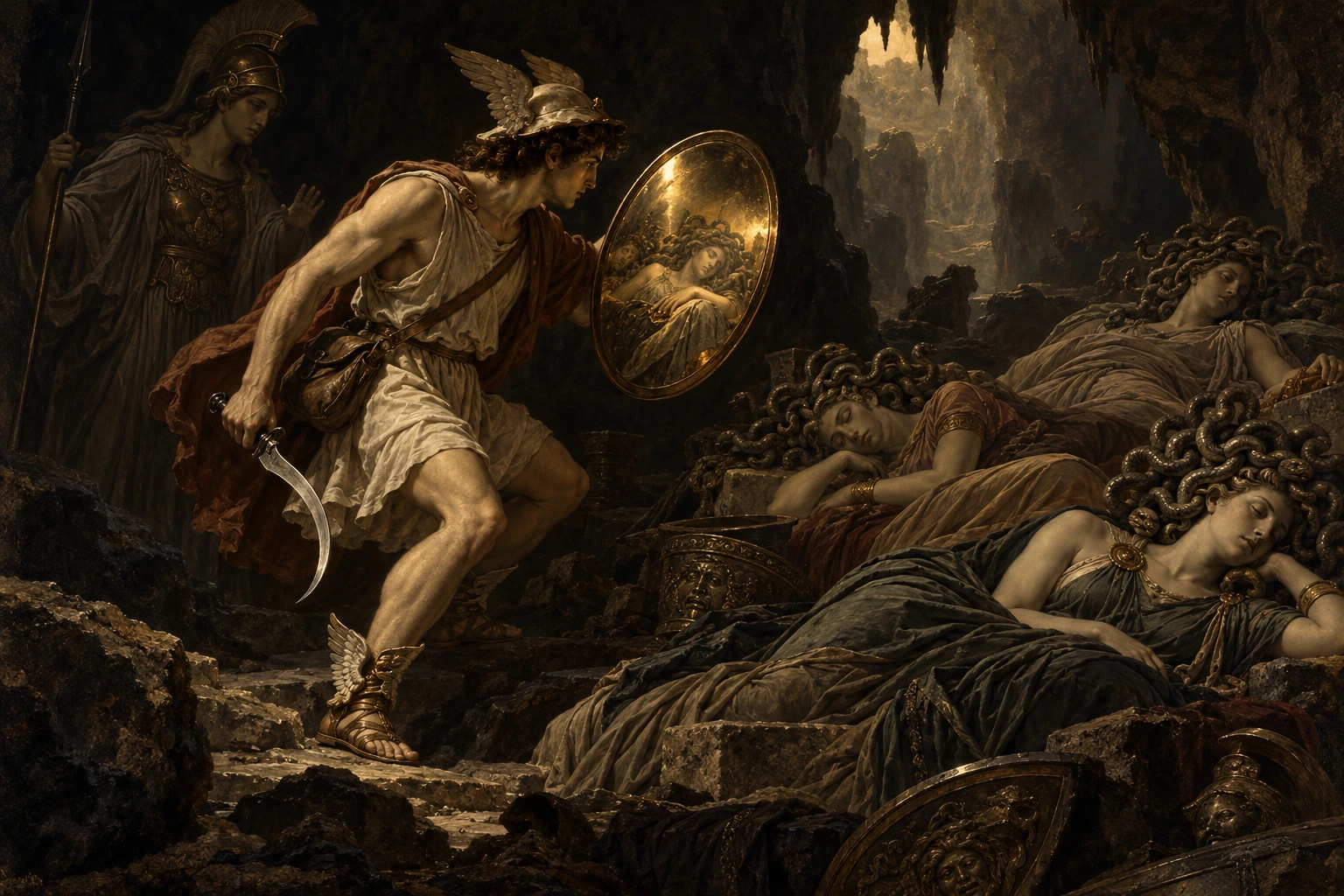
Guided by Hermes and Athena, Perseus went first to the Gorgons’ sisters, the daughters of Phorcys: Enyo, Pephredo and Deino, old women from birth, who had one eye and one tooth between them and passed them from one to another. Perseus took both, and would give them back only when they showed him the way to certain nymphs. From the nymphs he received winged sandals, a bag called the kibisis, and the cap of Hades: whoever wore it saw whom he pleased and was not seen. Hermes gave him a sickle of adamant.
1-4 The Shield
Perseus flew to Ocean and found the Gorgons asleep. Only Medusa could die, which is why it was her head he had been sent for. He stood over them. Athena guided his hand, and he looked not at the Gorgon but into a bronze shield, where he saw her image, and cut off her head.
From the Gorgon sprang the winged horse Pegasus and Chrysaor, later the father of Geryon: her children by Poseidon. The two sisters woke and gave chase, but the cap hid Perseus from them.
1-5 The Head
In Ethiopia Perseus killed a sea monster, freed the princess Andromeda and married her. When her uncle Phineus plotted against him, he showed him the head, and Phineus and his fellow plotters turned to stone. On Seriphos he found his mother and Dictys taking refuge at the altars from Polydectes. He went into the palace, where the king had gathered his friends, turned his own face away and held up the head. Everyone who saw it became stone, “each in the attitude which he happened to have struck”. Perseus made Dictys king, gave the sandals, the bag and the cap back to Hermes, and gave the head to Athena, who set it in the middle of her shield.
2 Where the Story Is Written Down
- Homer, Iliad and Odyssey (8th century BCE). He never names Medusa and tells no story; he only shows a head. On Athena’s aegis is “the head of the dread monster, the Gorgon, dread and awful” (Iliad 5.741–742); on Agamemnon’s shield the Gorgon is “glaring terribly”, with Terror and Rout around her (11.36–37). No one in these passages is turned to stone.
- Hesiod, Theogony 270–283 (8th–7th century BCE): the names, the family, the home beyond Ocean, Medusa’s mortality, Poseidon, the two children. Nothing about her face, her hair or her eyes.
- The Shield of Heracles, a poem handed down under Hesiod’s name (216–237). Perseus, worked in gold on Heracles’ shield, flies with the head in a silver bag, and the Gorgons rush after him with “two serpents” hanging at their girdles.
- Pindar, Pythian 12, probably of 490 BCE according to its translator Sir John Sandys. Athena invents a tune for the aulos, a reed pipe, to imitate the “dismal death-dirge” that poured “from beneath those maidens’ awful serpent-heads” when Perseus killed the third sister; the shrillest cry was Euryale’s. In the same poem Medusa is “fair-faced”. In Pythian 10 (498 BCE), Perseus brings the head “that glittered with serpent-locks” to the islanders of Seriphos and turns them into stone.
- Aeschylus, Prometheus Bound 798–800 (5th century BCE): three winged sisters, “the snake-haired Gorgons, loathed of mankind, whom no one of mortal kind shall look upon and still draw breath”.
- Ovid, Metamorphoses, end of book 4 (around the turn of the era). Perseus tells his own story at his wedding feast and explains the snakes (section 3).
- Apollodorus, Library 2.4.1–3 (2nd century CE): the fullest account of the quest, retold in section 1.
- Pausanias, Description of Greece (2nd century CE): a version without wonders, and the places where Medusa was still remembered (sections 3 and 4).
3 Competing Versions
3-1 Ovid: The Girl in Minerva’s Temple
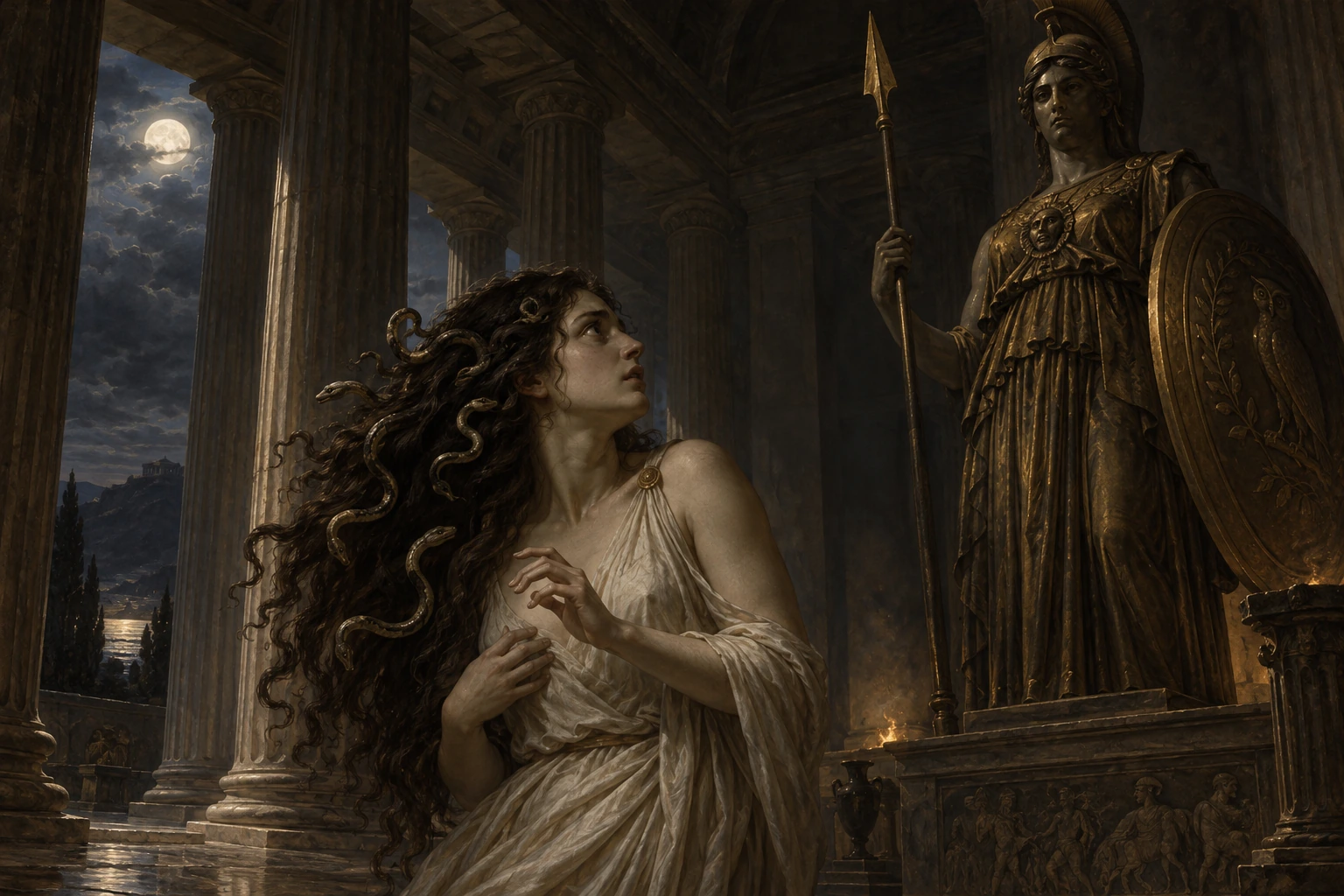
At the feast one of the lords asks Perseus why Medusa alone of the three sisters had snakes in her hair. She was, he answers, “famed for beauty, and the envious hope of many suitors”, and of all her charms her hair was the loveliest; he once met a man who said he had seen it. Then: “Fame declares”, in Latin dicitur, “it is said”, that the lord of the sea had her in Minerva’s temple.
The Latin verb is vitiasse, which the Latin dictionary of Lewis and Short glosses, in this sense, as “to violate a woman”; Brookes More’s 1922 translation softens it to “attained her love”. Minerva turned away and hid her chaste face behind her aegis. To punish the act, she changed the Gorgon’s hair into snakes, and she still wears them on her breast to frighten her enemies. Even Ovid’s Perseus tells it at second hand.
In book 6 Ovid returns to it. Arachne weaves the gods’ seductions into a tapestry, and among Neptune’s she shows him as “the bird that hovered round snake-haired Medusa, mother of the winged horse” (6.119–120).
3-2 Where the Versions Disagree
- Why does Athena wear the head? Homer: it is already on the aegis, and he gives no reason. Apollodorus: Perseus gives it to her. But “it is alleged by some that Medusa was beheaded for Athena’s sake”, because the Gorgon wished “to match herself with the goddess even in beauty”. Ovid: the snakes on Minerva’s breast are the ones she made.
- Poseidon. Hesiod sets their meeting “in a soft meadow amid spring flowers”, with no word of a crime. Ovid sets it in a temple, as a crime, and the punishment falls on Medusa. Apollodorus says only that she had her two children “by Poseidon”.
- Beautiful or terrible? One poem of Pindar has both: “fair-faced” Medusa and her sisters’ “awful serpent-heads”. Aeschylus’s Gorgons are snake-haired; Apollodorus’s have scales, tusks, bronze hands and golden wings. In Ovid only Medusa has snakes.
- Stone. In the Homeric passages and in the Theogony no one is turned to stone. Pindar’s Perseus turns the islanders “into stone”; in Aeschylus no mortal looks at the Gorgons and lives; in Apollodorus “they turned to stone such as beheld them”.
- No monster at all. In Argos, Pausanias gives only “the rational parts of the story”. After the death of her father Phorcys, Medusa ruled the people around Lake Tritonis in Libya, led them out hunting and to war, and was killed at night while camped against Perseus’s army. Perseus, “admiring her beauty even in death”, cut off her head to show the Greeks. Pausanias adds the guess of Procles of Carthage, that she was one of the wild women of the Libyan desert. The historian Diodorus (1st century BCE), following an earlier writer, Dionysius, makes the Gorgons a warlike nation of women in Libya, beaten by the Amazons under their queen Myrina, then “subdued a second time by Perseus, the son of Zeus, when Medusa was queen over them”.
4 History and Tradition
- A guarding face. The Gorgon’s head was often painted on armour and city walls as a sign of protection, writes Tange Kazuhiko in the Japanese encyclopedia Nipponica. On the west pediment of the temple of Artemis on Corfu (590–570 BCE, as the Greek Ministry of Culture dates it), a gigantic Gorgon fills the centre. “Her function was clearly to keep away malign influence,” says the Princeton Encyclopedia of Classical Sites. Beside her are Chrysaor and Pegasus, the children who in Hesiod spring out when she is beheaded, and two panthers.
- What Pausanias saw, in the 2nd century CE: a gilded head of Medusa with an aegis around it on the south wall of the Athenian Acropolis (1.21.3); her head in ivory on the breast of Athena’s statue in the Parthenon (1.24.7); at Tegea, a sanctuary called “Defence”, where Athena was said to have given the city a lock of Medusa’s hair as its guard (8.47.5); and in the market-place of Argos, a mound of earth said to hold her head (2.21.5).
- Florence. Benvenuto Cellini’s bronze Perseus, holding up the head, has stood in the Loggia dei Lanzi since the mid-16th century. The Uffizi calls it “a political manifesto”: Grand Duke Cosimo I de’ Medici had succeeded in “cutting off the head” of the infighting of the old Republic, “represented by the snakes of the monster”. Caravaggio painted the head on a wooden battle shield (1596–1598) at the moment of the cut, the mouth screaming; the Uffizi calls it his most famous self-portrait.
- New readings. In 1976 the journal Signs published Hélène Cixous’s essay “The Laugh of the Medusa” in English. In October 2020, Luciano Garbati’s bronze Medusa With The Head of Perseus, made in 2008 as an answer to Cellini, went up in Collect Pond Park in Manhattan, across from the criminal court where Harvey Weinstein was tried. Hyperallergic reported it as a reimagining of the myth “amid the #MeToo era”, and gave Ovid’s temple story as simply what “Greek mythology recounts”. Some critics asked why she holds Perseus’s head and not Poseidon’s.
“Medusa turned people to stone with her gaze” is how the story is usually told. The ancient texts put the danger in the one who looks. In Aeschylus no mortal “shall look upon” the Gorgons “and still draw breath”; in Apollodorus they “turned to stone such as beheld them”. That is why Perseus looks into a shield, and why the head still works after she is dead.
5 Related Stories
- Zeus: The Youngest Son Who Became King of the Gods: Perseus is his son. In Apollodorus, Zeus reaches the imprisoned Danaë as a stream of gold; Pindar calls Perseus the son “begotten of a shower of gold”.
- The Odyssey: Ten Years on the Way Home from Troy: in the land of the dead, Odysseus hurries back to his ship in “pale fear” that Persephone will send up “the head of the Gorgon, that awful monster” (Odyssey 11.633–635).
- Nüwa: The Serpent-Bodied Goddess Who Mended the Sky: another woman of myth whose looks changed as the centuries went by. The oldest texts never describe Nüwa’s body, and Hesiod, the oldest account of Medusa, never describes her face; the serpent body and the beauty came later. We have not found a scholar who compares the two; we link them for the theme.
- Yamata no Orochi: Susanoo and the Eight-Headed Serpent: a god kills a serpent and saves the girl who was to be its next victim. W. G. Aston, in his 1896 Nihongi, found it “hardly necessary to point out the resemblance of this story to that of Perseus and Andromeda”.
- Humbaba: The Guardian of the Cedar Forest: Eliza Gujabidze (2025), drawing on Sarah Graff’s study of Humbaba’s images, surveys the case that the face of this Mesopotamian guardian shaped the Greek Gorgon, and offers the borrowing as a hypothesis. Like Perseus, Gilgamesh comes home with the guardian’s head.
6 Sources
- Hesiod, Theogony 270–283, trans. Hugh G. Evelyn-White (Loeb, 1914): Perseus Digital Library; The Shield of Heracles 216–237, same translation: theoi.com
- Homer, Iliad 5.741–742 and 11.36–37, trans. A. T. Murray (Loeb, 1924), and Odyssey 11.633–635, trans. A. T. Murray (Loeb, 1919): Perseus Digital Library, Perseus Digital Library
- Pindar, Pythian 10 and 12, trans. Sir John Sandys (Loeb, 1915): archive.org
- Aeschylus, Prometheus Bound 788–800, trans. Herbert Weir Smyth (Loeb, 1926): Perseus Digital Library
- Ovid, Metamorphoses 4.765–804 (line numbers of Hugo Magnus’s Latin text, 1892) and 6.119–120, trans. Brookes More (1922): Perseus Digital Library, Latin text; with Lewis and Short, A Latin Dictionary (1879), “vitio”: Perseus Digital Library
- Apollodorus, Library 2.4.1–3, trans. Sir James George Frazer (Loeb, 1921): Perseus Digital Library
- Pausanias, Description of Greece 1.21.3, 1.24.7, 2.21.5–6 and 8.47.5, trans. W. H. S. Jones and H. A. Ormerod (Loeb, 1918): Perseus Digital Library
- Diodorus Siculus, Library of History 3.52–55, trans. C. H. Oldfather (Loeb, vol. II, 1935): LacusCurtius
- The Princeton Encyclopedia of Classical Sites (1976), “Kerkyra”: Perseus Digital Library
- Hellenic Ministry of Culture and Sports, “Archaeological Museum of Corfu”: odysseus.culture.gr, photographs
- Uffizi Galleries, “The Loggia dei Lanzi” and “Views from around the World”: uffizi.it, uffizi.it
- Hélène Cixous, “The Laugh of the Medusa”, trans. Keith Cohen and Paula Cohen, Signs 1, no. 4 (1976): doi.org
- “In New York City, a Public Statue Reimagines the Myth of Medusa”, Hyperallergic, 12 October 2020: hyperallergic.com
- Tange Kazuhiko, “ゴルゴン”, Nipponica: Kotobank
Cover and illustrations: AI-generated images made for Arcana. They are interpretations, not historical artworks.