Humbaba: The Guardian of the Cedar Forest
Enlil set him to guard the cedars, and Gilgamesh and Enkidu killed him to make their names. A tablet that reached the Sulaymaniyah Museum in 2011 fills his forest with birdsong and monkeys, and leaves the heroes wondering what they will tell Enlil.
- Type: myth, a hero’s expedition against the guardian of a far-off forest
- Culture: Mesopotamia, first in Sumerian, then in Akkadian; the epic was also translated into Hittite and Hurrian
- Earliest texts: the Sumerian poem Gilgamesh and Huwawa, perhaps composed about 2100 BCE and known from copies of about 1800 BCE; Old Babylonian tablets of the epic, 18th century BCE; Tablets II–V of the Standard Babylonian Epic of Gilgamesh, late 2nd millennium BCE
- Key figures: Humbaba (Huwawa), Gilgamesh, Enkidu, Enlil, Shamash (Utu), Ninsun
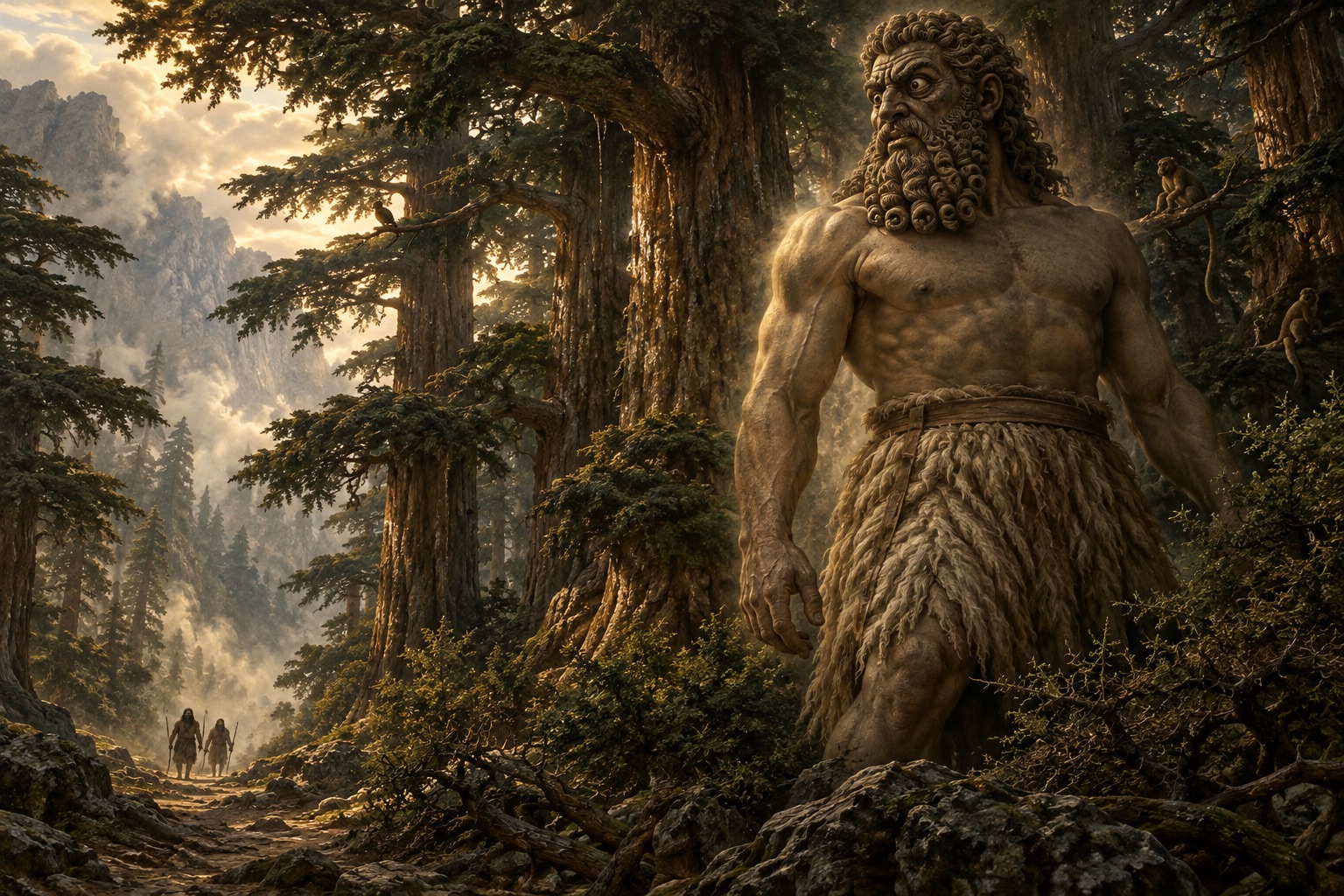
Far from Uruk, on a mountain of cedars, lived a guardian whose voice was the Deluge. Gilgamesh went to kill him and came back with his head and a raft of timber. The Sumerian poem and the Babylonian epic both tell how he did it, and both make room for the anger of Enlil, the god who had put Humbaba there.
Why did Gilgamesh go after Humbaba? To make a name that would outlast him. In the Sumerian poem he has looked over the wall of Uruk at bodies floating in the river, and knows the same end waits for him (Gilgamesh and Huwawa A 21–33). The Old Babylonian epic says it in a line: “If I fall, I will establish my name.” The cedar was the prize he brought home.
1 The Telling
The fullest telling is Tablets II–V of the Standard Babylonian epic. Line numbers follow Andrew George’s edition in the electronic Babylonian Library (eBL); many lines are broken and partly restored. Quotations come from the public-domain translations of R. Campbell Thompson (1928) and of Morris Jastrow and Albert Clay (1920); where they read a line differently from the modern edition, the modern reading is followed. The older Sumerian poem is told in 1-7.
1-1 The Guardian Enlil Appointed
When Gilgamesh proposes the journey, Enkidu tries to stop him (II 216–229). “So that he safeguard the Forest of Cedars, a terror to mortals, / Him hath Enlil appointed”, in Thompson’s words. His voice is the Deluge, his speech fire, his breath death: where Thompson has “his roar is a whirlwind”, the modern edition reads abūbu, the Flood. He hears the murmur of his forest sixty leagues away. The elders of Uruk repeat the warning (II 287–299). Gilgamesh answers that a man’s days are numbered anyway, and takes Enkidu to the forge to have axes and swords cast (II 230–250). In the Old Babylonian Yale tablet, Enkidu knows the forest at first hand: he went into it when he roamed with the cattle, to “Huwawa, whose roar is a flood, whose mouth is fire, whose breath is death”. To keep the forest safe, the tablet adds, Enlil had decreed for it “seven-fold terror” (lines 110–111 and 136–137 in Jastrow and Clay’s numbering; Enlil’s name there is restored).
1-2 The Road to Lebanon
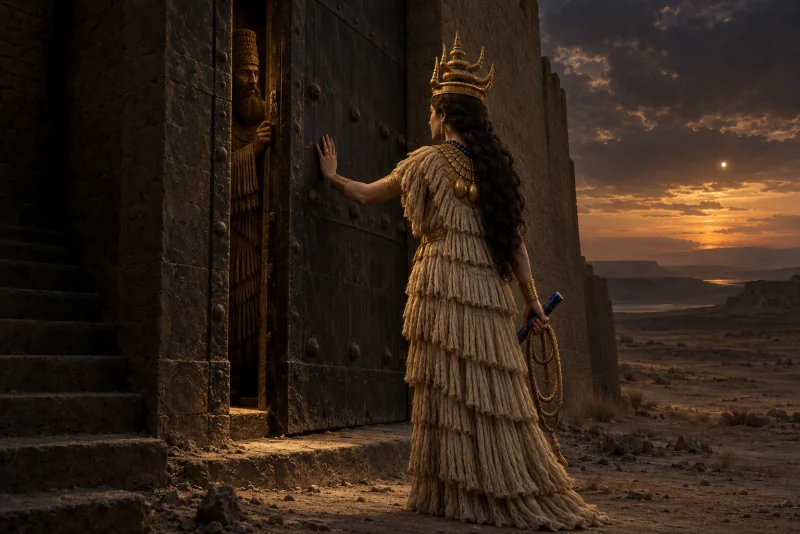
Before they leave, Gilgamesh’s mother, the goddess Ninsun, climbs to the roof, sets out incense for Shamash and asks why he gave her son a restless heart. She prays that her son will reach the forest, “till he o’erthrow the fierce Humbaba, / And from the land destroy all evil things / Which thou abhor’st” (Thompson; III 46–54). And she asks the sun god to raise thirteen winds against Humbaba on the day they meet (III 87–93).
Then they march fifty leagues a day, six weeks’ journey by the third day, until they draw near Mount Lebanon (IV 1–4). At each halt they dig a well, Gilgamesh climbs a mountain, pours out flour and asks it for a dream, and Enkidu builds him a shelter to dream in. Five times Gilgamesh wakes from a confused dream, and five times Enkidu reads it as a good sign (Tablet IV).
1-3 The Forest
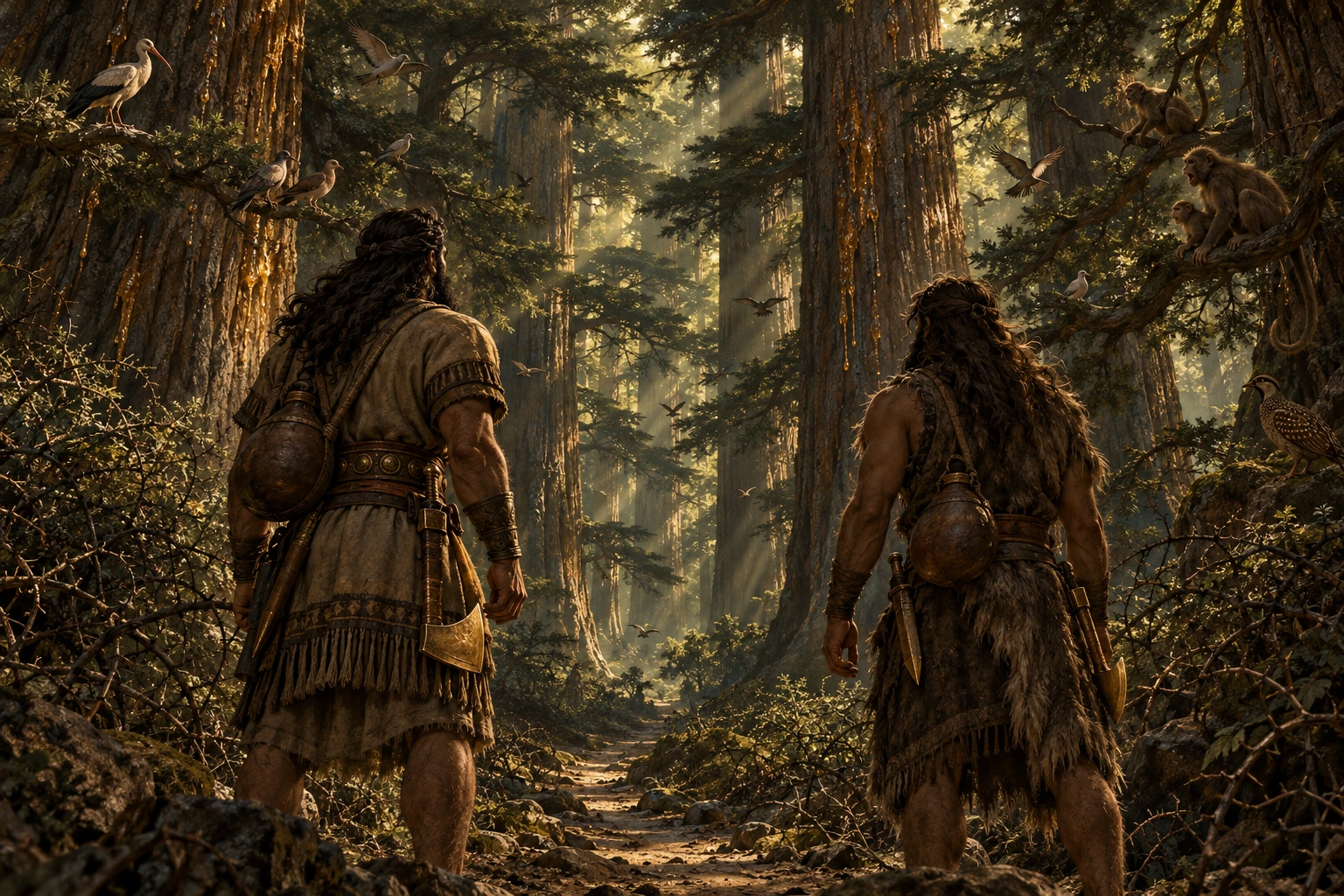
At the edge of the forest they stood and stared (V 1–26). Where Humbaba came and went there was a well-trodden track. The Cedar Mountain was the dwelling of the gods, its shade sweet; the thorn grew so thick that there was no way in, and the cedars, sixty cubits tall, dripped resin like rain into the ravines. Birds sang and answered, a tree-cricket kept up its chorus, the wood pigeon moaned and the turtle dove replied. Mother monkeys sang aloud and a young one shrieked, and every day they drummed out a rhythm before Humbaba, like a troupe of musicians. Lines 20–26 survive on one tablet only, the one now in the Sulaymaniyah Museum (see section 2).
1-4 Seven Cloaks, Thirteen Winds
As the cedar cast its shadow, terror fell on Gilgamesh: his arms stiffened and his legs shook, and the two friends had to urge each other on (V 27–50). Then a voice cried out from the sky. Shamash told them not to fear, but to stop Humbaba before he could go down into his grove and put on his auras: of his seven cloaks of radiance he wore one, and six he had laid aside (V 95–100). Humbaba bellowed, thundering like the storm god (V 103–105). He mocked Enkidu as the spawn of a fish who never knew his father, and swore to feed Gilgamesh’s flesh to the eagles and vultures of the forest (V 115–124). Gilgamesh saw his face change and lost heart; Enkidu told him to strike like a lion (V 126–142).
They seized Humbaba in the midst of the forest. The earth split under their heels, and as they whirled about, Sirara and Lebanon were torn apart and white cloud turned black (V 147–158). Then Shamash sent thirteen winds against him. Humbaba could neither charge forward nor kick back, and the weapons of Gilgamesh reached him (V 159–165).
1-5 The Plea
Humbaba begged for his life (V 166–177). A dead man pleases no master, he said; a living slave brings his owner profit. Let him stay in the forest at Gilgamesh’s command and keep its trees for him: myrtle, cedar and cypress, timber to be the pride of his palace. Enkidu told his friend not to listen: if Humbaba went free, it would be as if they had never been born (V 179–183).
So Humbaba turned to Enkidu. You know the ways of my forest, he said; I should have hanged you from a sapling at its entrance. Now my release rests with you (V 190–195). Enkidu’s answer was to finish him quickly, before Enlil could hear of it: the great gods might be angry, but the fame would last forever (V 197–204). The exchange is repeated, with a long break in the tablet. At last Humbaba cursed them: may the pair of them not grow old, and may Enkidu have no one to bury him but Gilgamesh (V 278–280).
1-6 The Cedar Felled
Gilgamesh drew the dirk at his side and struck him in the neck, and the tusks were taken from the head as spoils (V 285–290). Then Gilgamesh went trampling through the forest for resin for Enlil’s table. In lines found only on the Sulaymaniyah tablet, Enkidu says they have turned the forest into a wasteland, and wonders how they will answer Enlil in Nippur when he asks what fury made them trample it. They had also killed Humbaba’s seven sons (V 300–308).
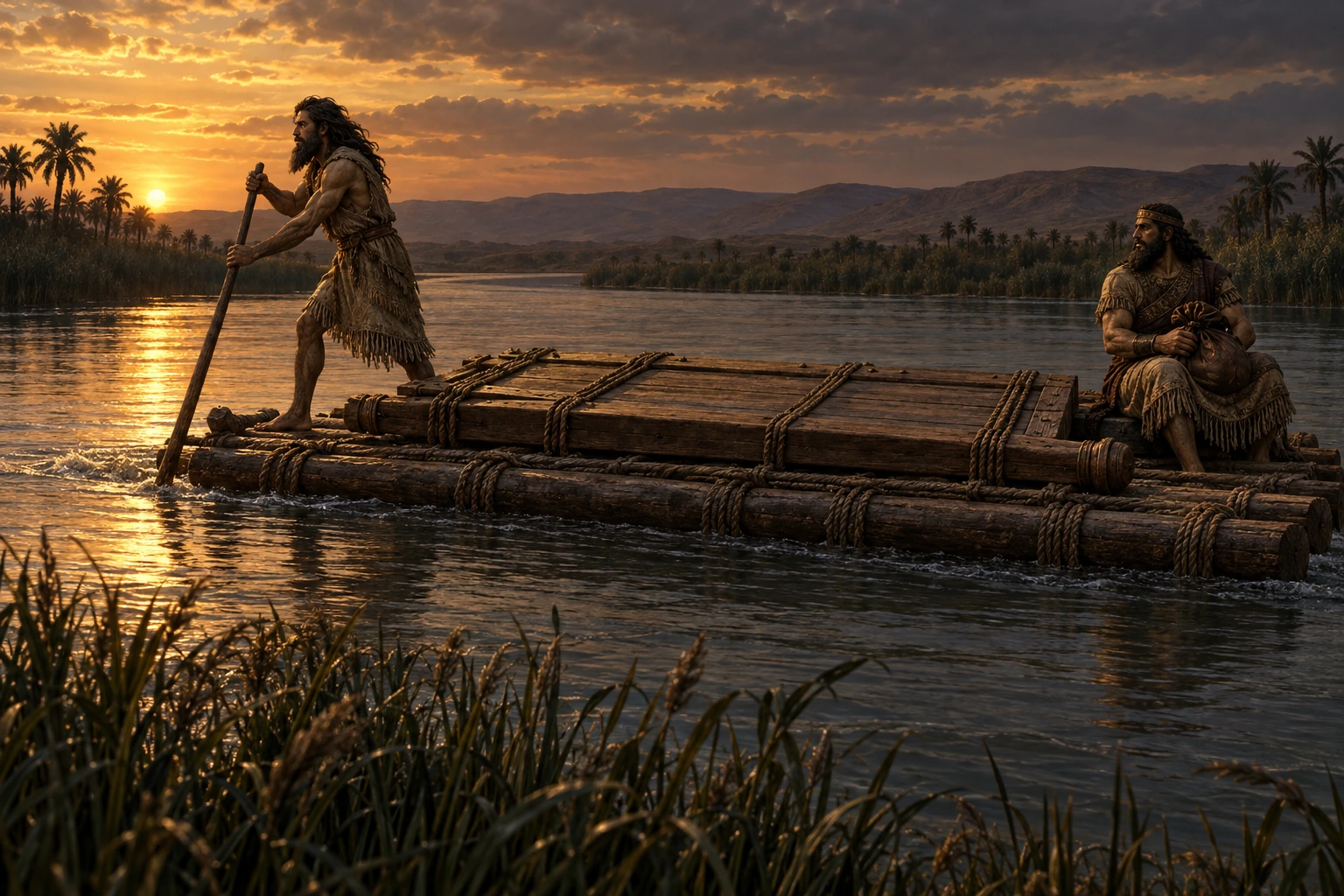
Gilgamesh felled the trees and Enkidu chose the best timber. From a cedar whose top touched the sky, Enkidu made a door six rods high and two wide, for the Euphrates to carry to Enlil’s house in Nippur. They bound a raft of cedar and cypress, and Gilgamesh rode on it with the head of Humbaba (V 311–324). The rest of the epic, from Ishtar’s proposal to Enkidu’s death, is told in the posts on Gilgamesh and Enkidu.
1-7 The Sumerian Poem: Seven Terrors
The Sumerian Gilgamesh and Huwawa A (ETCSL 1.8.1.5, with the line numbers of the ETCSL composite text) is older, and different. Gilgamesh wants to go into the mountains to make his name, but Enkidu says the mountains are the business of the sun god Utu. Utu accepts Gilgamesh’s tears and gives him seven warriors, sons of one mother, the first with a lion’s paws and an eagle’s talons, others serpents, fire, flood and lightning, to guide him through the valleys. Fifty unmarried men of Uruk go with him. Only beyond the seventh mountain range does he find the cedars. He begins to cut, Huwawa looses his terrors, and Gilgamesh falls into a sleep from which Enkidu has to wake him (1–89).
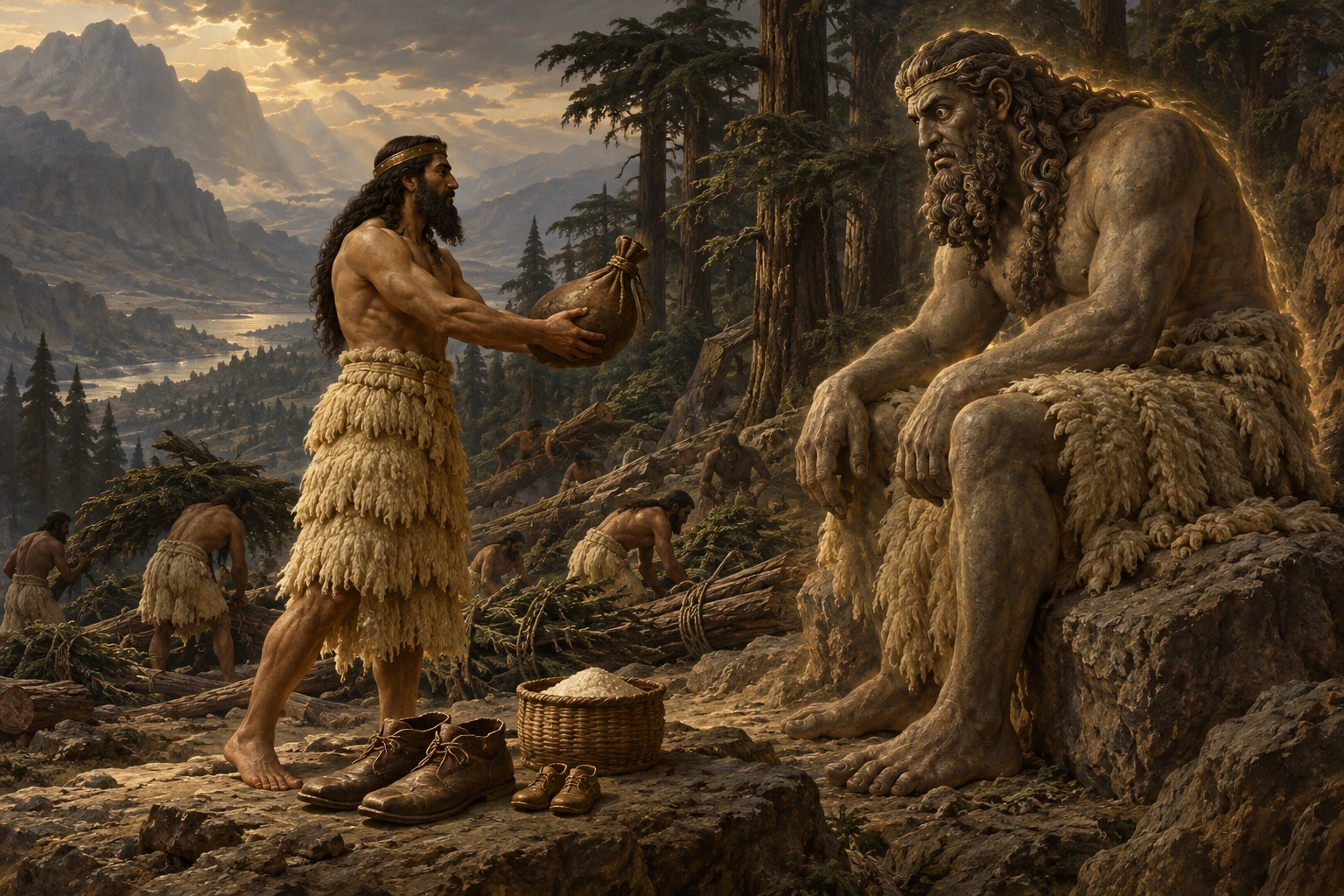
Enkidu describes the guardian: a dragon’s jaws, a lion’s face, a chest like a flood (98–103). Huwawa, when they meet, tells the paralysed king not to be afraid (130–135). And Gilgamesh offers him gifts: his elder sister Enmebaragesi as a wife and his younger sister Matur as a concubine, if Huwawa will hand over his terrors and let Gilgamesh become his kinsman. Huwawa gives up his first terror, and the men of Uruk lop off its branches, bundle them and lay them at the foot of the hills (136–148). Some manuscripts, none known to be from Nippur, go on through the other gifts, flour, a waterskin of cool water, big shoes and tiny shoes, rock crystal and lapis lazuli, until all seven terrors are gone.
Then Gilgamesh makes as if to kiss him and punches him on the cheek, and ties him like a captured wild bull (149–152b). Huwawa appeals to Utu: he never knew a mother or a father, he was born in the mountains and Utu brought him up, and Gilgamesh had sworn to him by heaven and earth (153–157). Gilgamesh pities him and would let the captured bird fly home; Enkidu answers that then Gilgamesh would never get home himself, and when Huwawa protests, Enkidu cuts his throat (158–179). They bring the head to Enlil in a leather bag. Enlil is angry: Huwawa should have sat before them, eaten their bread and drunk their water (181–192). He gives Huwawa’s seven auras away, to the fields, the rivers, the reed beds, the lions, the palace, the forests and Nungal, goddess of prisoners; the manuscripts disagree on the order (193–199).
2 Where the Story Is Written Down
- Gilgamesh and Huwawa, versions A and B (ETCSL 1.8.1.5 and 1.8.1.5.1), edited by Dietz Otto Edzard in 1990–1993. Version A survives in dozens of manuscripts, many from Nippur and Ur. Version B is shorter and breaks off while Huwawa is still pleading. The eBL dates the Sumerian Gilgamesh stories, possibly, to the end of the 3rd millennium BCE; the copies are of about the 18th century BCE.
- The Old Babylonian epic. The Yale tablet (YBC 2178) was bought from the same dealer, and at about the same time, as the Pennsylvania tablet, which the University of Pennsylvania Museum bought in 1914. Jastrow and Clay showed that it was the next tablet of the same series. A tablet from Ishchali, ancient Nerebtum, now in the ISAC Museum in Chicago (A 22007), preserves the killing; it, too, makes Sirion and Lebanon split at Huwawa’s yell (line 31′).
- The Standard Babylonian epic, attributed to Sîn-lēqi-unninni. The eBL counts some 75 manuscripts, from 8th-century BCE Assyria to 2nd-century BCE Babylonia. Tablet V rests on copies from Nineveh and Uruk and, since 2014, on one more.
- The Sulaymaniyah tablet (T 1447), acquired in 2011 by the Sulaymaniyah Museum in the Kurdistan Region of Iraq with other antiquities. Its findspot is unknown. Farouk Al-Rawi and Andrew George, who published it in 2014, judged it “highly probable” that it was dug up at a Babylonian site, and George dates the script, probably, to no later than the 6th century BCE. It measures 11 × 9.5 × 3 cm and preserves lines 1–46, 61–103, 249–276 and 300–324; Watanabe Kazuko notes that Tablet V, estimated in 2003 at 302 lines, is now counted at 324.
3 Competing Versions
- Who struck the blow? In Sumerian A, Enkidu cuts Huwawa’s throat; two manuscripts from Nippur say “they”. In the Ishchali tablet, Gilgamesh strikes the neck while Enkidu urges him on; in the Standard Babylonian epic, Gilgamesh strikes and Enkidu takes out the heart.
- Seven of what? Sumerian A has seven terrors, handed over one by one, and seven auras that Enlil gives away. The Yale tablet has the seven-fold terror; Tablet V, seven cloaks; the Ishchali tablet speaks of auras (melemmū) slipping away into the wood and then of seven slain, without saying who; the Sulaymaniyah tablet, seven sons. No text explains how these sevens relate.
- Who raised him? In A, Utu raised him. In B, his mother was a cave in the mountains, his father a cave in the hills, and Utu left him to live alone (163–166). In Tablet V it is Humbaba who taunts Enkidu for never knowing his father.
- Mercy. In B, Gilgamesh wants to free him as a guide. In the Hittite version, as Thompson translated it, Humbaba gives in to eight winds, not thirteen, and says: “be thou now my master, and I’ll be thy henchman.”
- Who was afraid? At the forest’s edge (V 35–46), George’s translation adds two changes of speaker that the tablet does not mark. Watanabe argues that the whole speech is Gilgamesh’s, bluffing to hide his own fear.
- East or west? The Akkadian texts are plain: Mount Lebanon (IV 4), Sirara and Lebanon (V 156), Sirion and Lebanon (Ishchali). Sirion is Mount Hermon (Deuteronomy 3:9); Watanabe places the forest in the Lebanon range, “far to the north-west”. The Sumerian poems name no country, only mountains seven ranges away under the sun god’s charge. Sidney Smith wrote in 1924 that Jensen had put the forest in the east, Gressmann on the Amanus and Clay in Lebanon, and that it “cannot be located with certainty”.
- A separate story? Daniel Fleming and Sara Milstein (2010) argue that ten of the twelve Old Babylonian tablets come from an older “Akkadian Huwawa narrative”, which the epic expanded (as summarized by Scott C. Jones).
4 History and Tradition
- A face made of entrails. A small clay face from Sippar in the British Museum (BM 116624) is modelled from a single strip of clay, twisted like intestines. Diviners read the entrails of sacrificed animals, and the inscription on its back, as Sidney Smith read it in 1924, says: “If the entrails [resemble] the face of Huwawa, it is the omen of Sargon, who ruled the land.” Smith dated the script to the 7th century BCE; Biblical Archaeology Review places the mask in the Old Babylonian period, about 1900–1600 BCE. Smith also cites an omen in which a face like Humbaba’s means “a rebel will rule all the land”, and omens for births with “the features” of a Huwawa.
- God and demon. Smith found Humbaba listed as a god at Sippar-Aruru, called in a prayer “the devil who hath no compassion”, into whose keeping the attacking evil spirits are to be handed, and, in the Neo-Babylonian period, honoured as a kindly god in personal names.
- Where the name came from. Jastrow and Clay took Huwawa for a West Semitic name, which to them pointed to Lebanon. Jensen had linked Humbaba with the Elamite god Humba and an eastern forest. Smith thought neither case conclusive.
Humbaba is usually introduced as a monster to be slain. The texts are less sure. Enlil gave him his post; in the Sumerian poem Utu raised him and Enlil is angry at his death; in the epic Enkidu wants him dead before Enlil can hear. The epic is divided, too: Ninsun prays for the end of “all evil things” Shamash abhors. Publishing the Sulaymaniyah tablet, Al-Rawi and George wrote that Humbaba emerges “not as a barbarian ogre” but as “a foreign ruler entertained with music at court”.
5 Related Stories
- Gilgamesh: The King Who Tried to Escape Death: the whole epic, from the walls of Uruk to the plant and the snake. The Cedar Forest fills Tablets II–V; Ishtar and the Bull of Heaven come next.
- Enkidu: The Wild Man Made to Match Gilgamesh: the guide who knew the forest, and the target of Humbaba’s last curse.
- Jason and the Argonauts: The Voyage for the Golden Fleece: in Colchis a serpent that never slept guarded the fleece in a grove of Ares. We have not found a scholar who compares the two guardians; we link them for the theme.
- Medusa: The Gorgon Whose Story Kept Changing: Eliza Gujabidze (2025), drawing on Sarah Graff’s study of Humbaba’s images, surveys the case that his face shaped the Greek Gorgon, and notes that Perseus’s victory is often compared with Gilgamesh’s. She offers the borrowing as a hypothesis.
6 Sources
- Gilgamesh and Huwawa, versions A and B, ETCSL 1.8.1.5 and 1.8.1.5.1, translation, composite text and bibliography: ETCSL, ETCSL, ETCSL, ETCSL
- Poem of Gilgameš, Standard Babylonian Tablets II–V and the Old Babylonian Yale and Ishchali tablets, ed. and trans. Andrew R. George, rev. Geraldina Rozzi and Enrique Jiménez, electronic Babylonian Library: eBL, Tablet V, Ishchali
- R. Campbell Thompson (trans.), The Epic of Gilgamish (1928): archive.org
- Morris Jastrow and Albert T. Clay, An Old Babylonian Version of the Gilgamesh Epic (1920): Project Gutenberg
- Farouk N. H. Al-Rawi and Andrew R. George, “Back to the Cedar Forest: The Beginning and End of Tablet V of the Standard Babylonian Epic of Gilgameš”, Journal of Cuneiform Studies 66 (2014), 69–90, quoted in Robin Ngo, “Ancient Clay Tablet Offers Insights into the Gilgamesh Epic”, Bible History Daily (2015): Biblical Archaeology Society
- Watanabe Kazuko, “『ギルガメシュ叙事詩』の新文書:フンババの森と人間”, Shiseigaku nenpō 12 (2016), 167–180: Toyo Eiwa University
- Sidney Smith, “The Face of Humbaba”, Annals of Archaeology and Anthropology 11 (1924), 107–114, pl. XIII: archive.org
- “World Wonders: The Demon Humbaba”, Biblical Archaeology Review, Spring 2023: BAS Library
- Scott C. Jones, review of D. E. Fleming and S. J. Milstein, The Buried Foundation of the Gilgamesh Epic, Journal of Hebrew Scriptures 11 (2011): JHS
- Eliza Gujabidze, “From Humbaba to Medusa: A Historical and Iconographic Overview”, Folia Humanistica et Socialia 3.1 (2025): DOI
- Deuteronomy 3:9, King James Version: Wikisource
Cover and illustrations: AI-generated images made for Arcana. They are interpretations, not historical artworks.