Enkidu: The Wild Man Made to Match Gilgamesh
The gods made him from a pinch of clay to be a match for the king of Uruk; he grazed with the gazelles, learned bread and beer from Shamhat, wrestled Gilgamesh in a doorway and became his friend. In the older Sumerian poems, though, Enkidu is Gilgamesh's servant.
- Type: epic, the wild man who becomes a hero’s friend
- Culture: ancient Mesopotamia, in Sumerian poems and then in the Akkadian Epic of Gilgamesh
- Earliest texts: Sumerian Gilgamesh poems, possibly composed at the end of the 3rd millennium BCE and known from copies of about the 18th century BCE; the Old Babylonian Pennsylvania and Yale tablets, 18th century BCE; the Standard Babylonian epic, in copies from the 8th century BCE onward
- Key figures: Enkidu, Gilgamesh, the goddess Aruru, the trapper, Shamhat, Ninsun, Shamash (Utu), Enlil, Ea (Enki), Ereshkigal
Enkidu was made for one purpose: to be a match for a king no one in Uruk could stop. He grew up with the gazelles, learned from a woman how to eat bread, fought Gilgamesh in the doorway of a wedding house and became his friend. And it is his death that sends Gilgamesh out into the world to look for a way not to die.
Was Enkidu Gilgamesh’s equal? Only in the Akkadian epic. In the Sumerian poems, which are older, he is Gilgamesh’s servant (Sumerian arad), and he calls him “my king”. The Akkadian poet has the gods create him to rival the king, and calls him friend, brother and equal throughout. Jeffrey Tigay calls this “raising the status of Enkidu from servant to friend”, and sees in it the change that made the epic.
1 The Telling
This is the Standard Babylonian epic, the late version in twelve tablets, with the Old Babylonian Pennsylvania and Yale tablets where the late text is broken. Line numbers for the Akkadian tablets follow the eBL edition (2022); in Tablet I they run two lower than in A. R. George’s 2003 edition. Those for the Sumerian poems are ETCSL’s.
1-1 A Pinch of Clay
Gilgamesh, king of Uruk, gave his people no rest. He let no son go free to his father and no girl to her bridegroom (Tablet I 83–89). The gods heard the complaint and summoned the goddess Aruru. Let her make a match for him, they said, so that the two would rival each other and Uruk could rest (I 91–96).
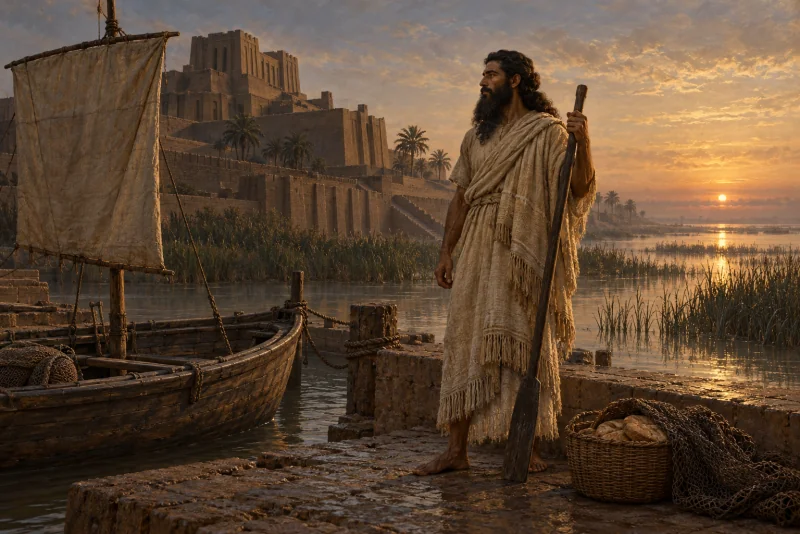
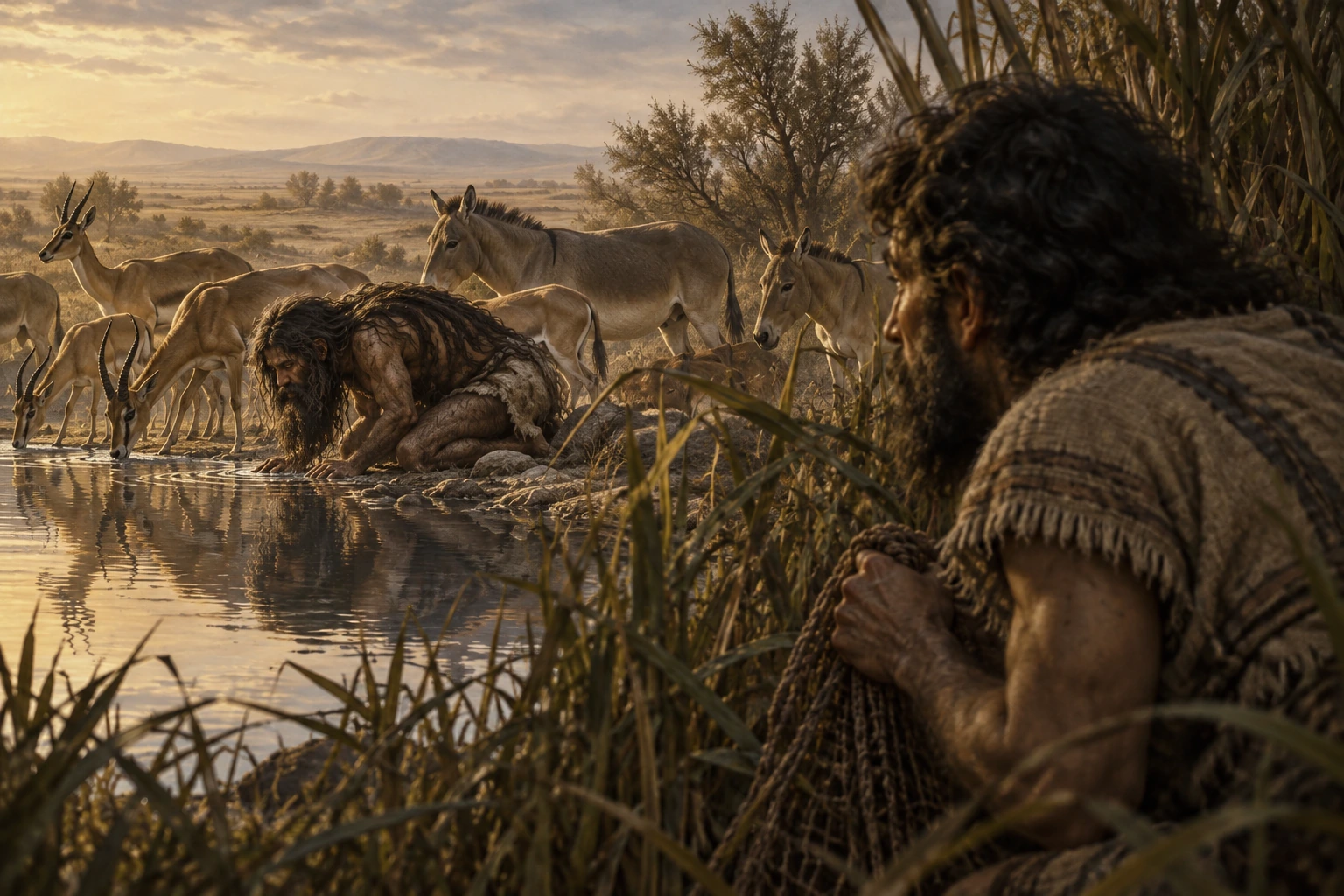
Aruru washed her hands, took a pinch of clay and threw it down in the wild (I 99–101). In R. Campbell Thompson’s 1928 translation, she “finger’d some clay, on the desert she moulded (it)”. So Enkidu was made. His whole body was matted with hair, and his locks grew thick like a woman’s. He knew no people and no land. He grazed on grass with the gazelles and jostled with the herd at the water-hole (I 103–110).
1-2 The Trapper
A trapper came face to face with him at the water-hole, one day, a second and a third, and his face froze with fear (I 111–119). Enkidu had filled in the trapper’s pits, pulled up his snares and set the animals free. The trapper’s father sent him to Gilgamesh, and Gilgamesh gave the same advice: take Shamhat, the harlot (harimtu), to the water-hole. When the herd comes down to drink, let her show herself to him. He will go to her, and his herd will turn away from him (I 120–164).
1-3 Six Days and Seven Nights
The trapper and Shamhat walked for three days and then waited two more. The animals came down to drink, and Enkidu with them. Shamhat did as she had been told, and Enkidu lay with her, in Thompson’s words, for “six days, (aye) seven nights” (I 192).
Then he turned back to his herd, and the gazelles ran away from him. His legs would not carry him as before: he was diminished, but now he had reason and understanding (I 193–200). He came back and sat at Shamhat’s feet. You are like a god, she told him; why roam the wild with the animals? She offered to take him to Uruk, to the temple of Anu and Ishtar, where Gilgamesh lorded it over men like a wild bull. His heart, the poet says, was now seeking a friend. He would go, Enkidu answered, and challenge Gilgamesh (I 201–221). He was already expected. Gilgamesh had dreamt of a rock fallen from the sky, and then of an axe lying in a street of Uruk. The rock was too heavy for him to move. He loved the rock and the axe like a wife, and his mother, the goddess Ninsun, made each his equal. A mighty companion is coming, Ninsun told him, a man who will save his friend (I 243–295).
1-4 Bread and Beer
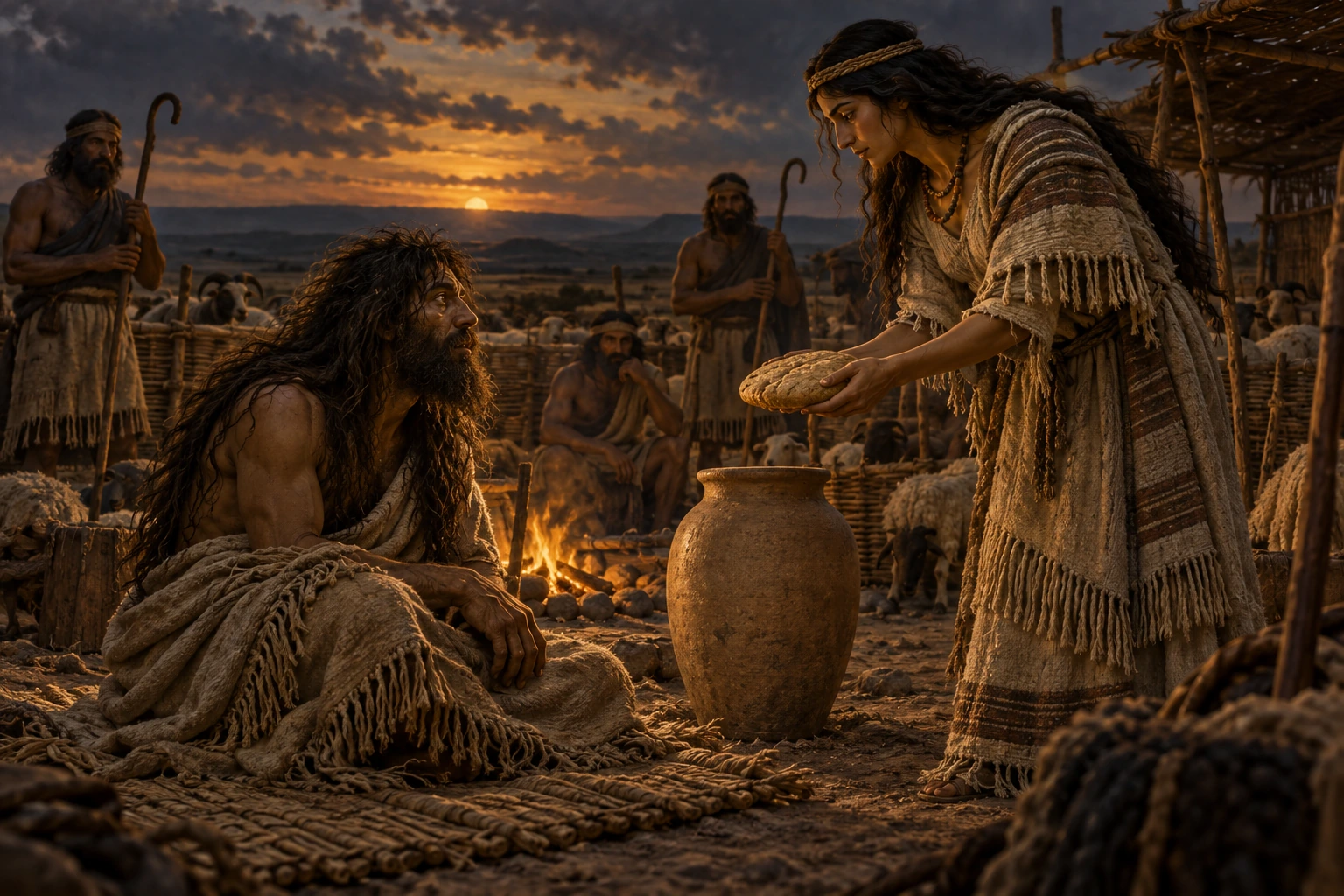
Here the late Tablet II is badly broken, and the Old Babylonian Pennsylvania tablet tells the scene in full. Shamhat took off her garment, dressed Enkidu in one part and kept the other, and led him by the hand to a shepherds’ camp (OB II 66–76). The shepherds set bread before him. He stared at it: he had only ever sucked the milk of animals. Shamhat spoke, in Morris Jastrow and Albert Clay’s 1920 translation: “Eat food, O Enkidu, The provender of life! Drink wine, the custom of the land!” (OB II 87–98). The drink is šikaru, beer; Jastrow and Clay called it wine.
He ate until he was full and drank seven jugs. His heart grew glad and his face shone. The barber shaved his hairy body, he rubbed himself with oil and “became manlike”, and he put on a garment and took up a weapon. At night he chased away the wolves and lions, and the shepherds slept while he kept watch (OB II 99–119).
1-5 The Wedding House
A man came by, hurrying to a wedding in Uruk. For the king, he said, the bride’s veil is parted first: Gilgamesh lies with her before the bridegroom does, as was decreed when his navel cord was cut. Enkidu’s face went pale (OB II 120–166). He walked into Uruk with Shamhat behind him, and a crowd gathered. In build he is the equal of Gilgamesh, people said, though shorter and heavier of bone (OB II 175–189).
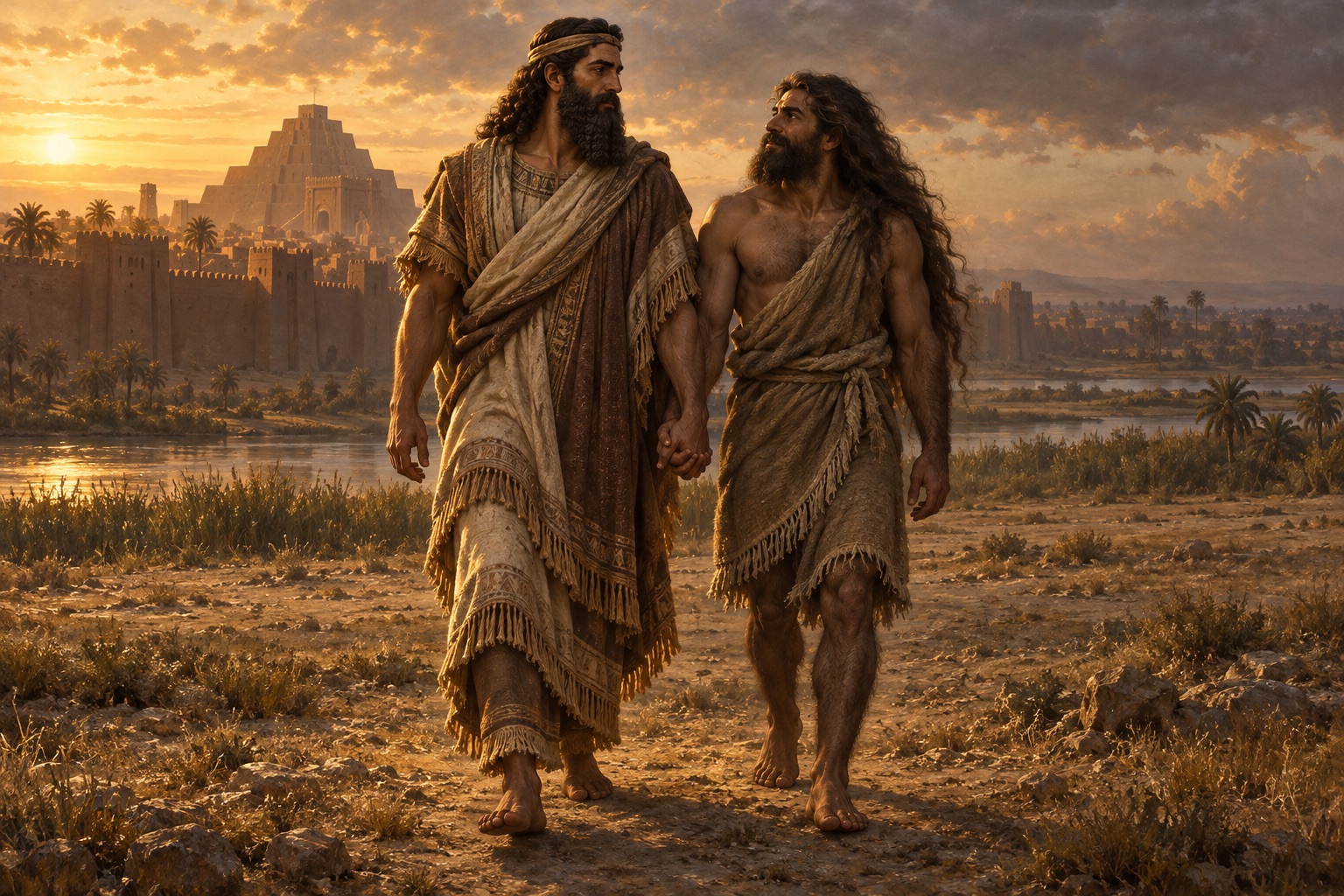
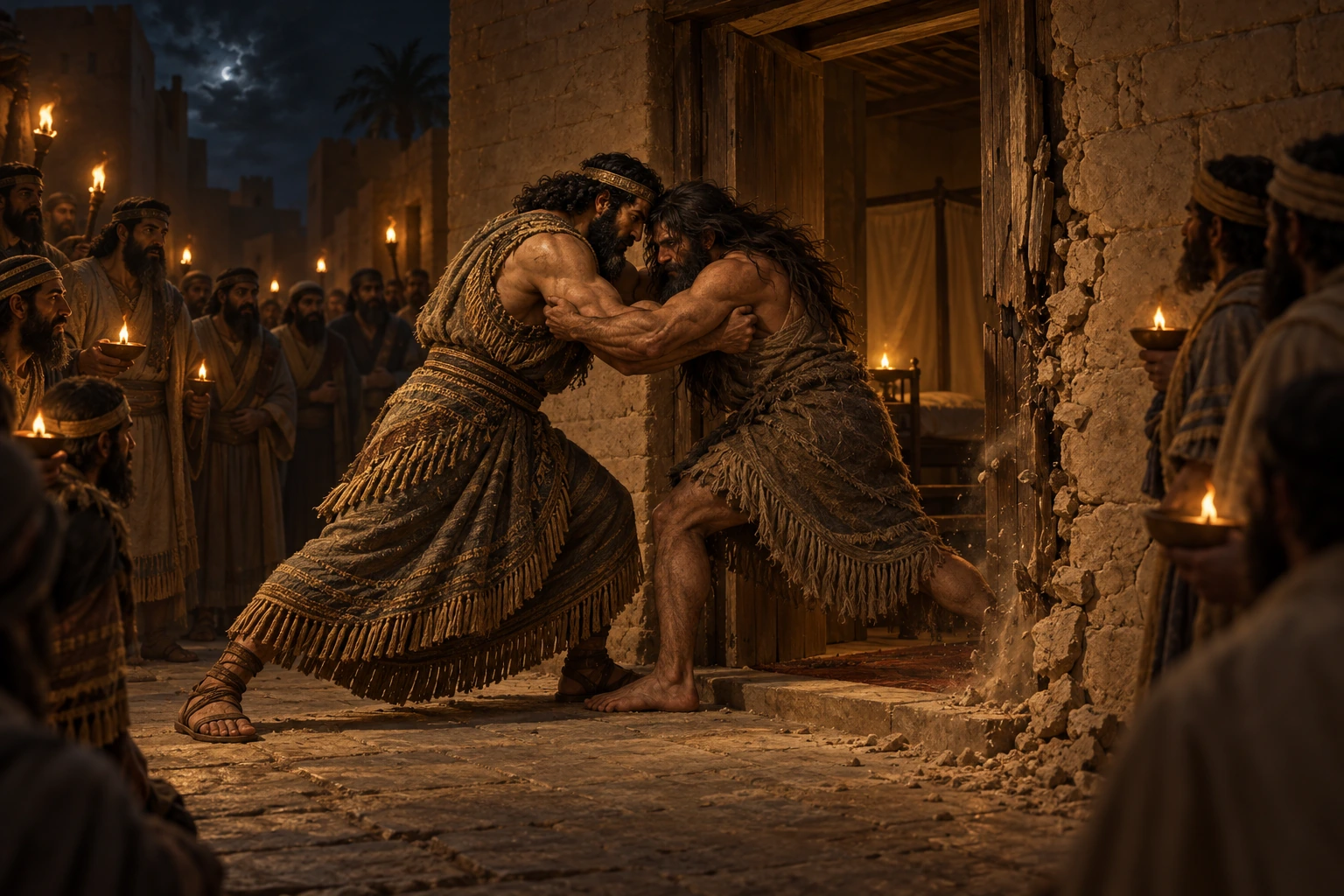
A bed was laid out for the goddess Ishhara, and Gilgamesh came at night to meet the bride. Enkidu stood in the street and blocked the doorway with his foot. In Jastrow and Clay’s words: “Like oxen they fought. The threshold they demolished; The wall they impaired” (OB II 196–226). Then Gilgamesh went down on one knee, his anger subsided, and he broke off the fight. Enkidu spoke to him: your mother Ninsun bore you to be unique, and Enlil gave you kingship over the people (OB II 227–240). Here the tablet ends.
On the Yale tablet, which follows straight on, the two kiss each other and become friends (OB III 18–19). In the late Tablet II, Ninsun says that Enkidu was born in the wild. Enkidu hears her, his eyes fill with tears, and the two take hold of each other (SB II 177–183). Together they go to the Cedar Forest and kill its guardian Humbaba, and back in Uruk they kill the Bull of Heaven that Ishtar sends against Gilgamesh. Those adventures are told in their own posts.
1-6 The Dreams and the Death
Tablet VII opens with Enkidu asking his friend why the great gods were taking counsel; the rest of the column is lost. A Hittite version fills the gap. In Thompson’s partly restored rendering, from the translation of Friedrich and Ungnad, the gods rule that for the Bull of Heaven and Humbaba, “Enkidu shall die: but Gilgamish shall not die”.
Enkidu cursed the great cedar door he had made and hung at Nippur (VII 37–63). He cursed the trapper. Then he cursed Shamhat: may she never found a household she can delight in, may she sit where the roads meet and stand in the shadow of the city wall (VII 93–131).
Shamash called to him from heaven. Why curse Shamhat, who fed you bread fit for a god and beer fit for a king, who clothed you and gave you Gilgamesh for a friend? Gilgamesh will lay you on a bed of honour, make all Uruk weep for you, and roam the wild in a lion’s skin (VII 132–147). Enkidu’s anger calmed, and he turned his curse into a blessing: may princes love her, and may men give her obsidian, lapis lazuli and gold (VII 148–161).
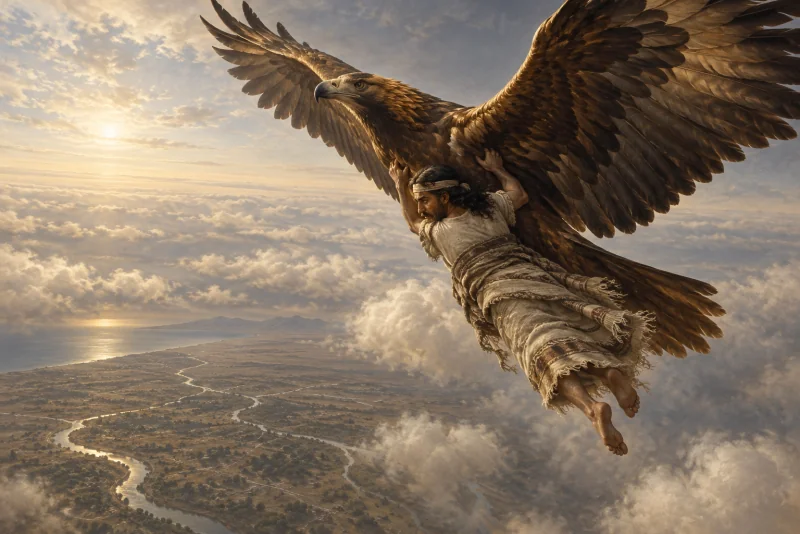
Then he dreamt again. A man with the face of an Anzu bird, a lion’s paws and an eagle’s talons seized him by the hair, bound his arms like a bird’s wings and led him down to the House of Dust, “where for their food is the dust, and the mud is their sustenance: bird-like wear they a garment of feathers” (Thompson). There sat kings who had once ruled the land, and priests of every kind, and Etana, and Ereshkigal, queen of the netherworld, with her scribe reading from a tablet before her (VII 165–205).
Enkidu fell ill, and for twelve days his sickness grew worse (VII 255–260). He grieved that he would not fall in battle and make his name (VII 263–267). Here the tablet breaks off, and the moment of his death is lost. At dawn, in Tablet VIII, Gilgamesh mourns the friend whose mother was a gazelle and whose father a wild donkey (VIII 3–4). He felt for his heart, and it was not beating; “then he veil’d (his) friend like a bride” (Thompson; VIII 57–59). What his grief drove him to belongs to Gilgamesh’s own story.
2 Where the Story Is Written Down
- The Sumerian poems. Five Sumerian stories of Gilgamesh survive, possibly composed at the end of the 3rd millennium BCE and known from copies of about the 18th century BCE. In Gilgamesh and Aga (ETCSL 1.8.1.1, 40–47), Gilgamesh and Huwawa (1.8.1.5, 1–12) and Gilgamesh, Enkidu and the Netherworld (1.8.1.4, 176), Enkidu is his servant or slave.
- Gilgamesh, Enkidu and the Netherworld (ETCSL 1.8.1.4). Gilgamesh cuts down a tree from Inanna’s garden and makes from it two playthings, an ellag and an ekidma (27–150). When they fall into the netherworld, Enkidu offers to bring them back. Gilgamesh warns him: wear no clean clothes, use no scented oil, throw no stick, wear no sandals, make no noise, and neither kiss nor strike your wife or son (176–204). Enkidu does all of it, and the netherworld holds him (205–220). Enlil will not help; Enki will, and Utu opens a hole through which Enkidu’s spirit comes up (221–242). The friends embrace, and Gilgamesh asks how the dead fare: the man with one son, the man with seven, the man with no one to make him offerings (243–303).
- Tablet XII of the late epic is a literal Akkadian translation of the second half of that poem, from the moment the playthings fall (Tigay, pp. 26–27). Here Enkidu is alive again, though he died in Tablet VII. He calls Gilgamesh “my lord”, and Gilgamesh weeps for “his servant” (XII 7, 55). Gilgamesh appeals to three gods, Enlil, Sîn and Ea, where the main Sumerian version has two (XII 56–83).
- The Old Babylonian tablets. The Pennsylvania tablet (CBS 7771) and the Yale tablet (YBC 2178) were bought in 1914 from the same dealer. They are Tablets II and III of one edition of the epic (Jastrow and Clay), from the 18th century BCE. The Pennsylvania tablet has the dreams, Shamhat, the bread and beer and the fight; the Yale tablet, the friendship and the plan to go to the Cedar Forest.
- The Standard Babylonian epic is attributed to Sîn-lēqi-unninni. It survives in some 75 manuscripts, the oldest from 8th-century BCE Assyria and the latest from 2nd-century BCE Babylonia. Tablets I, VII and VIII tell of Enkidu’s making, death and mourning. Older than these copies are translations into Hittite and Hurrian, from the second half of the 2nd millennium BCE; the Hittite paraphrase supplies the gods’ council that is lost at the start of Tablet VII.
- An unusual tablet. On one Middle Babylonian tablet, which George published in 2007 as “The civilizing of Ea-Enkidu”, Enkidu’s name is written as Ea and Gilgamesh’s as Sîn, and Gilgamesh dreams his dreams in Ur instead of Uruk (eBL, MB Priv₁ 1–37).
3 Competing Versions
- Servant or friend? Tigay, following Samuel Noah Kramer, notes that the friendship is absent from the Sumerian tales, which once or twice call Enkidu a friend but usually a servant. The Akkadian epic calls him friend, brother and equal throughout (pp. 28–30). Tablet XII keeps “servant” anyway, which Tigay calls “anomalous” (p. 107).
- Six days or seven? The late epic gives six days and seven nights (SB I 192). In the Pennsylvania tablet the numeral is damaged; George reads it as seven days and seven nights (OB II 48), where Jastrow and Clay had read six.
- Who won the fight? The Pennsylvania tablet says only that Gilgamesh knelt and his anger left him. Jastrow took it that Enkidu “forces Gilgamesh to the ground”, and so is “the real hero”. The Britannica entry in Japanese has Enkidu beaten by Gilgamesh.
- How did Enkidu die? In Tablets VII and VIII, by the gods’ decree, after twelve days of sickness. In Gilgamesh, Enkidu and the Netherworld and Tablet XII, he goes down alive and is held there for breaking Gilgamesh’s rules. Because of such contradictions, most scholars, after Jastrow, treat Tablet XII as an “inorganic appendage” to the epic (Tigay, pp. 5, 27).
- What fell into the netherworld? ETCSL leaves ellag and ekidma untranslated. In George’s commentary they are a ball and a mallet for a game; Piotr Steinkeller (2018) took them for a noisemaker that Gilgamesh used to call the men of Uruk to forced labour (eBL, note on XII 1).
- Were they lovers? The texts never say so. In his dreams Gilgamesh loves the rock and the axe like a wife (“I loved him as a woman”, in Jastrow and Clay), and at the end he veils his friend’s face like a bride’s. Scholars read this in different ways:
- Thorkild Jacobsen, in 1930, concluded that Enkidu became Gilgamesh’s lover, and that the king’s oppression of Uruk had consisted of sexual demands. Tigay adds that Jacobsen later understood the oppression differently (Tigay, p. 184, n. 22).
- Tigay finds “homosexual aspects” possible because of the dreams, but does not count the friends’ holding hands and sleeping side by side as evidence: young men in the Near East still walk with fingers interlocked, with no such meaning (p. 184, n. 22).
- Susan Ackerman argues that the language and imagery “suggest more than just an intense male bonding”, but warns against reading a same-sex partnership “in the modern sense”. For her the ambiguity is deliberate: it marks the two as heroes caught between stages of life.
4 History and Tradition
- Heabani. George Smith, in The Chaldean Account of Genesis (1876), read Enkidu’s name as Heabani and Gilgamesh’s as Izdubar. Where the text has ṣayyādu, “hunter”, Smith read a name, Zaidu, and he took Shamhat the harimtu for two women: “go Zaidu and with thee the female Harimtu, and Samhat take”. The Japanese Britannica still notes that the name was once read Eabani.
- A tablet misdated by 1,500 years. Stephen Langdon, who first published the Pennsylvania tablet, at first dated it to the Persian period. Jastrow and Clay pointed out “this error of some 1500 years”, collated the tablet again and published corrected readings in 1920.
- A death made for the epic. Kramer concluded that the Akkadian account of Enkidu’s death, which differs completely from the Sumerian one, was created for the epic, to give Gilgamesh a reason to seek immortality (Tigay, p. 28).
- Enkidu and Adam. Jastrow and Clay compared Enkidu among the animals, and the woman who leads him to human life, with Adam and Eve. They saw a difference: in Babylon the woman raises the man to a higher life, in Genesis she is the tempter. Neither story, they wrote, was modelled on the other; both “rest on similar traditions”.
5 Related Stories
- Gilgamesh: The King Who Tried to Escape Death: the epic as a whole. Over Enkidu’s body Gilgamesh vows to wear a lion’s skin and roam the wild, as Shamash foretold (VIII 90–91).
- Humbaba: The Guardian of the Cedar Forest: Enkidu knew the forest from his days with the herd and tried to talk Gilgamesh out of going (OB III 104–113). The cedar door he later curses was cut there.
- Etana: The King Who Flew on an Eagle: in his last dream Enkidu sees Etana sitting among the dead in the House of Dust (VII 202).
- Inanna’s Descent to the Underworld: Seven Gates and a Substitute: the tree of Gilgamesh, Enkidu and the Netherworld grows in Inanna’s garden, and in Tablet XII the description of Ereshkigal follows the lines of Inanna’s Descent more closely than its own Sumerian source (George, eBL, note on XII 29–30).
6 Sources
- Poem of Gilgameš, ed. A. R. George, revised by G. Rozzi and E. Jiménez, trans. A. R. George, electronic Babylonian Library (2022), with George’s notes from The Babylonian Gilgamesh Epic (2003): SB I, SB II, SB VII, SB VIII, SB XII, OB II, OB III, MB Priv₁, introduction
- Gilgamesh, Enkidu and the Netherworld (1.8.1.4), Gilgamesh and Huwawa, version A (1.8.1.5), Gilgamesh and Aga (1.8.1.1), ETCSL: 1.8.1.4, 1.8.1.5, 1.8.1.1
- Morris Jastrow Jr. and Albert T. Clay, An Old Babylonian Version of the Gilgamesh Epic (Yale Oriental Series, Researches IV.3, 1920): Project Gutenberg
- R. Campbell Thompson, The Epic of Gilgamish (London: Luzac, 1928), Tablets I, VII and VIII: archive.org
- George Smith, The Chaldean Account of Genesis (1876), chapter XII: archive.org
- Jeffrey H. Tigay, The Evolution of the Gilgamesh Epic (1982), pp. 5, 26–30, 107 and 184
- Susan Ackerman, When Heroes Love: The Ambiguity of Eros in the Stories of Gilgamesh and David (2005): Columbia University Press; review by Raymond-Jean Frontain, The Gay & Lesbian Review, March–April 2006: glreview.org
- Sources of Early Akkadian Literature, “Gilg. OB III” (YBC 2178): SEAL; Jessica A. Meyerson, “The University Museum: The House that Hilprecht Built”, Biblical Archaeology Review (2000): BAS Library
- “エンキドゥ”, Britannica International Encyclopaedia (Japanese): Kotobank; Japanese translations: Tsukimoto Akio, 『ギルガメシュ叙事詩』 (Iwanami Shoten, 1996), and Yajima Fumio, 『ギルガメシュ叙事詩』 (Chikuma Gakugei Bunko, 1998): CiNii, CiNii
Cover and illustrations: AI-generated images made for Arcana. They are interpretations, not historical artworks.