Inanna's Descent to the Underworld: Seven Gates and a Substitute
Inanna went down through seven gates to her sister's realm, was turned into a corpse, and came back only by handing the demons a substitute: her husband Dumuzi. For a century it was read as a myth of the seasons, which the Sumerian poem never says.
- Type: myth, a goddess’s journey to the land of the dead and back
- Culture: Sumer, Babylonia and Assyria, in Mesopotamia (today’s Iraq)
- Earliest texts: the Sumerian Inanna’s Descent to the Netherworld, on Old Babylonian tablets (c. 1900–1600 BCE) from Nippur, Ur and Sippar; the shorter Akkadian Ishtar’s Descent, on Neo-Assyrian tablets from Nineveh and Ashur
- Key figures: Inanna (Ishtar), her minister Ninshubur, Ereshkigal, the doorman Neti, Enki (Ea), Dumuzi (Tammuz), his sister Geshtinanna
Inanna, Ishtar in Akkadian, was the greatest goddess of Mesopotamia: a goddess of love and of war, the planet Venus as morning and evening star, the lady of the Eanna temple at Uruk. Her best-known story sends her where no one comes back from, down through seven gates into the realm of her sister Ereshkigal. She does come back. But the underworld lets no one go for nothing.
Why does Inanna go down? The poem never quite says. To the doorman she gives a reason: Ereshkigal’s husband has died, and she has come for his funeral. The gods she has left behind see it differently. His daughter, says Enlil, wanted the great below as well as the great above. Samuel Noah Kramer, who pieced much of the poem together, thought she wanted to rule the underworld too, but admitted that the reason “is not stated explicitly anywhere in the text”.
1 The Telling
This is the Sumerian poem as edited by the Electronic Text Corpus of Sumerian Literature (ETCSL 1.4.1). It runs to 412 lines, joined together from many tablets; the line numbers below are ETCSL’s, and the broken passages are marked as broken.
1-1 The Great Below
From the great heaven, the poem begins, Inanna set her mind on the great below (lines 1–5). She abandoned heaven and earth, the offices of en and lagar, and one by one her temples: the Eanna in Uruk, then her shrines in Bad-tibira, Zabalam, Adab, Nippur, Kish and Agade. One manuscript adds eight more (6–13).
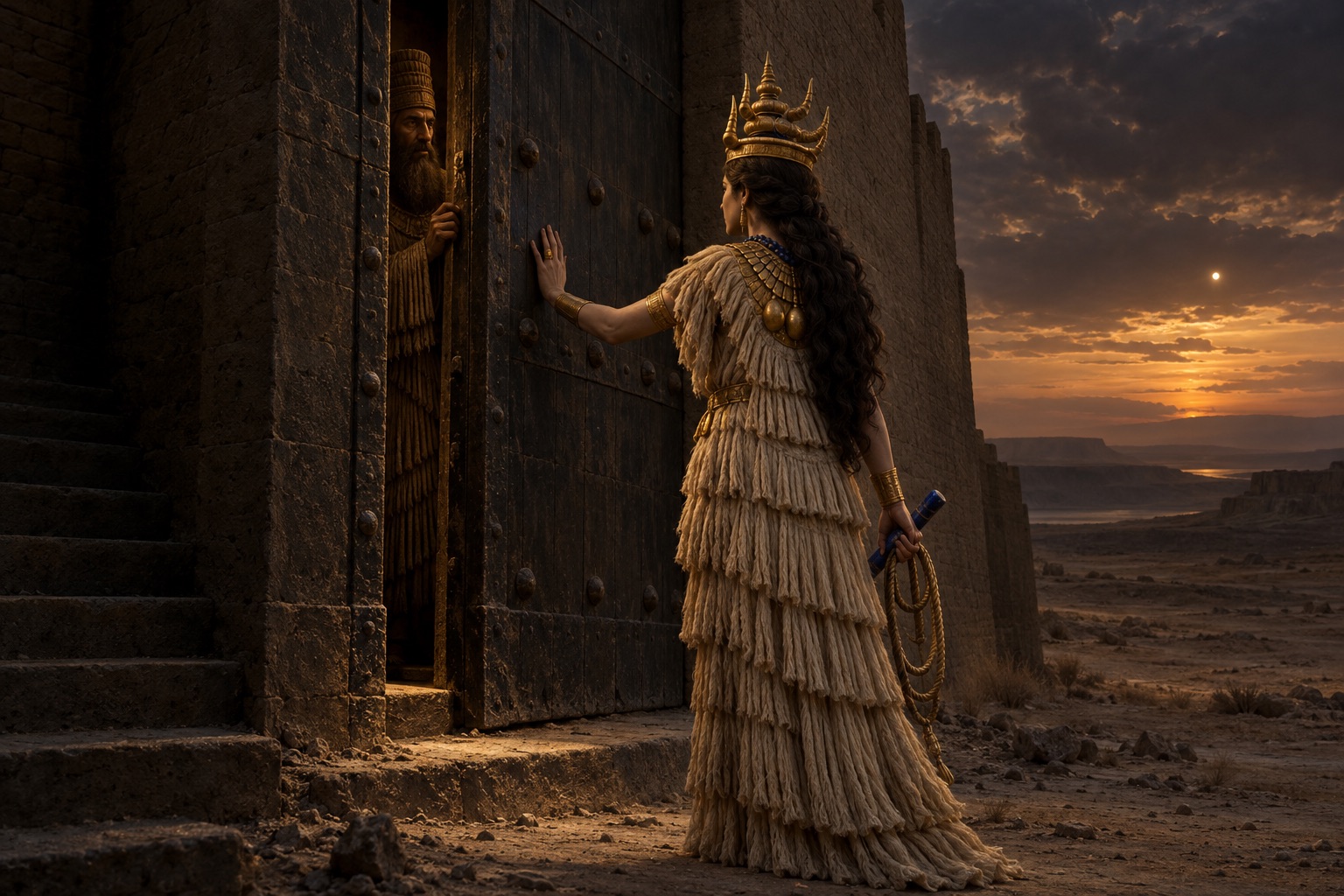
She took the seven divine powers, the me, and held them in her hand. Then she dressed: a turban for the open country, a wig, small lapis-lazuli beads at her neck, twin egg-shaped beads on her breast, the pala dress of ladyship, eye paint called “Let a man come”, a pectoral called “Come, man, come”, a golden ring, and a measuring rod and line of lapis lazuli (14–25).
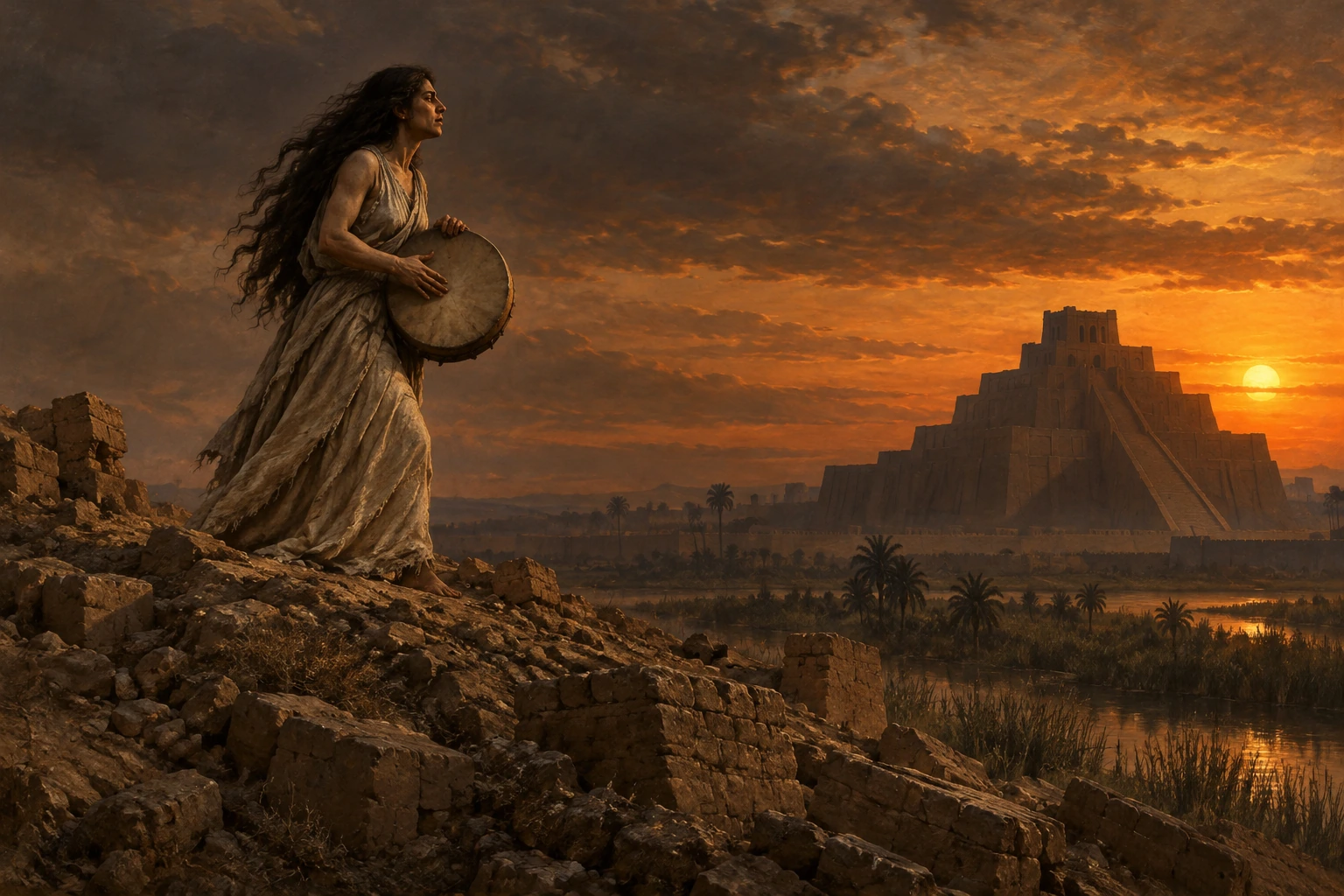
Her minister Ninshubur walked behind her, and Inanna told her what to do if she did not return. She was to lament on the ruin mounds, beat the drum in the sanctuary, go round the houses of the gods, tear at her own face and dress like a pauper. Then she was to go to Enlil in his temple at Nippur, and if he would not help, to Nanna at Ur, and last to Enki at Eridu. Enki knew the plant of life and the water of life, and he would bring her back (26–67).
1-2 Seven Gates
At the palace Ganzer, Inanna pushed hard at the door of the underworld and shouted for the doorman, Neti. She was Inanna, she told him, on her way to the east. Then why come to the land of no return? Because, she said, Gud-gal-ana, the husband of her elder sister Ereshkigal, had died, and she had come for his funeral rites (73–89).
When Neti told his mistress, Ereshkigal slapped her thigh and bit her lip. She had the seven gates bolted, then opened one at a time, and Inanna’s things taken from her as she passed (114–122). At the first gate the turban was taken, at the second the small beads, then the twin beads, the pectoral, the ring, the rod and line, and at the seventh the pala dress. Each time Inanna asked what this was, and each time she was told to be silent: a rule of the underworld had been fulfilled, and she must not question its rites (129–163).
1-3 The Corpse on the Hook
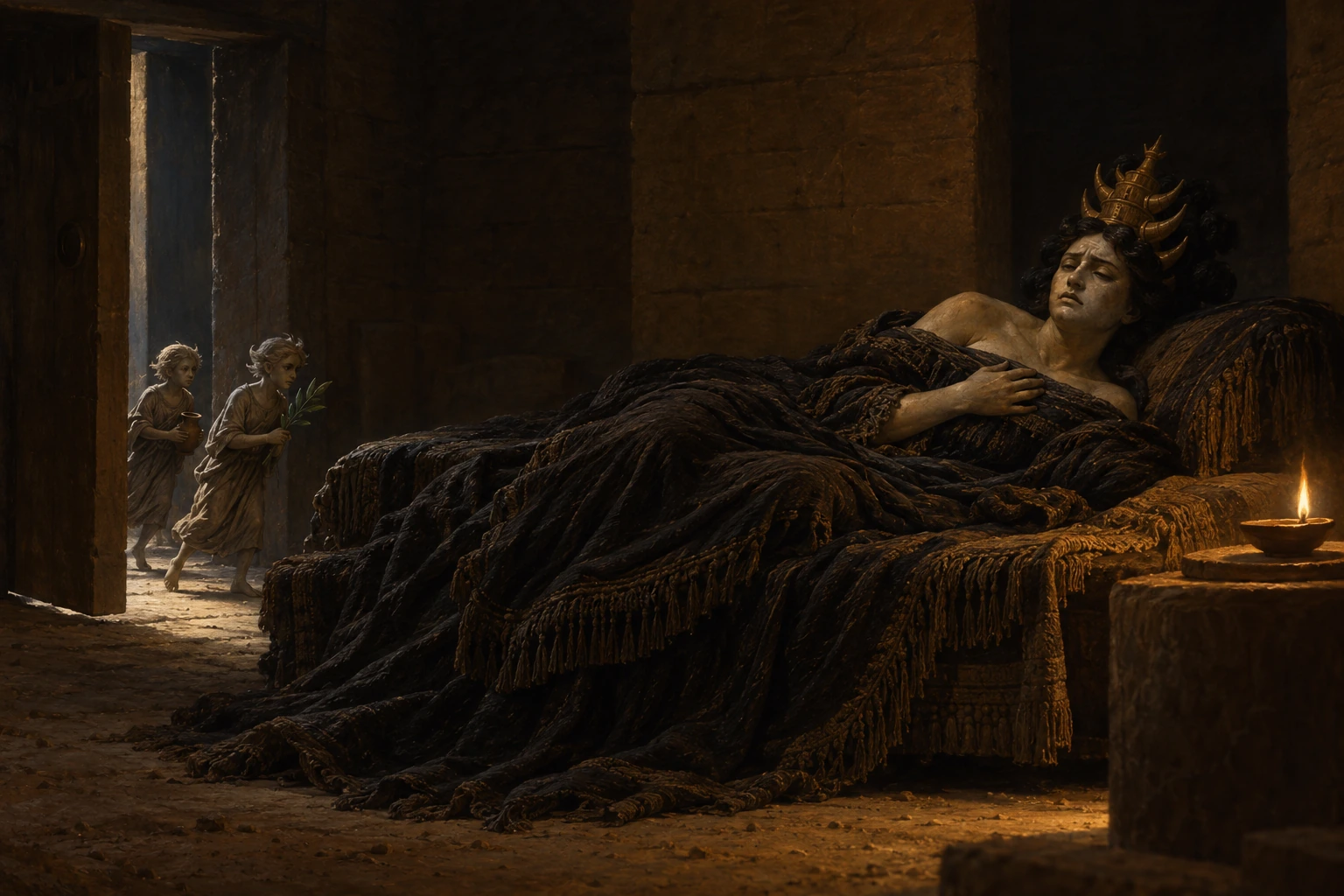
Stripped and crouching, Inanna made her sister rise from her throne and sat on it herself. The Anuna, the seven judges, gave their verdict. Their look was the look of death, their word was anger, their shout was guilt. Inanna became a corpse, and the corpse was hung on a hook (164–172). After three days and three nights, Ninshubur did all she had been told (173–182). Enlil answered her in anger. His daughter had wanted the great below as well; the powers of the underworld are not to be coveted, and whoever takes them must stay. Nanna said the same (190–208).
1-4 Like Flies through the Door
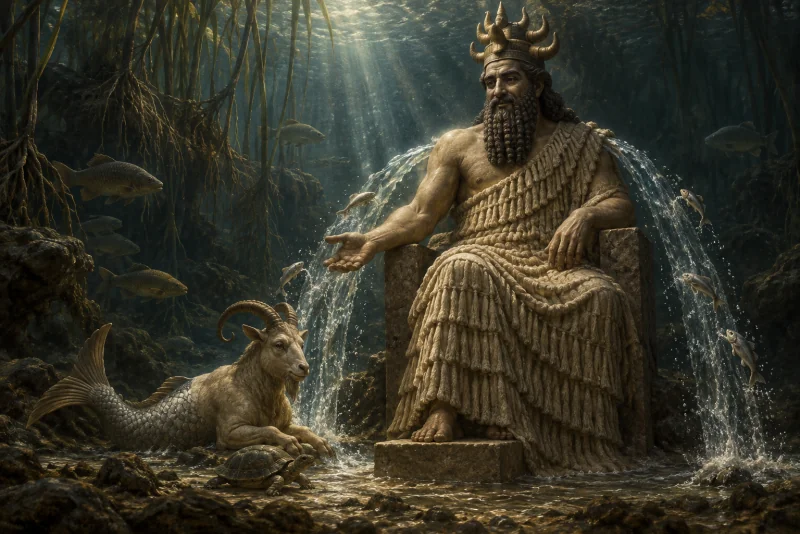
Enki was troubled. From the dirt under the tip of one fingernail he made a being called the kur-ĝara, and from under another the gala-tura. To one he gave the plant of life, to the other the water of life (217–225). They were to slip through the door like flies and through its pivots like phantoms. Inside they would find Ereshkigal, the mother who gave birth, lying in pain because of her children, her shoulders bare, her hair bunched up like leeks. When she groaned for her heart and her body, they were to groan with her. She would offer them a river full of water and a field of grain: they were to refuse, and ask instead for the corpse on the hook (226–253). All happened as Enki said. They sprinkled the plant and the water of life on the corpse, and Inanna rose (254–281).
1-5 The Substitute
But the Anuna held her back. Who had ever come up from the underworld unscathed? If Inanna was to leave, she must give someone in her place (282–289). Demons went up with her, small ones and big ones, close around her like a reed fence. They know no food or drink, the poem says; they take the wife from a man’s embrace and the son from his knee (290–305).
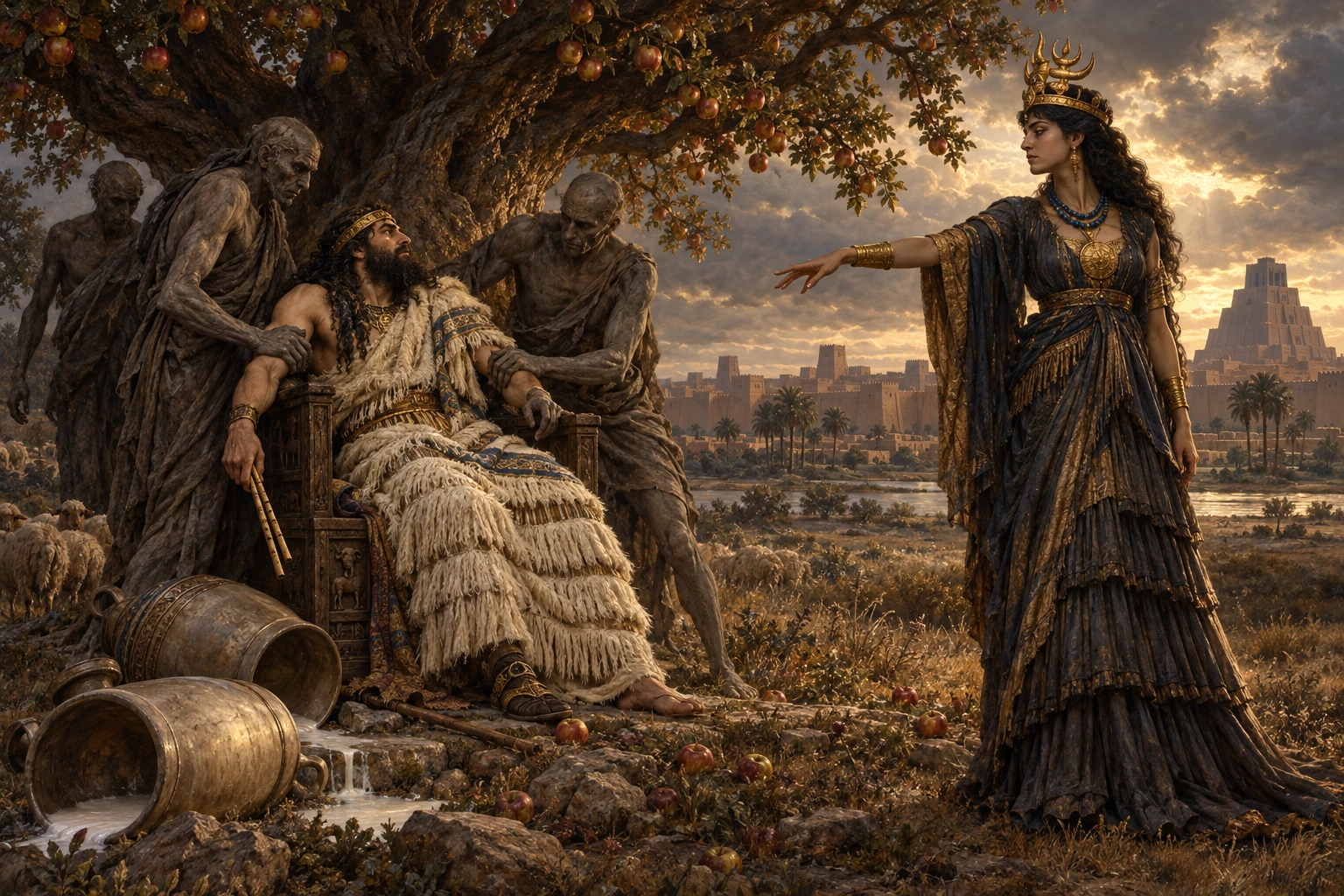
At the gate, Ninshubur threw herself at Inanna’s feet in a filthy garment. The demons wanted her, and Inanna refused: this was the one who had brought her back to life. At Umma, Shara, her singer and hairdresser, lay in the dust, and at Bad-tibira, Lulal. She gave up neither (306–347). Then they came to the great apple tree in the plain of Kulaba, at Uruk. There sat Dumuzi, her husband, in a magnificent garment, magnificently on a throne. The demons seized him. Inanna looked at him, and it was the look of death. “Take him away,” she said, and gave the shepherd into their hands (348–358).
1-6 Half the Year
Dumuzi wept and raised his hands to Utu, the sun god, his brother-in-law, and begged him to turn his hands and feet into a snake’s so that he could escape. Utu did, and Dumuzi slipped away. The next lines are broken (368–383). Inanna wept bitterly for her husband and tore at her hair, and a fly offered to show her where he was, for a reward (384–403).
The end is broken too. Someone is weeping, and a speaker, apparently Inanna, decrees: he for half the year, his sister for the other half. On the day he is called for, he must stay below; on the day she is called for, he goes free. So Inanna gave Dumuzi as her substitute (404–410). The last lines praise Ereshkigal (411–412).
2 Where the Story Is Written Down
- The Sumerian poem. The Cuneiform Digital Library Initiative (CDLI) lists 58 pieces of it, every one Old Babylonian (c. 1900–1600 BCE): 27 from Nippur, 20 from Ur, five from Sippar, the rest of unknown origin. Old Babylonian catalogues of literature from Nippur and Ur already cite it by its first line. Kramer published pieces of it from the late 1930s on, and William R. Sladek’s dissertation of 1974 gives a composite text with a score of the manuscripts.
- The Akkadian poem, Ishtar’s Descent, is much shorter: about 140 lines in R. W. Rogers’s numbering (1912), which we follow below. CDLI has three tablets, all Neo-Assyrian (c. 911–612 BCE): two from Nineveh (K 162 and BM 99129+) and one from Ashur (VAT 9729+). The Akkadian text was known, Kramer notes, “some decades before” any of the Sumerian was published. Its modern edition is Pirjo Lapinkivi’s (2010).
- Two more Sumerian poems tell how Dumuzi was caught. In Dumuzid and Geshtinanna (ETCSL 1.4.1.1) demons come for Inanna at Uruk and she hands Dumuzi over in exchange for herself. His sister will not tell the demons where he is hiding, even when they torment her. In Dumuzid’s dream (ETCSL 1.4.3) Inanna plays no part. Dumuzi dreams of his own death, Geshtinanna again refuses to betray him, a bribed friend gives him away, and the poem ends as a lament for the dead Dumuzi.
3 Competing Versions
- Who gets her out? In the Sumerian, Enki’s two beings, with the plant and the water of life. In the Akkadian, Ea makes Asushunamir, an assinnu (“a player (?)”, Rogers writes; the word is uncertain), who charms Ereshkigal into swearing by the great gods and then asks for the water-skin. She curses him to eat from the city’s gutters and drink from its sewers, but she has her minister Namtar sprinkle Ishtar with the water of life and lead her out (reverse 11–38).
- At the door. Sumerian Inanna pushes and shouts. Akkadian Ishtar threatens to break the door and “bring up the dead that they may eat the living” (obverse 16–20). Rogers thought the meaning of that line doubtful.
- The world above. Only the Akkadian says what happens while the goddess is below: “The bull does not spring upon the cow”, and man and woman sleep apart (obverse 76–80, reverse 6–10).
- What she wears. The Akkadian list is a great crown, earrings, neck chains, breast ornaments, a girdle of birth stones, bracelets for hands and feet, and the last garment on her body. On the way out she gets them back, one gate at a time (obverse 42–62, reverse 39–45).
- Whose look of death? In ETCSL, Inanna takes her sister’s throne and the seven judges look at her. In Kramer’s translation of 1969, Ereshkigal seats herself upon her throne, and it is she who fastens on Inanna “the eyes of death”.
- Whose half year? ETCSL reads “you for half the year and your sister for half the year”. Kramer, following a reading by Adam Falkenstein, gives “You—half the year, your brother—half the year”, spoken to the sister. The passage in which she offers to take his place is mostly broken; Kramer surmised it from the ending.
- The Akkadian ending turns suddenly to Tammuz: wash him in pure water, anoint him, dress him in red, let him play the lapis flute; then his sister Belili, and “let the dead return and smell the incense” (reverse 46 to the end). Rogers calls these lines “obscure”. J. Z. Smith reads them as funeral rites for a dead Tammuz, and notes that the older rendering of one line, “on the day when Tammuz comes up”, has been shown to be a mistranslation.
4 History and Tradition
- The goddess of Uruk. Inanna was the most important goddess of the Mesopotamian pantheon, ranked third after An and Enlil in the Early Dynastic god lists from Fara. Her main city was Uruk, but she had temples in all the great cities. Her name is usually read “Lady of the heavens”. Her early symbol was a bundle of reeds, the later one an eight-pointed star, and her animal the lion.
- Enheduanna. In the hymn The exaltation of Inana (ETCSL 4.07.2) the speaker names herself as the en priestess En-hedu-ana. Kramer identified her as the daughter of Sargon the Great, made high priestess at Ur, who “may have composed” a number of literary works.
- Weeping for Tammuz. In the summer month of Tammuz, Dumuzi was mourned with laments; the month still bears his name in the Jewish and Arab calendars. Ezekiel saw “women weeping for Tammuz” at a gate of the temple in Jerusalem (Ezekiel 8:14). J. Z. Smith calls it “a relentlessly funereal cult”: no celebration of his rebirth is attested except in late Christian texts.
- Frazer’s reading. James George Frazer’s Golden Bough grouped Tammuz with Osiris, Adonis and Attis as “a god who annually died and rose again”, and read Ishtar’s Descent as the goddess’s yearly journey “in quest of him”, from which she came back “in company probably with her lover”.
- Kramer’s correction. That Ishtar went down to rescue him, Kramer wrote in 1969, was an assumption “still current in almost all writings”, and it had “proved to be entirely erroneous”: Dumuzi was not in the underworld when she arrived, and it was she who sent him there. In J. Z. Smith’s account, Kramer’s own view moved with the tablets. Before 1950 he thought Dumuzi might have been freed; from 1950 to 1965 he took him for a dying god only; from 1966, once the half-year ending was known, he spoke again of “death and resurrection”.
- The debate since. Smith (1987) called the whole category of dying and rising gods “largely a misnomer”: an alternation of half a year below and half above, he argued, is not what is usually meant by a god’s rising. Tryggve Mettinger (2001) reopened the question; his reviewer David Frankfurter sums up his answer as “a qualified but confident ‘yes’”.
- The Burney Relief. This terracotta plaque in the British Museum shows a winged goddess with talons, standing on two lions between two owls. Who she is remains open, and its authenticity has long been disputed. The Oracc guide to the gods calls it a possible image of Ereshkigal and notes that lions belong to her sister Ishtar; Collon (2005) identifies the figure as Lilitu.
The Descent is often told as a myth of the seasons: the vegetation god Tammuz dies every year, and Ishtar goes down to bring him back. That is Frazer’s reading; R. Campbell Thompson’s notes to Gilgamesh (1928) even give the seasons, death in autumn and return in spring. The poems do not say it. In the Sumerian, Dumuzi sits on a throne, alive, when Inanna comes back, and she hands him to the demons. The broken last lines give him half the year below, but say nothing of seasons or crops; tying them to the summer is Kramer’s interpretation. If anyone here dies and rises, it is the goddess herself. Lapinkivi titled her edition Ištar’s Descent and Resurrection as a reminder that her journey “was not a one-way trip”.
5 Related Stories
- Gilgamesh: The King Who Tried to Escape Death: when Ishtar woos Gilgamesh, he turns her down and lists her past lovers. The first is Tammuz, whom she makes the cause of yearly wailing (Tablet VI).
- Enki: The Clever God of Fresh Water: in Inanna and Enki, among the divine powers Inanna carries off from Eridu are “going down into the netherworld” and “coming up from the netherworld”.
- Osiris: The Murdered King Who Rules the Dead: Frazer put Osiris and Tammuz in one class, gods who stood for “the yearly decay and revival of life”. Mettinger, in Frankfurter’s summary, sets Osiris apart from it.
- Baldr: The Death of the Shining God: in 1920 Gustav Neckel argued that the Norse god came from the Near East: “Balder (= Adonis) = Tammuz”. Frazer’s dying-god reading was applied to Baldr too, and met the same answer: in the sources his death is not a yearly return.
6 Sources
- Inana’s descent to the nether world, ETCSL 1.4.1, translation and composite text, with bibliography and list of sources: ETCSL, University of Oxford, composite
- Dumuzid and Ĝeštin-ana, ETCSL 1.4.1.1; Dumuzid’s dream, ETCSL 1.4.3; The exaltation of Inana, ETCSL 4.07.2: ETCSL, ETCSL, ETCSL
- “Ishtar’s Descent to Hades”, in Robert William Rogers, Cuneiform Parallels to the Old Testament (New York: Eaton & Mains, 1912), pp. 121–131: archive.org
- CDLI, Inanna’s Descent composite (P468903) and Descent of Ishtar, ex. 001–003 (P345482, P345483, P368996): CDLI, CDLI, CDLI
- Pirjo Lapinkivi, The Neo-Assyrian Myth of Ištar’s Descent and Resurrection (SAACT 6, 2010): Eisenbrauns
- Samuel Noah Kramer, The Sacred Marriage Rite (Indiana University Press, 1969), ch. 6, pp. 107–133, and notes: archive.org; History Begins at Sumer (1956), glossary: archive.org
- Yağmur Heffron, “Inana/Ištar” and “Ereškigal”; Nicole Brisch, “Geštinanna”, Ancient Mesopotamian Gods and Goddesses (2019): Oracc, Oracc, Oracc
- Kramer, “Inanna’s Descent to the Nether World Continued and Revised”, JCS 4 (1950) and 5 (1951), and “Dumuzi’s Annual Resurrection: An Important Correction to ‘Inanna’s Descent’”, BASOR 183 (1966), cited from the Keilschriftbibliographie: KeiBi, KeiBi, KeiBi
- James George Frazer, The Golden Bough, abridged edition (1922), ch. 29, “The Myth of Adonis”: Project Gutenberg
- R. Campbell Thompson, The Epic of Gilgamish (London: Luzac, 1928), Tablet VI: archive.org
- Jonathan Z. Smith, “Dying and Rising Gods”, Encyclopedia of Religion (1987): Encyclopedia.com
- David Frankfurter, review of Tryggve N. D. Mettinger, The Riddle of Resurrection (2001), BMCR 2002.09.07: BMCR
- Ezekiel 8:14, King James Version: Project Gutenberg
- Gustav Neckel, Die Überlieferungen vom Gotte Balder (Dortmund, 1920), preface: archive.org
- “タンムズ” and “ドゥムジ”: Kotobank, Kotobank
Cover and illustrations: AI-generated images made for Arcana. They are interpretations, not historical artworks.