Baldr: The Death of the Shining God
Everything in the world swore never to harm Baldr except a sprig of mistletoe, and everything wept for him except one giantess: that is Snorri's telling. A Danish historian of the same age tells another story entirely, of two rivals, one woman and a magic sword.
- Type: myth, the death of a god and the failed attempt to bring him back from the dead
- Culture: Norse: Iceland, Norway and Denmark; perhaps Germany too, if an Old High German charm names him
- Earliest texts: the skaldic poem Húsdrápa (late 10th century) describes his funeral, and the Eddic poems Völuspá and Baldrs draumar allude to his death; only Snorri Sturluson’s Edda (c. 1220–30) tells the whole story. Saxo Grammaticus, writing in Denmark around 1200, tells a very different one
- Key figures: Baldr, his parents Odin and Frigg, Loki, Höðr, Nanna, Hermóðr, Hel, Váli
Baldr is the best of the gods, Snorri says, so fair and so bright “that light shines from him”, and the whitest of plants is likened to his brow. Yet almost nothing is told of his life. As Henry Adams Bellows noted in 1923, he is “almost never mentioned anywhere except in connection with the story of his death”.
Why could a sprig of mistletoe kill him? Because, in Snorri’s telling, it was the one thing that had not sworn. Frigg took oaths from fire and water, metals, stones, trees, sicknesses, beasts, birds and poisons, but passed over a young shoot growing west of Valhalla: “I thought it too young to ask the oath of.” Völuspá names the mistletoe too, but gives no reason. In Saxo’s history there is no mistletoe at all, only a sword.
1 The Telling
This is the version of Snorri Sturluson in Gylfaginning, chapter 49, quoted in Arthur Gilchrist Brodeur’s translation of 1916. Much of it is found nowhere else; where an older poem tells part of the story, that is noted.
1-1 The Dreams
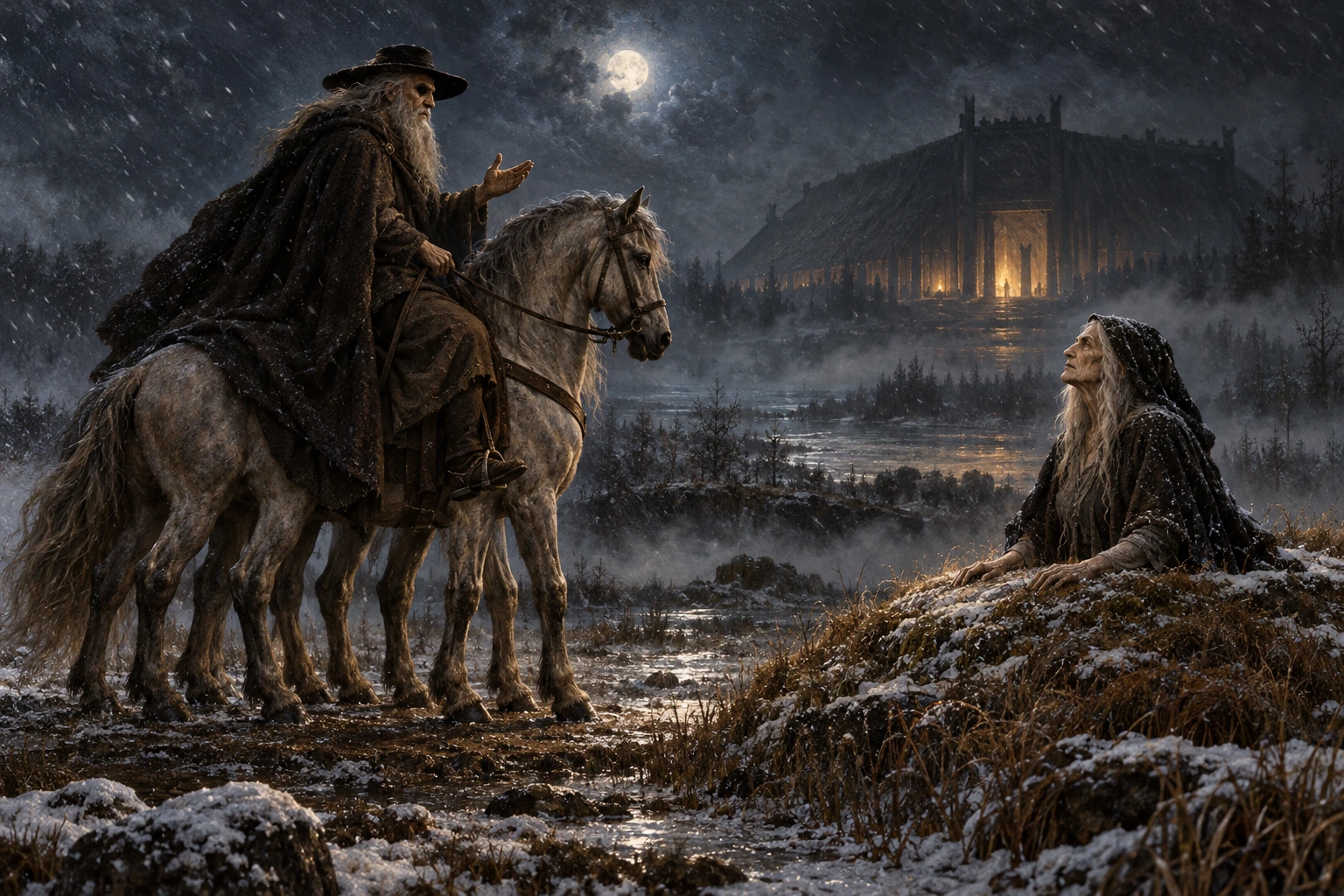
Snorri begins simply: Baldr “dreamed great and perilous dreams touching his life”. The poem Baldrs draumar, “Baldr’s Dreams”, tells what Odin did about them. While the gods met in council, he saddled Sleipnir and rode down to Niflhel. A hound came out of Hel to meet him, bloody on its breast, and howled at him. Near the eastern door of Hel’s hall lay the grave of a seeress. Odin chanted spells until she rose, complaining that she had long been dead, “snowed on with snow, and smitten with rain”.
Odin called himself Vegtamr, son of Valtamr, and asked for whom the benches in Hel were decked with rings. For Baldr, she said: the mead was brewed and a shield lay over it. Höðr would kill him, and Rindr would bear a son, Váli, who at one night old would avenge him. Then Odin asked who the maidens were who would weep and toss their sails to the sky, a question still obscure, and she knew him for Odin. “Ride home, Odin,” she said: no one would visit her again until Loki broke loose and the end of the gods came.
1-2 The Oaths and the Mistletoe
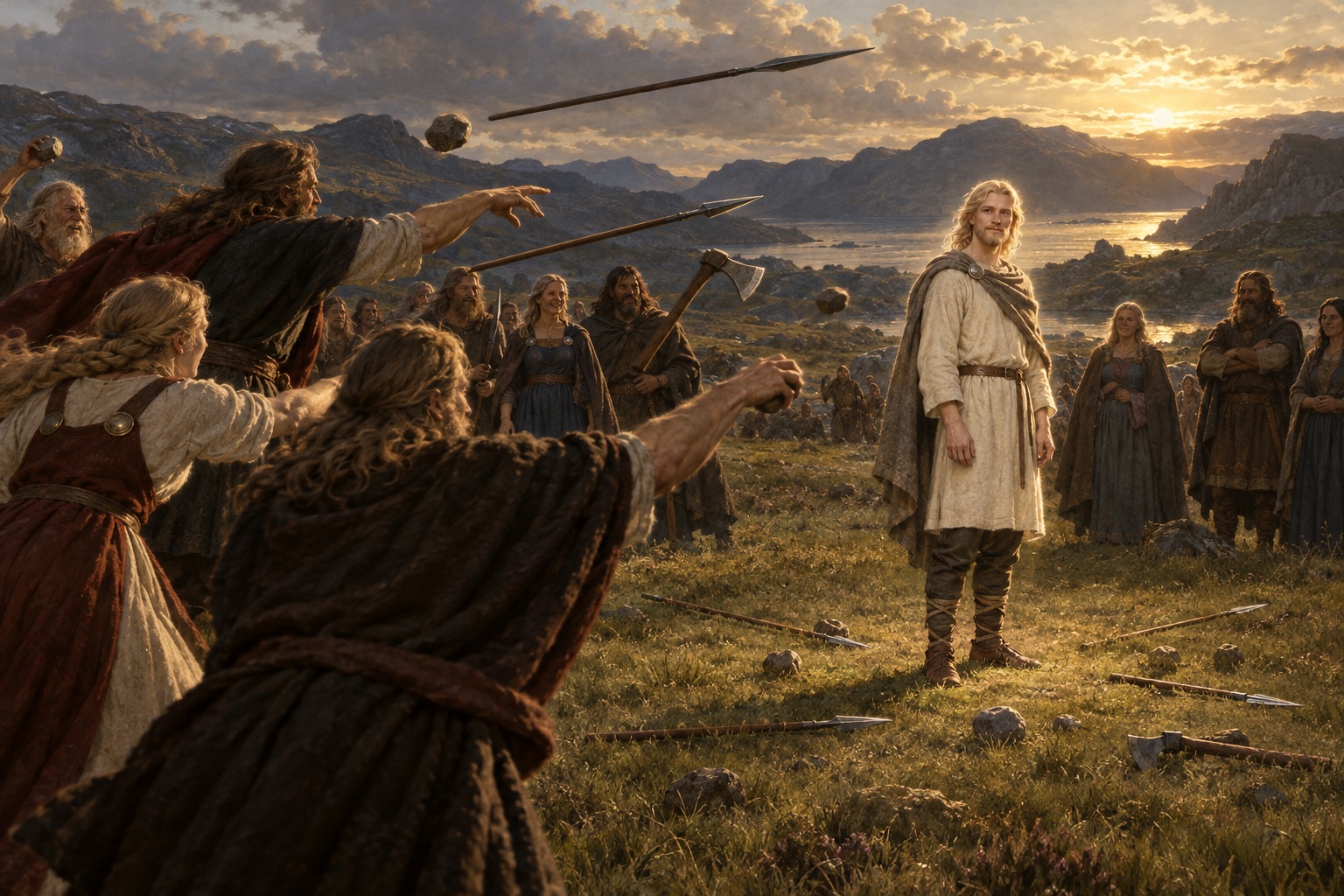
The gods resolved to ask safety for Baldr from every danger. Frigg took oaths from fire and water, iron and every metal, stones, earth, trees, sicknesses, beasts, birds, poison and serpents. After that it became a game: Baldr stood up at the assembly, and the others shot at him, hewed at him and threw stones at him. Nothing hurt him, “and that seemed to them all a very worshipful thing”.
Loki did not like it. In the likeness of a woman he went to Frigg’s hall, Fensalir, and asked whether all things had sworn. Frigg told him of the young shoot west of Valhalla called mistletoe. Loki pulled it up and went to the assembly.
Höðr, Baldr’s brother, stood outside the ring, because he was blind. Loki asked why he did not shoot. Because he could not see where Baldr was, Höðr said, and he had no weapon. Loki gave him the mistletoe and guided his aim. The shaft flew through Baldr and he fell dead: “the greatest mischance that has ever befallen among gods and men”. No one could take vengeance, for the place was a sanctuary. The gods could only weep, and Odin grieved most, because he understood best what the loss meant.
1-3 The Ship
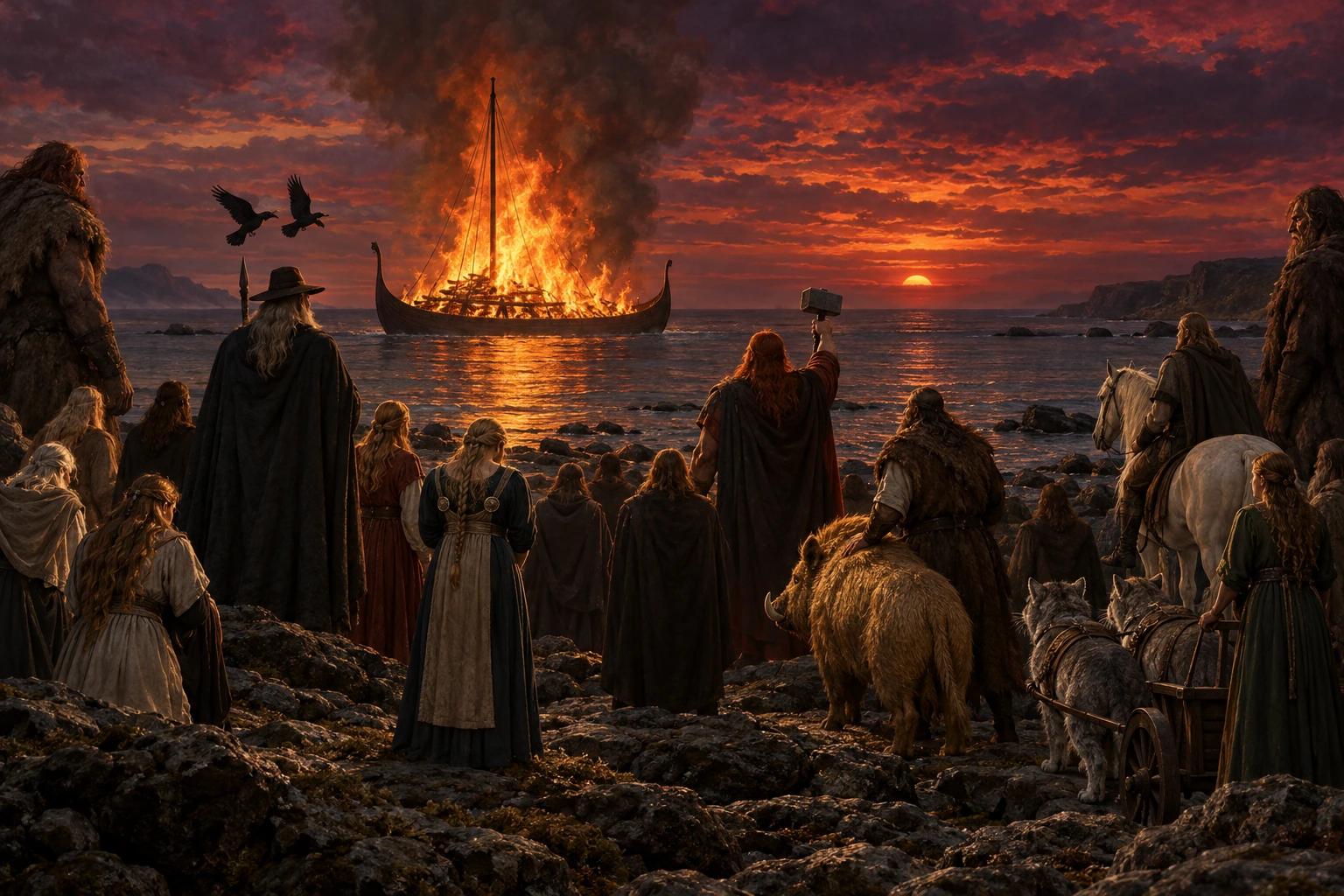
The gods carried Baldr to his ship Hringhorni, the greatest of all ships, to burn him on it, but they could not launch it. They sent to the land of the giants for the giantess Hyrrokkin. She came riding a wolf, with a viper for a bridle; four berserks could hold her mount only by felling it. With one push she launched the ship, so that fire flew from the rollers and all lands trembled. Thor gripped his hammer, and the gods had to beg for her life.
When Baldr’s wife Nanna saw his body carried on board, her heart burst with grief, and she was laid on the pyre with him. Thor hallowed the fire with Mjölnir; a dwarf called Litr ran in front of his feet, and Thor kicked him into the flames. Odin came with Frigg, the valkyries and his ravens, Freyr in his chariot with his boar, Heimdallr on his horse and Freyja with her cats, and frost giants and hill giants came too. Odin laid his gold ring Draupnir on the pyre, and Baldr’s horse was led to the fire in all its harness.
1-4 The Ride to Hel
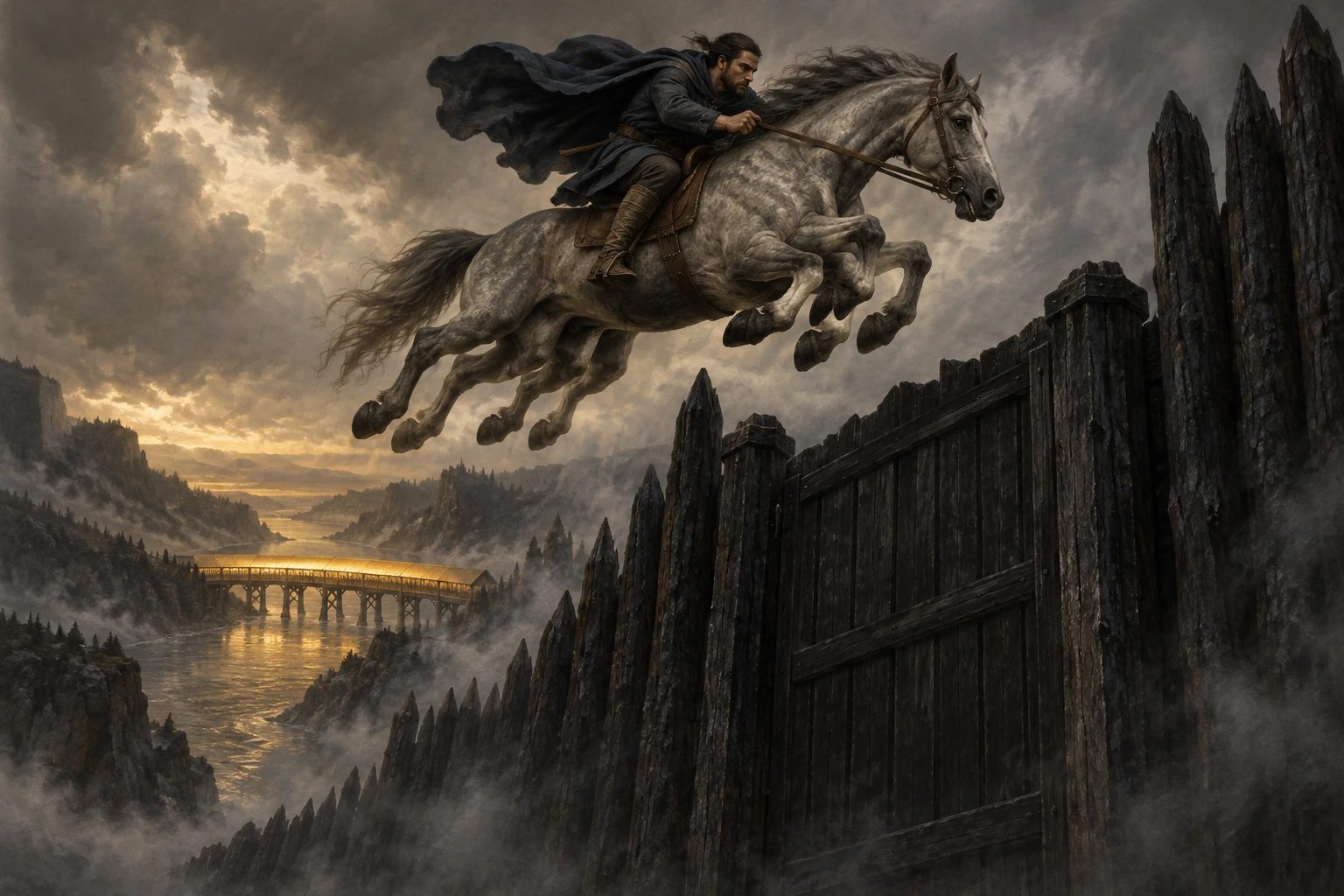
Frigg asked who would win her love and favour by riding to Hel to offer a ransom. Hermóðr the Bold, another son of Odin, took Sleipnir and rode nine nights through dark, deep valleys to the river Gjöll and its bridge, roofed with shining gold. The maiden who kept it, Móðguðr, said that five companies of dead men had crossed the day before, yet the bridge thundered as much under him alone: “thou hast not the color of dead men”. Baldr had passed, she said; the road to Hel ran down and to the north.
At Hel’s gate Hermóðr tightened his girths, and Sleipnir leapt clean over it. In the hall Baldr sat in the high seat. Hermóðr stayed the night and in the morning asked Hel to let him go. She set a test: “If all things in the world, quick and dead, weep for him, then he shall go back to the Æsir”; if any refused, he would stay. Baldr sent the ring Draupnir back to Odin, and Nanna sent Frigg a linen smock and Frigg’s attendant Fulla a gold ring.
The gods sent messengers through the world, and everything wept for Baldr: people, animals, the earth, stones, trees and every metal, “even as thou must have seen that these things weep when they come out of frost and into the heat”. On their way home the messengers found a giantess in a cave who called herself Þökk. She would weep “waterless tears” for him: “Let Hel hold to that she hath!” Men thought she was Loki in disguise. How the gods caught and bound him belongs to his own story.
2 Where the Story Is Written Down
Stanza numbers follow the edition of Gustav Neckel and Hans Kuhn; Bellows’s translation numbers some stanzas differently, given in brackets.
- Völuspá 31–35 [32–35], in the Codex Regius, an Icelandic manuscript of about 1270. The seeress sees Baldr’s fate, “the bleeding god”, and the mistletoe standing tall, slender and fair. From that shoot came “a harmful shaft” that Höðr threw. Baldr’s brother, one night old, will not wash his hands or comb his hair until he brings Baldr’s slayer to the pyre, and Frigg weeps in Fensalir. The next lines show a bound figure “to Loki like”, with his wife Sigyn beside him. Stanza 62 brings Baldr back, with Höðr, after the end of the world.
- Baldrs draumar, fourteen stanzas, survives only in AM 748 I a 4to, a fragmentary manuscript of the early 14th century. Bellows thought the poem took its form “not later than the first half of the tenth century”. Edward Pettit, in his edition of 2023, calls its date unknown, perhaps later than Völuspá, with which it shares lines.
- Lokasenna 27–28: at a feast of the gods, Frigg says that if she had a son like Baldr beside her, Loki would not leave the hall without a fight. Loki answers: “Mine is the blame that Baldr no more / Thou seest ride home to the hall.”
- Vafþrúðnismál 54: Odin wins a contest of wisdom with a question only he can answer: what did Odin say into his son’s ear before the son mounted the pyre? The poem does not name the son; Bellows takes him to be Baldr.
- Hyndluljóð 29 [30]: Váli avenged Baldr: “his brother’s slayer soon he slew”.
- Húsdrápa, “the House Poem”, by the Icelandic poet Úlfr Uggason, late 10th century. In Laxdæla saga (ch. 29) he recites it at a wedding in Óláfr Peacock’s new hall at Hjarðarholt, whose wainscot and roof were painted with legends. Snorri quotes a few verses: Odin riding “to the wide pyre of his offspring”, valkyries and ravens following him, Freyr on his golden-bristled boar, Heimdallr spurring his horse. “With old tales the hall was painted.”
- Snorri Sturluson’s Edda (c. 1220–30). Gylfaginning 49 tells the whole story. Skáldskaparmál lists poets’ names for Baldr, among them “God of Tears”, and calls Váli “Baldr’s Avenger” and the slayer of Höðr. Snorri notes that Úlfr composed “a long passage” on Baldr; Pettit adds that Snorri also drew on a stanza probably taken from a lost Eddic poem.
- Saxo Grammaticus, Gesta Danorum, book 3, a Latin history of the Danes: the very different story in section 3.
- The second Merseburg Charm, a healing spell in Old High German in a manuscript of the 9th or 10th century (Merseburg, cathedral chapter, Cod. 136): “Phol ende Uuodan uuorun zi holza; du uuart demo balderes uolon sin uuoz birenkit”. Phol and Wodan went to the wood, and the foal of balder sprained its foot; goddesses sing charms over it, then Wodan heals it, “bone to bone, blood to blood”. Jacob Grimm read balderes as the god’s name and Phol as another name for him. Others take balder as a plain word for “lord”, as Francisco Javier Muñoz Acebes notes; Grimm himself pointed out that Old English bealdor meant “lord, prince”.
3 Competing Versions
Saxo tells the story as Danish history, with gods “in a supposititious rather than in a real sense”. Frederick York Powell, introducing Oliver Elton’s translation of 1894, judged that the story “was greatly euhemerised in Saxo’s sources”, its gods turned into men, “but the essentials of the story are there”. Quotations below are from Elton.
- Who is Höðr? Snorri: a blind god, Baldr’s own brother. Saxo: Hotherus, a Swedish prince, son of King Hothbrodd and fosterling of King Gewar, a fine swimmer and archer and a master of the lyre. He is not blind, and no kin to Balderus. Loki has no part in Saxo’s story.
- Who is Nanna? Snorri: Baldr’s wife, who dies of grief at his pyre. Saxo: Gewar’s daughter. Balderus sees her bathing and is “seized with boundless love”, but she refuses him, since “a god could not wed with a mortal”, and marries Hotherus.
- Why can he not be wounded? Snorri: Frigg’s oaths. Saxo: “the sacred strength of Balder’s body was proof even against steel”. Only one sword can kill him, kept by Miming, “the Satyr of the woods”. In his introduction, York Powell marked that sword “[Mistletoe?]”.
- Gods at war. In Saxo, Odin and Thor fight for Balderus in a sea battle, until Hotherus hews off the haft of Thor’s club and the gods flee. Later Balderus wins a battle and makes springs gush from the earth for his thirsty soldiers. Wood-maidens guide Hotherus throughout; three of them, who strengthen Balderus’s food with the venom of snakes, give Hotherus a girdle of victory.
- How does he die? Snorri: at once, by the mistletoe. Saxo: Hotherus plunges his sword into his side. Proserpine, as Saxo calls the queen of the dead, appears to him in a dream and promises him her embrace, and three days later he dies and is buried in a barrow. In Saxo’s own day, he adds, men led by one Harald dug into it for treasure and fled from a sudden torrent.
- Who avenges him? The poems: Váli, son of Rindr. Saxo: Odin learns from the Finnish seer Rostioph that Rinda, daughter of the king of the Ruthenians, must bear the avenger. Refused three times, he wins her by trickery, disguised as a woman healer. Their son Bous kills Hotherus in battle and dies of his own wounds the next day.
- An English echo? In Beowulf (lines 2434–71), Hæðcyn kills his elder brother Herebeald by accident with an arrow, and their father can take no vengeance. Pettit notes that the names share elements with Höðr and Baldr. Jan de Vries, as Muñoz Acebes reports, did not think this proved a link.
4 History and Tradition
- A Christian author. Iceland became Christian in 999/1000, and Snorri, as Brodeur put it, “though a Christian, tells the old pagan tales with obvious relish”. How much he added is debated, as Muñoz Acebes’s survey of 2003 shows. Sophus Bugge argued that the story borrowed from Christian legend, setting the fatal shaft beside the spear of the blind soldier Longinus. Jan de Vries held that Snorri drew on Úlfr’s Húsdrápa and on material older than the poems. Muñoz Acebes himself judges Baldr too widely attested to be a Christian invention, while allowing that Snorri may have added touches of his own.
- Baldr’s Meads. The Icelandic Saga of Frithiof the Bold places a sanctuary of Baldr in Sogn, in western Norway, “a Place of Peace” with a great temple where, among many gods, “was Baldur held of most account”. No one might harm man or beast there.
- Gold pendants. Karl Hauck read the scenes on some gold bracteates of the Migration Period, among them one found at Fakse, as Baldr’s death: Wodan with a spear, a figure he took for Loki, and Baldr in the middle, often holding a ring that Hauck identified as Draupnir.
- Frazer’s oak. In Balder the Beautiful (1913), the last part of The Golden Bough, James George Frazer made Baldr the spirit of the sacred oak, whose life lay in the mistletoe: “neither more nor less than a personification of a mistletoe-bearing oak”. He tied the myth to Europe’s midsummer bonfires, which in parts of Sweden, he reported, were “formerly called Balder’s Balefires”.
- Neckel’s Near East. In 1920 Gustav Neckel went further. Baldr, he argued, was a god borrowed from the Near East, “Balder (= Adonis) = Tammuz”, and the memorial toast drunk to the gods had once been meant for “an Osiris-like god, Baldr”.
- The objections. Muñoz Acebes, citing Jan de Vries (1955), answers that Baldr is far from the gods of farming, and that in Snorri and in Saxo his death is final, not a yearly return. John Lindow, in 1997, set aside the search for hidden meanings and read the texts as they stand: as a story of feud, a killing within a family that calls for vengeance.
Baldr is often called a dying-and-rising god of vegetation, on Frazer’s authority. Frazer himself was unsure. In a note at the end of Balder the Beautiful he wrote that Baldr “may have been a real man”, deified after his death, and that he now found this “more probable” than his own oak theory. And in the sources Baldr does not come back each spring: he stays with Hel until the world has ended.
5 Related Stories
- Osiris: The Murdered King Who Rules the Dead: Gustav Neckel, in 1920, called Baldr “an Osiris-like god” and traced him to the dying gods of the Near East. Both are killed by a trick and mourned by the women closest to them, and neither returns to the living: Osiris rules the dead, and Baldr stays in Hel.
- Loki: The Shape-Shifter Between Gods and Giants: the god who guided Höðr’s hand and, as Þökk, refused to weep, and how the gods bound him for it.
- Odin: The God Who Gave an Eye for Wisdom: Baldr’s father, who woke a dead seeress to learn his son’s fate. In Vafþrúðnismál he asks what he whispered to his son on the pyre, a question no one else can answer.
- Ragnarök: The End of the World, and What Comes After: Baldr’s death is the first of the gods’ great disasters. After the end, Völuspá says, he and Höðr return together.
- Inanna’s Descent to the Underworld: Seven Gates and a Substitute: the Tammuz of Neckel’s equation “Balder (= Adonis) = Tammuz” is the Sumerian Dumuzi, Inanna’s husband. In the Sumerian poem he is not a god who dies and rises each year: Inanna hands him to the demons, and the broken ending gives him half of each year below.
6 Sources
- Snorri Sturluson, The Prose Edda, trans. Arthur Gilchrist Brodeur (1916), Gylfaginning 22, 28, 49 and Skáldskaparmál: Wikisource; Old Norse text, ed. Guðni Jónsson: heimskringla.no
- The Poetic Edda, trans. Henry Adams Bellows (1923), Völuspá, Baldrs draumar, Lokasenna, Vafþrúðnismál, Hyndluljóð: Wikisource
- Edda, ed. Gustav Neckel, 5th ed. by Hans Kuhn (1983), Old Norse text: TITUS, Frankfurt
- Edward Pettit, The Poetic Edda (Open Book Publishers, 2023), introduction and “Baldrs draumar”: Open Book Publishers
- Saxo Grammaticus, Gesta Danorum, book 3, trans. Oliver Elton, introduction by Frederick York Powell (London: David Nutt, 1894): archive.org, Project Gutenberg
- Laxdæla saga, ch. 29, trans. Muriel A. C. Press (1899): Project Gutenberg
- The Story of Frithiof the Bold, trans. Eiríkr Magnússon and William Morris: Project Gutenberg
- The Merseburg Charms (Merseburg, cathedral chapter, Cod. 136, fol. 85r): German Wikisource
- Jacob Grimm, Teutonic Mythology, trans. James Steven Stallybrass, vol. 1 (1882), ch. XI: archive.org
- James George Frazer, Balder the Beautiful (1913), vol. 1, preface and ch. III–IV; vol. 2, ch. IX and note III: Project Gutenberg, archive.org
- Gustav Neckel, Die Überlieferungen vom Gotte Balder (Dortmund, 1920), preface and p. 124: archive.org
- Francisco Javier Muñoz Acebes, “El Dios que muere en la mitología germánica: Estudio, fuentes e interpretaciones en torno a Baldr”, 'Ilu 8 (2003), 81–92: Universidad Complutense de Madrid
- Anna-Leena Siikala, review of John Lindow, Murder and Vengeance among the Gods: Baldr in Scandinavian Mythology (1997), FF Network 15 (1998): Folklore Fellows
Cover and illustrations: AI-generated images made for Arcana. They are interpretations, not historical artworks.