Ymir: The Frost Giant Whose Body Became the World
Before earth or sky, a giant took shape out of melting rime, and the gods built the world from his body. Three Eddic poems know him, but only Snorri Sturluson, a Christian writing in 13th-century Iceland, tells the whole story, and parts of it are his alone.
- Type: myth, the making of the world from the body of a primordial giant
- Culture: Norse, told in Norway and Iceland and written down in Iceland
- Earliest texts: poets of the 11th century already call the sky “Ymir’s skull”; the poems Völuspá, Vafþrúðnismál and Grímnismál survive in the Codex Regius, written in the second half of the 13th century; the only full telling is Snorri Sturluson’s Gylfaginning, from the same century
- Key figures: Ymir (Aurgelmir), the cow Auðumbla, Búri, Borr and Bestla, Odin, Vili and Vé, Bergelmir, Ask and Embla
In the 11th century the Icelandic poet Arnórr, called the Earls’ Poet, could praise a prince as the most generous ever to step aboard a ship “'neath the ancient Skull of Ymir”, and trust his listeners to know he meant the sky. More than a century later Snorri Sturluson explained the phrase: the world had been built out of a giant.
Who killed Ymir? In Snorri’s telling, the sons of Borr: Odin and his brothers Vili and Vé. The poems are vaguer. Völuspá says only that “Bur’s sons lifted the level land”, and Grímnismál that “the gods” made Midgard from his eyebrows. None of the stanzas Snorri quotes for the story says in so many words that Ymir was killed.
1 The Telling
This is the version of Snorri Sturluson’s Gylfaginning, “the Beguiling of Gylfi”. A Swedish king, Gylfi, comes in disguise to the hall of the Æsir, calls himself Gangleri, and questions three figures named High, Equally High and Third. Quotations are from Arthur Brodeur’s translation of 1916, chapters 4–9. Where Snorri goes beyond the poems is shown in sections 2 and 3.
1-1 Fire, Ice and the Yawning Gap
Gangleri asks what was in the beginning. High answers with a stanza of Völuspá: “Erst was the age when nothing was”, with no sand, no sea, no earth and no heaven, only “a Yawning Gap”: Ginnungagap.
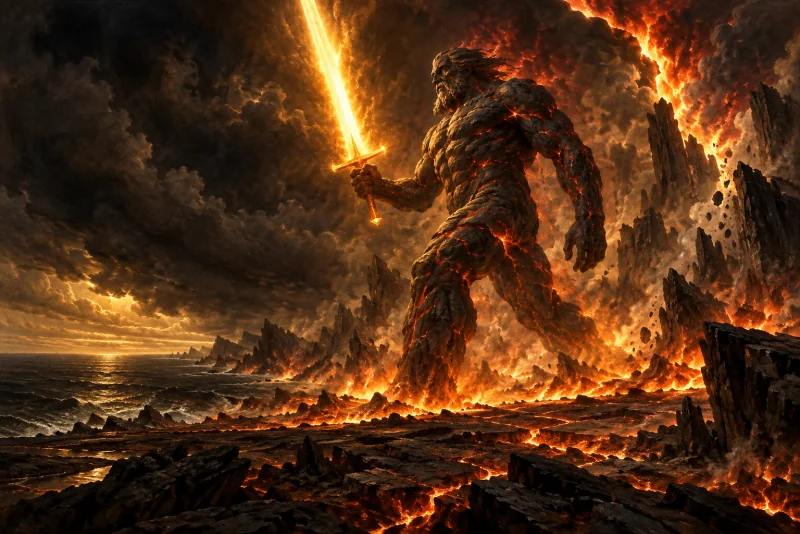
Equally High and Third then describe the worlds on either side of it. Many ages before the earth, Niflheim, the Mist-World, was made, with the spring Hvergelmir at its centre, from which many rivers flowed. Yet first of all, in the south, was Muspell, bright and burning. Surtr sits at its border with a flaming sword, and at the end of the world he will burn everything.
The rivers called Élivágar, the “Ice-waves”, carried a venom that hardened into ice, and rime built up over it, frost over frost, into the Gap. Its northern part filled with ice and gusts; its southern part was lit by sparks flying out of Muspell; and the middle was “as mild as windless air”.
1-2 The Giant in the Rime
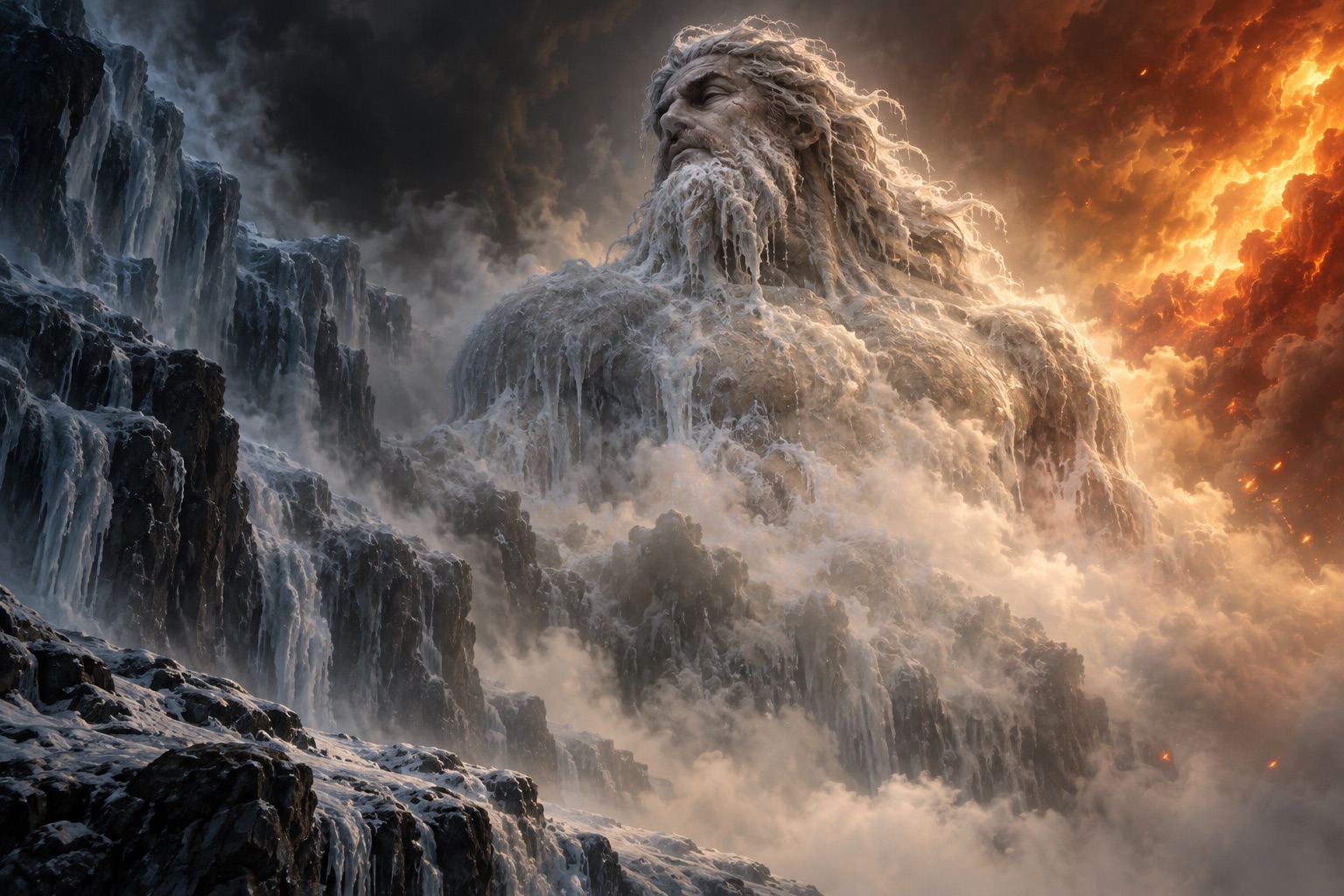
Where the breath of heat met the rime, it melted and dripped, and “life was quickened from the yeast-drops, by the power of that which sent the heat”. The drops took a man’s form. He was named Ymir, though the frost giants called him Aurgelmir, and every family of frost giants comes from him.
Gangleri asks whether they count him a god. “By no means do we acknowledge him God,” answers Equally High; “he was evil and all his kindred.” While Ymir slept he sweated, and under his left arm grew a man and a woman, and one of his feet begot a son with the other.
1-3 The Cow and the Salt Ice
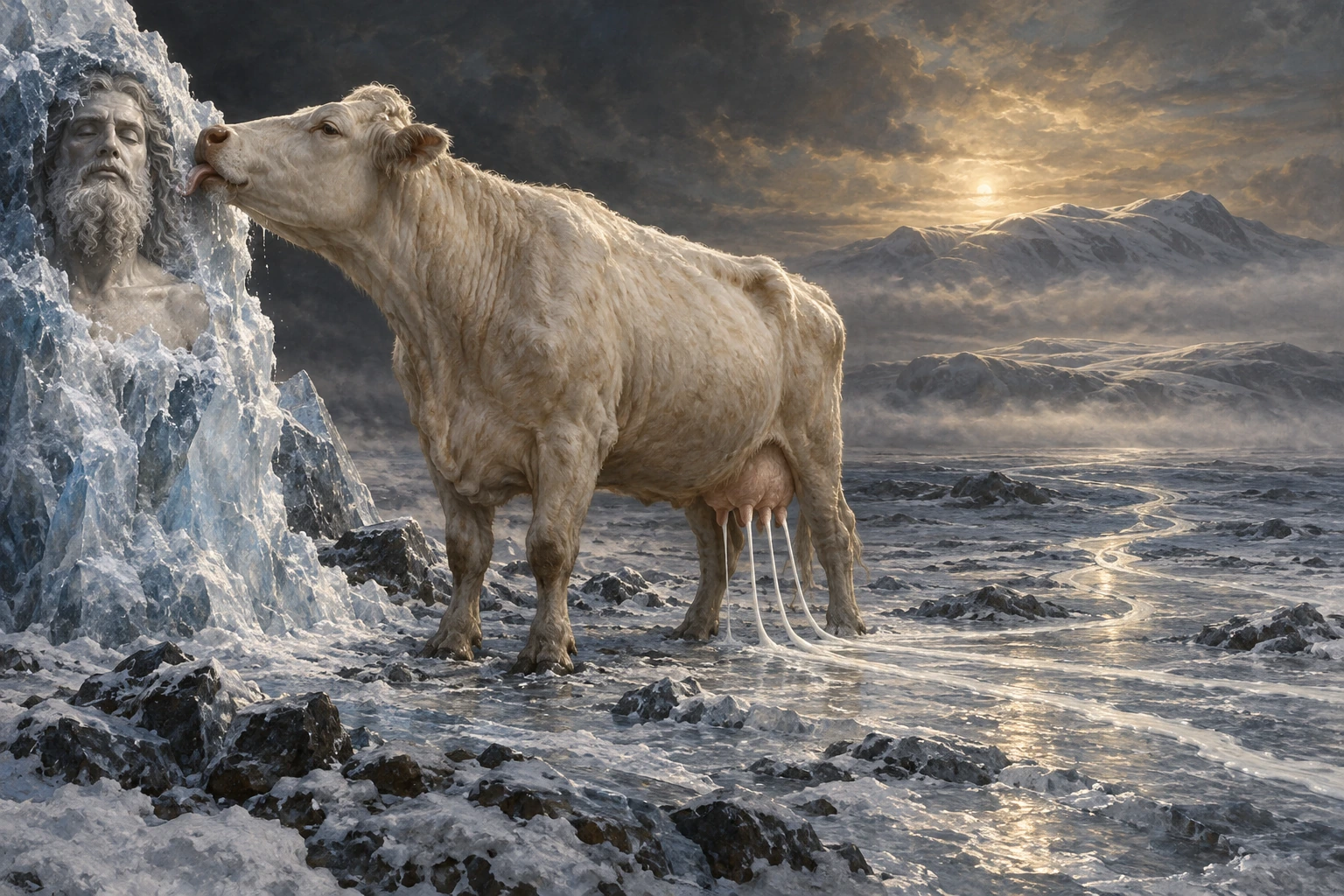
From the dripping rime came a cow as well, Auðumbla. Four rivers of milk ran from her udders, and she fed Ymir. She fed herself by licking the blocks of ice, which were salty. On the first evening a man’s hair came out of the ice, on the second day his head, and on the third day the whole man. He was Búri, “fair of feature, great and mighty”.
Búri had a son, Borr, who married Bestla, daughter of the giant Bölþorn. They had three sons: Odin, Vili and Vé.
1-4 The Flood
“The sons of Borr slew Ymir the giant.” So much blood poured from his wounds that it drowned the whole race of frost giants but one, Bergelmir, who went up with his wife onto his lúðr (Brodeur: “ship”) and was saved. From the two of them come all the frost giants since. Snorri quotes a stanza of Vafþrúðnismál as proof (section 3).
1-5 The World Made from a Body
The brothers carried Ymir into the middle of Ginnungagap and made the world from him:
- his flesh became the land, his bones the crags, and his teeth, molars and broken bones the gravel and stones;
- his blood became the sea, which they laid in a ring around the earth;
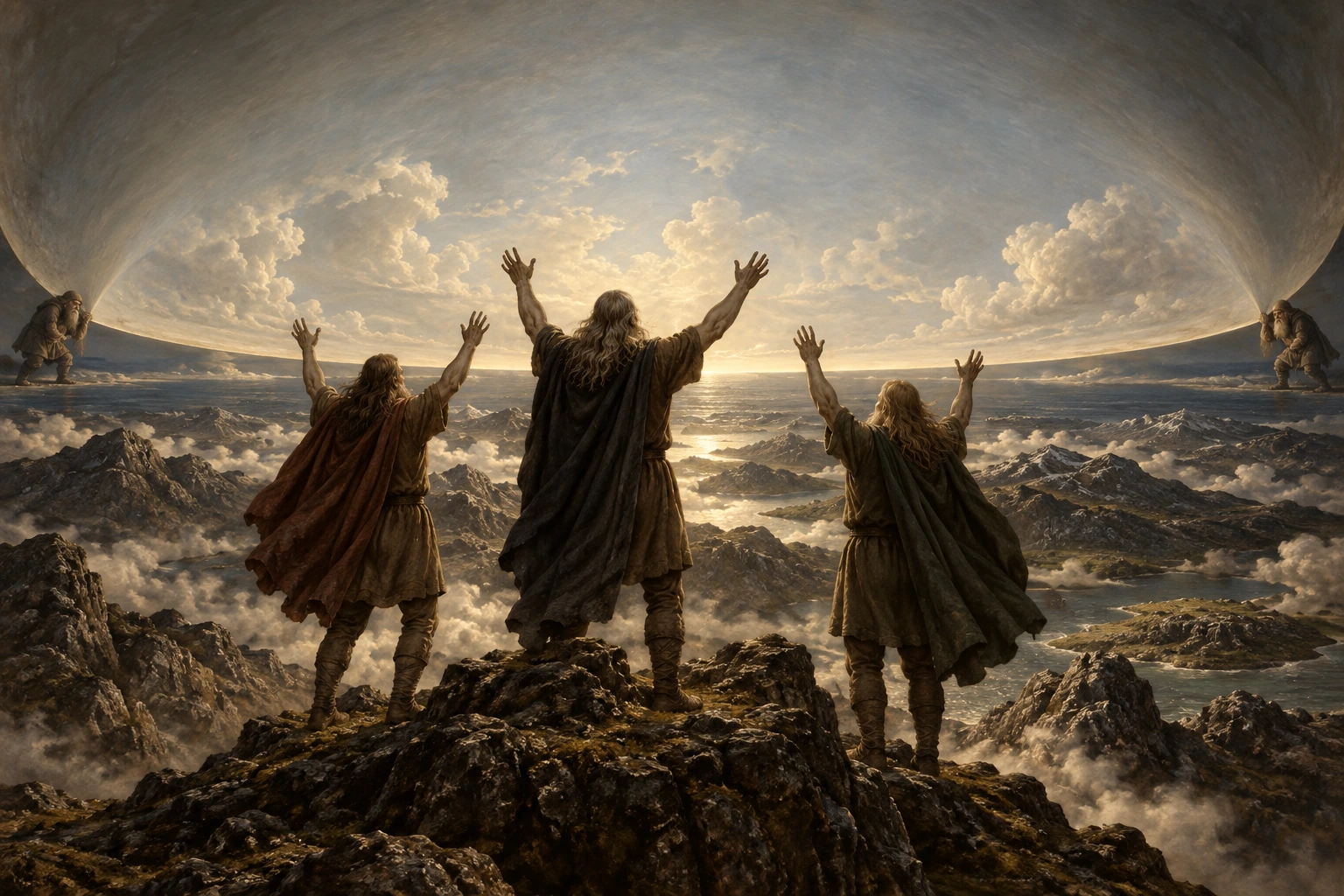
- his skull became the sky. They set it over the earth with four corners, and under each corner a dwarf: Austri, Vestri, Norðri and Suðri, East, West, North and South;
- sparks flying out of Muspell they fixed in the sky to light heaven and earth, and gave them their courses.
The earth was round, with the deep sea around it. Along the shore the gods gave land to the giants. Further in, against the giants, they raised a stronghold from Ymir’s eyebrows and called it Midgard. His brain they threw into the air, and it became the clouds. Snorri ends with two stanzas of Grímnismál: “Of Ymir’s flesh the earth was fashioned, And of his sweat the sea…”
1-6 Ask and Embla
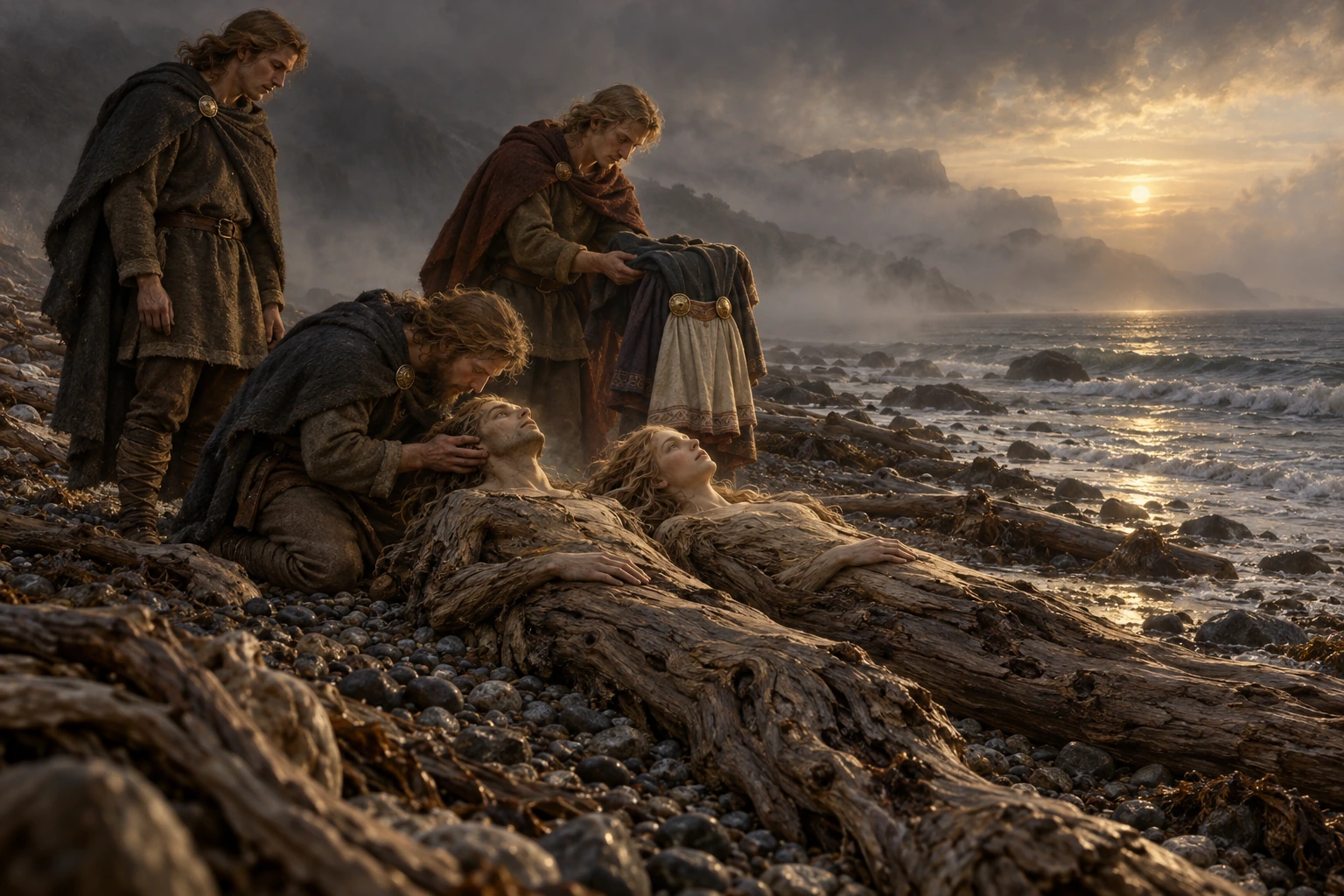
Walking along the shore, the sons of Borr found two trees, took them up and shaped people from them. The first gave them “spirit and life”, the second “wit and feeling”, the third “form, speech, hearing, and sight”. They gave them clothes and names: the man was Askr, the woman Embla, and from them came humankind, “which received a dwelling-place under Midgard”. Then the gods built a stronghold for themselves in the middle of the world, Ásgard, and Snorri adds: “men call it Troy”.
2 Where the Story Is Written Down
- Völuspá, “the Wise-Woman’s Prophecy” in Bellows’s title, is the first poem of the Codex Regius (GkS 2365 4to), written in the second half of the 13th century; another version survives in Hauksbók, from the early 14th. Bellows thought it the work of a heathen poet of the mid-10th century touched by Christian ideas. (Stanza numbers here follow Bellows’s translation of 1923; Guðni Jónsson’s Old Norse text numbers these stanzas the same way.) Stanza 3: “Of old was the age when Ymir lived; Sea nor cool waves nor sand there were; Earth had not been, nor heaven above, But a yawning gap, and grass nowhere.” Stanza 4: “Then Bur’s sons lifted the level land, Mithgarth the mighty there they made.” Stanzas 17–18 tell of Ask and Embla (section 3).
- Vafþrúðnismál, a contest of wisdom in which Odin questions the giant Vafþrúðnir. Stanza 21: the earth from Ymir’s flesh, the mountains from his bones, the sky from “the frost-cold giant’s skull”, the sea from his blood. Stanzas 28–35: the first giants, from Aurgelmir to Bergelmir.
- Grímnismál 40–41: earth, sea, hills, trees, sky, Midgard and clouds, from his flesh, blood, bones, hair, skull, eyebrows and brain.
- Hyndluljóð, in the 14th-century Flateyjarbók: “from Ymir sprang the giants all” (stanza 33 in Bugge’s numbering; 35 in Bellows). Snorri quotes it from the “Short Völuspá”.
- Poets’ kennings. Snorri’s handbook of poetic language, Skáldskaparmál, teaches that the sky may be called “Ymir’s skull” and the sea “Ymir’s blood”, and quotes poets who did: Arnórr the Earls’ Poet (died about 1075), and Ormr of Barra in the Hebrides (10th or 11th century). Another verse of Arnórr’s calls the sky “the Toil of Austri”, one of the dwarfs who hold it up.
- Snorri Sturluson (1179–1241), an Icelandic chieftain, wrote Gylfaginning as part of his Edda. When is not known; its editor Anthony Faulkes thinks the part on metre followed Snorri’s first visit to Norway, in 1218–20. Every manuscript was written more than half a century after his death. His texts of the poems are sometimes “quite different” from the Codex Regius, and Faulkes suggests he used a lost manuscript or knew them from oral tradition.
Only Snorri has Niflheim, a word that “does not occur in poetry” (Faulkes). In Völuspá, Muspell appears only in “Muspell’s people”, who sail in at the end of the world. Outside Gylfaginning, Auðumbla turns up in a verse list of names for cows (“she is the highest of cows”), and Búri in a kenning for Odin, “son of Borr, heir of Búri”. The killing, the flood and the trees are not in the poems Snorri quotes. Faulkes is frank about what this means: “Snorri was a Christian and had only a scholar’s and an artist’s interest in mythology”. He shaped Gylfaginning on the plan of Völuspá, from creation to the end of the world and its renewal, a scheme “of course, like that of the Bible”, and “he would probably not have felt inhibited from inventing new stories or drastically altering old ones if he saw fit”.
3 Competing Versions
- When Ymir lived, or when nothing was? The Codex Regius and Hauksbók begin Völuspá 3 with Ár var alda, þar er Ymir bygði, “Of old was the age when Ymir lived”. The manuscripts of Snorri’s Edda read þat er ekki var, “when nothing was”. The difference is usually put down to two oral versions, but Faulkes adds that “Snorri may have deliberately excluded Ymir at this point”: in his story, Ymir does not exist yet.
- Ymir or Aurgelmir? In Vafþrúðnismál 29–31 the first giant, grown from drops of venom out of the Élivágar, is Aurgelmir, grandfather of Bergelmir. The poem never says in so many words that he is Ymir; Snorri makes them one. The last two lines of stanza 31, “And thence arose our giants’ race”, survive only in Snorri’s quotation (Bellows).
- His children. In Vafþrúðnismál 33, under the arms of the frost giant grew “man-child and maid together”, and foot with foot he fathered “a son that six heads bore”. Snorri keeps the arm, now the left one, and the feet, adds the sweat of his sleep, and drops the six heads.
- Blood or sweat? In Vafþrúðnismál 21 and Grímnismál 40 the sea comes from Ymir’s sveiti. The word means “sweat”; in poetry, Faulkes allows, perhaps “blood”. Bellows translates “blood”, Brodeur “sweat”, and Snorri’s own prose says blood.
- What was the lúðr? Vafþrúðnismál 35 says only that the first thing the giant Vafþrúðnir remembers is Bergelmir being “laid on a lúðr”. The poem has no flood. Bellows translates “in a boat”, Brodeur “ship”, with a note: “literally, mill-bench or mortar”. The Icelandic etymological dictionary gives the box of a hand-mill, and perhaps a cradle; in Gylfaginning itself, a lúðr is also Heimdallr’s horn. Faulkes reads “probably coffin”, and thinks Snorri linked it with örk, “which could mean both coffin and ark”, which “seems to have led to his interpreting the verse as referring to a Norse deluge”.
- Who made the first people? In Völuspá 17–18 three gods, Odin, Hœnir and Lóðurr, find Ask and Embla on the land, “empty of might” and “without fate”. They do not shape them: “Soul gave Othin, sense gave Hönir, Heat gave Lothur and goodly hue” (Bellows). Snorri has the sons of Borr make them from trees, and does not say which brother gave what. Faulkes thinks he kept it vague because he “knew that Vsp has Hœnir and Lóðurr in place of Vili and Vé”. Askr means “ash tree”; for Embla the Icelandic etymological dictionary suggests a word for elm, or one related to the Greek for “vine”, and calls the matter doubtful.
- Where did the dwarfs come from? Völuspá 9 has the gods decide who should shape the dwarfs “Out of Brimir’s blood and the legs of Blain”. Bellows reports the suggestion that both are names for Ymir, and Finnur Jónsson read them so. In Snorri, the dwarfs first came to life as maggots in Ymir’s flesh.
4 History and Tradition
- A Christian’s creation story. Asked what the All-father did before heaven and earth were made, High answers: “He was then with the Rime-Giants.” Faulkes points to this line when he writes that Snorri “can hardly have taken his account of creation seriously”. He also notes that “several qualities attributed to Óðinn conform to the Christian conception of an almighty creator”. In his prologue the Æsir are men who came from Asia, and in Gylfaginning their Ásgard is Troy.
- An older formula. The Wessobrunn Prayer, a Christian poem in Old High German written down around or soon after 800 (Munich, Clm 22053), begins Dat ero ni uuas noh ufhimil, “that there was no earth, nor heaven above”. Völuspá 3 has jörð fannsk æva né upphiminn, “earth had not been, nor heaven above”. Finnur Jónsson pointed to the likeness in his notes to the stanza.
- The name. Ásgeir Blöndal Magnússon’s Icelandic Etymological Dictionary (1989) notes that Ymir has often been linked with the verb ymja, “to resound, to groan”. It thinks the name more likely related to Sanskrit yamá- and Avestan yǝ̄ma-, “twin”, and Middle Irish emon, “twins”. Ymir would then first have meant “a being of two sexes”, and the dictionary compares Tuisto, the “earth-born god” whom Tacitus’s Germania names as father of Mannus, ancestor of the Germans. Vafþrúðnismál 32 itself asks how “the giant grim, Who never a giantess knew” begat children. The dictionary has not been revised since 1989, and the etymology remains a proposal.
- Puruṣa. In the Rig Veda (10.90) the gods offer the cosmic man Puruṣa in sacrifice: “The Moon was gendered from his mind, and from his eye the Sun had birth”, the sky from his head, the earth from his feet. Writing about Pangu, the historian Yang Kuan quoted this hymn, then the story of Ymir. He judged that myths of a world made from a giant’s corpse arose among many peoples from similar ideas, not by borrowing, since northern Europe, North America and China lie too far apart. The two stories differ, too: Puruṣa is the gods’ offering, while Snorri’s Ymir is “evil”.
- Ymir in the sky. A small moon of Saturn found in 2000 was named Ymir. It belongs to the “Norse group” of moons, which circle the planet in the opposite direction to its rotation.
Niflheim, the world of ice and mist, often appears in lists of the “nine worlds” of the Eddic poems; Bellows’s own notes count it among them. The word never occurs in Old Norse poetry: it is Snorri’s. The poems know Niflhel, “the home where dead men dwell” (Vafþrúðnismál 43), and Snorri uses that name too, for the place below Hel where the wicked go.
5 Related Stories
- Pangu: The Giant Who Grew Between Heaven and Earth: China’s dying giant, whose breath became the wind, his eyes the sun and moon, his blood the rivers. Shirakawa Shizuka saw the same pattern, a world born from a giant’s corpse, in India and northern Europe, and thought it spread with farming. Yang Kuan, citing Ymir, thought such stories arose independently.
- Odin: The God Who Gave an Eye for Wisdom: in Snorri, Ymir’s killer. He is a giant’s kin as well: his mother Bestla is the daughter of the giant Bölþorn.
- Yggdrasil: The World Tree That Suffers More Than Men Know: Völuspá speaks of the nine worlds and the tree in the stanza just before Ymir, and Snorri sets one of the ash’s roots among the frost giants, “in that place where aforetime was the Yawning Void”.
- Ragnarök: The End of the World, and What Comes After: the world made from Ymir’s body does not last. Surtr, who guards the border of Muspell in Snorri’s opening, will burn it.
6 Sources
- Snorri Sturluson, Gylfaginning, chapters 2–9, 14–15, and Skáldskaparmál, chapters 23–25, trans. Arthur Gilchrist Brodeur, The Prose Edda (1916): Wikisource, Wikisource
- Anthony Faulkes (ed.), Snorri Sturluson, Edda: Prologue and Gylfaginning, 2nd ed. (2005), introduction, notes, glossary and index; and Edda: Skáldskaparmál, verses 26, 105–106, 123 and 506, with index: Viking Society, Viking Society
- Henry Adams Bellows (trans.), The Poetic Edda (1923), with notes: Völuspá, Vafþrúðnismál, Grímnismál, Hyndluljóð, General Introduction
- Old Norse texts, ed. Guðni Jónsson: Völuspá, Vafþrúðnismál, Grímnismál, Gylfaginning; Völuspá in the Codex Regius and in Snorri’s manuscripts, ed. Sophus Bugge (1867): heimskringla.no, heimskringla.no; the Hauksbók text: heimskringla.no; Finnur Jónsson, De gamle Eddadigte, with notes: heimskringla.no
- Ásgeir Blöndal Magnússon, Íslensk orðsifjabók (1989), entries “Ýmir”, “ymja”, “Embla”, “lúður”, “Auðhumla”: Árni Magnússon Institute, via Málið.is
- Rig Veda 10.90, trans. Ralph T. H. Griffith: Wikisource; Tacitus, Germania 2, trans. Church and Brodribb: Wikisource; the Wessobrunn Prayer: German Wikisource
- Yang Kuan, “盤古、槃瓠與犬戎、犬封”: aisixiang.com; Shirakawa Shizuka, “盤古”, Heibonsha World Encyclopedia: Kotobank
- NASA, “Ymir”: science.nasa.gov
Cover and illustrations: AI-generated images made for Arcana. They are interpretations, not historical artworks.