Pangu: The Giant Who Grew Between Heaven and Earth
The world began as an egg, and Pangu grew inside it until heaven and earth stood ninety thousand li apart. When he died, his body became the world. Yet no book names him before the third century CE, and scholars still argue over where he came from.
- Type: myth, the making of the world from a primordial giant
- Culture: China, known across East Asia through the Chinese classics
- Earliest texts: the Sanwu liji (三五曆紀) and Wuyun linian ji (五運歷年紀) of Xu Zheng, 3rd century CE. Both are lost and known only from quotations in later books, such as the encyclopedia Yiwen leiju (624)
- Key figures: Pangu (盤古)
Around 80 CE the philosopher Wang Chong pointed out a gap in the learning of his day. The scholars could recite the classics, he wrote, but ask them who ruled “when heaven and earth first opened”, and they did not know. In the third century an official of the southern state of Wu wrote down a name for that first being: Pangu.
Is Pangu China’s oldest god? He comes first in the story, but late in the books. No text before the third century CE names him, while Nüwa and Fuxi appear centuries earlier. Even the Qing historian who collected the passages about him doubted them (section 2).
1 The Telling
The story comes in two halves, from two books by the same author, Xu Zheng. Neither survives whole. What we have are the passages that later writers copied out.
1-1 The Egg
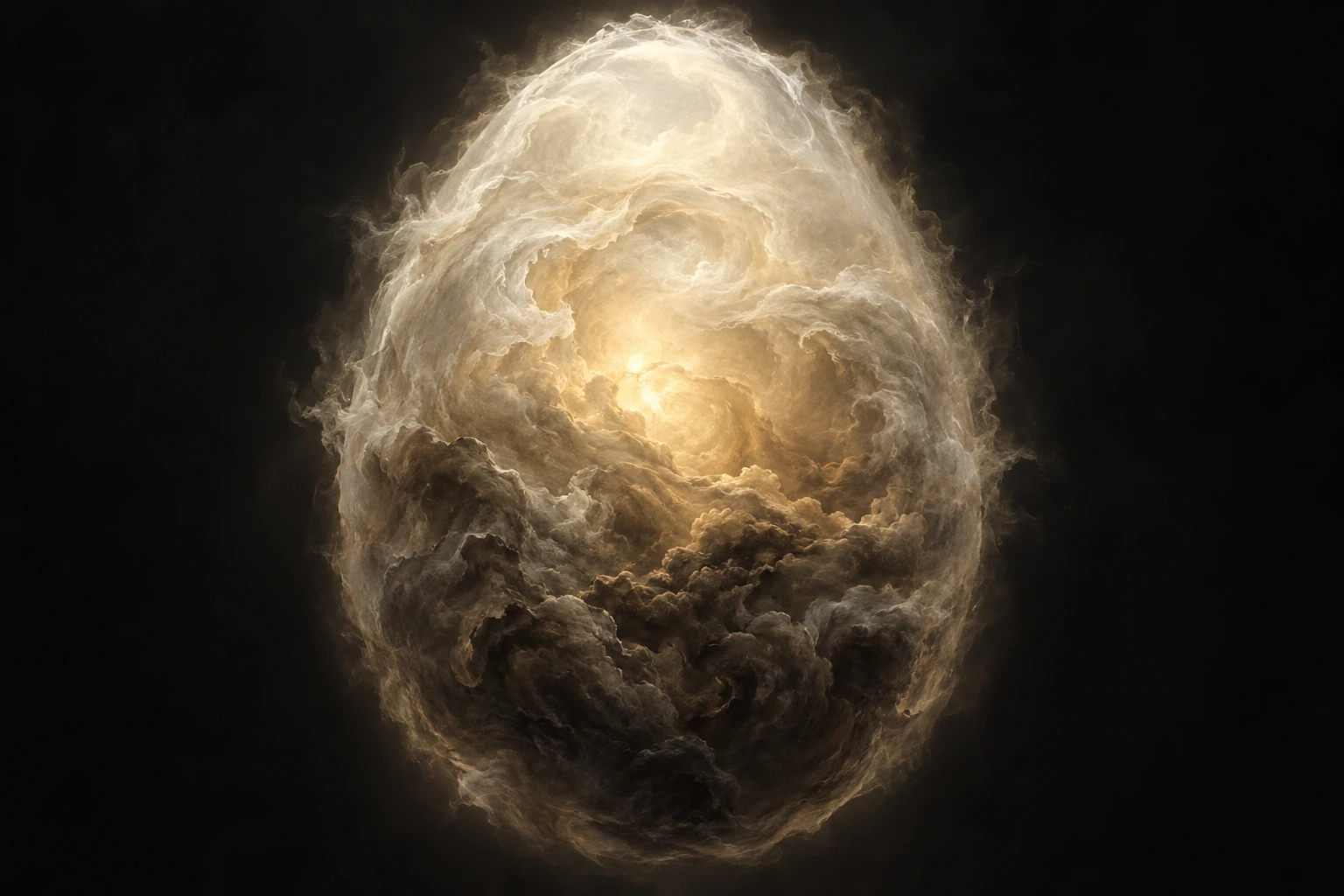
The Sanwu liji begins before anything could be told apart. Heaven and earth were mixed together in chaos, “like a hen’s egg”, and Pangu was born inside it.
Eighteen thousand years passed, and heaven and earth opened. What was clear, the yang, became heaven. What was murky, the yin, became earth.
1-2 Growing Between Them
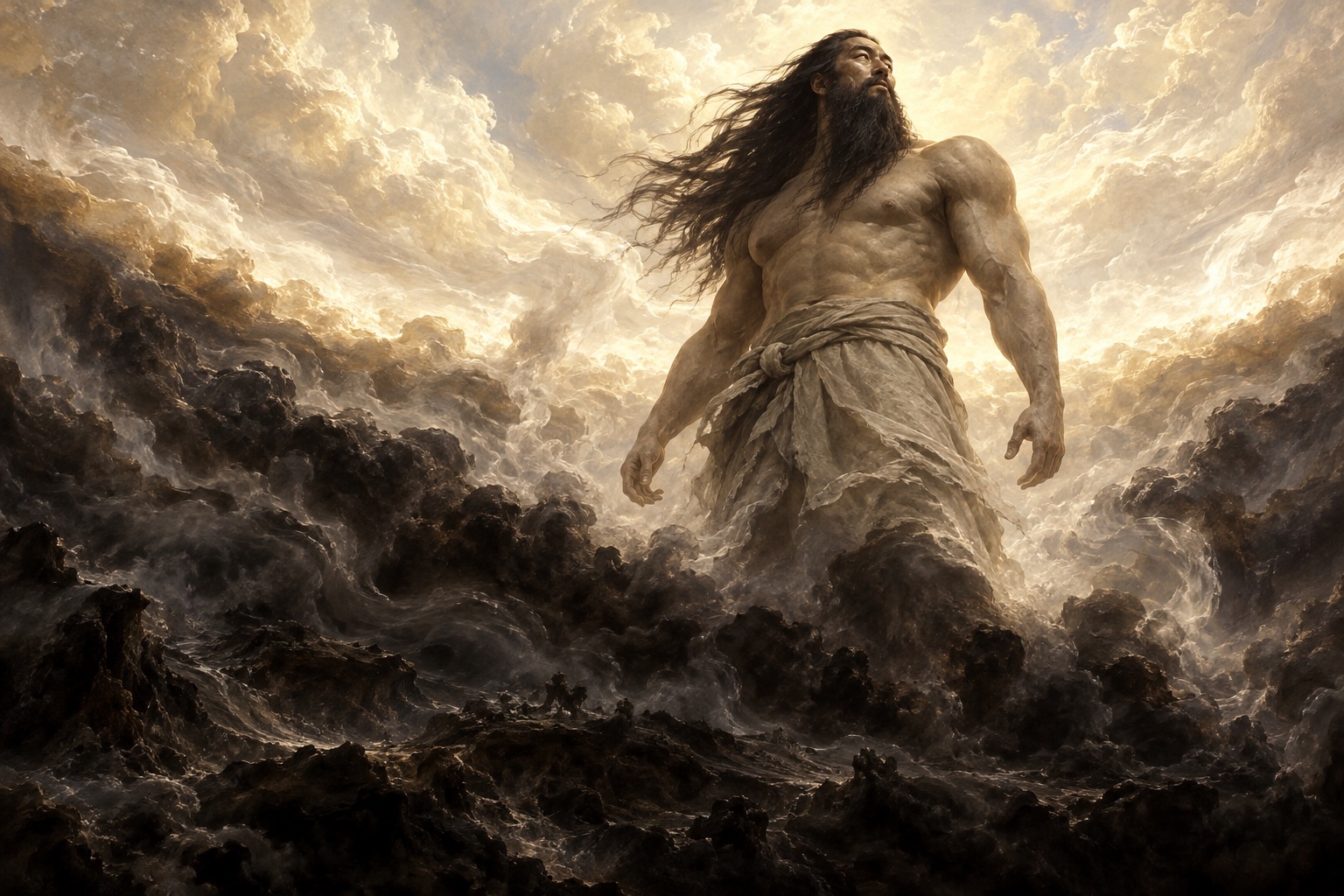
Pangu stayed in between. He changed nine times a day, and became more divine than heaven and wiser than earth. Every day heaven rose one zhang (ten Chinese feet) higher, earth grew one zhang thicker, and Pangu grew one zhang taller. It went on like this for eighteen thousand years, until heaven was as high as it could go, earth as deep, and Pangu as tall. That, the text says, is why heaven stands ninety thousand li from earth. Only after him came the Three Sovereigns, the first rulers of the old histories.
The passage ends with numbers: they begin with one, stand at three, are complete at five, flourish at seven and come to rest at nine. Notice what is missing. Pangu does not push, lift or hold anything. He grows, and the distance grows with him.
1-3 The Body That Became the World
The Wuyun linian ji begins with qi, the breath-stuff of the cosmos. Vast and murky, it began to sprout. Heaven and earth divided, yin opened and yang responded, and the qi spread out and conceived the harmony between them, “and that is humankind”. The first to be born was Pangu.
As he neared death, he transformed his body:
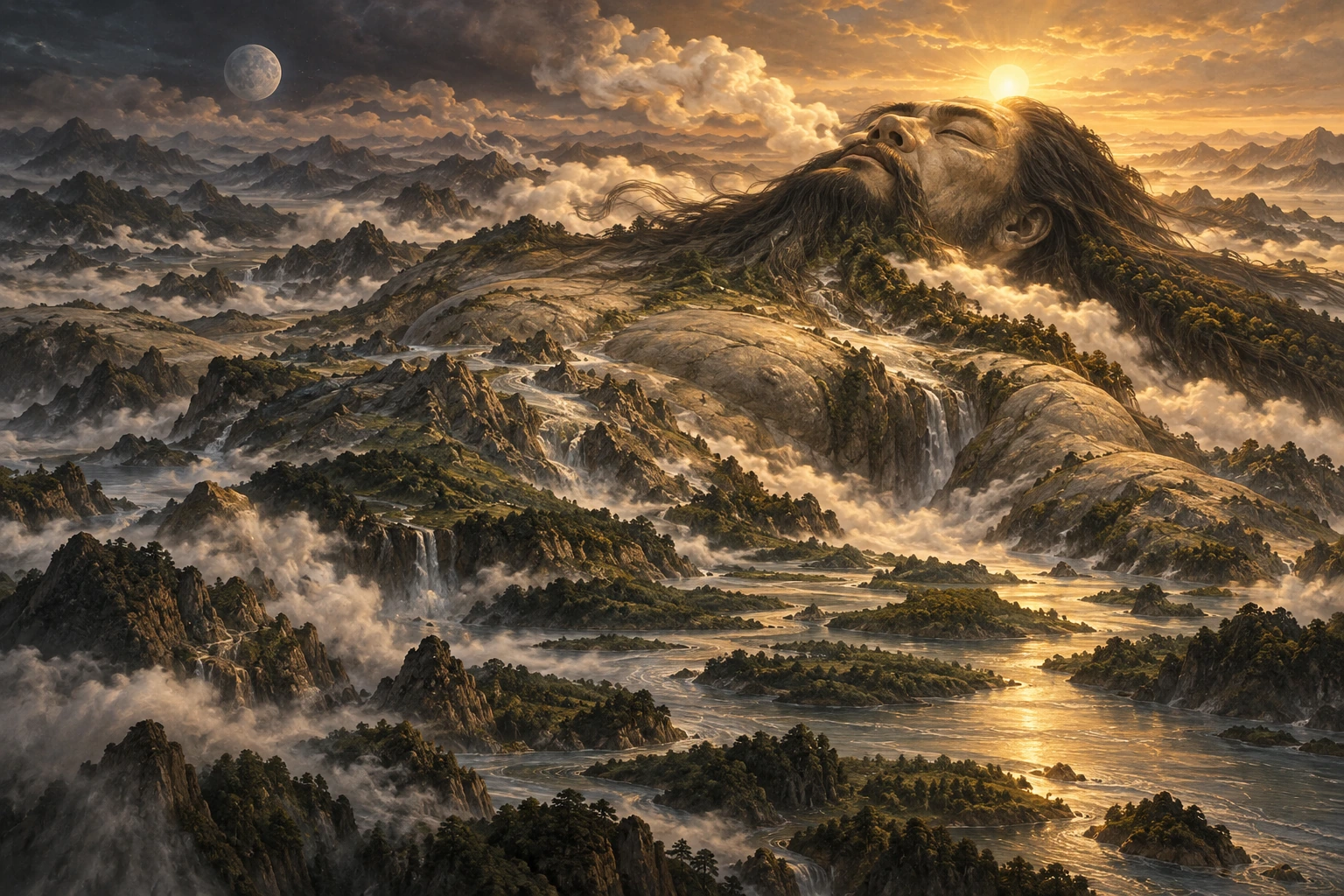
- his breath became the wind and the clouds, his voice the thunder, his left eye the sun and his right eye the moon;
- his four limbs and “five members” became the four ends of the earth and the five sacred peaks;
- his blood became the rivers, his sinews and veins the lie of the land, his flesh the fields, his hair and beard the stars, his skin and body hair the grass and trees;
- his teeth and bones became metal and stone, his marrow pearls and jade, his sweat the rain.
Last of all, the tiny creatures living on his body, stirred by the wind, became the common people.
1-4 Ren Fang’s List
The Shuyi ji, a book of marvels attributed to Ren Fang (460–508), gives a shorter version and then, unusually, lists the others it knew. (The editors of the Qing imperial library catalogue doubted that Ren Fang wrote it, and noted that its Pangu entry “is taken from Xu Zheng’s Sanwu liji”.)
- “Of old, when Pangu died, his head became the four peaks, his eyes the sun and moon, his fat the rivers and seas, his hair the grass and trees.”
- A popular saying “of the Qin and Han”: his head became the Eastern Peak, his belly the Central Peak, his left arm the Southern, his right arm the Northern, his feet the Western.
- The “former scholars” said his tears became the rivers, his breath the wind, his voice the thunder and his pupils the lightning; an “old saying”, that when he was happy the sky was clear, and when he was angry it clouded over.
- From the lands of Wu and Chu: Pangu and his wife were “the beginning of yin and yang”.
It adds that Pangu had a tomb over three hundred li long in Nanhai, in the far south; that people still made offerings at his temple in Guilin; and that in the southern sea lay a land of Pangu, whose people all bore his name.
2 Where the Story Is Written Down
- Xu Zheng lived in the 3rd century CE and served the state of Wu: the Book of Sui lists one of his works as by “Xu Zheng, Grand Master of Ceremonies of Wu”. His Sanwu liji and Wuyun linian ji are both lost.
- The Yiwen leiju (624), a Tang encyclopedia, quotes the egg and the growing giant in its first chapter, “Heaven”. The Taiping yulan (983) quotes the same passage, and another fragment: before heaven and earth existed, chaos was “shaped like a hen’s egg”, and “the vast dark began to sprout”.
- The dying body. The Song-dynasty reference book Shiwu jiyuan quotes a few lines of the Wuyun linian ji. The full passage is known from Ma Su (1621–1673), who printed it at the start of his history of antiquity, the Yishi. Paul Goldin notes that the sinologists Girardot and Kaltenmark both wrongly gave its source as the Shuyi ji.
- Older pieces. The Huainanzi (c. 139 BCE) already has the clear yang thinning out into heaven and the heavy, murky part settling as earth. The Book of Documents tells of Chongli, ordered to “cut the passage between earth and heaven”. And the Shanhaijing describes Zhuyin, god of Mount Zhong: when he looks it is day, when he shuts his eyes it is night, his breath is the wind, and his body is a thousand li long.
Ma Su did not trust what he copied. Under the passages he added a note: “The name of Pangu arises from miscellaneous books, hazy talk and wild tales. For historians to make him the first ruler of heaven, earth and humankind is no different from telling a dream.”
3 Competing Versions
- An egg or a breath? The Sanwu liji starts with an egg. The Wuyun linian ji starts with qi, and Pangu is simply “the first born”.
- What became what? The sun and moon are his left and right eyes in the Wuyun linian ji, but only “his eyes” in the Shuyi ji. The sacred peaks come from his limbs in one text, from his head in another, from head, belly, arms and feet in the Qin–Han saying. The Shiwu jiyuan adds an “old tradition” that moves them again: left hand East, right hand West, belly Centre, head South, feet North.
- A dragon’s head? In the Shiwu jiyuan’s quotations, “Lord Pangu” has a dragon’s head and a serpent’s body. His breathing out makes wind and rain, his blowing thunder and lightning; when he opens his eyes it is day, when he closes them night. Nothing in these lines says he is dead, and they read much like the description of Zhuyin.
- A couple? Two myths? Only the saying from Wu and Chu gives Pangu a wife. And Kirimoto Tōta, in the Japanese encyclopedia Nipponica, writes that it is not clear whether the growing giant and the dying giant belonged to one tradition, or were two traditions told under the same name.
- Where did people come from? Here, from the creatures on Pangu’s body. In Ying Shao’s story, when “heaven and earth had opened, and there were no people yet”, Nüwa shapes them from yellow earth.
“Pangu split the egg with his axe,” say many retellings and pictures. Xu Zheng gives him no tools at all. The axe arrives in a Ming novel, Zhou You’s Kaipi yanyi (17th century), where Pangu holds a chisel in his left hand and an axe in his right. In 1922 E. T. C. Werner described pictures of him with a hammer and a chisel.
4 History and Tradition
- Pangu or Panhu? The longest debate is whether Pangu began as Panhu (槃瓠). In the Hou Hanshu, Panhu is the five-coloured dog who brings the emperor Gaoxin an enemy general’s head, wins his daughter and becomes the ancestor of the southern “Man” peoples. The Miao, Yao and She still tell the story.
- Yes, said Su Shixue and the historian Xia Zengyou. The names sound alike, and in the local speech of Guangxi (西粵), Su noted, 瓠 was read like 古. Xia asked why, if Pangu belonged to the Chinese, whose ancient kings all lived in the north, his tomb and temple lay in the far south.
- Yes, but from the north, replied Yang Kuan. He agreed the two names were one, but traced the dog story to the Dog Rong (犬戎) of the northwest in the Shanhaijing. So Pangu was not borrowed from the Miao and Yao: they received him.
- Absorbed, in Yuan Ke’s view: the Pangu myth probably took in the Panhu myth of the southern peoples.
- No, argue Zhang Zhenli and others: the Pangu myth was born in the Central Plains of the north. Sun Shulin (2013) agrees. In Japan, Shirakawa Shizuka wrote that the Yao and Miao cult of “King Pan” is in part a Panhu tradition mixed up with the Pangu story.
- Borrowed from India? In the Rig Veda (10.90) the sun is born from the eye of the cosmic man Purusha; in the Norse Prose Edda the gods make the earth from the flesh of the giant Ymir. The scholar Tu Xiaoshi derived Pangu from that Vedic hymn, and Frederick Mote called the myth “clearly of alien origin”, probably from India. Yang Kuan disagreed: such stories are found almost everywhere, he wrote, citing Ymir, and China had its own Zhuyin. Paul Goldin (2008) adds that a myth first written down late need not have been unknown before. Shirakawa Shizuka saw the same pattern in India, northern Europe and Japan, and thought it spread with farming.
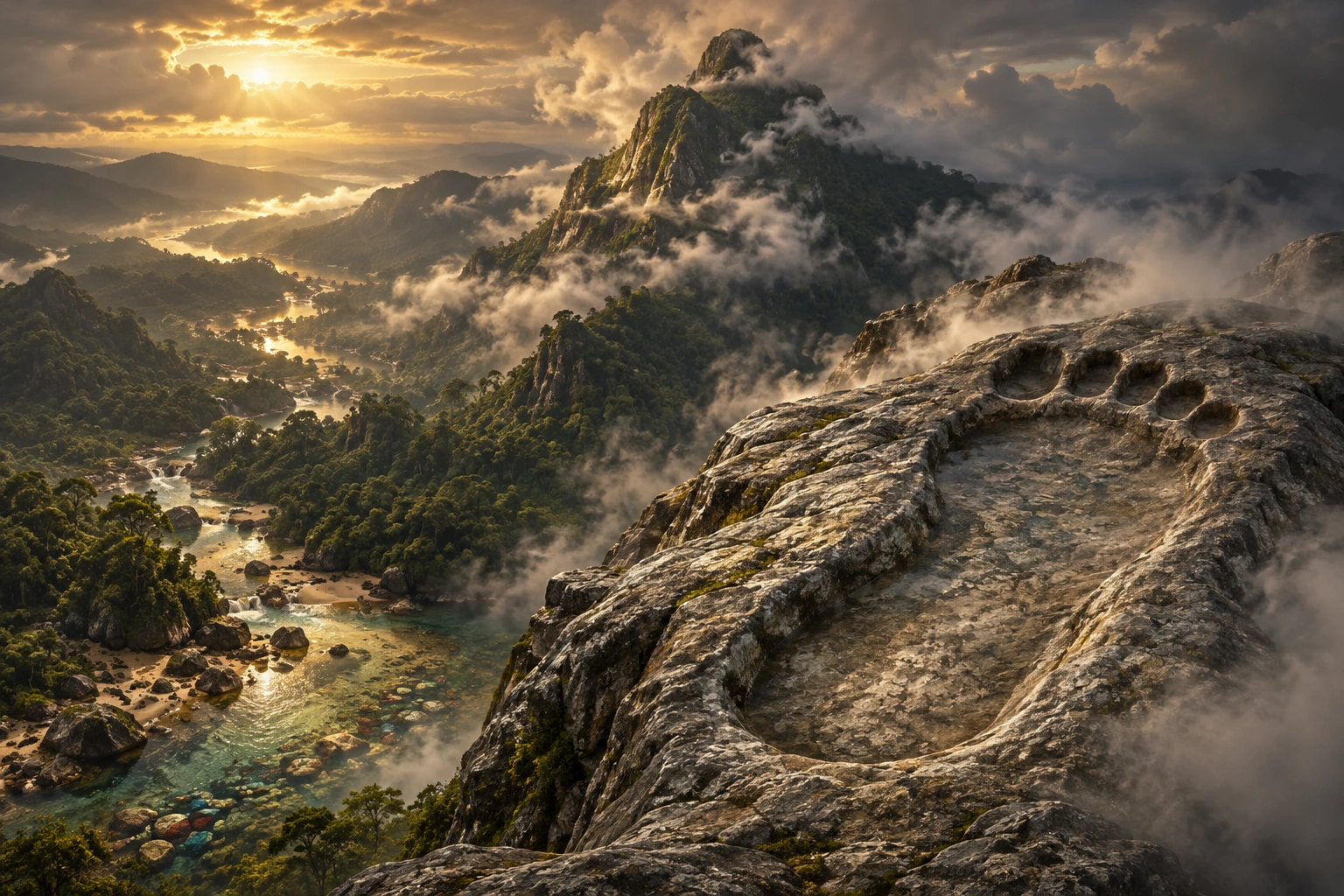
- The footprint. Ma Huan, who sailed with Zheng He’s fleets in the 15th century, wrote that on a mountain beside the king’s residence in Ceylon there was a footprint in the rock, said to be that of “the ancestor of humankind, the sage Adam, that is, Pangu”. Yang Kuan identifies the mountain as Adam’s Peak. The gems found below it, Ma Huan adds, were said to be the ancestor’s tears.
- Daoism. The Zhenzhong shu, attributed to Ge Hong (283–343), places “the Perfected Man Pangu” inside the egg-shaped chaos, where he “called himself the Heavenly King of the Primal Beginning” (元始天王).
- Henan, 2008. The Pangu myths of Tongbai and Biyang counties were entered on China’s national list of intangible cultural heritage.
- Japan. An examination essay in the Keikokushū (827) speaks of “eighteen thousand years” and “the age of Pangu”, and Kūkai names him in his inscription for the Masuda pond (c. 835). In Japanese, Pangu and Panhu are even read the same way, banko. Shirakawa adds that Kyokutei Bakin took the idea of his novel Nansō Satomi Hakkenden from the Panhu story.
- Vietnam. In Vietnamese he is Bàn Cổ, a name easily confused with Bàn Vương, “King Pan”, the ancestor of the Dao (Yao) of northern Vietnam, some 890,000 people at the 2019 census. In the tradition recorded there, Bàn Vương is the dragon-dog Bàn Hồ, that is, Panhu, who killed an enemy king for his ruler, married the ruler’s daughter and fathered the twelve Dao clans.
5 Related Stories
- Nüwa: The Serpent-Bodied Goddess Who Mended the Sky: China’s other answer to where people came from. Ying Shao’s story begins after “heaven and earth had opened”, and Nüwa makes people from yellow earth, not from the creatures on a giant’s body.
- Kuniumi: Izanagi and Izanami Give Birth to Japan: the Nihon Shoki (720) opens with heaven and earth not yet divided, a chaos like an egg in which the first shoots were stirring (渾沌如雞子,溟涬而含牙): words very close to the Sanwu liji fragment in the Taiping yulan (混沌狀如雞子,溟涬始牙). The Edo scholar Hirata Atsutane named the Huainanzi and the Sanwu liji among the books its author borrowed from.
- Amaterasu and the Rock Cave: The Day the Sun Hid: the sun goddess is born when Izanagi washes his left eye, and the moon god from his right. W. G. Aston compared this with Pangu’s eyes in 1896, noting that Hirata had rejected the link because the sun is male in China and female in Japan. Ōbayashi Taryō treats the Japanese story as a variant of the same type of myth.
- Thánh Gióng: The Boy Who Grew into a Giant: another figure who grows to an enormous size. We have not found a scholar who compares the two; we link them for the theme.
- Ymir: The Frost Giant Whose Body Became the World: the Norse giant whose flesh became the earth and whose skull became the sky. Yang Kuan cited Ymir to argue that such stories arose independently; Shirakawa Shizuka saw the same pattern in India and northern Europe and thought it spread with farming.
6 Sources
- Xu Zheng, Sanwu liji, quoted in Yiwen leiju, juan 1, Siku quanshu text: Wikisource; and in Taiping yulan, juan 1 and 2: Wikisource, Wikisource
- Xu Zheng, Wuyun linian ji, quoted in Ma Su, Yishi, juan 1, Siku quanshu text, with Ma Su’s notes: Wikisource; and in Gao Cheng, Shiwu jiyuan, juan 1: Wikisource
- Ren Fang (attrib.), Shuyi ji, with the Siku catalogue note: Wikisource; Wang Chong, Lunheng, “Xieduan”: Wikisource
- Shanhaijing, “Haiwai beijing”: Wikisource; Shangshu, “Lüxing”: Wikisource; Book of Sui, juan 32: Wikisource; Hou Hanshu, juan 86: Wikisource
- Zhenzhong shu, in the Yuanshi shangzhen zhongxian ji of the Zhengtong Daozang: Wikisource; Ma Huan, Yingya shenglan, “Ceylon”: Wikisource
- Nihon Shoki, book 1: Wikisource; W. G. Aston (trans.), Nihongi (1896), book I, with notes: Wikisource; Rig Veda 10.90, trans. Ralph T. H. Griffith: Wikisource; Prose Edda, “Gylfaginning” 8, trans. Arthur G. Brodeur (1916): Wikisource
- Paul R. Goldin, “The Myth That China Has No Creation Myth”, Monumenta Serica 56 (2008), quoting Mote: University of Pennsylvania
- Yang Kuan, “盤古、槃瓠與犬戎、犬封”, Zhongguo shanggushi daolun, quoting Su Shixue, Xia Zengyou and Tu Xiaoshi: aisixiang.com; Sun Shulin, “盤古の天地開闢と道家思想” (2013), quoting Yuan Ke, Zhang Zhenli and Zhou You: Shimane University
- State Council of China, notice of 14 June 2008, item I-57: gov.cn; Đàm Thị Uyên and Mai Thị Hồng Vĩnh, Tạp chí Dân tộc học 3 (2022), quoting Ngô Đức Thịnh: VJOL
- E. T. C. Werner, Myths and Legends of China (1922), chapter III: Project Gutenberg; “盤古” (Shirakawa Shizuka, Kirimoto Tōta, Nihon Kokugo Daijiten), “槃瓠” (Shirakawa Shizuka, Itō Seiji), “太陽” (Ōbayashi Taryō): Kotobank, Kotobank, Kotobank
Cover and illustrations: AI-generated images made for Arcana. They are interpretations, not historical artworks.