Guanyin: How the Bodhisattva of Compassion Became a Goddess
In India and in early China the bodhisattva who hears the cries of the world was a man, painted at Dunhuang with a moustache more than a thousand years ago. A princess who gave her eyes and arms to save her father, in a legend carved in stone in 1100, gave Guanyin a woman's life.
- Type: a Buddhist bodhisattva, and the Chinese legend that gave the bodhisattva a woman’s life
- Culture: India, then China and all of East Asia: Kannon in Japan, Gwaneum in Korea, Quan Âm in Vietnam
- Earliest texts: the “Universal Gate” chapter of the Lotus Sutra, translated into Chinese in 286 and 406; for Princess Miaoshan, a stele carved at Xiangshan, Henan, in 1100, and the retelling of the Southern Song monk Zuxiu
- Key figures: Guanyin (觀音, 觀世音), Princess Miaoshan (妙善), her father King Zhuangyan (later King Miaozhuang), the pilgrim boy Sudhana, the Japanese monk Egaku
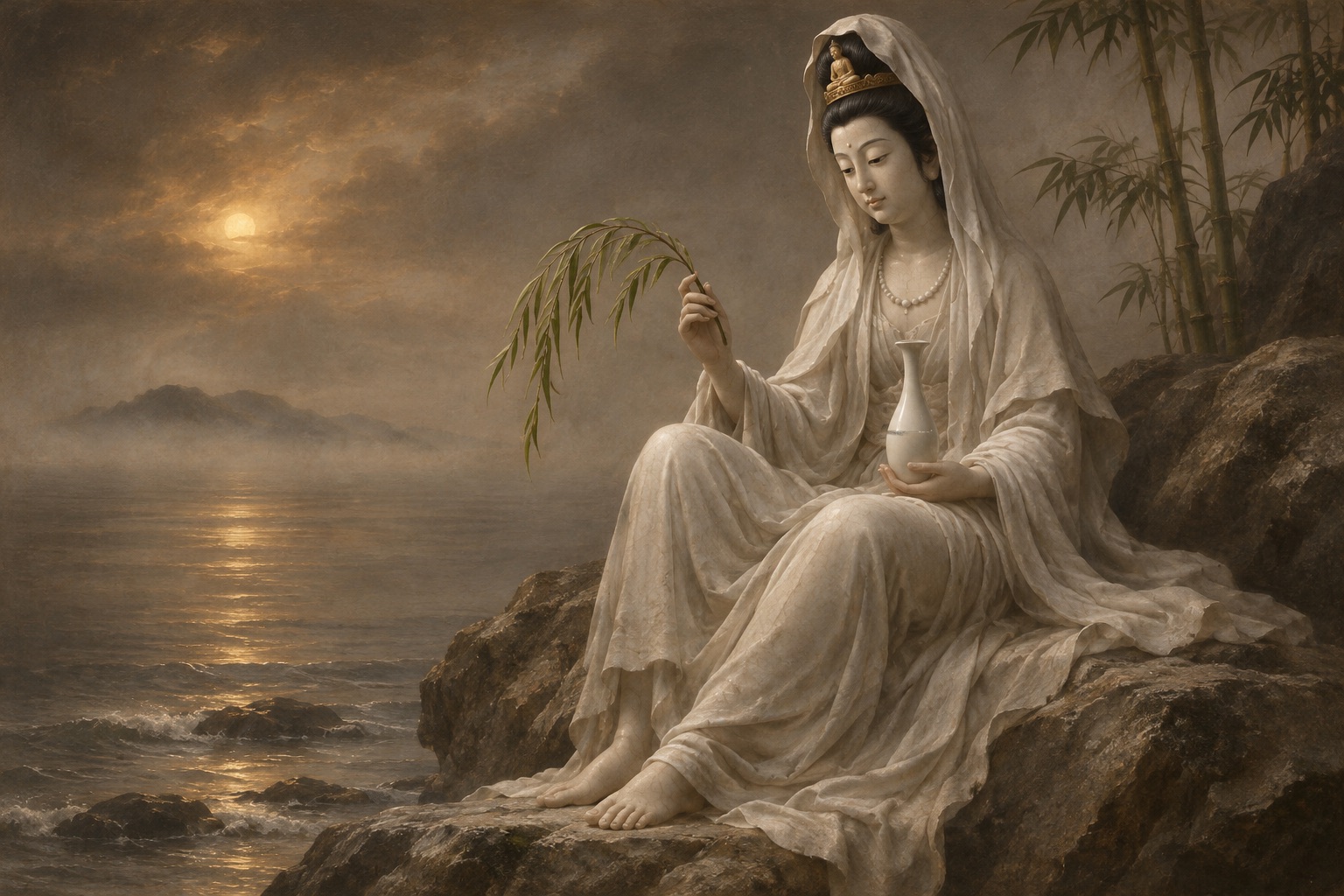
In temples and homes from Beijing to Hanoi she stands in white, a willow sprig in one hand and a vase of pure water in the other. Yet the scriptures that brought this bodhisattva to China speak of a man, and Chinese painters still gave him a moustache more than a thousand years ago. How he became she is a story first told in stone.
Is Guanyin a Buddha or a goddess? In Buddhist teaching, neither: a bodhisattva, one who is close to becoming a Buddha but stays in the world to save others. The Pure Land sutras set Guanyin at the side of the Buddha Amitābha, and the Contemplation Sutra puts a standing Buddha in Guanyin’s crown, a mark images still carry. Everyday speech is freer. Vietnamese say Phật Bà Quan Âm, “the Lady Buddha”, and English “the Goddess of Mercy”.
1 The Telling
Guanyin has no single myth. Here are the scripture that gave the name, the island the sutras gave the bodhisattva, the princess whose story was carved in stone in 1100, told as the Southern Song monk Zuxiu retold it in his chronicle of Buddhism, and the image that would not leave the sea.
1-1 The One Who Hears the Cries
In chapter 25 of the Lotus Sutra, the bodhisattva Akṣayamati asks the Buddha why this bodhisattva is called Guanshiyin, “Perceiver of the World’s Sounds”. The Buddha answers: if countless beings in pain hear of him and call his name with one mind, he “at once perceives the sound of their voices, and all are set free”. Whoever holds his name cannot be burned by fire; carried off by a flood, they call his name and reach the shallows.
A woman who wants a son and honours him will bear a son of merit and wisdom; if she wants a daughter, a daughter of beauty. And he takes whatever body will save each being: a Buddha, the god Brahmā, a king, a monk or a nun, the wife of an elder or of an official, a boy, a girl, a dragon. Tradition counts thirty-three forms. “In this world,” the Buddha says, “all call him the Giver of Fearlessness.”
1-2 The Island of Potalaka
The Avataṃsaka Sutra sends the young pilgrim Sudhana from teacher to teacher. One sends him south: “There is a mountain called Potalaka, and on it a bodhisattva called Guanzizai.” The verse that follows describes an island of jewels, fruit trees and springs, where “the heroic man Guanzizai dwells on this mountain for the good of all beings”.
The pilgrim Xuanzang places it in south India. Potalaka, he writes, rises east of the Malaya mountains, its paths perilous, with a lake on its summit and a palace of stone where Guanzizai comes and goes. Few who brave the water and the cliffs ever reach it. To the people below who pray to see him, he sometimes appears as the god Īśvara, or as an ascetic smeared with ashes.
1-3 Princess Miaoshan
The Tang monk Daoxuan once asked a heavenly being how Guanyin had come to be, and the being answered. In an age long past there was a king named Zhuangyan, whose queen was Baoying, and they had three daughters: Miaoyan, Miaoyin and the youngest, Miaoshan. While she carried her, the queen dreamed that she swallowed the moon, and on the night of the birth the earth shook and a strange fragrance and flowers from heaven filled the palace. The girl grew up gentle and kind, ate once a day, at noon, and the palace called her “the Buddha-hearted lady”.
When the king meant to marry her, she said she would obey if he could spare her three misfortunes: growing old, falling ill, and the death that no father can die in place of his child. If not, she would rather leave home and seek the Way. The king, angry, set her to work in the garden and cut her food. Her sisters and her mother pleaded with her in vain, until they persuaded the king to let her become a nun. He summoned the nuns and told them to make the life so hard that she would give it up. They gave her the firewood, the water, the mortar and the vegetable garden. The vegetables grew thick in winter, and a spring welled up beside the kitchen.
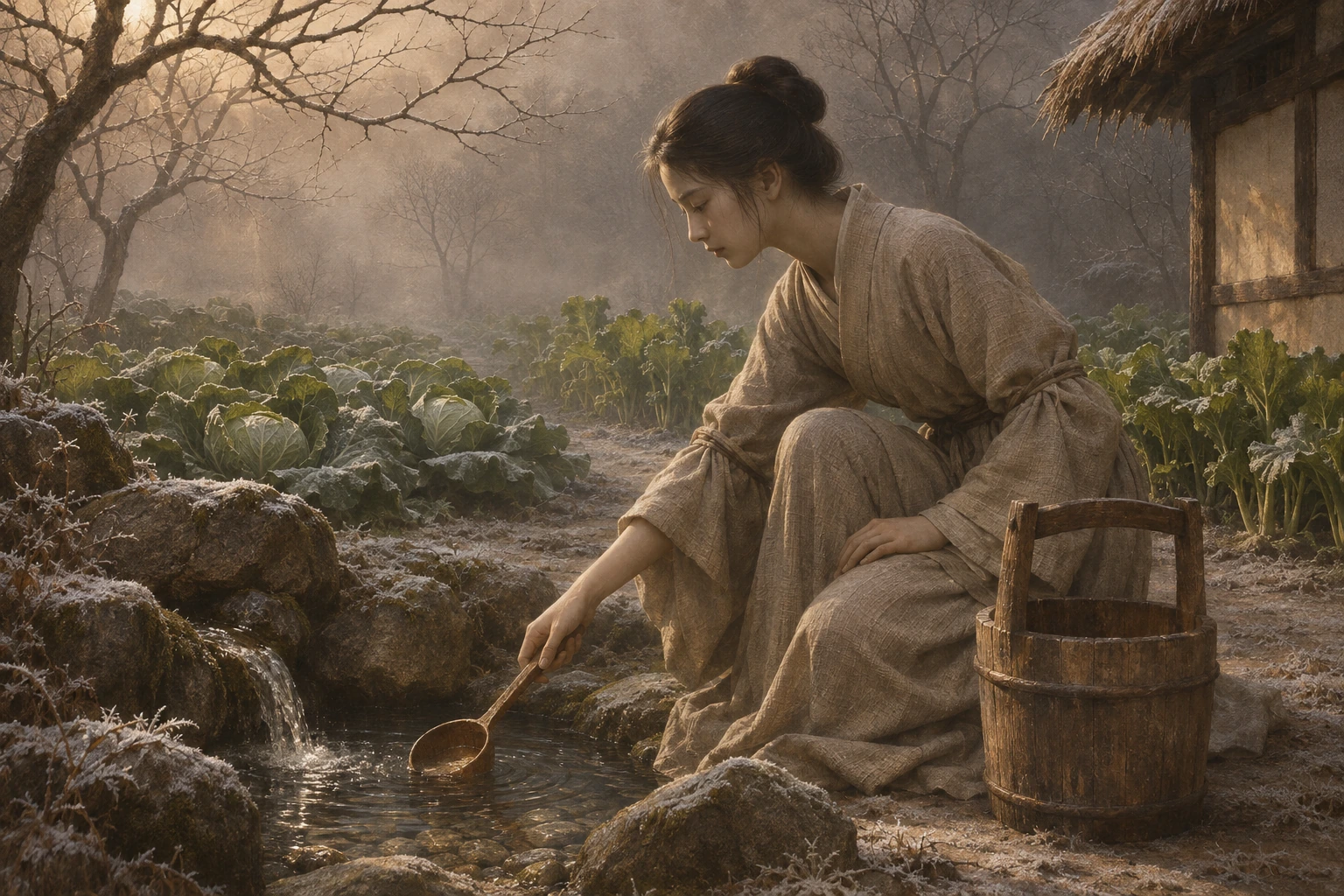
When the king heard of the spring and the vegetables, he sent soldiers to take her head and to kill the nuns. As they came near, clouds and mist rose like a mountain, and when it cleared Miaoshan was gone. A god had carried her away; the ground was too poor, he said, and he moved her three times before he settled her on Xiangshan, “Fragrant Mountain”. There she lived on the fruit of the trees and the water of the streams.
1-4 Arms and Eyes
Long after, the king fell ill with kāmalā, a jaundice. His whole body festered, he could neither eat nor sleep, and no court physician could cure him. A monk said he could heal him, but only with the hands and eyes of someone without anger, and that such a person was practising on Xiangshan. The king sent a palace servant. “My father did not honour the Three Treasures,” said Miaoshan, “he destroyed the true teaching and put innocent nuns to death: this is what it has brought him.” Gladly, she cut out her eyes and cut off her arms for the envoy, and sent word to her father to turn to the good.
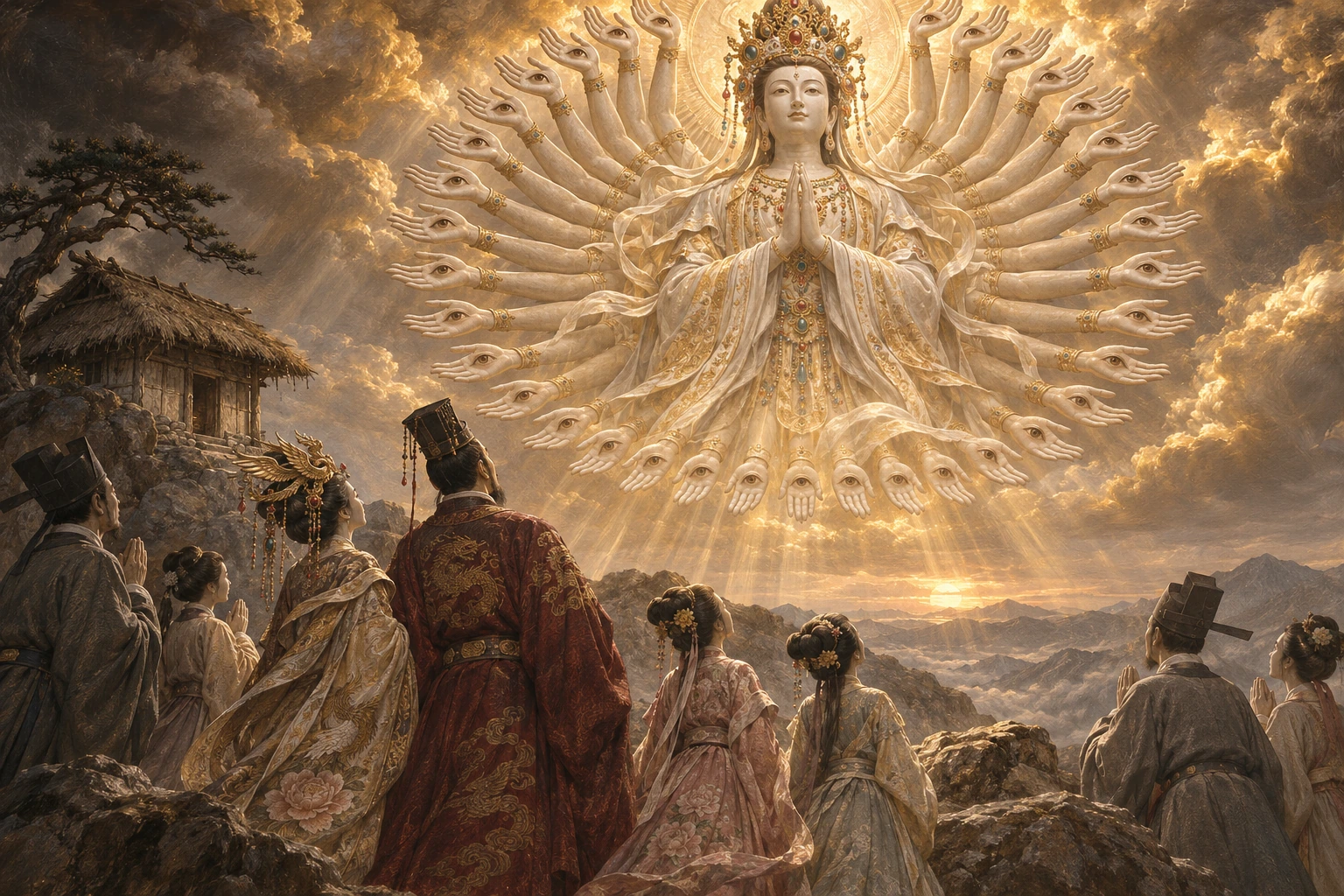
The monk made the medicine, and the king was cured at once. When he thanked the monk, the monk answered, “Why thank me? Thank the one who gave the hands and eyes,” and vanished. The king went up the mountain with the queen and the two elder daughters. Before a word was spoken, the queen knew her child. “I remembered my father’s kindness,” said Miaoshan, “and repaid it with my hands and eyes.” As the queen bent to lick her eyes, auspicious clouds closed round, heavenly music sounded, the earth shook, flowers rained down, and the Thousand-armed, Thousand-eyed Guanyin stood in the sky with a following of thousands. A moment later the bodhisattva returned to her own body and passed away. Her parents and sisters cremated her, gathered the relics and built a pagoda on the mountain. That mountain, the being told Daoxuan, is Xiangshan in Ruzhou, two hundred li south of Mount Song.
1-5 The Guanyin Who Would Not Leave
The Fozu tongji, a Song history of Buddhism, sets the next story in 858. Egaku, a Japanese monk, obtained an image of Guanyin at Mount Wutai and set out for home by way of Siming, around today’s Ningbo. Off the island of Putuo his ship stuck fast on a rock. The crew prayed: if the time of the image had not yet come in the lands to the east, let it stay on this island. The ship floated free, and Egaku, unable to part from the image, built a hut by the sea to keep it.
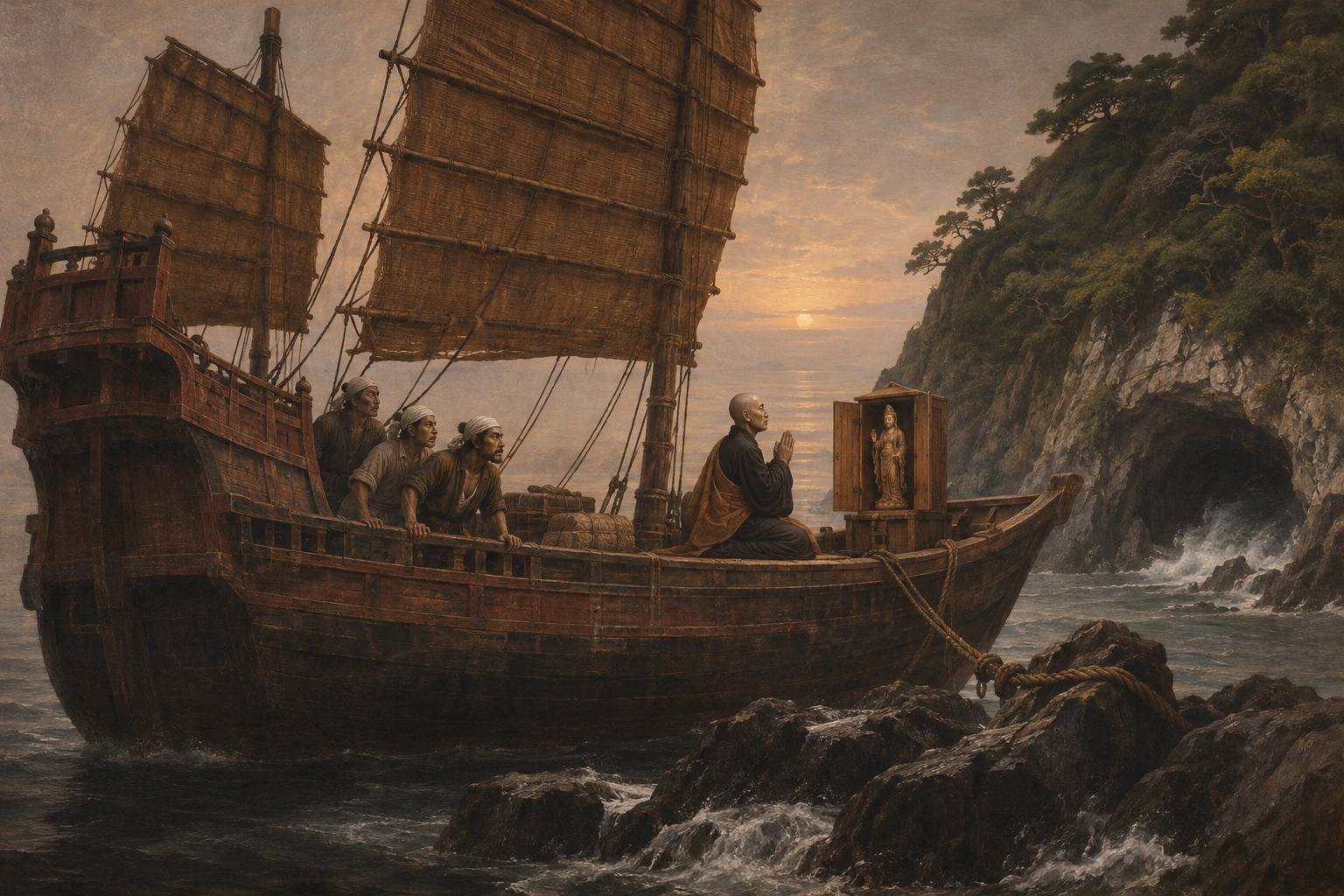
The book takes the island for the Potalaka of the Avataṃsaka. At its Cave of the Tidal Sound, it says, those who pray may see the Great Being seated, or Sudhana bowing, or only a jade vase, or a kalaviṅka bird dancing in the air.
2 Where the Story Is Written Down
- The Lotus Sutra: Dharmarakṣa translated it in 286 and named the bodhisattva Guangshiyin, “Light of the World’s Sounds”. Kumārajīva’s translation of 406 made the name Guanshiyin famous. The chapter circulated on its own as the Guanyin Sutra. Its verses, as the Taishō canon prints them, are Jñānagupta’s, added from a translation of 601.
- The Pure Land sutras set Guanyin and Mahāsthāmaprāpta on either side of Amitābha. The Contemplation Sutra, which the Heibonsha encyclopedia thinks was written in China, describes Guanyin’s body and crown in detail; the Lotus says nothing of how Guanyin looks.
- Xuanzang, back from India, wrote Guanzizai, in his Record of the Western Regions (646) and at the start of his Heart Sutra.
- Miracle tales: the Biographies of Eminent Monks (Gaoseng zhuan, 519) tells of the monk Zhu Fayi, who fell ill in 372, “kept Guanyin always in mind”, dreamed that a man washed his insides, and woke cured.
- The stele of 1100: early that year Jiang Zhiqi (1031–1104), prefect of Ruzhou, visited the Xiangshan monastery near Baofeng, and its abbot Huaizhou gave him a life of Miaoshan that a mysterious monk had brought a few days before. It claimed to record what a heavenly being told the Tang monk Daoxuan (596–667). Jiang copied it out with a preface of his own, the statesman Cai Jing wrote it out, and it was carved on a stele that same year. A stele of the same tale was set up at the Upper Tianzhu monastery in Hangzhou in 1104. The stone at Xiangshan was recarved in 1304, according to Wilt Idema, or in 1308, according to Chün-fang Yü.
- Zuxiu’s chronicle: the Southern Song monk Zuxiu retold the tale, as Daoxuan’s question to a heavenly being, in his chronicle of Chinese Buddhism, the Longxing fojiao biannian tonglun. His is the version told above.
- The Fozu tongji of the monk Zhipan (1269) has Egaku and Mr Ma’s wife (section 3).
3 Competing Versions
- Guanyin or Guanshiyin? It is often said that the short name dropped 世 because it was the personal name of the Tang emperor Taizong, Li Shimin. Trần Trọng Kim reports it in 1940. Chün-fang Yü rejects it: 觀音 already appears in a list of bodhisattvas in a sutra translated in 185, long before Kumārajīva. The Biographies of Eminent Monks writes 觀音 in 519, and so do the Sui verses of the Lotus chapter, all before the Tang.
- Sound or lord? The Nipponica encyclopedia gives two Sanskrit names: Avalokitasvara, “who perceives sounds”, and Avalokiteśvara, “the lord who looks on”. Xuanzang read the second, and called the old names “all mistaken”. The Heibonsha encyclopedia thinks the early translators only “believed” the name contained “sound”.
- The princess’s family. Zuxiu names the king Zhuangyan and the queen Baoying; in the Precious Scroll of Xiangshan and the versions after it, he is King Miaozhuang. The name recalls the Lotus Sutra’s King Wonderful Adornment (妙莊嚴), whom his two sons convert to the Buddha, and the Lotus is one of the backgrounds of the legend that Glen Dudbridge studied, writes Wilt Idema.
- The underworld. In Zuxiu the princess is carried off before the blade falls, and the early version, Idema writes, had no journey to the underworld. In the fully developed story, which Yü outlines from the Precious Scroll of Xiangshan, she is executed, and while a mountain spirit guards her body her soul tours hell and saves the beings there. Dudbridge found the journey first in a version linked with the painter Guan Daosheng (1262–1319). The Precious Scroll carries a preface dated 1103, but, Yü writes, it was clearly written under the Ming.
- Revealed or invented? The text claimed to be a disciple’s record of what a heavenly being told Daoxuan, a monk known for his visions. Dudbridge, Idema writes, implied the abbot made the story up; others now argue it may have been genuinely revealed, if not in the Tang.
- A monk’s objection. The Ming monk Zhuhong (1535–1615) condemned a Scroll of Guanyin at Xiangshan that made her King Miaozhuang’s daughter. Guanyin, he wrote, is an ancient Buddha who “may appear in a woman’s body”, not one who “first practised and attained the Way as a woman”.
- Mr Ma’s wife. The Fozu tongji, under 809, tells of a young woman in Shaanxi who set her suitors scriptures to learn by heart, last the whole Lotus Sutra in three days. Only young Ma succeeded, and she died on the wedding day; later an old monk opened her grave and showed her bones of linked gold. She was Samantabhadra, he said, another bodhisattva. Later tradition made her Guanyin, the Fish-basket Guanyin.
- Putuo’s first image. The Fozu tongji dates Egaku’s ship to 858. The Ming gazetteer of Putuo puts him under the Later Liang (907–923), and the Republican-era gazetteer gives the year 916.
4 History and Tradition
- From he to she. A painting from Dunhuang of about 800–900, now in the Asian Art Museum of San Francisco, shows Guanyin with willow sprig and vase, and with a thin moustache. The museum adds that from the Song on most Chinese images are female. Chün-fang Yü dates the change to the Five Dynasties, around the 10th century. The Water-Moon Guanyin, the first form invented in China, is still masculine or sexless, she notes, while the White-robed Guanyin is distinctly a woman.
- New forms. The White-robed Guanyin by the water, the Fish-basket Guanyin and, under the Qing, the Old Mother are forms born in China: from the 10th century on, Yü finds, miracle tales show Guanyin as a woman in white, then as a woman with a fish basket. The Child-giving Guanyin holds a baby boy, as the Lotus already promises sons and daughters. Guanyin’s feasts fall on the nineteenth of the second, sixth and ninth months; the one in the sixth month, Yü notes, marks the day she attained enlightenment.
- Putuo became one of China’s four great Buddhist mountains. In the Journey to the West, Guanyin gives the pilgrim Tang Sanzang the golden headband that tames Sun Wukong.
- Japan. The oldest dated Kannon in Japan is a gilt-bronze statue of 651. The pilgrimage to the thirty-three Kannon temples of western Japan, one for each form, is first securely recorded in 1161. Sanjūsangendō in Kyoto holds 1,001 Thousand-armed Kannon, with the gods of wind and thunder. Under the ban on Christianity, believers at Urakami kept white porcelain Guanyin from Dehua in China as images of Mary and called them “Hantamaruya”, Santa Maria. “Maria Kannon” is a later name, writes Hioki Naoko, taken up by museum catalogues in the 1920s.
- Korea. Iryeon’s Samguk yusa (1280s) tells how the monk Uisang, back from Tang China, named a cave by the sea Naksan after Potalaka, “the dwelling of the White-robed Great Being”, and after two weeks of fasting saw the bodhisattva’s true face. The monk Wonhyo, coming after him, met a woman in white cutting rice, and only later understood that she had been Guanyin.
- Vietnam. Trần Trọng Kim wrote in Phật lục (1940) that no scripture or painting from the Tang or earlier shows Guanyin as a woman, yet Vietnamese said Phật Bà. The Vietnamese tale, he adds, has her practise in the cave of Hương Tích. The anonymous Nôm verse tale Quan Âm Thị Kính begins with Guanyin as a man in former lives, reborn as a woman to be tested. Thị Kính is driven out for raising a knife to trim a stray whisker on her sleeping husband’s chin, lives as the monk Kính Tâm, and is blamed for Thị Mầu’s child, whom she raises. Only at her death is the truth known, and she rises as Quan Âm with the child on her arm. Her statue, Trần Trọng Kim says, is known as the Child-giving Guanyin.
Guanyin is often imagined as a goddess who was always a woman. Avalokiteśvara’s name is masculine in Sanskrit, the Avataṃsaka calls him “the heroic man”, and Dunhuang painted him with a moustache. Yet the Lotus Sutra already lets Guanyin appear as a woman. The monk Zuxiu, retelling Miaoshan’s story under the Southern Song, concluded that the bodhisattva “from the first has no fixed form, male or female”.
5 Related Stories
- Sun Wukong: The Monkey King Who Fought Heaven: in the Journey to the West, Guanyin, disguised as an old woman, gives Tang Sanzang a cap with a golden band and the spell that tightens it.
- Raijin and Fūjin: Thunder and Wind: at Sanjūsangendō the gods of thunder and wind stand at the two ends of the hall of the Thousand-armed Kannon.
- Ganesha: How the God of Beginnings Got His Elephant Head: in one Japanese account, Kannon takes a woman’s form and marries the chief of the Vināyakas, who becomes the elephant-headed Kangiten. One more woman’s form for the bodhisattva of thirty-three forms.
- Dangun: The Bear, the Tiger and the First Korean Kingdom: the oldest source for Dangun, Iryeon’s Samguk yusa, is also the book in which Uisang and Wonhyo go to Naksan to see Guanyin.
- Bari-gongju: The Abandoned Princess Who Guides the Dead: Princess Bari, too, is a king’s daughter cast out by her father, who saves him from a deadly illness. Shin Yeon-woo, comparing her with Miaoshan, finds them alike in filial piety, rejection, sacrifice and Buddhism, but not in Bari’s journey to the other world, the water of life or the raising of the dead.
6 Sources
- Lotus Sutra, trans. Kumārajīva, juan 7, chapter 25 (Taishō 262), and trans. Dharmarakṣa, juan 10, chapter 23 (Taishō 263); our translation: CBETA, CBETA
- Avataṃsaka Sutra, trans. Śikṣānanda, juan 68 (Taishō 279); Contemplation Sutra, trans. Kālayaśas (Taishō 365); Xuanzang, Heart Sutra (Taishō 251) and Da Tang Xiyu ji, juan 3 and 10 (Taishō 2087): CBETA, CBETA, CBETA
- Huijiao, Gaoseng zhuan, juan 4 (Taishō 2059); Sengyou, Chu sanzang jiji, juan 2 (Taishō 2145); Zhipan, Fozu tongji, juan 41–42 (Taishō 2035); Zuxiu, Longxing fojiao biannian tonglun, juan 13 (Xuzangjing 1512): CBETA, CBETA
- Zhuhong, Zheng’e ji, in Yunqi fahui, juan 15 (Jiaxing canon B277), “Guanyin Xiangshan juan”: CBETA; Zhou Yingbin, Chongxiu Putuo shan zhi (Ming), juan 2, and Wang Hengyan, Putuo luojia xinzhi (Republic of China), juan 1: CBETA, CBETA
- Chün-fang Yü, “Ambiguity of Avalokiteśvara and Scriptural Sources for the Cult of Kuan-yin in China”, Chung-Hwa Buddhist Journal 10 (1997), and “Miracle Tales and the Domestication of Kuan-yin”, Chung-Hwa Buddhist Journal 11 (1998): NTU Digital Library of Buddhist Studies, NTU Digital Library of Buddhist Studies
- Wilt L. Idema, “Glen Dudbridge, 1938–2017”, Biographical Memoirs of Fellows of the British Academy 17 (2018), on Dudbridge’s The Legend of Miao-shan (1978, revised 2004): British Academy
- Xiyou ji, chapters 8 and 14: Wikisource; Iryeon, Samguk yusa, juan 3, “Naksan’s two great sages”: Wikisource
- Asian Art Museum of San Francisco, “The bodhisattva Avalokiteshvara (Guanyin) with willow sprig” (B62D10): Google Arts & Culture
- “観音”, “観世音菩薩”, “白衣観音”, “魚籃観音”, “馬郎婦観音”, “三十三身”, “三十三間堂”, “普陀山”, Sekai Daihyakka Jiten, Nipponica, Nihon Kokugo Daijiten, Britannica Kokusai Daihyakka Jiten: Kotobank, Kotobank, Kotobank, Kotobank, Kotobank, Kotobank, Kotobank, Kotobank
- Hioki Naoko, “マリア観音をさがして”, Nanzan Institute for Religion and Culture Bulletin 27 (2017): Nanzan University; Nagasaki Museum of History and Culture, “日本の聖母マリア像展” (2019): nmhc.jp
- Quan Âm Thị Kính (anonymous Nôm verse tale), with Dương Quảng Hàm’s summary in Quốc văn trích diễm; Trần Trọng Kim, Phật lục (1940), “Quan-thế-âm Bồ-tát”: Vietnamese Wikisource, Vietnamese Wikisource
Cover and illustrations: AI-generated images made for Arcana. They are interpretations, not historical artworks.