Raijin and Fūjin: Thunder and Wind
A courtier rode out with a red banner to fetch the thunder for his emperor, and caught it twice. Japan's oldest books are full of thunder and wind gods, but the pair with the ring of drums and the bag of wind came later, with Buddhist art from China.
- Type: myth and image, the gods of thunder and wind
- Culture: Japan; the paired image came from China and Central Asia with Buddhist art
- Earliest texts: Kojiki (712), Nihon Shoki (720) and Nihon Ryōiki (about 822); in Japanese art, the pair first appear in an 8th-century illustrated sutra
- Key figures: Raijin, Fūjin, Chiisakobe no Sugaru, Emperor Yūryaku, Kamo Wakeikazuchi, Shinatsuhiko
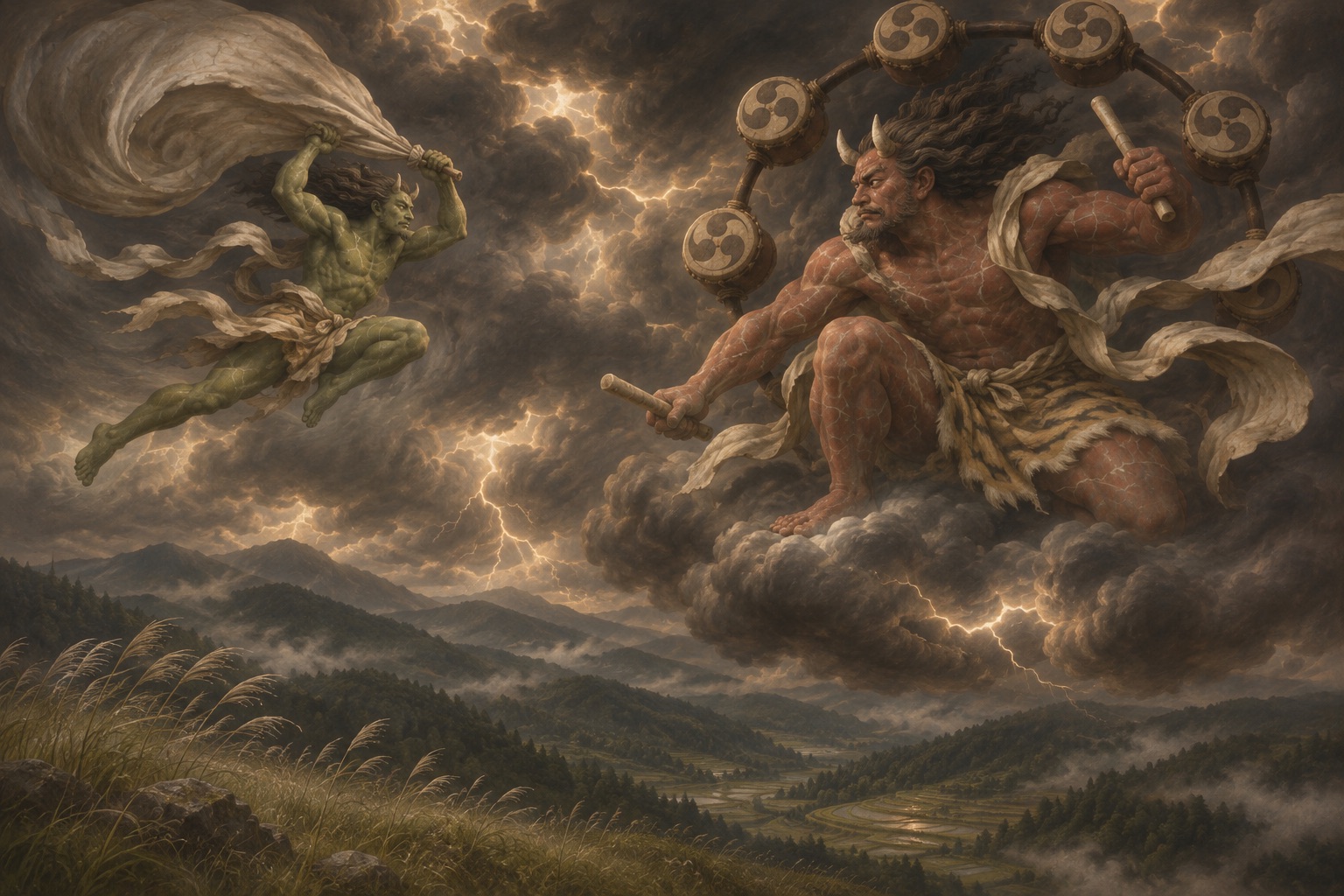
The first tale in Japan’s oldest collection of Buddhist stories is not about a monk. It is about a man who rides out with a red banner to fetch the thunder for his emperor, and brings it back in a palanquin. In the old books thunder is a snake on a hill, a flash of light, a god who can be caught. The figure most people now picture, a horned god in a ring of drums beside a god with a bag of wind, came later.
Why does Raijin carry a ring of drums? Because Chinese painters drew thunder that way long before Japan did. In the late 1st century CE the philosopher Wang Chong complained that painters drew thunder “like a string of linked drums”, and beside it “a man who looks like a strongman”, whom they called the Lord of Thunder, Leigong, pulling the drums with his left hand and striking them with a mallet in his right. The rumble was the drums, the crack the mallet. Japan took the image over with Buddhist art.
1 The Telling
This is the first tale of the Nihon Ryōiki, written by the monk Kyōkai of Yakushi-ji soon after 822. We follow the modern Japanese translation in Shogakukan’s Shinpen Nihon koten bungaku zenshū (1995), as the Nara National Research Institute for Cultural Properties quotes it, checked against the original Chinese text in Masamune Atsuo’s Kōhon Nihon ryōiki (1929).
1-1 The Emperor’s Errand
Chiisakobe no Sugaru was a guard and trusted attendant of Emperor Yūryaku, who ruled for twenty-three years from the palace of Asakura at Hatsuse. Once, while the emperor was living at the Iware palace, Sugaru walked in without knowing that the emperor and empress were in bed together. The emperor, embarrassed, broke off.
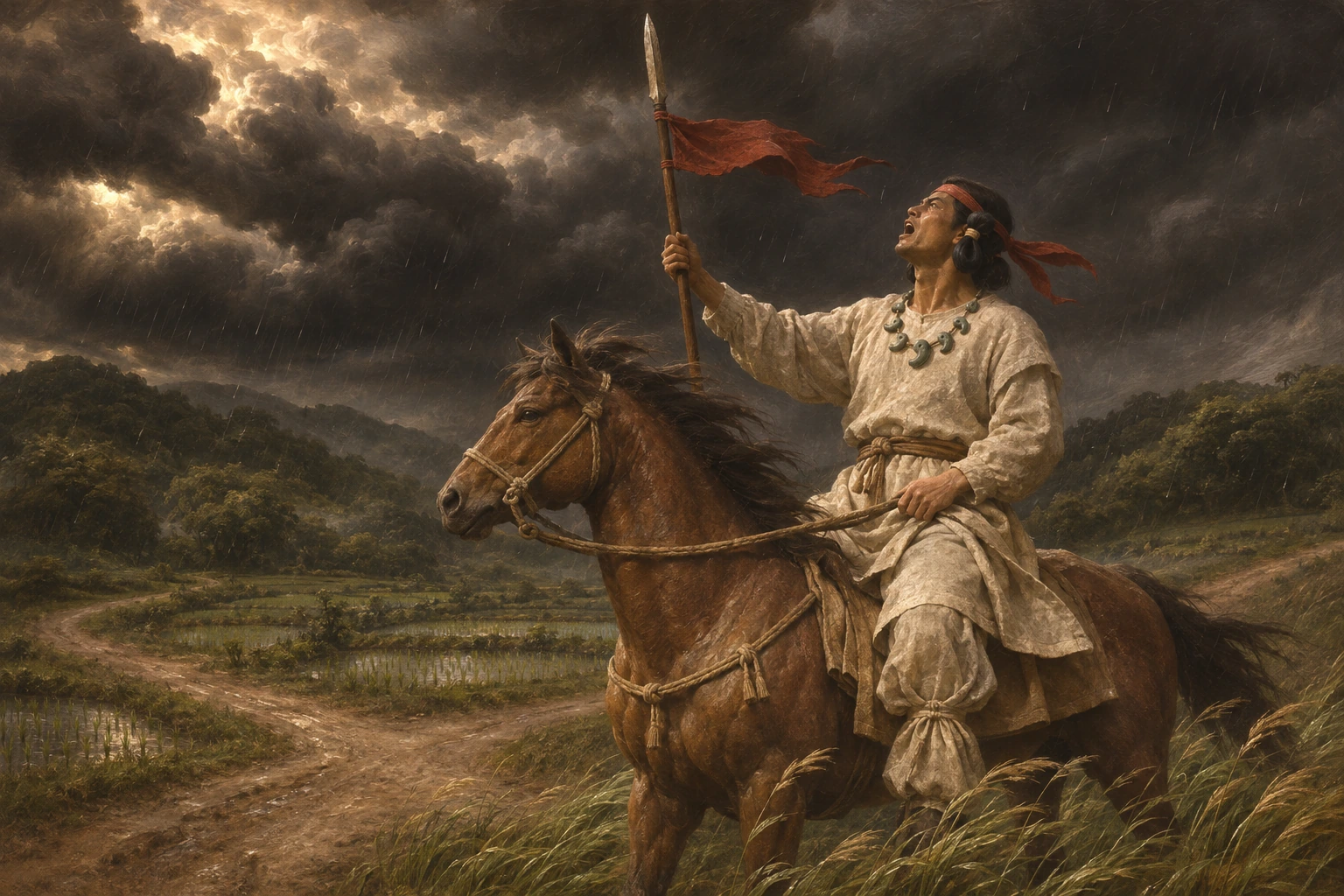
At that moment thunder rolled across the sky. The emperor asked Sugaru whether he could bring the thunder to him. “I will go and fetch it,” Sugaru answered. “Then bring it,” said the emperor.
Sugaru left the palace with a red band tied on his forehead and a halberd hung with a small red banner. He rode from the road before Yamada in Abe to the road before Toyura-dera, and at the crossroads of Karu no Morokoshi he shouted: “Thunder god of heaven, the emperor summons you!” Then he turned his horse for home, calling out that not even a thunder god could refuse the emperor’s summons.
1-2 The Thunder in the Palanquin
On his way back he found that the thunder had fallen, between Toyura-dera and Iioka. Sugaru called for shrine priests, set the thunder in a palanquin and carried it to the palace. “I have brought the thunder god,” he told the emperor.
The thunder gave off light and blazed. The emperor was frightened. He made many offerings and had the thunder taken back to the place where it had fallen, which is still called Ikazuchi-no-oka, the Hill of Thunder, north of the Owarida palace in the old capital at Asuka.
1-3 The Grave Post
Years later Sugaru died. The emperor had his body kept for seven days and seven nights, praised his loyalty, and built his tomb on the very spot where the thunder had fallen. On a post beside it he had written: “The tomb of Sugaru, who caught the thunder.”
The thunder hated the inscription. It roared down, kicked the post and trampled it, and got caught in the split of the wood. When the emperor heard, he had it pulled out and set free. The thunder did not die, but it lay dazed on the ground for seven days and seven nights. The emperor had the post set up again, now reading: “The tomb of Sugaru, who caught the thunder in life and in death.”
2 Where the Story Is Written Down
- Kojiki (712). In the land of the dead, when Izanagi lights a tooth of his comb, eight thunder gods have been born on Izanami’s body. The commentary of Kokugakuin University’s Kojiki viewer explains ikazuchi as “fearsome spirit”, and finds it hard to say whether these are dread spirits, monsters or thunder. Among the gods Izanagi and Izanami produce after the islands is the wind god Shinatsuhiko, Chamberlain’s “Prince-of-Long-Wind”: shi is an old word for wind, na means long.
- Nihon Shoki (720). In the variants of book 1, section 5 (numbered here in the order the text gives them; Aston leaves them unnumbered), Izanagi blows away the morning mists that cover the new land, and his breath becomes a god, Shinatobe, also called Shinatsuhiko: “This is the God of the Wind” (variant 6, Aston’s translation). In variant 7 he cuts the fire god Kagutsuchi into three, and one piece becomes a thunder god. The annals tell Sugaru’s story in another form (section 3).
- Nihon Ryōiki (Nihon koku genpō zen’aku ryōiki), three books of 116 tales in rough order of time, from Yūryaku’s reign to 822. Sugaru’s tale opens book 1. The manuscripts include those of Shinpuku-ji, Kōfuku-ji and the Maeda family.
- Yamashiro Fudoki, lost except for passages quoted in later books. One of them, in the Shaku Nihongi, tells how the thunder god of Kamo was born.
- Man’yōshū, book 3, poem 235. Kakinomoto no Hitomaro wrote it when the sovereign visited the Hill of Thunder: “Our lord, being a god, has made his lodging above the thunder in the heavenly clouds.”
- Chinese texts. The Classic of Mountains and Seas (Shanhaijing, “Hainei dong jing”) places a thunder god in the Thunder Marsh, “with a dragon’s body and a human head; he drums on his belly”. Wang Chong’s Lunheng (“Leixu”) describes the drums and the strongman. Much later, in chapter 99 of the Ming novel Fengshen yanyi, thunder has a whole ministry in heaven, twenty-four gods under one lord (see The Jade Emperor).
3 Competing Versions
- A snake on Mount Miwa. In the Nihon Shoki, Yūryaku’s 7th year (463), the emperor wants to see the god of Mimoro hill and sends Sugaru, who “excels in strength of body”, to seize him. Sugaru brings back a great serpent. “Its thunder rolled, and its eyeballs flamed”: the emperor, who had not purified himself, covers his eyes, flees into the palace and has it let loose on the hill, renaming it Ikazuchi, “thunderbolt” (Aston). There is no hill of thunder and no grave post. The year before, the annals add, Sugaru was told to gather silkworms (kahiko) and brought babies (ko) instead; the laughing emperor told him to raise them himself, and gave him the title Chiisakobe, chiisako meaning “little child” (Aston).
- Snake, child, arrow. Suzuki Kentarō, in the Encyclopedia of Shinto, notes that ancient texts make the thunder appear as a serpent or a small child, and that pictures and statues give it a demonic form with a whip and a ring of drums from around the Kamakura period. In another tale of the Nihon Ryōiki, a thunder falls as a child before a farmer of Owari, begs for its life and promises him a son, the strong monk Dōjō Hōshi (Izumoji Osamu, Heibonsha World Encyclopedia).
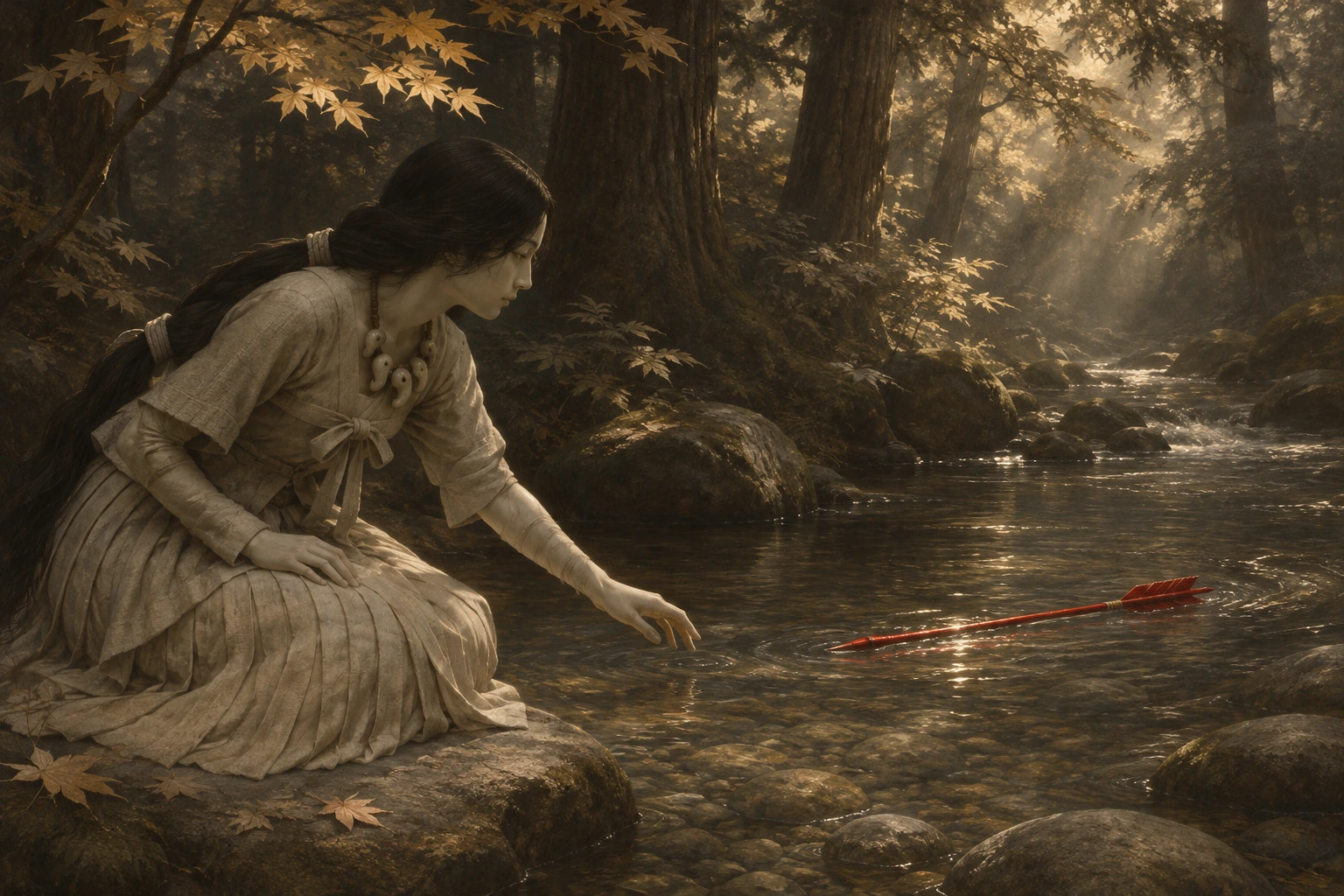
- The red arrow of Kamo. In the Yamashiro Fudoki fragment, Tamayori-hime is playing by the Semi-no-ogawa stream when a red-lacquered arrow comes floating down. She takes it home and sets it by her bed, and bears a son. At his coming of age her father Kamo Taketsunumi holds a feast of seven days and tells the boy to offer the cup to the one he thinks his father. The boy raises the cup to heaven, breaks through the roof and rises into the sky. He is Kamo Wakeikazuchi, the god of Kamigamo Shrine. As Kanai Seiichi and others report it, the fragment names the arrow as Ho-no-ikazuchi, the Fire-Thunder god of the Otokuni shrine; Kamigamo Shrine’s own retelling begins with the arrow falling from heaven amid thunder. For Kanai Seiichi, the red arrow, like the snake and the sword, is the thunder god’s form when he visits a mortal woman.
- The wind god’s birth. The Kojiki has Shinatsuhiko born to Izanagi and Izanami like any of their children; the Nihon Shoki variant has him come from Izanagi’s breath. Nakayama Kaoru notes that the Nihon Shoki gives him a female name too, Shinatobe, and that the Tatsuta wind liturgy of the Engishiki suggests the two were once a male and female pair.
- Defying the thunder. In Suiko’s 26th year (618), Kahabe no Omi is sent to Aki to cut timber for ships and told that a tree is a “thunder-tree”. “Shall even the Thunder-god oppose the Imperial commands?” he asks, makes offerings, and stands under the storm. The god thunders more than ten times without harming him, then turns into a small fish caught in the branches, and Kahabe burns it (Aston).
4 History and Tradition
- The bag and the drums. Sadakata Akira writes that the two appear as a pair chiefly as a theme of Buddhist art. He finds the wind god’s figure, running with his bag held up in both hands, on the copper coins of the Kushan king Kanishka (2nd century CE), and the Greek wind god Anemos in the same pose on the king’s gold coins. A coin record of the University of Wisconsin names the Kushan god Oado. In cave 249 at Dunhuang, dug in the 6th century, the same wind god appears beside a thunder god in a ring of drums.
- Guardians of Kannon. In the Great Compassion Dhāraṇī Sūtra (Bhagavaddharma’s Tang translation), Kannon promises to send “the gods of water, fire, thunder and lightning” to guard whoever recites the spell. The JAANUS dictionary notes that the pair have no basis in early scripture but were added to the Twenty-eight Attendants of the Thousand-armed Kannon. In Japan they appear in an 8th-century illustrated sutra among the demons who threaten the Buddha.
- Sanjūsangendō. The temple hall in Kyoto, built for the retired emperor Go-Shirakawa in 1164 and rebuilt after a fire, keeps a Fūjin 123 cm tall and a Raijin of 105 cm, Kamakura-period statues now National Treasures. The temple calls them “completely Japanized” and says they fixed the image of the two gods for later ages; the sculptor Tankei, who led the rebuilding’s statues, is thought to have had a hand in them. In 2018 they and the attendants were put back in their original order, following a Kamakura-period print.
- Sōtatsu’s screens. Tawaraya Sōtatsu (died about 1640) painted the pair on a pair of two-panel screens covered in gold leaf, Fūjin on the right, Raijin on the left. They bear no signature or seal, but are held to be his late masterpiece. They belong to Kennin-ji, which has deposited them at the Kyoto National Museum and shows a high-resolution copy. Ogata Kōrin traced them faithfully, but turned Raijin’s gaze from the world below to Fūjin; his screens are in the Tokyo National Museum. Sakai Hōitsu copied them too, and on the back of Kōrin’s screens painted summer grasses in the rain behind Raijin and autumn grasses in the wind behind Fūjin. Neither was the pupil of the painter before him: each found his model in the paintings (Yamakawa Aki, Kyoto National Museum).
- Sensō-ji’s Thunder Gate. The Kaminarimon of Sensō-ji in Tokyo is properly the Fūraijin-mon, the gate of the wind and thunder gods. A senryū of the early 19th century already jokes that “the wind god lodges at the Thunder Gate”. The gate burned in 1865; only the statues’ heads survived, and the bodies were carved anew in 1874. The present gate, given by Matsushita Kōnosuke, was built in 1960.
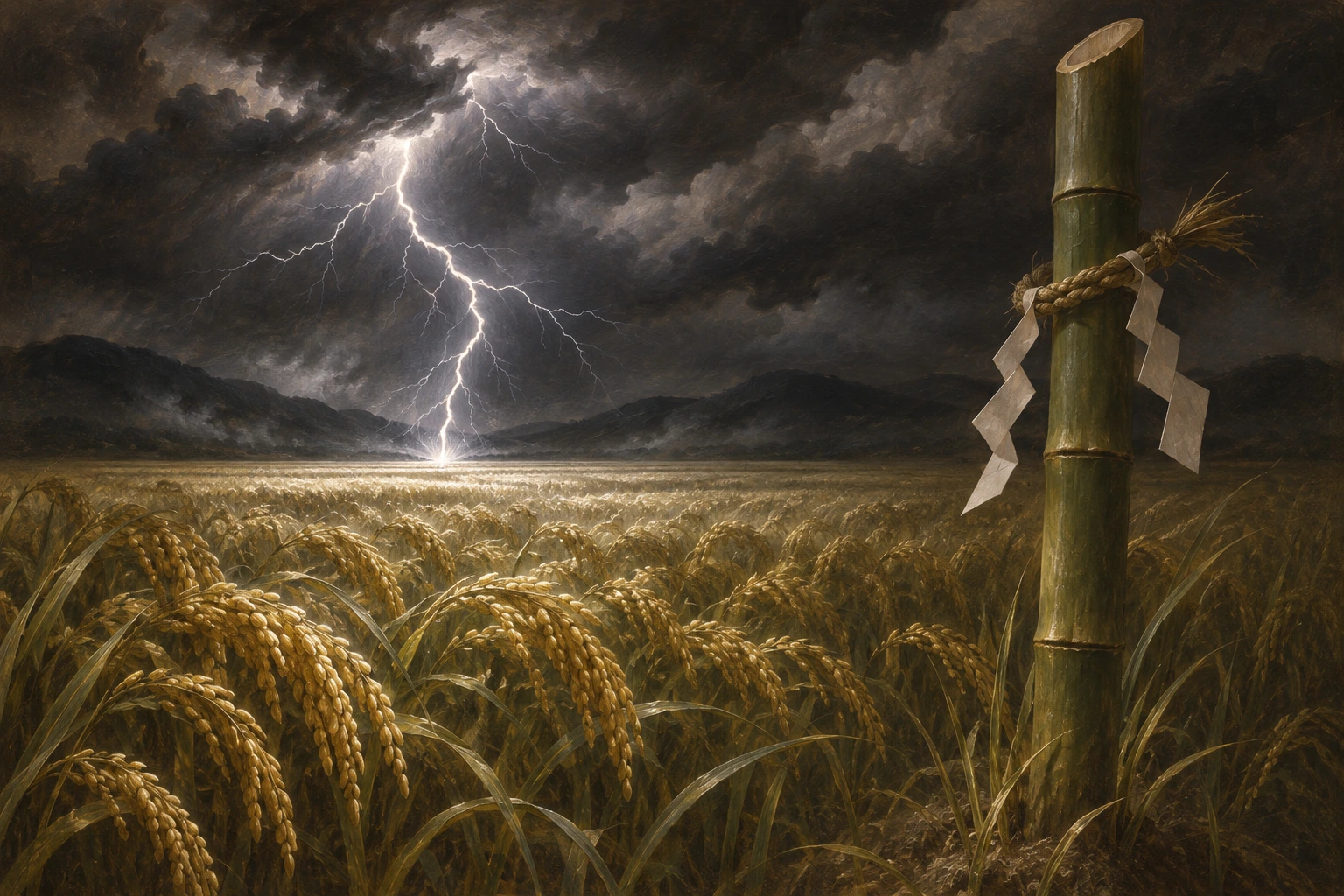
- The rice’s spouse. Inazuma, “lightning”, means “the rice’s spouse”: lightning was believed to join the rice ears and make them bear, perhaps because it often flashes when rice flowers. The Kokinshū already has “lightning that lights up the ears of the autumn rice”. Where lightning struck a field, farmers set up green bamboo and a sacred straw rope; in parts of the Kantō plain the spot was left unplanted for a year.
- Words for thunder. Kaminari is “the god’s roar”; kandachi, a lightning strike, “the god standing”.
- The navel thief. The thunder god is said to love human navels and to take any he finds bare. We have not traced the oldest source. Matsumoto Nobuhiro read the saying as a warning: a storm brings cold air down from above, so children were wrapped in belly bands when thunder was heard.
- “Kuwabara, kuwabara”. People said it to keep lightning away; the Nihon kokugo daijiten’s earliest example is from the Noh play Dōjōji (about 1516). One explanation says lightning never struck Kuwabara, the estate of Sugawara no Michizane, the courtier whose angry spirit was believed to strike as thunder (his story is for a later post). Another tells of a thunder god trapped in a farmer’s well, who swore that he hated mulberry, kuwa, and would never fall where people called “kuwabara”.
- The thunder who promised rain. In the comic kyōgen play Kaminari, a thunder god misses his footing, falls and hurts his back. A passing doctor treats him with needles, and in thanks he promises rain in good measure for the crops.
Raijin and Fūjin are often introduced as Shinto gods. Japan’s own gods of thunder and wind, such as Kamo Wakeikazuchi and Shinatsuhiko, are kami, but as Sekiguchi Masayuki notes, their shrines made no images of them. The horned pair with the drums and the bag come from Buddhist art: they guard Kannon at Sanjūsangendō, and Sensō-ji keeps them at its gate as protectors of the Buddha’s teaching.
5 Related Stories
- Izanagi in Yomi: The Land of the Dead and the First Quarrel: the eight thunder gods of the Kojiki, born on Izanami’s body in the land of the dead, are sent after Izanagi as he flees.
- Kuniumi: Izanagi and Izanami Give Birth to Japan: after the islands, the two gods give birth to the gods of the sea, the trees and the mountains, and to the wind god Shinatsuhiko.
- Guanyin: How the Bodhisattva of Compassion Became a Goddess: the bodhisattva known in Japan as Kannon, whose thousand-armed form Fūjin and Raijin attend at Sanjūsangendō.
- Thor: The Thunder God Who Lost His Hammer: the Norse thunder god and his hammer. We have not found a scholar who compares him with Raijin; we link them for the theme.
6 Sources
- Nihon Ryōiki, book 1, tale 1, modern Japanese translation in Shinpen Nihon koten bungaku zenshū 10 (Shogakukan, 1995), as quoted in “雷丘の発掘調査” (2005): Nara National Research Institute for Cultural Properties; original text in Masamune Atsuo (ed.), Kōhon Nihon ryōiki (Nihon koten zenshū kankōkai, 1929): NDL Digital Collections
- Kojiki, book 1, “Kami-umi” and “Yomi no kuni” 1, with the commentary: Kokugakuin University Kojiki Viewer
- Basil Hall Chamberlain (trans.), Kojiki, 1882, §§VI and IX: Wikisource
- Nihon Shoki, books 1 and 14 (original text): Wikisource, Wikisource
- W. G. Aston (trans.), Nihongi, 1896, books I, XIV and XXII: Wikisource, Wikisource, Wikisource
- Man’yōshū, book 3, poem 235 (original text): Wikisource
- Wang Chong, Lunheng, chapter 23, “Leixu”; Shanhaijing, “Hainei dong jing”; Great Compassion Dhāraṇī Sūtra, trans. Bhagavaddharma; Fengshen yanyi, chapter 99 (original texts): Wikisource, Wikisource, Wikisource, Wikisource
- Dunhuang Academy, “Mogao cave 249”: Digital Dunhuang
- Encyclopedia of Shinto, Kokugakuin University: Suzuki Kentarō, “Raijin”; Nakayama Kaoru, “Shinatsuhiko”; “Kazenokami”
- Nihon Daihyakka Zensho (Nipponica): Sadakata Akira, “風神・雷神”; Ōtō Tokihiko, “雷神”; Tada Kazuomi, “日本霊異記”: Kotobank, Kotobank, Kotobank
- Heibonsha World Encyclopedia: Sekiguchi Masayuki, “風神・雷神”; Matsumoto Nobuhiro, “雷”; Kanai Seiichi, “火雷神”; Mutō Takemi, “賀茂伝説”; Ōyama Kyōhei, “賀茂別雷神社”; Izumoji Osamu, “道場法師”; Wada Atsumu, “雷丘”: Kotobank, Kotobank, Kotobank, Kotobank, Kotobank, Kotobank, Kotobank
- Seisenban Nihon kokugo daijiten and Digital Daijisen: “稲妻”, “雷”, “桑原”, “風神雷神図”: Kotobank, Kotobank, Kotobank, Kotobank
- “Fūjin Raijin”, JAANUS: Columbia University
- University of Wisconsin–Madison Libraries, “Coin of the Kushan King Kanishka I”: UW Digital Collections
- Kamigamo Shrine, “御神話”: kamigamojinja.jp
- Sanjūsangendō, “風神雷神像” and “歴史”: sanjusangendo.jp, sanjusangendo.jp
- Kennin-ji, “風神雷神図屏風”: kenninji.jp; Agency for Cultural Affairs, “風神雷神図屏風” (Ogata Kōrin): Cultural Heritage Online
- Yamakawa Aki, “琳派 京を彩る”, Bunkaru, Agency for Cultural Affairs: bunka.go.jp
- Sensō-ji, “雷門”: senso-ji.jp
Cover and illustrations: AI-generated images made for Arcana. They are interpretations, not historical artworks.