Izanagi in Yomi: The Land of the Dead and the First Quarrel
Izanagi followed his dead wife into Yomi, the land of the dead, broke the one thing she asked of him and saw what she had become. He fled with her army behind him and sealed the pass with a boulder, and the words they spoke across it set how many people die and are born each day.
- Type: myth, a descent to the land of the dead and the origin of death
- Culture: Japan, the Yamato court; the places it names are in Izumo
- Earliest texts: Kojiki (712); Nihon Shoki (720), only in its variant versions; the Izumo Fudoki (733) names a cave of Yomi
- Key figures: Izanagi, Izanami, Kagutsuchi, the Yomotsu-shikome, the eight thunder gods, the three peaches (Ōkamuzumi)
Every day, by the Kojiki’s reckoning, a thousand people die and fifteen hundred are born. The numbers come from a quarrel. A husband and a wife stood on either side of a boulder at the edge of the land of the dead, and each said what they would do to the other’s world.
Why could Izanami not simply come back? Because she had already eaten food cooked at the hearth of Yomi. Yet in the Kojiki that is not the end: she says she wants to return and will go and ask the gods of Yomi. What ends it is the look. The Kokugakuin University commentary reads the meal as what made her belong to Yomi, and his breaking of the ban on looking as what made the parting certain.
1 The Telling
This is the telling of the Kojiki, book 1. Quotations are from Basil Hall Chamberlain’s English translation of 1882, which renders Yomi as “Hades”. Section 3 sets the Nihon Shoki beside it.
1-1 The Sword and the Blood
Izanami died giving birth to the fire god Kagutsuchi and was buried on Mount Hiba, as Kuniumi tells. Izanagi drew the long sword at his side and cut off his son’s head. Gods were born from the blood that ran down the blade and spattered the rocks, among them Takemikazuchi, who will later be sent down to Izumo to win the land for the gods of heaven, and two more came from the blood that leaked between Izanagi’s fingers. Eight mountain gods were born from the slain god’s head, chest, belly, genitals, hands and feet. The sword itself was named Ame-no-ohabari.
1-2 “Look Not at Me”
Then, wishing to see her again, Izanagi followed his wife to the land of Yomi. She came out to meet him at the closed door of a palace. “The lands that I and thou made are not yet finished making,” he said; “so come back!”
“Lamentable indeed that thou camest not sooner!” Izanami answered. “I have eaten of the furnace of Hades.” The words are yomotsu-hegui: she had eaten what was cooked at the hearth of Yomi. Still, she was honoured that he had come, and she wished to return. She would talk it over with the gods of Yomi. “Look not at me!”
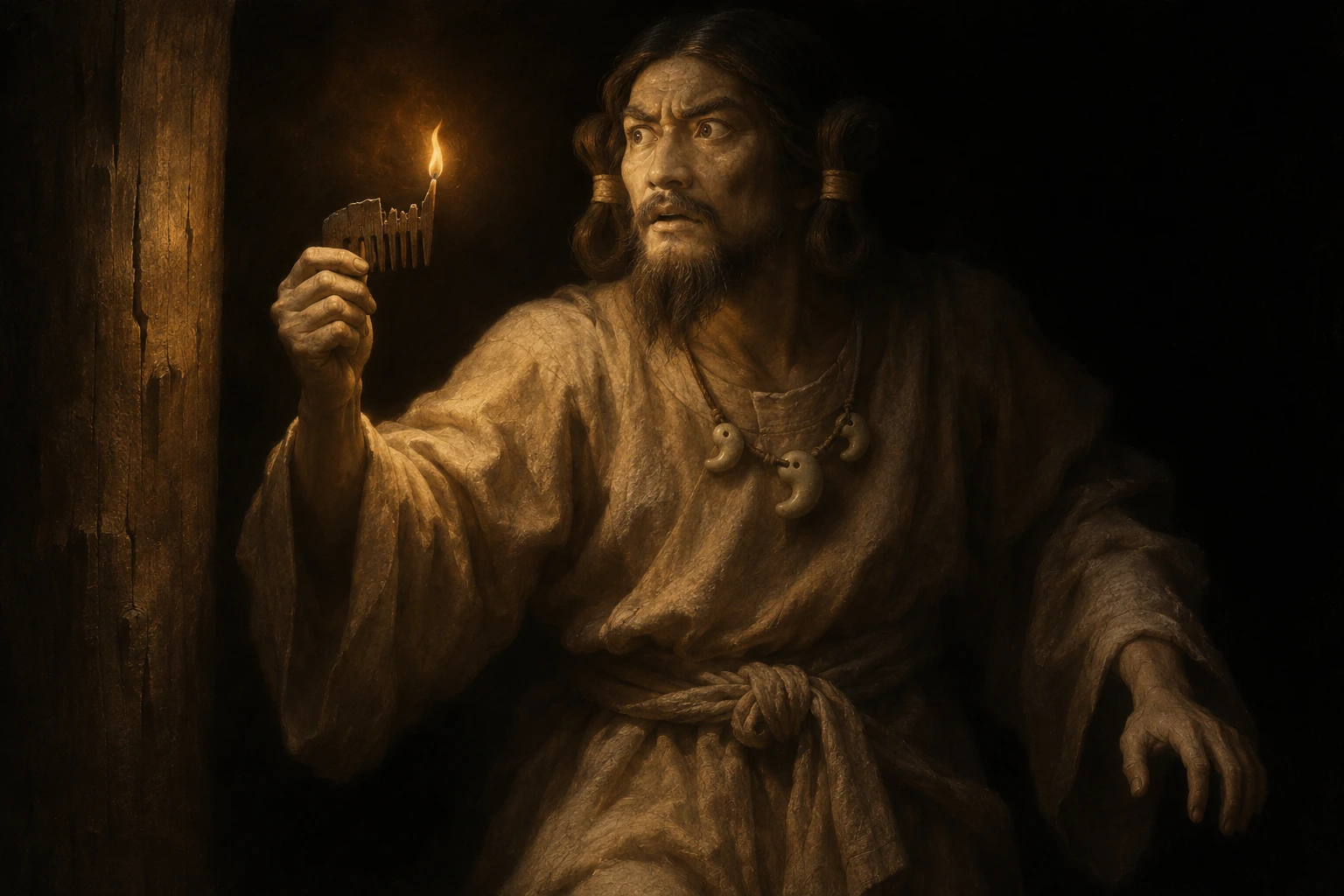
She went back into the palace and was gone so long that he could not wait. He broke off the large end tooth of the comb in the loop of hair over his left ear, lit it as “one light”, and went in.
1-3 What He Saw
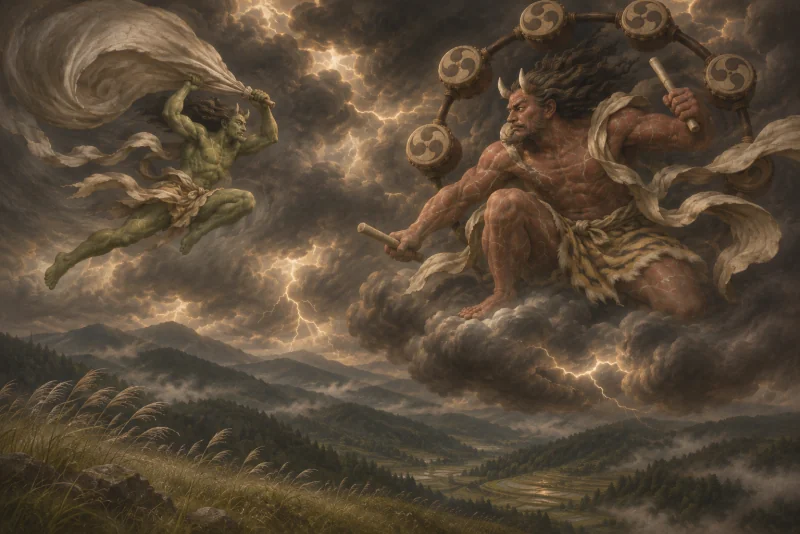
Maggots were swarming, and she was rotting. In her head, breast, belly and genitals, in her two hands and her two feet, eight thunder gods had come into being: the Great Thunder, the Fire Thunder, the Black Thunder, the Cleaving Thunder, the Young Thunder, the Earth Thunder, the Rumbling Thunder and the Couchant Thunder. Thunder gods return again and again in Japanese myth and art; Raijin and Fūjin follows them.
Izanagi, “overawed at the sight”, turned and fled. “Thou hast put me to shame,” said Izanami.
1-4 The Flight
She sent the Yomotsu-shikome, the “Ugly Female of Hades”, after him. Izanagi threw down the black headdress from his hair, and it turned into grapes; while she picked them and ate, he ran on. When she came on again, he broke the comb from his right loop of hair and threw it down, and it became bamboo shoots; while she pulled them up and ate, he ran on.
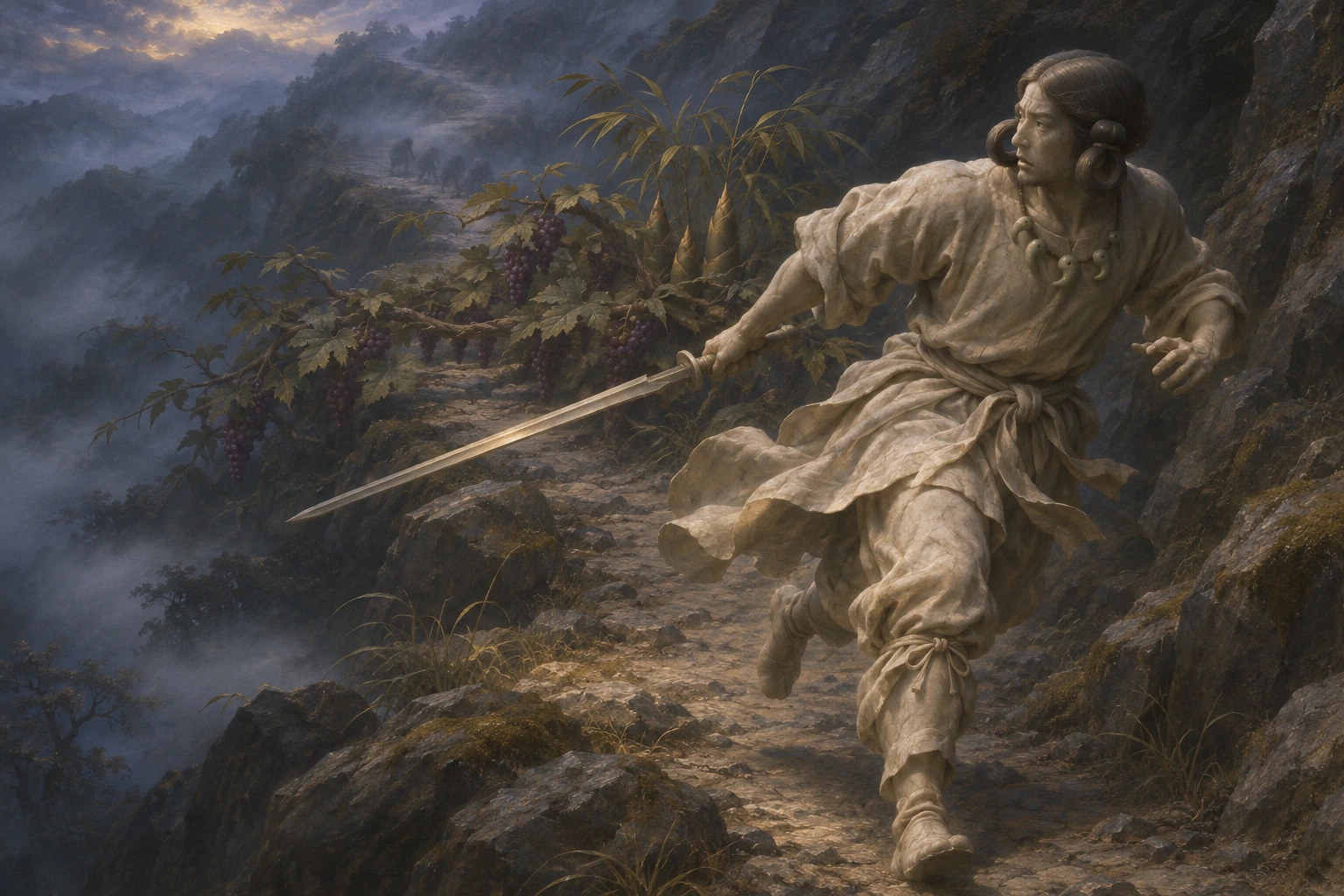
Then Izanami sent the eight thunder gods after him, with fifteen hundred warriors of Yomi. Izanagi drew his sword and fled, brandishing it behind him.
1-5 Three Peaches
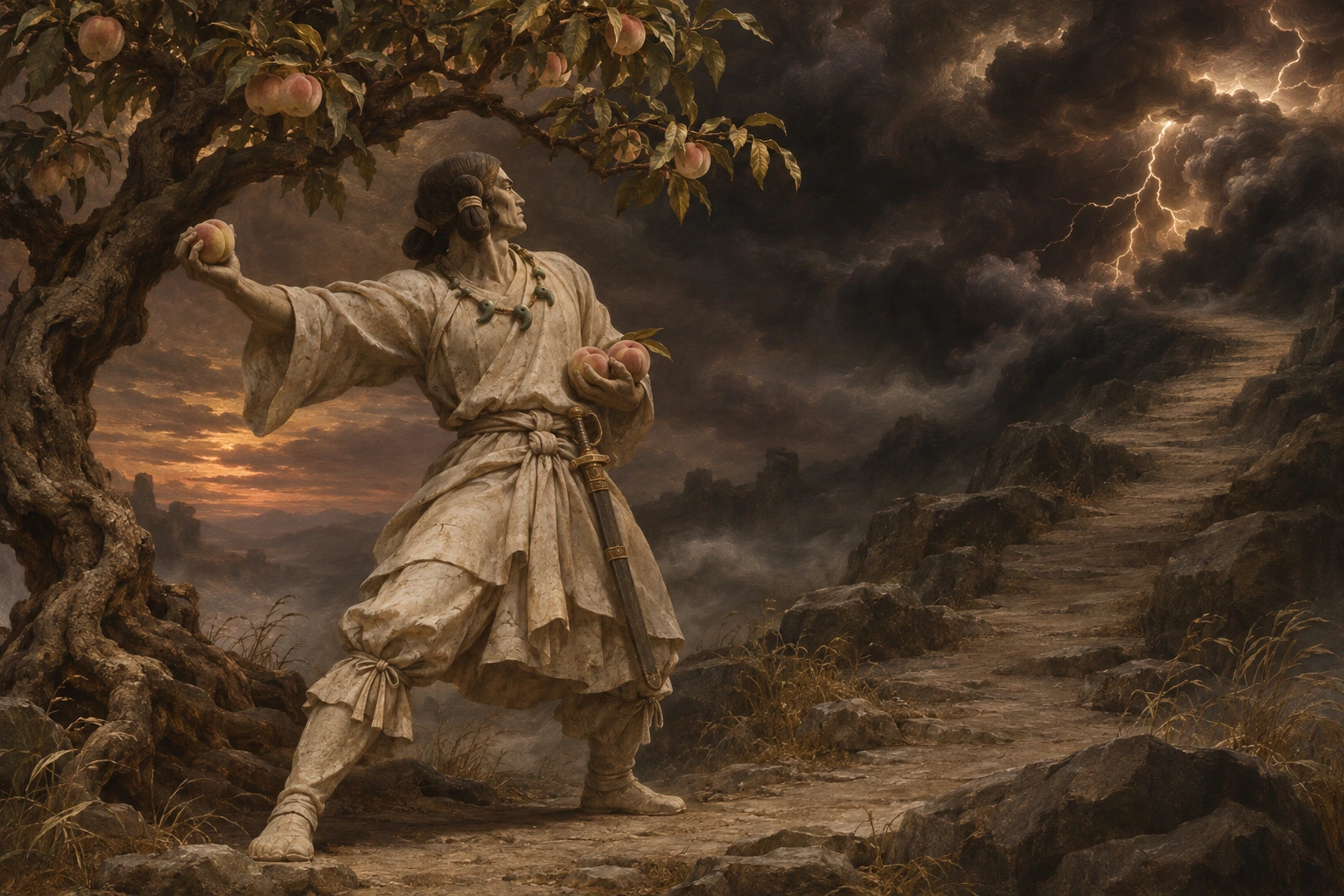
At the foot of the slope called Yomotsu Hirasaka, the Even Pass of Yomi, three peaches were growing. Izanagi took them, waited, and struck at his pursuers, and they all turned back. Then he spoke to the peaches: “Like as ye have helped me, so must ye help all living people in the Central Land of Reed-Plains when they shall fall into troublous circumstances and be harassed!” He gave them a name, Ōkamuzumi-no-mikoto, which Chamberlain renders “Great-Divine-Fruit”.
1-6 The Rock
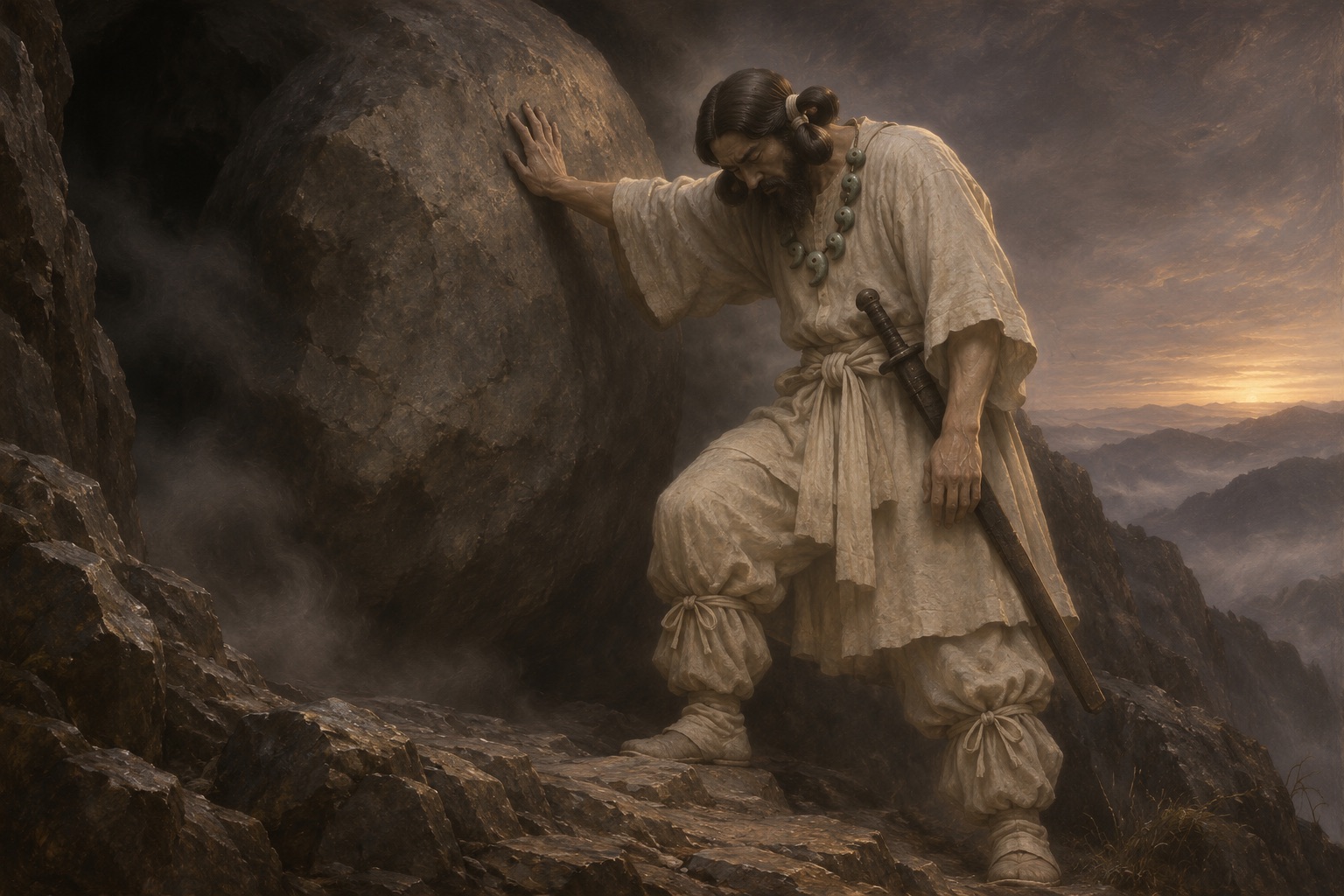
Last of all, Izanami came after him herself. Izanagi pulled a “thousand-draught rock”, one that would take a thousand men to move, across the pass. With the rock between them they stood face to face and spoke the words of their parting.
“If thou do like this,” said Izanami, “I will in one day strangle to death a thousand of the folks of thy land.” Izanagi replied: “If thou do this, I will in one day set up a thousand and five hundred parturition-houses”, huts for women about to give birth. “In this manner,” the text concludes, “each day a thousand people would surely die, and each day a thousand and five hundred people would surely be born.”
So Izanami is called the Great Deity of Yomi. The rock that blocks the way is called the Great Deity of the Road-Turning-back. And the slope “is now called the Ifuya Pass in the Land of Idzumo”. “I have come to a hideous and polluted land,” said Izanagi, and he went to wash himself. From that washing came the sun goddess, as Amaterasu and the Rock Cave begins.
2 Where the Story Is Written Down
- Kojiki (712). It writes the land of the dead 黄泉, a Chinese word, “the yellow springs”. Chamberlain traced it to a remark of Mencius and a story in the Zuozhuan. In the Zuozhuan (Duke Yin, year 1, 722 BCE), Duke Zhuang of Zheng swore to his mother, “We shall not see each other again until we reach the Yellow Springs”, regretted it, and had a tunnel dug down to a spring so that they could meet there.
- The Japanese word. The characters stand for a Japanese word, yomi or yomo. The Kokugakuin commentary leaves open whether the old reading was Yomotsu-kuni or Yomi-no-kuni. “Night” and “darkness” have been proposed as its origin, but the commentary notes that the sounds of old Japanese rule them out; “mountain”, yama, is the strongest proposal, and still unproven.
- Nihon Shoki (720), book 1, section 5. In its main text Izanami does not die and there is no journey to Yomi; the wild Susanoo is simply sent away to the “Nether Land”, Ne-no-kuni, which Aston took to be Yomi. The descent appears only among the variants, each introduced “in one writing it is said”. Aston leaves them unnumbered; counted in the order the text gives them, the sixth, ninth and tenth tell it.
- Izumo Fudoki (733). Under the village of Uka in Izumo district it describes a cave by the shore of Nazuki: “about six feet high and wide”, with a hole inside that no one can enter, of unknown depth. “Whoever reaches the cave by this shore in a dream will surely die,” and so, it says, the people have called it the Slope of Yomi and the Hole of Yomi from ancient times to the present.
3 Competing Versions
- Where they meet. Kojiki: at the door of a palace in Yomi. Ninth variant: at “the temporary burial-place”, where Izanami, “still as she was when alive”, comes out to talk with him, then vanishes into the dark.
- What he sees. Sixth variant: “Putrefying matter had gushed up, and maggots swarmed.” Ninth: she is “swollen and festering”, and eight kinds of thunder god rest on her, placed differently from the Kojiki’s (one on her back, one on her posteriors). Tenth: nothing is described. She says, “Thou hast seen my nakedness. Now I will in turn see thine”, and he is ashamed.
- The comb and the light. The sixth variant draws a custom from the scene: “This is why people at the present day avoid using a single light at night, and also avoid throwing away a comb at night.”
- The pursuers. The sixth variant sends eight Ugly Females, and in one account Izanagi makes water against a tree, which becomes a great river to slow them. In the ninth only the thunders chase him. He hides under “a large peach tree” by the road and throws its fruit, “the origin of the practice of keeping off evil spirits by means of peaches”, then flings down his staff: “The thunders may not come beyond this.”
- The parting. In the sixth variant Izanagi “pronounced the formula of divorce”, and after the threats of a thousand and fifteen hundred he says “Come no further” and throws down his staff, girdle, garment, trousers and shoes, each of which becomes a god. In the tenth, “Road-wardens of Yomi” bring her answer: “I and thou have produced countries. Why should we seek to produce more? I shall stay in this land.” A goddess, Kukuri-hime, says something that pleases Izanagi; the text does not say what.
- Where the pass is. The Kojiki puts it in Izumo. The sixth variant adds: “Some say that the Even Pass of Yomi is not any place in particular, but means only the space of time when the breath fails on the approach of death.”
- Kagutsuchi. The sixth variant cuts him into three pieces, the eighth into five, which become five mountain gods. His blood stained the rocks, trees and grasses, the eighth says, and “this is the reason that herbs, trees, and pebbles naturally contain the element of fire.”
4 History and Tradition
- The food of the dead. The Kokugakuin commentary explains hegui as eating what is cooked on the hearth of another world, which makes the eater belong to it; what matters, it suggests, is the fire of Yomi itself. Aston, in 1896, set it beside Ovid’s Proserpina, who ate seven pomegranate seeds below, and the Indian Nachiketas, told to stay with the god of death but “taste not, though a guest, his food”.
- Yomi and the tombs. Archaeologists have long compared Yomi with the horizontal stone chamber (yokoana-shiki sekishitsu) of the later burial mounds, a room reached by a passage and sealed with stones. Kobayashi Yukio (1949) linked the pottery found in them to yomotsu-hegui, Shiraishi Taichirō (1975) matched the sealing of the chamber with the parting at the rock, and Habuta Yoshiyuki (1998) tied the birth of the idea of Yomi to the arrival of these chambers. Yoshii Iwao, in Nipponica, gives the view that the dead of the early mounds were still seen as priests or gods, and that the gloomy Yomi came only with the continental-style tombs. The archaeologist Sasō Mamoru, in the Kokugakuin commentary, urges caution: such chambers had gone out of use before the Kojiki was compiled, and its Yomi is above all a polluted place, written to lead into Izanagi’s washing.
- A corpse, or her true form? Mutō Takeyoshi traces the bodily horror to mogari, the time when the dead were laid out before burial; the ninth variant sets the meeting at just such a place. Taniguchi Masahiro, in the Kokugakuin commentary, reads the maggots and thunders not as a corpse but as what Izanami has become in Yomi: as in other tales of a forbidden look, seeing the other’s true form ends the marriage.
- Down below, or far away? The Chinese word points underground, but only the Kojiki speaks of the “foot” of the slope. Yamaori Tetsuo saw Yomi as a land at the edges, reached horizontally rather than below, and Kōnoshi Takamitsu argued that Yomi and Susanoo’s land of Ne lie on the same plane as the world of the living. Later in the Kojiki, Susanoo chases the young Ōkuninushi out of Ne as far as the same Yomotsu Hirasaka.
- The cave of Yomi. The Shimane prefectural government calls the Inome cave, a sea cave on the north shore of the Shimane peninsula, the strongest candidate for the Fudoki’s Hole of Yomi. Found during harbour works in 1948, it held more than ten burials of the Yayoi and Kofun periods, one wearing a shell bracelet from the southern seas; it became a national historic site in 1957.
- Ifuya-zaka today. In Iya, Higashi-Izumo, now part of Matsue, a wooded slope is marked as Yomotsu Hirasaka, and the Japan Tourism Agency’s guide says the rock can be seen there. In 1940, for the 2,600th year of the imperial era, the town’s mayor, Satō Chūjirō, set up a stone naming it the sacred site of the legend. Iya Shrine, in the same district, counts Izanami among its gods. In 659, the Nihon Shoki records, a dog left a dead man’s arm at this shrine, read as a sign that the empress would die.
- Comparisons. Yoshida Atsuhiko found the story “exactly” like that of Orpheus and Eurydice, and Izanami’s meal “just like” Persephone’s pomegranate; he thought Greek myths reached Japan through the Scythians and the Korean peninsula. Matsumae Takeshi saw in the division of rule over the living and the dead “a motif paralleling that of Tane and Hina in Polynesia”. The chase itself, Aston wrote, any student of folklore would recognize, and he quoted Andrew Lang: “A common incident is the throwing behind of a comb, which turns into a thicket.”
Yomi is often translated “hell”, but no one in the Kojiki is judged or punished there. Izanami goes to Yomi because she died, not for anything she did. Motoori Norinaga defined it, in Chamberlain’s translation, as “the land whither, when they die, go all men, whether noble or mean, virtuous or wicked”. The Buddhist hell, jigoku, a place of punishment for wrongdoing, came later; only then, the Nihon Kokugo Daijiten notes, did the two come to be confused.
5 Related Stories
- Kuniumi: Izanagi and Izanami Give Birth to Japan: the story before this one. The two gods make the islands and the gods, until the birth of fire kills Izanami.
- Amaterasu and the Rock Cave: The Day the Sun Hid: the story after it. Izanagi washes away the pollution of Yomi, and Amaterasu, Tsukuyomi and Susanoo are born.
- Orpheus and Eurydice: The Look Back: a husband goes down to bring back his dead wife and loses her by looking. Yoshida Atsuhiko found the two stories “exactly” alike in their plot.
- Persephone: The Pomegranate and the Seasons: a goddess who cannot simply leave the dead because she has eaten there. Aston set Izanami’s meal beside Proserpina’s pomegranate in 1896, and Yoshida called the two “just like” each other.
6 Sources
- Kojiki, book 1, “Kashin hisatsu” and “Yomotsukuni” 1–3, with the commentary of Taniguchi Masahiro, Sasō Mamoru and Matsumoto Hisashi: Kokugakuin University Kojiki Viewer; “Ne no katasukuni hōmon” 2 and “Ashihara no nakatsukuni heitei” 5: Kokugakuin University Kojiki Viewer, Kokugakuin University Kojiki Viewer
- Basil Hall Chamberlain (trans.), Kojiki, 1882, §§VIII–X: Wikisource
- Nihon Shoki, book 1, section 5, main text and variants (original text): Wikisource
- W. G. Aston (trans.), Nihongi, 1896, vol. 1, book I, and vol. 2, book XXVI (Saimei 5): Wikisource, Wikisource
- Zuozhuan, Duke Yin, year 1 (original text): Wikisource
- Izumo Fudoki, Izumo district, Uka village (original text): Wikisource; with the reading given by the Shimane Prefectural Board of Education, Inishie no Shimane gaidobukku 5 (1996), pp. 30–31: Shimane Prefecture; Shimane Prefecture, “Inome dōkutsu iseki”: pref.shimane.lg.jp
- Encyclopedia of Shinto, Kokugakuin University: Nishioka Kazuhiko, “Yomi”
- Heibonsha World Encyclopedia, revised edition: Mutō Takeyoshi, “黄泉国”; Yoshida Atsuhiko, “神話”; Yamaori Tetsuo, “地獄”; with Yoshii Iwao, “黄泉国”, Nipponica: Kotobank, Kotobank, Kotobank
- “黄泉”, Seisen-ban Nihon Kokugo Daijiten: Kotobank; “揖夜神社”, Nihon rekishi chimei taikei: Kotobank
- Matsue City, Higashi-Izumo machi-aruki map: city.matsue.lg.jp; Japan Tourism Agency, “Yomotsu Hirasaka”: mlit.go.jp
- Matsumae Takeshi, “Izanagi and Izanami”, Encyclopedia of Religion (1987): Encyclopedia.com
Cover and illustrations: AI-generated images made for Arcana. They are interpretations, not historical artworks.