Urashima Tarō: The Fisherman Under the Sea
A fisherman catches a turtle that becomes a woman, lives three years in her land beyond the sea, and comes home to find three hundred years gone. Japan has told the story since the 8th century, but the children on the beach, the ride on the turtle's back and even the name Tarō came much later.
- Type: legend and folk tale: a stay in the other world, a forbidden box, and centuries lost
- Culture: Japan; the oldest tellings belong to the Tango peninsula, in the north of today’s Kyoto prefecture
- Earliest texts: Nihon Shoki (720), under the year 478; the Tango Fudoki (8th century), known from a quotation in the Shaku Nihongi (1274–1301); Man’yōshū, book 9, poems 1740–1741; the otogizōshi “Urashima Tarō” (Muromachi period)
- Key figures: Urashimako, later called Urashima Tarō; the turtle woman, Kamehime in the Fudoki, Otohime in modern tellings; the villagers who no longer know him
Japanese children have sung it since 1911: long ago Urashima, carried off by the turtle he had saved, came to the Dragon Palace, “more beautiful than any picture”. The story is far older than the song. In 720 a court chronicle filed it under the year 478, and added that the whole tale was written down somewhere else.
What was in the box? The old texts do not agree. In the Man’yōshū poem a white cloud slips out and drifts away towards the everlasting land, and the young man’s skin wrinkles, his hair turns white, and he dies. In the Tango Fudoki something “fragrant as an orchid” is carried off on the wind and clouds. The commentator Kurita Hiroshi read it as his youthful looks flying away, but the text itself says only that he knew he would never see her again. The Otogi bunko has an answer of its own: the turtle had folded his years into the box.
1 The Telling
The fullest of the old tellings is the one in the Tango Fudoki. Sections 1-1 to 1-3 follow it, in our own translation of the text as Kurita Hiroshi printed it in 1927. Section 1-4 is the otogizōshi “Urashima Tarō” as printed in the Otogi bunko, the version in which the hero first gets the name Tarō.
1-1 The Five-Coloured Turtle
In the village of Tsutsukawa, in Yosa district, lived a man the Fudoki calls Tsutsukawa no Shimako, “the one known as Mizunoe no Urashimako”. He was an ancestor of the Kusakabe no Obito family, and handsome and refined beyond compare.
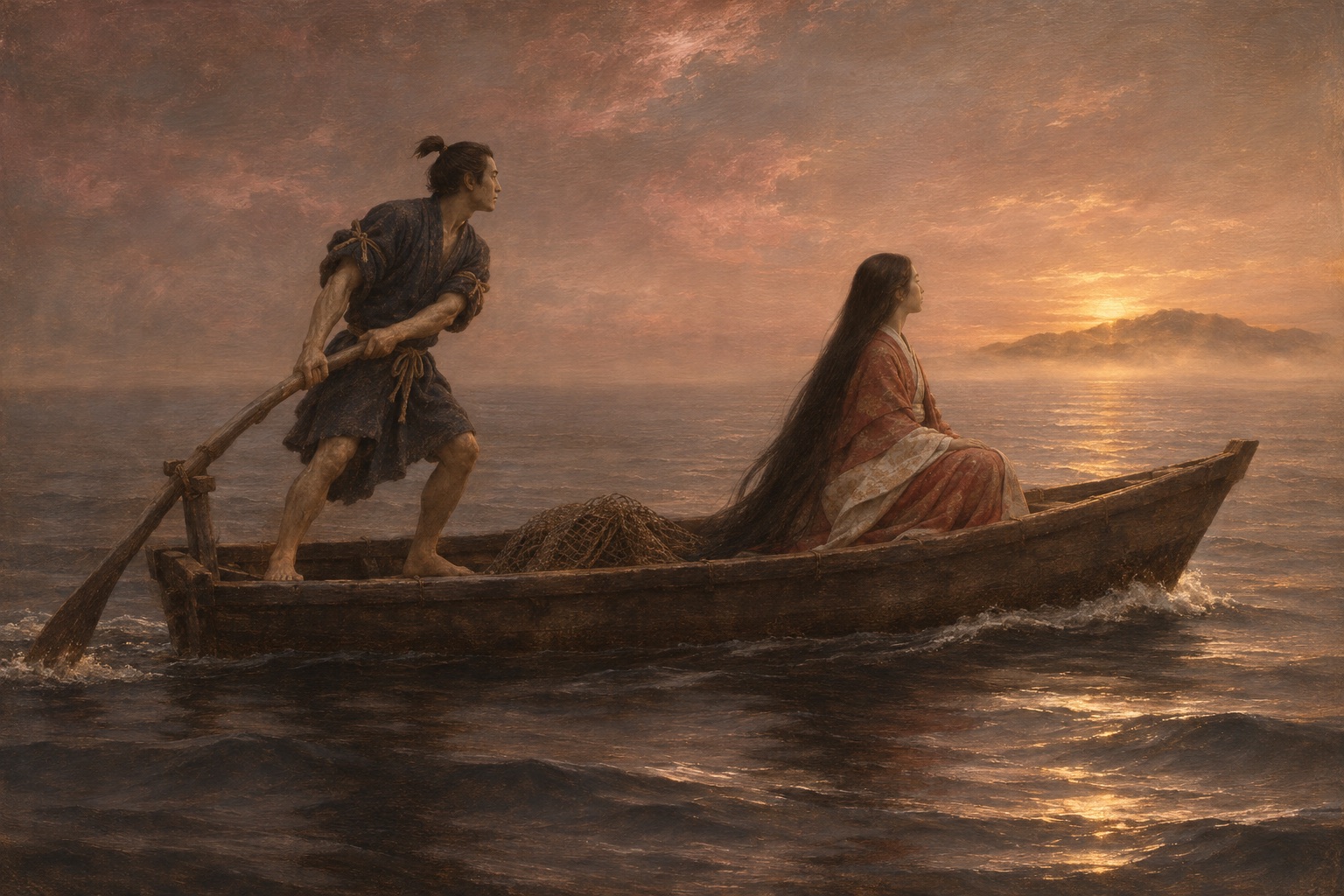
In the reign of the emperor who ruled from the Asakura palace at Hatsuse, that is Yūryaku, Shimako rowed out alone in a small boat to fish. For three days and three nights he caught nothing. Then he caught a turtle of five colours. He thought it strange, laid it in the boat and fell asleep, and the turtle became a woman more beautiful than anyone he had ever seen.
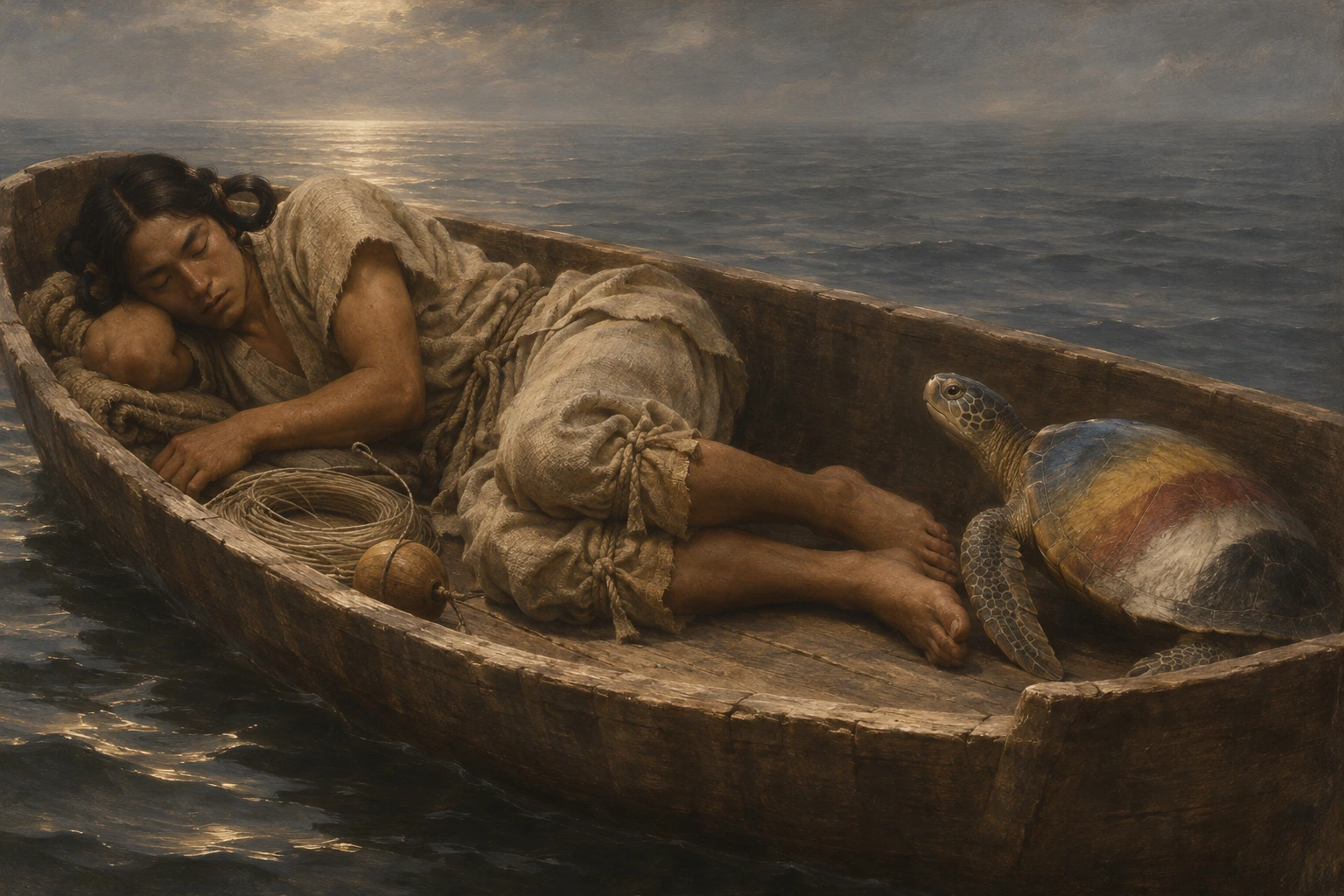
“How did you come here, so far from where people live?” he asked. She smiled: she had seen a refined man alone on the sea with no one to talk to, and had come “on the wind and the clouds”. She was “of the household of the immortals in heaven”. She meant to stay with him as long as heaven and earth lasted, she said, and what did he think? He had nothing to say against it. “Then turn your oar towards Hōrai,” she said, and told him to close his eyes. In the poems at the end of the fragment, the land is called Tokoyo, the everlasting land.
1-2 Kamehime’s Husband
In a moment they reached a broad island in the middle of the sea. The ground seemed paved with jewels, and gate towers and tall halls shone. Hand in hand they walked to the gate of a great house, and she went in ahead. Seven boys came out and said to each other, “This is Kamehime’s husband.” Then eight boys came and said the same. So he learned her name: Kamehime, “turtle princess”. When she came back she told him the seven boys were the Pleiades and the eight the Hyades, and he should not wonder at them.
Her father and mother welcomed him. They spoke of the difference between the world of men and the land of the immortals, and of the rare meeting of a man and a god. A hundred delicacies were served, brothers and sisters raised their cups, the girls of the neighbourhood joined the play, and the immortals sang and danced. The feast was ten thousand times finer than any among men, and he did not notice the day ending. When the guests had gone, Kamehime stayed, and they became husband and wife.
1-3 The Jewelled Box
Three years passed. Then Shimako began to long for his home and his parents, and he sighed more each day. When she asked why, he quoted an old saying: the small man longs for his own land, the dying fox turns its head towards its hill. He had thought it empty talk; now he knew it was true. He asked to go home for a while.
She wept, but let him go, and her parents and kin saw him off. She gave him a jewelled comb box, a tamakushige: “If you do not forget me and wish to come back, hold it fast, and never open it.” He closed his eyes again, and found himself at Tsutsukawa.
Nothing was as it had been. He asked a villager where the family of Mizunoe no Urashimako lived. The old people, the man said, told of an Urashimako who had gone out alone on the sea long ago and never returned: “that was more than three hundred years ago”. Ten days went by. Shimako stroked the box and thought of her, and, forgetting his promise, opened it. Before he could see anything, a form fragrant as an orchid was carried off on the wind and the clouds into the blue sky. He knew then that he would never meet her again.
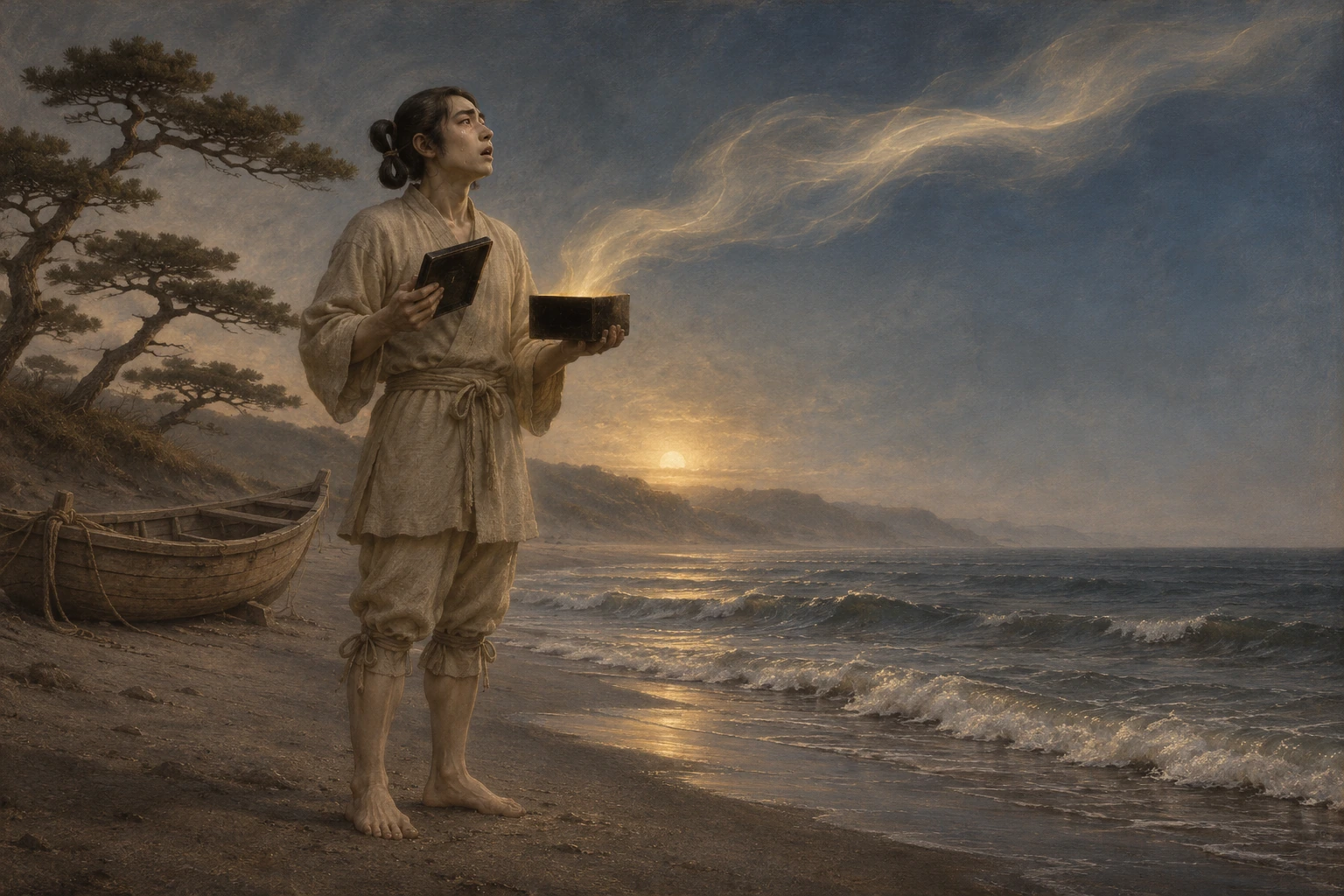
The fragment ends with poems. He sings that the clouds stretch away towards Tokoyo; her answer comes from afar: “Do not forget me.” Of the two poems “people of a later time” added, one says that if he had not opened the box he would have met her again.
1-4 Urashima Tarō
In the otogizōshi, Tarō is the son of a man named Urashima of Tango. He is twenty-four or twenty-five, and fishes to feed his parents. At a place called Ejima-ga-iso he catches a turtle on his line. “The crane lives a thousand years and the turtle ten thousand,” he tells it; it would be a pity to end such a long life here. He lets it go and tells it to remember the kindness.
The next day a small boat drifts in with a beautiful woman alone in it. Her ship, she says, was struck by a storm and she was set adrift; she begs him to take her home. They row for more than ten days and come to a palace with walls of silver and roof tiles of gold, and there she asks him to marry her. This, she tells him, is the Ryūgū-jō, the Dragon Palace, and on each of its four sides lies a season: plum and cherry blossom to the east, lotus and cicadas to the south, red leaves, white chrysanthemums and the cry of deer to the west, frost and snow to the north.
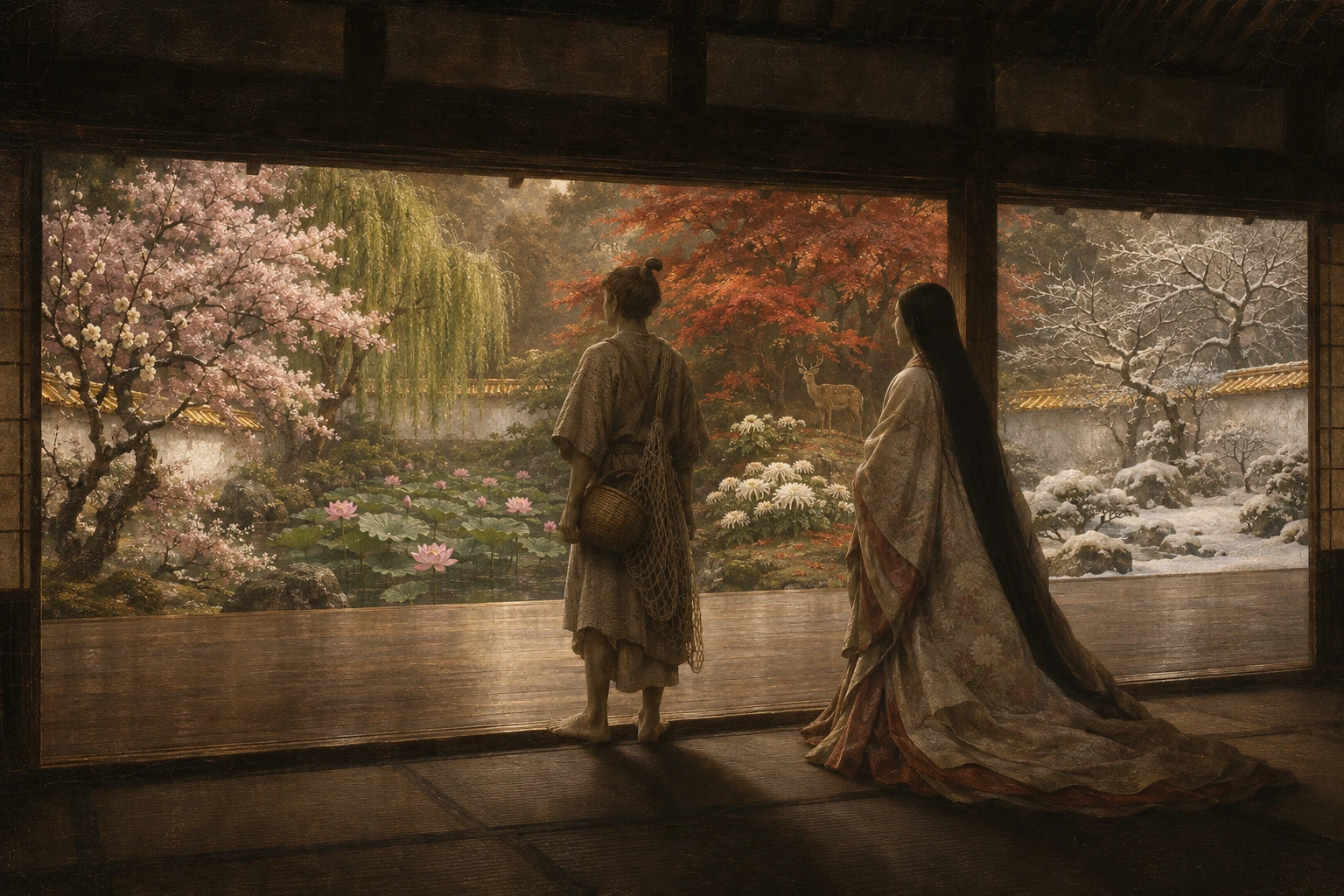
After three years he asks for thirty days’ leave to see his parents. She weeps, and tells him the truth: she is the turtle he spared. She gives him a beautiful box as a keepsake and tells him never to open it. At home he finds a wilderness. An old man of about eighty tells him that Urashima lived seven hundred years ago, and points to an old grave. Tarō opens the box, three wisps of purple cloud rise from it, and his youth is gone. Then he becomes a crane and flies up into the sky. On Mount Hōrai crane and turtle meet again, and in the end Urashima appears in Tango as the god Urashima Myōjin, with the turtle beside him: “the married gods”.
2 Where the Story Is Written Down
- Nihon Shoki (720), book 14, Yūryaku 22 (478), seventh month. In a few lines: Mizunoe no Urashimako of Tsutsukawa in Yosa district, Tamba, went fishing, caught a large turtle that became a woman, married her, went with her into the sea to Hōrai and “saw the immortals”. “The story is in another book.” Tango was carved out of Tamba only in 713. W. G. Aston, in his translation of 1896, notes that the interlinear reading gives Hōrai as Tokoyo no kuni, and that one editor rejected the last sentence as a later addition.
- Tango Fudoki. In 713 the court ordered every province to report its products, place names and “old tales handed down by the elders”. Tango’s report is lost. The Urashima passage survives because Urabe Kanekata quoted it in the Shaku Nihongi, a commentary on the Nihon Shoki completed between 1274 and 1301. Its writer says his account agrees with what a former governor, Iyobe no Umakai, had written before him.
- Man’yōshū, book 9, poems 1740–1741, “On Urashima no ko of Mizunoe”, from the collection of the poet Takahashi no Mushimaro (section 3).
- Heian biographies. The Zoku Urashimako denki (920) and the Urashimako den retell the story in Chinese, as a tale of immortals. The Zoku Urashimako denki, the Mypedia encyclopedia notes, borrows from Chinese works, among them the Tang tale of Liu Yi and the dragon princess, and the story of Liu Chen and Ruan Zhao on Mount Tiantai. Neither has a grateful turtle yet.
- The otogizōshi. In the Muromachi period, writes the folklorist Ōshima Hiroshi, the story gains the grateful turtle, the name Tarō and the Dragon Palace. The Osaka bookseller Shibukawa Seiemon printed it among the 23 illustrated tales of the Otogi bunko. Fujii Otoo, editing them in 1922, placed the set around the Kyōhō era (1716–1736); one Heibonsha entry dates it to the Kanbun era (1661–1673).
3 Competing Versions
Tango or Suminoe? The Man’yōshū poem moves the story to Suminoe, today’s Sumiyoshi in Osaka, and has no turtle:
- the young man, proud of his catches of bonito and sea bream, stays out seven days, rows past the edge of the sea and meets “the daughter of the sea god”;
- in her father’s palace in Tokoyo they could have lived “without ageing, without dying”;
- “the fool of this world” goes home, promising to be back the next day, finds his house gone after “three years”, and opens the box a little;
- a white cloud drifts out, he runs, shouts, waves his sleeves, rolls on the ground, his skin wrinkles, his hair turns white, and he dies.
The envoy sums it up: he should have stayed in Tokoyo; it was his own doing, “what a fool, this man”.
How long was he away? Three years there and more than three hundred at home in the Fudoki; three years and seven hundred in the Otogi bunko. The best-known modern version, as Ōshima summarizes it, has three days and three hundred years.
Who is the woman? An immortal from heaven named Kamehime in the Fudoki; the sea god’s daughter in the Man’yōshū; in the Heian biographies, his wife in a former life; the turtle he spared in the Otogi bunko. In the Edo period, the Nihon kokugo daijiten notes, the turtle and the woman became two separate beings, and modern children’s versions drop the marriage altogether.
Under the sea? The Nihon Shoki says they “went into the sea”; the Fudoki puts the palace on an island. Hōrai is the Chinese isle of the immortals; Tokoyo, in the words of the Encyclopedia of Shinto, was “a utopia of eternal youth, long life, bounteous wealth, and pleasure across the sea”. Urashima riding on the turtle’s back belongs, Ōshima writes, to the red-cover picture books (akahon) of the Edo period.
Folk versions collected across Japan differ again: Tarō is a stepchild in Fukui, the turtle is a flatfish in Aomori, and in Kagawa and Tottori he becomes a crane, as in the otogizōshi. Ōshima also sets the broken promise beside the Kojiki’s sea princess Toyotama-hime, whose husband, too, does the one thing she forbade.
4 History and Tradition
- The shrine at Ine. On the Tango peninsula, Urashima Jinja, also called Ura Jinja, worships Urashimako and dates its founding to 825. It keeps a tamatebako among its treasures, and its picture scroll Urashima Myōjin engi, from around the 14th century, is an Important Cultural Property. Other local traditions place Mizunoe at the Asamogawa lagoon in Amino, on the same peninsula.
- Other Urashima places. The Dragon Palace is said to lie beneath the gorge of Nezame-no-toko in Kiso; Yokohama shows the well where Urashima washed his feet and the stone he sat on; on the Misaki peninsula in Kagawa, Mount Shiude, “purple clouds rise”, is named for the smoke from his box.
- A turtle bought and set free. In the Nihon Ryōiki (book 1, tale 7), a monk from Paekche buys four turtles at the port of Naniwa and releases them; when robbers later force him into the sea, the turtles carry him to shore. Watanabe Shōgo, in the Nipponica encyclopedia, counts it among Japan’s tales of grateful animals from the other world.
- Meiji schoolbooks. By 1910 “Urashima no hanashi” was a lesson in the national school reader for second-year pupils, and the song quoted above, with words credited to Otsukotsu Saburō, was printed in 1911. Lafcadio Hearn retold the tale in “The Dream of a Summer Day” (Out of the East, 1895), and Yei Theodora Ozaki in her Japanese Fairy Tales (1908).
- The Urashima effect. In Japanese, the slowing of time on a ship moving close to the speed of light is called the Urashima kōka, a name credited to the science-fiction writer Ishihara Fujio or to the translator Shibano Takumi. And to be an “Urashima Tarō” is to come back from a long absence to a world one no longer understands.
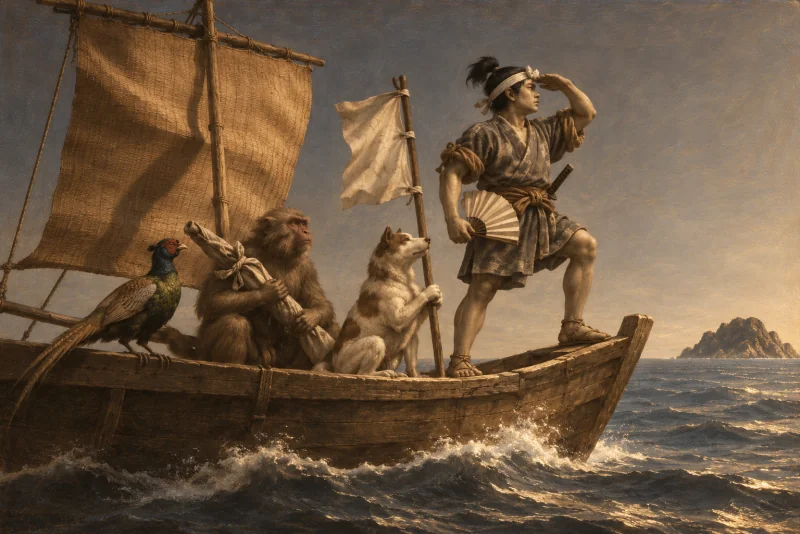
In the picture books, Urashima saves the turtle from children who are tormenting it on the beach. None of the old texts has them: in the Nihon Shoki and the Fudoki he catches the turtle himself, and in the Otogi bunko he catches it on his line and lets it go. The earliest children we have found are Meiji ones. A school song printed with music in the Yōnen shōka (1900–1902) begins with Urashima seeing “a turtle the children were teasing” and buying it, and the national school reader in use in 1910 has the same scene. Ozaki’s 1908 version, which she says she translated from Iwaya Sazanami’s retellings, has a band of boys beating it with a stick and a stone. In 1926 the writer Nakada Senpo wrote that he had no sure evidence of when, or by whom, it was first told so.
5 Related Stories
- Oisín and Tír na nÓg: The Land of Youth: an Irish hero goes over the sea with a woman of the otherworld, comes home three hundred years later, and is old and blind the moment he touches the ground. E. S. Hartland’s 1891 chapters on “the supernatural lapse of time in fairyland” take in a Japanese voyage to Hōrai, but not Urashima. We have found no scholar who compares Oisín and Urashima directly: it is a shared theme.
- Từ Thức: The Man Who Married a Fairy: a Vietnamese official marries a fairy and comes home to find his time long gone, and is often called “the Vietnamese Urashima Tarō”. One Chinese tale touches both: Từ Thức’s last poem laughs at Liu Chen of Mount Tiantai, whose story the Zoku Urashimako denki borrows from. We have found no scholar who derives one of the two stories from the other.
- Kaguya-hime: The Princess from the Moon: a woman from another world who must go back to it. Watanabe Shōgo points out that the Taketori monogatari, too, knows the idea that a short time in the other world is a long time in ours.
- The Chinese Dragon: The Long, Bringer of Rain and Emblem of Emperors: the Dragon Palace of the later tale is the undersea home of the Dragon Kings. That post tells the tale of Liu Yi and the dragon princess of Lake Dongting, which the Zoku Urashimako denki already draws on, and Ōshima calls the Chinese tales of Lake Dongting, which join the story of a dragon woman to a stay among the immortals, important in the search for Urashima’s origins.
6 Sources
- Nihon Shoki, book 14, Yūryaku 22 (original text): Wikisource; W. G. Aston (trans.), Nihongi, 1896, vol. 1, book XIV: Wikisource
- Tango Fudoki fragment, from the Shaku Nihongi, book 12, in Kurita Hiroshi, Ko-fudoki itsubun (Ōokayama Shoten, 1927), and his commentary, quoting Ban Nobutomo on the name, in Ko-fudoki itsubun kōshō, vol. 2 (Dai Nippon Tosho, 1903): NDL Digital Collections, NDL Digital Collections
- Man’yōshū, book 9, poems 1740–1741, original text and reading: Man’yōshū Navi; with notes by Mizugaki Hisashi: Yamatouta
- “Urashima Tarō”, Otogi bunko text, in Fujii Otoo (ed.), Otogizōshi (Yūhōdō Bunko, 1922), pp. 277–282: NDL Digital Collections
- Nakada Senpo, Urashima to hagoromo (Sakamoto Shoten, 1926), pp. 80–81, quoting the Nihon Ryōiki, book 1, tale 7: NDL Digital Collections
- Meiji teaching books quoting the songs and the 1910 reader: Jidō kyōiku ni okeru kaiga no kachi (Tenshindō, 1904); Kokugo kyōju saian, second year (Kinkōdō, 1910); Jinjō shōgaku shōka tekiyō yūgi, second year (Hakuhōdō, 1912): NDL, NDL, NDL
- Yei Theodora Ozaki, Japanese Fairy Tales (1908), “The Story of Urashima Taro, the Fisher Lad”: Project Gutenberg; Lafcadio Hearn, Out of the East (Boston, 1895), “The Dream of a Summer Day”: Project Gutenberg; E. S. Hartland, The Science of Fairy Tales (1891), chapter 7: Project Gutenberg
- “浦島太郎”: Ōshima Hiroshi (Heibonsha World Encyclopedia), Watanabe Shōgo (Nipponica), Seisen-ban Nihon kokugo daijiten, Daijisen Plus: Kotobank
- Kotobank: “浦島伝説” (Britannica Japan), “浦島子伝” and “続浦島子伝記” (Mypedia), “釈日本紀” (Aoki Kazuo, Heibonsha), “風土記”, “丹後国”, “宇良神社” (Nihon rekishi chimei taikei), “浦嶋神社” (Daijisen Plus), “浦島効果” (Daijisen, Hōsoku no jiten): Kotobank, Kotobank, Kotobank, Kotobank, Kotobank, Kotobank, Kotobank, Kotobank, Kotobank
- Encyclopedia of Shinto, Kokugakuin University: “Tokoyo”, “Ryūjin shinkō”
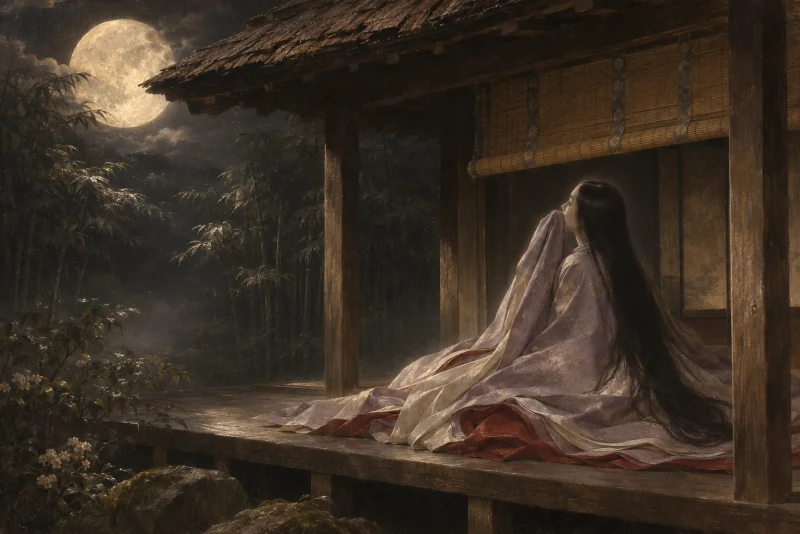
Cover and illustrations: AI-generated images made for Arcana. They are interpretations, not historical artworks.