Momotarō: The Peach Boy
An old woman pulls a giant peach from the river, and the boy named after it sails to the island of the oni with a dog, a monkey and a pheasant. In the oldest picture books, though, he does not come out of the peach: the old couple eat it, grow young again and have a son.
- Type: folk tale (mukashibanashi), a hero of wondrous birth who defeats the oni
- Culture: Japan; told across the country, and printed in Edo (today’s Tokyo) from the early 18th century
- Earliest texts: red-covered picture books for children (akahon) of the Kyōhō era (1716–1736), one of them dated 1723; Kyokutei Bakin’s essays Enseki zasshi (1811); the standard modern form comes from the school reader of 1887 and Iwaya Sazanami’s retelling of 1894
- Key figures: Momotarō, the old man and the old woman, the dog, the monkey and the pheasant, the oni of Onigashima
The old man goes up to the hills to cut brushwood, the old woman goes down to the river to wash clothes, and a peach comes bobbing down the stream. When the writer Akutagawa Ryūnosuke retold the story in 1924, he did not bother to say who picked the peach up: an old woman, “as every child in Japan knows”. Momotarō has been a picture book, a school lesson, a war film and a satire on war, and he was not always born from the peach.
Where did the story happen? The tale does not say. Three places claim it. In Okayama, the Kibitsu Shrine tells how a prince of the Yamato court killed an oni named Ura. Inuyama, on the Kiso river in Aichi, has a Momotarō Shrine. And in Kagawa, the island of Megijima has an “oni cave”. Kagawa’s claim grew after the cave was found in 1914; Okayama’s was first put forward in 1930, the year Inuyama’s shrine was founded.
1 The Telling
This is the version of Iwaya Sazanami, the first volume of his Nihon mukashibanashi (“Old Tales of Japan”), published in July 1894. Most later picture books follow it. We have not seen the 1894 book itself: we quote the text as a teachers’ handbook of 1929 reprints it.
1-1 The Peach in the River
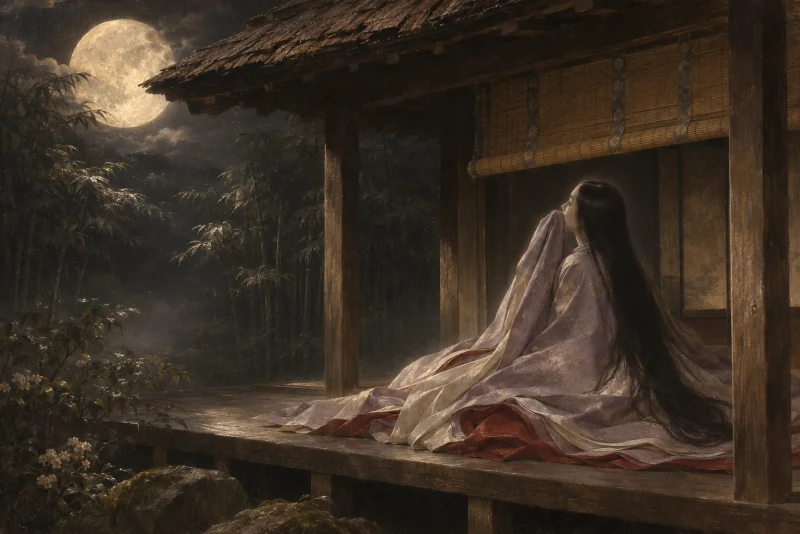
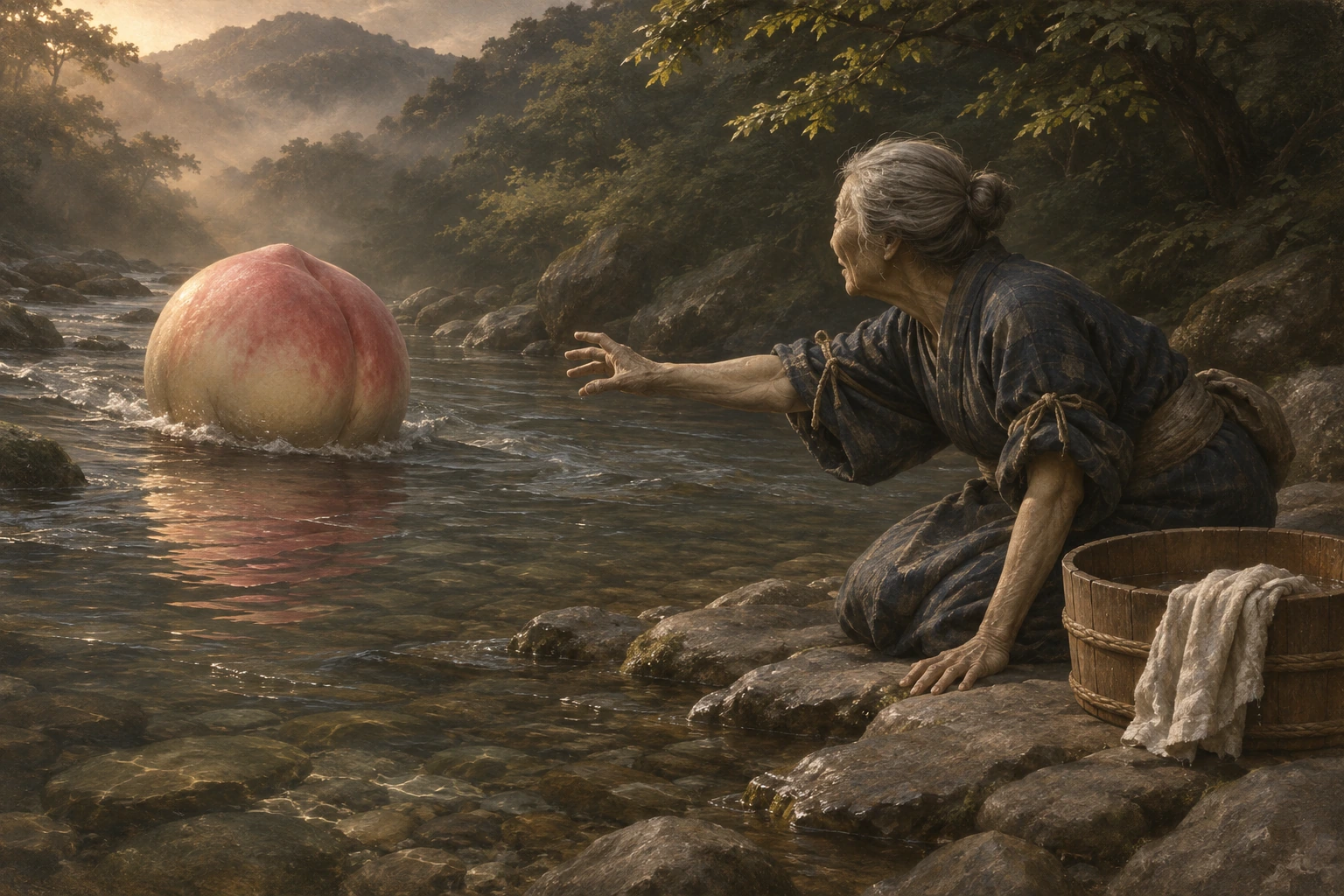
Once there lived an old man and an old woman who had always longed for a child. One day the old man went up to the hills to cut brushwood, and the old woman went to the river to wash. As she scrubbed, a peach “as big as an armful” came bobbing down from upstream, tonburiko sukkokko.
She could not reach it. So she clapped her hands and sang: “Far water is bitter! Near water is sweet! Keep off the bitter, come to the sweet!” The peach drifted to her feet and stopped, and she carried it home as a present for her husband.
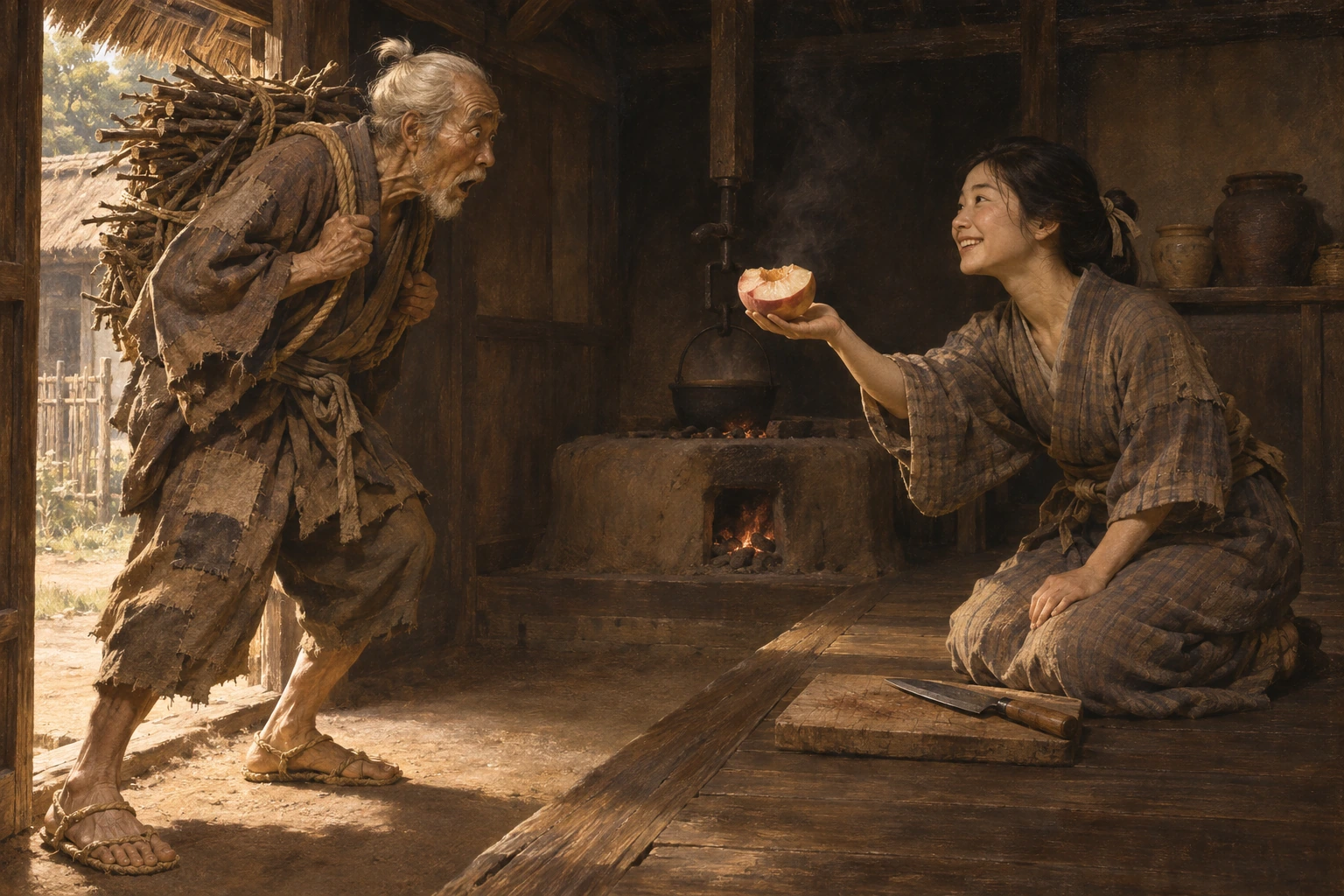
That evening the old man fetched a kitchen knife to cut it in two. A child’s voice cried from inside, “Grandfather, wait!”, the peach split open and out jumped a baby boy. The couple raised him as their own and, since he was born from a peach, named him Momotarō, “Peach Boy”.
1-2 The Millet Dumplings
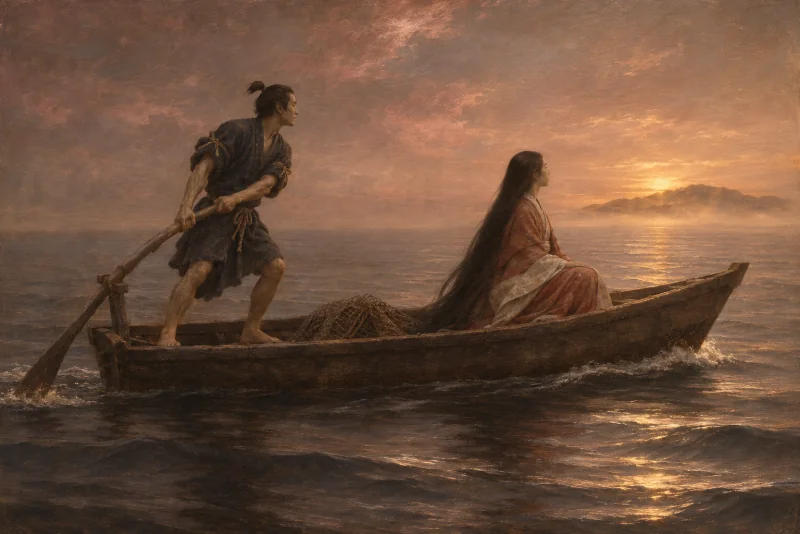
At fifteen, Momotarō thanked his parents: their kindness, he said, was higher than the hills where they cut grass and deeper than the river where they washed. Then he asked leave to conquer Onigashima, the island of the oni, and bring back its treasure. The old man, proud of him, agreed. The couple pounded millet into kibi-dango, millet dumplings, and saw him off in tears.
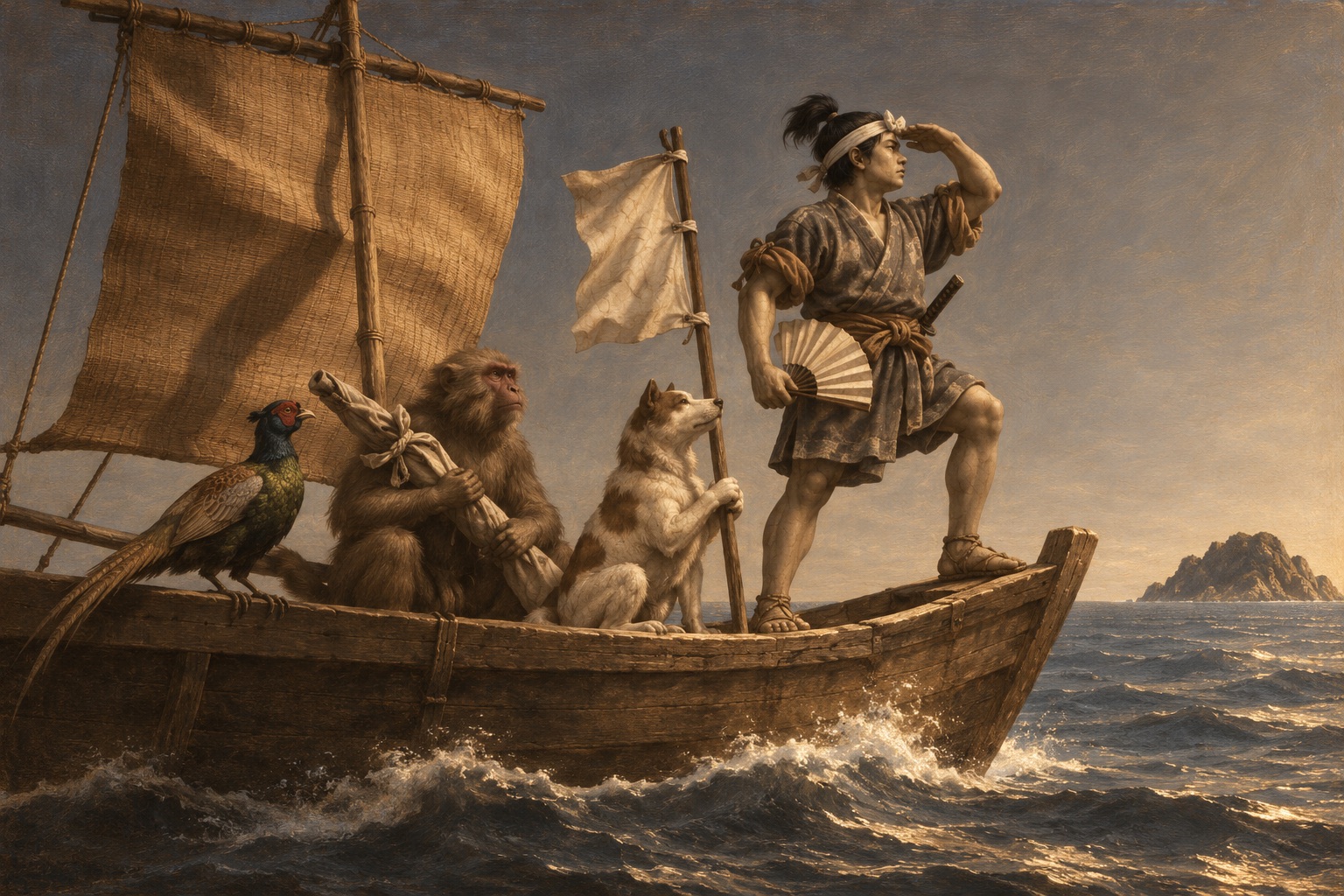
At noon, as Momotarō sat by the road eating, a spotted dog as big as a calf came out of the grass. “Momotarō, Momotarō, what is that at your waist?” “The best millet dumplings in Japan.” “Give me one, and I’ll go with you.” Next a monkey jumped down from a tree. The dog went for it, and Momotarō had to pull them apart; the monkey got a dumpling too and carried his sword, while the dog carried his banner. Last came a pheasant, which Momotarō threatened until it surrendered and asked to serve. After that, the three became the best of friends.
1-3 Onigashima
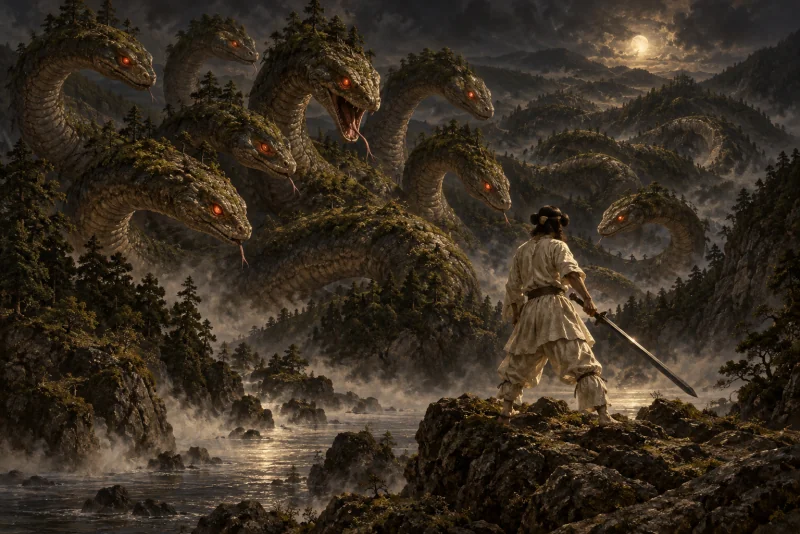
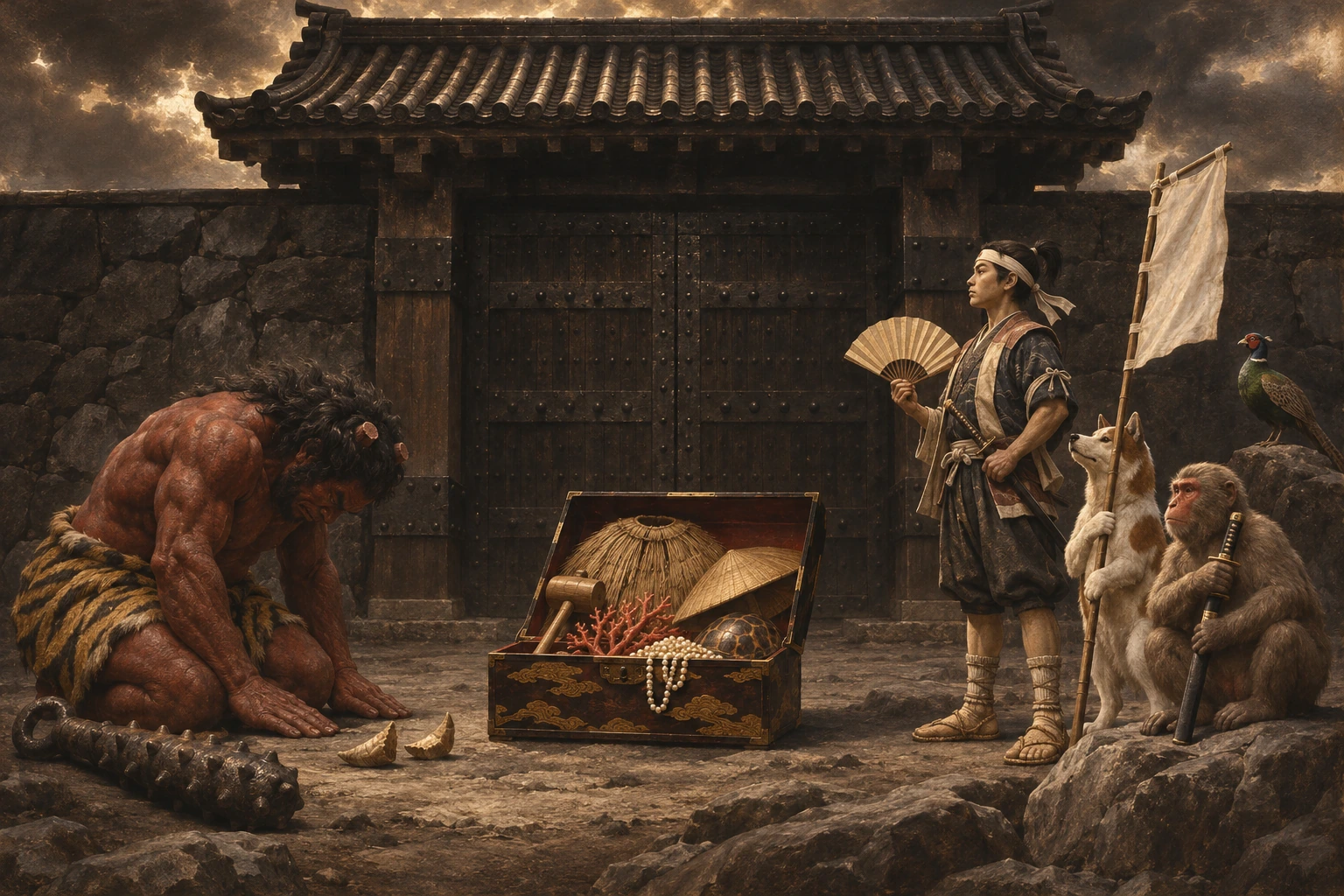
They sailed with a following wind. On the island, on rocks “as if cut with an axe”, stood an iron gate, an iron fence and an iron house. The pheasant flew ahead, landed on the roof and called out that “General Momotarō of Great Japan” had come: if the oni wanted to live, they must break off their horns and hand over their treasure.
The oni, in tiger-skin loincloths, laughed and swung their iron clubs. Then the dog and the monkey broke through the iron gate. Some oni drowned, some fell on the rocks and many more fell to the animals, until only the great chief was left. He threw down his club, broke off his own horns and laid them before Momotarō with the treasure, begging for his life.
Momotarō bound him and gave the rope to the monkey. The dog and the pheasant carried the spoils: the straw cloak and the hat that make the wearer invisible, the mallet that brings forth whatever one wishes, the wish-granting jewel, coral, tortoiseshell and pearls. And they sailed home in triumph.
2 Where the Story Is Written Down
No medieval text tells Momotarō. It was an oral tale, and it reached print in Edo.
- Red picture books. From the late 17th century, Edo publishers sold akahon, small picture books in red covers, for children at New Year, and Momotarō was among their subjects. The Kusazōshi jiten, cited by Fujita Tomoko, traces a reprint of the 1770s back to a tiny red book of 1723; many reprints followed. By 1748 the preface of a book of comic sermons already mentions “the old woman who picked up Momotarō” (Nihon kokugo daijiten).
- A scroll without words. The Hyogo Prefectural Museum of History owns an Edo-period Momotarō emaki in fourteen scenes, drawn as a model for painters.
- Kyokutei Bakin, the great novelist of late Edo, retold the tale in book 4 of his essays, Enseki zasshi (1811), and looked for its sources. We have not seen the 1811 print: we read his text as the 1929 handbook quotes it.
- Into English. A. B. Mitford’s Tales of Old Japan (1871) has “The Adventures of Little Peachling”: the peach “split in two, and a little puling baby was born into the world”.
- The school reader. In 1887 the Ministry of Education’s Jinjō shōgaku tokuhon (Elementary School Reader) gave the tale three lessons in its first volume. The peach splits by itself and a boy is born; Momotarō sets out “to take treasure” from Onigashima.
- Iwaya Sazanami (1870–1933) opened the 24 volumes of his Nihon mukashibanashi (1894–96) with it. Summing up Namekawa Michio’s history of the tale, Kawachi Shigeo writes that this standard form settled in the decade after 1887, largely through the school textbooks.
3 Competing Versions
Scholars call the two old forms kashō-gata, “born from the fruit”, and kaishun-gata, “made young again”. In the akahon and other old records, writes Kojima Yoshiyuki in the Nipponica encyclopedia, the old woman eats the peach, grows young and gives birth. The Hyogo scroll shows the same: an astonished old man, a wife made young, and then a small boy lifting a mortar. In 1779 the comic writer Ichiba Tsūshō has his old couple, now living in Edo, remark that picking up a peach would surely make them young again, a joke that needs readers who knew that form (Fujita).
Bakin, in 1811, tells the peach splitting open by itself. Then he adds that “some say” the old woman found two peaches; the couple ate them, “at once grew young”, and that very night she conceived. He also notes that he has seen no source for a child born from a peach, though Japan and China know children born from a bamboo stem. Akabane Yuriko studied three later picture books in the gōkan format of the 19th century: in all of them the couple eat the peach and grow young, but in two the boy then comes out of the peach.
- One peach or two? In a long poem in the ancient style by the scholar Kurosawa Okinamaro (1795–1859), a second peach floats down for the old man, and when they cut it open a child is inside.
- Who joins first? Bakin and Sazanami have the dog, then the monkey, then the pheasant. Mitford’s Little Peachling meets the ape first, then the pheasant, then the dog.
- What treasure? Bakin names the cloak, the hat and the mallet. Mitford adds the jewels that rule the tide, coral, musk, emeralds, amber, tortoiseshell, gold and silver. A song by Tanabe Tomosaburō in the Yōnen shōka school songbooks (1900–1902), the one that begins “Born from a peach, Momotarō”, sums it up as “gold, silver, coral, twill and brocade”.
- A bride? Kojima mentions a Momotarō emaki of 1735 in which Momotarō rescues a princess and marries her, though he does not take it for the original form. Nomura Keiko thinks the tale once told of a marriage, lost as it was told to small children. In folk versions the boy may come in a peach or in an incense box, and in some regions he brings a princess back from hell (Mypedia).
4 History and Tradition
- Okayama and the oni Ura. The Nihon Shoki sends Kibitsuhiko west as one of four generals under Emperor Sujin, and Kibitsu Shrine worships him. In the shrine’s legend, as Japan Heritage retells it, an oni named Ura built a castle on a mountain and raided the villages. Kibitsuhiko’s arrows met Ura’s in the air until one struck Ura’s left eye. Ura fled as a pheasant and Kibitsuhiko chased him as a hawk; Ura became a carp and Kibitsuhiko a cormorant, and caught him. Buried under the shrine’s kettle, Ura’s head kept groaning, until he came in a dream and promised that if his wife cooked rice in the kettle, he would tell fortunes through its voice. That is the narukama rite still held there: an old woman called the Aso-me heats the kettle, and its booming tells good or ill. Ura’s “castle”, Kinojō, is in fact an ancient mountain fortress, thought to date from the 7th century.
- Okayama City Museum credits the link with Momotarō to the metal-caster Namba Kinnosuke, who in 1930 published Momotarō no shijitsu (“The Historical Facts of Momotarō”). Japan Heritage adds that peaches have long been grown in Kibi, that the millet (kibi) of the dumplings is said to take its name from Kibi, and that the dog lives on in local names such as Inukai, “dog-keeper”. Millet dumplings were already sold at the shrine gate in the early Edo period; today’s kibi-dango sweet was created in 1856.
- Inuyama. The Momotarō Shrine at Kurisu, on the Kiso river, was founded in 1930. Its god is Momotarō himself, said to be Ōkamuzumi-no-mikoto “who appeared from the peach”: the name the Kojiki gives Izanagi’s peaches, written here with characters that mean “great divine fruit”. Mount Momoyama behind it is said to be where Momotarō finally vanished, and a rock on the river is shown as the old woman’s washing place. In 1929 the painter of bird’s-eye maps Yoshida Hatsusaburō had argued that Inuyama suited the legend best (Tabi-mag).
- Megijima and Kinashi. Megijima, off Takamatsu, is also called Onigashima, and a man-made cave near its summit is known as the oni’s home; a local historian found it in 1914. Since then the district of Kinashi, “No Oni”, has said that Momotarō was Prince Wakatakehiko, who fought pirates with three warriors, and that Sugawara no Michizane, governor of Sanuki, heard the story from fishermen and made a tale of it.
- “A thief”, 1871. In Hibi no oshie (“Daily Lessons”), written for his sons Ichitarō, eight, and Sutejirō, six, Fukuzawa Yukichi argued that “the owner of the treasure was the oni”. Taking it without reason made Momotarō “a wicked man, one might call him a thief”. Punishing harmful oni would have been good, but carrying the treasure home to his grandparents was “work done only for greed”.
- For the empire, 1894. Sazanami’s first volume came out in July 1894, the month Japan went to war with Qing China. Masui Makoto notes that his Momotarō calls himself “the envoy of the heavenly gods” and goes to Onigashima “for the imperial land”.
- Akutagawa, 1924. That spring Akutagawa recalled the Chinese scholar Zhang Taiyan telling him in Shanghai: “The Japanese I most detest is Momotarō, who conquered Onigashima.” In July he published his own “Momotarō”. Onigashima is a peaceful island of palm trees; Momotarō goes because he hates work, hires his retainers for half a dumpling each, and orders every oni killed. Asked what wrong they had done, he answers that he came because he had hired three loyal retainers. At the end, young oni put bombs in coconuts to free their island.
- War films. Seo Mitsuyo directed Momotarō no umiwashi (“Momotarō’s Sea Eagles”, 1943) and, at the Navy Ministry’s request, Momotarō: Umi no shinpei (“Momotarō’s Divine Sea Warriors”), released in April 1945. In it, Momotarō leads paratroopers who are monkeys, dogs, pheasants and bears to an Onigashima in the south. Its prints were disposed of at the war’s end; one was found in 1983.
- Readings. Kojima notes that Yanagita Kunio and Ishida Eiichirō saw a belief in a “little child” god behind Momotarō, and he compares a Burmese tale of a thumb-sized boy who wins companions with pieces of a cake and fights the sun.
Momotarō was not always born from the peach. In the picture books of the 18th century, the old couple eat the peach, become young again and have a son. Among the dated texts we could read, the peach first splits open by itself in Bakin’s essay of 1811, and even he adds that “some say” otherwise. The peach birth became the rule through the school readers, from 1887 on.
5 Related Stories
- Izanagi in Yomi: The Land of the Dead and the First Quarrel: fleeing the land of the dead, Izanagi throws three peaches at his pursuers and names them Ōkamuzumi-no-mikoto; Inuyama’s Momotarō Shrine gives the same name, in other characters, to its god. Kurosawa Okinamaro’s poem calls the boy Kamutsumimaro, sends him to “the land of Yomi”, and ends by recalling that in Izanagi’s age too the kamutsumi drove back the army of Yomi. Akutagawa’s story opens on the tree that bore Izanagi’s peaches.
- Oni: The Ogres of Japan: who the enemies on Onigashima are, with their horns, tiger skins and iron clubs.
- Kaguya-hime: The Princess from the Moon: the girl found in a stalk of bamboo. Bakin set Momotarō beside the children born from bamboo, and Nomura Keiko counts the children born from a peach, a melon or a bamboo, hollow plants, as one family, from an old belief in the water god’s little child.
- Thánh Gióng: The Boy Who Grew into a Giant: a Vietnamese child who suddenly grows strong and drives out invaders. We have not found a scholar who compares the two; we link them for the theme.
6 Sources
- Iwaya Sazanami, Nihon mukashibanashi, vol. 1, Momotarō (Hakubunkan, 1894): NDL Digital Collections. Text quoted from Tōkyō-fu Toshima Shihan Gakkō Fuzoku Shōgakkō (ed.), Jinjō shōgaku kokugo tokuhon no genkyo oyobi sankō, vol. 1 (1929), which also quotes Kyokutei Bakin’s Enseki zasshi (1811), book 4, Kurosawa Okinamaro’s Dōwa chōhen and Tanabe Tomosaburō’s song from the Yōnen shōka: NDL Digital Collections
- Ministry of Education, Jinjō shōgaku tokuhon, vol. 1 (1887), lessons 26–28: NDL Digital Collections
- Fukuzawa Yukichi, Hibi no oshie (1871), in Zoku Fukuzawa zenshū, vol. 7 (Iwanami Shoten, 1934), p. 406: NDL Digital Collections; Keio University on Hibi no oshie: keio.ac.jp
- Akutagawa Ryūnosuke, “Momotarō” (Sunday Mainichi, July 1924) and “Hekiken” (Josei kaizō, 1924): Aozora Bunko, Aozora Bunko
- A. B. Mitford, Tales of Old Japan (1871), “The Adventures of Little Peachling”: Project Gutenberg
- Kojiki, book 1, the three peaches (original text): Wikisource; Basil Hall Chamberlain (trans.), Kojiki, 1882, §IX: Wikisource
- Hyogo Prefectural Museum of History, Momotarō emaki: hyogo-c.ed.jp
- “桃太郎” (Kojima Yoshiyuki, Nipponica; Nomura Keiko, Heibonsha World Encyclopedia; Britannica; Nihon kokugo daijiten; Mypedia), “赤本”, “燕石雑志”, “日本昔噺”, “黒沢翁満”, “瀬尾光世”: Kotobank, Kotobank, Kotobank, Kotobank, Kotobank, Kotobank
- “吉備津神社” (Fujii Manabu, Heibonsha; Nihon rekishi chimei taikei), “吉備団子” (Sawa Fumio, Nipponica), “鬼城山”, “女木島”, “鬼無”: Kotobank, Kotobank, Kotobank, Kotobank, Kotobank
- Agency for Cultural Affairs, Japan Heritage, “「桃太郎伝説」の生まれたまち おかやま”: japan-heritage.bunka.go.jp; Okayama City Museum, “岡山桃太郎の生みの親 難波金之助”: city.okayama.jp
- Inuyama Tourism Association, “桃太郎神社”: inuyama.gr.jp; Momotarō Shrine: yha.gr.jp; Aichi Now: aichinow.pref.aichi.jp; Tabi-mag: tabi-mag.jp
- Kagawa Tourism Association, “桃太郎神社(熊野権現)”: my-kagawa.jp; KSB Setonaikai Broadcasting on the Megijima cave: news.ksb.co.jp
- Akabane Yuriko, KAKEN report 08710302 (1996): KAKEN; Fujita Tomoko, 「市場通笑のうがち」, Kokusai Nihongaku ronsō 15 (2018): Hosei University
- Masui Makoto, 「明治日本の正義と江戸的機知:巌谷小波『日本昔噺』論」, Sō: eizō to hyōgen 13 (2021): HUSCAP; Kawachi Shigeo, 「芥川龍之介「桃太郎」論」, Gobun kenkyū 133 (2022): Kyushu University
- “桃太郎 海の神兵”: eiga.com
Cover and illustrations: AI-generated images made for Arcana. They are interpretations, not historical artworks.