Oni: The Ogres of Japan
Horned, wrapped in tiger skin and armed with an iron club, the oni is the ogre Japan drives out with beans every year. Yet the oldest oni has one eye and no description, the word may once have meant something hidden, and in some villages the oni at the door is a god.
- Type: folk belief, legend and rite: a horned, man-eating ogre that is driven out every year, and in some places welcomed
- Culture: Japan; the figure drew on native ideas of hidden spirits, the Chinese gui (the dead), the hells of Buddhism and the court’s year-end exorcism
- Earliest texts: the Izumo Fudoki (733) records a one-eyed oni; the dictionary Wamyō ruijushō (about 934) explains the word; the tales follow in the Ise monogatari, the “Tsurugi no maki” of the Heike monogatari and the Noh play Rashōmon
- Key figures: the one-eyed oni of Ayo, Watanabe no Tsuna, the oni of Ichijō Modoribashi and of Rashōmon, the hōsōshi of the court exorcism, Gozu and Mezu, the Namahage of Oga
On the night before the first day of spring, families across Japan throw roasted beans out of the door and shout “Oni wa soto, fuku wa uchi!”: “Oni out, good luck in!” The creature they chase has two horns, a loincloth of tiger skin and an iron club, and every child knows its face. That face is younger than the word. The oldest oni in Japanese writing has one eye and nothing more is said of it, and the court’s exorcist, who led the chase against the oni in a mask with four golden eyes, came in time to be taken for the oni himself.
Why do oni have ox horns and tiger-skin loincloths? The best-known answer is a pun on a point of the compass. The north-east, through which oni were believed to come and go, is the kimon, the “demon gate”, and on the twelve-animal compass it lies between the ox and the tiger, ushitora. Toriyama Sekien wrote it beside his picture of an oni in 1779: oni are drawn with ox horns on their heads and tiger skins round their waists, and “this, it is said, puts the ox and the tiger together to make that shape”. He gives it as something people say, and we have not found it written down earlier. Sadakata Akira, writing on oni and Buddhism, looks elsewhere: to the ox-headed wardens of hell, drawn with two horns in the hell paintings of Bezeklik in Central Asia, and to the Hindu god Shiva, who carries a club on Kushan coins and is called “the one who wears the (tiger’s) skin”.
1 The Telling
There is no single oni story. The four tellings below run from the oldest to the most famous, and each is given with its text. Quotations are our own translations of the Japanese.
1-1 The One-Eyed Oni of Ayo
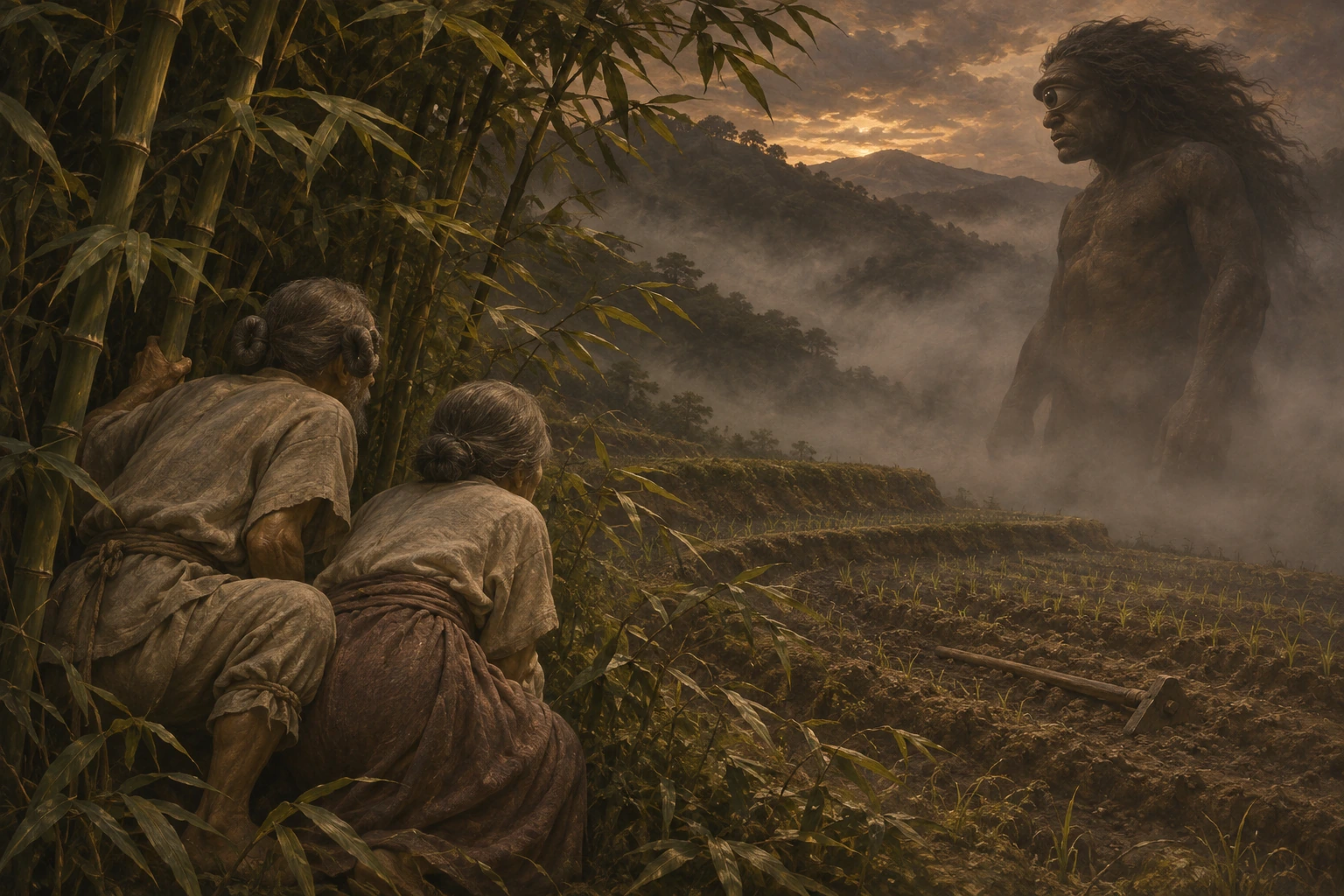
The Izumo Fudoki, the gazetteer of Izumo province completed in 733, explains how places got their names. Under the village of Ayo, in Ōhara district, it tells this story. Long ago someone farmed a mountain field there and kept watch over it. Then a one-eyed oni came and ate the farmer’s son. The son’s father and mother hid in a bamboo thicket, and the bamboo leaves stirred. The son, as he was being eaten, cried out “Ayo, ayo”, “it moves, it moves”. So the place was called Ayo, written 阿欲, and in 726 the characters were changed to 阿用.
That is the whole tale. The text gives the oni one eye and an appetite, and nothing else: no horns, no club, no name. Even its reading is uncertain, for in this period the character 鬼 could also be read mono or kami (see section 2).
1-2 Eaten in One Mouthful
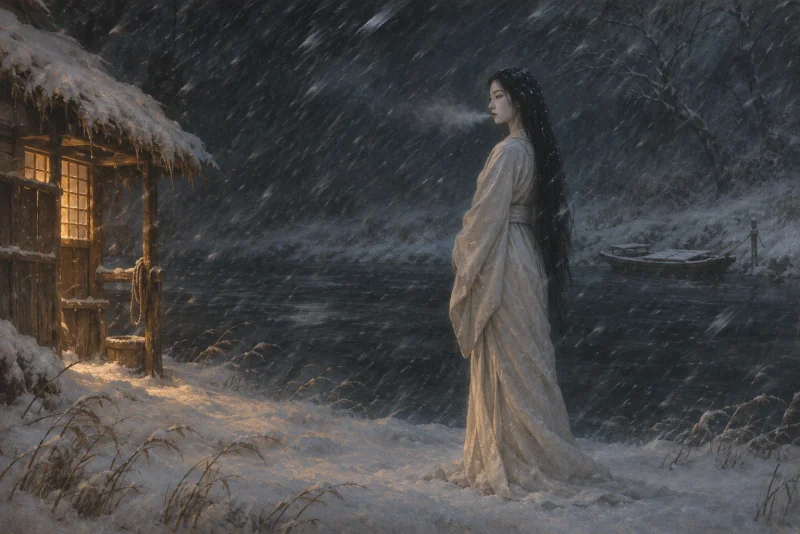
In the sixth episode of the Ise monogatari, a tale-in-poems of the Heian period, a man has courted for years a woman he could never hope to marry, and at last he steals her away by night. As he carries her along the Akuta river, she sees dew on the grass and asks what it is. The way is long and the night late. Thunder and heavy rain break, and not knowing that oni live in the place, he pushes her into the back of a ruined storehouse and stands at the door with his bow and quiver, waiting for dawn. Meanwhile “the oni ate the woman in one mouthful”. She cried out, but the thunder drowned her voice. At daybreak she is gone. He stamps and weeps, and makes a poem: when she asked whether those were white jewels, he should have answered “dew”, and vanished like the dew.
Then the text explains itself. The woman was the future Empress of Nijō, then serving her cousin, an imperial consort, and her brothers Mototsune and Kunitsune, still junior officials on their way to the palace, heard someone weeping and took her back. “That is what is here called an oni.” The phrase oni hitokuchi, “the oni’s one mouthful”, became a byword for mortal danger.
1-3 The Arm at Modoribashi
The best-known oni tale is told of Watanabe no Tsuna (953–1025), one of the four warriors who served Minamoto no Yorimitsu, also read Raikō. The oldest version we have read of is in the “Tsurugi no maki”, the “Book of the Swords”, in the Yashiro text of the Heike monogatari; we follow the summary of the scholar Yamamoto Kichizō in the Heibonsha encyclopedia.
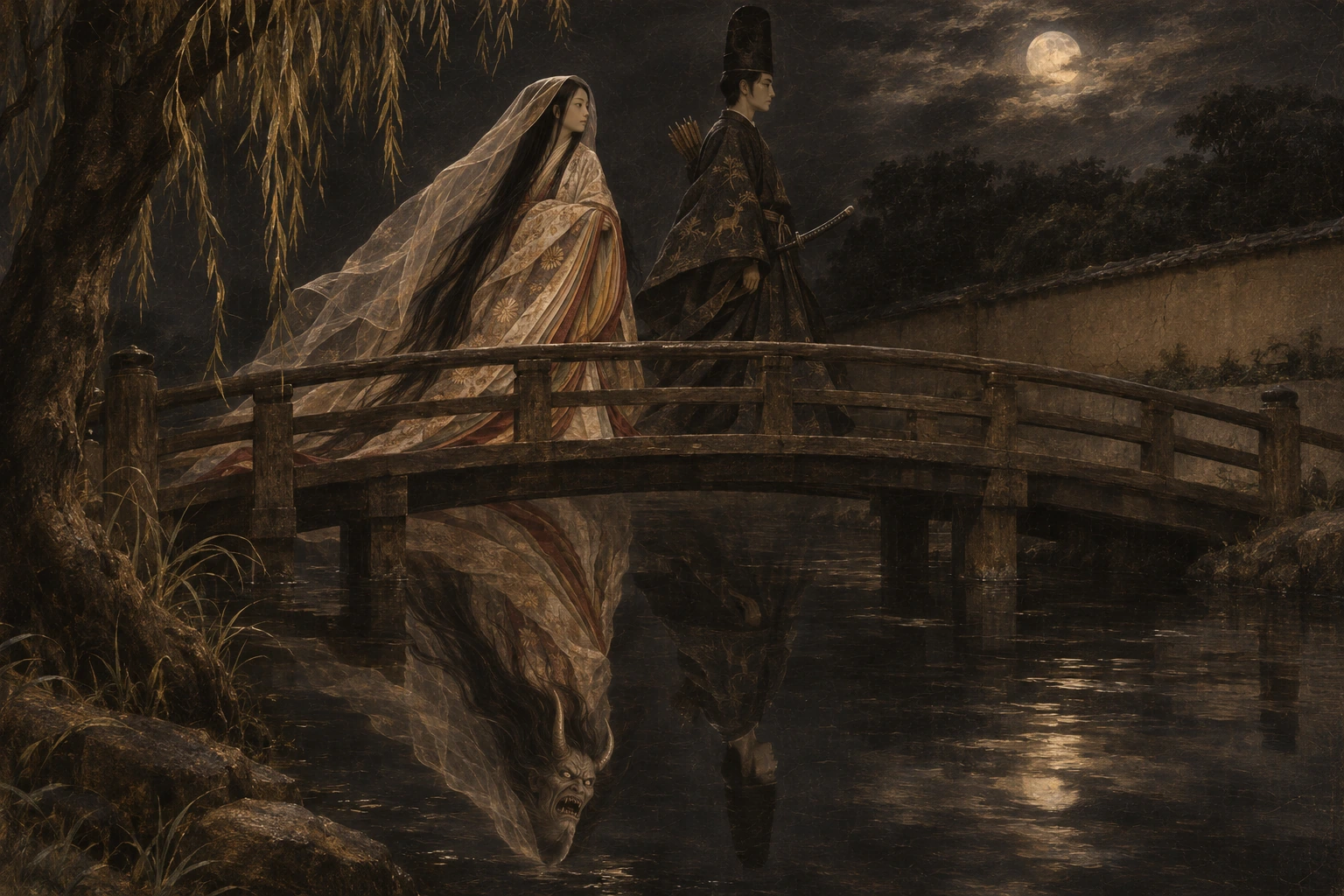
Tsuna met a beautiful woman at Modoribashi, the bridge where Ichijō street crosses the Horikawa stream, and went along with her. At the Gojō crossing she turned into an oni. With Higekiri, the heirloom sword of the Minamoto that his lord had entrusted to him, Tsuna cut off its arm, and the oni flew away towards Mount Atago. On the advice of the diviner Abe no Seimei he shut himself away with the arm under a ritual abstinence, monoimi. Then his foster mother came up from Watanabe, in Naniwa, and begged so hard to see the arm that he showed it to her. She turned into an oni and flew out through the gable of the roof. Since then, the story ends, the Watanabe family has built its houses without gables, and Higekiri was renamed Onimaru.
The book also says who the oni was: the lady of the bridge at Uji, a woman who in her jealousy had prayed at Kibune shrine to become an oni. Komatsu Kazuhiko counts her among the people who turn their own bodies into oni to settle a grudge.
1-4 The Oni at Rashōmon
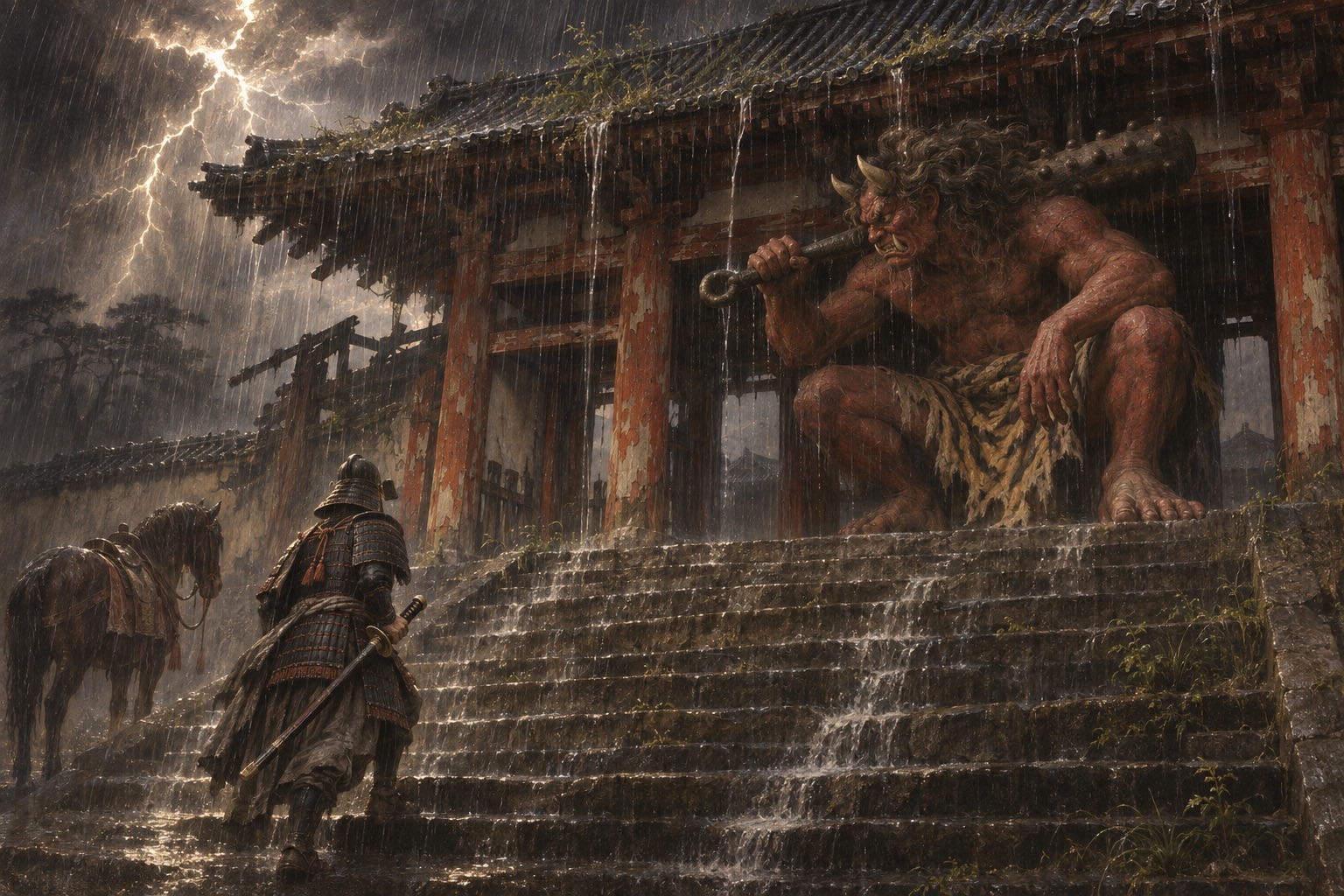
The Noh play Rashōmon, by Kanze Nobumitsu (1435–1516), moves the fight to the great gate at the south end of the capital, which had long fallen into ruin and was said to be haunted by oni. It is a night of spring rain, and Yorimitsu’s men are drinking at his house. Talk turns to a rumour that an oni haunts Rashōmon, and Hirai Yasumasa and Tsuna quarrel over whether it is true. Tsuna rides out through the downpour to see for himself. When his horse balks, he leaves it, climbs the stone steps and sets up a tag to prove he was there. As he turns to go, the oni seizes his helmet from behind. Tsuna snaps the helmet cord, draws his sword and cuts off the oni’s arm, and the oni escapes into the sky.
The oni never speaks a word; the play belongs to the actor who plays Tsuna (Yokomichi Mario, Masuda Shōzō). It opens just after Yorimitsu and his men have come back from Mount Ōe, where they killed Shuten-dōji, the oni chief of the mountain: that is a story of its own.
2 Where the Story Is Written Down
- The word. The Wamyō ruijushō, a dictionary compiled by Minamoto no Shitagō around 934, gives the Japanese reading of 鬼 as oni (於邇), and adds: “Some say oni is a corruption of on, the reading of 隠, ‘hidden’: oni hide and do not wish to show their form.” Watanabe Shōgo quotes it from the ten-volume text in the Nipponica encyclopedia. Yamaguchi Kenji, comparing four manuscripts of the dictionary, argues that this “some say” was added by a later hand. Komatsu Kazuhiko, in the Heibonsha encyclopedia, calls this and the other theories of the word “still guesses”. He notes that the reading oni for 鬼 settled only in the late Heian period: before, the character was also read kami, mono or shiko, and the Konjaku monogatari shū still reads it mono in places. In China, 鬼 (gui) meant the soul of the dead (Mugitani Kunio).
- Izumo Fudoki (733), Ōhara district, Ayo village: the one-eyed oni, in a tale told to explain a place-name. We translate the original text.
- Ise monogatari, episode 6. We quote the text printed in the Gunsho ruijū.
- Ōjōyōshū (985), by the monk Genshin. In its hells, “Gozu, Mezu and the other wardens, weapons in hand”, drive the sinners in among the mountains. As its ideas spread, writes Watanabe Shōgo, the oni of hell were painted, and explained to listeners with the pictures.
- The “Tsurugi no maki”, in the Yashiro text of the Heike monogatari: Watanabe no Tsuna and the oni of Modoribashi, with the lady of Uji.
- Noh. Zeami, in his treatise Fūshi kaden, divides the oni of the stage into two kinds: vengeful spirits that possess the living, as in Aoi no ue, and the oni of hell. Rashōmon is by Kanze Nobumitsu.
- Gaun nikkenroku, the diary of the Zen monk Zuikei Shūhō, which survives only in an excerpt made in 1562. Its entry for the 22nd day of the 12th month of 1447: “Tomorrow is the first day of spring. So at dusk beans were scattered in every room, to the chant of the four characters ‘oni out, luck in’.” The National Diet Library cites it for the bean-throwing.
- Toriyama Sekien, Konjaku gazu zoku hyakki (1779), the sequel to his illustrated catalogue of yokai, Gazu hyakki yagyō. The oni page gives the ox-and-tiger explanation; we read it in the copy of Kyushu University Library.
3 Competing Versions
- Where was the arm cut off? Near the Gojō crossing, after a meeting at Modoribashi, in the “Tsurugi no maki”; at Ōmori in Uda district, Yamato, in the Taiheiki; at the gate itself in the Noh Rashōmon. The otogizōshi tale “Rashōmon” splits the difference: Tsuna first meets the oni at the gate, and cuts off its arm at Modoribashi (Yamamoto Kichizō).
- Who came back for it? Tsuna’s foster mother, in the “Tsurugi no maki”. In the Taiheiki, an oni disguised as an old mother comes to Yorimitsu, who has been given the arm, and is cut down with the sword Onikiri (Nomura Jun’ichi). In the otogizōshi it is Yorimitsu who loses the arm, to an oni posing as his mother from Takayasu in Kawachi. In the legend as Japanese dictionaries give it, the oni of Rashōmon is named Ibaraki-dōji, and comes back for its arm disguised as Tsuna’s aunt.
- Was there an oni at all? In the Ise monogatari, the text itself says that the “oni” was the woman’s brothers.
- One eye, two or four? The oni of Ayo has one. Komatsu describes the usual oni of the tales as having “one or two” eyes. The exorcist who chased oni at court wore four.
- Born or made? For Komatsu, Japanese oni were rarely a race apart. Gods could become oni and oni gods, and people became oni through too much hatred, like the lady of Uji, or through great age: in the Konjaku monogatari shū old women turn into oni women, and in the Tsukumogami ki old tools thrown away become oni called tsukumogami.
- Seen or unseen? Kawamura Kunimitsu, in Kokugakuin University’s Encyclopedia of Shinto, writes that the oni that brought disaster and plague “initially were considered invisible beings, but later came to have visible forms”. The Nihon kokugo daijiten dates the familiar type, the muscular body, the horns and the tiger-skin loincloth, to the Muromachi period, spread by the illustrated otogizōshi tales.
4 History and Tradition
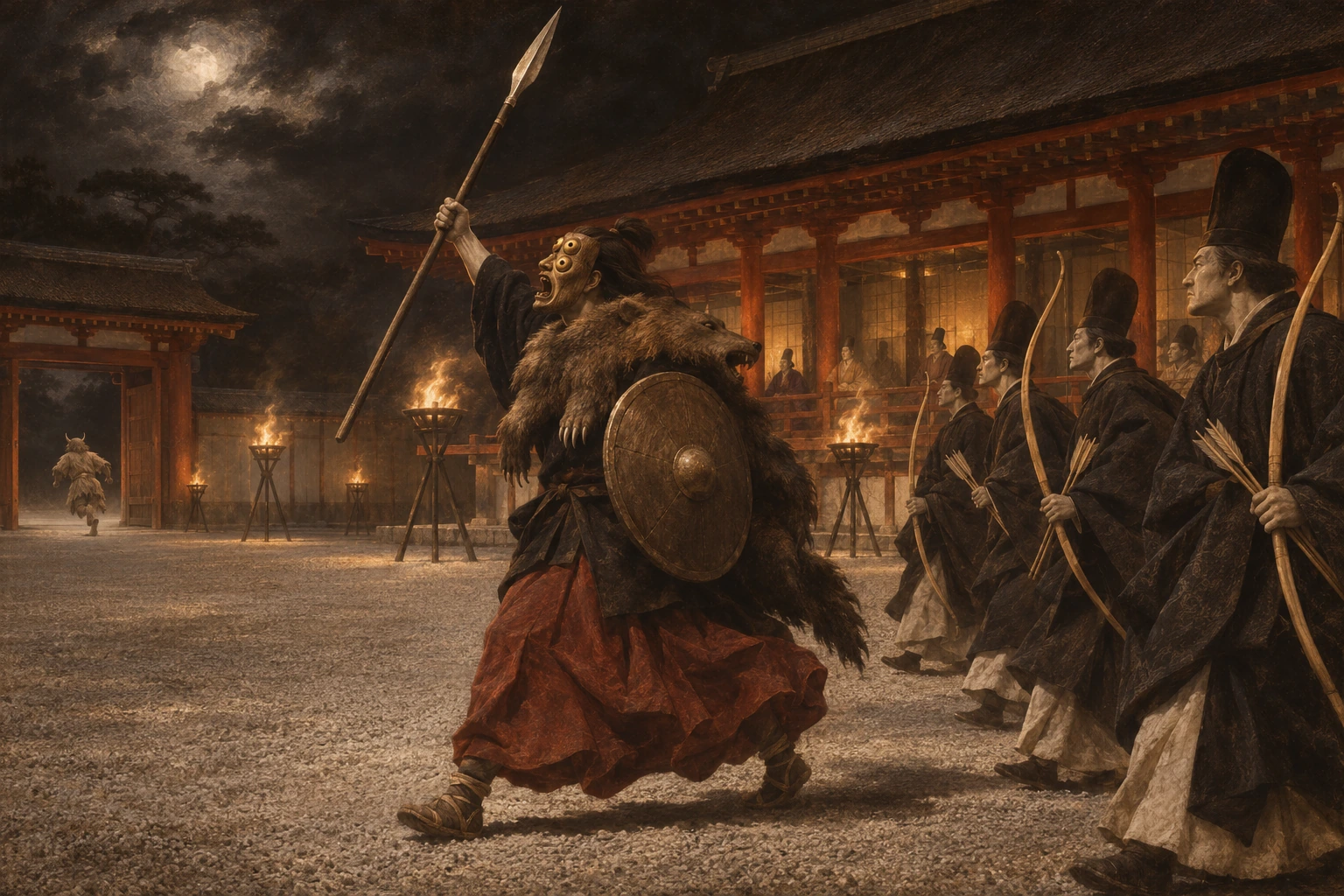
- The court’s exorcism. The tsuina, or oni-yarai, “driving away the oni”, came from the Chinese nuo. In the Zhou li, an exorcist called the fangxiangshi (in Japanese, hōsōshi) wore a bearskin, a mask with four golden eyes, a black tunic and a red skirt, and drove out the demons of plague with spear and shield. In Japan it is first recorded in the Shoku Nihongi for 706, a year when epidemics killed many people in the provinces (Shintani Takanori). By the Engi shiki (927) it was held in the palace on the last night of every year: the hōsōshi gave a great shout and struck his shield three times, and the courtiers chased the oni with bows of peach wood and arrows of reed. In this rite, Itō Yuishin writes, a palace attendant played the oni. But because the hōsōshi looked so strange, people came to think that he was the oni being driven out; the National Diet Library dates the change to the late Heian period.
- Setsubun. The court held its tsuina on the last night of the year until the end of the Kamakura period; it became a rite of Setsubun, the eve of spring, from the Muromachi period (Inokuchi Shōji). The bean-throwing of 1447 is the earliest the National Diet Library cites, and the custom spread to ordinary people in the Edo period. For Inokuchi, scattering beans began as sangu, food scattered as an offering to lesser spirits; Tanaka Sen’ichi records a reading in which the beans are offerings to a god who visits that night. In the comic Kyōgen play Setsubun, an oni from the island of Hōrai comes to Japan for the beans, falls in love with a woman alone at home, and is tricked out of his treasures and pelted out of the door.
- “Oni in”. Not every house shouted “oni out”. Around 1813, when the scholar Yashiro Hirokata sent a questionnaire on customs to the provinces, the reply from Obama in Wakasa said that a few houses chanted “luck in, oni in”. At Kinpusen-ji in Yoshino the cry is “Fuku wa uchi, oni mo uchi”, “luck in, oni in too”: the temple takes in all the oni driven out across the country and makes them mend their ways, as En no Gyōja, the founder of Shugendō, is said to have done with two oni, Zenki and Gōki (Japan Tourism Agency). Families in the Ōmine mountains trace their descent from those two oni (Komatsu).
- Hell’s wardens. Gozu and Mezu, the ox-headed and horse-headed wardens of the Ōjōyōshū, torment sinners with iron forks (Inahata Kōichirō), and fire bursts from their horns (Ishigami Zennō). Komatsu notes that the thunder gods of heaven came to be counted as oni too.
- Women who become oni. The hannya mask of Noh, with two horns and a gaping mouth, shows a woman’s jealousy and rage. Its name is traced to the carver Hannyabō, active in the late 15th or early 16th century (JAANUS). It is worn in Aoi no ue and in Dōjōji, where the woman becomes a serpent; Masuda Shōzō notes that a fiercer mask, ja, “serpent”, is also used in Dōjōji. In Kanawa, a woman abandoned by her husband goes to Kibune shrine by night and is told that if she dresses in red, paints her face red and wears an iron trivet with lit candles on its three legs, she will become an oni while still alive. Her spirit attacks her husband, but the prayers of Abe no Seimei and the guardian gods drive it off (Yokomichi Mario).
- Gods in oni masks. On the Oga peninsula in Akita, young men in oni masks and straw capes, the Namahage, go from house to house on New Year’s Eve (once on the 15th night of the first month), roaring at lazy children; the head of the house receives them in formal dress with sake and rice cakes. Inokuchi Shōji reads them as gods who come from afar at the turn of the year to bless the house. In 2018 UNESCO listed them with nine other rites of masked visiting gods, raihō-shin.
- On the roofs. The end tiles of a roof ridge, onigawara, have carried oni faces since the 8th century, to keep the building safe; horned oni spread on them from the 14th century (Mori Ikuo).
Oni are often taken for pure evil, Japan’s devils. Kawamura Kunimitsu counts “oni as good kami” as one of their three kinds. The Namahage are visiting gods in oni masks. In the Hanamatsuri of northern Aichi, the Sakaki-oni goes from house to house driving out evil spirits and stamps on the sick to heal them. And at Kinpusen-ji, the oni are let in.
5 Related Stories
- Izanagi in Yomi: The Land of the Dead and the First Quarrel: in the ninth variant of book 1, section 5, of the Nihon Shoki, Izanagi throws peaches at the thunder gods who chase him from the land of the dead, and the text adds: “This is the origin of keeping off oni with peaches” (此用桃避鬼之緣也). Aston translated 鬼 here as “evil spirits”, and noted that bows and staves of peach wood were used in the year-end oni-yarahi.
- Momotarō: The Peach Boy: the boy who goes to Onigashima, the island of the oni, with a dog, a monkey and a pheasant. For Watanabe Shōgo, folk tales such as “Momotarō” and “Issun-bōshi” fixed the picture of the oni that every Japanese knows.
- Tengu: The Goblins of the Mountains: the other power of the mountains. Watanabe Shōgo writes that bandits and mountain people, unseen by villagers, were taken for oni or monsters, “the tengu among them”, and that the mountain witch and the tengu, like the oni, often have to be thought of as both good and evil.
- Raijin and Fūjin: Thunder and Wind: in folk belief, Watanabe Shōgo writes, the gods of wind and thunder were often pictured in the same shape as oni, and Komatsu Kazuhiko notes how widely the thunder god came to be seen as one.
- Dokkaebi: The Goblins of Korea: in the tales, Korea’s goblins have no fixed shape. Kim Jong-dae argues that the horns, tiger skins and iron clubs they wear today came from the oni in the pictures of the school readers of colonial Korea: no horns in 1915, horns in the edition of 1923.
6 Sources
- Izumo Fudoki (733), Ōhara district, Ayo village (original text): Wikisource; with “阿用郷”, Nihon rekishi chimei taikei (Heibonsha): Kotobank
- Ise monogatari, episode 6, text of the Gunsho ruijū, vol. 307: Wikisource
- Nihon Shoki, book 1, section 5, variants (original text): Wikisource; W. G. Aston (trans.), Nihongi, 1896, vol. 1, book I: Wikisource
- Toriyama Sekien, Konjaku gazu zoku hyakki (1779), vol. 1 “Rain”, “Oni” (image 3): Kyushu University Library
- Gaun nikkenroku, 22nd day of the 12th month of Bun’an 4 (1447), and the replies to Yashiro Hirokata’s questionnaire, in National Diet Library, “Setsubun and bean-throwing” (Hon no mangekyō 21, chapter 1): NDL
- Heibonsha World Encyclopedia: Komatsu Kazuhiko, Nakamura Shigeko, Sadakata Akira and Mugitani Kunio, “鬼”; Itō Yuishin, “追儺”; Yamamoto Kichizō, “渡辺綱”; Yokomichi Mario, “羅生門” and “鉄輪”; Tanaka Sen’ichi and Hada Akira, “節分”; Inahata Kōichirō, “牛頭馬頭”; Mori Ikuo, “鬼瓦”; Ueno Kazuo, “来訪神”: Kotobank, Kotobank, Kotobank, Kotobank, Kotobank, Kotobank, Kotobank, Kotobank, Kotobank
- Nihon Daihyakka Zensho (Nipponica): Watanabe Shōgo, “鬼”; Shintani Takanori, “追儺”; Inokuchi Shōji, “節分”, “豆撒き” and “なまはげ”; Masuda Shōzō, “般若(能面)”, “羅生門(能)” and “鉄輪”; Nomura Jun’ichi, “羅生門(説話)”; Ishigami Zennō, “牛頭・馬頭”; Kobayashi Seki, “節分(狂言)”: Kotobank, Kotobank, Kotobank, Kotobank
- Seisen-ban Nihon kokugo daijiten, “鬼”, “鬼一口”, “牛頭馬頭” and “茨木童子”; Digital Daijisen, “鬼門”, “来訪神”, “観世信光”, “往生要集” and “出雲国風土記”; Nipponica, “臥雲日件録”: Kotobank, Kotobank, Kotobank, Kotobank, Kotobank, Kotobank, Kotobank
- Yamaguchi Kenji, 「『和名抄』のオニ(於邇)」, Tōhoku Daigaku Chūgokugo gakubungaku ronshū 13 (2008), read in the Internet Archive’s copy: Internet Archive
- Kawamura Kunimitsu, “Oni”, Encyclopedia of Shinto: Kokugakuin University
- JAANUS (Japanese Architecture and Art Net Users System), “hannya” and “Modoribashi”: aisf.or.jp, aisf.or.jp
- Japan Tourism Agency, multilingual explanation “The Setsubun-e Ritual” (Kinpusenji): mlit.go.jp
Cover and illustrations: AI-generated images made for Arcana. They are interpretations, not historical artworks.