Dokkaebi: The Goblins of Korea
They wrestle travellers all night and turn out to be an old broom by morning; they knock gold out of a club and run from the crack of a hazelnut. Their name is in Korean books from 1447, but the horns they wear today, a Korean folklorist argues, were drawn for them in colonial-era school readers.
- Type: folk belief, folk tale and rite: goblins of the night, made from old things, who play tricks, make some people rich, and in places are fed and worshipped as gods
- Culture: Korea, mainland and islands; Jeju and Jindo have dokkaebi rites
- Earliest texts: the word dotgabi in the Seokbo sangjeol (1447); the Samguk yusa (1280s) story of Bihyeong and his spirits, which the Encyclopedia of Korean Culture counts as the first written dokkaebi tale; the folk tales in print from 1910
- Key figures: Bihyeong (鼻荊) and the spirit Gildal (吉達); the woodcutter and the hazelnut; the old man with the lump (hokburi yeonggam); Jeju’s yeonggam
In Korean tales the dokkaebi is what you meet on the road home from market after dark. It asks you to wrestle and keeps asking all night; in the morning, where it fell, you find a worn-out broom. It strikes the ground with a club and gold pours out; it flees from the crack of a hazelnut; it buys the lump on an old man’s cheek because it thinks his songs come from there. It seldom kills anyone. On Jeju, shamans and fishermen call it yeonggam, “Your Excellency”, and feed it.
Is a dokkaebi a ghost? No. A Korean gwisin is the soul of someone who has died. The folklorist Im Dong-gwon, in the Encyclopedia of Korean Culture, sets the dokkaebi apart: it comes from trees and stones, or from things people have handled, a broom, a poker, a pestle, a winnowing basket. It plays spiteful tricks but is “not wicked enough to kill”, and it is easily fooled.
1 The Telling
There is no single dokkaebi story. Below are the oldest written tale, what the tales say of dokkaebi, and the two best known, each with its source.
1-1 Bihyeong and the Bridge of Spirits
The Samguk yusa, book 1, tells it under “Dohwa-nyeo and Bihyeong-rang”. King Jinji of Silla, who came to the throne in 576, wanted a beautiful married woman called Dohwa-rang, the Peach-Blossom Girl. She refused him while her husband lived. That year the king was deposed and died; two years later her husband died too. Then the dead king came to her room at night, as in life, and stayed seven days under clouds of five colours. She bore a son, Bihyeong.
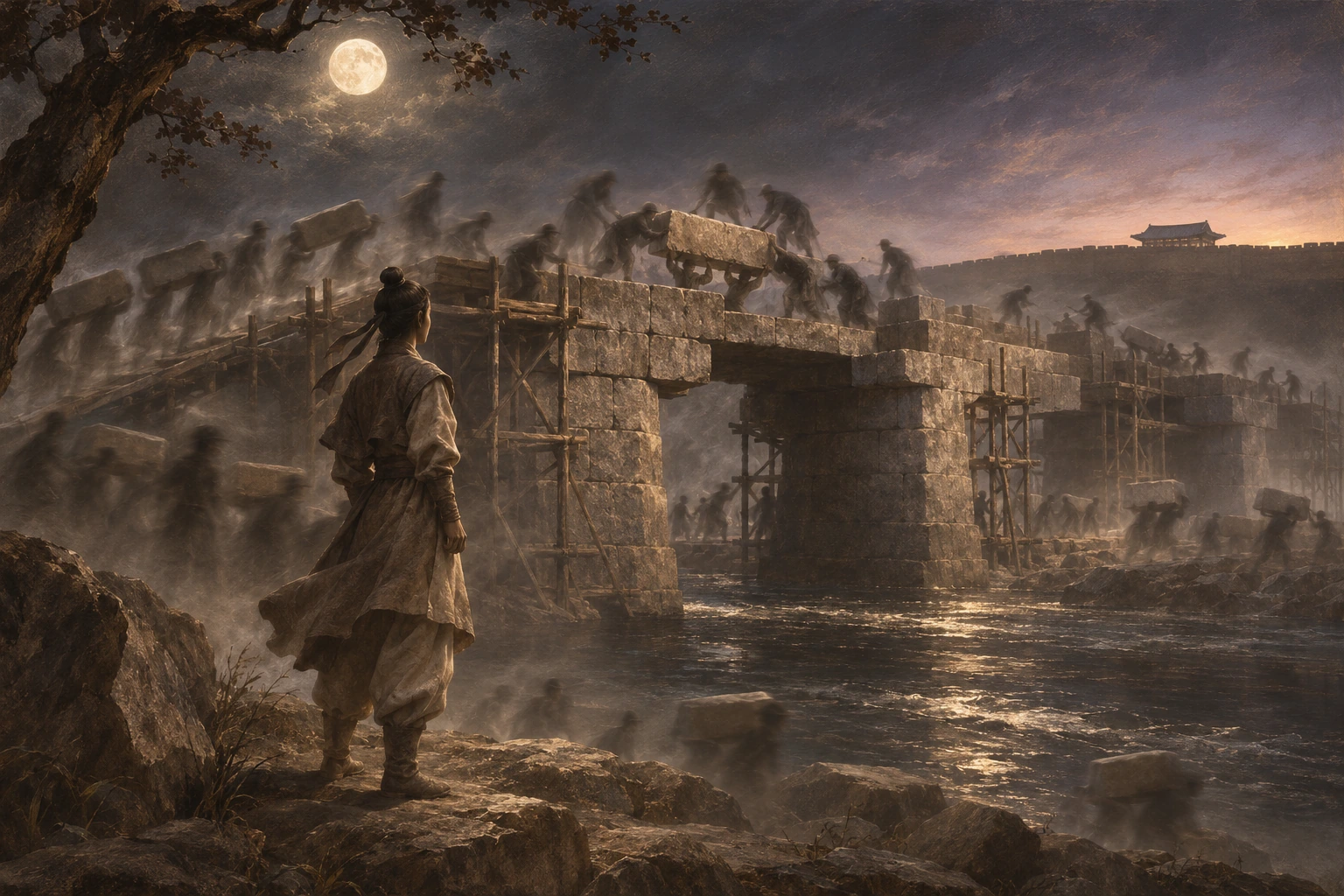
King Jinpyeong raised the boy in the palace. Every night Bihyeong flew over the walls of Wolseong to the bank of the Hwangcheon and played with a host of spirits (鬼衆) until the temple bells rang at dawn. The king asked him to have his spirits build a bridge over the channel north of Sinwon-sa. They dressed the stones and built it in one night: the Gwigyo, the Spirits’ Bridge.
Asked for a spirit who could serve at court, Bihyeong brought Gildal, who served faithfully until one day he turned into a fox and fled. Bihyeong had the spirits catch and kill him, and from then on they ran at his name. People pasted a verse on their doors: “Son born of a sainted king’s spirit, this is Bihyeong-rang’s house; all you flying, racing spirits, do not stop here.” The text says gwi (鬼), spirits. Im Dong-gwon calls it the first dokkaebi story in writing.
1-2 The Broom in the Morning
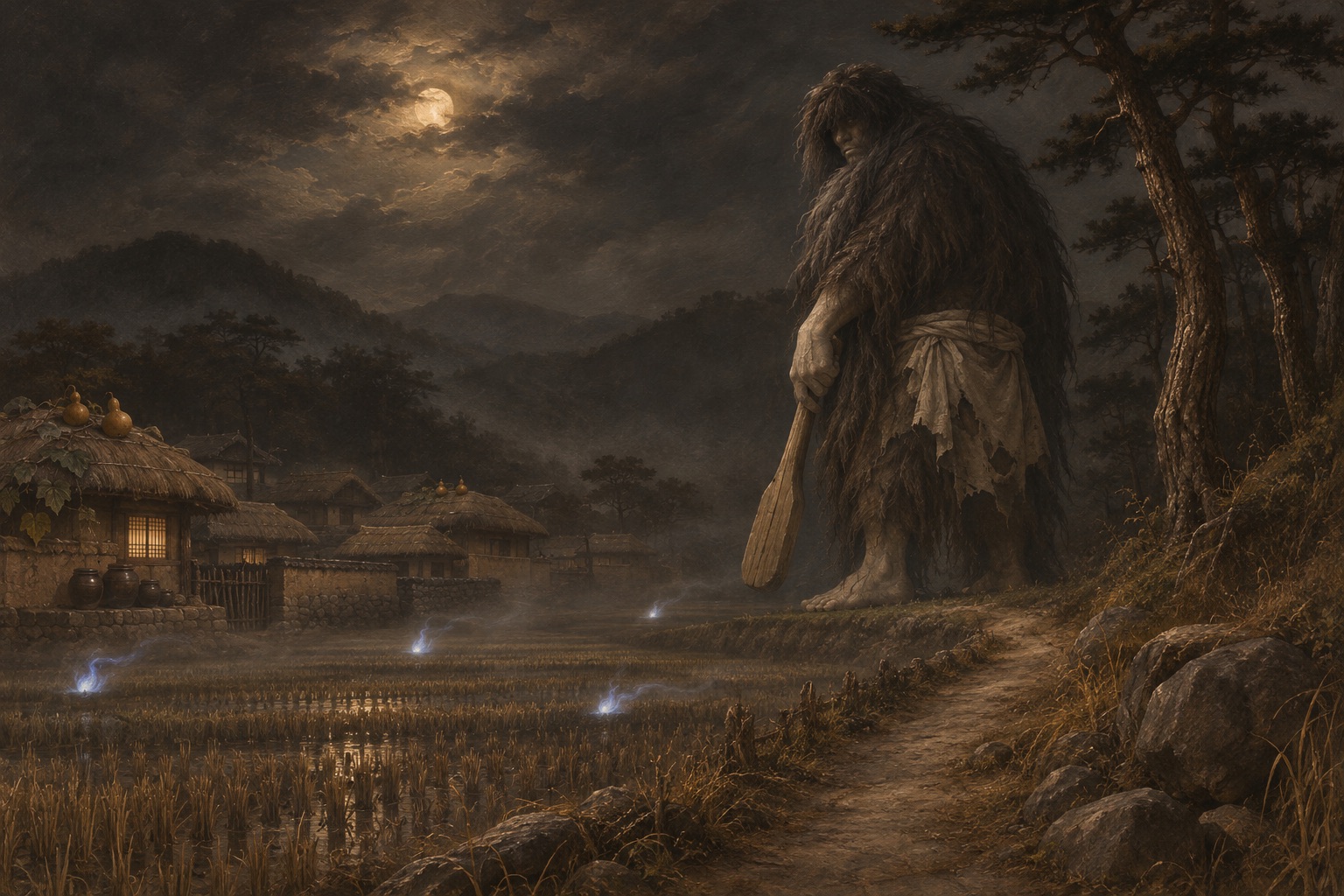
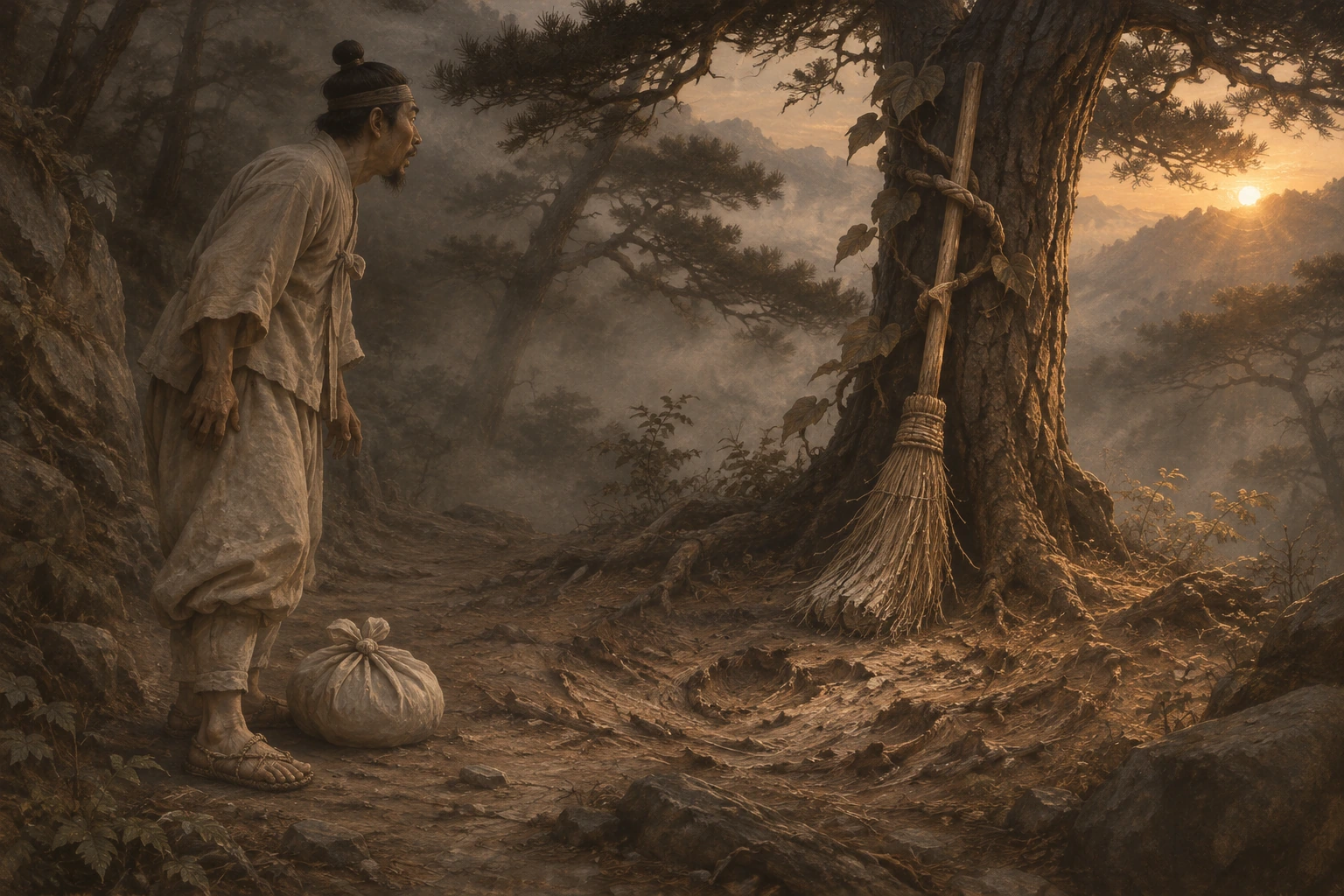
What follows is what the tales recorded across Korea share, as the Encyclopedia of Korean Culture sums them up. A man on his way home from market at night meets a giant as tall as a village post, who challenges him to wrestle. They wrestle almost till dawn; the man stabs the giant in the neck, or ties it to a tree with arrowroot vine. In the morning he brings the villagers, and finds an old flail or a broom with a stick through it.
Dokkaebi, Im writes, are often made from such things: brooms and pokers, straw sandals, pestles, sieves, winnowing baskets, pots, broken bowls and cushions, things worn by human hands or stained with a woman’s blood, which is why country people burn them. They haunt empty houses, old trees, disused wells and mountain paths, love rainy, murky nights, and vanish when the cock crows. They know only one surname, Kim, so they are called “Mr Kim”.
Their fires, dokkaebi-bul, cross the fields at night. They work for food: by a legend of Sangju, dokkaebi built a weir for a promise of red-bean porridge. On Jindo, fishing households scattered buckwheat cakes or buckwheat jelly on the shore, “which the dokkaebi are said to like” (Na Gyeong-su).
1-3 The Club and the Hazelnut
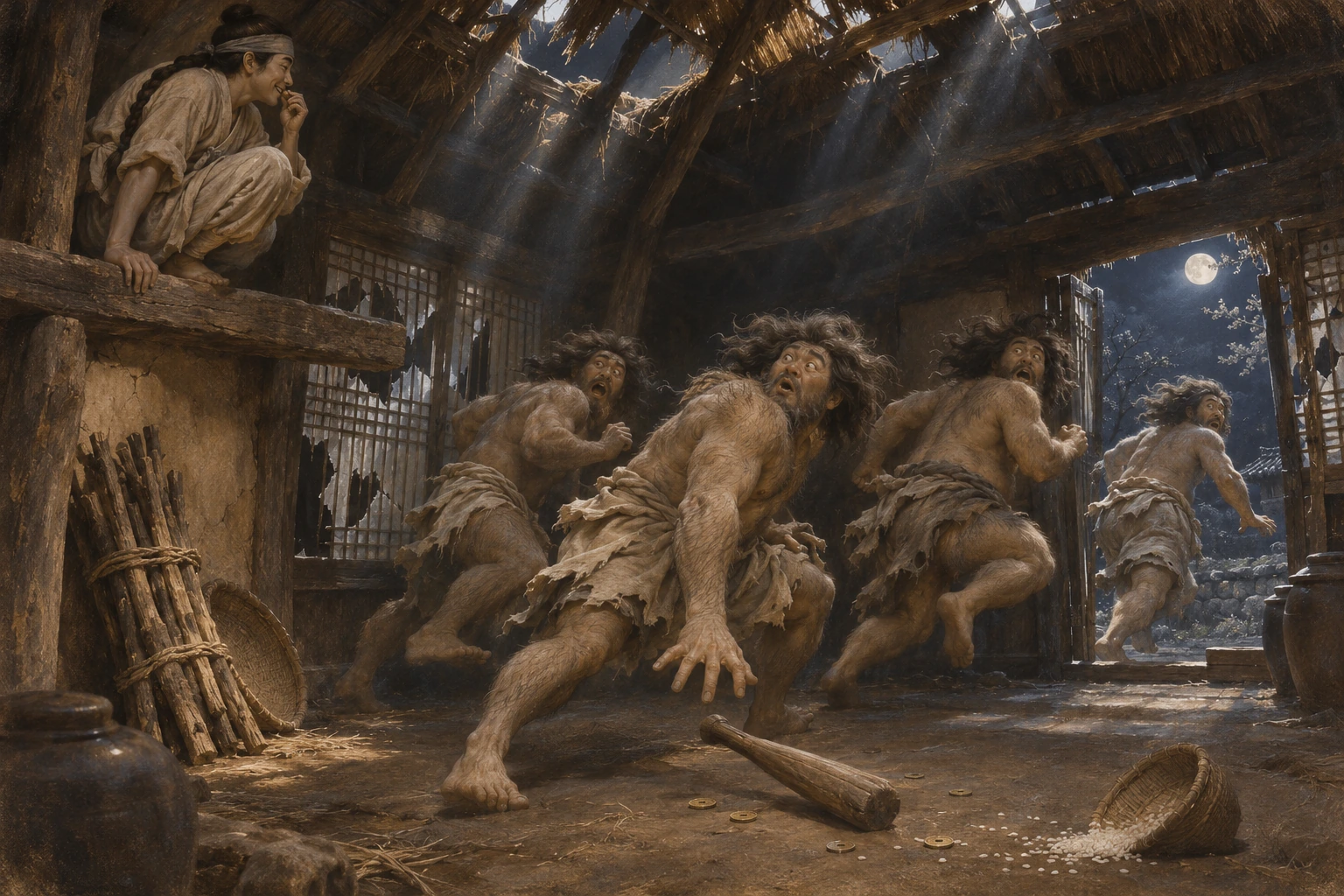
The tale of the dokkaebi bangmangi, the dokkaebi’s club, is summed up in the Encyclopedia by Park Hyun-sook. A good man cutting wood in the hills sees a hazelnut roll towards him: “This one for my father.” Another: “This one for my mother.” A third: “This one is mine.” Night falls, and he shelters in an empty house. Dokkaebi crowd in and beat their club, and out comes whatever they wish for. From his hiding place he bites a hazelnut. At the loud crack the dokkaebi drop the club and run, and he goes home rich.
His neighbour copies him, but keeps the first nut for himself, the next for his wife, the last for his parents. When he bites his nut in the empty house, the dokkaebi are not fooled: they beat him as the thief of their club.
The oldest printing we have found is in Japanese, in Takahashi Tōru’s Chōsen no monogatari-shū (1910). There an honest old man gathers oak nuts for his mother, his wife, his child and himself; the creatures beat the floor with their clubs crying “Gold, come out! Silver, come out!” and flee from the crack of his nut, thinking the old house is falling.
1-4 The Old Man with the Lump
An old man with a lump on his cheek sings where a band of dokkaebi has gathered. They ask where such a voice comes from; from the lump, he says. They take the lump off and give him treasure for it. A neighbour with a lump of his own goes to sing for them too. “Liar,” they say, and stick the first lump on his other cheek (Encyclopedia of Korean Culture). In Takahashi’s 1910 version they explain why: they paid good money for the first lump, stuck it on, and could not sing a note. They stick it beside his own and go off laughing at human folly.
2 Where the Story Is Written Down
- The word. Dotgabi appears in the Buddhist Seokbo sangjeol (1447): people kill animals for the spirits and “invite the dotgabi to beg for blessings and long life”. The line follows a sentence of the Medicine Buddha Sutra, which in Xuanzang’s Chinese has 魍魎 there. In the Worin seokbo (1459), “魅 is a dotgabi”. Later glossaries give dokgabi for “yaksha spirit” and “fox spirit” (1690), “the dokgabi’s fire” for 鬼火 (1748), and dokgabi for 魍魎 (1880) and “one-legged ghost” (獨脚鬼, 1895) (National Institute of Korean Language). Kim Jong-dae reads the 1447 line as evidence that people then kept dokkaebi as household gods, and derives the word from dot, “fire” or “seed”, and abi, “grown man”.
- The Samguk yusa of the monk Iryeon (1280s), book 1: Bihyeong and the spirits’ bridge.
- The Sinjeung Dongguk yeoji seungnam (1530), the royal gazetteer, under Gyeongju: the people there still pasted Bihyeong’s verse on their doors, “the beginning of the Duduri of the Eastern Capital”. They worshipped a spirit called Mokrang, “the wooden lad”, “commonly called Duduri”, and “since Bihyeong the custom of serving Duduri has flourished”.
- The Uji shūi monogatari, a Japanese tale collection of around 1220, has the lump tale as “Oni ni kobu toraruru koto”.
- Kang Hang (1567–1618), a Korean scholar held prisoner in Japan from 1597 to 1600, wrote “Yugye” (“A Warning about Lumps”), printed in his Sueun-jip (1658). A Japanese monk he calls Shun shuso told him the story.
- Takahashi Tōru, Chōsen no monogatari-shū (1910): “Kobutori” and “Oni kingin-bō o ushinau”, with a note that Koreans call all spirits and demons tokkebi, that every old tree, mountain and river has one, and that “ignorant men and women” revere them greatly.
- School readers and children’s books. The Government-General’s Korean-language reader printed the lump tale in 1915 as “The old man with a lump”; its Chōsen dōwa-shū (1924) printed the club tale much as it is told today. For both as told in villages, the Encyclopedia cites the Academy of Korean Studies’ survey of oral literature, the Hanguk gubi munhak daegye (1980–1988).
3 Competing Versions
- Korean tale or Japanese? The lump tale is missing from the written tale collections of late Joseon. One view in the Encyclopedia holds that it came from Japan with the 1915 reader; another, that it was Korean all along and the colonial government used it because it matched the Japanese one. Kim Jong-dae calls the reader’s tale Japanese. Kang Hang’s “Yugye” shows a Korean writer hearing the tale from a Japanese monk three centuries earlier; Takahashi printed it as a Korean tale five years before the reader.
- Sing or dance? In the Uji shūi monogatari the old man dances for the oni, red ones dressed in blue, black ones in red loincloths, some one-eyed, some without mouths, and they keep his lump as a pledge that he will come back. Kang Hang’s version, set in Luzon, also has a dance and a pledge, and the second man hangs himself. In the Korean versions he sings, and the dokkaebi buy the lump.
- Which nut? A hazelnut in Park’s summary, an acorn for Im Dong-gwon, an oak nut in Takahashi. In some versions the greedy man is not beaten but has his arms and legs stretched.
- An older club. The Youyang zazu of Duan Chengshi, of the Tang dynasty, tells of Bang-i of Silla, who watched children in red strike a rock with a golden awl to call up wine and food, took the awl and grew rich; his greedy brother came home with a nose like an elephant’s. Park counts it as an early written form of the club tale, and as one root of the Heungbu-jeon.
- One leg or a giant? Im gives dokkaebi one leg, which is how wrestlers beat them, and points to the Chinese Baopuzi, where a mountain spirit is “like a small child, with one foot”. Kim Jong-dae’s tellers spoke of a hairy fellow “as big as a village post”.
- No club on Jeju. Kim Seon-hui finds no club tale on Jeju, where the yeonggam god plays its part.
- Dokkaebi tiles? Roof tiles with a glaring face (gwimyeonwa) are popularly called dokkaebi tiles. Kim Jong-dae says the design came from China; the art historian Kang Woo-bang, a former director of the Gyeongju National Museum, argues that the Silla tiles show dragons.
4 History and Tradition
- Jeju’s yeonggam. On Jeju the dokkaebi is dochaebi, honoured as yeonggam or chambong, titles of the gentry, which Jeong Jin-hui reads as commoners’ satire. By the Yeonggam bonpuri he is the seventh son of a minister Heo in Seoul. He loves pork, sorghum porridge and soju, haunts misty nights, and follows divers and widows home, making them ill. Treated well, he makes a household rich and drives shoals to the fishermen, and he is kept as a household god, a god of fishing boats, of the smithy or of a village shrine. In the yeonggam-nori, played to cure the sick, he comes in a paper mask, an old horsehair hat, a worn coat and straw sandals, chats with the shaman, and leaves in a little straw boat set afloat (Jeong Jin-hui).
- Jindo’s dokkaebi-gut. On the island of Jindo, married women went from house to house at night in paper masks or faces blackened with charcoal, beating pot lids and anything that rang, behind a pole hung with an underskirt stained with menstrual blood, to drive the dokkaebi out of the village. No man could watch. Jeong Byeong-ho dates it to the first day of the second lunar month; Na Gyeong-su to the eve of the first full moon, and to years of epidemic.
- Fires and harvests. On the nights of the fourteenth and fifteenth of the first lunar month, people watched the dokkaebi fires: moving east to west, they meant a good harvest; west to east, a bad one (Im Dong-gwon).
- The first picture. The picture counted as the oldest of a dokkaebi is in an album painted by Heo Ryeon in the late 19th century: a small, pale, child-like figure holding a torch to lead the filial son Chae Hong-nyeom through a storm to his father’s memorial rite.
- The horns. Kim Jong-dae, who wrote his doctoral thesis on dokkaebi tales in 1993, argues that the horned dokkaebi is the Japanese oni. He traces it to the pictures for the lump tale in the colonial readers: no horns on the dokkaebi in 1915, horns added in the edition of 1923, the present look fixed from the 1940s. Already in Takahashi’s 1910 Japanese, the club tale’s dokkaebi are written 鬼, oni, with “gold and silver clubs”. Against him, the folk-painting collector Zo Za-yong held that the goblins of all East Asia began in Korea, and all have horns (reported by Lee Jong-ho).
Dokkaebi are now usually drawn with two horns, a tiger-skin loincloth and a studded iron club: the dress of the Japanese oni. The tales give them no fixed shape: a hairy giant, a one-legged wrestler, a fire, a broom by morning. Their bangmangi is a carved club that knocks out gold. On Jeju the dokkaebi god comes in a paper mask and a worn horsehair hat. Kim Jong-dae dates the horns to a school reader of 1923.
5 Related Stories
- Oni: The Ogres of Japan: the Japanese ogres whose horns, tiger skins and iron clubs the modern dokkaebi borrowed, Kim Jong-dae argues. The oni post’s tsukumogami, old tools thrown away that become oni, share a theme with the dokkaebi born of a worn-out broom; we have not found a scholar who compares them.
- Tengu: The Goblins of the Mountains: Nomura Keiko notes that in the Edo-period Seisuishō it is a tengu, not an oni, that takes the lump, from a tonsured layman.
- Heungbu and Nolbu: The Swallow’s Gourds: Park Hyun-sook counts the Bang-i tale, whose golden awl is an older form of the dokkaebi’s club, among the sources of the Heungbu-jeon; in the spoken versions of the Bang-i tale, the Encyclopedia of Korean Culture notes, the poor brother wins his club by frightening dokkaebi with the crack of a hazelnut.
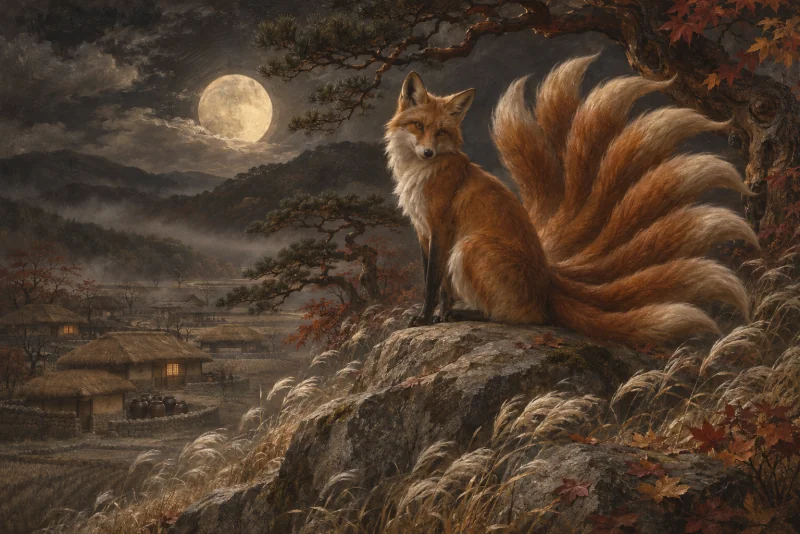
- Gumiho: The Nine-Tailed Fox of Korea: in Bihyeong’s tale in the Samguk yusa, the spirit Gildal escapes by turning into a fox.
6 Sources
- Iryeon, Samguk yusa, book 1, “Dohwa-nyeo Bihyeong-rang”, 1512 Gyujanggak print: Chinese Wikisource, Chinese Wikisource, Chinese Wikisource
- Seokbo sangjeol 9:36b (1447) and Worin seokbo 21:91a (1459), with the later glossaries, in the “history” section of Urimalsaem, “도깨비”: National Institute of Korean Language; Xuanzang (trans.), Yaoshi liuliguang rulai benyuan gongde jing: Chinese Wikisource
- Sinjeung Dongguk yeoji seungnam, book 21, Gyeongju, with Korean translation: Korean Classics DB, Korean Classics DB
- Uji shūi monogatari, book 1, “Oni ni kobu toraruru koto”, text of the Kokushi taikei, vol. 17 (1901): Japanese Wikisource
- Kang Hang, “Yugye”, Sueun-jip, book 3: Korean Classics DB
- Duan Chengshi, Youyang zazu, sequel, book 1: Chinese Wikisource; Ge Hong, Baopuzi, quoted in Taiping yulan, book 886: Chinese Wikisource
- Takahashi Tōru, Chōsen no monogatari-shū (Nikkan shobō, 1910), “Kobutori” and “Oni kingin-bō o ushinau”: National Diet Library
- Encyclopedia of Korean Culture: Im Dong-gwon, 도깨비; 도깨비 설화; Park Hyun-sook, 도깨비방망이 설화; 혹부리 영감 설화; 방이 설화; Jeong Byeong-ho, 도깨비굿; Jeong Jin-hui, 영감놀이
- Digital Jindo Culture Encyclopedia: Na Gyeong-su, 마을신앙 and 정월대보름; Lee Yun-seon and Park Jong-o, 민속놀이
- Kim Seon-hui, “제주도 도깨비담의 특징”, Inmunhak yeongu 25 (Jeju National University, 2018), abstract: earticle
- Heibonsha World Encyclopedia: Nomura Keiko, “瘤取爺”; Konno Tōru, “宇治拾遺物語”; Kang Jae-eon, “姜沆”; Yoshida Mitsuo, “東国輿地勝覧”: Kotobank, Kotobank, Kotobank, Kotobank
- Interviews with Kim Jong-dae: Seoul Shinmun, 27 April 2000: seoul.co.kr; Weekly Kyunghyang, 4 August 2015: khan.co.kr
- Kang Woo-bang on the Silla tiles, Seoul Shinmun, 4 September 2000: seoul.co.kr
- Lee Jong-ho, “새로 태어나는 도깨비(2)”, 31 December 2004, on Zo Za-yong: korea.kr
Cover and illustrations: AI-generated images made for Arcana. They are interpretations, not historical artworks.