Samsin Halmeoni: The Goddess of Birth
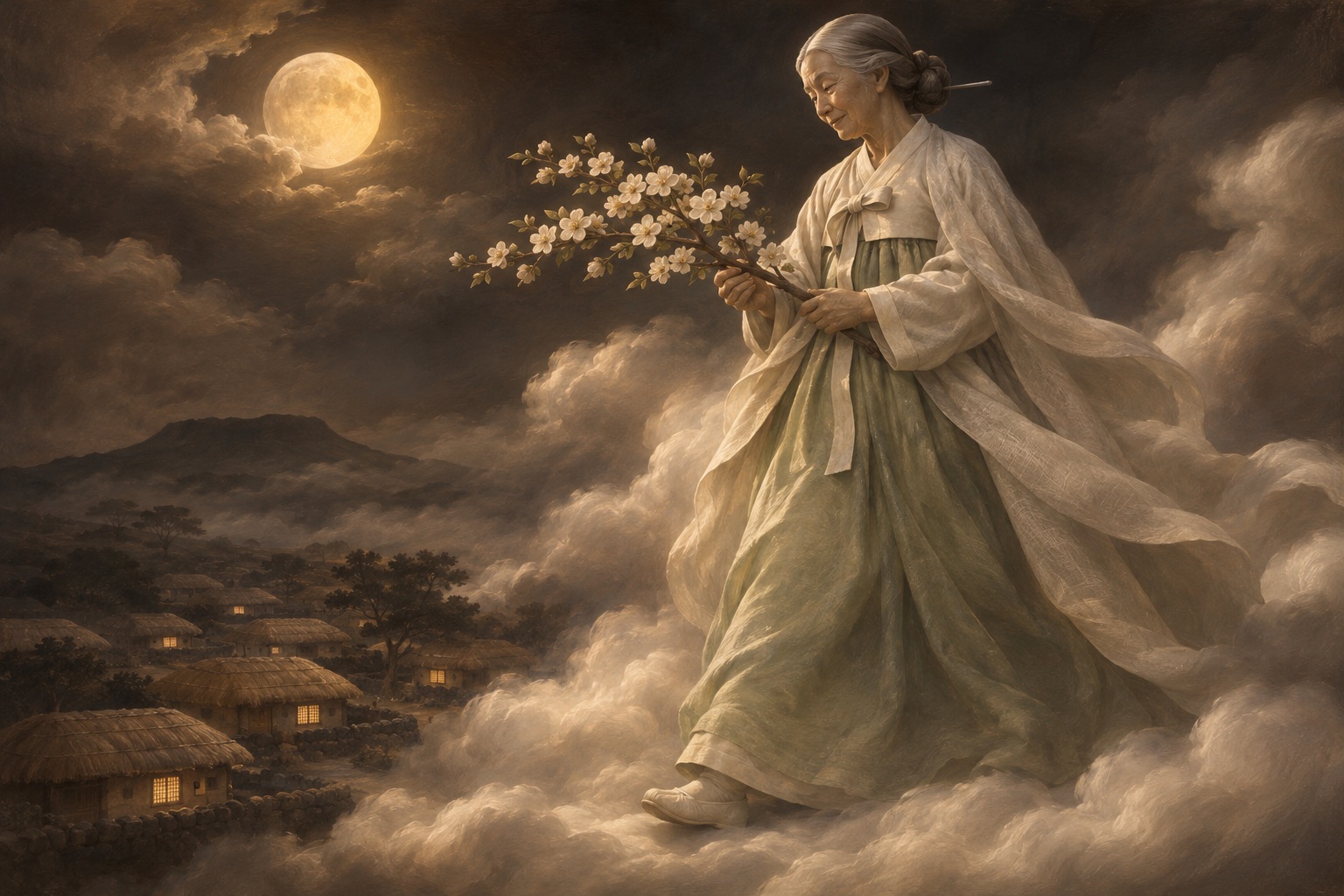
After a birth, Korean families set the first bowl of rice and seaweed soup before Samsin Halmeoni, the grandmother who gives children and guards them while they are small. How she won the post is sung only in Jeju: a flower contest in heaven, lost by the Dragon King's daughter.
- Type: goddess of birth, worshipped in the home; her origin is told in a Jeju shamanic song
- Culture: Korea; the myth of how she won her post is Jeju’s
- Earliest texts: the Jeju Samseung halmang bonpuri, an oral song, read today in the collections of shamans’ songs published by Hyeon Yong-jun (1980) and Jin Seong-gi (1991); the table set for her already appears in the woodblock Simcheong-jeon of Jeonju, carved in 1906
- Key figures: Samsin Halmeoni (三神), called Samseung Halmang in Jeju; the daughter of Myeongjin-guk; the daughter of the Dragon King of the Eastern Sea, who becomes Jeoseung Halmang; Okhwang Sangje (玉皇上帝); Danggeum-aegi
When a Korean child was born, the first meal of rice and seaweed soup did not go straight to the mother. It was set on a small table for Samsin Halmeoni, Grandmother Samsin, with a prayer for the child’s health, and only then did the mother eat it. Samsin was believed to grant the child, bring it safely into the world and watch over it while it was small. Households all over Korea worshipped her. Only Jeju tells how she got the post.
Does Samsin Halmeoni have a myth of her own? Yes, but it is sung in Jeju. Belief in her is found all over Korea, writes the scholar of oral literature Jeong Jin-hui, yet a myth like Jeju’s Samseung halmang bonpuri is found nowhere else. On the mainland, many versions of the song of Danggeum-aegi end with her seated as samsin. It is the Jeju song that tells, in the folklorist Jang Ju-geun’s words, “in detail” how the goddess came to rule birth.
1 The Telling
This is the Jeju song as the folklorist Hyeon Yong-jun retells it in the Digital Jeju Culture Encyclopedia. Section 3 shows where other versions differ.
1-1 The Dragon King’s Daughter
The Dragon King of the Eastern Sea married the daughter of the Dragon King of the Western Sea. They were past forty and still had no child, so they went to pray at Gwaneumsa, a temple of the bodhisattva Gwaneum, and a daughter was born to them.
They spoiled her, and she grew up into every kind of mischief. When she was seven, her father could bear it no longer and meant to kill her. Her mother held him back: they would shut the girl in an iron chest and put her out to sea instead.
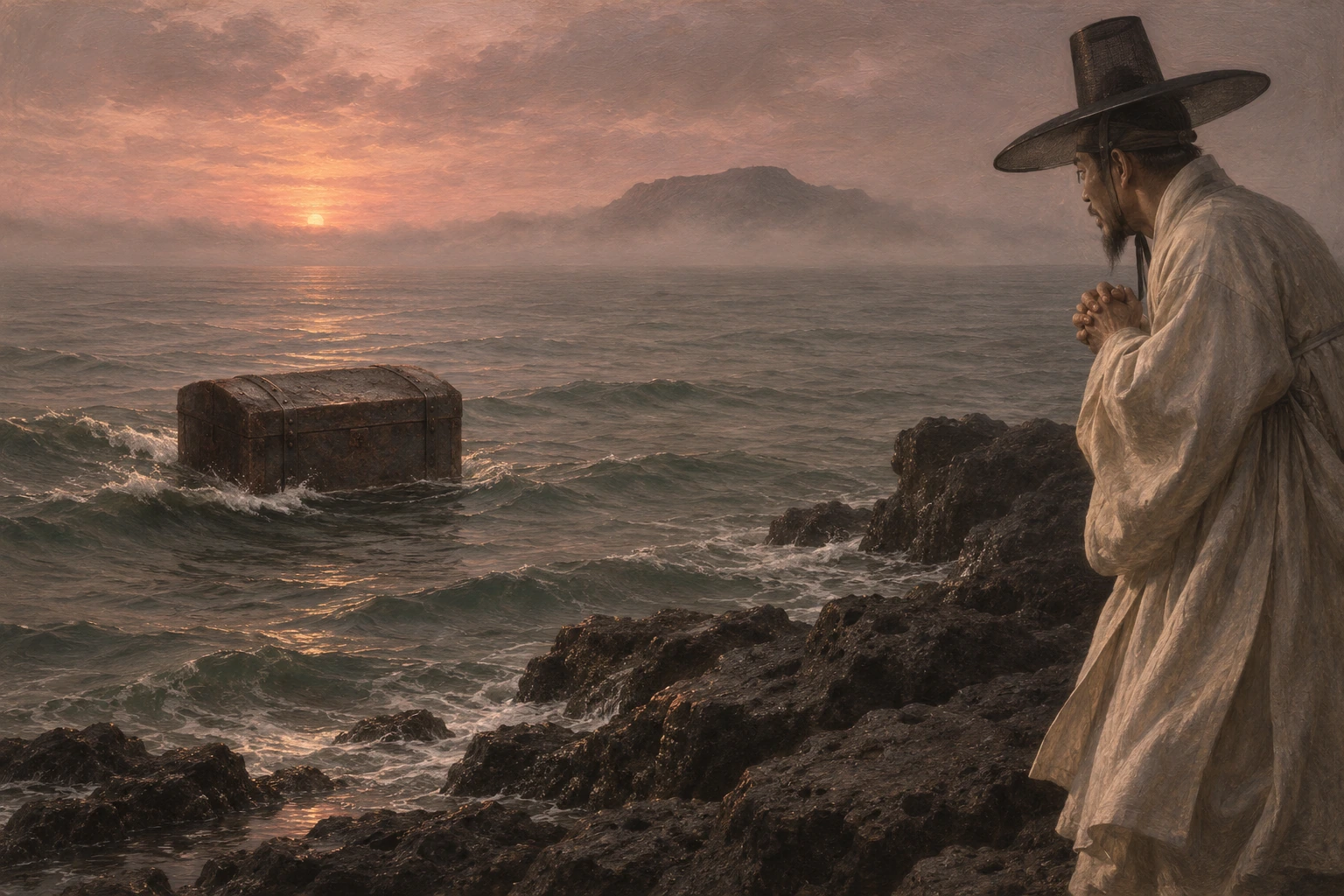
Before she closed the lid, the mother told her daughter to go to the human world and become the grandmother who gives life. She taught her how to give a woman a child. But the chest was shut before she could teach her how to bring the child out.
The chest drifted three years on the water, three years under it and three years along the shore, until it came to Im Baksa, a scholar who had no children.
1-2 The Child Who Could Not Be Born
Im Baksa took the girl home, and she gave his wife a child. Three months and ten days went by, then twelve months, and still the child did not come: she had never learned how. In the version the Encyclopedia of Korean Culture summarizes, she tried in her haste to bring it out through the mother’s armpit, and mother and child came close to death.
Im Baksa climbed Mount Geumbaek, set up an altar to the Seven Stars and told Okhwang Sangje, the Jade Emperor, what had happened. Okhwang Sangje chose the wise daughter of Myeongjin-guk to be the goddess of birth and sent her down.
1-3 Two Goddesses for One Post
Myeongjin-guk’s daughter came down and did the work. The Dragon King’s daughter flew at her and beat her. “It was my seed that was sown,” she said. “Who are you to reap it?” In the end the two agreed to go up to heaven and let Okhwang Sangje decide.
1-4 The Flower Contest
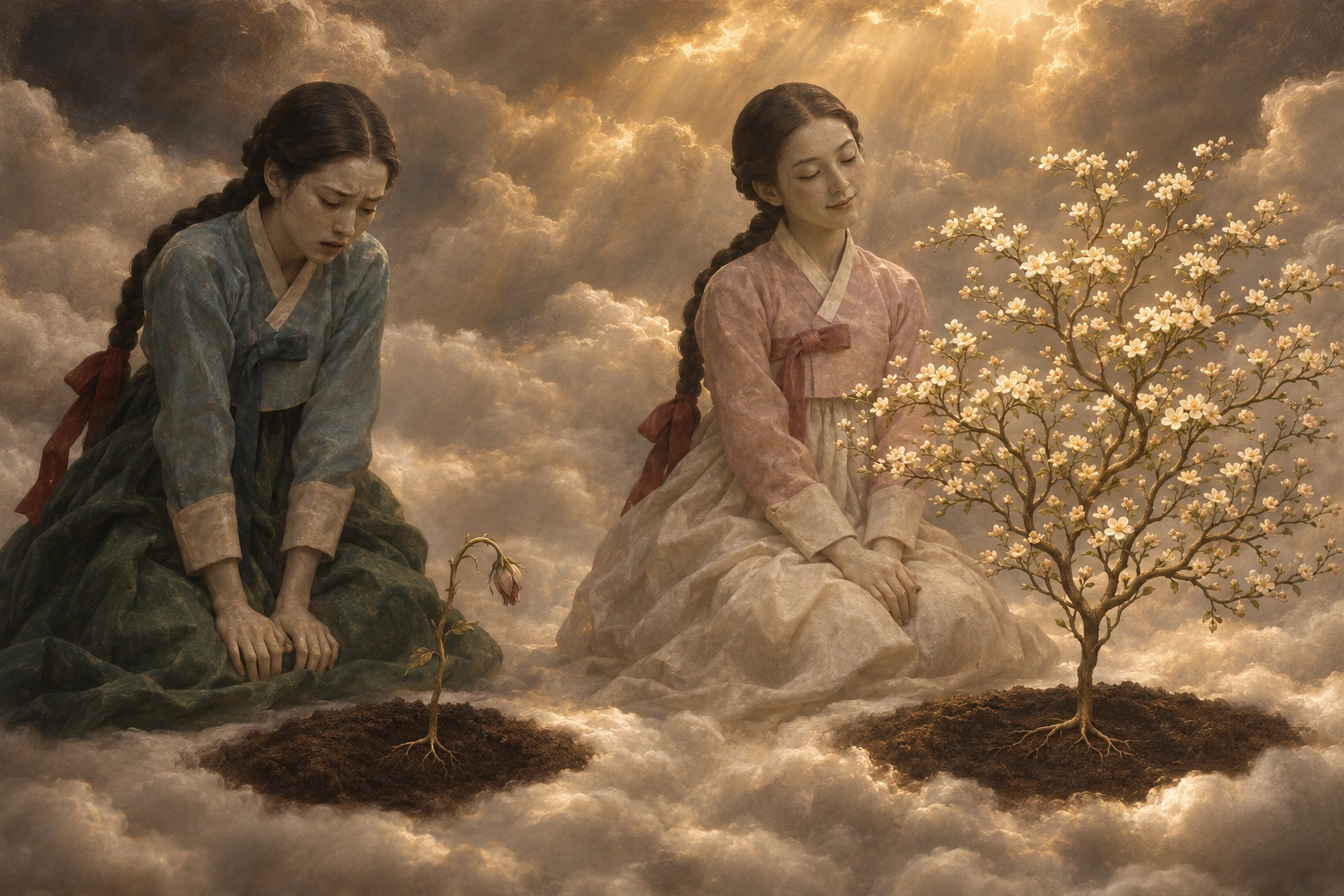
Okhwang Sangje gave each of them a flower seed: whoever’s flower flourished would be the grandmother who gives life. The Dragon King’s daughter’s flower came up with one root, one branch and one shoot, and began to wither. Myeongjin-guk’s daughter’s had one root and forty-five thousand six hundred branches.
The Dragon King’s daughter protested. After all her work in the human world, was it to be handed to someone else? Okhwang Sangje questioned her. How long would she keep a child in the womb? “Three or four months if I’m busy, twelve if I’m slow.” And when the child was born, what would she do? “Tear off the navel cord…” “Enough,” said Okhwang Sangje.
Myeongjin-guk’s daughter passed his test and became Samseung Halmang. Ever since, says the Encyclopedia of Korean Culture, she goes busily about with flowers from the Western Flower Garden, flowers that decide a child’s fate, granting children, helping them safely into the world and raising them until they are fifteen.
1-5 The Grandmother of the Other World
Samseung Halmang meant to send her rival to the Western Flower Garden. The Dragon King’s daughter refused. She had put work and love into the human world, she said; she would look in on it now and then and take an offering. “Then so be it,” said Okhwang Sangje. “It is a land you love. Come back to it when you are hungry.” He sent her to the other world to take the souls of children who die, and she became Jeoseung Halmang, the grandmother of the other world, also called Gu-samseung Halmang.
Still angry, she broke off a branch of Samseung Halmang’s flower and swore that once a child was a hundred days old, she would send it convulsions and every other illness. Samseung Halmang soothed her: whenever a child was born, food would be set out for her, so let her be kind. That, the entry says, is why a table of food is still set for Jeoseung Halmang when a child falls ill.
2 Where the Story Is Written Down
- The Samseung halmang bonpuri (“the origin of Grandmother Samseung”) is a song of Jeju’s shamans, the simbang. It is sung in the Buldomaji, the rite held to pray for a child, a safe pregnancy or a sick child’s recovery, either within a great gut or on its own. In the part called halmang-giltchim, the shaman sings the goddess’s story while clearing and smoothing the road by which she comes.
- The texts. The Encyclopedia of Korean Culture names as its sources the two large collections of Jeju shamanic songs: Hyeon Yong-jun’s Jejudo musok jaryo sajeon (Singu Munhwasa, 1980; revised edition, Gak, 2007) and Jin Seong-gi’s Jejudo muga bonpuri sajeon (Minsokwon, 1991).
- The mainland song. The Jeseok bonpuri, the song of Danggeum-aegi, is sung in shamans’ rites all over the peninsula, under a different name in each region. Hong Tae-han counts some eighty versions recorded as of 2022 (section 3).
- The customs in a novel. In the woodblock Simcheong-jeon printed in Jeonju (the 71-leaf edition, carved in 1906 and published in 1911), the blind Sim waits out his wife’s labour with a handful of straw and a bowl of clean water on a small table. He prays to “Samsin Jewang” that she may give birth as easily “as a cucumber seed slips through an old skirt”. After the birth he cooks the first rice soup, sets it on the samsin table, prays for the child’s long life and health, and then feeds it to the mother. When she falls ill, he wonders whether Samsin has taken offence.
3 Competing Versions
- Does samsin mean “three gods”?
- The usual spelling, 三神, says so. The Standard Korean Language Dictionary defines the word as “the three spirits who grant a baby and look after the mother and the newborn”. It lists separately another 三神, the trinity of Hanim, Hanung and Hangeom in Daejonggyo, the religion that honours Dangun: a different idea altogether.
- Jang Ju-geun reads it otherwise. From words such as samjul, he argues, sam first meant the womb, and samsin was the god of the womb. The dictionary still has both words: sam, “the membranes and placenta that wrap the fetus”, and samjul, the umbilical cord. The folklorist Im Seok-jae writes her name with the characters 産神, “god of birth”.
- Three is not foreign to her, though. In the Jeseok bonpuri, Danggeum-aegi bears three sons. Jang notes that in some versions she becomes samsin, and in others the title goes to the Three Buddha Jeseok, a trio of gods whose origin the same song tells.
- Driven out or to be killed? In Jeong Jin-hui’s summary, the Dragon King means to drive his daughter out for her misdeeds; in Hyeon’s, to kill her.
- What happened at Im Baksa’s house? In Jeong’s summary, mother and child come close to death. In Hyeon’s short entry on Samsin Halmang, the Dragon King’s daughter kills the baby.
- One test or two? Jeong’s summary has only the flower contest. Hyeon’s has the flowers, then the questions.
- Who is in the song? Some versions tell only the story of Myeongjin-guk’s daughter, and many tell both goddesses’. Some add the Manura bonpuri: Manura, the god of smallpox, slights Myeongjin-guk’s daughter, and when his daughter-in-law (or wife) cannot give birth, he has to beg her pardon.
- Until what age? In Jeju the goddess looks after a child until fifteen, and the Dragon King’s daughter takes the children who die before that age. In Yeongcheon, in North Gyeongsang, Samsin looks after a child until seven, so that a small child who falls is not badly hurt.
- The mainland: Danggeum-aegi. In the Jeseok bonpuri, Danggeum-aegi is locked in at home, kept from all outsiders, while her family is away. A monk comes begging alms, opens the locked gate by magic, and she conceives. Her family finds out; she is punished and barely escapes death, then is driven out to seek the monk, or locked away, and bears sons. When the sons grow up they go looking for their father, who tests them before he owns them. At the end the gods’ offices are handed out: in the summary of Seo Dae-seok, Danggeum-aegi takes her seat as samsin and her three sons become gods of farming and harvest. In Jeju the same story is the Chogong bonpuri, with a heroine named Jaji-myeongwang-agissi.
4 History and Tradition
- A goddess in a bag or a gourd. In central Korea, Jang Ju-geun writes, rice was put in a long cloth pouch under a paper hood and hung in a corner of the inner room, and a share of the food was offered to it at festivals, birthdays and memorial rites. In Yeongnam a large gourd bowl of rice, covered and tied with paper, sat on a shelf in the inner room, often replaced by a jar; in Honam it was a jar. Some houses set out rice and seaweed only around a birth.
- The samsin table. When a child is born, a table is set for Samsin: rice and seaweed soup, three bowls of each or one, offered with a prayer for the child’s health and then eaten by the mother. In Yeongcheon the mother-in-law set seaweed, a bowl of rice and a bowl of water in the inner room, changed the water every day, and laid the table again every seventh day until the twenty-first. A woman there told the local encyclopedia that she had kept a simple table of water, seaweed soup and rice for a week when her daughter came home after a birth in 2004.
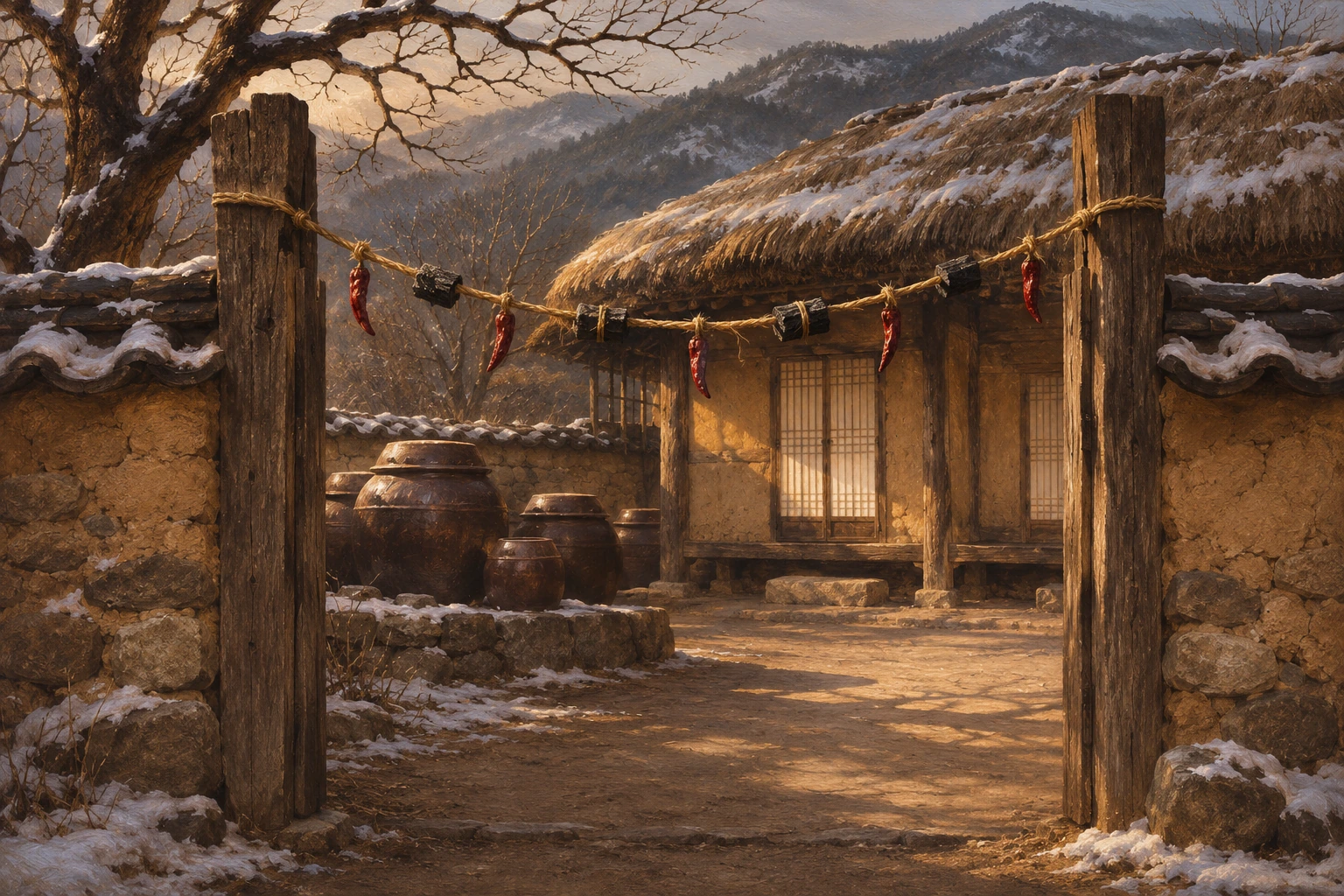
- The straw rope. For three weeks after a birth, a left-twisted straw rope, the geumjul, hangs across the gate: with charcoal and red peppers for a boy, sprigs of pine and charcoal for a girl. No one but the family goes in, not even a married daughter, because, Im Seok-jae writes, Samsin would be angered and harm the child. Some families keep it up for seven weeks. The rope is not found in the Hamgyeong provinces of the far north-east, and from this Im concludes that it is a product of rice-farming culture.
- The blue spot. In Yeongcheon, the folklorist Lee Eun-jeong records, a baby born with many blue birthmarks (the “Mongolian spot”) is said to have been slapped by Samsin for being slow to leave its mother’s womb.
- The flowers of the rite. In Jeju’s Buldomaji the shaman becomes the keeper of the flower garden, tilling it, sowing it and acting out the flowers growing. Then, as a shaman again, the shaman steals the camellia on the altar, the “flower of life”, and sells it to the woman of the house. From the branch she draws, the shaman foretells whether she will bear a son. Hyeon writes that hardly any family holds the rite now: there are fewer children, and the childless go to hospital.
- An older goddess behind her? In the worship of Jeju’s shrines, the goddess who looks after children is the grandmother of the illetdang shrines, said to be the Dragon King’s daughter. Jeong Jin-hui suggests the song may record a change of faith: a new birth goddess taking the place of one who recalls the illetdang goddess, as prayers for children grew in importance.
- The household god who lasted. Lee Eun-jeong found in Yeongcheon that Samsin has kept her hold better than the other household gods, even among young mothers.
Samsin is often explained as “three gods”. Its usual spelling, 三神, says so, and so does the Standard Korean Language Dictionary, which defines it as three spirits. Yet families pray to one grandmother, and in Jeju the post goes to one goddess. The folklorist Jang Ju-geun reads the word otherwise: from words such as samjul, the umbilical cord, he argues that sam first meant the womb, and that samsin was the god of the womb.
5 Related Stories
- Bari-gongju: The Abandoned Princess Who Guides the Dead: Hong Tae-han names Bari-gongju and Danggeum-aegi as the two heroines of the shamanic myths sung across the whole country. One is the shamans’ ancestor who leads the dead to the other world; the other is the origin of samsin. Life and death, he concludes, matter that much.
- Dangun: The Bear, the Tiger and the First Korean Kingdom: Hong Tae-han sets Danggeum-aegi beside the bear-woman Ungnyeo and beside Yuhwa, Jumong’s mother. Each is joined to a man of divine power and bears a child, and the child accomplishes a mission.
- Izanagi in Yomi: The Land of the Dead and the First Quarrel: Jeong Je-ho finds the same structure in the Jeju song and in Izanagi and Izanami in the Kojiki: a deity of birth set against a deity of illness and death. The Dragon King’s daughter loses the contest and turns into a bringer of illness, and the new goddess of birth rises by it.
- Guanyin: How the Bodhisattva of Compassion Became a Goddess: in Hyeon Yong-jun’s telling, the childless Dragon King and his queen get their daughter by praying at a temple of Gwaneum, as Koreans call Guanyin. The Lotus Sutra already promises a son or a daughter to the woman who honours the bodhisattva.
6 Sources
- Hyeon Yong-jun, “삼신할망”, “저승할망” and “불도맞이”, Digital Jeju Culture Encyclopedia: jeju.grandculture.net, jeju.grandculture.net, jeju.grandculture.net
- Encyclopedia of Korean Culture: Jang Ju-geun, 삼신; Jeong Jin-hui, 삼승할망본풀이; Hong Tae-han, 제석본풀이; Seo Dae-seok, 제석굿; Im Seok-jae, 금줄
- Lee Eun-jeong, “삼신”, Digital Yeongcheon Culture Encyclopedia: yeongcheon.grandculture.net
- National Institute of Korean Language, Standard Korean Language Dictionary, entries 삼신, 삼, 삼줄, 삼신상 and 삼칠일: stdict.korean.go.kr
- Simcheong-jeon, Jeonju woodblock edition in 71 leaves (Seogye Seopo, carved 1906, published 1911), from the copy in the National Library of Korea: Korean Wikisource
- Jeong Je-ho, “한국 신화의 보편적 성격과 신화적 의미: 〈삼승할망본풀이〉를 중심으로”, Ilbonhak yeongu 50 (2017), abstract: earticle
Cover and illustrations: AI-generated images made for Arcana. They are interpretations, not historical artworks.