Bari-gongju: The Abandoned Princess Who Guides the Dead
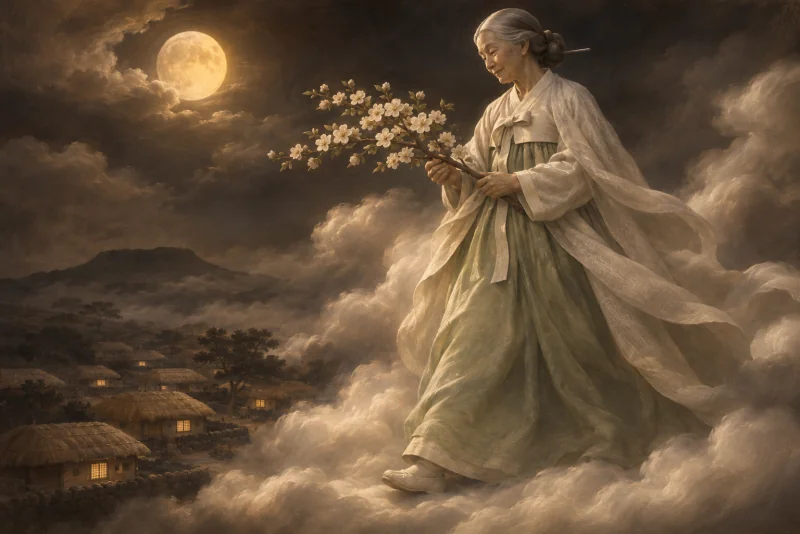
A king had his seventh daughter shut in a box and thrown into a river because she was not a son, and she came back from the other world with the water that raised him from his bier. Korean shamans still sing her story at the rites for the dead, and count her as their ancestor.
- Type: shamanic narrative song (seosa muga): the life of the goddess who leads the dead
- Culture: Korea; sung at rites for the dead across the mainland, but not on the islands or in Hwanghae Province
- Earliest text: sung by the Seoul shaman Bae Gyeong-jae and printed by Akamatsu Chijō and Akiba Takashi in 1937; about a hundred versions have been recorded since
- Key figures: Bari-gongju, “Princess Bari”, also called Baridegi; her father the king (King Eobi in the Seoul songs, King Ogu in the south and east) and the queen; her six elder sisters; the old couple Biri-gongdeok; Mujangseung, the keeper of the water; the Buddha Śākyamuni
Near the end of a Seoul rite for the dead, a shaman dressed as a princess of old stands her drum on its end and sings, at length, the life of a girl who was thrown away at birth. Then she turns to the dead. In the oldest text we have, printed in 1937, she tells them to listen well “with rotted ears”, for “today is the day you follow Princess Bari to the Western Pure Land, the world of utmost bliss”.
Why is this story sung when someone dies? Because Bari is the one who takes the dead to the other world. In Seoul the song is called the malmi. It comes just after the messengers of the underworld have been received, and just before the shaman, still in a princess’s dress, leads the dead through the gates of the other world. The dead must be guided by Bari, writes the folklorist Hong Tae-han, so the shaman sings her whole life to show why she is there.
1 The Telling
This is the Seoul song. We follow the version of the Seoul shaman Mun Deok-sun, which the folklorist Kim Tae-gon recorded and printed in 1971, as Lee Hyang-ae summarizes and quotes it in her doctoral dissertation (Sogang University, 2017). Lines from the oldest printed text, sung by Bae Gyeong-jae in the 1930s, are marked as such; we quote them as the folklorist Hwang Rushi does, from the 1997 collection of the recorded songs.
1-1 The Seventh Daughter
King Eobi ignored a fortune-teller’s prophecy and held the royal wedding. (In the Seoul song that Hwang Rushi describes, the prophecy was plain: marry next year and have three sons, marry this year and have seven daughters.) The queen bore him a daughter, then another, until there were six. The seventh child was a daughter too.
The king had wanted a son to take the throne. He had the baby shut in a jade box and thrown into the Hwangcheon, the river of the Yellow Springs. Her name says what was done to her: Bari, or Baridegi, is “the thrown-away one”. In the song Hwang Rushi describes, the king names her with a jingle: beoryeotda beoridegi, baryeotda baridegi, “thrown away, cast away”.

1-2 Where No Bird Could Fly
The Buddha Śākyamuni saved the child and gave her to a childless old couple, the old man and old woman Biri-gongdeok. They lived at Taeyang Seochon, so far from the world that, when a courtier later came to fetch her, they cried out that not even birds or beasts could enter there.
Bari grew up learning what girls were not taught: astronomy, geography and the books of strategy. At fifteen she asked who her parents were. The old couple said they were, and then that a bamboo in Jeolla and a tree on the hill behind the house were. She believed neither answer.
1-3 Six Refusals
For the sin of throwing her away, the king and queen fell mortally ill. Only the water of life could save them, and no one at court would go for it. The six princesses refused, wailing, the song says, like frogs in early summer. When they had gone to see the flowers in the back garden, they had “not known east from west” and could not find their way back to the palace hall.
So the king sent for the daughter he had thrown away. Bari would not go with the courtier until tokens had proved that the king and queen were her parents. Then she agreed to fetch the water. In a line of the Seoul song that Hwang Rushi quotes, she says she owes the kingdom nothing, but she will go for the ten months she lay in her mother’s womb.
1-4 Nine Years at the Spring
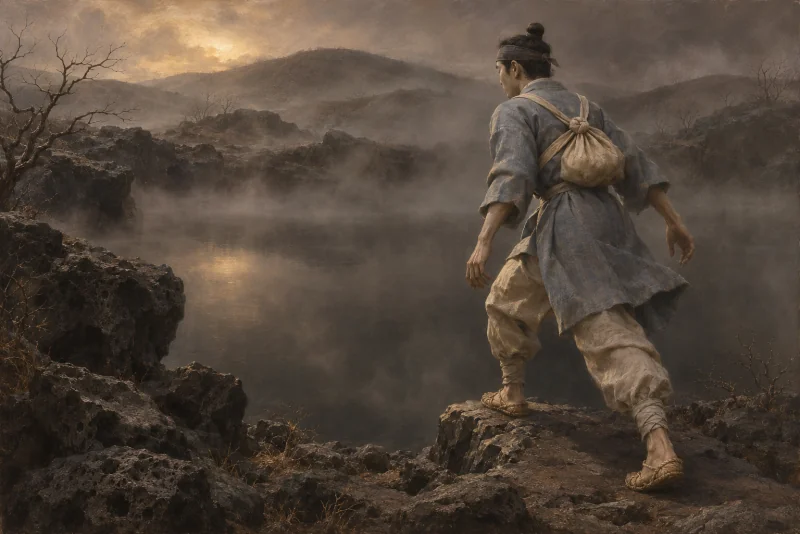
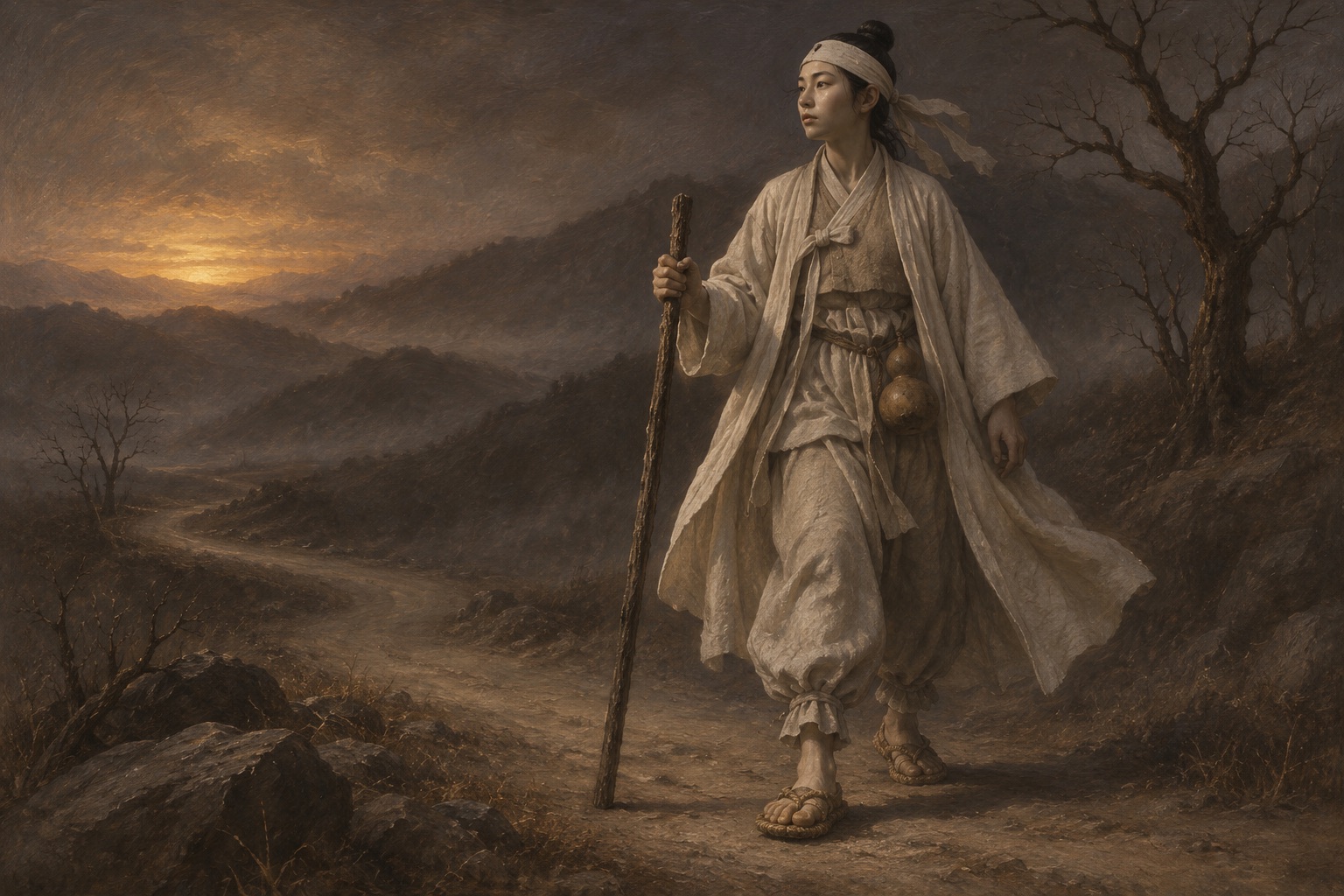
Bari set out dressed as a man. On the way Śākyamuni gave her a flower and a spell-bell. The flower opened a road before her, and with the bell she set free the souls of the dead she met in the hells.
In Seocheon Seoyeok-guk, the land of the western heaven, she found Mujangseung, who kept the water. She told him she was the king’s seventh prince. He asked for the price of the road, and she had brought nothing in her haste. So she paid in work: three years of cutting wood, three years of tending fire, three years of drawing water. When the nine years were over he told her that from the front she had a prince’s bearing but from behind a woman’s body, that heaven had made them a pair, and that she must bear him seven sons. She married him, and bore them.

1-5 The Bier on the Road
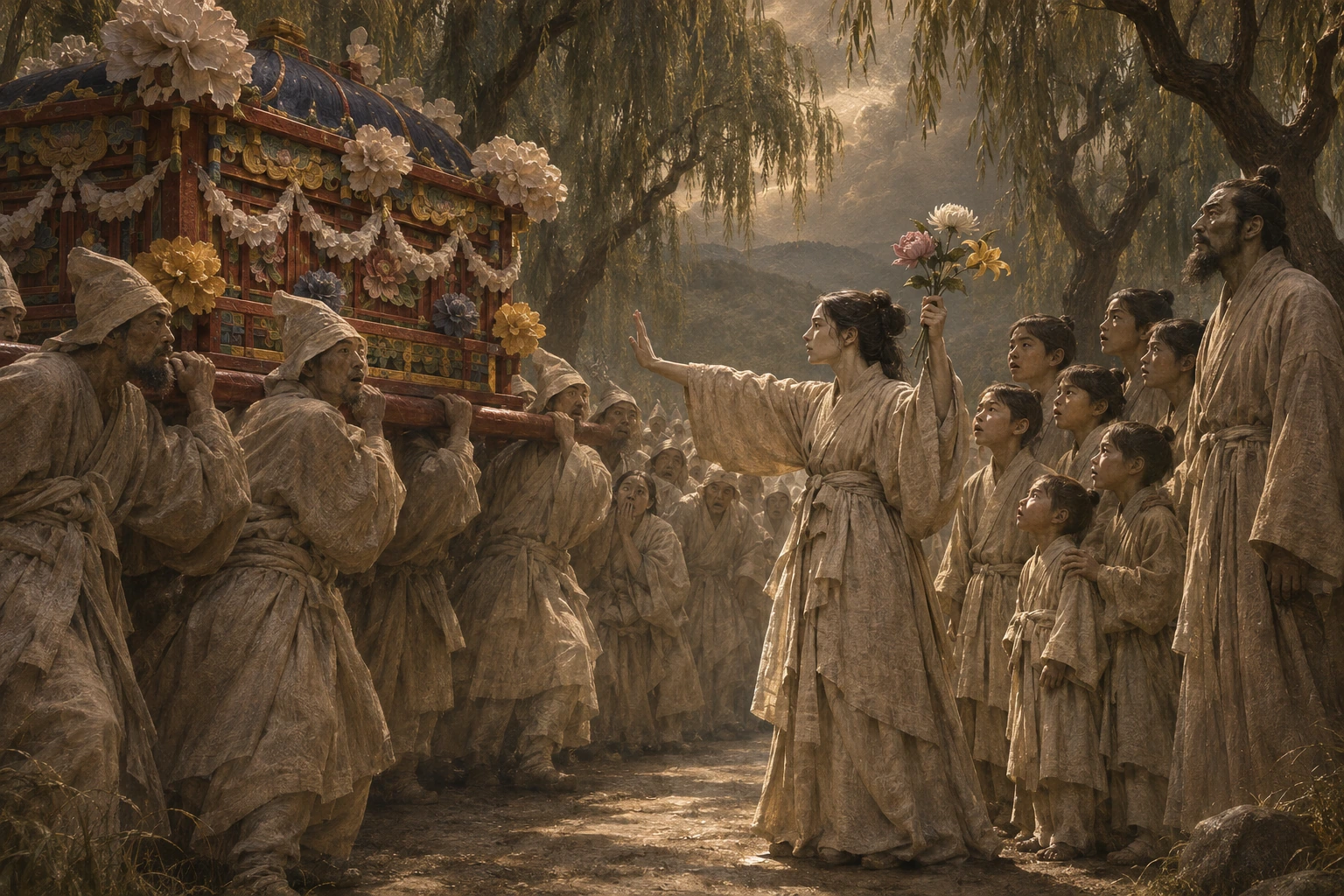
On the way home Bari saw the boats of the dead, some bound for paradise and some for hell, as each had earned by their deeds. She came too late. In the Seoul songs her parents have died on the same day and at the same hour, and their funeral procession is already on the road.
Bari stopped the bier. The 1937 text says what was done, in our translation: the seven knots of the grave-clothes were untied, the “breath-flower” was laid on the breath, the “bone-flower” on the bones and the “flesh-flower” on the flesh, the ilyeongju bead on the eyes, and the medicinal water was poured into the mouth. The king and queen came back to life together. “I slept so deep,” says the king. “Did we come out to see the sea, or the flowers on the hill behind?”
1-6 The Guide of the Dead
The king offered her treasures, which she refused. What she asked for was to become the god who leads the dead to the other world, and the king granted it. In Mun Deok-sun’s ending Bari asks him to provide for others too: the old couple Biri-gongdeok and Gangnim, the messenger of death, are all to be fed and clothed; Mujangseung is to receive offerings at the graveside rites, the old man Biri-gongdeok at the roadside rite when a funeral goes out, and the old woman at the gates of the saenam, the great Seoul rite for the dead.
2 Where the Story Is Written Down
The oldest text of the song that scholars cite was printed in 1937. The song lives in the shamans’ memory, and in the copied song books some of them keep.
- The first book of shaman songs, Son Jin-tae’s Joseon singa yupyeon (Tokyo, 1930), has no Bari song. It holds songs gathered between 1922 and 1926 in four districts, from Hamheung in the north to Dongnae near Busan.
- Akamatsu Chijō and Akiba Takashi, Chōsen fuzoku no kenkyū (“A Study of Korean Shamanism”, two volumes, 1937–1938). The first volume opens with the song, under the heading “Legend of the shaman ancestor: the abandoned princess” (巫祖傳說 捨姬). Its singer was Bae Gyeong-jae of Seoul, and Kim Hwan-hee, comparing it with European tales, treats it as the oldest version. Sim U-seong translated the book into Korean in 1991.
- Kim Tae-gon, Hanguk muga jip (“Korean Shaman Songs”, four volumes, 1971–1980), recorded on tape and checked against later performances. Mun Deok-sun’s Seoul version is in the first volume.
- Kim Jin-yeong and Hong Tae-han, Seosa muga Bari-gongju jeonjip (“The Complete Bari-gongju Songs”), a collection of the recorded texts: the first two volumes appeared in 1997, and Hong added more later.
- How many versions? More than fifty had been recorded across the country, Kim Hwan-hee wrote in 2002. Hong Tae-han gives about ninety in the National Folk Museum’s encyclopedia, and about a hundred in his 2022 article for the Encyclopedia of Korean Culture.
- The shamans’ own books. In Namyangju, near Seoul, the shaman Lee Yeong-hui, recorded in 2002, recited Bari with the help of a copied song book she had obtained before the 1970s. Bari-gongju is its last song.
3 Competing Versions
- Four families. Hong Tae-han sorts the versions by region:
- the centre-west (Seoul, Gyeonggi, Chungcheong): the six elder sisters’ births told one by one, the Biri-gongdeok couple, and Mujangseung as Bari’s destined husband. It is the most solemn family, and the closest to the rite;
- the east coast: the keeper of the water is Dongsuja, who sees through her man’s dress and keeps trying to expose her. These versions are long and full of comedy, some of it bawdy;
- Jeolla: Bari does not disguise herself, and what follows her return differs from place to place;
- the north: her parents are exiled from heaven, and Bari dies after bringing the water. Her role as the guide of the dead is weaker.
- The parents’ names. King Eobi or Eopbi in Seoul; in the east and in Jeolla, King Ogu and Queen Gildae; in the north, a noble couple called Deokju-a and Sucharang.
- Who raises her? The Biri-gongdeok couple in the centre-west; a wandering beggar couple, or no one, alone in the mountains, in other versions (Hwang Rushi). In Yoda Chiyoko’s summary the box is of stone, and an old couple of mountain gods raise her.
- The road. In Hwang Rushi’s account, Bari asks the way of people at work and must first do their work: ploughing a field, grinding grain, breaking the ice on a river to do the washing, washing charcoal until the water runs clear, picking the lice from an old person’s hair. Mujangseung sees through her disguise by her looks in Mun Deok-sun’s song; in the one Hwang Rushi tells, he hides her clothes while she bathes.
- What becomes of everyone. In the version that Kim Heon-seon summarizes, Bari learns of the royal funeral from Gangnim on the road home. At the end her seven sons become the Seven Stars, Mujangseung a guardian of the Ten Kings, and Bari the guardian spirit of every shaman.
4 History and Tradition
- Four rites, one song. In Seoul and Gyeonggi, the jinogi-gut (also jinogwi-gut); on the east coast, the ogu-gut of Gyeongsang and the Yeongdong region of Gangwon, where hereditary shamans sing it and Bari is the Ogu god; in Jeolla, the ssitgim-gut; in Hamgyeong, the week-long mangmuk-gut. Hwanghae’s rites for the dead have no Bari song.
- In Seoul the shaman sings in a princess’s dress and a great wig, beating a drum stood on its end, and the family must be there. Then, as Bari, she leads the dead round the twelve gates of the other world. The Seoul Saenamgut, the grandest form of the rite, has been a National Intangible Heritage since 1 May 1996.
- The shamans’ ancestor. In Seoul and Gyeonggi Bari is worshipped as the ancestor of shamans. Elsewhere, Hwang Rushi writes, she is the Ogu god, a guide of souls like the Buddhist bodhisattva Inrowang. Kim Heon-seon calls her the guardian spirit (momju) of every shaman.
- What malmi means. For Kim Heon-seon it is the “leave” given to the dead held by the Ten Kings; for Hwang Rushi, “that from which all things come”.
- Buddhism. Śākyamuni, the hells, the Western Pure Land and the Ten Kings run through the Seoul song. Kim Heon-seon reads it as a fusion of native and foreign gods, in which Bari stands below the bodhisattva Jijang, the Ten Kings and the Buddha.
- Two readings. As Kim Hwan-hee sums up the debate in the abstract of a 2002 article, Seo Dae-seok sees a Confucian daughter, deified as a reward for her filial piety, “sublime but subordinate”; the analytical psychologist Lee Bu-yeong sees Korean shamanism’s protest against a patriarchal Confucian order.
- Retold. Picture books and webtoons retell the story. Hwang Sok-yong’s novel Baridegi (2007; in English Princess Bari, 2015) makes Bari a North Korean girl who flees through China to London.
Bari-gongju is often retold as a folk tale or a children’s story. It is a ritual song: shamans sing it at the rites for the dead, and Seoul’s shamans count Bari as their ancestor. The scholars who printed the oldest text, in 1937, already headed it “legend of the shaman ancestor”.
5 Related Stories
- Jeoseung Saja: The Messengers of Death: in the Seoul rite the messengers who fetch the dead are received just before Bari’s song, and Mun Deok-sun’s ending asks that Gangnim, the messenger of death, be fed and clothed as well.
- Guanyin: How the Bodhisattva of Compassion Became a Goddess: Princess Miaoshan, too, is a king’s youngest daughter, cast out by her father, who saves him from a deadly illness. Shin Yeon-woo, comparing the two, finds them alike in filial piety, rejection, sacrifice and Buddhism, but not in the journey to another world, the water of life or the raising of the dead.
- Inanna’s Descent to the Underworld: Seven Gates and a Substitute: the plant of life and the water of life bring Inanna back from her sister’s realm, as flowers and medicinal water bring back Bari’s parents. We have not found a scholar who compares the two; we link them for the theme.
6 Sources
- Mun Deok-sun’s Seoul version, in Kim Tae-gon, Hanguk muga jip 1 (1971; Jipmundang reprint, 2013), pp. 150–175, as summarized and quoted in Lee Hyang-ae, “Hanguk musok sinhwa-ui munhwa giho-hakjeok yeongu” (PhD dissertation, Sogang University, 2017), pp. 11–12, 22–27, 82–83: jst.re.kr
- Bae Gyeong-jae’s Seoul version, in Akamatsu Chijō and Akiba Takashi, Chōsen fuzoku no kenkyū 1 (Ōsakayagō Shoten, 1937), “巫祖傳說 捨姬”, pp. 3–58, table of contents of the 1938 printing: NDL Digital Collections; its closing lines as quoted by Hwang Rushi, “Princess Bari” (Seoul Mediacity Biennale and e-flux Journal 156, 2025), from Kim Jin-yeong and Hong Tae-han, Seosa muga Bari-gongju jeonjip 1 (Minsokwon, 1997), p. 141: mediacityseoul.kr, e-flux
- Encyclopedia of Korean Culture: 바리공주, 서울 새남굿, 지노귀굿, 오구굿, 씻김굿, 망묵굿, 무조신, 조선신가유편, 한국무가집
- National Folk Museum of Korea, Encyclopedia of Korean Folk Beliefs: Hong Tae-han, 바리공주 and 진오기굿; Encyclopedia of Korean Folk Literature: Kim Heon-seon, 바리공주
- Lee Hyo-nyeong, 「바리공주」, Digital Namyangju Culture Encyclopedia: grandculture.net
- Kim Hwan-hee, “The Shamanist Myth of ‘Princess Bari’ and Its Western Counterparts”, Comparative Korean Studies 10.1 (2002), abstract: KISS
- Shin Yeon-woo, “A Comparative Study of Princess Bari, Miaoshan, and Other Similar Folklores”, Hanguk musokhak 27 (2013), abstract: KCI
- Korea Heritage Service, Seoul Saenamgut: heritage.go.kr
- Yoda Chiyoko, “朝鮮神話”, Heibonsha World Encyclopedia: Kotobank
- “‘Princess Bari’ by Hwang Sok-yong”: Korea.net
Cover and illustrations: AI-generated images made for Arcana. They are interpretations, not historical artworks.