Jeoseung Saja: The Messengers of Death
In a song of Jeju Island, a magistrate's runner named Gangnim went down alive to arrest the king of the dead, and the king kept him as his messenger. Television dressed Korea's messengers of death in black; in the rites they were soldiers, and a temple painting of 1676 shows them in red and green beside their horses.
- Type: gods of death: the messengers who fetch the dead to the court of the other world
- Culture: Korea; the fullest story belongs to the shamanic rites of Jeju Island
- Earliest texts: the Jeju song Chasa bonpuri, first written down in 1931 and published in 1937; the Ten Kings the messengers serve come from a Chinese Buddhist scripture of the late Tang, carved for printing in Korea in 1246
- Key figures: Gangnim (강림), King Yeomra (閻羅), the magistrate Gimchi, the three princes of King Beomeul, the wife of Gwayang-saeng
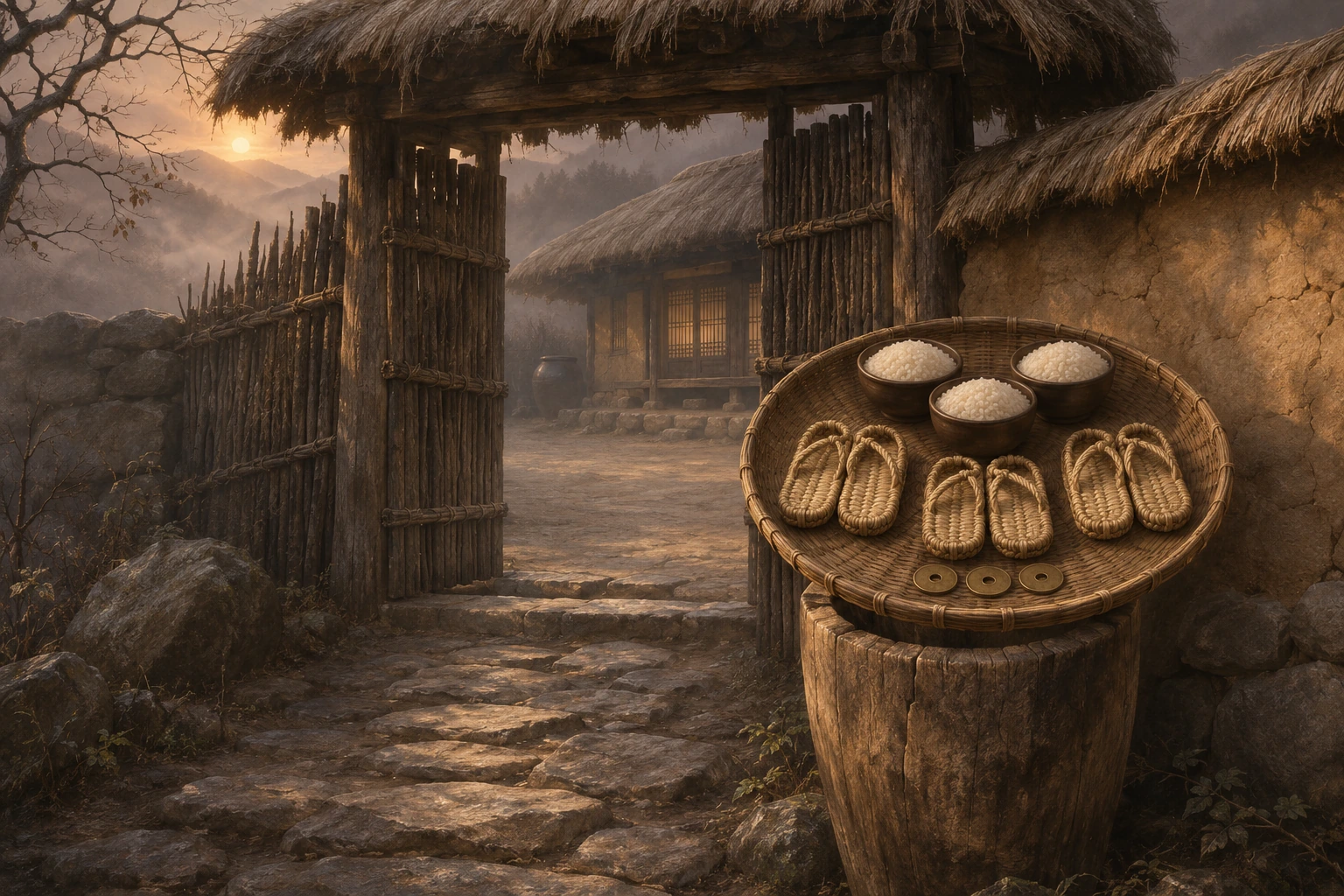
When someone dies, Korean custom sets a small meal outside the gate: rice, and in some regions straw sandals and a few coins. It is not for the dead. It is for the jeoseung saja, the messengers from jeoseung, the other world, who have come a long way to fetch them and are said to treat them more gently if they have been fed.
Is there a Korean god of death? Not one. The jeoseung saja are messengers, not judges: they bring the dead before King Yeomra and the Ten Kings of the underworld, who judge them. How many come is not fixed. A Hwanghae shaman said that three come for the dead and seven wait in the other world, numbers that stand for many; the meal at the gate is often laid for three, but temple paintings show two of them, or four. Only one has a name and a life story of his own: Gangnim, in the shamanic songs of Jeju Island.
1 The Telling
This is the version sung by the Jeju shaman An Sa-in and published by the folklorist Hyeon Yong-jun in 1980, as the Encyclopedia of Korean Culture summarizes it and the scholars Kim Hyeong-geun and Kim Heon-seon quote it. It is a bonpuri, the story of how a god came to be, sung in the rites that send the dead on their way.
1-1 The Three Princes
Three sons of King Beomeul of Donggyeong were fated to die at fifteen. A great monk, before he died, told his disciple to take them into the temple and pray for longer lives. After three years of prayer the princes longed to see their parents. The monk sent them home carrying silk and fine cloth, with one warning: beware the land of Gwayang.
By the time they reached Gwayang they were too hungry to go on, and they asked for food at the house of Gwayang-saeng. His wife coveted their silk. She made them drunk, killed them and sank their bodies in a pond.
1-2 Flowers, Beads and Triplets
Seven days later three flowers were floating on the pond. She picked them and hung them on a pillar, but they caught at her head every time she passed, so she threw them in the fire. In the ashes lay three beads. She rolled them in her mouth, swallowed them, and bore three sons.
At fifteen the triplets passed the state examination together. On the day they came home they bowed down and never rose: all three died at once. Their mother petitioned the magistrate, Gimchi, again and again. On his wife’s advice he decided that only King Yeomra, the king of the dead, could judge such a case, and he ordered his runner Gangnim to go and bring him.
1-3 The Road to the Other World
Gangnim was clever, but he kept many concubines and had neglected his first wife since their wedding night. Now he went to her for help. She steamed three batches of rice cakes, one for the kitchen goddess, one for the door god and one for her husband’s journey, and prayed to the two gods to open his road.
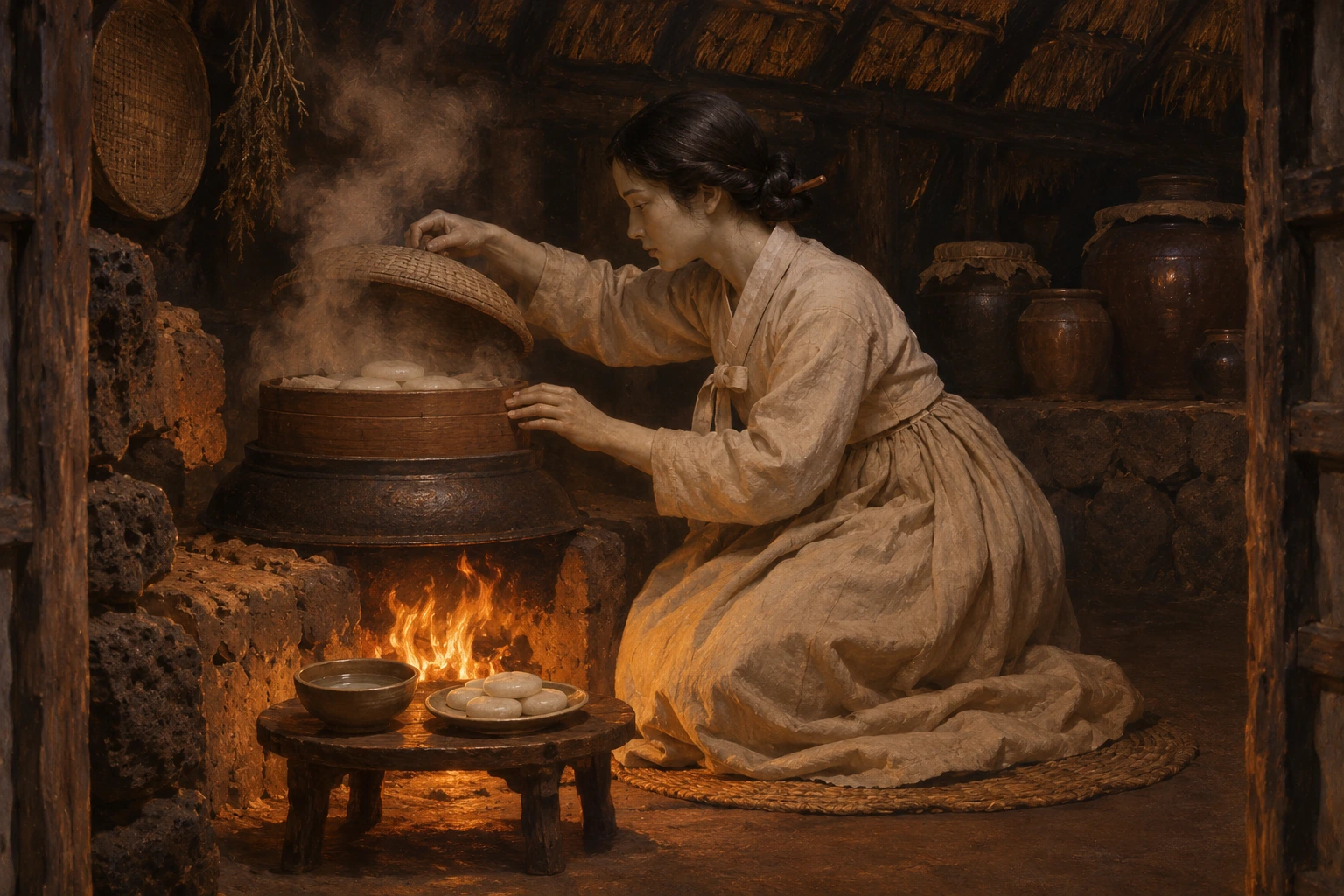
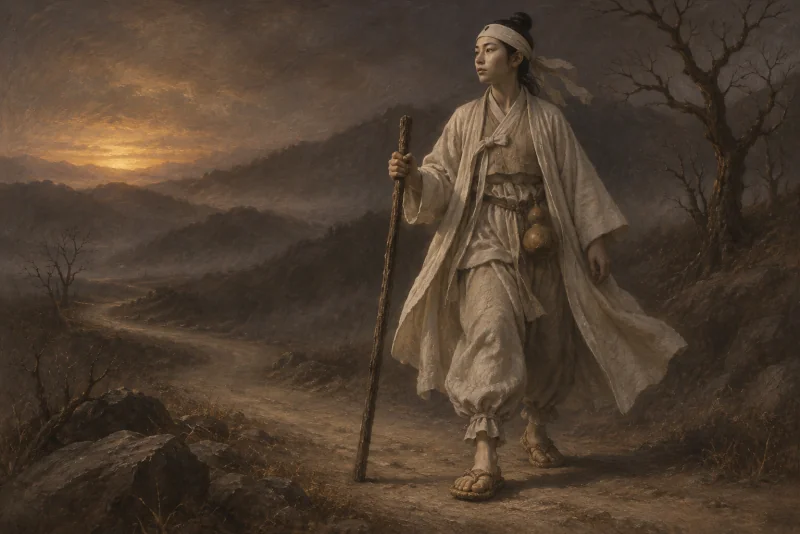
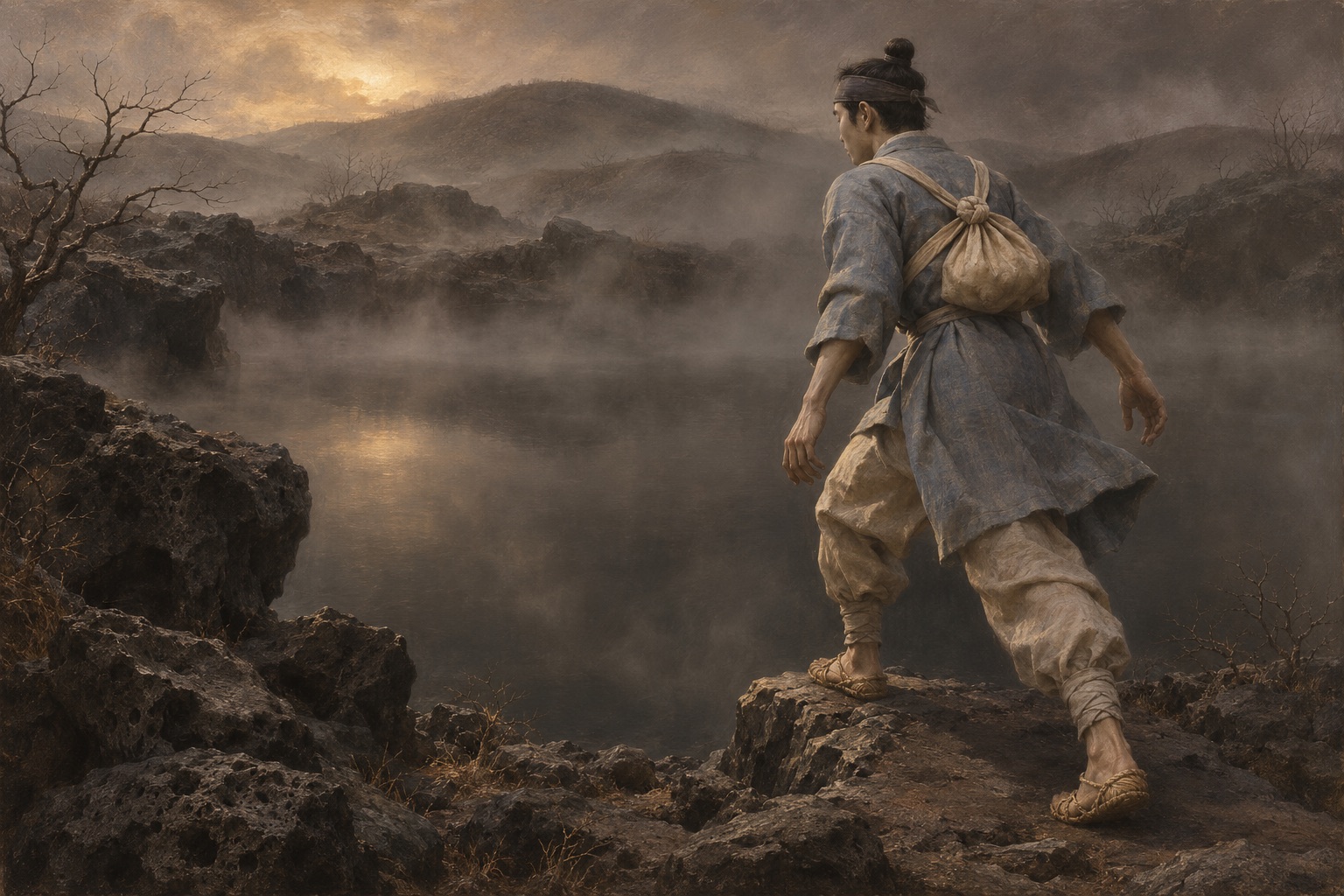
The kitchen goddess and the door god led him to the place where seventy-eight roads part. On the right one he found the road-mender of the underworld, Jiltoraebi, dozing with hunger on a stone. As he had been told, Gangnim set his rice-cake lunch in front of him; the road-mender ate it and showed him the way. At the edge of the Haenggi pond Gangnim shut his eyes and jumped. When he came to himself, he was standing at the gate of the underworld.
1-4 Arresting the King of the Dead
Gangnim waited at the great gate and seized Yeomra. The song gives him a line for it: the king of this world is a king, and the king of the other world is a king too. Yeomra took him along to a rite at a rich man’s house, and there tried to slip away: he became a bird and perched at the top of the tall ritual pole. The kitchen goddess told Gangnim to saw the pole down. As soon as he set to it, Yeomra caught his wrist. There was no fooling Gangnim’s eyes. The king promised to come to the magistrate’s court on a day and at an hour he named. Gangnim went home ahead of him, following a white puppy, as most versions tell it.
1-5 The Judgment
At the appointed hour Yeomra came down with a noise that shook heaven and earth. The magistrate ran and hid, and it was Gangnim who stepped between them. Yeomra had the pond drained. At the bottom lay the princes’ bones; he gathered them, brought the three back to life and sent them home to their parents. Gwayang-saeng and his wife were put to death.
Yeomra asked the magistrate to lend him Gangnim, and Gimchi refused. Then let us share him, said the king: which will you have, his soul or his body? Gimchi chose the body. Yeomra took the soul, and Gangnim fell dead. His wife blamed the magistrate who had chosen the empty half.
1-6 The Crow and the Red List
In the other world Yeomra sent Gangnim to carry the jeokpaeji, the red list, to the living: people were to come to the other world in order, when they reached eighty. On the way a crow offered to deliver it. Gangnim tucked it under the crow’s wing; it fell, and a snake swallowed it. Since then, the song explains, death has kept no order, and the young may go before the old.

Then Yeomra set a harder task. Dongbangsak had lived three thousand years, and no messenger had caught him. Gangnim sat by a stream washing charcoal. A passer-by asked why. “To make it white,” said Gangnim. “I have lived three thousand years and never heard such a thing,” said the man, and gave himself away. Gangnim brought him to the other world, and Yeomra made Gangnim the messenger who fetches human beings.
2 Where the Story Is Written Down
The Chasa bonpuri (chasa, 差使, is an envoy) is an oral song, sung all over Jeju; about ten versions have been reported. In 2008 Kim Hyeong-geun and Kim Heon-seon compared nine:
- the oldest, sung by the shaman Park Bong-chun in Seogwipo and recorded in October 1931 by the Japanese ethnologist Akiba Takashi, in Akamatsu Chijō and Akiba Takashi’s Chōsen fuzoku no kenkyū (vol. 1, 1937);
- Go Dae-jung’s, recorded by Jang Ju-geun in 1962 and published in Tokyo in 1973;
- An Sa-in’s, recorded between 1959 and 1967 for Hyeon Yong-jun’s Jejudo musok jaryo sajeon (1980): the fullest, and the one told here;
- two in Jin Seong-gi’s Namguk-ui muga (1968), and one sung at a funeral rite in Jeju City on 9 December 1979;
- a manuscript written down from a shaman’s telling in 1982, and versions of 1994 and 1998.
All nine tell the story as far as Gangnim’s death. Six have the crow; only three have Dongbangsak.
Behind the song, the Encyclopedia of Korean Culture notes, scholars have pointed to a Buddhist song in Korean, the Hoesimgok, and a folk tale about a magistrate called Kim Chi (section 4). A Jeju song of almost the same name, the Hesimgok, is sung just before the story in the rite.
A northern twin. In Hamheung, in the far north, the rite for the dead (mangmuk-gut) had a song with nearly the same plot, the Jimgaje-gut (section 3). It was recorded only twice, by Im Seok-jae (published 1965) and by Kim Tae-gon (1978), and is no longer performed.
The Ten Kings. The court Gangnim serves comes from Buddhism. In the Sutra on the Ten Kings (預修十王生七經), made in China late in the Tang dynasty, the dead pass before one king on each seventh day up to the forty-ninth, then on the hundredth day, after one year and after three. Yeomra (閻羅大王) is the fifth. In Korea the sutra was carved on woodblocks in 1246, and Yeomra’s page shows him with the bodhisattva Ksitigarbha. In Joseon temples the Ten Kings sit around Ksitigarbha in a hall of the underworld (myeongbu-jeon), which also held paintings of two envoys of hell, Gamjae saja and Jikbu saja.
3 Competing Versions
- Why do the princes leave home? To pray at a temple, in most versions. In Park Bong-chun’s the monk tells them to wander the world as peddlers; in Kim Hae-chun’s a monk they meet on the road warns them. Most versions give King Beomeul nine sons, Go Dae-jung’s seven; the Encyclopedia’s summary also says seven.
- Whose idea is Gangnim? The magistrate’s wife’s (An Sa-in, Yi Yeong-ju, Yi Jeong-ja), a page boy’s (Park Bong-chun, Kang Sun-seon), the runners under him (Go Dae-jung, Kim Hae-chun, the manuscript), or the magistrate’s own.
- Who shows the way? Only the kitchen goddess in some versions; three immortals in Park Bong-chun’s; an earth god and a fortune-teller in Kim Hae-chun’s.
- How does Yeomra hide? As a bird on the pole for An Sa-in. In the manuscript he becomes an owl and then a blowfly, and Gangnim a hawk and then a spider. Kim and Kim set this beside the contest of shapes between Haemosu and the River Lord in Yi Gyu-bo’s “Dongmyeong wang pyeon”, told in the story of Jumong.
- The crow. In Kim Hae-chun’s version Yeomra hands the list to the crow himself. In the manuscript the crow gives the wrong cry and a girl dies, and Gangnim teaches it which cry to give when.
- The northern twin. In the Jimgaje-gut a man named Jimgaje kills three young men; his wife eats a crucian carp and bears triplets, who die on the day they pass the examination. Son, a runner from the village of Gangnim, waits under a bridge with rice cakes and meets the messengers of death. In the end he is taken to serve the Ten Kings, or, in the other recording, becomes a roadside guardian post. There is no King Yeomra and no journey through the other world.
4 History and Tradition
- The rites of Jeju. The song is sung in the gwiyang-puri, held on the evening of a burial to send the dead off, and in the siwangmaji, the rite of welcoming the Ten Kings, held around the end of mourning. The shaman (simbang), in everyday clothes, sits before the messengers’ own table and sings to the drum: first why this person died, then the story, then the prayer that the messenger lead them gently. The messenger, it is believed, comes with the red list and a cord, checks the name with the village’s guardian god, and is led by that god to the house. Parts of the song are acted out: the white rice cake tossed in the air for the messengers, and the clearing of the road of the Ten Kings.
- The meal at the gate. On the mainland a meal for the messengers, saja-bap, is laid outside the gate just after a death. In southern Gyeonggi it is a winnowing basket on a wooden mortar, with rice, straw sandals and coins. In a Hwanghae rite it is three plates of rice, three pairs of sandals and three pairs of spoons. The messengers are always served in the yard: one let into the room may stay, and take someone else.
- Why feed them? A tale told all over Korea explains it. Dongbangsak, warned that he would die young, set out rice, shoes and travelling money for each messenger. The messengers could not bring themselves to take him, and with one stroke turned the 十 of his thirty sixty-year cycles into 千: three thousand. Jeju’s Saman-i bonpuri, sung to turn misfortune away, tells the same of a poor hunter: three messengers ate his feast, put on the robes and sandals he had left for them, and used the same stroke of the brush.
- Comic messengers. In the rites of Seoul and Hwanghae the messengers are played for laughs. In Hwanghae they grumble that the food is meagre, demand money, fall asleep full and pretend to pick lice; Seoul’s rite calls them the sajae samseong, and counts three.
- Kim Chi. The magistrate’s name recalls Kim Chi (金緻), an official of the early 17th century who served as magistrate of Heungdeok and then on Jeju. The court annals blame him for greed, but anecdotes praise his justice at Heungdeok: one, in the Haedong ijeok bo, follows the same plan as the song, and another tale says he sat as King Yeomra after his death. Scholars see these tales behind the song’s magistrate, who in the song is helpless, though Kim and Kim note that on Jeju the name may simply mean a man named Kim from the mainland.
- On screen. KBS’s drama series Jeonseol-ui gohyang (“Hometown of Legends”) ran from 1977 to 1989 and came back in 1996–1999 and 2008–2009. Ju Ho-min’s webtoon Along with the Gods, which finished on Naver in 2012 after three years, put the messengers in black suits, as a team of three with Gangnim; the first of its two films, released in December 2017, drew 14.4 million viewers. Ju said what drew him to the old songs was messengers who make “a great many mistakes”. In the drama Goblin (tvN, 2016–2017) a reaper receives the dead in a teahouse between the two worlds.
The black gat, black coat and white face are often taken for the way Korea’s messengers of death always looked. The Encyclopedia of Korean Culture traces that look to Jeonseol-ui gohyang; in the rites the messenger appears as a soldier. Four messengers painted in 1676 by the monk Ilho, and kept at Gaesimsa temple, each stand beside a horse with a scroll or a long spear, in green with a red cape or in red with a green one. The black hat had an older relative, though: as SBS reported, a funeral-bier figure in the National Folk Museum shows a white-faced messenger in a black gat and black clothes, astride a tiger or some other beast.
5 Related Stories
- Bari-gongju: The Abandoned Princess Who Guides the Dead: in the mainland’s rites for the dead the messengers come first, then Bari, who guides the dead. A Seoul shaman told Kim Hyeong-geun and Kim Heon-seon that the messengers are the escort, Bari the advocate and the Ten Kings the judges. In Jeju’s rite, they write, Gangnim does both jobs.
- Sun Wukong: The Monkey King Who Fought Heaven: two summoners drag the sleeping Monkey King to the underworld, where he fights his way to the Ten Kings and strikes his name out of their registers. Another register of the dead that goes wrong; we have not found a scholar who compares the two, so we link them for the theme.
- Izanagi in Yomi: The Land of the Dead and the First Quarrel: another story of why people die as they do. In Japan the answer is a quarrel at the edge of the land of the dead, here a lost list. A shared theme only.
- Táo Quân: The Kitchen Gods Who Ride to Heaven: Gangnim’s road begins at the hearth, with the kitchen goddess. In Vietnam the gods of the kitchen ride up to heaven every year to report on the household. Again, a shared theme.
- Savitri and Satyavan: The Wife Who Argued with Death: in Savitri’s story Yama comes in person. The Japanese encyclopedia Sekai Daihyakka Jiten explains that belief in King Yama reached China through Buddhist scriptures, which wrote his name 閻魔 or 閻羅, and that he became one of the Ten Kings of the dead; 閻羅 is Korea’s King Yeomra, whose messengers fetch the dead in Korea.
6 Sources
- Chasa bonpuri, sung by An Sa-in, in Hyeon Yong-jun, Jejudo musok jaryo sajeon (濟州島巫俗資料事典; Singu Munhwasa, 1980), read through the Encyclopedia summaries below and the passages Kim and Kim quote (pp. 254, 260, 261): CiNii
- Park Bong-chun’s version, in Akamatsu Chijō and Akiba Takashi, Chōsen fuzoku no kenkyū (朝鮮巫俗の研究), 2 vols. (Ōsakayagō Shoten, 1937–1938), and Go Dae-jung’s, in Jang Ju-geun, Kankoku no minkan shinkō (韓国の民間信仰; Tokyo: Kinkasha, 1973), both known to us through Kim and Kim: CiNii, CiNii
- Encyclopedia of Korean Culture: Jeong Jin-hui, 차사본풀이; Kim Deok-muk, 저승사자; Kim Jeong-hui, 시왕상, 시왕도, 서산 개심사 오방오제위도 및 사직사자도; Kang Jin-ok, 동방삭 설화
- National Folk Museum of Korea, Encyclopedia of Korean Folk Literature: Kang Jin-ok, “차사본풀이”, read in the copy of 2019: Internet Archive
- Digital Jeju Culture Encyclopedia: 귀양풀이, 사만이 본풀이
- Kim Hyeong-geun and Kim Heon-seon, “제주도 무속신화 〈차사본풀이〉 연구”, Jeongsin munhwa yeongu 31.3 (2008), 239–271: accesson.kr
- Jeong Myounghee, “Hyeonwangdo from Seongbulsa Temple and the Tradition of Hyeonwangdo of the Joseon Dynasty”, Journal of Korean Art and Archaeology 7 (2013), 20–39: National Museum of Korea
- Kim Myeong-jin, “저승사자는 정말 3인조일까?”, SBS, 14 January 2018: Daum; on Jeonseol-ui gohyang, Maeil Shinmun, 13 July 2017: imaeil.com
- Ji Seung-ho, interview with Ju Ho-min, Kyunghyang Shinmun, 8 September 2012: khan.co.kr; interview with Kim Yong-hwa, Sports Chosun, 31 July 2018: Daum; on Goblin, Sports Kyunghyang, 23 January 2017: sports.khan.co.kr
Cover and illustrations: AI-generated images made for Arcana. They are interpretations, not historical artworks.