Jumong: The Archer Born from an Egg
A river god's daughter, shut away by a king, was followed by the sunlight and laid an egg. The boy who broke out of it fled across a bridge of fish and turtles and founded Goguryeo, and the kingdom itself carved his story in stone in 414.
- Type: founding myth
- Culture: Goguryeo, a kingdom of what is now north-east China and North Korea (37 BCE by tradition, to 668 CE)
- Earliest texts: the Gwanggaeto Stele (414 CE) tells it in a few lines; the full story is in the Wei shu (554) and the Samguk sagi (1145)
- Key figures: Jumong, also called Chumo (朱蒙, 鄒牟), later King Dongmyeong; his father Haemosu (解慕漱); his mother Yuhwa (柳花), daughter of the River Lord Habaek (河伯); King Geumwa (金蛙) of East Buyeo
Most founding myths reach us through books written long after the kingdoms they explain. Goguryeo carved its own. In 414, King Jangsu set up a stone more than six metres tall for his father, King Gwanggaeto, and its first lines tell how the founder of the dynasty was born from a split egg.
Is Jumong his name? It is closer to a nickname. The Samguk sagi says that in the speech of Buyeo a good archer was called jumong. The stele of 414 calls him King Chumo (鄒牟), and the histories give him the title Dongmyeong, “Eastern Brightness”. That title had belonged to someone else first: the founder of Buyeo, in a Chinese book some three centuries older than the stele (section 3).
1 The Telling
This is the version in the Samguk sagi, the oldest surviving Korean history, compiled by Kim Busik in 1145. It is the fullest telling in prose; section 3 shows where the older and later texts differ.
1-1 The Golden Frog and the River Lord’s Daughter
Haeburu, king of Buyeo, was old and had no son. One day his horse stopped at a pool called Gonyeon and shed tears before a great rock. Under the rock lay a small child, golden and shaped like a frog. The king took him as heaven’s gift and named him Geumwa, “Golden Frog”. Later the king’s minister said heaven had told him that its own descendants would found a kingdom there, so Haeburu moved east, to a land by the sea he called East Buyeo. Into the old capital came a stranger who said he was Haemosu, son of the Heavenly Emperor.
When Geumwa was king, he met a young woman south of Mount Taebaek, by the river Ubal. “I am the daughter of Habaek, the River Lord,” she said, “and my name is Yuhwa. I was out with my sisters when a man who called himself Haemosu, son of the Heavenly Emperor, lured me to a house by the Yalu, beneath Mount Ungsim, and lay with me. Then he left and never came back. My parents blamed me for following a man without a go-between, and banished me here.”
1-2 The Egg
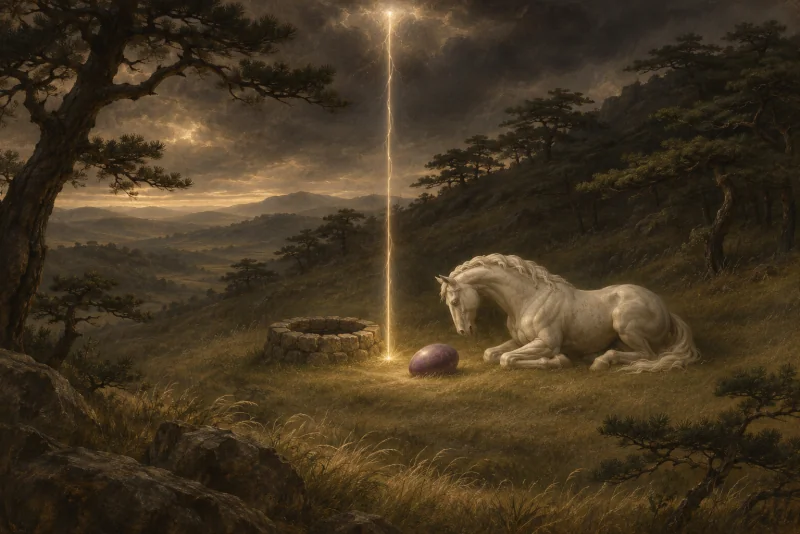
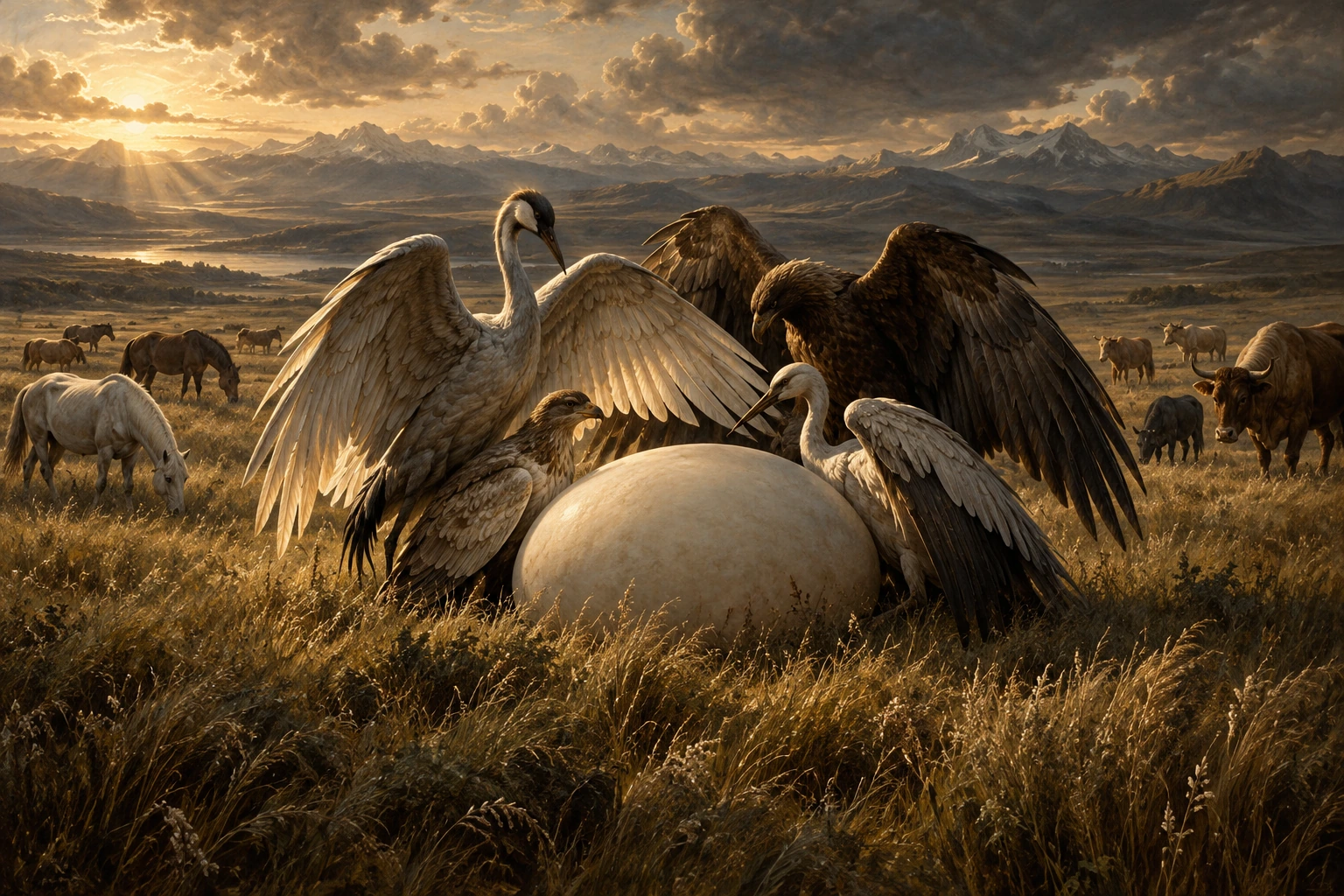
Geumwa found this strange and shut her in a room. The sunlight shone on her. She moved away, and the sun’s rays followed her and shone on her again. She conceived, and laid an egg “as big as five doe”, five measures of grain.
The king threw it to the dogs and pigs, and they would not eat it. He left it in the road, and the cattle and horses stepped around it. He left it in the open country, and the birds covered it with their wings. He tried to split it and could not, so he gave it back to its mother. She wrapped it and set it somewhere warm, and a boy broke through the shell, with a frame and a face “heroic and strange”.
1-3 The Archer
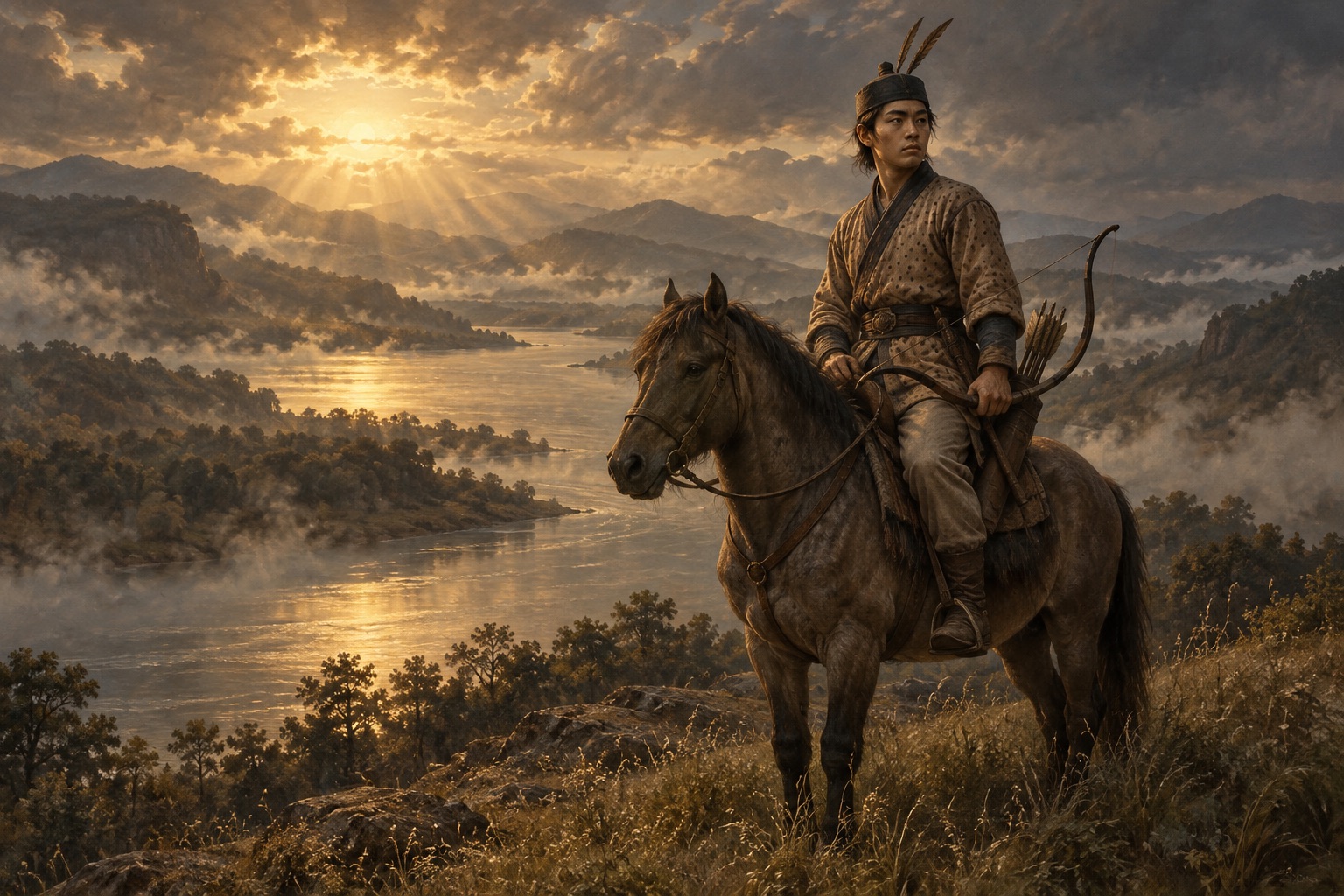
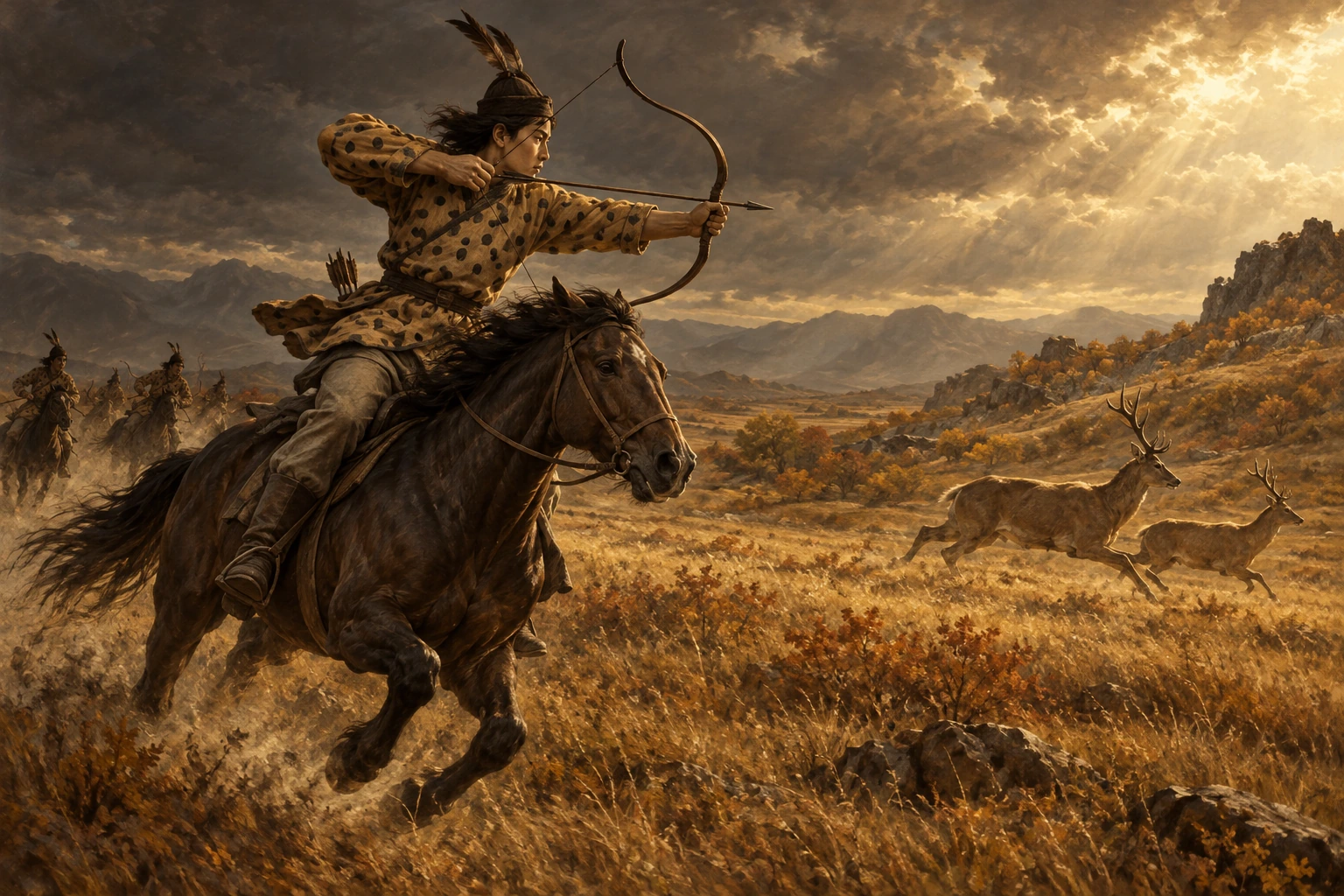
At seven he was already unlike other children. He made his own bow and arrows, and of a hundred shots a hundred hit. In the speech of Buyeo a good archer was called jumong, and that became his name.
Geumwa had seven sons who played with Jumong, and none of them could match him. The eldest, Daeso, told the king: “Jumong was not born of a human being, and he is bold. If we do not deal with him early, I fear trouble later. Get rid of him.” The king would not listen, and set Jumong to tend the horses. Jumong found out which were the fast ones and gave them less fodder until they were thin, and fattened the slow ones. The king rode the fat horses himself and gave the thin ones to Jumong. When they hunted, they gave Jumong few arrows, but he brought down more game than anyone. Then the princes and ministers plotted to kill him. His mother found out and warned him: “They mean to harm you. With your gifts, where could you not go? Better to go far away and make something of yourself than to linger here and be shamed.”
1-4 The Bridge of Fish and Turtles
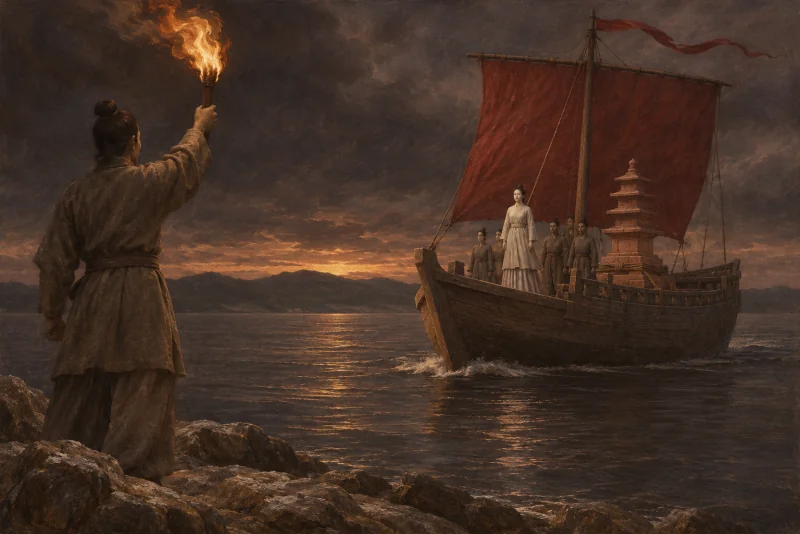
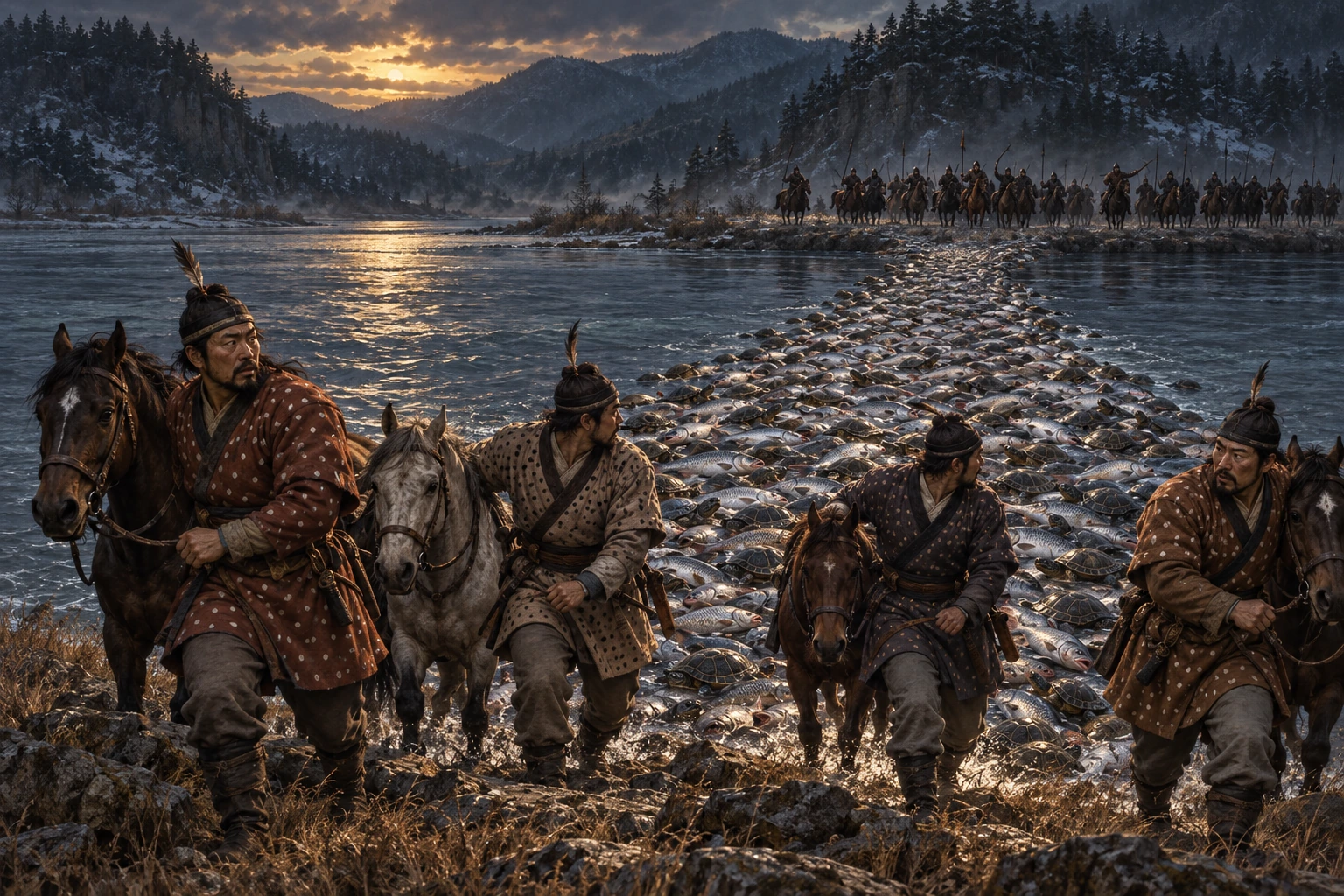
Jumong left with three friends, Oi, Mari and Hyeopbo (烏伊, 摩離, 陜父). They came to the river Eom, north-east of the Yalu, and there was no bridge, and the soldiers were close behind. Jumong spoke to the water: “I am the son of the Heavenly Emperor and the grandson of the River Lord. Today I am fleeing, and my pursuers are almost upon me. What shall I do?” Fish and turtles rose to the surface and made a bridge. Jumong crossed. Then the fish and turtles scattered, and the horsemen behind him could not cross.
1-5 Goguryeo
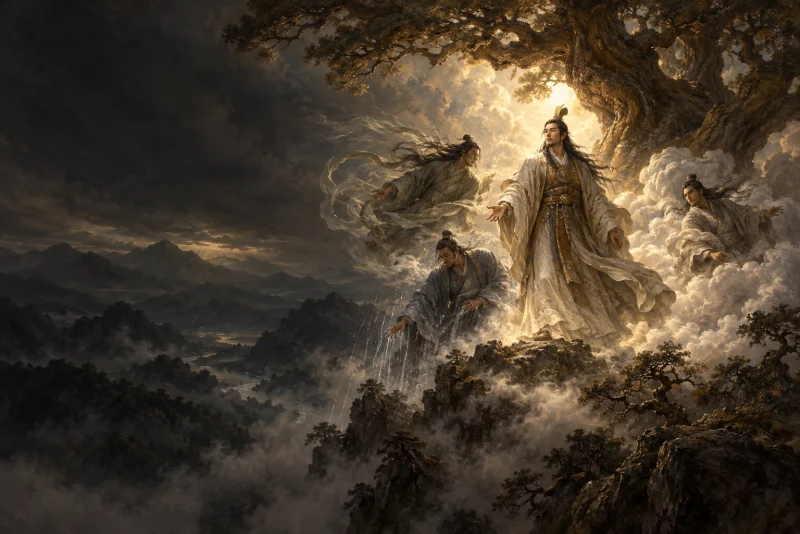
In the valley of Modun he met three men, one dressed in hemp, one in a patched robe and one in waterweed. He gave them surnames and work: “I am about to receive a great mandate and lay a foundation, and I have met three wise men. Is this not heaven’s gift?” With them he came to the river of Jolbon. The soil was rich and the mountains and rivers were strong, but there was no time to build a palace, so he put up a hut by the river Biryu. He named the country Goguryeo and took Go (高) as his surname. He was twenty-two. The year was 37 BCE.
Vegetable leaves floating downstream told him that people lived upriver. There he met Songyang, king of Biryu, whose family had ruled for generations. The land was too small for two kings, Songyang said: Jumong should be his vassal. They argued, then matched their skill with the bow, and Songyang could not hold his own. The next year he surrendered his country.
In the fourteenth year of the reign, Yuhwa died in East Buyeo, and Geumwa buried her with the rites of a queen mother. In the nineteenth year, Jumong’s son Yuri escaped from Buyeo with his mother. He brought half of a broken sword, and it matched the half his father had kept. That autumn the king “ascended far” at the age of forty. He was buried at Yongsan and given the name Dongmyeong Seongwang, Holy King of Eastern Brightness.
2 Where the Story Is Written Down
- The Gwanggaeto Stele (414) stands at what is now Ji’an, in Jilin Province, China. King Jangsu set it up for his father, King Gwanggaeto; it is about 6.4 metres tall and once carried some 1,775 characters. Before the deeds of the king it gives the founding, in a few lines:
- “Of old, the first ancestor King Chumo laid the foundation. He came out of Northern Buyeo. He was a son of the Heavenly Emperor; his mother was a daughter of the River Lord. He split the egg and came down.”
- At the great river Eomni he says: “I am the son of August Heaven, my mother is the daughter of the River Lord: I am King Chumo. Join the reeds and float the turtles for me!” At once the reeds joined and the turtles floated up, and he crossed.
- The epitaph of Moduru, written in ink on the wall of a tomb at Ji’an, probably in the reign of King Jangsu, and found in 1935, opens the same way: “Holy King Chumo, grandson of the River Lord and son of the sun and the moon, came out of Northern Buyeo.”
- The Wei shu (“Book of Wei”), the history of the Northern Wei compiled by Wei Shou in 554, has a chapter on Goguryeo. That chapter has no trace of the Dangun sentence that Iryeon attributes to a Wei shu. The Encyclopedia of Korean Culture notes that the chapter drew on what the envoy Li Ao learned in Goguryeo in 435. Its story already has the sunlight, the egg, the animals, the horses and the bridge; at the river, Zhumeng (the Chinese reading of 朱蒙) says, “I am the son of the sun.”
- The Samguk sagi (1145) gives the fullest prose version and the date of 37 BCE. Where it differs from the Wei shu, a note says so.
- The “Dongmyeong wang pyeon” (“Lay of King Dongmyeong”), by the poet Yi Gyu-bo (1168–1241), is a narrative poem of 282 lines of five characters, in book 3 of his collected works. Its notes quote at length the “Basic Annals” of the Gu Samguk sa (“Old History of the Three Kingdoms”), a history now lost.
- The Samguk yusa of the monk Iryeon (1280s) copies the Samguk sagi almost word for word in its Goguryeo chapter. Its Northern Buyeo chapter, quoting an “Old Record”, makes Haemosu a king who came down from heaven in a five-dragon chariot in 59 BCE.
Yi Gyu-bo explains in his preface why he wrote. When he first heard the story he laughed: Confucius “did not speak of prodigies”. Then, in the fourth month of 1193, he found the Old History. After reading it three times over he decided it was “not illusion but sagehood, not ghosts but gods”. Kim Busik, he complains, had left much of it out. He wrote the poem so that “the world may know our country was from the first a city of sages”.
3 Competing Versions
- Dongming of Buyeo. In the 1st century CE the Chinese thinker Wang Chong told, in his Lunheng (“Discourses Weighed in the Balance”), the story of Dongming (東明), founder of Buyeo. A maid of a northern king fell pregnant from a vapour “as big as a hen’s egg” that came down from heaven. The baby was thrown into a pigsty and then a stable, and the pigs and horses breathed on him to keep him alive. He grew up herding cattle and horses, was a fine archer, and fled south from a king who feared him. At the river 掩淲, almost the same name as the Samguk sagi’s 淹淲, he “struck the water with his bow”, fish and turtles made a bridge, and the pursuers could not cross.
- In the Japanese encyclopedia Nipponica, Hamada Kōsaku writes that the Jumong legend “has many elements in common” with this one. In the Heibonsha encyclopedia, Inoue Hideo notes that the founder who flees to found a kingdom was told of northern peoples from the Later Han onward, and appears in the founding myths of Buyeo and Baekje too.
- In a 2018 article, Song Yeong-dae sums up earlier Korean research: Dongming and Jumong were separate figures, and the Chinese histories keep them apart. When the two became one “King Dongmyeong” is disputed. Song argues for the Goryeo dynasty, from 1011, when an honorary title was added to the shrine of King Dongmyeong.
- Iryeon already knew the Buyeo story. At the end of his Goguryeo chapter he quotes it from a book he calls the Jurim jeon (珠琳傳), and adds that it means Dongmyeong “became king of Jolbon Buyeo”.
- Who was the father? The stele says only “the Heavenly Emperor”. The Moduru epitaph says “the sun and the moon”, and in the Wei shu Jumong calls himself “the son of the sun”. The Samguk sagi has both Haemosu and the sunlight. A note in the Samguk yusa says his surname had been Hae, and he took Go because he was “born by receiving the sunlight”.
- What was the bridge made of? On the stele, reeds and turtles; everywhere else, fish and turtles. In the Samguk sagi Jumong speaks to the river. In Yi Gyu-bo’s notes, as in Wang Chong’s Dongming story, he strikes it with his bow, and the bridge falls apart under the pursuers, who drown.
- Who chose the horse? In the Samguk sagi Jumong starves the fast horse himself. In Yi Gyu-bo’s notes his mother whips the herd, and a chestnut horse leaps a fence two jang high. Jumong pushes a needle into its tongue so it cannot eat, and pulls it out once the king has given him the thin horse.
- What the poem adds. Haemosu comes down in a chariot drawn by five dragons, with a hundred followers on white swans, and goes back to heaven every evening. The River Lord tests him: he becomes a carp, a pheasant and a deer, and Haemosu an otter, a hawk and a jackal. The angry River Lord stretches Yuhwa’s lips three feet long. Two doves sent by his mother bring Jumong the barley seed he forgot, and a white deer hung upside down cries until heaven floods Songyang’s capital.
- Did he die? Not on the stele: a yellow dragon comes down, and carries him up to heaven from the eastern ridge of Holbon. The Samguk sagi uses the usual word for a king’s death, “ascended far”, and buries him at Yongsan. In Yi Gyu-bo’s notes he “ascended to heaven and did not come down”, and his son buried at Yongsan the jade whip he left behind.
4 History and Tradition
- Goguryeo was real. Inoue Hideo writes that Goguryeo can be taken to have arisen in the late 1st century BCE, and that the Samguk sagi’s date of 37 BCE “is broadly accepted”. Its first capital is identified with Wunu Mountain City, in Huanren, Liaoning; the court later moved to Guonei, at Ji’an, and in 427 to Pyongyang.
- A king killed in 12 CE. The Hanshu says that Wang Mang’s general Yan You lured “Zou, Marquis of Goguryeo” to him and beheaded him. Inoue notes the view that identifies Zou with Jumong, and thinks the founder has both sides, the legend and the man.
- Shrines. According to the Encyclopedia of Korean Culture, shrines to Dongmyeong stood in Goguryeo’s capitals and at strongholds such as Liaodong, and Baekje, which also claimed him as its founder, built them too. Goryeo, whose very name declared it the heir of Goguryeo, honoured his shrine in turn.
- The stele dropped out of the records after Goguryeo fell, and was found again by a farmer around 1880. In 2004 UNESCO inscribed it, with the capitals and tombs around it, as “Capital Cities and Tombs of the Ancient Koguryo Kingdom”, in China.
- The Tomb of King Tongmyong, in the Ryokpo district of Pyongyang, was excavated by North Korea in 1974 and rebuilt on a grand scale in 1994. North Korean scholars hold that the founder’s tomb was moved there when the capital moved to Pyongyang. In 2004 it was inscribed in the “Complex of Koguryo Tombs”, the first World Heritage Site in North Korea.
North Korea presents the Tomb of King Tongmyong as Jumong’s grave. The Samguk sagi buries him at Yongsan, which the Encyclopedia of Korean Culture places at Jolbon, the first capital; it traces the Pyongyang tradition to the Goryeo period. When UNESCO listed the site, its advisers asked for a sign explaining that “the tomb of the ‘First King’ is his second tomb, which did not house his body”.
5 Related Stories
- Dangun: The Bear, the Tiger and the First Korean Kingdom: Iryeon ties the two founders together. In a note to the Goguryeo chapter he quotes a “Record of Dangun” in which Dangun marries a daughter of a River Lord and has a son, Buru, and concludes that Buru and Jumong were half-brothers.
- Nüwa: The Serpent-Bodied Goddess Who Mended the Sky: Yi Gyu-bo opens his poem with the wonders of the Chinese sage kings, “Nüwa mended the blue sky” among them, before turning to the wonders of Dongmyeong.
- Hou Yi and Chang’e: The Archer Who Shot the Suns and the Woman in the Moon: two archers whose bows change the world. We have not found a scholar who compares the two stories; we link them for the theme.
- Lạc Long Quân and Âu Cơ: The Dragon, the Fairy and the Hundred Eggs: another founding myth with eggs. Inoue Hideo reads the egg birth in the Jumong myth as a southern element, joined to a northern tale of conception by sunlight. He does not mention Vietnam; the link is the theme.
- Bak Hyeokgeose: The Egg-Born Founder of Silla: Silla’s founder, also born from an egg. The Samguk sagi has Jumong found Goguryeo in the twenty-first year of Hyeokgeose’s reign. In the Encyclopedia of Korean Culture, Heo Won-gi notes that Jumong’s egg, which carried no sign from heaven, was cast away, while Hyeokgeose was raised up at once.
6 Sources
- The Gwanggaeto Stele inscription (414): Chinese Wikisource
- The epitaph of Moduru, as read by Geng Tiehua: Chinese Wikisource
- Wei Shou, Wei shu, book 100, “Goguryeo”: Chinese Wikisource
- Kim Busik, Samguk sagi, book 13, “King Dongmyeongseong”, Oksan Seowon print: Chinese Wikisource; Korean translation: Korean Wikisource
- Yi Gyu-bo, “Dongmyeong wang pyeon”, Dongguk Isangguk jeonjip, book 3: Chinese Wikisource
- Iryeon, Samguk yusa, book 1, “Northern Buyeo” and “Goguryeo”, 1512 Gyujanggak print, with Korean translation: Korean Wikisource, Korean Wikisource
- Wang Chong, Lunheng, chapter 9, “Jiyan”: Chinese Wikisource
- Ban Gu, Hanshu, book 99B, “Wang Mang”: Chinese Wikisource
- Encyclopedia of Korean Culture: 동명왕 신화, 동명왕편, 광개토왕릉비, 모두루 묘지, 동명왕릉
- Song Yeong-dae, “고려의 주몽·동명 인식과 동명성왕 관념 성립”, Korean Studies Quarterly 41.3 (2018): accesson.kr
- Inoue Hideo, “朱蒙” and “高句麗”, Heibonsha World Encyclopedia; Hamada Kōsaku, “朱蒙”, Nipponica: Kotobank, Kotobank
- UNESCO World Heritage Committee, decisions 28 COM 14B.25 and 14B.33 (Suzhou, 2004), and the ICOMOS evaluations: whc.unesco.org, ICOMOS 1091, ICOMOS 1135
Cover and illustrations: AI-generated images made for Arcana. They are interpretations, not historical artworks.