Bak Hyeokgeose: The Egg-Born Founder of Silla
A white horse knelt by a well, then rose into the sky and left an egg. The boy inside became the first king of Silla, and two more royal houses began with a chest from the sea and a golden chest in a tree.
- Type: founding myth
- Culture: Silla, a kingdom of south-eastern Korea with its capital at Gyeongju (57 BCE by tradition, to 935 CE)
- Earliest texts: the Samguk sagi (1145) and the Samguk yusa (1280s)
- Key figures: Bak Hyeokgeose (朴赫居世); his queen Aryeong (閼英); Sobeol-gong (蘇伐公), chief of Goheo village; Hogong (瓠公); Seok Talhae (昔脫解); Kim Alji (金閼智)
By the count of the old histories, Silla lasted almost a thousand years, and its kings came from three families: Bak, Seok and Kim. Each told how its first ancestor arrived: in an egg beside a well, in a chest washed in from the sea, in a golden chest hanging in a tree. Kim Busik, who put them into Korea’s oldest surviving history in 1145, found the golden chest “all the more strange, and not to be believed”. Yet, he added, people handed the stories down as fact.
Where do the names Bak and Hyeokgeose come from? From the egg and its light. The Samguk sagi says that the people of Jinhan called a gourd bak, and because the great egg looked like a gourd, the boy took Bak as his surname. Iryeon thought Hyeokgeose was a native word. He says it was also written Bulgunae (弗矩內), meaning “ruling the world with light”. In the Heibonsha encyclopedia, Inoue Hideo regards the surname Bak as a later addition.
1 The Telling
This follows the Samguk yusa of the monk Iryeon, written in the 1280s, which gives the fullest telling. The annals of the Samguk sagi, compiled by Kim Busik in 1145, add the events of the reign. Section 3 shows where the two differ.
1-1 Six Villages without a King
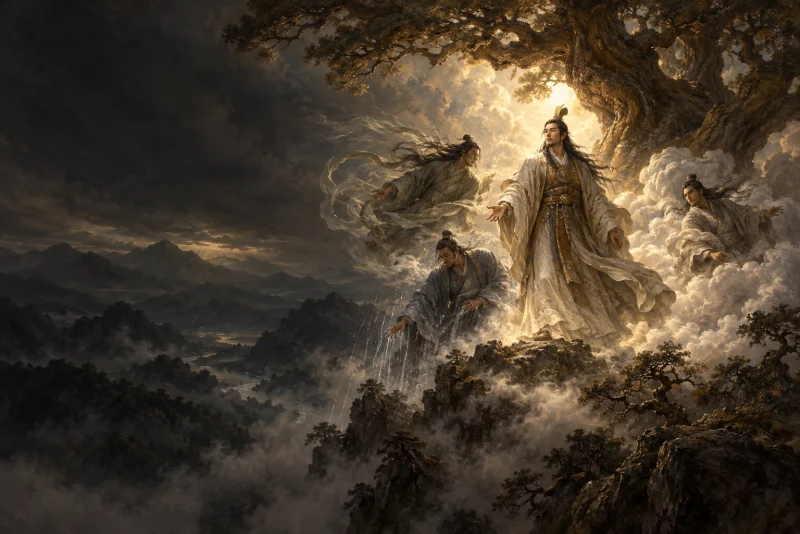
Long ago the land of Jinhan had six villages. Iryeon names each chief and the mountain where he first came down: Alpyeong onto Pyoam Peak, Sobeol-dori onto Hyeongsan, and four more, each the ancestor of a later clan. “Reading the text above,” he adds, “the ancestors of these six divisions all seem to have come down from heaven.” The Samguk sagi says that the villagers were people left from Joseon, the kingdom of the Dangun story, living apart in the mountain valleys.
In 69 BCE, on the first day of the third month, the six chiefs and their sons met on the bank of the river Alcheon. “We have no ruler above us to govern the people,” they said, “and the people are unruly and do as they please. Why not find a man of virtue, make him our lord, found a country and set up a capital?”
1-2 The White Horse at Najeong
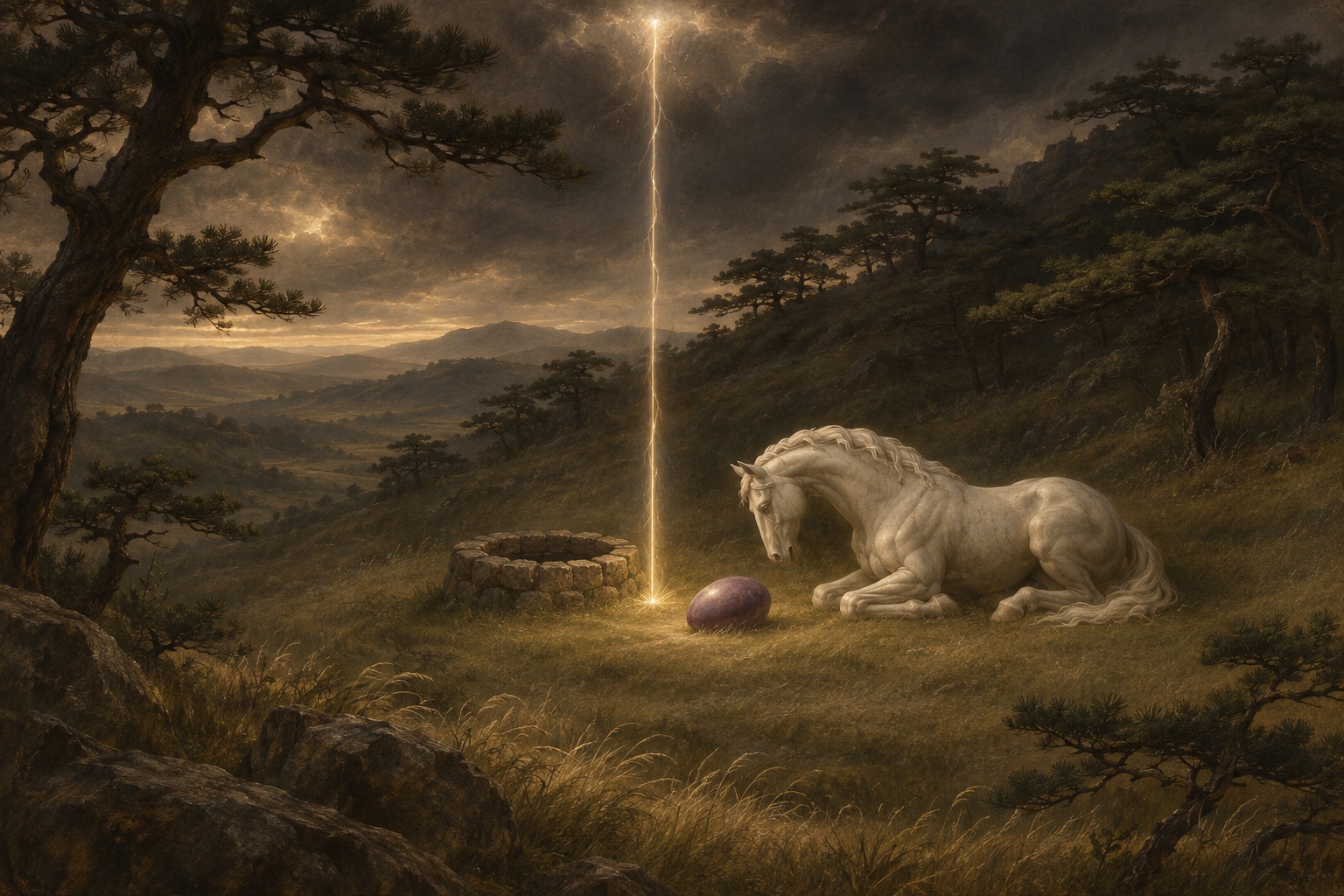
They climbed to a height and looked south. Below Mount Yangsan, beside the well called Najeong, a strange vapour like lightning hung down to the ground, and a white horse knelt there as if bowing. They went to look and found a purple egg (a note says “a large blue egg”). The horse saw the people, gave a long neigh and rose into the sky.
They split the egg and found a boy, well formed and handsome. Amazed, they bathed him in the spring of Dongcheon. His body gave off light, birds and beasts danced, heaven and earth shook, and the sun and moon shone clear. So they named him Hyeokgeose. His title was geoseulhan, also written geoseogan: when the boy first opened his mouth, Iryeon explains, he announced himself as “Alji geoseogan, arisen”, and from then on the word was a title for kings.
1-3 The Girl with a Beak
People vied with one another to celebrate. “The Son of Heaven has come down to us,” they said. “Now we must find a woman of virtue to be his match.” That same day, beside the Aryeong well in Saryang village, a gyeryong, a rooster-dragon, appeared, and from its left side a girl was born. (In another account, the dragon appeared and died, and the girl was found when its belly was opened.) She was beautiful, but her lips were like a chicken’s beak. When she was bathed in the stream north of Wolseong, the beak fell away, and the stream was called Balcheon, “the stream where it fell off”. She was named Aryeong, after the well.
A palace was built at the western foot of Namsan, and the two sacred children were raised there. When they were thirteen, in 57 BCE, the boy became king and the girl his queen. The country was called Seorabeol or Seobeol, also Sara or Saro. Because “the king was born at the Rooster Well”, Iryeon adds, it was sometimes called Gyerim, “Rooster Forest”, for the omen of the rooster-dragon; others say that name came later, with Kim Alji.
1-4 The Two Sages and the Five Tombs
The Samguk sagi tells the reign year by year. People called the king and queen “the two sages”. Raiders from Wa turned back when they heard of the king’s divine virtue. In 37 BCE he walled his capital and named it Geumseong. Soldiers from Lelang came to attack, saw that the people of the border left their doors unbarred at night and their grain stacked in the fields, and said: “To creep up on a people who do not steal from each other would make us no better than thieves.” They went home. His envoy to the king of Mahan was Hogong, a man “of unknown clan, originally from Wa”, so named because he had crossed the sea with a gourd (ho) tied at his waist.
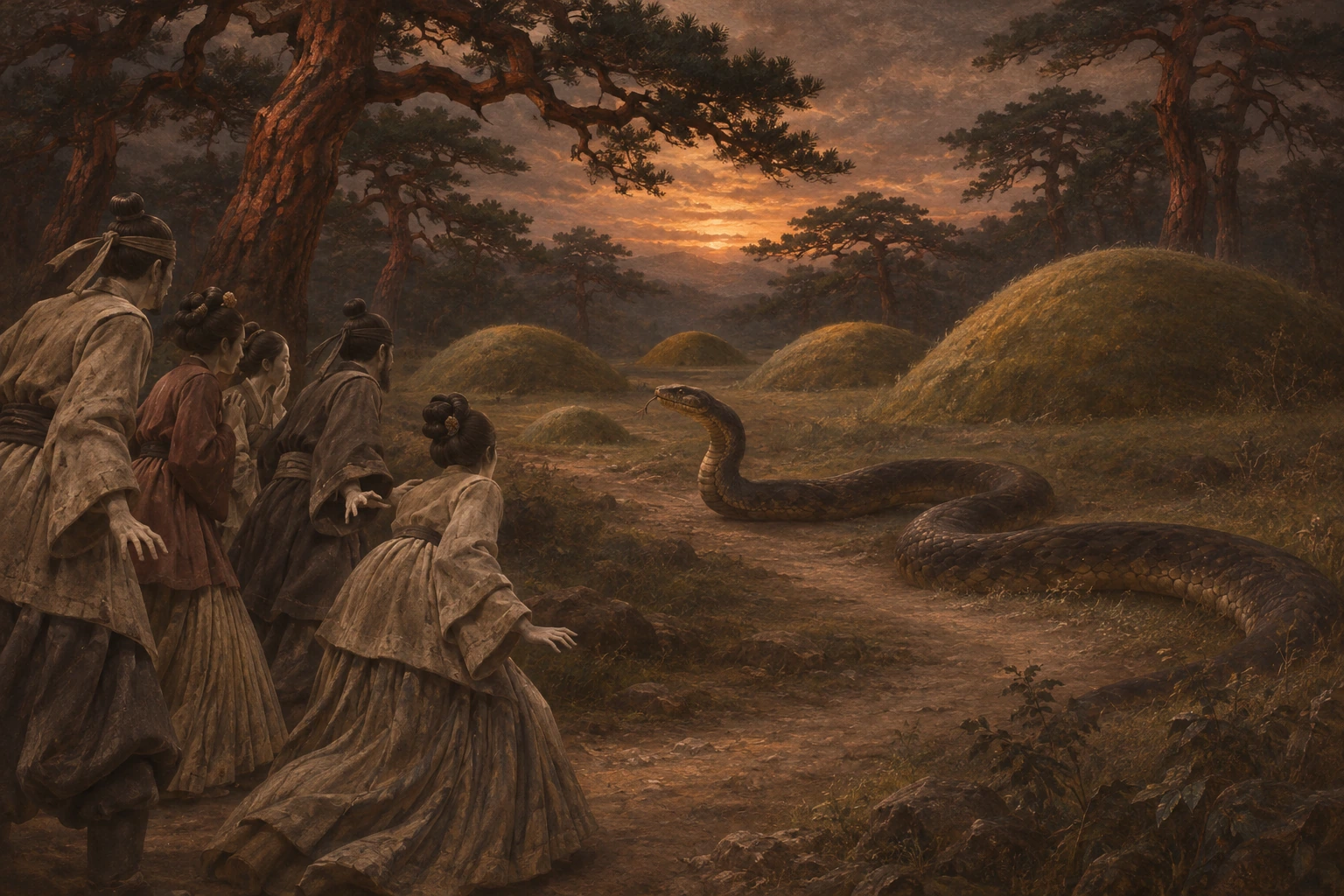
After ruling for sixty-one years the king rose to heaven. Seven days later, says Iryeon, his remains fell scattered to the earth, and the queen died too. The people wanted to bury them together, but a great snake drove them away. So they buried the five parts separately, as five tombs, called the Five Tombs and also the Snake Tombs, north of Dameom temple. His son Namhae succeeded him.
1-5 Seok Talhae and the Chest from the Sea
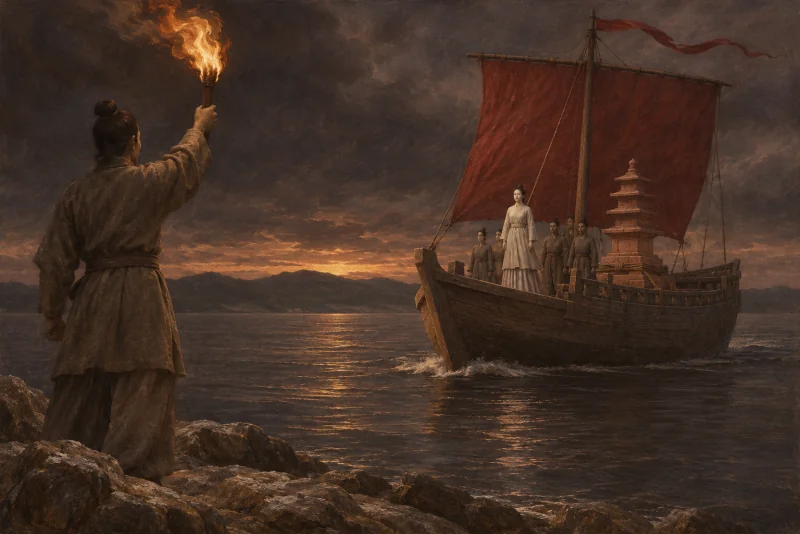
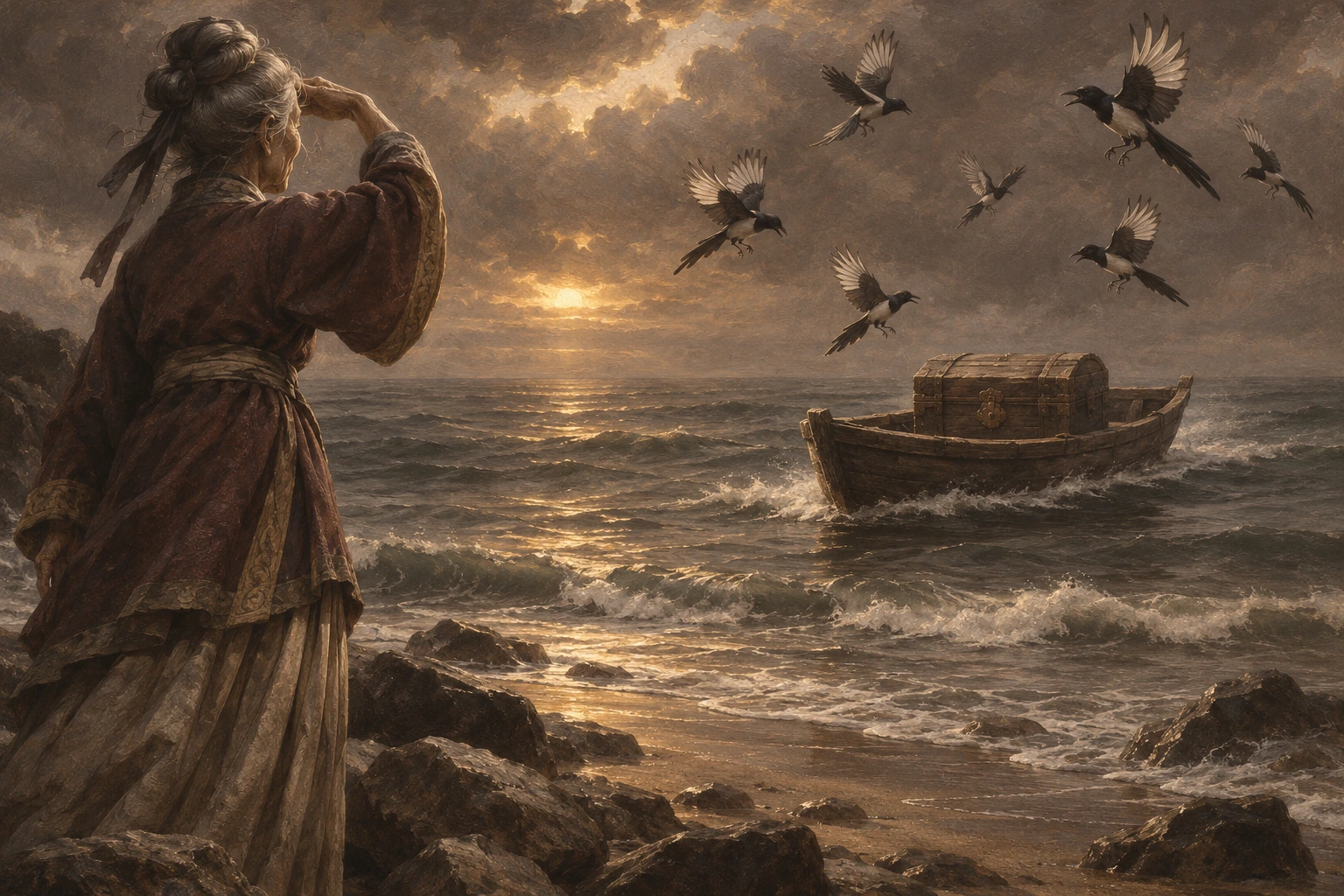
In the reign of Namhae, Iryeon goes on, a boat came to the coast of Garak. King Suro and his people went out beating drums to welcome it and keep it, but it sped away. (The Garak-guk gi tells their meeting another way: see Related Stories.) The boat reached Ajinpo, east of Gyerim, where an old woman named Ajin Uiseon saw magpies gathering and crying over the sea. In the boat was a chest, and in the chest a handsome boy, with treasures and servants. After seven days he spoke. He came from Yongseong, a land a thousand li north-east of Wa. His mother, a princess, had laid a great egg, and his father the king had said: “A person who lays an egg: this has never been, and it cannot be lucky.” So the boy was put in a chest and set adrift, with a prayer that he would reach a land he was bound to, and found a country and a family there; a red dragon guarded the boat.
The boy climbed Tohamsan, built a cairn of stones and stayed there seven days, looking over the town for a place to live. He saw a hill shaped like a crescent moon: the house of Hogong. By night he buried whetstones and charcoal beside it, and in the morning claimed it as his family’s old home. “I am a smith,” he told the officials. “I went to the next village for a while, and someone moved in. Dig, and see.” The whetstones and charcoal were found, and the house was his. King Namhae saw how clever he was and gave him his eldest daughter, and in 57 CE Talhae became the fourth king. His surname Seok (昔, “formerly”) came from “this was formerly my family’s house”, or from the magpie (鵲) without its bird; Talhae means “freed from the chest, out of the egg”. When he died his bones proved enormous, “the bones of a strongman without equal under heaven”, and he was honoured as the god of the eastern peak, Tohamsan.
1-6 Kim Alji and the Golden Chest
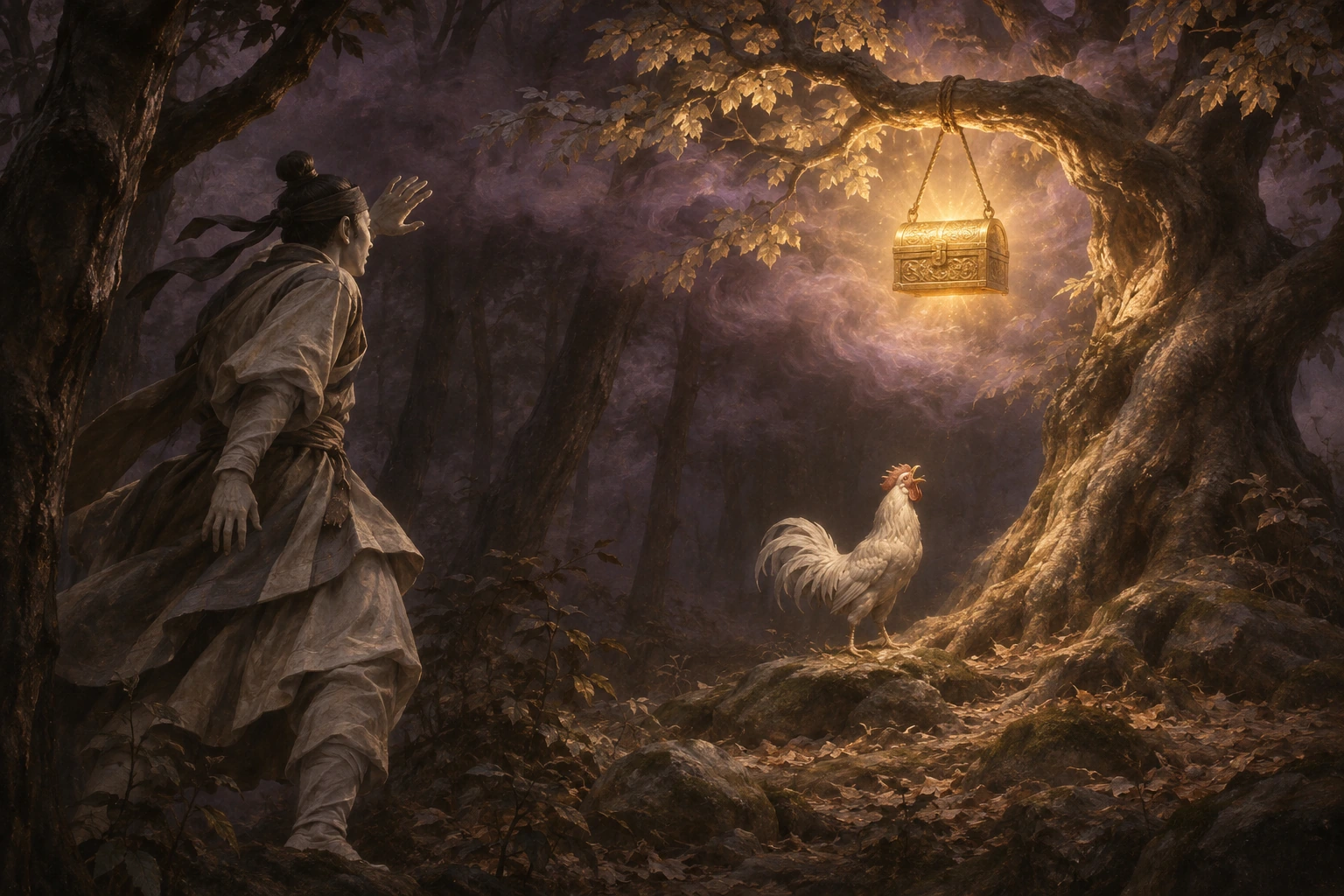
In 60 CE, on the fourth day of the eighth month, Hogong was walking at night west of Wolseong when he saw a great light in the wood of Sirim. A purple cloud hung down from the sky to the earth. In the cloud a golden chest hung from a branch, light poured out of it, and a white rooster crowed beneath the tree. The king came to the wood and opened the chest. A boy lay inside, and he sat up at once, “as in the old story of Hyeokgeose”. So he was named Alji, which, Iryeon says, is the local word for a little child. Birds and beasts followed him to the palace, leaping for joy. He was made crown prince but gave up the throne and never reigned. Because he came out of a golden chest his surname was Kim (金, “gold”), and seven generations on his descendant Michu became the first king of the Kim line. The Samguk sagi adds that the wood was renamed Gyerim, Rooster Forest, and that the name was used for the whole country.
2 Where the Story Is Written Down
- The Samguk sagi (“History of the Three Kingdoms”), compiled by Kim Busik and presented in 1145, opens with Silla. Book 1 gives Hyeokgeose’s reign as annals: the accession in 57 BCE at thirteen, Aryeong in the fifth year, the deeds of the reign, the death in the sixty-first year and the burial at the Snake Tomb. The same book tells of Talhae, and of Kim Alji in the ninth year of Talhae’s reign.
- The Samguk yusa (“Memorabilia of the Three Kingdoms”) of the monk Iryeon (1206–1289) gives the fullest telling, in book 1: “King Hyeokgeose, Founder of Silla”, “King Talhae” and “Kim Alji, in the Reign of King Talhae”. Its notes quote other versions and correct dates. In book 5, Iryeon tells the story of the Holy Mother of Seondo-san (section 3).
- The shrines. Book 32 of the Samguk sagi, on rites, says that King Namhae set up a shrine to Hyeokgeose in the third year of his reign, with his own sister Aro in charge of the rites. A later king built a singung, a “divine palace”, at Naeul, “the place where the founder was born and came down”. Book 32 credits King Jijeung; book 3 dates it to 487, under King Soji.
- Elsewhere. According to the Encyclopedia of Korean Culture, the Jewang ungi (1287) mentions the story only briefly.
At the end of the Silla annals, in book 12, Kim Busik adds a comment of his own: “The Bak and the Seok of Silla were both born from eggs. The Kim came down from heaven in a golden chest, or some say rode a golden chariot. This is all the more strange, and not to be believed. Yet the world hands it down as fact.” Then he recalls a visit to the Song court in the Zhenghe era (1111–1118), where a Chinese official showed him the statue of a goddess.
3 Competing Versions
- Who found the egg? In the Samguk sagi, one man: Sobeol-gong, chief of Goheo village, looks toward the woods beside Najeong and sees a horse kneeling and neighing. When he gets there the horse has vanished, and only a large egg is left. He raises the boy, who is wise beyond his years by the age of ten, and the six villages make him king at thirteen. There is no light from the sky, no flight and no bath. In the Samguk yusa the six chiefs see it all together.
- Which year? Both give 57 BCE for the accession; the Samguk sagi says the fourth month, or in a note the fifteenth day of the first. Only Iryeon dates the chiefs’ meeting to 69 BCE, and he rejects two dates in an “old book”, 25 CE and 138 BCE, as errors.
- Aryeong. In the Samguk sagi she is born in the fifth year of the reign, from the dragon’s right side, and an old woman finds and raises her. In the Samguk yusa she is born from the left side, on the day the boy is found. In the Encyclopedia of Korean Culture, Sin Jong-won reads the birth from the side as a later Buddhist touch, recalling the birth of the Buddha.
- The end. The Samguk sagi uses the ordinary word for a king’s death, “ascended far”, and buries him at the Snake Tomb; Namhae, Yuri and later Pasa are buried “within the Snake Tomb precinct”. Only the Samguk yusa has the body falling in five parts and the snake. Kim Yeol-gyu calls this ending almost grotesque, without parallel in other founding myths, and suggests, with caution, a comparison with the cutting apart of the body in Siberian shamans’ initiations.
- A mother from China? In a note, Iryeon reports that some say Hyeokgeose was born of the Holy Mother of Seosul, as Chinese writers praising the Holy Mother of Seondo spoke of her “conceiving a sage to found a country”. In book 5 he tells her story. Saso, a daughter of the Chinese imperial house, learned the arts of the immortals and came east. Her father sent a letter tied to a kite’s foot: she should make her home where the kite came down. It came down on this mountain, and she stayed as an earthly immortal. “When she first came to Jinhan, she bore sacred children who became the first rulers of the Eastern Land”: Hyeokgeose and Aryeong. Kim Busik heard a version in China. At the Youshen Lodge the scholar Wang Fu showed him the statue of an emperor’s daughter who “conceived without a husband”, crossed the sea to Jinhan and bore the first ruler of the land east of the sea.
- Where did Talhae come from, and when? The Samguk sagi calls his country Dapana, a thousand li north-east of Wa. His chest drifts first to Geumgwan, where people find it strange and leave it, then to Ajinpo in the thirty-ninth year of Hyeokgeose (19 BCE). The Samguk yusa calls the country Yongseong, or Jeongmyeong, Wanha or Hwaha, and puts the arrival under Namhae. The Encyclopedia of Korean Culture lists modern theories of Talhae’s origin: horse-riding peoples of the north, seafarers from the south, refugees from Lelang, and others.
- When did Kim Alji appear? In 65 CE in the Samguk sagi, where King Talhae himself hears the rooster in the night; in 60 CE in the Samguk yusa, where Hogong sees the light. Iryeon dismisses a third date as an error.
4 History and Tradition
- Saro, a small state. The Sanguozhi, a Chinese history of the 3rd century, lists twenty-four small states of Jinhan and Byeonhan in the south of the peninsula, Saro (斯盧) among them, and says that Jinhan “at first had six states, and gradually divided into twelve”. The Samguk yusa gives Saro as one of the names of Hyeokgeose’s country, and the Encyclopedia of Korean Culture identifies it with the Seorabeol of the myth.
- The people left from Joseon. In the same encyclopedia Kim Byeong-gon points to sites around Gyeongju from the 2nd century BCE, and to wooden-coffin tombs of about 100 BCE, that he links to the Gojoseon culture of the north-west. He concludes that Saro was indeed founded as refugees from Joseon settled there.
- Three founders, three clans. The encyclopedia’s articles read the stories as the histories of clans. They see the Bak, with their white horse and descent from heaven, as newcomers who came to rule the villages; the Talhae group as fishing people of the coast east of Gyeongju who already worked iron, which is why Talhae claims to be a smith; the Kim as an older local group whose totem was the rooster.
- Najeong was excavated in four seasons between 2002 and 2005. A well had been expected beneath the square foundation stone; instead the diggers found an oval pit, finally identified as a setting for a post, with ditches and a ring of wooden fencing going back to the Early Iron Age. In the late 7th century, under King Munmu, the excavators believe, an eight-sided building was raised there, eight metres along each side. Some ninety roof tiles carry the character 生, “birth”. From the story and the likeness of the names, Kim Byeong-gon thinks the site may be the singung of Naeul, while noting that much is still unclear.
- The Five Tombs (Oreung) in Gyeongju are five round earthen mounds, the largest about ten metres high. Tradition gives them to Hyeokgeose, Aryeong, Namhae, Yuri and Pasa. They have never been excavated, and since no round mound tombs earlier than the 3rd century have been found around Gyeongju, the Encyclopedia of Korean Culture holds that it is too early to tie them to the named kings.
- Sungdeokjeon, a shrine to Hyeokgeose in Gyeongju, was founded by royal order in 1429, with rites in spring and autumn; a stele recording his virtues was set up there in 1752. Of Talhae, Iryeon writes that the state rites to the god of the eastern peak “have never ceased to this day”.
Silla is often called the first of the Three Kingdoms, founded in 57 BCE, ahead of Goguryeo (37 BCE) and Baekje (18 BCE). That order is the Samguk sagi’s. The Encyclopedia of Korean Culture doubts the date on two counts: the history takes Silla’s side and puts its founding before the other two, and 57 BCE is a gapja year, the first of the sixty-year cycle, in which Han-dynasty prophecy expected great change. Kim Byeong-gon suggests that later Silla chose it as the first gapja year after Gojoseon fell. In Chinese records a marquis of Goguryeo is named in 12 CE, while Saro is still one small state among twelve in the 3rd century; Inoue Hideo dates the kingdom called Silla to the late 4th century.
5 Related Stories
- Jumong: The Archer Born from an Egg: the Samguk sagi has Jumong found Goguryeo in the twenty-first year of Hyeokgeose. In the Encyclopedia of Korean Culture, Heo Won-gi notes that Jumong, like Talhae, was cast away because his egg carried no sign from heaven, while Hyeokgeose and Suro were raised up at once. Kim Yeol-gyu compares Aryeong’s beak with Yuhwa, whose lips her father stretched long.
- Dangun: The Bear, the Tiger and the First Korean Kingdom: the Samguk sagi makes the six villages people left from Joseon, and Kim Yeol-gyu sets the name “ruling the world with light” beside the “broadly benefit humankind” of the Dangun story.
- Suro and Heo Hwang-ok: The Founder of Gaya and the Queen from Ayuta: the founder of Gaya, whose people tried to keep Talhae’s boat. In the Garak-guk gi the two meet instead in a contest of transformations for Suro’s throne.
- Lạc Long Quân and Âu Cơ: The Dragon, the Fairy and the Hundred Eggs: a sac of eggs left in the fields for fear of an ill omen, as Talhae’s egg was set adrift. We have not found a scholar who compares the two stories; we link them for the theme.
6 Sources
- Kim Busik, Samguk sagi, book 1, “Hyeokgeose geoseogan” and “Talhae isageum”, book 3, book 12 (Kim Busik’s comment) and book 32 (“Rites”), Oksan Seowon print: Chinese Wikisource, book 3, book 12, book 32; Korean translation of book 1: Korean Wikisource
- Iryeon, Samguk yusa, book 1, “Silla sijo Hyeokgeose wang”, 1512 Gyujanggak print, with Korean translation: Korean Wikisource, Korean Wikisource, Korean Wikisource
- Iryeon, Samguk yusa, book 1, “Je sa Talhae wang” and “Kim Alji Talhae wang dae”, 1512 Gyujanggak print: Chinese Wikisource, Chinese Wikisource; with Korean translation: Korean Wikisource
- Iryeon, Samguk yusa, book 5, “Seondo seongmo suhui bulsa”, unscanned transcription with Korean translation (no edition named): Korean Wikisource
- Chen Shou, Sanguozhi, book 30, “Han”: Chinese Wikisource
- Ban Gu, Hanshu, book 99B, “Wang Mang”: Chinese Wikisource
- Encyclopedia of Korean Culture: 박혁거세 신화 (Kim Yeol-gyu), 혁거세거서간, 알영부인 (Sin Jong-won), 석탈해 신화 (Kim Yeol-gyu), 탈해이사금, 김알지, 사로국 (Kim Byeong-gon), 경주 나정 (Kim Byeong-gon), 경주 오릉, 숭덕전, 건국신화 (Heo Won-gi)
- Inoue Hideo, “赫居世” and “新羅”, Heibonsha World Encyclopedia, and “新羅”, Nipponica: Kotobank, Kotobank
Cover and illustrations: AI-generated images made for Arcana. They are interpretations, not historical artworks.