Dangun: The Bear, the Tiger and the First Korean Kingdom
A god came down from heaven, and a bear kept to a dark cave until she became a woman. Their son Dangun founded Joseon. The oldest text that tells it was written in the 1280s, and it quotes two books no one has ever found.
- Type: founding myth
- Culture: Korea, North and South
- Earliest text: the Samguk yusa (三國遺事) of the monk Iryeon, written in the 1280s
- Key figures: Hwanin (桓因), Hwanung (桓雄), the bear-woman Ungnyeo (熊女), Dangun Wanggeom (檀君王儉)
Every year on 3 October, South Korea takes a day off for a story about a bear. The holiday is Gaecheonjeol, “the day the heavens opened”, and the story is how the first Korean kingdom began.
Did the bear wait a hundred days? Not quite. Hwanung told the two animals to stay out of the sunlight for a hundred days. The text then says the bear became a woman after keeping the taboo for “three sevens of days”, that is, twenty-one. Of the tiger it says only that he “could not keep the taboo”. It never says he ran away.
1 The Telling
This is the version in the Samguk yusa. Iryeon says he took it from a book he calls the Gogi (古記), the “Old Record”.
1-1 The Son Who Wanted the World Below
Long ago there was Hwanin. A note in the text identifies him with Śakra, the king of the gods in Buddhism. One of his sons who was not the heir, Hwanung, kept turning his thoughts to the world below and longed for the human world.
His father understood. He looked down on the land of Samwi and Taebaek and judged that it could “broadly benefit humankind”. He gave Hwanung three heavenly seals (天符印) and sent him down to rule it.
1-2 The City under the Tree
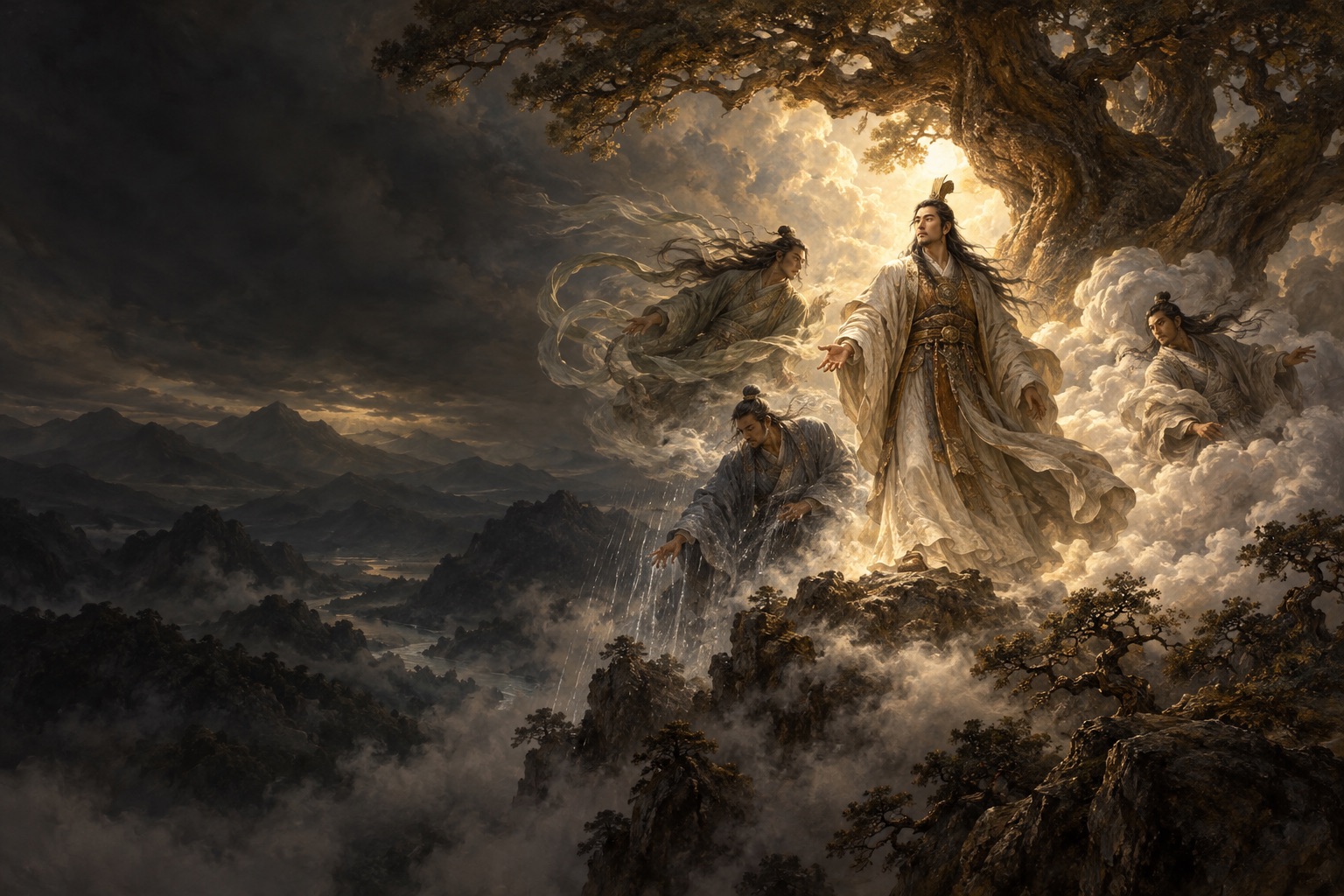
Hwanung came down with three thousand followers onto the summit of Mount Taebaek, beneath the Sacred Altar Tree (神壇樹). The place was called Sinsi, the City of the Gods, and he was called the Heavenly King Hwanung.
He brought with him the Earl of Wind, the Master of Rain and the Master of Clouds. Hwanung took charge of grain, of the span of life, of sickness, of punishment, and of good and evil. In all he managed more than 360 human affairs, governing the world and bringing it civilization.
1-3 The Bear and the Tiger
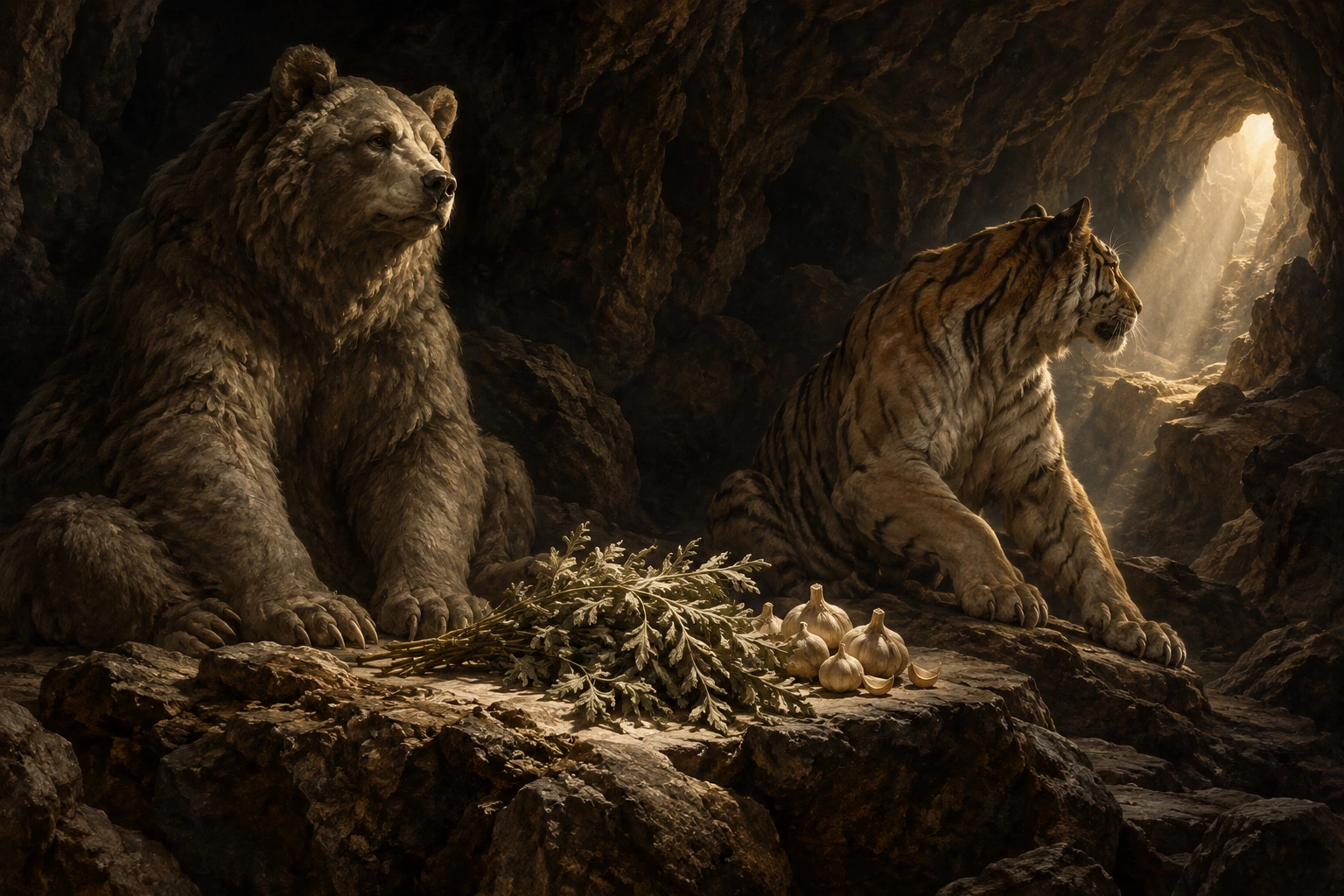
A bear and a tiger lived together in one cave, and they kept praying to Hwanung to let them become human. He gave them one bundle of sacred mugwort and twenty bulbs of san (蒜, usually read as garlic) and said: “Eat these and do not see the sunlight for a hundred days, and you will take human form.”
They ate. After keeping the taboo for three sevens of days, the bear received a woman’s body. The tiger could not keep the taboo, and did not receive a human body.
1-4 Ungnyeo and Dangun
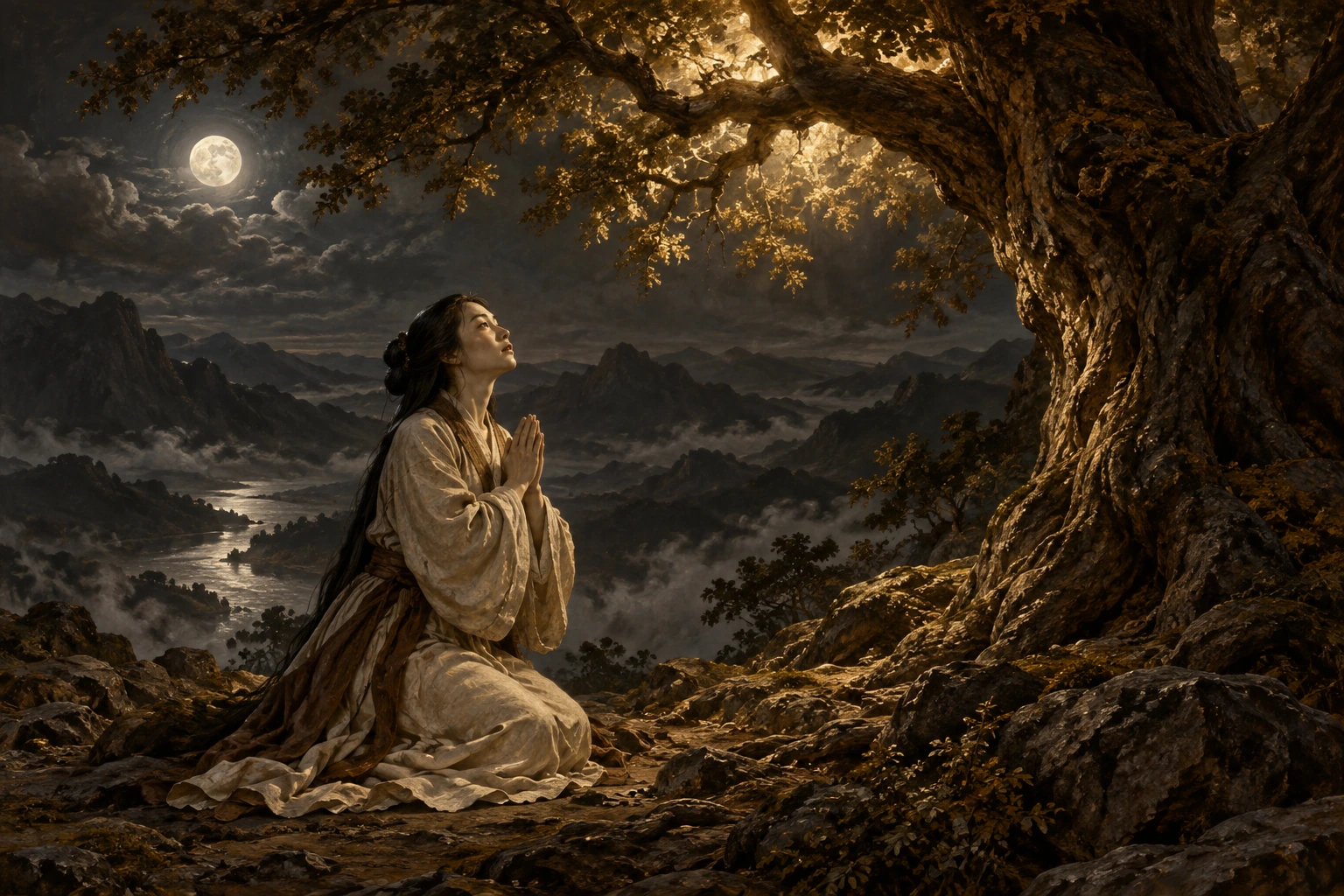
The bear-woman, Ungnyeo, had no one to marry. So every day, beneath the altar tree, she prayed for a child. Hwanung took on a human shape for a time and married her, and she gave birth to a son. He was called Dangun Wanggeom.
1-5 The Kingdom and the Mountain
In the fiftieth year of the Chinese sage-emperor Yao, a gyeongin year, Dangun made Pyongyang his capital and named his country Joseon. Later he moved his capital to Asadal on Mount Baegak, and he ruled for fifteen hundred years.
When King Wu of Zhou made Gija the lord of Joseon, Dangun moved away to Jangdang-gyeong. Later he returned to Asadal, hid himself there and became a mountain god. He was 1,908 years old.
Iryeon heads the chapter Gojoseon, “Old Joseon”. Historians still use that name, to tell this kingdom apart from the Joseon dynasty of 1392 to 1910.

2 Where the Story Is Written Down
The Samguk yusa (“Memorabilia of the Three Kingdoms”) is by the Buddhist monk Iryeon (1206–1289). He wrote most of it in his last years, and it is usually dated to the 1280s. The oldest complete printing that survives is from 1512. For the Dangun chapter Iryeon names two sources:
- the Wei shu (魏書), for one sentence only: two thousand years earlier, Dangun Wanggeom founded Joseon with its capital at Asadal, in the time of Yao;
- the Gogi, for everything else: the descent, the bear and the tiger, the birth.
Neither book survives. No surviving Chinese history of the Wei contains the sentence.
The Samguk sagi (1145) is the oldest surviving Korean history, and it has no Dangun story. It says only that Pyongyang “was originally the dwelling of the immortal Wanggeom”.
The Jewang ungi (“Rhymed Record of Emperors and Kings”), by Yi Seunghyu, was finished in 1287, the same decade as Iryeon’s book. It tells a different version (section 3).
Later works retell the story in the court histories of the Joseon dynasty, among them the Sejong sillok jiriji (1454) and the Dongguk tonggam (1485).
Iryeon did not take his source on trust. Next to the date he writes that if Yao’s first year was a mujin year, then his fiftieth was jeongsa, not gyeongin: “I suspect this is not accurate.”
3 Competing Versions
- Who was Dangun’s mother?
- In the Samguk yusa, she is the bear who became a woman.
- In the Jewang ungi and the Sejong sillok jiriji there is no bear. Hwanung has his granddaughter drink a medicine so that she takes human form, and she marries the spirit of the dan tree (檀樹神). Dangun is their son.
- Altar or tree? The 1512 print of the Samguk yusa writes 壇, “altar”: 壇君 and 神壇樹. The Jewang ungi and most later texts write 檀, a kind of tree (usually translated birch or sandalwood). 檀君 is the standard spelling today.
- How long did he live? The Samguk yusa gives a reign of 1,500 years and a lifespan of 1,908. The other sources give a reign of about a thousand years.
- Where is Mount Taebaek? A note in the Samguk yusa says it is today’s Myohyang-san, in what is now North Korea. Placing it on Baekdu-san, the highest peak on the peninsula, is a modern reading.
- Where does “2333 BCE” come from? Not from Iryeon. The Dongguk tonggam (1485) has Dangun take the throne in a mujin year, twenty-five years after Yao. Counted back on the traditional Chinese reckoning of Yao’s reign, that mujin year falls in 2333 BCE. Iryeon’s gyeongin year would give a different date.
4 History and Tradition
- Gojoseon was real. Chinese sources describe it, and it fell to the Han dynasty in 108 BCE. Historians treat the date of 2333 BCE as part of the history of the legend, not of the kingdom.
- Gaecheonjeol, 3 October, has been a national holiday in South Korea since the Act on National Holidays of 1949. The festival began with the Daejonggyo religion, revived in 1909, which honours Dangun. The Korean Provisional Government in Shanghai kept it too.
- The Dangun era. From 1948 South Korea officially counted its years from 2333 BCE. It switched to the Western calendar on 1 January 1962.
- Chamseongdan, an altar on Mani-san on Ganghwa Island, is said by tradition to have been built by Dangun. A rite is held there every 3 October, and the flame for Korea’s National Sports Festival is lit there.
- North Korea, 1993. The Academy of Social Sciences in Pyongyang announced that it had found the bones of Dangun and his wife in a tomb near the city. South Korean scholars point out that the tomb and the gilt-bronze crown found in it belong to the much later Goguryeo period.
- Colonial-era scholarship. In 1894 the Japanese historians Naka Michiyo and Shiratori Kurakichi dismissed the story as a fabrication of Buddhist monks. In 1910 Imanishi Ryū replied that it was a legend already current in Iryeon’s day, not his invention. The debate was about more than history: Japan annexed Korea that same year.
- Not ancient: books that give Dangun a long line of predecessors, such as the Hwandan gogi, first appeared in 1979, and historians do not accept them as old sources.
“Broadly benefit humankind” (弘益人間, hongik ingan) is often quoted as Dangun’s motto. In the Samguk yusa it is Hwanin’s verdict on the land below, given before Dangun is even born.
5 Related Stories
- Kuniumi: Izanagi and Izanami Give Birth to Japan: after the islands are born, the Japanese myths send a grandson of the sun goddess down from heaven to rule them. The folklorist Yoda Chiyoko writes that the first half of the Dangun story “corresponds to” that Japanese descent from heaven.
- Lạc Long Quân and Âu Cơ: The Dragon, the Fairy and the Hundred Eggs: another founding myth whose famous date was worked out by later chroniclers: 2879 BCE for the Hùng kings, 2333 BCE for Dangun. Both are now celebrated with a national holiday. We have not found a scholar who compares the two myths themselves.
- Nüwa: The Serpent-Bodied Goddess Who Mended the Sky: Iryeon opens this chapter of his book by recalling the miraculous births of the Chinese sage kings, Fuxi, Nüwa’s partner, among them, as a reason not to doubt the wonders of Korea’s founders.
- Jumong: The Archer Born from an Egg: the founder of Goguryeo. In a note to that chapter, Iryeon quotes a “Record of Dangun” in which Dangun marries a daughter of a River Lord, and concludes that their son Buru and Jumong were half-brothers.
- Bak Hyeokgeose: The Egg-Born Founder of Silla: the founder of Silla. The Samguk sagi says the six villages that made him king were settled by people left over from Joseon.
6 Sources
- Iryeon, Samguk yusa, book 1, “Gojoseon”, 1512 Gyujanggak print, with Korean translation: Korean Wikisource
- Encyclopedia of Korean Culture: 단군 신화, 제왕운기, 동국통감, 단군기원, 개천절, 강화 참성단, 고조선
- Act on National Holidays (1949) and Act on the Era Name (1948, 1961): Korea Law Information Center
- Yoda Chiyoko, “檀君神話”, Nipponica: Kotobank
- Choe Nam-seon, Dangun-ron (1926), quoting Naka, Shiratori and Imanishi: Korean Wikisource
- Seoul Shinmun, 3 October 1993, on the North Korean announcement: seoul.co.kr
Cover and illustrations: AI-generated images made for Arcana. They are interpretations, not historical artworks.