Nüwa: The Serpent-Bodied Goddess Who Mended the Sky
She shaped people from yellow earth and patched the broken sky with five-coloured stones. But was Nüwa really half serpent? The oldest texts, the tomb art and the later novels give three different answers.
- Type: myth, a creator goddess
- Culture: China, known across East Asia through the shared classics
- Earliest texts: the Tianwen of the Chuci (Warring States), the Huainanzi (c. 139 BCE), the Fengsu tongyi (c. 195 CE)
- Key figures: Nüwa (女媧), Fuxi, Gonggong
There was a time, the old books say, when the sky itself was broken. Fire burned that no one could put out, water rose that would not go down, and the corners of the world had nothing left to stand on. Someone had to repair it. That someone was Nüwa.
Was she really snake-bodied? Yes, but not from the start. The oldest stories never describe her body. From the 2nd century CE, texts and tomb art show her with a human head and a serpent’s body, usually beside Fuxi. Late Ming novels made her a fully human beauty. Section 2 has the details.
1 The Telling
1-1 Mending the Sky
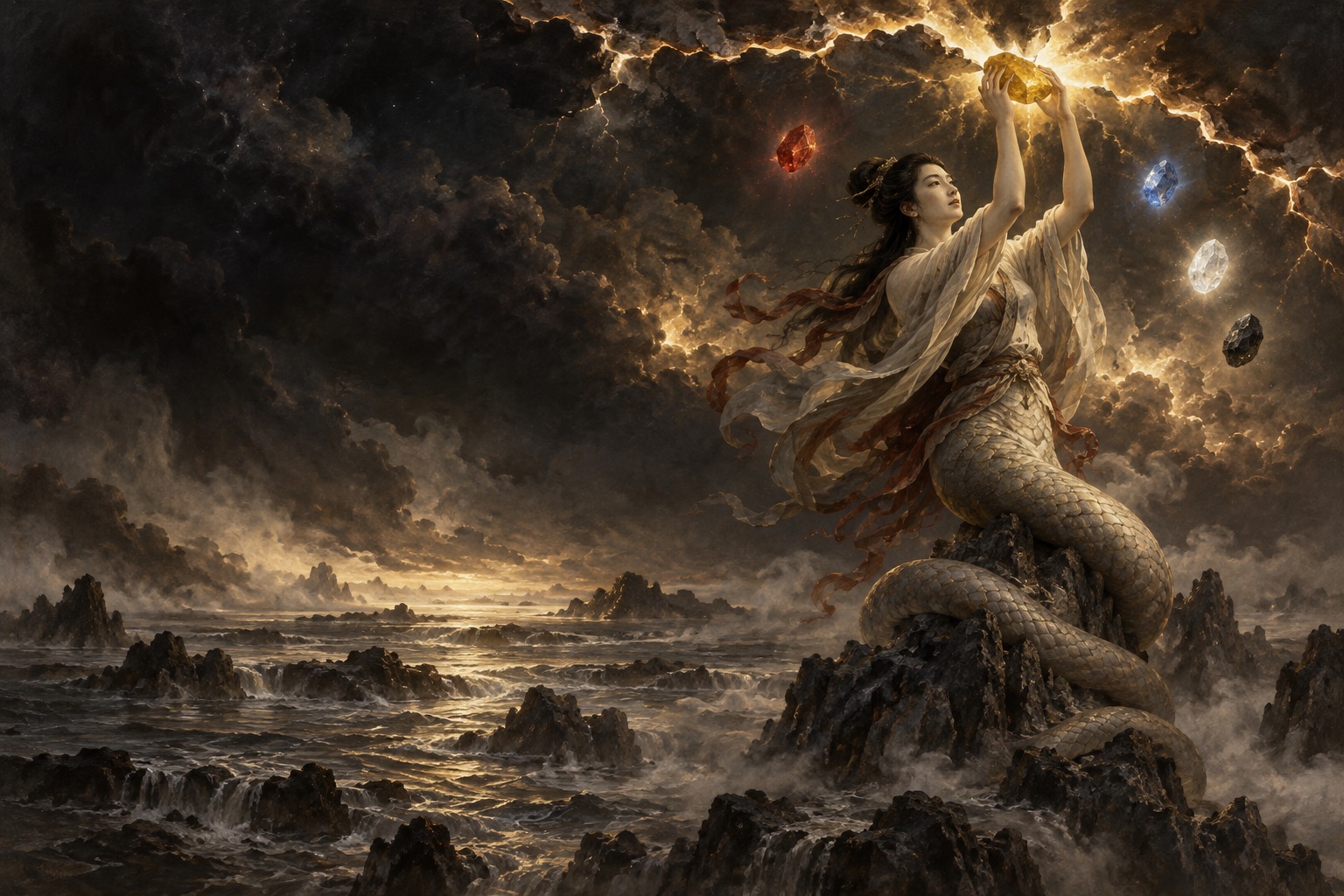
The Huainanzi tells it like this. In a distant age the four pillars at the edges of the world gave way and the nine provinces split apart. The sky no longer covered everything, and the earth no longer held everything up. Fires blazed without end, floods spread without end, wild beasts devoured the people and birds of prey carried off the old and the weak.
So Nüwa went to work:
- she smelted five-coloured stones to patch the blue sky;
- she cut off the legs of Ao, the great turtle, and set them up as the four pillars;
- she killed the black dragon to save the land of Ji;
- she piled up the ashes of reeds to stop the flood.
The sky was whole again, the pillars stood straight, the waters dried, and the people lived.
1-2 Shaping People from Yellow Earth
A second story comes from the Fengsu tongyi of Ying Shao. When heaven and earth had just been separated there were no people yet, so Nüwa kneaded yellow earth into human beings. The work was too much even for her. She dragged a cord through the mud and lifted it, and every drop that fell from it became a person. That, the text says, is why the rich and noble are the people of yellow earth, and the poor and lowly are the people of the cord.
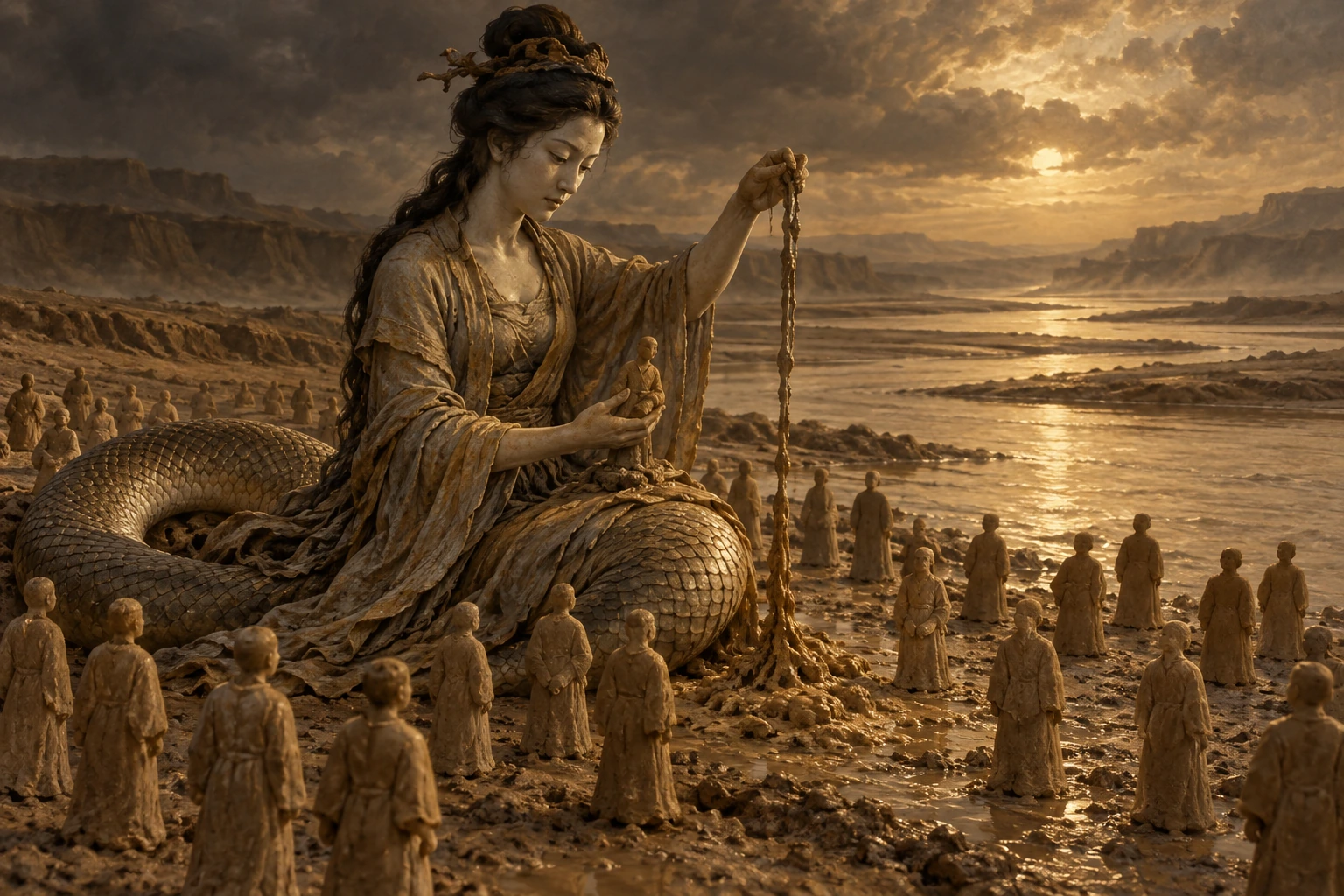
An origin story with a social order already baked into the clay. It is worth remembering who wrote such stories down, and for whom.
1-3 Other Deeds
- The Huainanzi also says that other gods helped shape the parts of the human body, and that this is how Nüwa made her “seventy transformations”.
- The Classic of Mountains and Seas (Shanhaijing) mentions ten spirits called “Nüwa’s intestines”, who turned into gods and live on a distant plain.
- The Book of Rites speaks of “Nüwa’s sheng”, and other early texts credit her with inventing this reed mouth organ.
- Much later, in the Song dynasty, the Lushi makes her the first matchmaker, honoured as the goddess of marriage (gaomei).
2 Was She Really Snake-Bodied?
The oldest texts say nothing. The Huainanzi, the clay-people story and the Shanhaijing itself never describe her body. The Tianwen, a poem of questions from the Warring States period, only asks: “Nüwa had a body: who shaped it?”
The serpent appears in the 2nd century CE. Two Eastern Han writers are the first to say it outright:
- Wang Yanshou, describing the murals of a palace hall, writes: “Fuxi with a scaly body, Nüwa with a serpent’s body.”
- Wang Yi, commenting on the Tianwen, writes: “It is said that Nüwa had a human head and a serpent’s body, and changed seventy times in a single day.” Even he presents it as hearsay.
Later authors repeat the description, among them Huangfu Mi in the 3rd century and Sima Zhen in the Tang: “a serpent’s body and a human head”.
The tomb art agrees:
- Wu Liang Shrine, Shandong (mid-2nd century CE). On the west wall, the line of ancient sovereigns opens with Fuxi and Nüwa: human heads, serpent bodies, tails intertwined. In Academia Sinica’s description she holds a compass and he holds a set-square; some sources reverse the two.
- Tomb of Bu Qianqiu, Luoyang (1st century BCE). A ceiling painting shows a serpent-tailed pair, Fuxi with the sun and Nüwa with the moon. The names are the museum’s identification.
- Astana tombs, Turfan (6th–8th centuries). Painted silk and hemp hangings show the couple again: human above, serpent below, tails coiled together, with compass and square, sun, moon and stars. Examples are now in Ryukoku University and the Tenri Museum in Japan, the National Museum of Korea, the National Museum in New Delhi and the Xinjiang Museum.
- Mawangdui banner (c. 168 BCE). The serpent-tailed figure at its top is sometimes identified as Nüwa, but that identification is disputed.
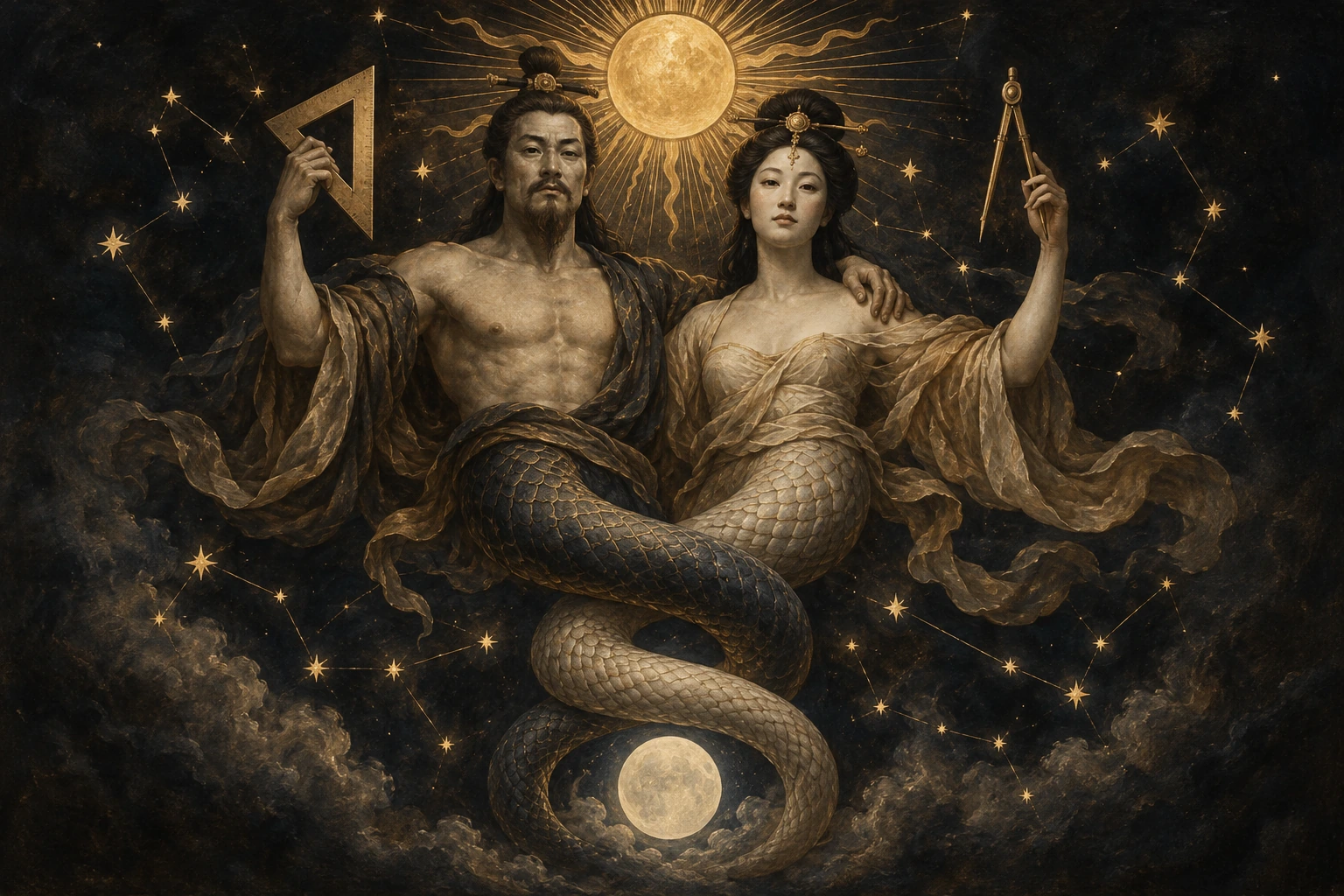
Not everyone liked it. In 1167 the scholar Hong Kuo, recording the Wu Liang carvings, objected that giving Fuxi a serpent’s lower body was simply wrong.
Then she became human. In the Ming novel Investiture of the Gods (Fengshen yanyi, 16th century), King Zhou of Shang is so struck by the beauty of her temple statue that he writes an insolent poem on the wall. Her revenge, carried out through a fox spirit, sets the whole novel in motion. The statue has no serpent anywhere. And the 18th-century Dream of the Red Chamber opens with the one stone left over from her mending of the sky.
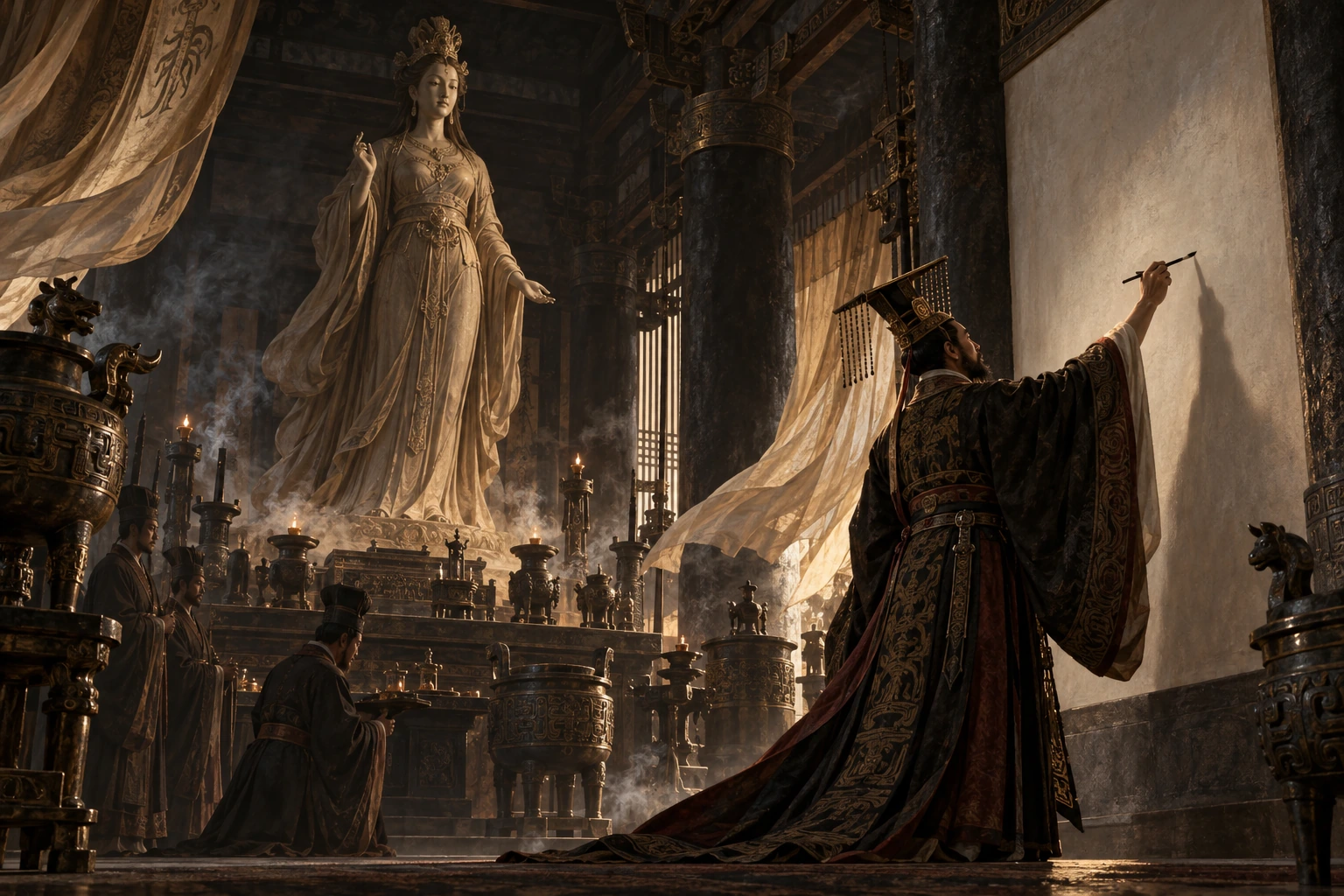
So the honest answer: Nüwa was never simply “a snake”. From the Han to the Tang she was a hybrid, human above and serpent (sometimes called dragon) below, and she was usually shown beside Fuxi. The fully human goddess belongs to late imperial fiction and to modern images.
3 Where the Story Is Written Down
- Warring States: the Chuci, “Tianwen”, asks only a question about her body.
- c. 139 BCE: the Huainanzi, “Lanming xun”, tells the mending of the sky and names Fuxi and Nüwa as sage rulers of the distant past.
- c. 80 CE: Wang Chong’s Lunheng reports that Gonggong broke the sky and Nüwa mended it, and dismisses the tale as “probably empty talk”.
- 2nd century CE: Wang Yanshou and Wang Yi describe the serpent body.
- c. 195 CE: Ying Shao’s Fengsu tongyi tells how people were made from yellow earth. The passage survives only as a quotation in the encyclopedia Taiping yulan (983).
- 3rd–4th centuries: in the Liezi, she mends the sky first, and Gonggong strikes the mountain afterwards.
- 8th century: Sima Zhen’s Basic Annals of the Three Sovereigns gives the popular version, with Nüwa ruling between Fuxi and Shennong.
- 9th century: Li Rong’s Duyi zhi tells of a brother and sister who marry at the beginning of the world.
4 Competing Versions
- Why did the sky break?
- In the Huainanzi no reason is given. The famous collision of Gonggong with Mount Buzhou is told in a different chapter, without Nüwa, to explain why the sky tilts to the northwest and the rivers run to the southeast.
- The two stories first appear together in Wang Chong’s report around 80 CE, and the Liezi even puts them in the opposite order.
- Sima Zhen’s Tang version, in which Gonggong fights Zhurong, breaks the pillar of heaven and Nüwa then mends the sky, is the one most retellings follow today. It is often credited to the Huainanzi or to Sima Qian’s Records of the Grand Historian, but it is in neither.
- Fellow ruler, wife, or sister?
- Han texts pair Fuxi and Nüwa as sage rulers, and Han art shows their tails entwined. No Han text we checked calls them husband and wife, or brother and sister.
- In the Tang, the poet Lu Tong calls Nüwa “Fuxi’s wife”.
- Li Rong’s Duyi zhi tells of a brother and sister, the only people alive, alone on Mount Kunlun. They prayed that if Heaven meant them to marry, the smoke of their two fires would join. It did, and she covered her face with a fan of grass, which is said to be why brides carry fans. The brother is not named Fuxi.
- The flood siblings of the south. Among the Miao of western Hunan, the anthropologist Ruey Yih-fu recorded in the 1930s a brother and sister who survive a great flood, often in a gourd, and repopulate the world. They are worshipped as the god and goddess of the Nuo rites and have been linked to Fuxi and Nüwa. The scholar Wen Yiduo argued that both names originally meant “gourd”.
5 Nüwa in Vietnam and Japan
- Vietnam. Nữ Oa vá trời (“Nüwa mends the sky”) is taught as a Chinese myth in the Vietnamese grade-10 literature curriculum. A separate Vietnamese folk tale makes Nữ Oa a giantess who holds a three-day mountain-building contest with the giant Tứ Tượng. We have found it only in popular retellings, not in a scholarly collection of folk tales, so treat it with care.
- Japan. Her name is read Joka (じょか), and it is attested in a haikai sequence of Bashō’s circle in 1689. Astana paintings of her are held at Ryukoku University and the Tenri Museum. Many readers know her as the final antagonist of Fujisaki Ryū’s manga Hōshin Engi, itself based on Fengshen yanyi.
6 Related Stories
- Kuniumi: Izanagi and Izanami Give Birth to Japan: a divine couple circles a pillar before they marry, and their first child is a failure. Scholars have compared it with the brother–sister flood myths of southern China.
- Lạc Long Quân and Âu Cơ: The Dragon, the Fairy and the Hundred Eggs: Vietnamese tradition traces Lạc Long Quân’s line to Shennong, the sovereign who follows Nüwa in Sima Zhen’s list.
- The Churning of the Ocean: Gods, Demons and the Nectar of Immortality: in India, too, a great turtle holds up the world, here the mountain the gods use to churn the sea.
- Dangun: The Bear, the Tiger and the First Korean Kingdom: the monk Iryeon opens his account of Korea’s founders by recalling the miraculous birth of Fuxi.
- Pangu: The Giant Who Grew Between Heaven and Earth: China’s other beginning. Pangu is first named in the third century CE, centuries after Nüwa, and in his story people come from the creatures on a giant’s body, not from yellow earth.
7 Sources
- Huainanzi, “Lanming xun”, “Tianwen xun”, “Shuolin xun”: Wikisource
- Chuci, “Tianwen”, with Wang Yi’s commentary: Wikisource
- Taiping yulan, juan 78 (quoting the Fengsu tongyi, Huangfu Mi and the Shiben): Wikisource
- Shanhaijing, “Dahuang xijing”: Wikisource
- Liezi, “Tangwen”: Wikisource
- Wang Chong, Lunheng, “Tantian”: Wikisource
- Sima Zhen, Sanhuang benji: Wikisource
- Wang Yanshou, Lu Lingguang dian fu: Wikisource
- Li Rong, Duyi zhi: Wikisource
- Institute of History and Philology, Academia Sinica, Wu Liang Shrine west wall rubbing and Nüwa and Fuxi
- Ueno Aki, “Paintings of Fu-hsi and Nu-wa from Astana (Part I)”, Bijutsu Kenkyū 292 (1974)
- Fengshen yanyi, chapter 1; Hongloumeng, chapter 1 (Wikisource)
- “女媧”, Nipponica, Sekai Daihyakka Jiten and Nihon Kokugo Daijiten: Kotobank
Cover and illustrations: AI-generated images made for Arcana. They are interpretations, not historical artworks.