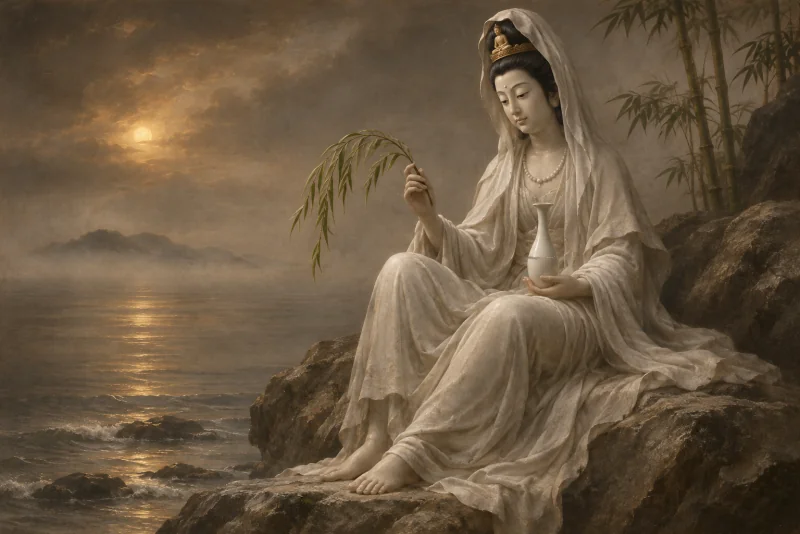
Kunlun: The Mountain of the Immortals
On a mountain in the far northwest, the old books say, the Lord on High kept his capital on earth, guarded by a nine-headed beast, and the Queen Mother of the West grew peaches that ripen once in three thousand years. A Han emperor gave its name to real mountains, and the historian who recorded it did not believe him.
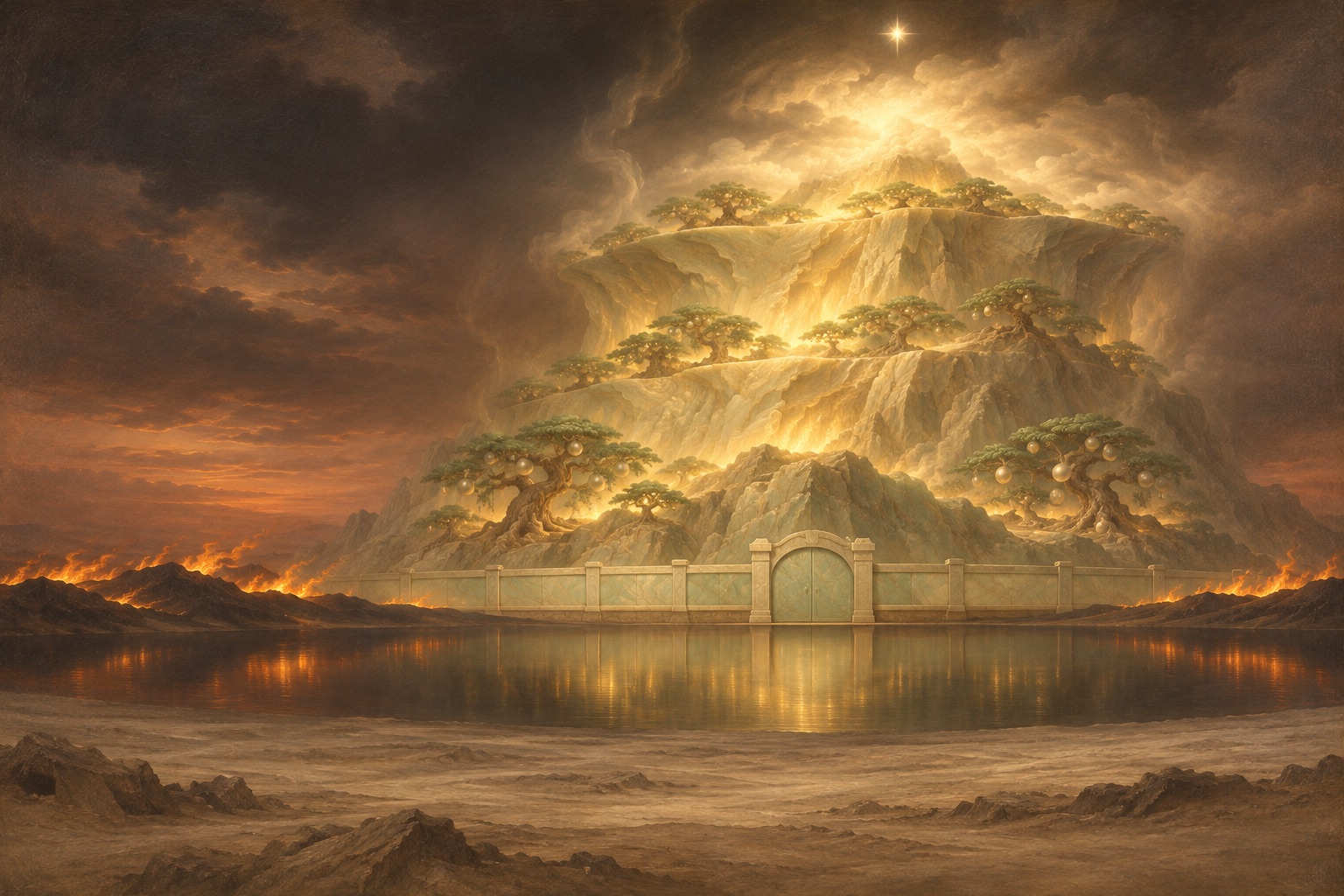
- Type: sacred mountain; the earthly capital of the Lord on High, later the home of the Queen Mother of the West and the immortals
- Culture: China; known as Konron in Japan and Côn Lôn in Vietnam
- Earliest texts: the Classic of Mountains and Seas (Shanhaijing, compiled from the Warring States to the Han); the “Tianwen” and “Lisao” of the Chuci (Warring States); the Mu tianzi zhuan, found in a tomb in 281 CE; the Huainanzi (139 BCE)
- Key figures: the Lord on High (Di), the god Luwu, the Kaiming beast, the Queen Mother of the West (Xiwangmu, 西王母), King Mu of Zhou, Emperor Wu of Han, Dongfang Shuo
Somewhere beyond China’s western frontier, the old books say, stood a mountain where heaven came down to earth. It was so high that the sun and moon hid behind it, and the water around its foot would not float a feather. Its name was Kunlun (崑崙). For two thousand years it has been a myth, and a name on the map.
Did the Queen Mother of the West live on Kunlun? Not in every text. In the “Classic of the Western Mountains”, Kunlun belongs to the Lord on High, and she lives further west, on the Jade Mountain. Kominami Ichirō, writing in Heibonsha’s World Encyclopedia, counts the passages that put her on Kunlun among the newer parts of the book. Guo Pu, who annotated it under the Jin dynasty, made peace between them: she had “detached palaces and other caves”.
1 The Telling
There is no single story of Kunlun. This section follows the texts roughly in the order they were written, from the Classic of Mountains and Seas to the Han tales of the Queen Mother.
1-1 The Lord’s Capital on Earth
The Classic of Mountains and Seas (Shanhaijing) walks its reader from mountain to mountain. In its “Classic of the Western Mountains” (Xishan jing), you look south from Mount Huaijiang to Kunlun: “its light blazes, its vapour rises”. Four hundred li to the southwest stands “the hill of Kunlun”, which “is truly the lower capital of the Lord”: the city that the Lord on High keeps on earth.
It is ruled by the god Luwu (陸吾), who has a tiger’s body with nine tails, a human face and a tiger’s claws. He governs “the nine regions of heaven and the seasons of the Lord’s gardens”. On the hill live a beast like a sheep with four horns that eats people, and a bird like a bee, as big as a mandarin duck, whose sting kills animals and withers trees. A tree there bears a fruit like a plum without a stone, which keeps you from drowning. The Yellow River flows out of the hill, and so do the Red River, the Yang River and the Black River.
1-2 Nine Gates and the Kaiming Beast
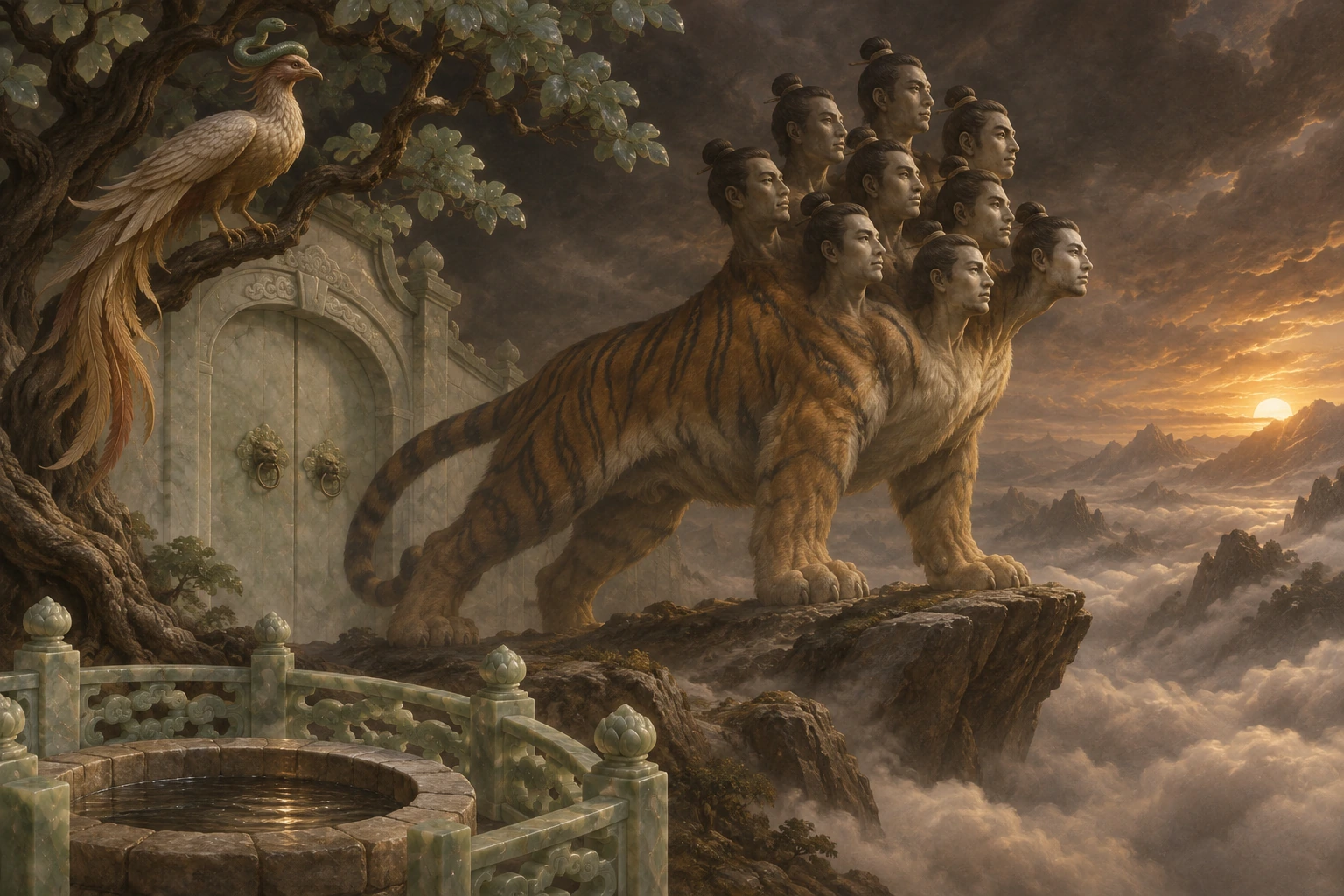
Another chapter, the “Classic of the Lands within the Seas: West” (Hainei xi jing), measures it. “The mound of Kunlun within the seas” lies in the northwest, eight hundred li on each side and ten thousand ren high. A grain grows on it as tall as a tree. Each face has nine wells with railings of jade and nine gates, which “the Kaiming beast guards”: this is “where the hundred gods dwell”. Its crags are so steep that “none but one like the good Yi” can climb them.
The Kaiming beast (開明獸) “has a body as big as a tiger’s and nine heads, all with human faces; it stands on Kunlun facing east”. Around it are phoenixes with snakes on their heads, a tree of no death, and six shamans holding the medicine of no death. Rivers run from the mound’s corners: the Red River from the southeast, the Yellow River from the northeast, the Yang and Black Rivers from the northwest, the Weak and Blue Rivers from the southwest.
1-3 The Queen Mother of the West
Further west, past the shifting sands, the Xishan jing comes to the Jade Mountain, “where the Queen Mother of the West lives”. “The Queen Mother of the West looks like a person, with a leopard’s tail and tiger’s teeth, and she is good at whistling. Her hair is unkempt and she wears a sheng”: a hair ornament of jade, says Guo Pu. She “governs the calamities of heaven and the five punishments”.
The later “Classic of the Great Wilderness: West” (Dahuang xi jing) brings her to Kunlun itself. Its “hill of Kunlun” stands south of the western sea, on the shore of the shifting sands, between the Red and the Black Rivers. A god with a human face and a tiger’s body lives there, striped, with a white-flecked tail. Around the foot runs the abyss of the Weak Water, which, Guo Pu says, “will not bear a goose feather”. Beyond it is a mountain of fire, where “anything thrown in catches light”. “Someone wearing a sheng, with tiger’s teeth and a leopard’s tail, lives in a cave: she is called the Queen Mother of the West.” And “on this mountain all things are found”. In the “Classic of the Lands within the Seas: North” (Hainei bei jing) she leans on a stool, wearing her sheng, and three blue birds fetch her food, “north of the mound of Kunlun”.
1-4 Climb and Become a God
The Huainanzi, presented at court in 139 BCE, describes Kunlun in its chapter on the shape of the earth, “Dixing xun”. Inside the mound is a walled city of nine tiers, “eleven thousand li, one hundred and fourteen paces, two feet and six inches high”. Pearl trees, jade trees and the tree of no death grow there. It has 440 gates, and its north gate stands open to let in the wind of Mount Buzhou. A Yellow Water circles it three times and returns to its source: this is the Cinnabar Water, and “whoever drinks it does not die”. Its rivers are “the Lord’s divine springs”, for mixing “the hundred medicines”.
Then comes the ascent: “Twice as high as the hill of Kunlun is the Mountain of the Cool Wind (Liangfeng): climb it and you will not die. Twice as high again is the Hanging Garden (Xuanpu): climb it and you become a spirit, able to command wind and rain. Twice as high again, it reaches up to heaven: climb it and you become a god. This is called the dwelling of the Great Lord.”
1-5 King Mu at the Jasper Pool
The Mu tianzi zhuan (Account of King Mu, Son of Heaven) follows King Mu of Zhou on a journey to the far west. “On the auspicious day xinyou, the Son of Heaven climbed the hill of Kunlun to see the palace of the Yellow Emperor.” He raised a grave mound for the thunder god Fenglong (a character is missing, and the name is Guo Pu’s guess), and made offerings to the mountain.
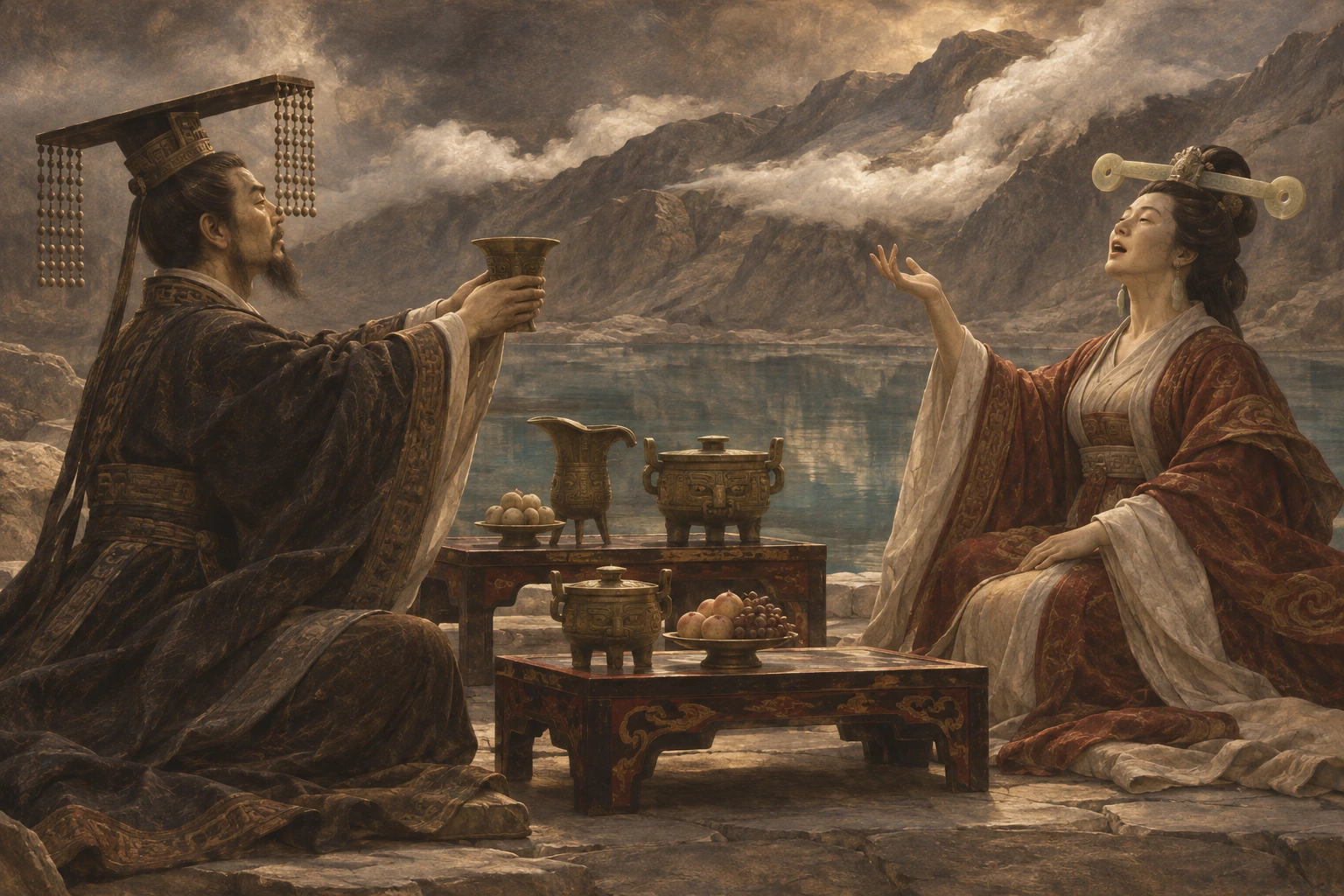
On a jiazi day he was the guest of the Queen Mother of the West. He brought her a white jade tablet, a dark jade disc and silk, “and the Queen Mother of the West bowed twice and received them”. The next day “the Son of Heaven feasted the Queen Mother of the West above the Jasper Pool”, and she sang: “White clouds are in the sky, the hills rise of themselves. The road is long, mountains and rivers lie between. If you do not die, perhaps you can come again.”
He answered that he would go home to the eastern lands and set the Xia states in order, and when the people were at peace he would come back to see her: “in three years I will return to this wilderness”. She sang again, of a land where she lives among tigers and leopards, crows and magpies: “I am the Lord’s daughter.” Then the king drove up Mount Yan, carved a record of his visit on its rock, planted a pagoda tree, and called it “the Mountain of the Queen Mother of the West”.
1-6 Peaches Once in Three Thousand Years
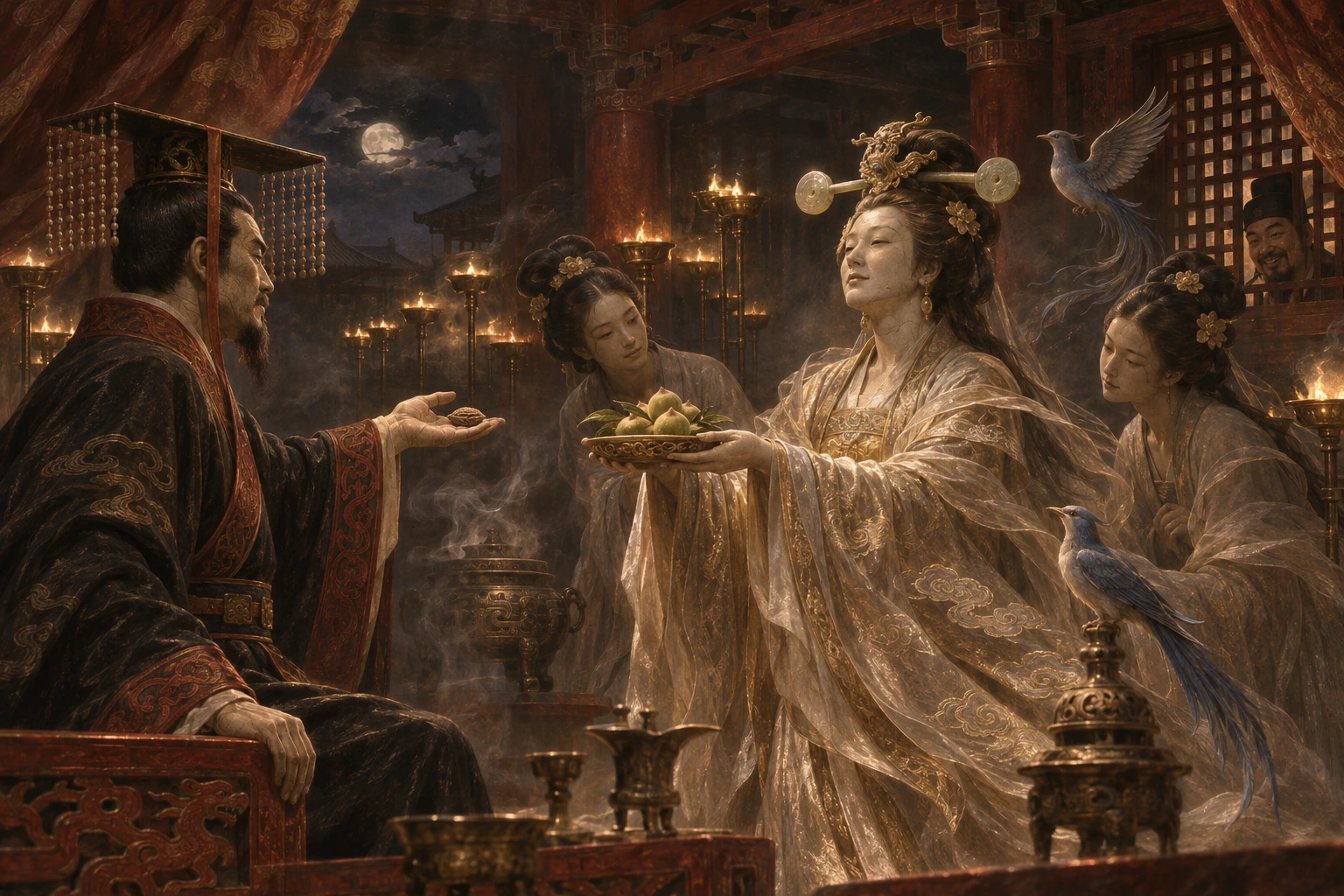
In the Han Wu gushi (Stories of Emperor Wu of Han), the emperor who longed for immortality gets his visit. On the seventh day of the seventh month a blue bird flies in from the west, and Dongfang Shuo, the court wit, says the Queen Mother will come down that night. She arrives in a purple carriage, with jade maidens and two blue birds at her side. The emperor bows and asks for the medicine of no death. Not for him, she says: his desires “are still many”.
She brings out seven peaches, eats two and gives him five. He keeps the stones. “What for?” she asks. “These peaches are delicious; I want to plant them.” She laughs: “This peach bears fruit once in three thousand years. It is not something the lower world can grow.” Dongfang Shuo peeps at her through the window of the Vermilion Bird, and she tells the emperor that the boy “likes to make trouble” and has long been banished from heaven. Earlier in the same book, a man seven inches tall, sent by the Queen Mother, has already given him away: “The Queen Mother plants peaches that fruit once in three thousand years. This boy is no good: he has stolen them three times.”
2 Where the Story Is Written Down
- The Shanhaijing, compiled between the Warring States and the Han. Kunlun appears in the “Classic of the Western Mountains” and again in the “Classics of the Seas”. We read it with Guo Pu’s commentary, in the Sibu congkan reprint of a Ming edition of 1470.
- The Chuci. The “Tianwen” asks: “Kunlun and the Hanging Garden: where are they? The walled city in nine tiers: how many li high? The gates on four sides: who goes through them?” In the “Lisao” the poet sets out in the morning from Cangwu and reaches the Hanging Garden by evening. Wang Yi’s 2nd-century commentary explains that the Hanging Garden is a divine mountain on top of Kunlun, which “reaches up to heaven”.
- The Zhuangzi, chapter “Dazongshi”, lists beings who obtained the Way. One of them “entered Kunlun” by it, and “the Queen Mother of the West obtained it and sits on Shaoguang; no one knows her beginning, no one knows her end”.
- The Mu tianzi zhuan was written on bamboo slips found in 281 CE in the tomb of a king of Wei at Ji, in Henan (Shimura Ryōji, in the Nipponica encyclopedia). Guo Pu annotated it. Kominami reads it as a story of the Warring States, though one that may reflect real knowledge of the west.
- The Shiji of Sima Qian, finished about 94 BCE. Its chapter on Dayuan tells how Kunlun was put on the map (section 4). In his closing comment Sima Qian quotes the lost Basic Annals of Yu: Kunlun is more than 2,500 li high, the sun and moon hide behind it in turn to make their light, “and on its top are the Sweet Spring and the Jasper Pool”.
- The Han Wu gushi and the Han Wudi neizhuan both go under the name of the 1st-century historian Ban Gu. The Japanese Britannica calls both forgeries of the Six Dynasties. The Gushi survives only in a short Ming text.
3 Competing Versions
- Where does the Queen Mother live? On the Jade Mountain (Xishan jing); in a cave on Kunlun (Dahuang xi jing); north of Kunlun (Hainei bei jing); on Mount Yan, which King Mu names after her (Mu tianzi zhuan). Guo Pu’s answer: “although the Queen Mother takes the palace of Kunlun as her own, she also has detached palaces and other caves where she roams and rests”, and “each writer named what he had seen”.
- Monster or queen? Tiger’s teeth, a leopard’s tail and charge of heaven’s calamities in the Shanhaijing; a hostess who trades songs with a king in the Mu tianzi zhuan; a goddess in a purple carriage in the Han tales. Under the influence of the cult of immortals, writes Kirimoto Tōta in Nipponica, she became a beauty, and her home was fixed on Kunlun.
- How many tiers, and what names? In the Huainanzi, the Cool Wind, the Hanging Garden, then heaven. In the Shuijing, as the Song scholar Hong Xingzu quotes it in his notes to the “Lisao”: Fantong at the bottom, the Hanging Garden (also called Langfeng) above it, and the Tiered City, “also called the Court of Heaven”, at the top. In the Shizhou ji (“Record of the Ten Islands”), a book of the Daoist canon falsely attributed to Dongfang Shuo (Kominami), three peaks, Langfeng to the north, the Hanging Garden to the west and the Kunlun Palace to the east, and on the fourth corner a walled city of heaven, a thousand li square, with five gold terraces and twelve jade towers, “ruled by the Queen Mother of the West”.
- How high? Ten thousand ren in the Hainei xi jing; more than eleven thousand li in the Huainanzi; more than 2,500 li in the Basic Annals of Yu; 36,000 li above the plain in the Shizhou ji.
- Where is the Jasper Pool? The Mu tianzi zhuan never puts it on Kunlun: the king climbs the mountain and feasts by the pool on different days. The Basic Annals of Yu, as Sima Qian quotes it, puts the pool on the summit. In the 16th-century novel Journey to the West, the peach garden and the Jasper Pool are in heaven, where Sun Wukong eats the peaches.
- Two peaches or three? In the Han Wu gushi she eats two and gives five. In the Han Wudi neizhuan the peaches are “as big as duck eggs, round and green”; she eats three and gives four, and refuses the stones because “the soil of the central lands is thin”. There it is the Queen Mother herself who names the face at the window: “my neighbour’s little boy”, who “has come three times to steal these peaches”.
4 History and Tradition
- An emperor names the mountains. Zhang Qian, back from the west, reported that east of Yutian (Khotan) the waters flow east into the Salt Marsh, which “flows underground, and to the south the source of the River comes out”. Then “the Han envoys traced the River to its source. The source comes out of Yutian, whose mountains have much jade; they gathered it and brought it back, and the Son of Heaven, consulting the old maps and books, named the mountains from which the River comes Kunlun.” Yamakawa’s dictionary of world history places them south of Khotan, on the upper Khotan River.
- The historian’s doubt. Sima Qian did not believe it: “since Zhang Qian’s mission to Bactria men have traced the River to its source: where did they see the Kunlun of the Basic Annals?” For the mountains and rivers of China he trusted the Shangshu. “As for the strange creatures of the Basic Annals of Yu and the Shanhaijing, I dare not speak of them.”
- A mountain that kept moving. As Chinese knowledge of geography grew, writes Kominami, Kunlun “receded further and further west”. In the Wei and Jin periods a mountain south of Jiuquan, in Gansu, was taken for Kunlun, with a stone chamber of the Queen Mother. Later, Yamakawa’s dictionary adds, the Pamirs were called Kunlun, and Kunlun was confused with Sumeru, the world mountain of Indian legend.
- The range today. The Kunlun Mountains run about 2,500 km from the southeast corner of the Pamirs to the western edge of the Sichuan basin, between the Tarim Basin and the Tibetan plateau. Explorers such as Przhevalsky and Hedin mapped them only from the late 19th century (Sakai Toshiaki, Nipponica).
- The cult of 3 BCE. In the spring of 3 BCE, after a drought, the Hanshu records people running through twenty-six commanderies to the capital, passing stalks from hand to hand as “the Queen Mother of the West’s tally”. That summer they gathered in lanes and fields “and sang and danced in worship of the Queen Mother of the West”, and a writing went round: “The Mother tells the people: whoever wears this writing will not die.” By autumn it was over. From then on, Kominami suggests, she was a goddess of the people, and her image spread on carved stones and bronze mirrors. On the west wall of the Wu Liang Shrine in Shandong (Eastern Han), the gable shows the Queen Mother seated in the middle among winged immortals and sacred beasts, with hares grinding the elixir of immortality in a mortar (Academia Sinica).
- In Daoism and the novels. Daoism made her the head of the female immortals and gave her titles such as Golden Mother; in popular religion she became Wangmu Niangniang (Kominami). Daoist doctrine puts its highest god, Yuanshi Tianzun, on Mount Yujing in the highest heaven (Mugitani Kunio, Nipponica). The late-Ming novel Investiture of the Gods (Fengshen yanyi) gives him the Jade Void Palace on Kunlun: Jiang Ziya has studied there for forty years when he is sent down the mountain (chapter 15), and Nezha’s ring was the palace’s gift to his teacher Taiyi Zhenren (chapter 12). And in the Tang Duyi zhi, it is on Kunlun that the only brother and sister alive decide to marry (Nüwa).
- Japan and Vietnam. A ritual formula in the Engishiki (927) names “on the left the King Father of the East, on the right the Queen Mother of the West”. In the Noh play Seiōbo she brings King Mu of Zhou the peach that flowers and fruits once in three thousand years (the summary of the Noh publisher Hinoki Shoten and the Nihon Kokugo Daijiten; Nipponica names Emperor Wu). The same dictionary records, as separate senses of the word, “Kunlun” as a Chinese name for the southern seas and, under the Yuan and Ming, for an island off southern Indochina: the archipelago that Vietnamese called Côn Lôn or Côn Sơn until the 20th century, now Côn Đảo.
Kunlun is often pointed out on the map: the range between Tibet and the Tarim Basin. The myth’s Kunlun cannot be found there, because it was nowhere a traveller could reach: “in the northwest”, behind water that will not bear a feather and a mountain of fire. Guo Pu already read the Shanhaijing’s “within the seas” to mean that “beyond the seas there is another Kunlun”. The range has the name because Emperor Wu gave it from old books, and Sima Qian doubted him. Even the river was wrong: the Yellow River does not come from Khotan, but rises at the foot of the Bayan Har range, far to the east.
5 Related Stories
- Hou Yi and Chang’e: The Archer Who Shot the Suns and the Woman in the Moon: the Shanhaijing says that only “one like the good Yi” can climb Kunlun’s crags, and Guo Pu adds that Yi “once asked the Queen Mother of the West for the medicine”. Her medicine of immortality, and the woman who stole it, are that post’s story.
- Từ Thức: The Man Who Married a Fairy: at a fairy wedding in Nguyễn Dữ’s 16th-century tale, the Golden Immortal complains of gossip that she feasted a king of Zhou at the Jasper Pool and sent a blue bird to a Han emperor: the Queen Mother’s stories, told in Vietnam.
- Sun Wukong: The Monkey King Who Fought Heaven: Kominami Ichirō counts the legends of Dongfang Shuo, the trickster who stole the Queen Mother’s peaches, among the sources of stories like the monkey’s havoc in heaven.
- Mount Olympus: The Real Mountain Where the Gods Lived: Olympus is a real mountain that Greek poets lifted into the sky; Kunlun is a mountain of the sky that a Han emperor put on the map. We have not found a scholar who compares the two; we link them for the theme.
- The Descent of the Ganga: The River That Fell from Heaven: in the Bhāgavata Purāṇa the Ganga splits into four on Mount Meru, as in Chinese books rivers run from the corners of Kunlun. Later, Yamakawa’s dictionary notes, Kunlun was confused with Sumeru, the world mountain of Indian legend. We have not found a scholar who links the two sets of rivers; we link them for the theme.
6 Sources
- Shanhaijing, “Xishan jing”, “Hainei xi jing”, “Hainei bei jing”, “Dahuang xi jing”, with Guo Pu’s commentary, Sibu congkan reprint of a Ming edition of 1470: Wikisource, Wikisource, Wikisource, Wikisource
- Chuci, “Lisao” and “Tianwen”, with Wang Yi’s commentary and Hong Xingzu’s supplement (Sibu congkan): Wikisource, Wikisource
- Zhuangzi, “Dazongshi”: Wikisource; Huainanzi, “Dixing xun”: Wikisource
- Mu tianzi zhuan, juan 2 and 3, with Guo Pu’s commentary: Wikisource, Wikisource
- Sima Qian, Shiji, juan 123, “Dayuan liezhuan”: Wikisource; Ban Gu, Hanshu, “Aidi ji” and “Wuxing zhi”: Wikisource, Wikisource
- Han Wu gushi (Ming Gujin yishi text), Han Wudi neizhuan and Shizhou ji (Zhengtong Daozang): Wikisource, Wikisource, Wikisource
- Fengshen yanyi, chapters 12 and 15; Xiyou ji, chapter 5: Wikisource, Wikisource
- Institute of History and Philology, Academia Sinica, West Wall (Wu Liang Shrine III)
- Kominami Ichirō, Itō Seiji, Kirimoto Tōta, Sakai Toshiaki, Shimura Ryōji, Mugitani Kunio and others, “崑崙”, “崑崙山”, “崑崙山脈”, “西王母”, “穆天子伝”, “東方朔”, “元始天尊”, “漢武内伝”, in Sekai Daihyakka Jiten, Nipponica, Nihon Kokugo Daijiten, Yamakawa Sekaishi Shōjiten and the Japanese Britannica: Kotobank, Kotobank, Kotobank, Kotobank, Kotobank, Kotobank, Kotobank, Kotobank
- Hinoki Shoten, NOH-Sup, “Seiōbo”: hinoki-shoten.co.jp; “About Con Dao”, Côn Đảo tourism portal, after the Department of Culture and Sport of Bà Rịa–Vũng Tàu: condao.com.vn
Cover and illustrations: AI-generated images made for Arcana. They are interpretations, not historical artworks.