The Descent of the Ganga: The River That Fell from Heaven
King Bhagiratha spent years in austerities to bring the heavenly river Ganga down to earth, and Shiva caught her in his hair so that her fall would not break the world. The old tellings disagree on much else, and the great relief at Mamallapuram may not show her at all.
- Type: myth, a river brought down from heaven to free the dead
- Culture: India (Hindu tradition)
- Earliest texts: the two Sanskrit epics, the Rāmāyaṇa (Book 1) and the Mahābhārata (Book 3); later the Bhāgavata Purāṇa
- Key figures: Ganga, King Sagara and his sixty thousand sons, the sage Kapila, Anshuman, Dilipa, Bhagiratha, Brahmā, Shiva, the sage Jahnu
The Ganga is a river and a goddess at once. Pilgrims bathe in her to wash away their sins, and the ashes of the dead are given to her. The old stories explain why her water can do this: she was a river of heaven, and a king gave his life, as his father and grandfather had given theirs, to bringing her down.
Is the Ganga of the story the real river? Yes. In the Rāmāyaṇa the sage who tells the story is sitting on her bank, and the god Brahmā ends it by naming her after the king who brought her: Bhāgīrathī. The headstream that rises in the Gangotri Glacier is still called the Bhagirathi.
1 The Telling
This follows the Rāmāyaṇa, Book 1 (the Bālakāṇḍa), sargas 37 to 43 of the critical edition published in Baroda. The sage Viśvāmitra tells the story one evening to the young Rama and Lakshmana, on the bank of the Ganga. Rama is hearing the history of his own family: Sagara, the king in it, ruled in Ayodhya.
1-1 Sixty Thousand Sons
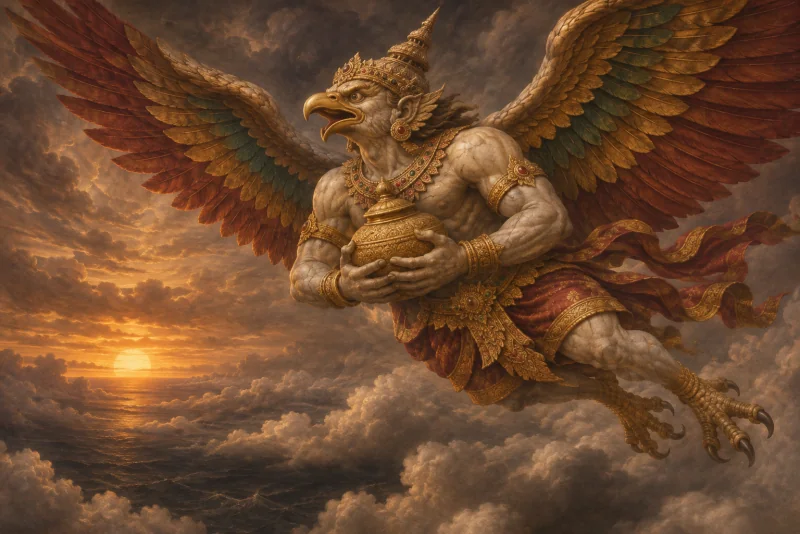
King Sagara had no children. With his two queens, Keśinī, a princess of Vidarbha, and Sumati, the sister of the bird king Garuda, he practised austerities for a hundred years in the Himalaya. The sage Bhṛgu then promised him sons: one queen would bear a single heir, the other sixty thousand sons, and each could choose. Keśinī chose the one son, and Sumati the sixty thousand.
Keśinī bore Asamañja. Sumati bore a gourd, and when it split open sixty thousand babies came out. Nurses raised them in jars full of ghee until they were grown. Asamañja grew up cruel: he threw children into the Sarayū river and laughed as they drowned, and his father banished him. Asamañja’s son, Anshuman, was loved by everyone.
1-2 The Stolen Horse
Sagara held a horse sacrifice between the Himalaya and the Vindhya mountains. On the chosen day Indra took the shape of a demon and stole the horse. An unfinished sacrifice, the priests warned, would bring misfortune on them all, so Sagara sent his sixty thousand sons to find the thief. Each was to dig a league into the earth until they saw the horse.
They tore the earth open with spikes and ploughs, killing the snakes and demons who lived inside it. The gods complained to Brahmā, and Brahmā reassured them: the earth belongs to Vāsudeva, that is Vishnu, who holds it up in the form of the sage Kapila, and the end of Sagara’s sons was foreseen long ago. The sons found nothing, and Sagara angrily sent them down again. Deep below they met the four great elephants who carry the earth on their heads at the four quarters, and walked around each one in respect. In the northeast they saw Kapila, and the horse grazing near him. “Stop! You stole our horse!” they shouted, and ran at him. Kapila uttered a single angry sound, and all sixty thousand fell to heaps of ash.
1-3 Anshuman and Garuda
When his sons did not return, Sagara sent his grandson Anshuman after them with a sword and a bow. Anshuman followed the tunnel they had dug, greeted each elephant, and came to the ashes and the grazing horse. He wanted to pour water for the dead, but there was no water anywhere. Then he saw Garuda, the brother of the dead men’s mother.
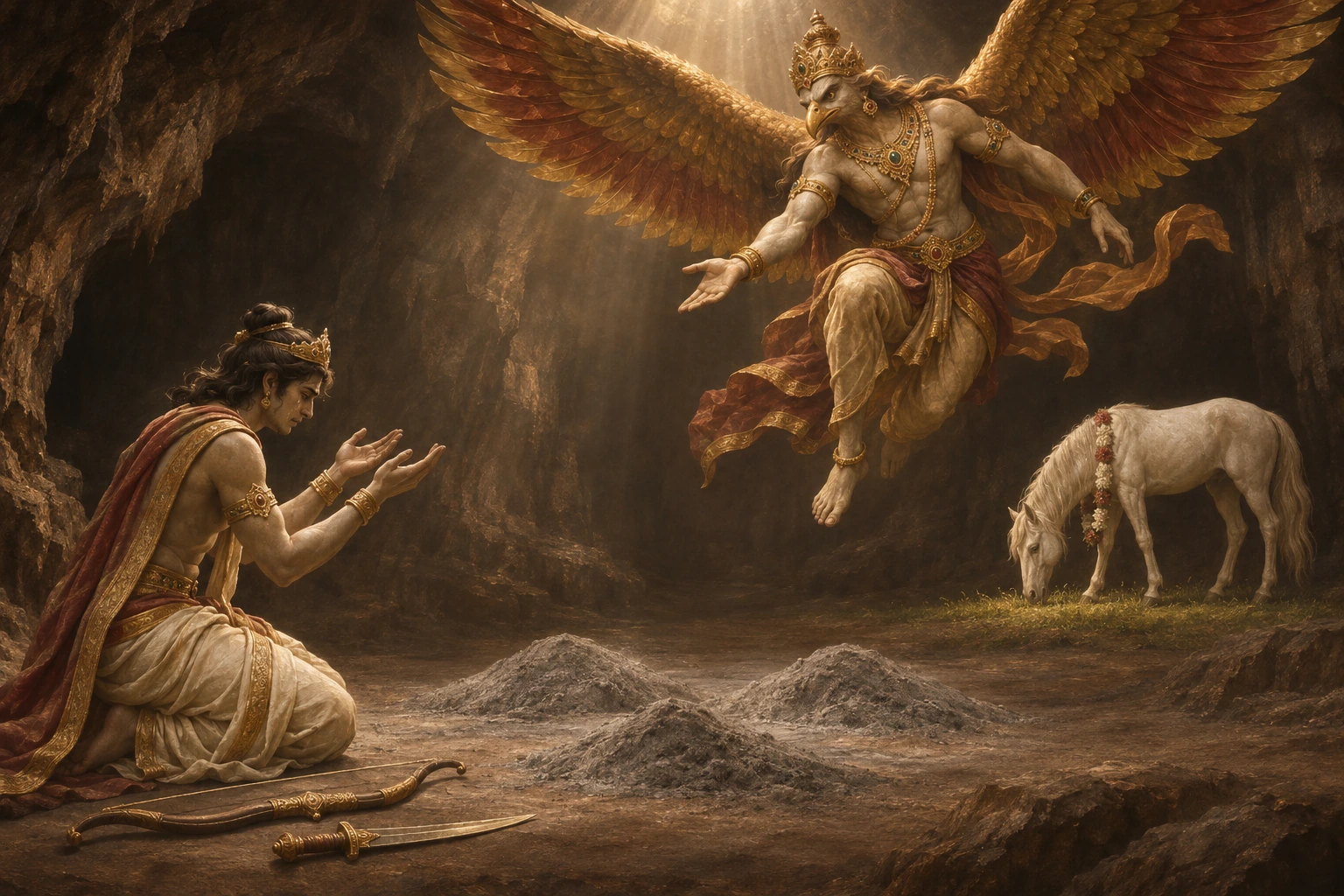
“Do not grieve,” said Garuda: the world accepted this death. Ordinary water was not fit for them. Ganga, the eldest daughter of the Himalaya, purifies the worlds, and if her water wetted these ashes it would carry the sixty thousand to heaven. Anshuman brought the horse home and Sagara finished his sacrifice, but he found no way to bring the Ganga down, and after thirty thousand years on the throne he died. Anshuman left the throne to his son Dilipa and spent thirty-two thousand years in austerities in the Himalaya, in vain. Dilipa found no way either, and died of an illness.
1-4 Bhagiratha
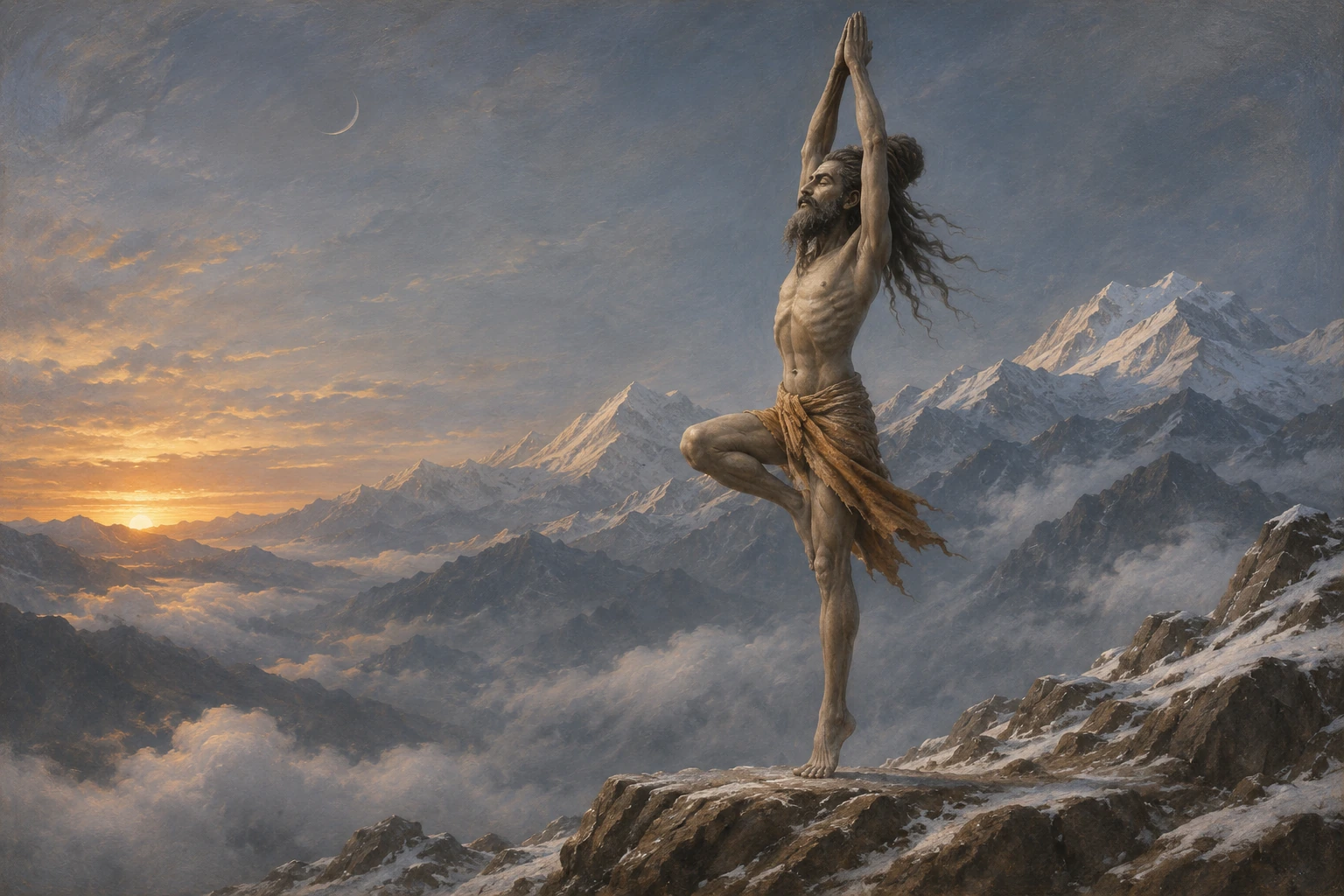
Dilipa’s son Bhagiratha had no children. He went to Gokarṇa and practised austerities for thousands of years: arms raised, between five fires, eating once a month. At last Brahmā came with the gods and offered him a wish. Bhagiratha asked for two things: that the sons of Sagara receive water from his hands, their ashes wetted by the Ganga, and that his family line should not die out.
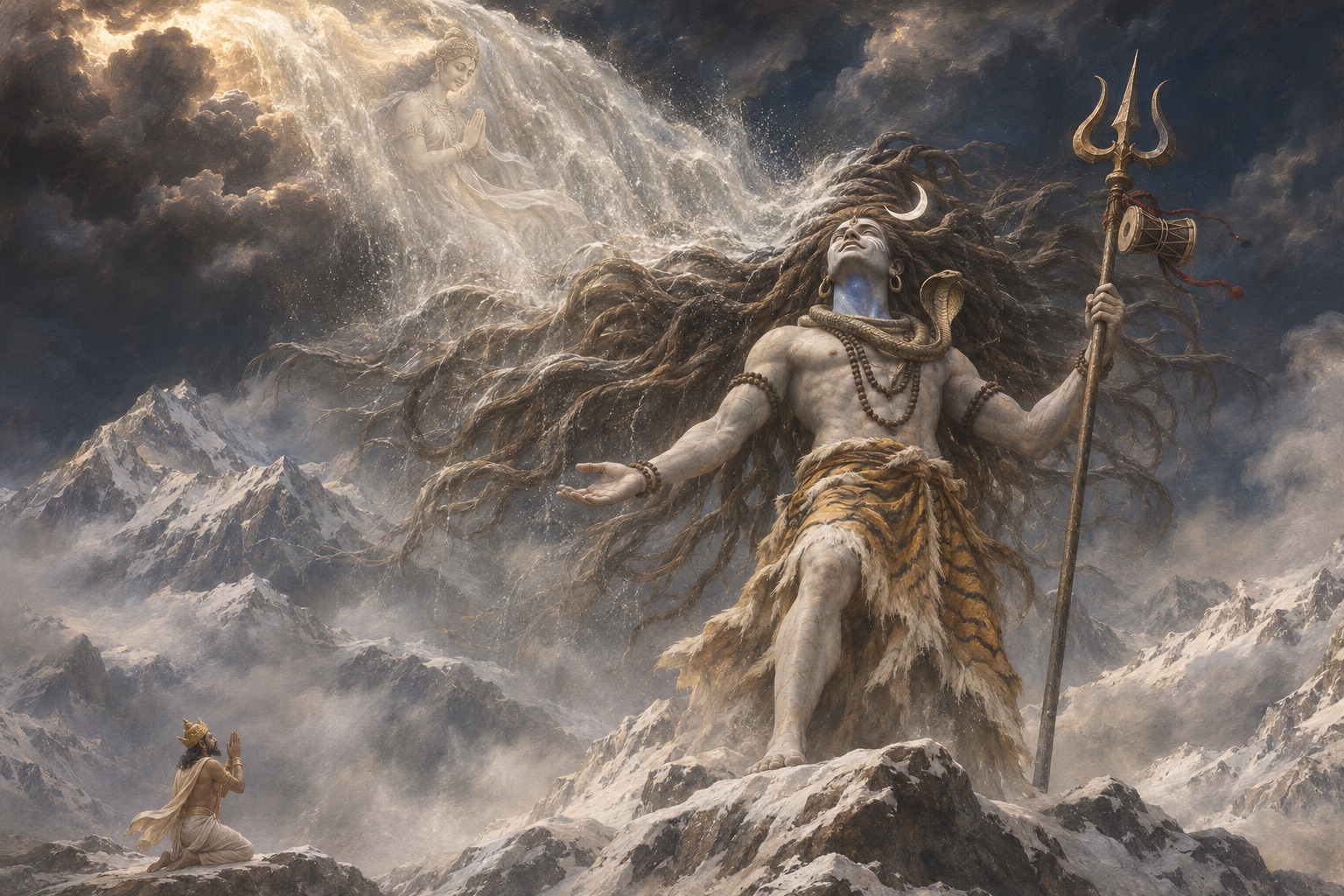
Brahmā granted both. But the earth, he warned, could not bear the Ganga’s fall, and he saw no one but Shiva, the god with the trident, who could hold her. So Bhagiratha stood for a whole year with the earth pressed under the tip of his big toe. At the end of the year Shiva, the lord of Umā, came to him: “I will hold the daughter of the king of mountains on my head.”
1-5 Into Shiva’s Hair
The Ganga took on a huge form and an unbearable speed, and fell from the sky onto Shiva’s head. She could not find her way out of the tangle of his matted hair, and wandered in it for many years. At last, pleased with Bhagiratha, Shiva let her go toward Lake Bindu, and she reached the earth with a roar.
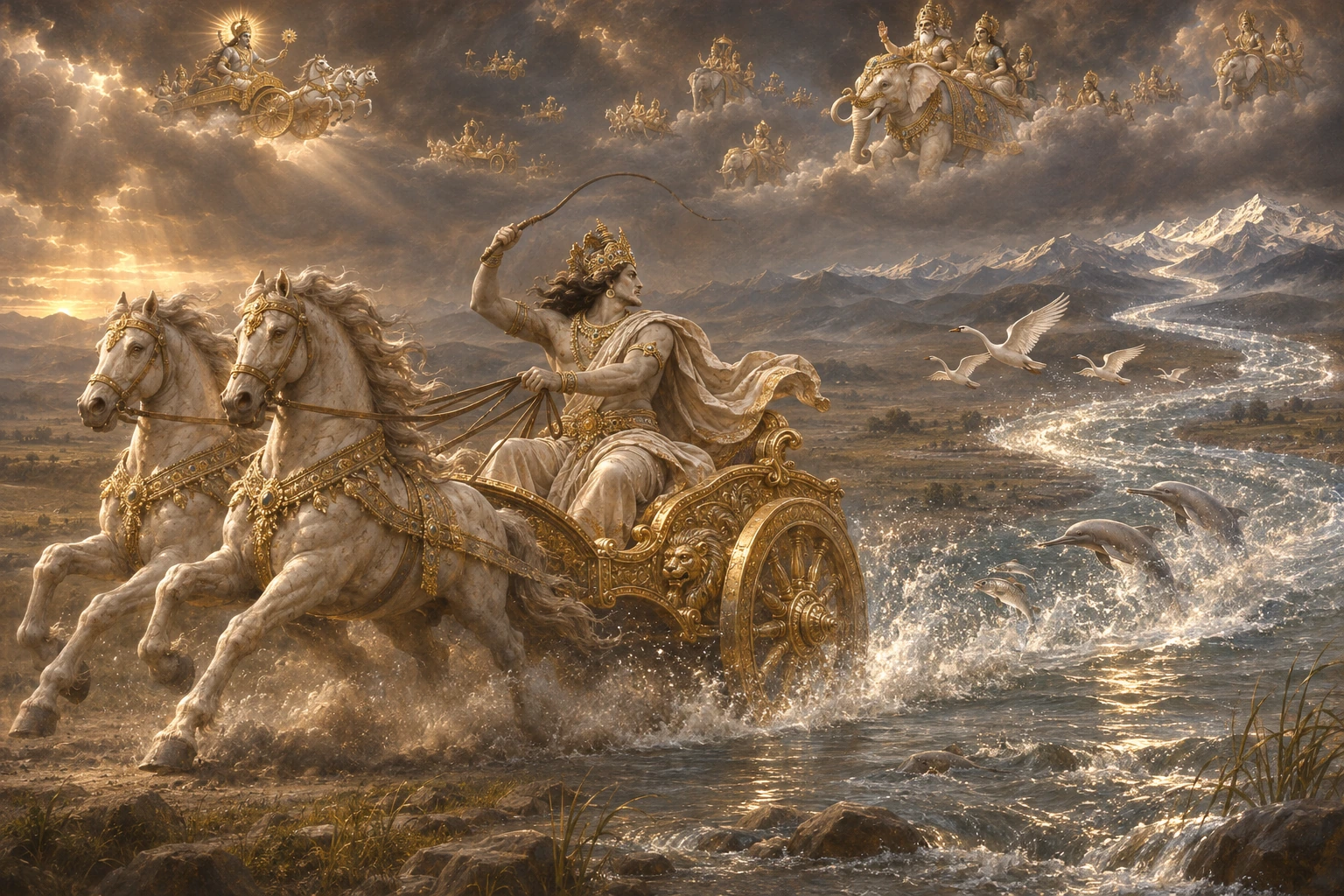
The gods came to watch in chariots like flying cities, and their jewels made the sky shine as if with a hundred suns. Fish, dolphins and water snakes flashed like lightning in the falling water, and the white spray looked like autumn clouds full of swans. Sages and spirits touched it as holy, because it had fallen from Shiva’s body, and those who had been cursed to fall from heaven bathed in it and went home.
1-6 The River Follows the King
Bhagiratha mounted a divine chariot and drove ahead, and the Ganga followed him. Gods, sages, demons, celestial musicians, serpents, nymphs and every creature of the water followed the river. Bhagiratha led her to the ocean and down into the depths his ancestors had dug, and her water flooded the ashes.
Brahmā appeared and told the king that the sixty thousand had gone to heaven, where they would live like gods as long as the ocean had water. “This Ganga will be your eldest daughter,” he said, and she would be famous by a name taken from his: Bhāgīrathī. She would also be called Tripathagā, “she who goes three ways”, because she purifies three paths. Bhagiratha poured the water offerings for his ancestors and went home to rule. Whoever hears this story, Viśvāmitra ends, will gain wealth, fame, long life, sons and heaven.
2 Where the Story Is Written Down
- The Rāmāyaṇa, Book 1, attributed to the poet Vālmīki. Arthur Macdonell, following Hermann Jacobi, wrote in 1900 that the epic first had five books and that Book 1 has passages that conflict with the later ones. The Baroda critical edition, whose text is on GRETIL, tells Ganga’s birth in sarga 34 (she is the elder daughter of the Himalaya and Menā; Umā, Shiva’s future wife, is the younger) and her descent in sargas 37 to 43. The popular text on valmikiramayan.net numbers them 35 and 38 to 44, and Ralph Griffith’s verse translation of 1870–1874 has them as cantos 36 and 39 to 44.
- The Mahābhārata, Book 3, the book of the forest years. During the Pandavas’ pilgrimage to holy places, the sage Lomaśa tells the story to Yudhishthira (3.104 to 3.108 in the Pune critical edition; Vana Parva sections 106 to 109 in K. M. Ganguli’s translation of 1883–1896). Here it is the sequel to another tale: the sage Agastya has drunk the ocean dry, and Brahmā tells the gods it will be filled again one day, through Bhagiratha. Both epics also tie the ocean, sāgara, to King Sagara: the Rāmāyaṇa calls Sagara the king “by whom the ocean was dug” (1.5.2), and in the Mahābhārata he adopts the ocean as his son (3.106.33).
- The Bhāgavata Purāṇa retells it in book 9 (chapters 8 and 9) and says where the river comes from in books 5 and 8. It was probably composed in the 9th or 10th century, in South India.
- Before the epics. The Rigveda names the Ganges directly only once, Macdonell noted. He thought that hymns calling the river goddess Sarasvatī to come down from the sky may have suggested the idea of a heavenly Ganges.
3 Competing Versions
- Sagara’s sons. In the Rāmāyaṇa the sage Bhṛgu promises them, and Sumati bears the gourd. In the Mahābhārata Shiva promises them on Mount Kailasa, and the Vidarbha princess bears the gourd while the other queen, Śaibyā, bears Asamañja. Sagara is about to throw it away when a voice from the sky tells him to keep its seeds in jars of ghee.
- How did the sons die? In the Rāmāyaṇa, Kapila utters one angry sound. In the Mahābhārata, he opens his eyes and his fiery energy burns them. The Bhāgavata Purāṇa says they burned in the fire of their own bodies when he opened his eyes, and that it is wrong to say a sage of pure goodness burned them in anger (9.8.12–13).
- Who told of the Ganga? In the Rāmāyaṇa, Garuda. In the Mahābhārata, Kapila himself, pleased with Anshuman, gives him the horse and foretells that his grandson will bring the river down.
- Who appeared to Bhagiratha? In the Rāmāyaṇa, Brahmā. In the Mahābhārata, after a thousand years of the gods, the Ganga herself, who sends him to Shiva. In the Bhāgavata Purāṇa she has a second worry: people will wash their sins into her, so where will she wash them off? Holy men bathing in her, Bhagiratha answers, will take the sins away (9.9.5–6).
- Was the Ganga proud? Not in the critical edition. In the popular text and in Griffith, she means to sweep Shiva down to the underworld with her flood, and Shiva, angered by her pride, keeps her prisoner in his hair until Bhagiratha does penance again. In the Mahābhārata she is not trapped at all: Shiva holds her on his brow “like a string of pearls”, and she runs on.
- How many streams? The popular text has seven from Lake Bindu: three flow east, three west, and the seventh follows Bhagiratha. The Mahābhārata has three. In the Bhāgavata Purāṇa she splits into four on top of Mount Meru, and one of them, the Alakanandā, flows south into India (5.17).
- Jahnu. In the popular text and in Griffith, the river floods the sacrificial ground of the sage Jahnu, who drinks her up, then lets her out through his ears: so she is called Jāhnavī, Jahnu’s daughter. The episode is not in the critical edition’s text of the Rāmāyaṇa. In the Mahābhārata’s critical edition it is a single variant line in the notes, and Ganguli’s translation does not have it. The Bhāgavata Purāṇa mentions Jahnu drinking the Ganga in a list of kings of another dynasty (9.15.3).
- Where does she come from? In the Rāmāyaṇa, she is the Himalaya’s daughter, given to the gods. In the Bhāgavata Purāṇa she comes from Vishnu’s foot. When he takes his giant strides as the dwarf Vamana, Brahmā washes the raised foot with water from his pot, and that water becomes the river of heaven (8.21.4). In book 5, she is the water outside the universe, which poured in where the nail of his big toe broke the shell of the world as he strode (5.17.1).
4 History and Tradition
- The relief at Mamallapuram. On the coast south of Chennai, under the Pallava kings of the 7th century, two granite boulders were carved with more than a hundred figures of gods, sages, people and animals. Serpent deities, the nagas, rise up the cleft between the boulders, and scholars believe water was once sent down the cleft from a hollow on top. Beside it, an ascetic stands on one leg near a four-armed Shiva, and a cat stands on one leg too, in mock penance, surrounded by mice. Those who read the Ganga’s descent point to the nagas and the water. Those who read Arjuna’s penance, from the Mahābhārata, point to the dwarf with a face on his belly whom Shiva seems to present to the ascetic: in the epic, Shiva’s weapon stands “embodied” at Arjuna’s side (3.41). The austerity decides nothing, for in the Mahābhārata (3.39) Arjuna, like Bhagiratha in the Rāmāyaṇa, stands with arms raised on the tips of his toes.
The great relief at Mamallapuram is often called “the Descent of the Ganges”, and as often “Arjuna’s Penance”. No one has settled which it shows. In 1880 James Fergusson and James Burgess knew it as “the penance of Arjuna”. Victor Goloubew (1914, 1921) and Gabriel Jouveau-Dubreuil were, as Francis, Gillet and Schmid write, the first to read it as the descent of the Ganga. Michael Rabe (2001) reads it as a eulogy of the Pallava king with both stories inside, “a deliberate conundrum”, and Padma Kaimal (1994) sees a “playful ambiguity” in it, like the puns of Pallava court poetry. We know Goloubew only through Francis, Gillet and Schmid (2005), and Rabe and Kaimal through Kaimal’s review of Rabe’s book and Edward Fosmire’s essay.
- The goddess. A sandstone Ganga of about 700 from Mathura, now in the Cleveland Museum of Art (1966.119), stands on a makara, a crocodile-like water creature. The museum explains that images of Ganga were placed at temple doorways, because her purifying water symbolically cleanses those who enter. The Mahābhārata gives the goddess a second story: in Book 1 she marries King Shantanu and becomes the mother of Bhishma (Kurukshetra).
- Ganga Dussehra. Monier-Williams’s Sanskrit dictionary (1899) explains daśaharā, “taking away the ten sins”, as a name of the Ganga and of her festival on the tenth day of the month of Jyeshtha. In 1915 the folklorist William Crooke described it in Bengal: it “commemorates the descent of the river Ganges from heaven”, crowds bring flowers, fruit and grain to the river, and bathing at the right moment removes the sins of ten lives. It is not the autumn Dasahra of October, Crooke adds, the season of Durga Puja and of the Ramlila plays about Rama.
- Gangotri and the Bhagirathi. The temple at Gangotri, in the Himalaya of Uttarakhand, is “the seat of the goddess Ganga” and one of the four shrines of the Char Dham pilgrimage, says the Uttarkashi district. At its source, at Gomukh (“the cow’s mouth”) in the Gangotri Glacier, the river is called the Bhagirathi; it takes the name Ganga at Devprayag, where it meets the Alaknanda. The Japanese World Encyclopedia (Heibonsha) notes that the name keeps the memory of King Bhagiratha.
- Kumbh Mela. Two of the four Kumbh Mela towns, Haridwar and Prayagraj, stand on the Ganga. The popular story of drops of amṛta that fell there is not in the old texts (The Churning of the Ocean).
5 Related Stories
- Shiva: The Destroyer and the Dancer: the god who caught the river. Because she flows forever through Shiva’s hair, the Cleveland Museum’s label explains, the river is holy.
- Kurukshetra: The War of the Mahābhārata: the epic whose third book tells the descent, and whose first book makes the goddess Ganga the mother of Bhishma, the old commander of the war.
- The Churning of the Ocean: Gods, Demons and the Nectar of Immortality: another story about what lies in the ocean. Sagara’s sons dug it, Agastya drank it dry, the Ganga refilled it, and the gods and the asuras churned it for amṛta.
- Kunlun: The Mountain of the Immortals: in Chinese books, rivers run from the corners of the mountain of the immortals, as in the Bhāgavata Purāṇa the Ganga splits into four on Mount Meru. Later, Yamakawa’s dictionary notes, Kunlun was confused with Sumeru, the world mountain of Indian legend. We have not found a scholar who links the two sets of rivers; we link them for the theme.
6 Sources
- Rāmāyaṇa, critical edition, Bālakāṇḍa 1.5, 1.34 and 1.37–44: GRETIL; the popular text, sargas 35 and 38–44: valmikiramayan.net. A Japanese translation is Nakamura Ryōshō’s Shin’yaku Rāmāyaṇa, seven volumes (Heibonsha, Tōyō Bunko, from 2012)
- Ralph T. H. Griffith (trans.), The Rámáyan of Válmíki (1870–1874), Book I, cantos 36 and 39–44: Project Gutenberg
- Mahābhārata, critical edition, Āraṇyakaparvan 3.39, 3.41 and 3.103–108, with variant passages: GRETIL; Ādiparvan 1.91–92: GRETIL
- K. M. Ganguli (trans.), The Mahabharata, Book 3, Vana Parva, sections 105–109: Project Gutenberg
- Bhāgavata Purāṇa, books 5, 8 and 9: GRETIL; Hartmut E. Scharfe, “Bhagavata Purana”, Encyclopedia of India: Encyclopedia.com
- Arthur A. Macdonell, A History of Sanskrit Literature (1900), chapters on the Rigveda and the Rāmāyaṇa: Project Gutenberg
- Monier Monier-Williams, A Sanskrit-English Dictionary (1899), p. 472, “daśa-harā”: Cologne Digital Sanskrit Dictionaries; W. Crooke, “The Dasahra: An Autumn Festival of the Hindus”, Folklore 26 (1915): Zenodo
- James Fergusson and James Burgess, The Cave Temples of India (1880), p. 107: archive.org; Emmanuel Francis, Valérie Gillet and Charlotte Schmid, “L’eau et le feu : chronique des études pallava”, Bulletin de l’École française d’Extrême-Orient 92 (2005): Persée
- Padma Kaimal, review of Michael D. Rabe, The Great Penance at Mamallapuram: Deciphering a Visual Text (Institute of Asian Studies, Chennai, 2001), and Rabe’s response, caa.reviews (2003): caareviews.org, caareviews.org; Edward Fosmire, “The Great Relief at Mamallapuram” (2017), quoting Kaimal, “Playful Ambiguity and Political Authority in the Large Relief at Mamallapuram”, Ars Orientalis 24 (1994), and Rabe (2001): Brewminate
- Cleveland Museum of Art, “River Goddess Ganga” (1966.119): clevelandart.org; District Uttarkashi, Government of Uttarakhand, “Gangotri Dham” and “Gomukh”: uttarkashi.nic.in, uttarkashi.nic.in
- “ガンガー川”, Kaitei shinban Sekai daihyakka jiten; “ガンジス川”, Nihon daihyakka zensho; “マハーバリプラム”: Kotobank, Kotobank, Kotobank
Cover and illustrations: AI-generated images made for Arcana. They are interpretations, not historical artworks.