Kali: The Dark Goddess Born from Anger
When the goddess's face grew dark with anger, Kali sprang from her brow and drank the blood of a demon who multiplied with every drop that fell. Colonial writers made her the goddess of a cult of stranglers; the poets of Bengal call her Mother.
- Type: myth, a fierce goddess who fights for the gods
- Culture: India (Hindu tradition), above all Bengal, where Kali Puja is kept on the new-moon night of the month of Kartik
- Earliest texts: her story is told in the Devī Māhātmya, part of the Mārkaṇḍeya Purāṇa, placed by its translator in the 5th or 6th century CE; the word kālī, “black”, is older: the Muṇḍaka Upaniṣad uses it for a flame of the sacrificial fire, and the Mahābhārata as a name of Durga
- Key figures: Kali (also called Chamunda), the goddess Ambikā or Caṇḍikā (Durga), the asura kings Śumbha and Niśumbha, their generals Caṇḍa and Muṇḍa, Raktabija, the Mothers, Shiva
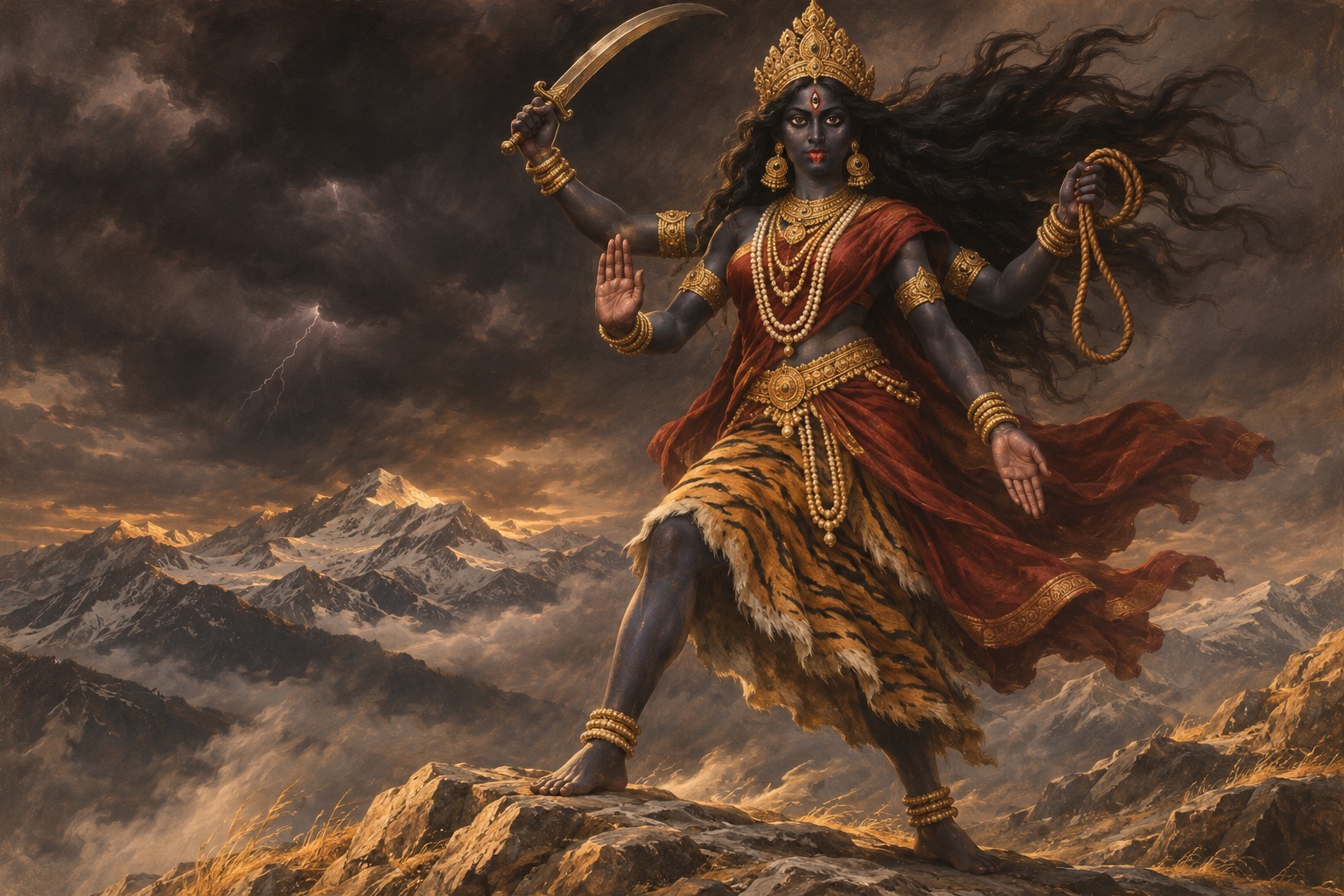
On the darkest night of autumn, the new moon of the month of Kartik, Kolkata worships a goddess darker still. She is black or deep blue, her tongue is out, and one of her feet rests on Shiva. Her oldest story says nothing of Shiva beneath her. It is a battle, in which she springs from another goddess’s anger and fights for the gods.
Is Kali the same goddess as Durga? In the oldest story she is part of her and apart from her. In the Devī Māhātmya, Kali springs from the forehead of the goddess Ambikā, whom the poem also calls Durgā, and fights beside her as a goddess with her own name. Her translator Pargiter read the poem as “a glorification of Durga in her terrible aspect, with Kali as an emanation from her”. The Indologist Kamimura Katsuhiko writes that Kali is taken for Durga’s terrible form, but seems to have been a separate goddess at first.
1 The Telling
This follows the Devī Māhātmya, chapters 5 to 10, which are chapters 85 to 90 of the Mārkaṇḍeya Purāṇa, in F. Eden Pargiter’s English translation of 1904. As in the story of the buffalo demon Mahiṣa, the sage Medhas tells it to a king who has lost his kingdom.
1-1 The Goddess on the Mountain
Two asura brothers, Śumbha and Niśumbha, took from Indra the three worlds and his share of the sacrifices, and seized the domains of the Sun and the Moon, of Kubera, Yama and Varuṇa, of Vāyu and Agni. The gods remembered the goddess’s promise to come whenever they called her to mind, and went to the Himalaya to sing her a hymn.
Pārvatī came there to bathe in the Ganga and asked them whom they were praising. A goddess stepped out of her body and answered: the hymn was for her. Because this goddess, Ambikā, came out of the sheath (kośa) of Pārvatī’s body, she is called Kauśikī. And Pārvatī, once Ambikā had left her, turned black. She is “celebrated as Kālikā”, the text says, and she made her home on the mountain.
Two servants of the asura kings, Caṇḍa and Muṇḍa, saw Ambikā and told Śumbha of a beauty no one had ever seen. He already owned every treasure of the three worlds, they said, so why not this one? Śumbha sent a messenger to offer her marriage to himself or his brother. She smiled, and answered that she had once made a vow, “by reason of my small understanding”, to marry only the one who defeated her in battle. Śumbha sent his general Dhūmralocana to drag her to him by the hair, and Ambikā “with a mere roar reduced him to ashes”. Then Śumbha sent Caṇḍa and Muṇḍa with an army.
1-2 Out of the Brow
The asuras found her “slightly smiling, seated upon the lion, on a huge golden peak” of the mountain. Some rushed to seize her, others came with bows bent and swords drawn. Ambikā’s anger rose, and “her countenance then grew dark as ink”. From her forehead, “rugged with frowns”, sprang Kali. She held a sword and a noose and a skull-topped staff, wore a garland of skulls and a tiger’s skin, and her flesh was withered. Her mouth was very wide, her tongue lolled, her red eyes were sunk deep, and her roars filled the sky.
She fell on the army and devoured it: elephants with their riders and their bells, horses with their warriors, chariots with their drivers, all ground between her teeth. Caṇḍa rushed at her, and Muṇḍa covered her with arrows and with discs hurled by the thousand. The discs vanished into her face “like as very many solar orbs might penetrate the body of a thunder-cloud”. Kali laughed. She seized Caṇḍa by the hair and cut off his head with her sword, and struck Muṇḍa down after him. The rest of the army fled.
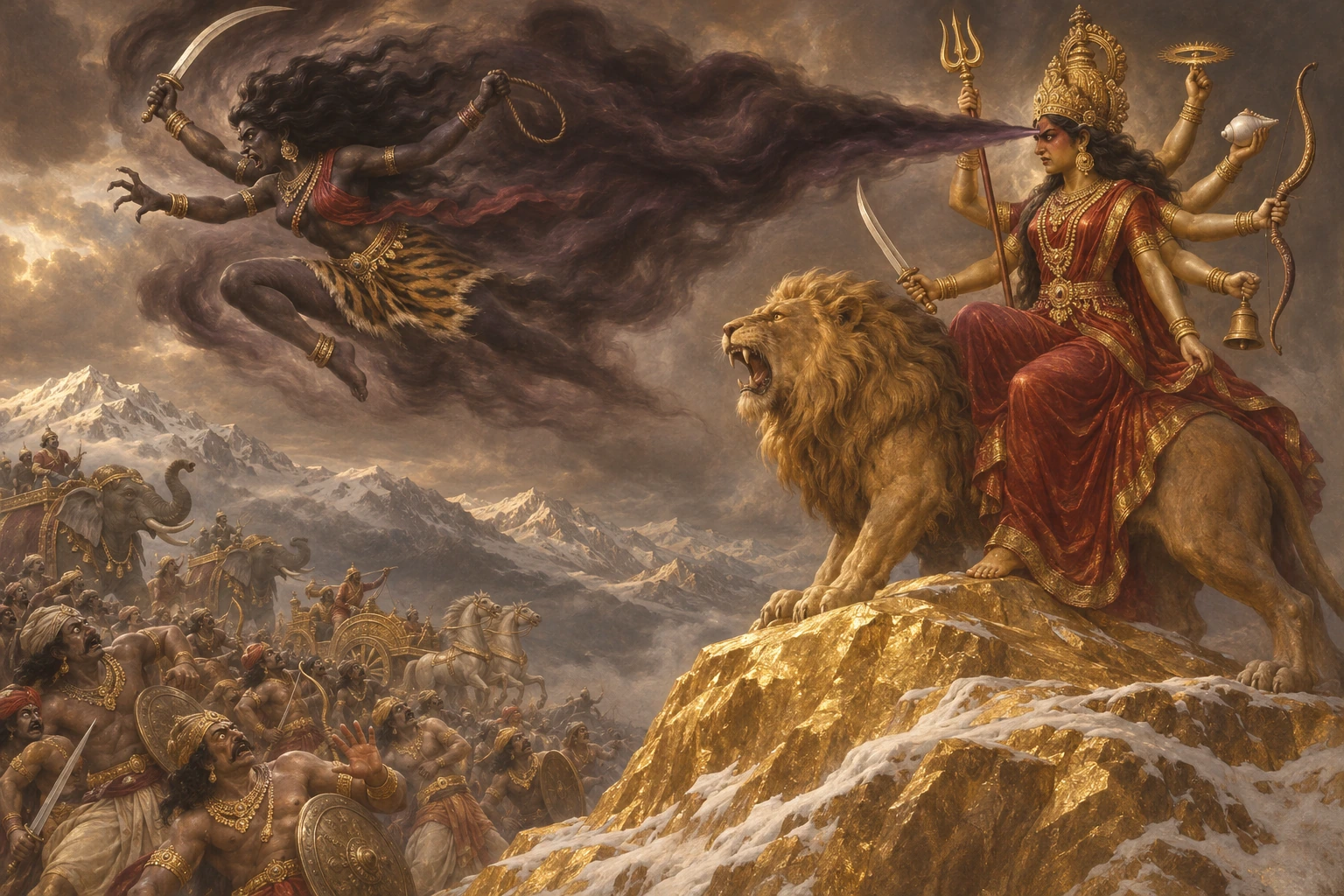
Kali brought the two heads to Caṇḍikā, laughing aloud: “Here I have brought thee Caṇḍa and Muṇḍa, two great beasts; thou thyself shalt slay Śumbha and Niśumbha in the battle-sacrifice.” Caṇḍikā answered with a pun, which Pargiter calls “a bon mot”. Because Kali had brought her Caṇḍa and Muṇḍa, she would be famed in the world as Chamunda (Cāmuṇḍā).
1-3 The Mothers
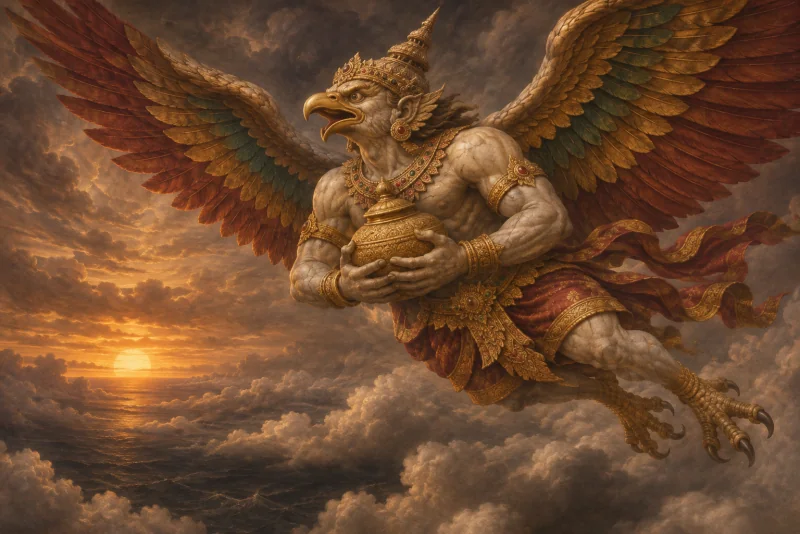
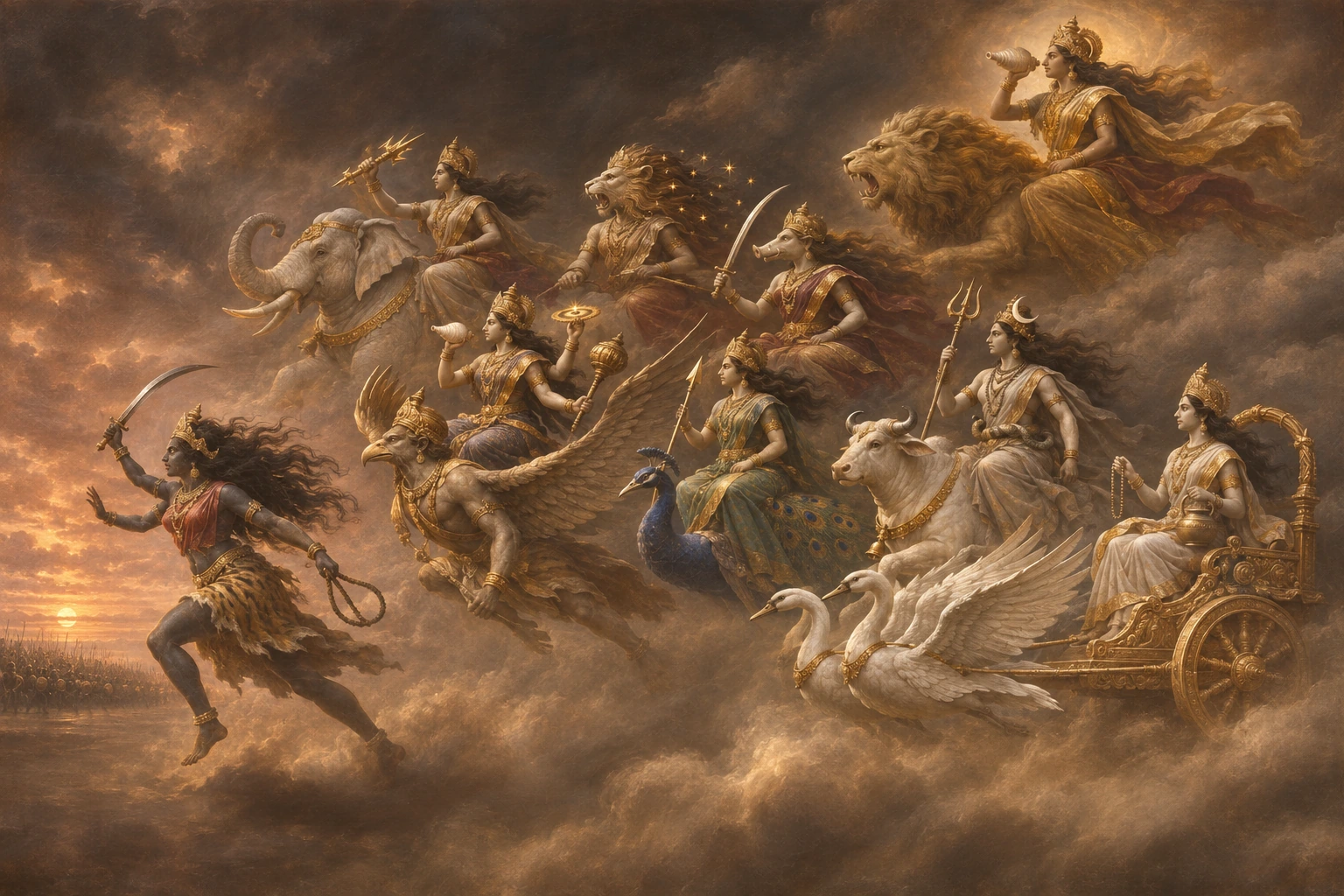
Śumbha sent out every army he had. Then, “for the well-being of the lion-like Immortals”, the energies (śakti) of the gods came out of their bodies and went to Caṇḍikā, each with the form, ornaments and mount of her god. Brahmā’s came in a car drawn by swans, with a rosary and a water pot. Shiva’s rode a bull, with a trident and the crescent moon. Skanda’s rode a peacock with a spear, and Vishnu’s rode Garuda with conch, discus, club and bow. The boar’s energy came as a boar, the man-lion’s with a mane that scattered the stars, and Indra’s on his elephant with the thunderbolt. The text calls them the band of Mothers.
From Caṇḍikā’s own body came her own energy, the most terrible of all, “howling like a hundred jackals”, and she sent Shiva himself as her messenger. Let Indra have back the three worlds and the gods their offerings, he was to tell the asuras, and “go ye to Pātāla if ye wish to live”. So she is called Śivadūtī, “she whose messenger is Shiva”. The asuras chose to fight.
1-4 Raktabija
Then came the great asura Raktabija, “blood-seed”. Whenever a drop of his blood fell to the ground, an asura of his size and strength rose from the earth. Every wound the Mothers gave him, with thunderbolt, discus, spear, sword and trident, made more of him, until “the whole world” was filled with them and the gods were terrified.
Caṇḍikā said to Kali: “O Cāmuṇḍā! stretch out thy mouth wide.” She was to take in the drops, and the asuras born from them, before they could reach the ground: “so shall this Daitya with his blood ebbing away meet destruction”. Kali did so. Caṇḍikā struck him with dart, thunderbolt, arrows, swords and spears, and Chamunda drank all that flowed, until Raktabija fell, “blood-less”. The Mothers broke into a dance.
1-5 Alone
In chapter 9 Niśumbha fell. In chapter 10 Śumbha taunted the goddess, calling her Durgā: she fought in pride, “trusting in the strength of the other goddesses”. She answered: “Alone verily am I in the world here; what other goddess is there besides me?” Brahmāṇī and the other goddesses were drawn back into her, and she fought Śumbha alone and killed him.
2 Where the Story Is Written Down
- The word. Kālī is the feminine of kāla, “black, of a dark colour”, in Monier-Williams’s Sanskrit dictionary (1899), which also gives it as “a form of Durgā”. Among its uses it cites the Muṇḍaka Upaniṣad (1.2.4), where the word names a flame of the sacrificial fire: “Kâlî (black), Karâlî (terrific), Manogavâ (swift as thought)” and four more are “called the seven tongues (of fire)”, in Max Müller’s translation of 1884. Another kāla means “time”, and explanations of her name often join the two, but the dictionary lists them as two words. Nor is she kali, with a short i: the losing throw at dice, and the name of the last and worst age of the world.
- The Devī Māhātmya is a poem of thirteen chapters, 81 to 93 of the Mārkaṇḍeya Purāṇa, which Pargiter judged “very probably” composed in the 5th or 6th century CE. Kālikā appears in chapter 85 (the poem’s 5th), Kali and Chamunda in chapters 87 and 88. Pargiter noted that Kali “is made a separate goddess who issued from Caṇḍikā’s forehead”, and doubted the pun on Chamunda: “fanciful derivations are common in this Purana”.
- The Sanskrit on GRETIL calls her karālavadanā, “of the terrible face”, and naramālāvibhūṣaṇā. Pargiter turns the second into “decorated with a garland of skulls”; word for word, it is “adorned with a garland of men” (our translation).
- The goddess’s dark names. In the first chapter Brahmā praises the goddess herself as “the Night of the world’s destruction, the Great Night, and the Night of delusion”. In the hymn of chapter 91 (the poem’s 11th) the gods salute her as Chamunda, “decorated with a garland of heads”, and as Bhadrakālī, and ask her trident to “guard us from fear”.
- The Mahābhārata. In the Calcutta edition that Pargiter cites, Durga is already called Mahākālī, Bhadrakālī and Kālī, “no distinction being made”. There Kālī is one of the goddess’s names.
3 Competing Versions
- Where does Kali come from? The same poem gives two answers. In chapter 5, Pārvatī herself turns black when Ambikā leaves her body, and is called Kālikā. In chapter 7, Kali springs from Ambikā’s forehead in the heat of battle.
- One goddess or two? In chapter 10 the goddess says there is no other goddess besides her. In Kamimura’s article for the Japanese Sekai daihyakka jiten, Kali is “said to be” the name of Durga, Shiva’s consort, in her terrifying form, “but originally seems to have been a separate deity” (our translation).
- Why is her tongue out? In the Devī Māhātmya it lolls from the moment she appears, before Raktabija comes into the story.
- The Cleveland Museum of Art reads the tongue in a Pahari painting of about 1740 as a sign of “her ability to catch blood before it touches the ground”. In 1836 William Sleeman, who wrote on the Thugs (section 4), recorded how other Hindus told Raktabija’s end: “she licked them all off with her enormous tongue”.
- The story told at Kali Puja is another. In the words of India’s Ministry of Tourism, the gods begged Shiva to stop Kali’s rampage, and he lay down beneath her feet. Seeing what she had done, she stopped, her tongue out “in astonishment”. Other tellings say she bit her tongue in guilt (Outlook) or put it out in embarrassment (Arts Illustrated).
- Shiva beneath her. The Devī Māhātmya has no such scene: there Shiva is the goddess’s messenger.
- In the “Tantric Devi” paintings from Basohli in the Punjab Hills (about 1660–70), the verse that goes with the goddess Bhadrakālī meditates on her “standing upon a corpse” (Smithsonian, 1999).
- In a Pahari painting of about 1810 in Cleveland, Kali kneels on Shiva, who lies “like a corpse (shava)”: the energy is active, the male principle still. In the Kalighat paintings sold in Kolkata about 1890, she stands on him.
- The stranglers’ Raktabija. Sleeman’s vocabulary of the Thugs’ speech gives their own version (1836). The goddess cut down a demon whose every drop of blood made another, and grew tired. So she made two men from her sweat and gave each a handkerchief to kill the demons without spilling a drop. She let them keep the handkerchiefs, the Thugs said, “as the instruments of a trade”.
4 History and Tradition
- Kalighat. The temple in Kolkata is counted among the 51 Shakti Peeths, and Sati’s right toe is believed to have fallen to earth there. The present building was completed around 1809 under the Sabarna Roy Chowdhury family, and the image has three eyes, four hands and a tongue of gold, India’s Ministry of Tourism writes. Painters around the temple sold pictures of her to pilgrims. The Cleveland Museum of Art has one of about 1890 in which two of her hands make “gestures of protection and blessing”.
- Ramprasad Sen (1718–1775), born at Kumarhati near Halisahar, sang to Kali as his Mother. Edward Thompson, who translated his songs in 1923, found that Bengal thought of God as a Mother, “yet, as Ramprasad’s songs show”, with fear. The old tradition said Ramprasad died singing to Kali. The historian Dineshchandra Sen told Thompson that he drowned on Kali Puja day, following the clay image into the Ganges in a trance.
- Dakshineswar. On 31 May 1855 the widow Rani Rashmoni consecrated a nine-spired temple to Kali on the Hooghly, north of Kolkata, where the goddess is worshipped as Bhavatarini. (Max Müller gives 1853.) Its priest was Ramkumar, whose youngest brother Ramakrishna took over the worship when he fell ill. “He now began to look upon the image of the goddess Kali as his mother and the mother of the universe,” Max Müller wrote, and he prayed to her “as a child to his mother”.
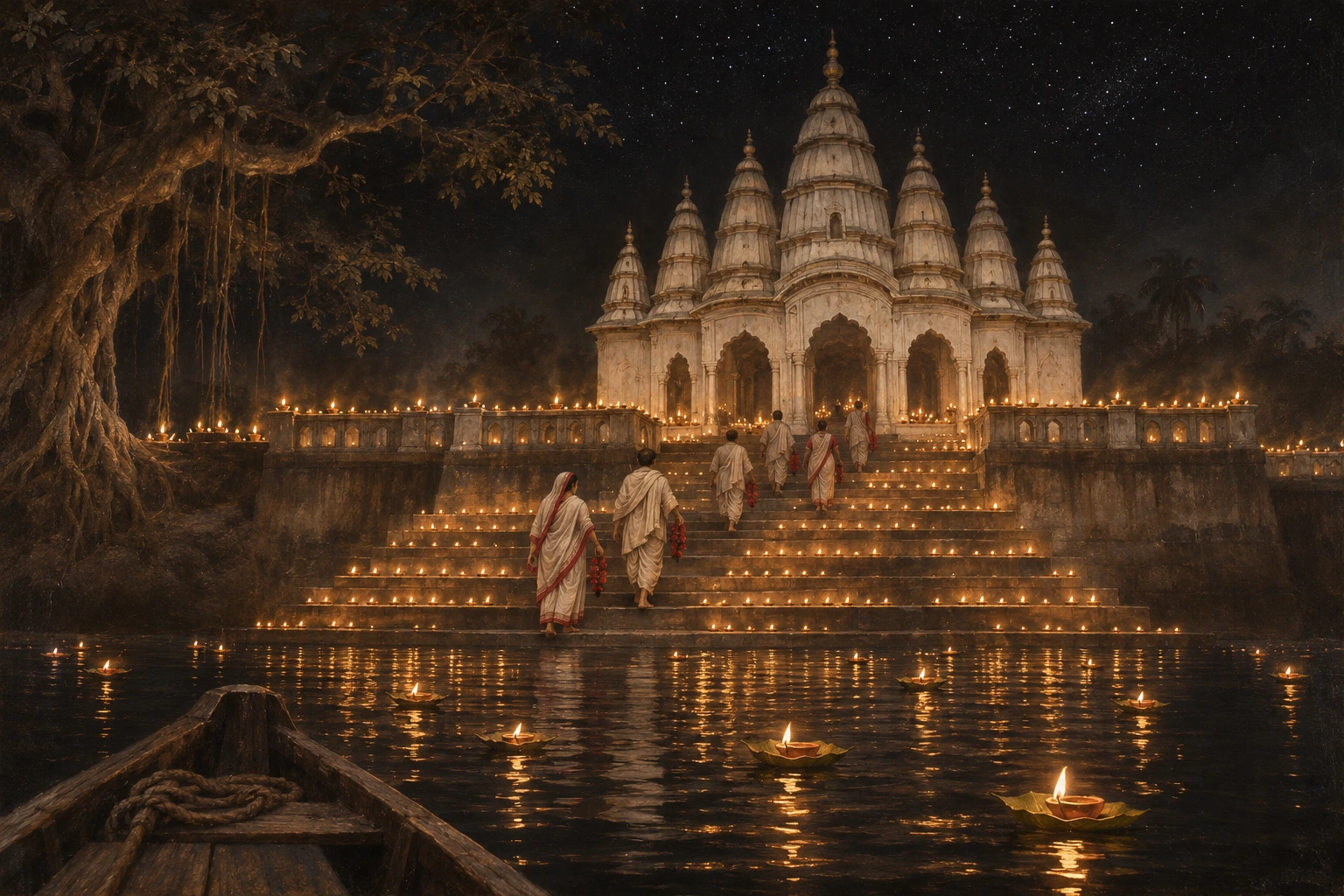
- Kali Puja falls on the new-moon night of Kartik, in October or November, with midnight as the holy hour. Devotees offer red hibiscus flowers and meditate through the night, and the clay images are then immersed in rivers and ponds.
- The colonial picture. In the 1830s Captain William Sleeman and the governor-general, Lord William Bentinck, set out to destroy the Thugs, bands said to strangle travellers on the roads. In 1836 Sleeman wrote that every one of them believed he murdered on the orders of “the Goddess Devee, Durga, Kalee or Bhawanee, as she is indifferently called”.
- Philip Meadows Taylor’s novel Confessions of a Thug (1839) carried the story to England, and films from The Stranglers of Bombay (1960) to Indiana Jones and the Temple of Doom kept it alive (NPR, 2013). The Cleveland museum notes that the Kalighat pictures of Kali, sold to British visitors too, “fit into the colonial imagination and into Victorian popular culture”.
- Historians now read that archive with care. Kim A. Wagner found that court records of 1809–1812 describe the crime without the religious elements Sleeman stressed, and that the Thugs were Hindus and Muslims alike, as the Italian historian Francesco Benigno sums up his work. The colonial account formalized in the 1830s “was at large extent a misrepresentation”, Wagner concluded.
Kali is often called a goddess of death, even of evil, and the colonial stories of the Thugs fixed that picture in English. In the Devī Māhātmya she fights for the gods against the asuras who had taken heaven, and in Bengal she is the Mother. “Countless are the evil children, but who ever heard of an evil mother?” sang Ramprasad Sen, and in another song: “I can be the death of Death, if I remember the Almighty Mother’s power.”
5 Related Stories
- Durga and Mahishasura: The Goddess and the Buffalo Demon: the first battle of the same poem. The goddess who killed Mahiṣa returns to fight Śumbha and Niśumbha, and Kali springs from her brow. Already in 1904 Pargiter called the poem “a text-book of the worshippers of Kali”.
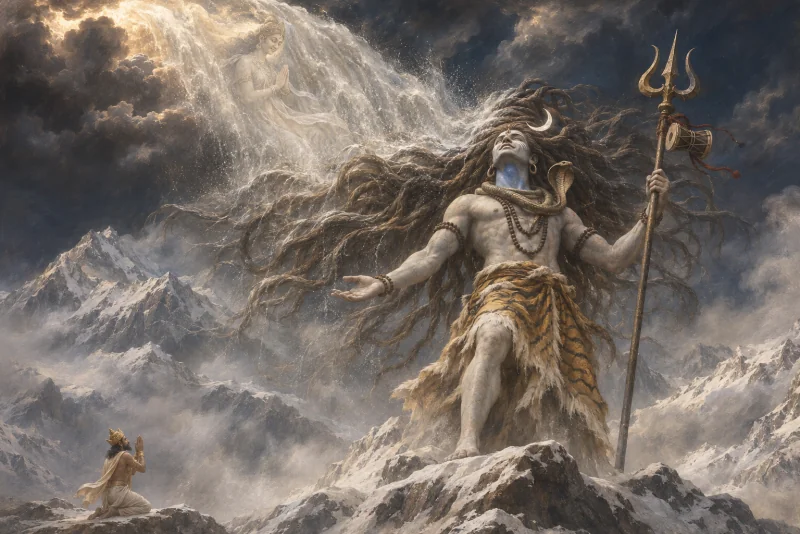
- Shiva: The Destroyer and the Dancer: in the Devī Māhātmya Shiva carries the goddess’s message to the asuras. In the image Bengal worships, he lies beneath Kali’s feet.
- The Churning of the Ocean: Gods, Demons and the Nectar of Immortality: Śumbha’s messenger boasts that the horse Uccaiḥśravas, “which came forth at the churning of the sea of milk”, now belongs to his master. What the gods won from the ocean has passed to the asuras.
- The Morrígan: The Phantom Queen of Battle: another war goddess often called a goddess of death, whose texts give her more to do than the label says. We have not found a scholar who compares the two; we link them for the theme.
- The Eye of Ra: Sekhmet and the Destruction of Mankind: in Egypt, too, a goddess’s slaughter has to be stopped: Ra’s Eye, as Sekhmet, is checked only when she drinks seven thousand jars of beer dyed red as blood. A shared theme; we link them for it.
6 Sources
- Devī Māhātmya (Mārkaṇḍeya Purāṇa 81–93), Sanskrit text: GRETIL
- F. Eden Pargiter (trans.), The Markandeya Purana (Asiatic Society, Calcutta, 1904), cantos 81 and 85–91, with the introduction: archive.org
- Muṇḍaka Upaniṣad 1.2.4, trans. F. Max Müller, The Upanishads, part 2 (Sacred Books of the East 15, 1884): Wikisource
- Monier Monier-Williams, A Sanskrit-English Dictionary (1899), “kāla”, “kālī” and “kali”: Cologne Digital Sanskrit Dictionaries
- Edward J. Thompson and Arthur Marshman Spencer (trans.), Bengali Religious Lyrics, Śākta (Association Press, Calcutta; Oxford University Press, 1923), introduction and songs XXIX and LVIII: archive.org
- F. Max Müller, Râmakrishna: His Life and Sayings (Charles Scribner’s Sons, New York, 1899), pp. 35–37: archive.org
- W. H. Sleeman, Ramaseeana, or a Vocabulary of the Peculiar Language Used by the Thugs (Military Orphan Press, Calcutta, 1836), p. 7 and “Rukut Beej Dana”, pp. 127–129: archive.org
- Cleveland Museum of Art, “Kali attacking Nisumbha” (1968.44), “Kali on Shiva, from a Tantric Devi Series” (2014.650) and “Leaf from a Kalighat album: The Goddess Kali; Kali Standing on Shiva” (2003.110): clevelandart.org, clevelandart.org, clevelandart.org
- Arthur M. Sackler Gallery, Smithsonian Institution, Devi: The Great Goddess (online exhibition, 1999), “Bhadrakali, Destroyer of the Universe”: web.archive.org
- Ministry of Tourism, Government of India, “Kalighat Temple”, “Dakshineswar Kali Temple” and “Kali Puja”: Incredible India, Incredible India, Incredible India; Dakshineswar Kali Temple: dakshineswarkalitemple.org
- Francesco Benigno, “Il ritorno dei Thugs. Ancora su trasformazioni discorsive e identità sociali”, Storica, no. 50: Università di Bologna
- Lakshmi Gandhi, “What A Thug’s Life Looked Like In 19th Century India”, NPR Code Switch, 18 November 2013: npr.org
- K. Karthik Venkatesh, “The Different Images Of Goddess Kali Through The Eyes Of Bengali Identities”, Outlook, 15 July 2022: outlookindia.com; Suzanne McNeill, “A Tale of Two Kalis”, Arts Illustrated, 7 May 2020: artsillustrated.in
- Kamimura Katsuhiko, “カーリー”, Kaitei shinban Sekai daihyakka jiten: Kotobank
Cover and illustrations: AI-generated images made for Arcana. They are interpretations, not historical artworks.