The Morrígan: The Phantom Queen of Battle
She meets the Dagda in a river at Samhain, fights Cú Chulainn as an eel, a wolf and a heifer, and after the great battle of the gods foretells first peace, then the end of the world. Even the scribes who copied her stories could not agree whether her name meant great queen or phantom queen.
- Type: myth, a goddess of war who foretells battles, stirs them up and takes part in them
- Culture: early medieval Ireland
- Earliest texts: a gloss written in 876 or 877 that explains the biblical lamia as a morigain; the Ulster tales in Lebor na hUidre, written about 1100; Cath Maige Tuired, put together in the 11th or 12th century from older material and preserved in one 16th-century manuscript
- Key figures: the Morrígan, Badb, Macha, Nemain, the Dagda, Lugh, Cú Chulainn, the Donn Cúailnge
The Morrígan has no story of her own. She walks into other people’s. A week before the great battle of the gods she stands in a river with one foot on each bank; she warns a bull that an army is coming for it; she offers herself to Cú Chulainn, and when he turns her away she fights him in the ford. She is the best known of the war goddesses of medieval Ireland, and yet the texts never quite agree who she is, how many she is, or even what her name means.
Does “Morrígan” mean “great queen”? That depends on one accent. Written Mórrígan, with a long ó, the name reads “great queen”, and in the Middle Irish period the first syllable was commonly taken as mór, “great”. But most manuscripts, the earlier ones included, write a short o, and then mor- looks like the mare of English “nightmare”. Whitley Stokes proposed this in 1891 and put the accent down to “popular etymology”; the Dictionary of the Irish Language still cites his reading. Hence “phantom queen”, or, as the historian Ronald Hutton prefers, “the nightmare queen”.
1 The Telling
The Morrígan appears in two groups of stories: among the gods, in Cath Maige Tuired, “the Battle of Mag Tuired”, and in the Ulster tales around Cú Chulainn. The battle itself is told in the post on the Tuatha Dé Danann; here only her part. Quotations from Cath Maige Tuired follow Whitley Stokes’s translation of 1891, with his paragraph numbers. The Táin Bó Cúailnge is quoted from Winifred Faraday’s translation of 1904, which follows Lebor na hUidre, and Táin Bó Regamna from A. H. Leahy’s of 1905.
1-1 A Woman in the Unshin
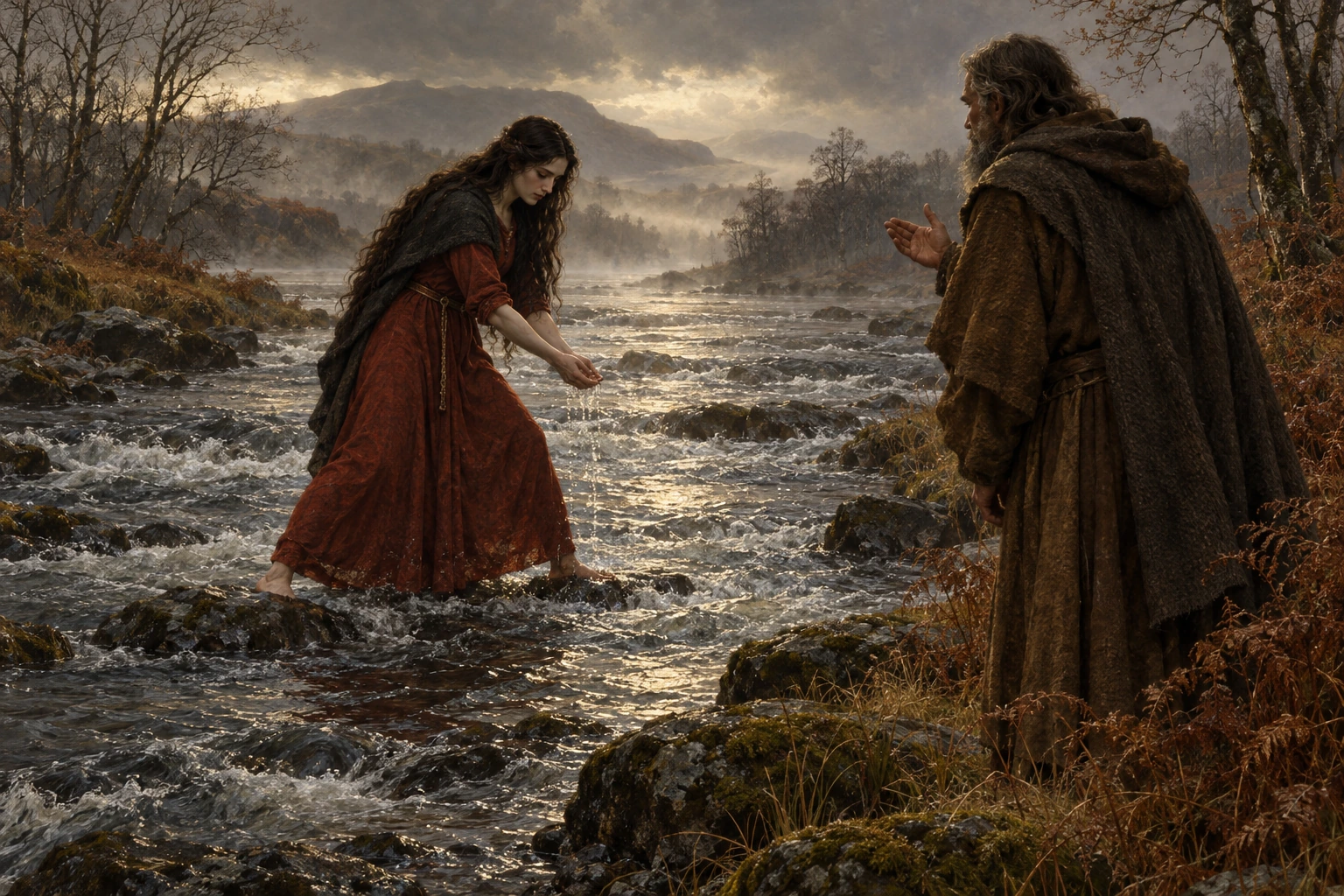
The Dagda had a house at Glenn Etin in the north, and he had a meeting there with a woman, a year from that day, at the Samhain of the battle: Stokes translates samain as “Allhallowtide”, the feast at the start of November. South of it “the Unius of Connaught roars”, the river Unshin. He found the woman in the river at Corann, washing, with one foot on the south side of the water and the other on the north. Nine loosened tresses hung from her head. The Dagda spoke with her, and they lay together, and the place was called “the Bed of the Couple” from then on. “The woman that is here mentioned,” the text adds, “is the Morrigan” (§84).
Then she told him where the Fomoire would land. He was to call the men of art of Ireland to meet her at the ford of the Unshin, and she herself would go and destroy Indech son of Dé Domnann, king of the Fomoire, and take from him “the blood of his heart and the kidneys of his valour”. She gave two handfuls of that blood to the hosts waiting at the ford, and it was called the Ford of Destruction ever after (§85). All this was a week before Samhain (§87).
1-2 Peace up to Heaven
Before the battle Lugh asks each of the Tuatha Dé what power they will bring. The Morrígan answers in three lines so obscure that Stokes could translate them only with question marks and gaps (§106–107). During the battle she came “heartening the Tuatha Dea to fight the battle fiercely and fervently”, and sang a lay that begins “Kings arise to the battle”; Stokes printed only that line and left out the rest as “very obscure” (§137). Macha, daughter of Ernmas, fell there with King Nuada at the hands of Balor (§133).
When the battle was won and the slain cleared away, the Morrígan, daughter of Ernmas, went to proclaim the victory “to the royal heights of Ireland and to its fairy hosts and its chief waters and its rivermouths”. “And hence it is,” the text says, “that Badb also describes high deeds.” Everyone asked her for news, and she answered: “Peace up to heaven, / Heaven down to earth, / Earth under heaven, / Strength in every one” (§166). Then, the text goes on, “she was prophesying the end of the world, and foretelling every evil that would be therein, and every disease and every vengeance”, and she sang: “I shall not see a world that will be dear to me. / Summer without flowers, / Kine will be without milk, / Women without modesty, / Men without valour.” Old men will judge wrongly, every man will be a betrayer, a son will deceive his father and a daughter her mother (§167). With that the tale ends.
1-3 The Woman in the Red Chariot
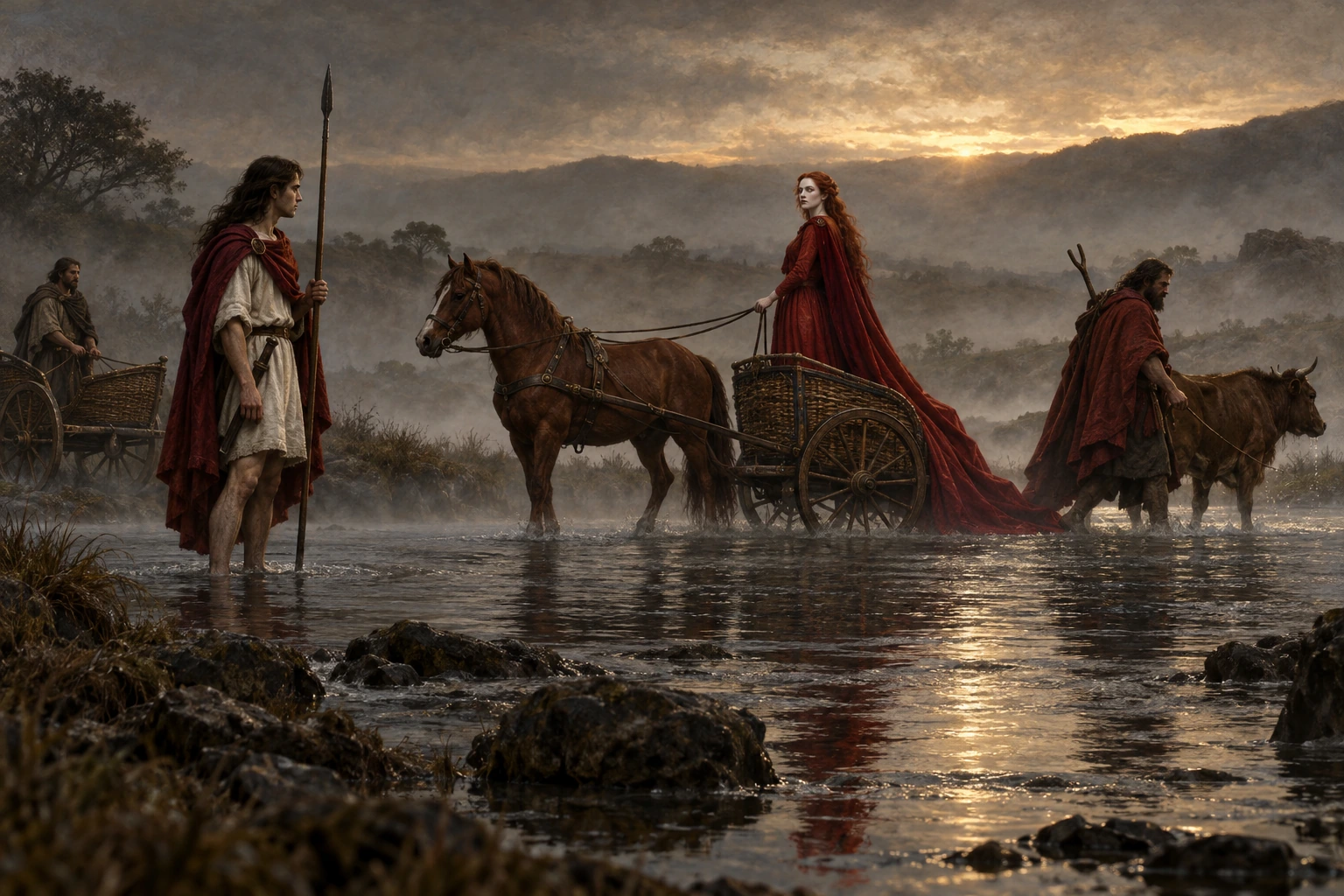
Táin Bó Regamna is one of the “preludes” to the great cattle raid. Cú Chulainn was asleep at Dún Imrid when a terrible cry from the north threw him out of his bed. With his charioteer Láeg he followed it to a ford, and a chariot came towards them, drawn by a single chestnut horse that had only one leg. In it sat a woman all in red, with two red eyebrows, her red cloak trailing on the ground behind the chariot. Beside it walked a big man in a red cloak with a forked staff of hazel, driving a cow.
“That cow is not joyful at being driven by you!” said Cú Chulainn. The woman answered for the man and gave his name, “Cold-wind-and-much-rushes”; the man then gave hers, a longer string of the same kind. Cú Chulainn leapt into her chariot, set his feet on her shoulders and his spear on the top of her head. She said she was a female satirist, and that the cow was her fee for a poem. When he sprang at the chariot again, horse, woman, man and cow were gone, and she was a black bird on a branch near him.
“It is at the guarding of thy death that I am; and I shall be,” she said. She had brought the cow out of the síd, the fairy mound, of Crúachan, to be bred by the bull of Cúailnge; Cú Chulainn would live only as long as the calf in the cow was a yearling, and this would lead to the Táin. And when he fought a man his equal in a ford, she would be an eel and draw a noose about his feet, then a grey wolf, then a white heifer with red ears leading a hundred like her. He answered each threat: he would break her against a green stone of the ford, burst her eye with his spear, break her leg with a sling stone, “and thou shalt have no healing from me”. Then she went back with her cow to Crúachan.
1-4 Eel, Wolf and Heifer
In the Táin itself she first comes as a bird: “that was the Morrigan in the form of a bird on the pillar in Temair Cuailnge”, warning the Donn Cúailnge, the Brown Bull of Cooley, that the men of Ireland were coming for him. The bull went off to Sliab Culind with fifty heifers.
Later, while Cú Chulainn was holding the fords alone against the army, a young woman came to him in a dress of every colour. She was the daughter of King Búan, she said; she had loved him for his fame and had brought her treasures and her cattle with her. He told her the time was not good: he was starving, and it was not easy to meet a woman in the middle of this strife. Then she would trouble him, she said, as an eel about his feet in the ford, as a grey she-wolf driving the cattle at him, as a hornless red heifer at the head of the herd. “I think that likelier than the daughter of a king,” said he, and made his three threats again.
All three came true in his fight with Lóch. The eel wound three coils round his feet, so that he fell on his back across the ford, and Lóch wounded him. Bricriu jeered that “a little salmon” had overthrown him, and Cú Chulainn rose and broke the eel’s ribs. The she-wolf drove the cattle on him, and a sling stone broke her eye; the heifer rushed before the cows over the pools and fords, and another stone broke her leg. “It is there then,” the text says, “that Cuchulainn did to the Morrigan the three things that he had promised her in the Tain Bo Regamna.” Then he killed Lóch. In Táin Bó Regamna the heifer was to be white with red ears, and the eye was to be burst with a spear.
1-5 Three Drinks of Milk
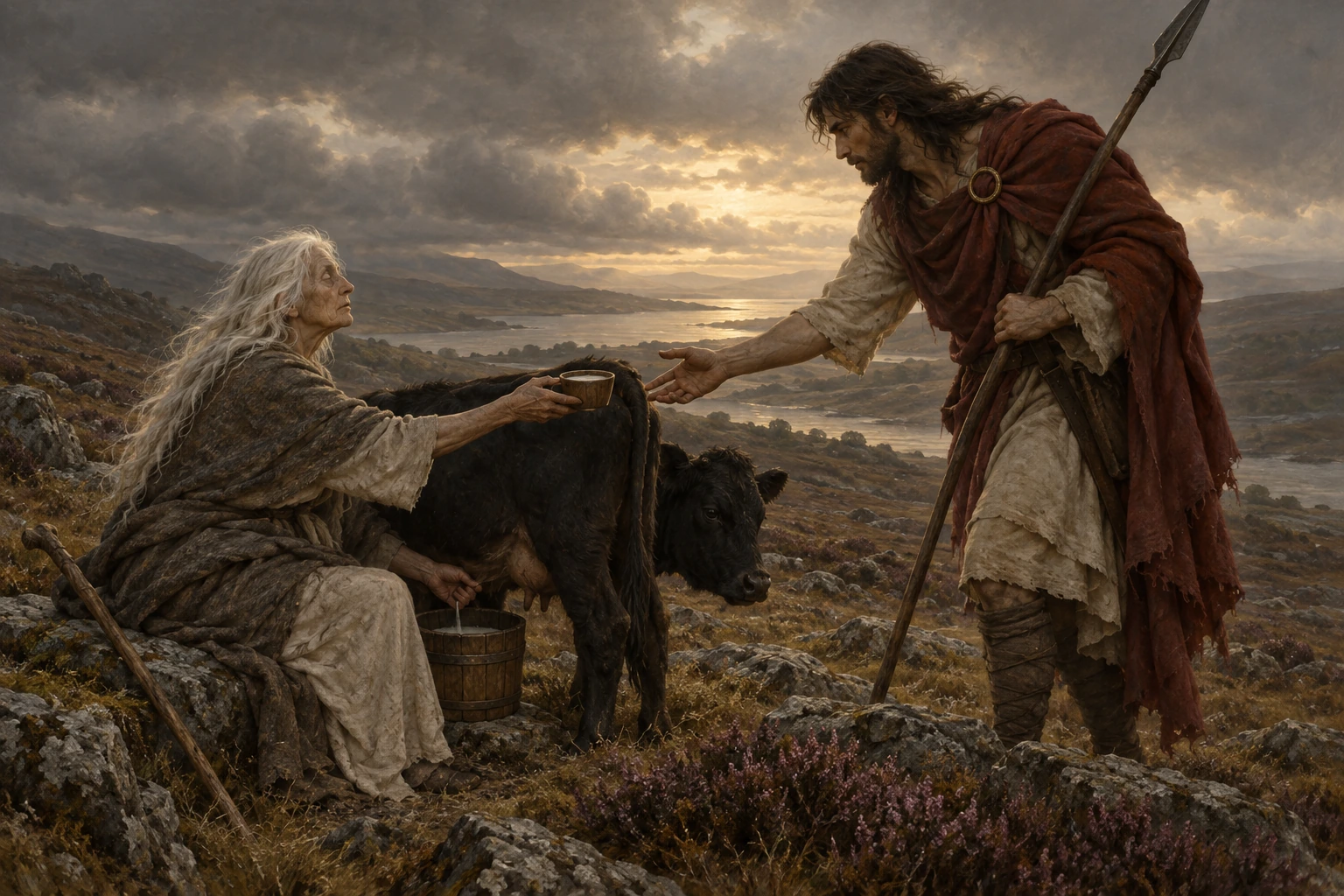
Worn out after the fight, Cú Chulainn met an old woman, blind and lame, milking a cow with three teats, and he asked her for a drink. She gave him milk from one teat. “The blessings of gods and non-gods on you,” said he, and her head was whole; a gloss that has slipped into the text explains that the gods were “the Mighty Folk” and the non-gods “the people of husbandry”. The second teat healed her eye, and the third her leg. “You told me,” said the Morrígan, “I should not have healing from you for ever.” “If I had known it was you,” said Cú Chulainn, “I would not have healed you ever.”
1-6 The Broken Chariot
She acts once more in the Book of Leinster’s tale of Cú Chulainn’s death, this time against the battle. “On the night before the Mórrigu had broken the chariot, for she liked not Cúchulainn’s going to the battle, for she knew that he would not come again to Emain Macha.” He went all the same. At the end, mortally wounded, he tied himself to a pillar stone so that he would die standing, and a bird settled on his shoulder. “That pillar is not wont to be under birds,” said Erc son of Cairpre. The text does not say who the bird was. The death itself is told in the post on Cú Chulainn.
2 Where the Story Is Written Down
- A gloss of 876 or 877. In a manuscript now in the Vatican Library (Reg. lat. 215), a gloss ascribed to John Scottus Eriugena explains the lamia of Isaiah 34:14: “Lamia is a monster in the form of a woman, that is: a morrígain” (in Jacqueline Borsje’s translation). Here the word is a common noun, a kind of being, not a name. Cormac’s Glossary, too, explains gúdemain, “false demons”, with its plural, morrígna.
- Cath Maige Tuired survives in one manuscript, British Library Harley 5280, ff. 63a–70b, written in the first half of the 16th century, mainly by Gilla Riabach Ó Cléirigh. Gerard Murphy saw the text as “the product of an eleventh or twelfth-century redactor working mainly upon ninth-century material”. Stokes’s edition (Revue Celtique 12, 1891) is “abridged”: he left out what he could not understand, among it parts of the Morrígan’s speeches and poems. Elizabeth Gray’s edition (Irish Texts Society, 1982) translates the text in full, marking the passages that remain unclear.
- Táin Bó Cúailnge, recension I, is in Lebor na hUidre, the Book of the Dun Cow, written around 1100, probably at Clonmacnoise (Royal Irish Academy MS 23 E 25), where it breaks off; the Yellow Book of Lecan, a late 14th-century manuscript, gives the end. Recension II, in the Book of Leinster (before 1160), is in Faraday’s words “longer, fuller, and later in both style and language”. Faraday quotes its fuller account of the bird on the pillar.
- Táin Bó Regamna is in the Yellow Book of Lecan and in British Library Egerton 1782, and was edited by Ernst Windisch in Irische Texte II. Its title has nothing to do with the tale; Windisch guessed that it was once Táin Bó Morrígna, “the driving of the cow of the Great Queen” (Leahy).
- The death of Cú Chulainn is in the Book of Leinster (ff. 77a–78b), and was abridged and translated by Stokes in Revue Celtique 3 (1876–78).
- Lebor Gabála Érenn, the Book of Invasions, lists the families of the Tuatha Dé: “Ernmas had other three daughters, Badb and Macha and Morrigu, whose name was Anand.” Another version of the list names the three as Badb, Macha and Anand, “of whom are the Paps of Anu in Luachair” (Macalister’s edition, ¶¶314–316).
- Reicne Fothaid Canainne, a poem that Kuno Meyer dated to about 900 and that survives in a single late copy made by Michael O’Clery. The spirit of a warrior killed that day speaks to the woman he was to meet: “horrible are the huge entrails which the Mórrígan washes”, “horrible the hateful laugh she laughs” (stanzas 41–42). The washer at the ford is told in the post on the banshee.
3 Competing Versions
- The Morrígan or the Badb? In Táin Bó Regamna the Egerton manuscript calls the woman the Morrígan, the Yellow Book of Lecan “the Badb”. Cath Maige Tuired gives the victory speech to the Morrígan and then says “Badb also describes high deeds”. And badb is also a common word: the Dictionary of the Irish Language defines it as the “name of a war-goddess; hooded crow; scald-crow (in which form the goddess appeared)”.
- One, three or five? The Book of Invasions makes Badb, Macha and the Morrígu sisters; Macalister notes that one paragraph treats Anand and the Morrígu as two people. A gloss in O’Mulconry’s glossary calls Macha badb, a scald-crow, “or she is the third morrígan”, and explains “Macha’s mast” as “the heads of men who have been slaughtered”. In the Táin, “Badb and Net’s wife and Nemain” call out over the men of Ireland at night, and a hundred of them die of terror. W. M. Hennessy, in 1870, took Nemain, Macha and the Morrígan for three different characters; Angelique Gulermovich Epstein, in 1998, concluded that “the Morrigan appears under many names”; Ronald Hutton counts five war goddesses and says that medieval writers “shuffled them like cards in a deck”.
- Macha. In Noínden Ulad, “the Debility of the Ulstermen”, Macha, the wife of an Ulster farmer, is made to race the king’s horses after he boasts that she is faster, though she is about to give birth. She wins, bears twins at the finish, and curses the men of Ulster: in their time of need they will be as weak as a woman in childbirth for five days and four nights, to the ninth generation. Emain Macha, “the twins of Macha”, is named from it. Macalister thought it “reasonable” to equate her with Macha daughter of Ernmas.
- Whose bird? The Book of Leinster says that ind ennach came to his shoulder. Stokes translated “the Birds”; the Dictionary of the Irish Language gives ennach as “a scald-crow” and cites this very line. Lady Gregory’s retelling of 1902 keeps “a bird”. Lucy Allen Paton, in 1903, retold the scene with the Morrígan hovering over him as a crow and perching on a stone near him; the medieval text names no one.
- Enemy or guardian? In Táin Bó Regamna she threatens him and says she is guarding his death; in the Táin she fights him, then tricks him into healing her; before his last battle she breaks his chariot to keep him at home.
4 History and Tradition
- A Badb in Gaul? An altar from Haute-Savoie, in the French Alps, is dedicated to a goddess whose name is damaged at the start, [C]athubodua (CIL XIII 2571). Adolphe Pictet read her in 1868 as a Gaulish goddess of war, and Hennessy recognised in the name “the badb-catha of Irish mythology”, the “Badb of battle”. The bird of the badb, he insisted, is the scald-crow, “not the raven”, and in most parts of Ireland country people still looked on it “with feelings of mingled dislike and curiosity”.
- Her places. Hennessy lists, among the monuments of the Brugh on the Boyne, “Mur-na-Morrigna (the mound of the Morrigan)” and “Da cich na Morrigna, or the ‘Morrigan’s two paps’”. The Book of Invasions names the Paps of Anu after Anand; Macalister places those two mountains in County Kerry.
- Morgan le Fay. Lucy Allen Paton, in Studies in the Fairy Mythology of Arthurian Romance (1903), found the resemblance between the Morrígan and Morgan “too suggestive to be dismissed without consideration”. She proposed that the war goddess became a fairy queen in Wales before reaching France as Morgain: the Morrígan hovers over the dying Cú Chulainn, and Morgain carries Arthur away to Avalon. In 1913 Adolphe Reinach called the Morrígan the “ancestor of our fairy Morgane”.
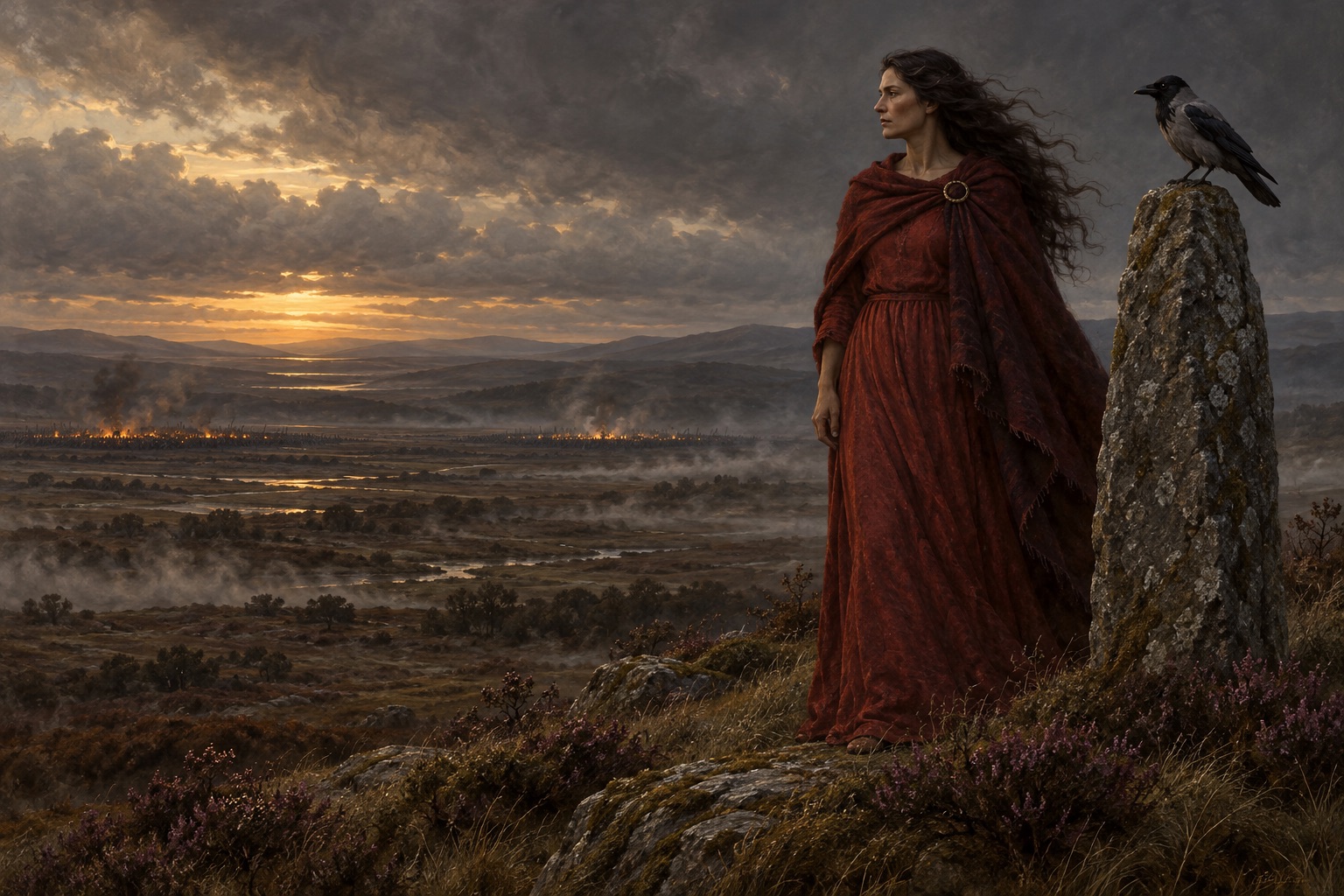
- In English. Lady Gregory’s Cuchulain of Muirthemne (1902) gave English readers “the War-goddess, the Battle Crow, the Morrigu” sitting on a pillar stone to warn the Brown Bull. Today, Hutton observes, she “is usually portrayed as a black-haired Gothic woman wearing black and associated with crows and ravens”, trappings that “were not part of her medieval persona”, some of them “borrowed from other figures such as the Badb”.
The Morrígan is often called a goddess of death, or the original of Morgan le Fay. The medieval texts make her a war goddess who also offers love and foretells peace as well as ruin: “definitely a war goddess”, in Hutton’s words, but “not only dangerous, but also sensual”, in Borsje’s. The link with Morgan remains, as Angelique Gulermovich put it, “one of speculation rather than fact”, and the Dictionary of the Irish Language derives Morgan’s name from a different word, mor, “sea”.
5 Related Stories
- The Tuatha Dé Danann: The Gods Who Went into the Hills: the people she belongs to, as a daughter of Ernmas, and the battle of Mag Tuired, for which she promises the heart’s blood of the Fomorian king.
- Cú Chulainn: The Hound of Ulster: the hero she offers herself to, fights in the ford, is healed by and tries to keep from his last battle.
- The Banshee: The Woman Who Keens Before a Death: the woman who washes the clothes of those about to die. In Reicne Fothaid Canainne it is the Morrígan who washes the spoils of the dead, and the Dictionary of the Irish Language cites that poem for the Morrígan as “the washer at the ford”.
- Valkyries and Valhalla: The Choosers of the Slain and Odin’s Hall: in 1870 C. Lottner wrote that “to the ancient Irish goddesses of war correspond the Norwegian (and, in general, Germanic) Valkyrias”, and Epstein judged that the likenesses “go beyond what one would expect from parallel typology”. Hutton sees a difference: the Irish spirits of battle did not carry off the souls of the dead, “like Norse Valkyries”.
- Kali: The Dark Goddess Born from Anger: another war goddess often called a goddess of death. We have not found a scholar who compares the two; we link them for the theme.
6 Sources
- Cath Maige Tuired, ed. and trans. Whitley Stokes, “The Second Battle of Moytura”, Revue Celtique 12 (1891), 52–130, 306–308, §§84–87, 106–107, 133, 137, 166–167, and index: archive.org; trans. Elizabeth A. Gray (Irish Texts Society, 1982): CELT
- Táin Bó Cúailnge, recension I, trans. L. Winifred Faraday, The Cattle-Raid of Cualnge (David Nutt, 1904): Project Gutenberg
- Táin Bó Regamna, “The Apparition of the Great Queen to Cuchulain”, trans. A. H. Leahy, Heroic Romances of Ireland, vol. 2 (David Nutt, 1905): Project Gutenberg
- “Cuchulainn’s Death, abridged from the Book of Leinster”, ed. and trans. Whitley Stokes, Revue Celtique 3 (1876–78), 175–185: archive.org
- Lebor Gabála Érenn, ed. and trans. R. A. Stewart Macalister, Part IV (Irish Texts Society 41, 1941), section VII, ¶¶314–316: archive.org
- “The Debility of the Ultonian Warriors”, from Ernst Windisch’s German, in Eleanor Hull, The Cuchullin Saga in Irish Literature (David Nutt, 1898), 95–100: archive.org
- “Reicne Fothaid Canainne”, ed. and trans. Kuno Meyer, Fianaigecht (Todd Lecture Series 16, 1910): archive.org
- Lady Gregory, Cuchulain of Muirthemne (John Murray, 1902): archive.org
- Dictionary of the Irish Language: Morrígan, badb, ennach, Macha; CODECS: Cath Maige Tuired, London, British Library, MS Harley 5280; Irish Script on Screen: RIA MS 23 E 25
- W. M. Hennessy, “The Ancient Irish Goddess of War”, with a postscript by C. Lottner, Revue Celtique 1 (1870–72), 32–57: archive.org; Adolphe Reinach, “Les têtes coupées et les trophées en Gaule”, Revue Celtique 34 (1913): archive.org
- Lucy Allen Paton, Studies in the Fairy Mythology of Arthurian Romance (Ginn, 1903), 11–12, 33–34, 163: archive.org
- Jacqueline Borsje, “The ‘terror of the night’ and the Morrígain: shifting faces of the supernatural”, in Proceedings of the Seventh Symposium of Societas Celtologica Nordica (Uppsala, 2007), 71–98: UvA-DARE
- Angelique Gulermovich Epstein, War Goddess: The Morrígan and her Germano-Celtic Counterparts (doctoral dissertation, 1998); Zoë Enstone, “‘Wichecraft & Vilaine’: Morgan le Fay in Medieval Arthurian Literature” (PhD thesis, University of Leicester, 2011), quoting Angelique Gulermovich, “Woman’s Word” (1992): Leicester Research Archive; Ronald Hutton, “The Morrigan: The Nightmare Queen”, Gresham College lecture: gresham.ac.uk
Cover and illustrations: AI-generated images made for Arcana. They are interpretations, not historical artworks.