The Banshee: The Woman Who Keens Before a Death
Before a death in certain Irish families, a woman is heard keening outside the house. She is the bean sí, the woman of the fairy mound, and in the oldest tales she stands in a river ford, washing the harness of a king who will not live to wear it again.
- Type: folk belief, a supernatural messenger of death
- Culture: Ireland, in Irish and in English; kindred figures in Gaelic Scotland and in Wales
- Earliest texts: the washer at the ford in the tale Bruiden Da Chocae (manuscripts of the 16th and 17th centuries) and in Caithréim Thoirdhealbhaigh, a history of the wars of Thomond up to 1318; the bean sí defined in John O’Brien’s Irish–English dictionary (Paris, 1768); folk accounts written down from the 1820s to the 1970s
- Key figures: the banshee (bean sí; also the Bow, the Bibe, the bean chaointe), the washer at the ford, the Badb, the keening women
Someone in the house is dying. In the night a woman’s voice is heard outside, wailing the way mourners wail over the dead, and the family knows what it means. The banshee does not come for everyone: in Irish tradition she follows certain families, and she is heard, sometimes seen, before one of them dies. Older than her cry is her washing. In medieval Irish tales a woman stands in a river ford, washing the clothes and armour of men who will soon be dead.
What does “banshee” mean? It is the Irish bean sí, “fairy woman”. Sí, written sidhe in the older spelling, is first of all a fairy mound: Niall Ó Dónaill’s Irish–English dictionary gives “Fairy mound”, then “Bean ~, fairy woman, banshee”. W. B. Yeats explained the word the same way in 1888, from bean, “a woman”, and sidhe, “a fairy”. By her name, then, the banshee is a woman from the otherworld of the mounds, not the ghost of someone who has died.
1 The Telling
The banshee has no single story. What follows are the scenes the sources tell most often, each with the text it comes from: first the banshee of the folk accounts, then the older washer at the ford.
1-1 A Cry at the Window
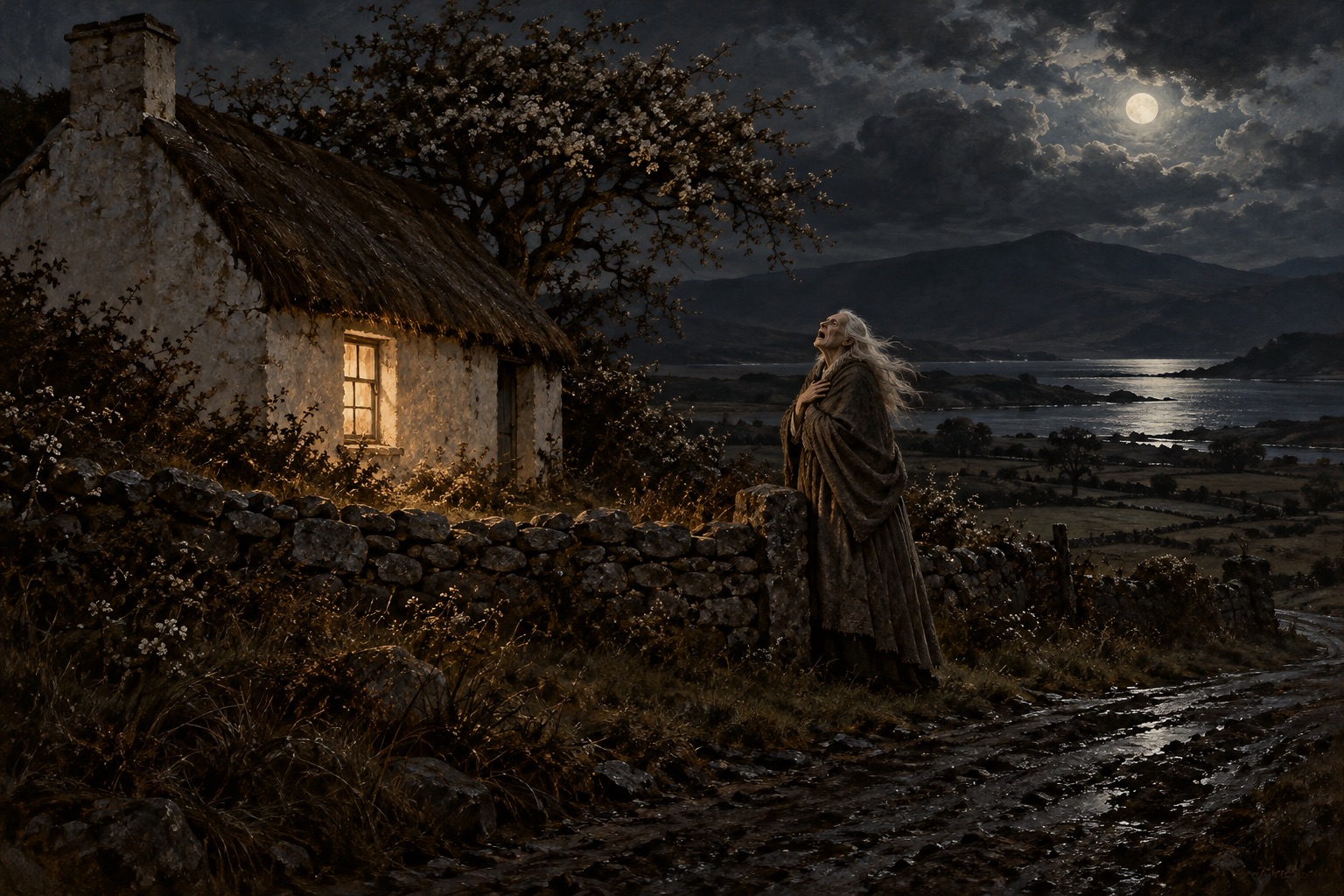
Thomas Crofton Croker’s Fairy Legends and Traditions of the South of Ireland (1825) tells of the Reverend Charles Bunworth, rector of Buttevant in County Cork in the middle of the 18th century, a harper and a friend of the travelling harpers. About a week before he died, his herdsman Kavanagh came home from Mallow in tears. As he came through the glen, he said, the banshee had walked beside him “keening, and screeching, and clapping her hands”, her long white hair about her shoulders, repeating his master’s name. Then she sat down under a tree struck by lightning and keened on.
On the last night, while the old man slept, the rose tree outside his window was pushed aside, and a low moaning was heard with a clapping of hands, “as if of a female in deep affliction”. Two sceptical guests went out and searched. The bed under the window had been freshly dug, yet it held no footprint, and while they were outside the people in the house heard the moaning louder than before. At first light, Mr Bunworth died.
The accounts go on into living memory. In 1973 Patrick Leary of County Wexford, then 79, told the folklore collector James Delaney that years before, sitting up with his dying father, he had heard three cries outside, “on the cement walk”: “And I heard them as plain as I can hear myself talking now.” No one else in the room heard them, not even his father.
1-2 The Comb
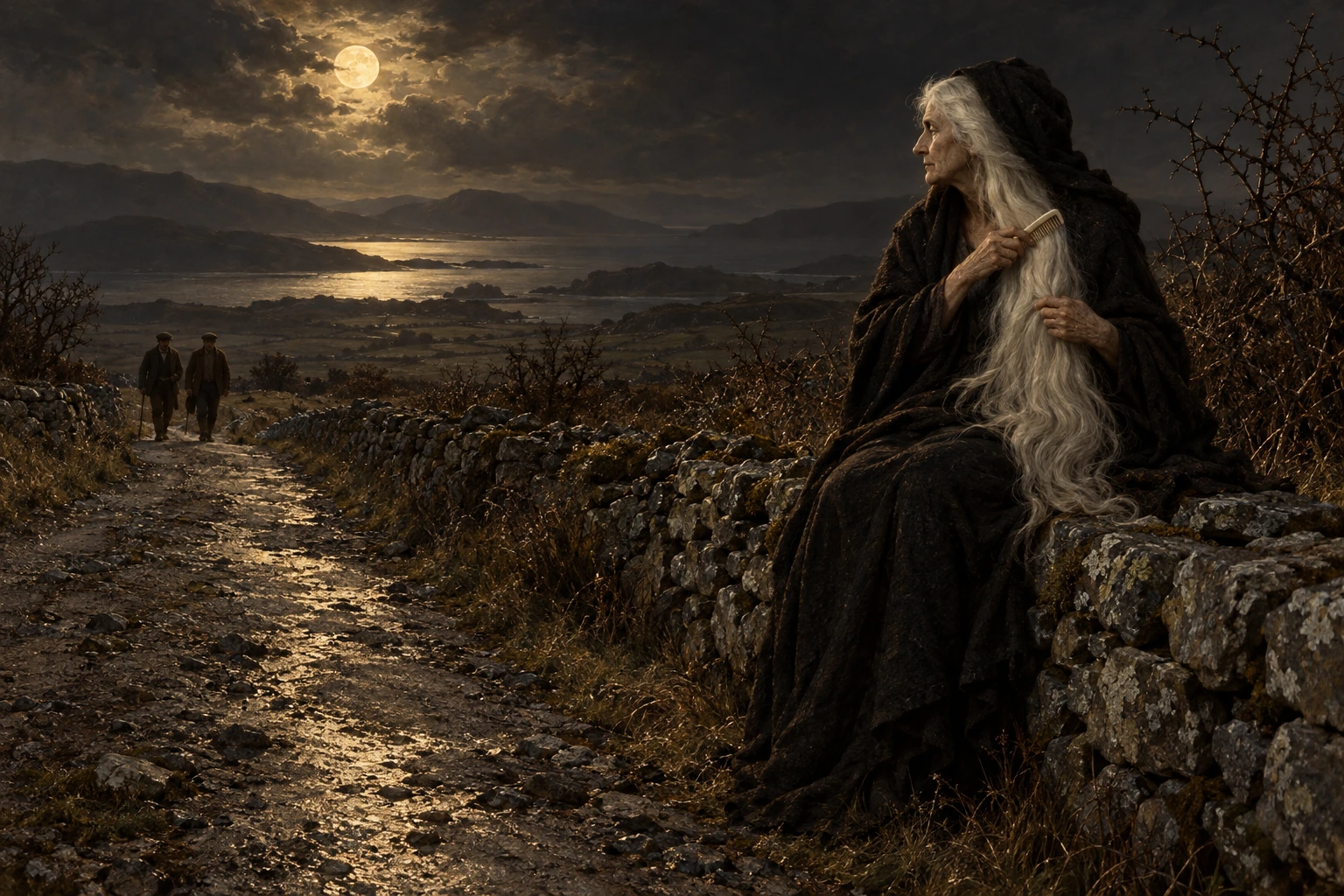
The banshee is often seen combing her hair. An account from Loughrea, County Galway, in the Schools’ Collection of the National Folklore Collection, tells of two men coming home at night who saw her sitting on a wall, combing. As they came near she vanished, leaving her comb on the wall, and one of them took it. “In the middle of the night the banshee came to the window and asked the man for her comb. The man handed out the comb on a spade. The banshee thinking the spade was the man’s hand broke it in two.”
Hence the rule: never pick up a comb found on the ground, in case it is hers. On RTÉ’s Late Late Show in February 1986, a woman in the audience told how her mother had seen the banshee in Inchicore, in Dublin: “A small little woman in black with long white hair, and she was combing, and she was moaning and groaning.”
1-3 The Washer at the Ford
The oldest form of the figure is not a mourner at the window but a woman washing in a river. In the tale Bruiden Da Chocae, “Da Choca’s Hostel”, the men of Ulster send for Cormac Conloinges, son of their dead king Conchobar, to make him king. On the way, at the river crossing by Athlone, his men unyoke their chariots and see “a red woman on the edge of the ford, washing her chariot and its cushions and its harness”. When she lowers her hand, the riverbed runs red with blood; when she raises it, the water rises with it, and they cross without wetting their feet.
Cormac sends a man to ask what she is doing. Standing on one foot, with one eye closed, she chants: “I wash the harness of a king who will perish.” Cormac goes down to the ford himself. “O woman, what harness washest thou?” “This is thine own harness, O Cormac,” she answers, “and the harness of thy men of trust.” The tale calls her the Badb. Soon afterwards, at Da Choca’s Hostel, the troops of Connacht kill Cormac and almost all his men (Whitley Stokes’s translation, §§15–17).
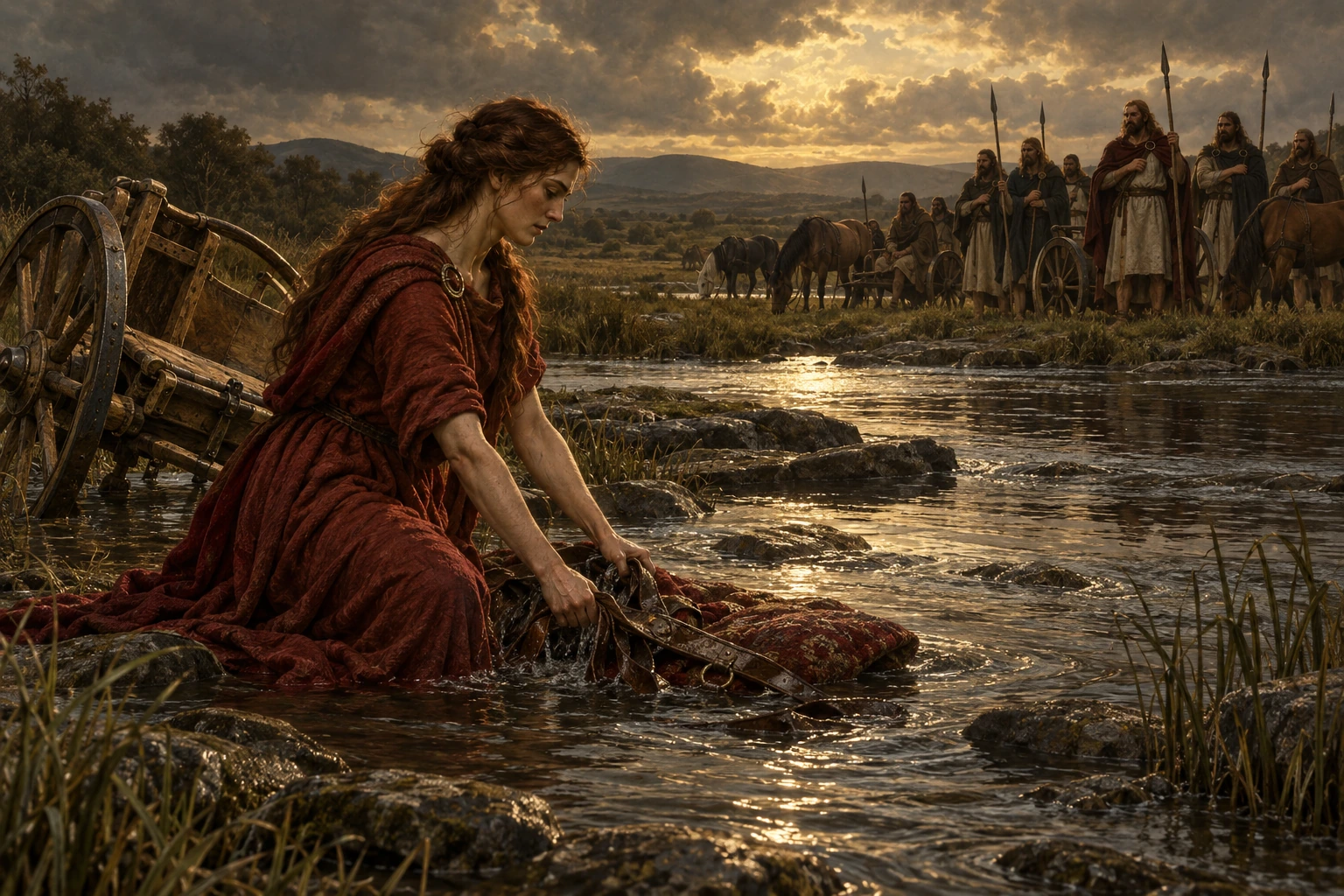
In Lady Gregory’s Cuchulain of Muirthemne (1902), Cú Chulainn meets the washer too, on his way to his last battle. With the druid Cathbad he comes to a ford where a young girl, “thin and white-skinned and having yellow hair”, is washing and ever washing clothes stained crimson, “crying and keening all the time”. “It is your red clothes she is washing,” Cathbad tells him, and begs him to turn back. Cú Chulainn will not: “And what is it to me, the woman of the Sidhe to be washing red clothing for me?” How he dies is told in his own story.
1-4 The Dismal One of Burren
The washer appears twice in Caithréim Thoirdhealbhaigh, a history of the wars of Thomond, today’s County Clare. In 1317 the army of Donough O’Brien, marching past Loch Rask, sees a hideous old hag stooped over the shore, washing a heap of heads, arms and legs. Asked her name, she answers in Standish Hayes O’Grady’s translation: “‘the Dismal of Burren’ I am named alway; 'tis of the tuatha dé Danann I declare myself”. The heads, she says, are his army’s, with his own in their midst. His men reach for their javelins, and she rises on the wind and prophesies from the air: “thou, comely Donough, thou com’st not back”. Donough tells his men she is only a sorceress in league with his rivals, trying to turn them back, and marches on. After the battle near the abbey of Corcomroe, he lies among the dead.
In 1318 it is the turn of the Anglo-Norman lord de Clare. As his army comes to cross the River Fergus, a “horrific beldam” is washing armour, satin vestments and silk shirts in the current, and the river below her runs with blood and water. De Clare has the Irish lords riding with him question her in her own language. “Armour, raiment and other strippings of de Clare with his sons … are these which now I wash,” she says. Her name is “the Water-doleful, that in this land’s hill-dwellings often sojourn, but in my origin I am of Hell’s tuatha”. In the Irish she is in dobarbrónach, who says she often dwells in the síd mounds of this land, and the narrator calls her simply in badb. “A witch cannot be truthful,” says de Clare. Soon after, at Disert, the O’Deas kill “both himself and every man that he had with him”.
2 Where the Story Is Written Down
- Togail Bruidne Da Derga (“The Destruction of Da Derga’s Hostel”), which Stokes translated from the copy in Lebor na hUidre (around 1100), has no washer. Its omen is Cailb, a woman who comes to the door of the hostel after sunset and chants her many names, Némain, Badb and Mache among them, standing on one foot, holding up one hand, in one breath. She tells King Conaire that “neither fell nor flesh of thine shall escape from the place into which thou hast come, save what birds will bear away in their claws”.
- Bruiden Da Chocae survives in two manuscripts in Trinity College Dublin, H.3.18 (16th century) and H.1.17 (17th century). Neither is complete, and each fills gaps in the other. Stokes, who published the tale in 1900, gave only the first lines of the verse passages, because both copies are corrupt there. The lines that name the washer the Badb come from H.1.17.
- Caithréim Thoirdhealbhaigh (“The Triumphs of Turlough”) is attributed to Seán mac Ruaidhrí Mac Craith, historian to the O’Briens. The Dictionary of National Biography (1893) dates him to 1459 and calls the work “a finished historical composition”, not a chronicle. Its oldest copy is a vellum fragment written in 1509 (Royal Irish Academy, 23 Q 16); a full copy was made by Aindrias Mac Cruitín in 1721 (Trinity College Dublin, H.1.18). O’Grady’s edition and translation appeared in 1929, after his death.
- The 17th and 18th centuries. Ann, Lady Fanshawe, staying with Lady Honor O’Brien around 1650, woke at one in the morning to see at the window “a woman … in white, with red hair and pale and ghastly complexion”, who said “A horse” three times and vanished. A cousin O’Brien died in the house at two. Her Memoirs, written in 1676, were first printed in 1830. John O’Brien’s Irish–English dictionary (Paris, 1768) explains bean-sighe, plural mná-sighe, “she-fairies or women-fairies”, believed to lament about the houses of certain families “whenever any of the family labours under a sickness which is to end by death”.
- The 19th-century collectors. Croker’s Fairy Legends (1825); Lady Wilde’s Ancient Legends, Mystic Charms, and Superstitions of Ireland (1887); Yeats’s Fairy and Folk Tales of the Irish Peasantry (1888), with his note that the banshee “follows the old families, and none but them, and wails before a death”. For Cú Chulainn’s death, Lady Gregory lists among her sources the Irish tale Brislech Mór Maige Muirthemne, printed in the Gaelic Journal in 1901.
- Patricia Lysaght’s study. Lysaght, a folklorist at University College Dublin, wrote her doctoral thesis on the banshee (1982) and published it as The Banshee: The Irish Supernatural Death-Messenger (Dublin, 1986; new edition 1996). From folklore and documentary sources, analysed with maps of where each form is found, she drew a composite picture of the banshee, and, in her publisher’s words, traced the belief back “in some form” to “the 8th century and probably earlier”.
3 Competing Versions
- Old or young? She is usually described as an old woman with white or grey hair left loose, and RTÉ’s summary of Lysaght’s findings describes “a small woman … dressed in black”. Lady Fanshawe’s visitor had red hair. Lady Wilde says she sometimes takes “the form of some sweet singing virgin of the family who died young”. The washers range from Cormac’s “red woman” and Cú Chulainn’s yellow-haired girl to the hags of the Caithréim.
- Seen or only heard? According to Lysaght’s account on RTÉ, she may be seen anywhere in Ireland except Cork and Kerry, “where she is heard but never seen”. Croker’s story, though, is set in Cork, and Kavanagh describes her white hair.
- What is she called? Bean sí in most places. In Wexford, Carlow and parts of Wicklow she is “the Bow”, in Waterford “the Bibe”, and in Tipperary and Mayo the bean chaointe, “keening woman”. Ó Dónaill’s dictionary gives badhbh chaointe, “banshee”, under badhbh, whose first sense is “War-goddess”.
- Whom does she cry for? For families whose names begin with O or Mac, “and the old Anglo-Norman families”, in RTÉ’s summary of Lysaght. O’Brien in 1768 limited her to families “of an ancient & noble stock”, and quoted an Irish elegy on a Knight of Kerry in which the merchants of Dingle, hearing her lament, fear for their own lives, until the poet assures them “in a very humourous manner” that they need not. Yeats limited her to “the old families, and none but them”. Lady Wilde adds “persons gifted with music and song”, and Croker’s banshee keens for a parish rector who loved the harp.
- Who is she? A woman of the fairy mounds, by her name. A dead ancestor of the family, in Lysaght’s reading of the folk accounts, an “attendant spirit” whose lament extends the family’s grief. A murdered woman, said Lady Fanshawe’s hostess. The Dismal of Burren claims the Tuatha Dé Danann; the Water-doleful says she is “of Hell’s tuatha”.
- Washer or mourner? In the medieval texts the washer meets warriors on the road and foretells the death of a king or of a whole army. In the folk accounts the banshee comes to the house and cries for one member of a family.
- Scotland and Wales. In the Scottish Highlands, J. G. Campbell wrote in 1900, the fairy woman is seen “beside a pool or stream, washing the linen of those soon to die”, and is then called the bean nighe, “washing woman”. In Wales the gwrach y Rhibyn, a hag who flaps her wings against the window and calls the dying by name, was set beside the banshee by Dr Owen Pughe, in a manuscript note Croker quotes, and by Wirt Sikes in British Goblins (1880).
4 History and Tradition
- The keen. Caoineadh, the keen, was the lament sung over the dead at wakes and funerals, often by a bean chaointe, a keening woman, who might be paid for it. Yeats wrote that the keen “is said to be an imitation of her cry”. Keeners let down their hair and often went barefoot, and the call for them had died out by the middle of the 20th century; RTÉ keeps a recording of Bríd Iarnáin of Inishmore, made in 1949. Lysaght suggested that a woman who had keened in life might become a banshee after her death.
- The church against the keeners. The folklorist Seán Ó Súilleabháin traced the bishops’ campaign against wakes to the Synod of Tuam of 1614. A second synod at Tuam, in 1660, condemned the excessive lamenting of women mourners, some of them hired for it, and the condemnations went on into the 19th century.
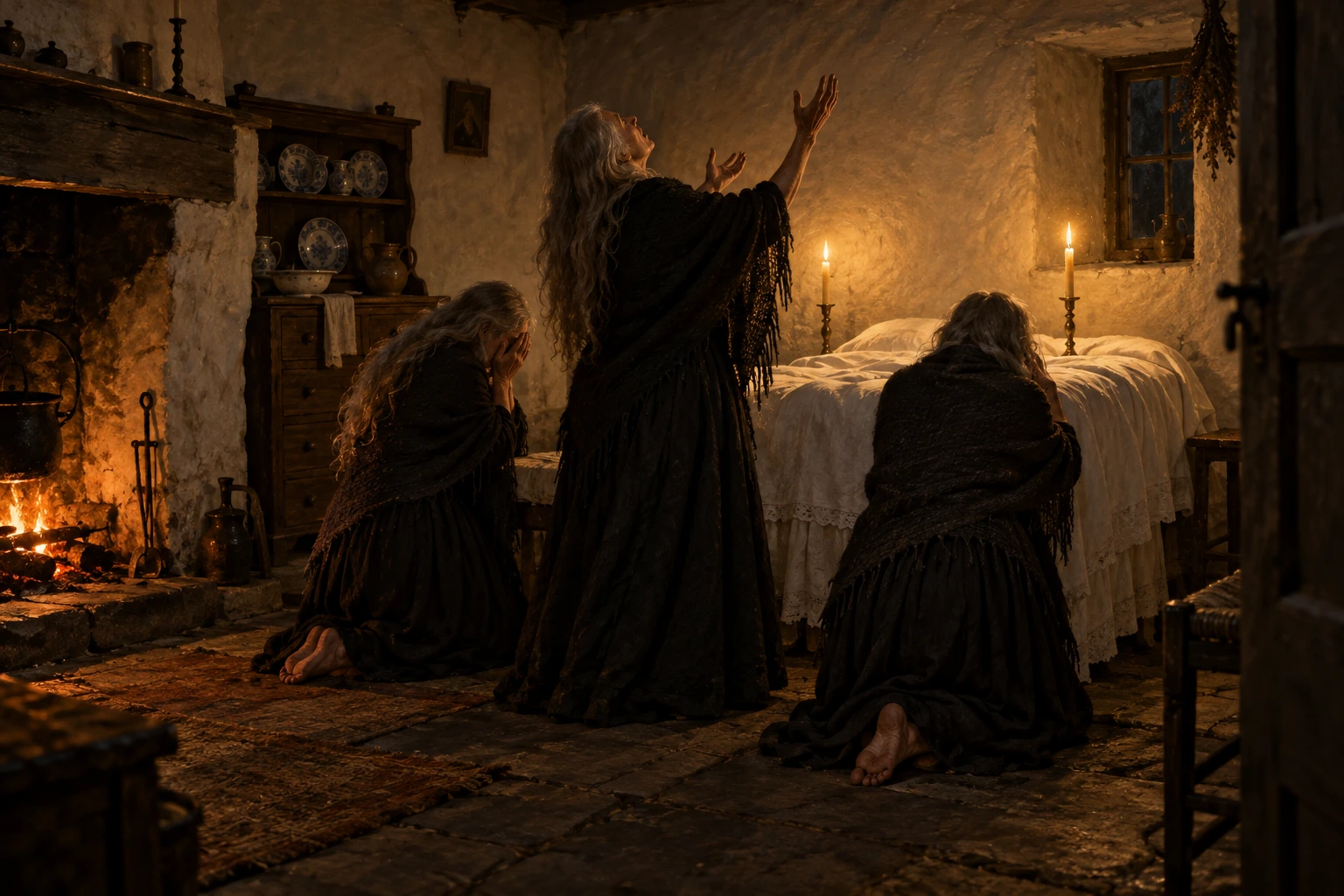
- On television. On 28 February 1986, the year her book came out, Lysaght explained the banshee on RTÉ’s Late Late Show. Why is the banshee never approached? Her answer, as RTÉ gives it: “In belief systems the otherworld is left alone, and if you leave the otherworld alone, it will leave you alone.”
- Across the ocean. Lady Wilde wrote that the banshee “even follows the old race across the ocean”, and told of O’Gradys drowned in Canada after her cry was heard. Irish emigrants have reported hearing her abroad just before a death in the family at home. Lysaght has called her cry an “intergenerational link” with the ancestors: “one of your own coming to convey you to the other side”.
The banshee is easily imagined as a monster whose scream kills. The tradition says otherwise: she announces a death that is already coming, and it is the family who hears her, not the dying person. Even The Ashgate Encyclopedia of Literary and Cinematic Monsters (2014) says that her keening “foretells, but usually does not cause” a death; only at times, in literature, is she “a more sinister being who delights in or even causes death”. The washers, too, only foretell: “neither can that she utters work us harm”, says de Clare, and it is the O’Deas who fulfil the prophecy.
5 Related Stories
- The Morrígan: The Phantom Queen of Battle: the washer at Cormac’s ford is called the Badb, the name of a war goddess. Who the Badb is, and how she belongs with the Morrígan, is told there.
- Cú Chulainn: The Hound of Ulster: the hero who sees a girl washing his red clothes at a ford, and goes on to his last fight anyway.
- The Tuatha Dé Danann: The Gods Who Went into the Hills: the people of the síd mounds the banshee is named after. The Dismal of Burren claims to be one of them.
- Valkyries and Valhalla: The Choosers of the Slain and Odin’s Hall: in Njáls saga, twelve women weave a web of war on the morning of the battle in Ireland in which King Brian fell. Women who foretell a battle’s dead are a shared theme; we have not found a scholar who compares them with the washer at the ford.
- La Llorona: The Woman Who Weeps for Her Children: in Mexico, too, a woman’s wailing is heard at night by the water. The banshee foretells a death, while La Llorona mourns her own children; we have not found a scholar who compares them, and link them for the theme.
6 Sources
- Bruiden Da Chocae, ed. and trans. Whitley Stokes, “Da Choca’s Hostel”, Revue Celtique 21 (1900), §§15–17: archive.org
- The Destruction of Da Derga’s Hostel, trans. Whitley Stokes (Revue Celtique 22, 1901; Paris, 1902), from Lebor na hUidre: CELT
- Caithréim Thoirdhealbhaigh, ed. and trans. Standish Hayes O’Grady (Irish Texts Society, 1929), Irish text and translation: CELT, CELT; Norman Moore, “Magrath, John Macrory”, Dictionary of National Biography 35 (1893): Wikisource
- Lady Gregory, Cuchulain of Muirthemne (John Murray, 1902), “The Washer at the Ford”, and the list of sources: archive.org
- Memoirs of Lady Fanshawe (written 1676): Project Gutenberg
- John O’Brien, Focalóir Gaoidhilge-Sax-Bhéarla, or An Irish-English Dictionary (Paris, 1768), s.v. sith-bhrog: archive.org
- T. Crofton Croker, Fairy Legends and Traditions of the South of Ireland (1825; new edition, Philadelphia, 1844), “The Bunworth Banshee” and notes: Project Gutenberg
- Lady Wilde, Ancient Legends, Mystic Charms, and Superstitions of Ireland (1887; new edition, Chatto & Windus, 1919), “The Banshee”: Project Gutenberg; W. B. Yeats (ed.), Fairy and Folk Tales of the Irish Peasantry (Walter Scott, 1888), “The Banshee”: Project Gutenberg
- J. G. Campbell, Superstitions of the Highlands and Islands of Scotland (Glasgow, 1900), “The Bean Nighe, or Washing Woman”: archive.org; Wirt Sikes, British Goblins (1880), “The Gwrach y Rhibyn”: Project Gutenberg
- Patricia Lysaght, The Banshee: The Irish Supernatural Death-Messenger (Glendale Press, 1986): CiNii; publisher’s description of the O’Brien Press edition (1996): schweitzer-online.de
- RTÉ Archives, “Explaining the Banshee” (The Late Late Show, 28 February 1986): rte.ie; Marion McGarry, “Do you believe in the banshee?”, RTÉ Brainstorm, 2025: rte.ie; Clodagh Finn, “The banshee was a career woman with a job to do”, Irish Examiner, 2026: irishexaminer.com
- Jeffrey Andrew Weinstock (ed.), The Ashgate Encyclopedia of Literary and Cinematic Monsters (Routledge, 2014), “Banshee”: taylorfrancis.com; Christopher Shannon, “An uneasy history: Irish Catholicism and the Irish wake”, Catholic World Report, 2022: catholicworldreport.com
- Niall Ó Dónaill, Foclóir Gaeilge–Béarla, s.v. sí, badhbh, caoineadh: teanglann.ie, teanglann.ie, teanglann.ie
Cover and illustrations: AI-generated images made for Arcana. They are interpretations, not historical artworks.