Cú Chulainn: The Hound of Ulster
At seven he killed a smith's hound and took its place; at seventeen he held the fords of Ulster alone against the armies of four provinces. The two medieval versions of his saga disagree on much, and modern Ireland has made him a symbol on both sides of its divide.
- Type: hero tale, the boy champion of Ulster
- Culture: early medieval Ireland; the Ulster Cycle of tales
- Earliest texts: the Táin Bó Cúailnge, recension I, in Lebor na hUidre (around 1100) and the Yellow Book of Lecan (late 14th century); recension II, and the tale of his death, in the Book of Leinster (second half of the 12th century)
- Key figures: Cú Chulainn (Setanta), Conchobar mac Nessa, Culann the smith, Cathbad the druid, Medb and Ailill, Fergus mac Róich, Ferdiad, Láeg the charioteer, Lugh, Lugaid son of Cú Roí
Inside the General Post Office in Dublin, the rebels’ stronghold in the Easter Rising of 1916, stands a bronze of a dying warrior. He is Cú Chulainn, the champion of Ulster in the oldest Irish sagas: the boy who took his name from a dog he had killed, and who at seventeen held the fords of his province alone against the armies of the rest of Ireland while the men of Ulster lay sick.
Why is he called the Hound of Culann? Because of a dog. As a boy, Setanta came late to a feast at the house of Culann the smith, and the smith’s guard dog went for him; he killed it with his bare hands. Seeing the smith’s grief, he offered to rear him a pup of the same litter and to guard his cattle himself until it was grown. “Then your name shall be Cu-chulainn,” said the druid Cathbad. The name means “Culann’s hound”.
1 The Telling
His boyhood and his war are told inside one saga, the Táin Bó Cúailnge, “the Cattle Raid of Cooley”, which survives in two main recensions (section 2). The telling below follows recension I, in Lebor na hUidre and the Yellow Book of Lecan, and notes where recension II, in the Book of Leinster, differs. His death follows the Book of Leinster. Quotations come from the translations of Winifred Faraday (recension I, 1904), Joseph Dunn (recension II, 1914) and Whitley Stokes (the death, in the Revue Celtique); details are checked against Cecile O’Rahilly’s editions.
1-1 The Boy from Mag Muirthemne
The boyhood deeds are told to Medb and Ailill by Ulster exiles in their army, so that they know whom they face. Fergus mac Róich begins. The boy was reared by his parents in Mag Muirthemne, a plain along the coast of what is now County Louth, and heard of the hundred and fifty boys who played at Emain Macha, King Conchobar’s seat near Armagh. He set out alone with a toy shield, a toy javelin, a hurley and a ball. He did not know that a newcomer must ask the boys for their protection, so they attacked him; he caught their balls against his chest and warded off their hurleys. Then he was distorted for the first time: his hair stood on end, one eye shrank to a needle’s eye, the other opened wide, and the hero’s light rose above his head. He knocked down fifty of them. When Conchobar caught him by the arm, he said: “Setanta Mac Sualtaim am I, and the son of Dechtere, your sister.”
1-2 The Hound of Culann
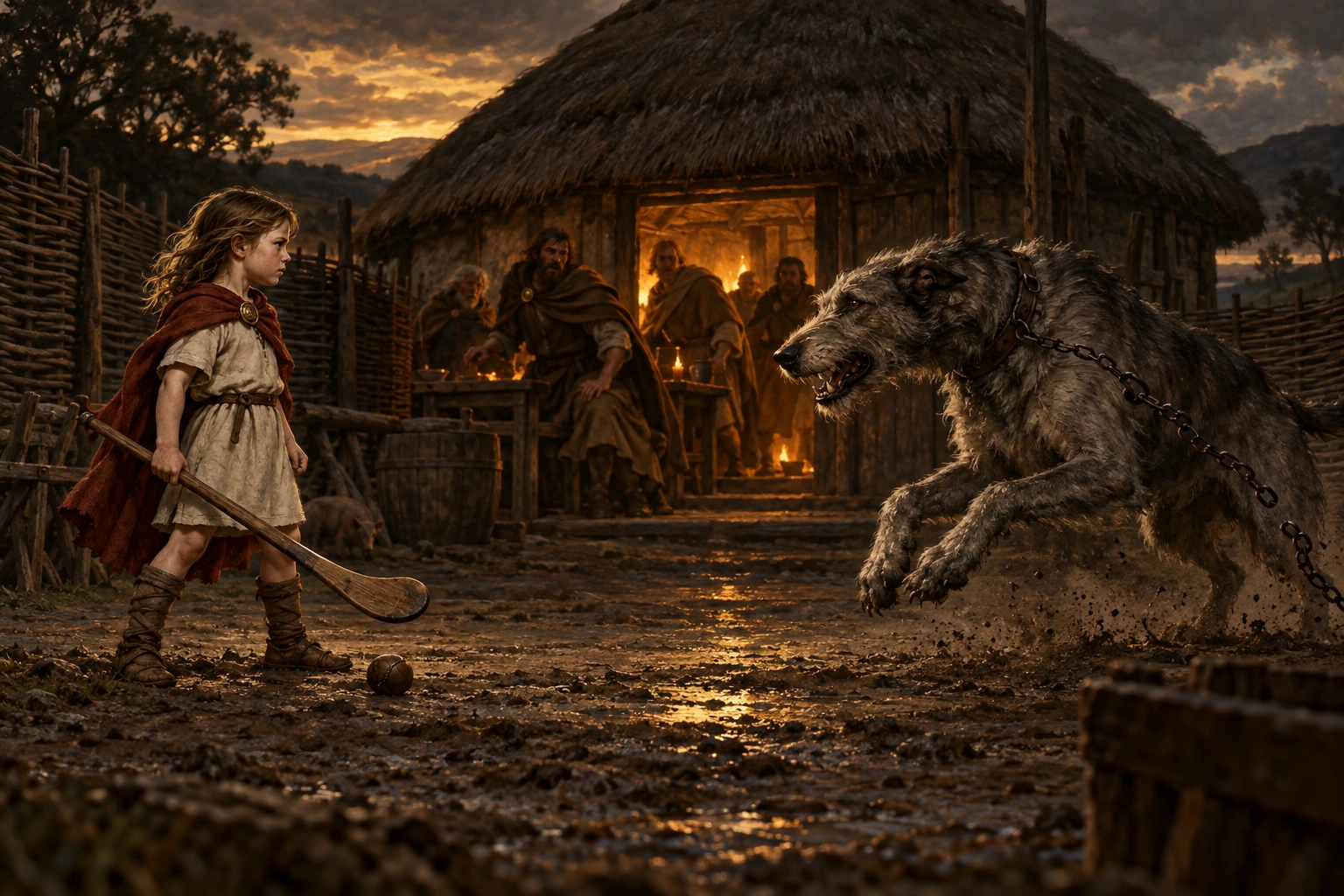
Conall Cernach, one of his fosterers, tells the next deed. Culann the smith gave a feast for Conchobar. The king asked the boy to come, and he said he would follow when his game was done. At the feast Conchobar forgot him, and Culann loosed his hound to guard the cattle: it was held by three chains with three men on each, and a gloss says it came from Spain. The boy arrived still playing, striking his ball and throwing his hurley after it. When the hound sprang at him he took it by the throat and the back of the head and dashed it against a pillar stone.
Culann welcomed him for his mother’s sake but mourned the dog that had guarded his herds and his house. The boy promised a whelp of the same litter and, until it was grown, to be his hound himself and to guard all Mag Muirthemne. “Then your name shall be Cu-chulainn,” said Cathbad. “I am content that it may be my name.” He was seven years old.
1-3 The Day of the Prophecy
Fiachu mac Fir Fhebe tells the third deed. Cathbad told his pupils that whoever took arms that day would be famous in Ireland for ever. The boy asked Conchobar for weapons and broke fifteen sets; only the king’s own held. Then Cathbad added that he would be famous, “but he will be short-lived only”. “Provided I be famous,” said Cú Chulainn, “I am content though I were but one day in the world.” He broke twelve chariots, took the king’s own and his charioteer Ibor, and drove to the fort of the three sons of Nechta Scéne, who boasted that they had killed as many Ulstermen as were still alive. He threw their withe from a pillar stone into the river, a breach of their taboo, fought them one after another at the ford and cut off their heads.
He came back to Emain with a wild stag tied to his chariot, swans fluttering over it and three heads inside, and in his fury swore to shed the blood of everyone in the fort unless a man were found to fight him. Conchobar sent the women out to meet him naked, led by Queen Mugain. He hid his face, and the warriors plunged him into a vat of cold water. The first vat burst, the second boiled, the third only grew warm. Then they dressed him in a blue mantle, and he sat at Conchobar’s knee.
1-4 One Man at the Ford
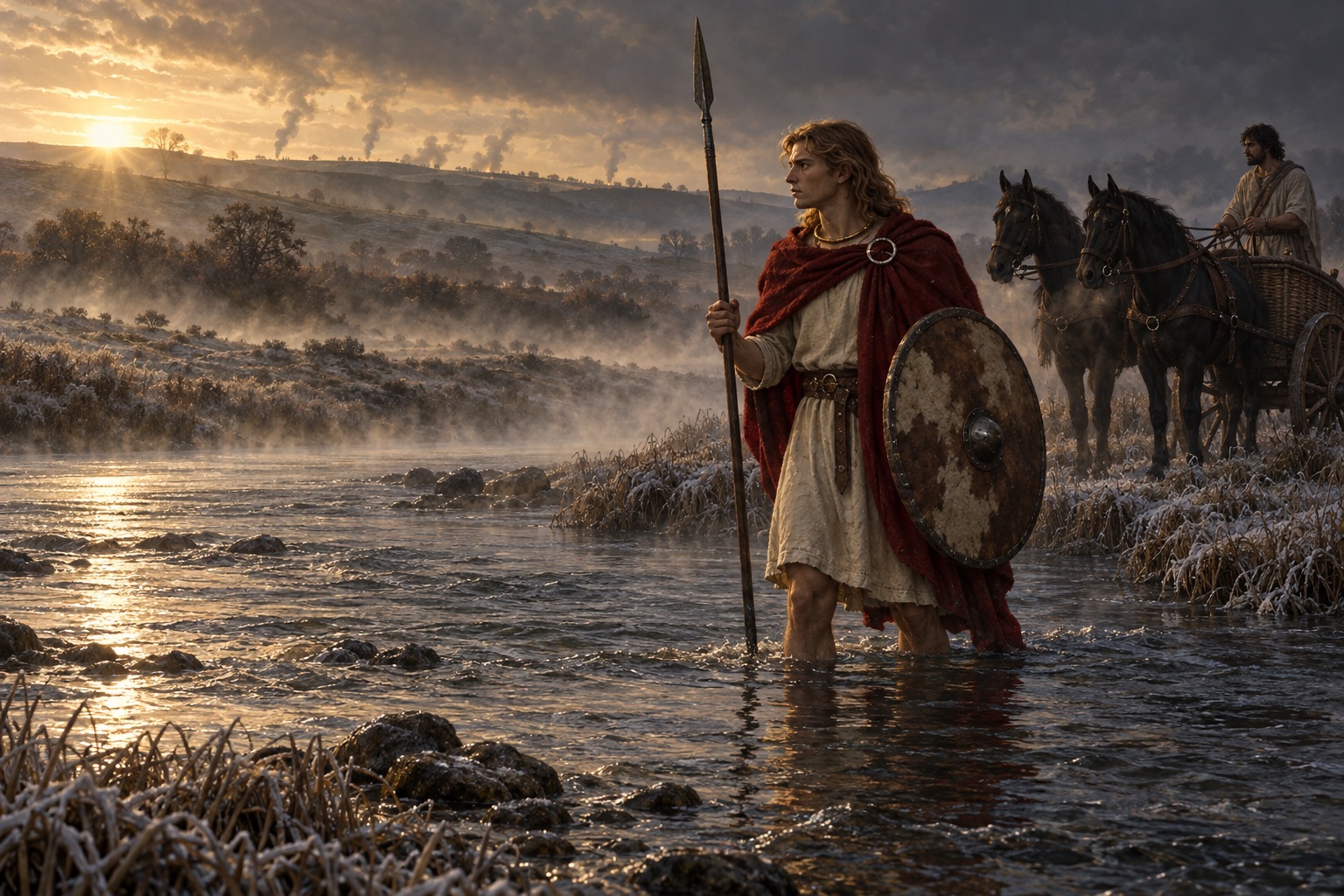
When he was seventeen, Medb and Ailill, queen and king of Connacht, gathered the armies of four provinces at Crúachain to carry off the Donn Cúailnge, the Brown Bull of Cooley. “I see very red, I see red,” the prophetess Feidelm told Medb. The men of Ulster could not meet them, for they lay in their debility, the effect, another tale explains, of a curse laid on them by a woman of the síd. Women and boys were spared it, and so were Cú Chulainn and his father. So he faced the army alone.
He killed their men with his sling by night until Ailill sent him terms. He refused gifts of land, women and cattle, and at last they agreed that one champion would meet him at a ford each day, and that the cattle would not be taken from that ford for a day and a night. “It is indeed easier for us,” said Ailill, “a man every day than a hundred every night.” Champion after champion fell. The war goddess the Morrígan also came to him in several shapes, as her own post tells.
From the Monday after Samain, the start of winter, to the Wednesday after the feast of spring he had barely slept. Wounded at last, he slept for three days and nights while a warrior of the síd healed him with herbs: “your father from the síd, Lug Mac Ethlend”. Meanwhile the hundred and fifty boys of Emain came south to fight for him and were all killed. When he woke and armed himself, the ríastrad, the “distortion”, came on him: his body turned inside his skin, one eye sank into his head and the other started out on his cheek, and a jet of dark blood rose from the crown of his head like the mast of a ship. He drove his chariot round the army, and the text counts a hundred and fifty kings among the dead. The next day he showed himself to the women of the camp in his own handsome form.
1-5 Ferdiad at the Ford
At last Medb sent for Ferdiad, his foster-brother, who had learned arms beside him under the woman warrior Scáthach. He had every feat that Cú Chulainn had except the gáe bulga, and a skin of horn. He would not come until Medb threatened him with satirists, then offered him her daughter Finnabair. Fergus drove to warn Cú Chulainn, who said he would rather not meet Ferdiad, “not for fear of him but for the greatness of our love for him”.
In recension I they fight for a single day. In recension II they fight for four: with missiles, with spears from their chariots, with heavy swords. On the first two evenings they kissed three times; their horses grazed in one paddock and their charioteers sat at one fire. Every herb put into Cú Chulainn’s wounds he sent across the ford to Ferdiad, and Ferdiad sent him an equal share of his food.
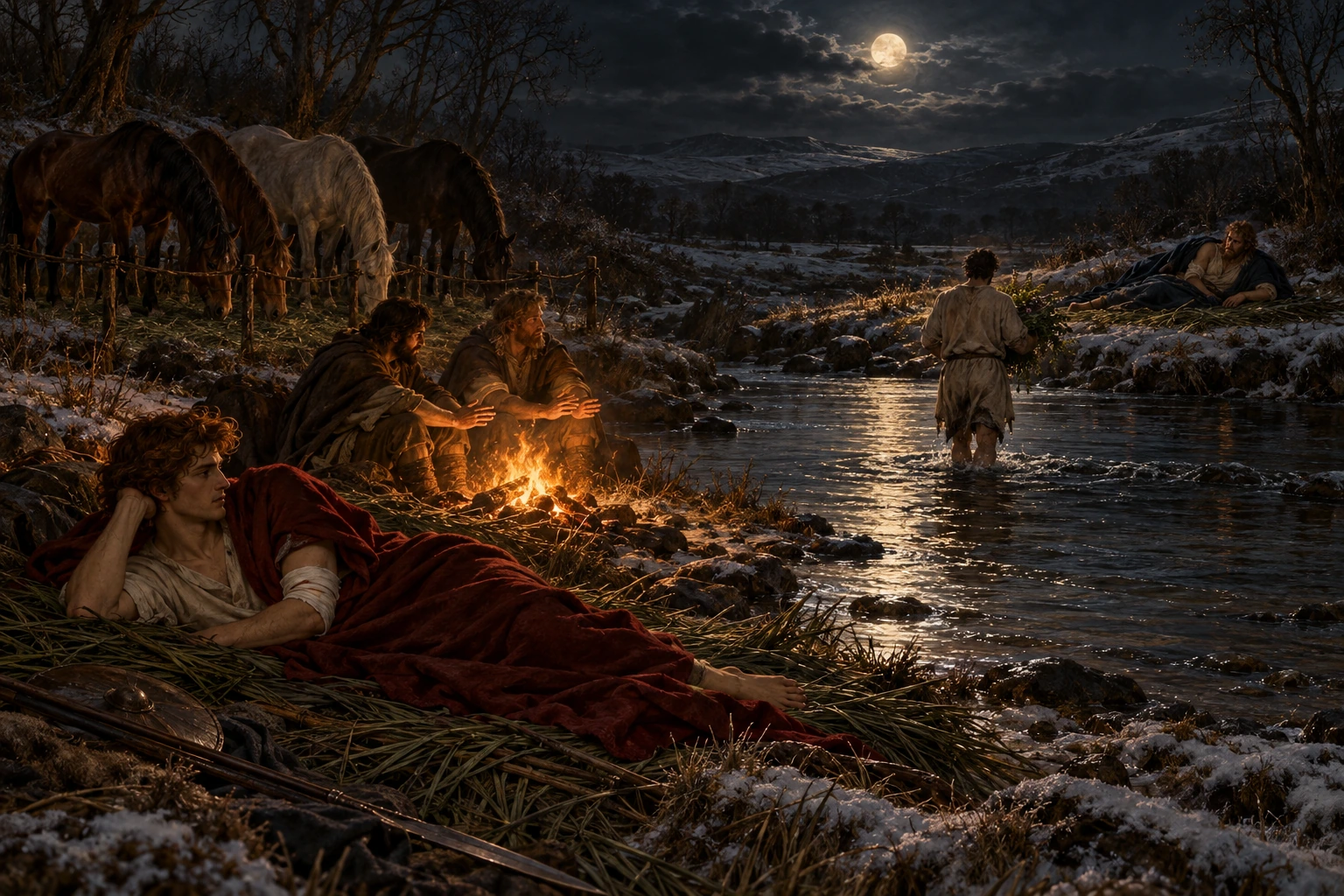
On the fourth day Ferdiad wore an apron of iron over a stone as big as a millstone, against the gáe bulga. When Ferdiad’s sword wounded him, Cú Chulainn called for it. His charioteer Láeg sent it down the stream, and Cú Chulainn caught it between his toes and cast it. “My heart is all gore,” says Ferdiad in Dunn’s translation; “I’m smitten, O Cu!” Cú Chulainn carried him north across the ford, so that his spoils would not stay with the men of Ireland, and fainted over him.
1-6 The Pillar Stone
His death came years later, when the sons of men he had killed, Lugaid son of Cú Roí and Erc son of Cairpre, came against him with the children of Calatin. The Book of Leinster gives the omens: his brooch fell and pierced his foot, and his horse, the Grey of Macha, turned its left side to him three times and let fall tears of blood. On the road three crones, blind in the left eye, were roasting a dog on spits of rowan. Two of his geasa, his taboos, were at stake: one concerned cooking hearths, the other forbade him to eat the flesh of his namesake. He tried to pass, but the crone shamed him: “Unseemly are the great who endure not the little.” He ate from his left hand, and that hand and thigh lost their strength.
In the battle, satirists demanded his spear three times, and three times he gave it, throwing it handle first so that it killed the man who asked. Each time his enemies cast it back, for the sons of Calatin had foretold that a king would fall by it. It killed Láeg, “the king of the charioteers of Eriu”; it wounded the Grey of Macha, “the king of the steeds of Eriu”, who broke away; the third cast struck Cú Chulainn himself. Mortally wounded, he went to a loch to drink, then to a pillar stone, “and he put his breastgirdle round it that he might not die seated nor lying down, but that he might die standing up”.
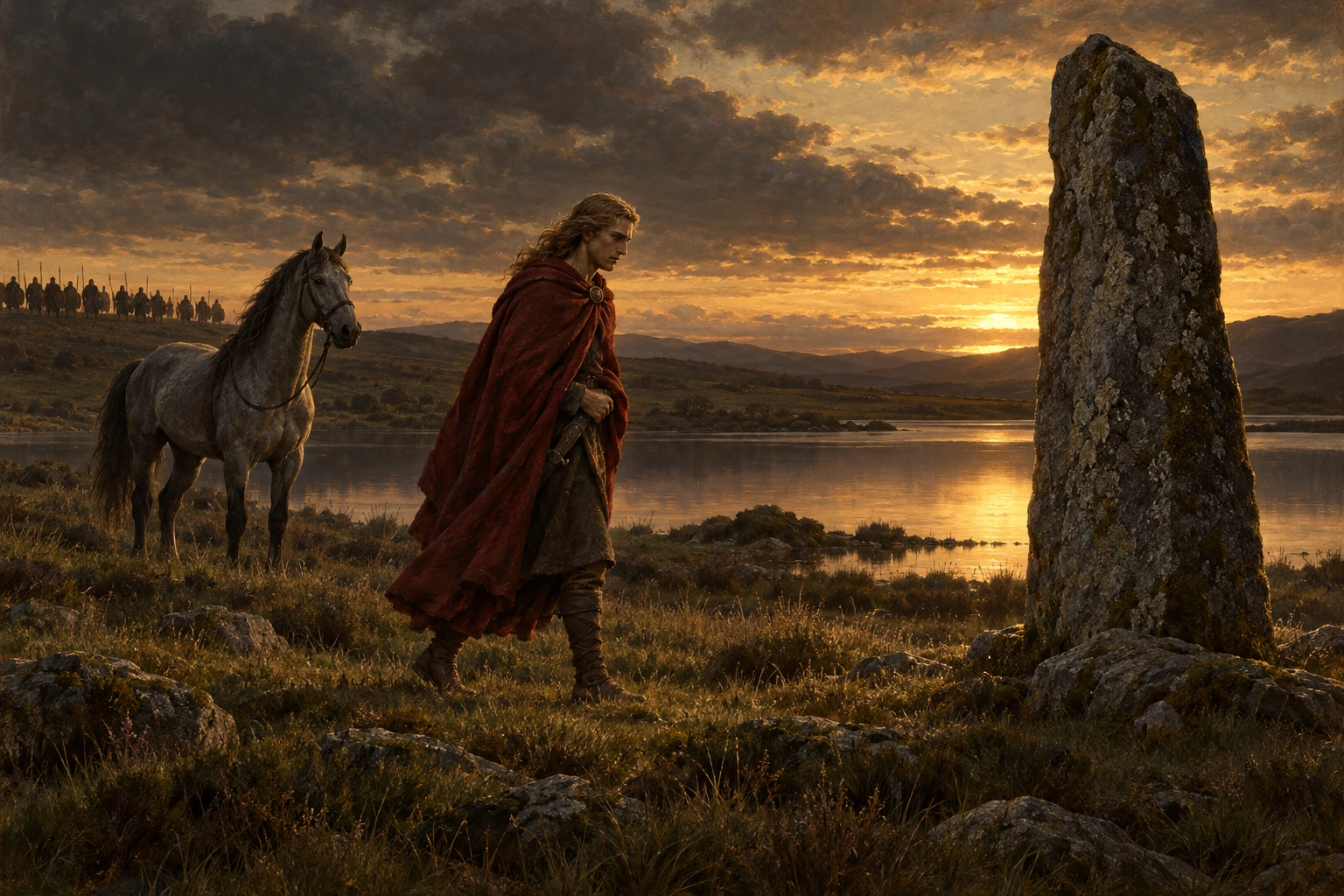
His enemies dared not come near, thinking him alive, and the Grey of Macha came back to guard him. Then a bird settled on his shoulder. Lugaid cut off his head; Cú Chulainn’s falling sword struck off Lugaid’s right hand. Conall Cernach rode after Lugaid and killed him, and the soul of Cú Chulainn appeared over Emain in a chariot, singing of the coming of Christ and the Day of Doom.
2 Where the Story Is Written Down
- Lebor na hUidre, “the Book of the Dun Cow” (Royal Irish Academy, MS 23 E 25), was written around 1100; its main scribe, Máel Muire mac Célechair, was killed at Clonmacnoise in 1106. It holds the oldest copy of recension I, which breaks off before the end, and a version of Compert Con Culainn, the tale of his conception.
- The Yellow Book of Lecan (Trinity College Dublin, MS 1318), of the late 14th century, has recension I with the beginning lost and the end kept. Faraday found that it “often gives an older and better text than the earlier MS”. It also holds Aided Óenfir Aífe, the death of his only son.
- The Book of Leinster (Trinity College Dublin, MS 1339), of the second half of the 12th century, compiled mainly by Áed Ua Crimthainn, abbot of Terryglass, has recension II, “longer, fuller, and later in both style and language” in Faraday’s words, and the oldest copy of the death tale. After the Táin its scribe adds a blessing on all who learn it faithfully, then, in Latin: “But I who wrote this history, or rather this fable, do not believe some things in it. Some are tricks of demons, some poetic inventions; some are like the truth and some not; and some are for the delight of fools.”
- How old is the story? The manuscripts are late, but the language is older. Faraday argued that a version “goes back to the early eighth, or seventh century”, from linguistic evidence. One version of the conception tale stood in the lost Book of Druim Snechta, of the first half of the eighth century.
- The death tale, Aided Con Culainn, “the death of Cú Chulainn”, was abridged from the Book of Leinster by Whitley Stokes in the Revue Celtique of the 1870s. Eleanor Hull (1898) also translated from “a fine modern recension” its opening, Brislech Mór Maige Muirthemne, “the great rout of Mag Muirthemne”; the slaughter inside the Táin bears the same name.
3 Competing Versions
- Who was his father? In the Lebor na hUidre conception tale, Deichtine is Conchobar’s daughter and drives his chariot. She swallows a tiny creature in a drink, and in her sleep a man tells her that the child is his and will be called Setanta: he is Lug mac Ethnenn. The Ulstermen suspect Conchobar, and she is married to Súaltam. Faraday sums it up: his father is “in different accounts, either Sualtaim … Lug Mac Ethlend … or Conchobar himself”. The Táin calls him Setanta son of Súaltam, yet Lugh comes as “your father from the síd”.
- Who tells of the hound? In recension I, Conall Cernach; the boy is seven and takes the name at once. In recension II, Cormac Cond Longas; the boy is six and at first refuses: “dearer to me mine own name, Setanta son of Sualtaim” (Dunn).
- How does the war begin? Recension I opens with the muster at Crúachain. Recension II opens in Medb and Ailill’s bed, with a quarrel over which of them owns more; they are equal in everything except Ailill’s white-horned bull, Findbennach.
- One day or four? Recension I has a long build-up and a short fight with Ferdiad; recension II has the four days. Faraday thought it “still a matter of question whether the whole Fer Diad episode may not be late”; Heinrich Zimmer thought it was.
- Who struck the last blow? In the Book of Leinster, Lugaid. The Annals of Tigernach name Lugaid, Erc and the three sons of Calatin, and Hull cites poems that make Erc the one who took his head.
- The washer at the ford is not in the Book of Leinster. In Lady Gregory’s retelling, on his last road he and Cathbad see a girl washing crimson clothes at a ford: “It is your red clothes she is washing.”
4 History and Tradition
- Born under Augustus. The first fragment of the Annals of Tigernach enters his birth in the reign of Augustus and his death a few entries after the birth of Christ: “Seven years was his age when he assumed arms, seventeen … when he followed the Driving of the Kine of Cualnge, but twenty-seven years was his age when he died.”
- The revival. Lady Gregory retold the cycle as Cuchulain of Muirthemne (1902), with a dedication “to the people of Kiltartan”, among whom she lived. W. B. Yeats’s preface begins: “I think this book is the best that has come out of Ireland in my time.” When the Abbey Theatre opened on 27 December 1904, the first words spoken on its stage were Cuchullain’s, in Yeats’s On Baile’s Strand, where the hero kills the son he had by Aífe: “He was my son, and I have killed my son.”
- Pearse’s school. Patrick Pearse wanted the boys of St Enda’s to keep “the high tradition of Cuchulainn”. Desmond Ryan recalls a saying inscribed around a fresco at Cullenswood House, the school’s first home, from the recension II version of the day of arms: “I care not though I were to live but one day and one night, if only my fame and my deeds live after me.”
- The statue. Oliver Sheppard’s bronze was chosen by Éamon de Valera as the official memorial of the Rising, cast in Brussels and unveiled on Easter Sunday, 21 April 1935. Yeats asked in “The Statues”: “When Pearse summoned Cuchulain to his side, / What stalked through the Post Office?” The state put the figure on the 1916 veterans’ medal and the 1966 ten-shilling coin.
- Both sides of the divide. In the murals of Northern Ireland recorded by Jonathan McCormick around 1996–2000, he appears for both. A loyalist wall on the Newtownards Road in Belfast called him “Ancient Defender of Ulster from Irish Attacks over 2000 Years Ago”; a republican wall in Derry set him beside Bobby Sands and the other hunger strikers. Loyalists, The Irish Times notes, pointed out that in the saga he defended Ulster against “the men of Ireland”.
- In County Louth. Delga, his home, is Dundalk in Dunn’s notes; Ardee takes its name from Áth Fhirdhia, “the Ford of Ferdia”; and the Clochafarmore standing stone near Knockbridge is, by local tradition, the stone he tied himself to.
Sheppard’s bronze is often thought to have been made for the Rising. It was not. He modelled it in 1911–12 and showed it at the Royal Hibernian Academy in 1914, two years before the Rising. It stayed unsold in his studio until de Valera chose it, two decades later.
5 Related Stories
- The Morrígan: The Phantom Queen of Battle: the war goddess who meets him in several shapes during the Táin. Her encounters with him, and the bird at the pillar stone, are told in her own post.
- The Tuatha Dé Danann: The Gods Who Went into the Hills: the divine race of Lugh, the god who is his father in the conception tale and who heals him during the Táin.
- The Banshee: The Woman Who Keens Before a Death: the girl washing his red clothes at the ford on his last road is one form of the washer at the ford, told in full there.
- Horatius at the Bridge: One Man Holds the Sublician Bridge: one man holding a crossing against an army is a shared theme. Georges Dumézil, in Horace et les Curiaces (1942), compared Cú Chulainn’s first fight, against three brothers, and the cold water that calmed his fury, with another Horatius: the brother who killed the three Curiatii, mentioned in that post.
- Rostam and Sohrab: The Father Who Killed His Son: Murray Potter’s study of the combat between father and son (1902) puts Cú Chulainn and his son by Aífe in the same group as Rostam and Sohrab: a son raised far away seeks his father, will not give his name, and dies at his father’s hand.
6 Sources
- Táin Bó Cúailnge, recension I, ed. and trans. Cecile O’Rahilly (Dublin Institute for Advanced Studies, 1976): CELT; trans. L. Winifred Faraday, The Cattle-Raid of Cualnge (David Nutt, 1904), from Lebor na hUidre and the Yellow Book of Lecan: Project Gutenberg
- Táin Bó Cúalnge from the Book of Leinster, ed. and trans. Cecile O’Rahilly (Dublin Institute for Advanced Studies, 1967): CELT, CELT, Irish and Latin text; trans. Joseph Dunn, The Ancient Irish Epic Tale Táin Bó Cúalnge (David Nutt, 1914): archive.org
- Compert Con Culainn, ed. A. G. van Hamel, Compert Con Culainn and Other Stories (Dublin Institute for Advanced Studies, 1933): CELT; Tochmarc Emire, trans. Kuno Meyer: CELT; Aided Óenfir Aífe: CELT
- Whitley Stokes, “Cuchulainn’s Death, abridged from the Book of Leinster”, Revue Celtique 3 (1876–1878), 175–185: archive.org; Whitley Stokes, “The Annals of Tigernach. First Fragment”, Revue Celtique 16 (1895): archive.org
- Eleanor Hull (ed.), The Cuchullin Saga in Irish Literature (David Nutt, 1898): archive.org; Lady Gregory, Cuchulain of Muirthemne, with a preface by W. B. Yeats (John Murray, 1902): archive.org; W. B. Yeats, The King’s Threshold; and On Baile’s Strand: Project Gutenberg
- CODECS, “Dublin, Royal Irish Academy, MS 23 E 25” and “Dublin, Trinity College, MS 1339”: codecs.vanhamel.nl, codecs.vanhamel.nl
- Padraic H. Pearse, The Story of a Success, ed. Desmond Ryan, with Ryan’s The Man Called Pearse (Phoenix, [1917]): archive.org; Abbey Theatre, “Abbey Theatre opens its doors”: abbeytheatre.ie
- John Turpin and Fintan O’Toole, “Modern Ireland in 100 Artworks: 1935 – The Death of Cúchulainn, by Oliver Sheppard”, The Irish Times, 28 March 2015: irishtimes.com; Paula Murphy, “1916 Centenary: Warriors and statesmen”, Irish Arts Review 33.1 (2016): irishartsreview.com
- Jonathan McCormick, A Directory of Murals, albums 1 and 9, CAIN, Ulster University: cain.ulster.ac.uk, cain.ulster.ac.uk; Visit Louth, “Ardee” and “Cúchulainn’s Stone”: visitlouth.ie, visitlouth.ie
- Synopsis of Georges Dumézil, Horace et les Curiaces (1942), Cahiers pour l’Analyse 7: Kingston University
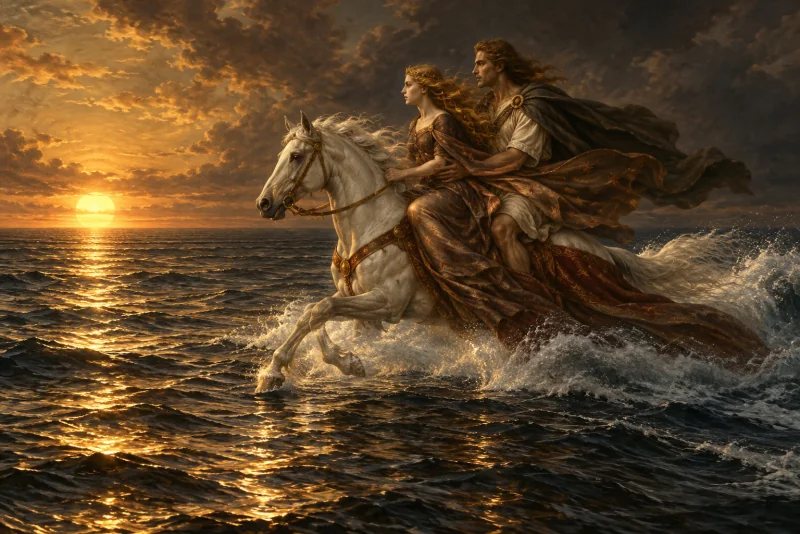
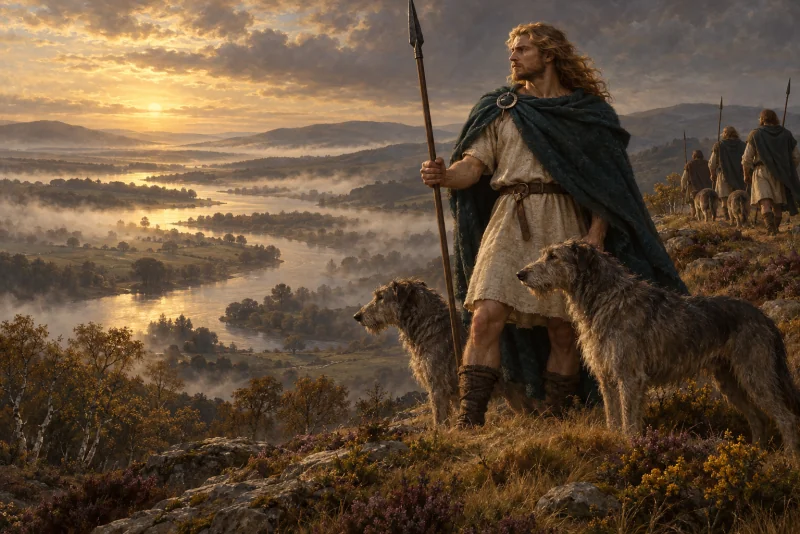
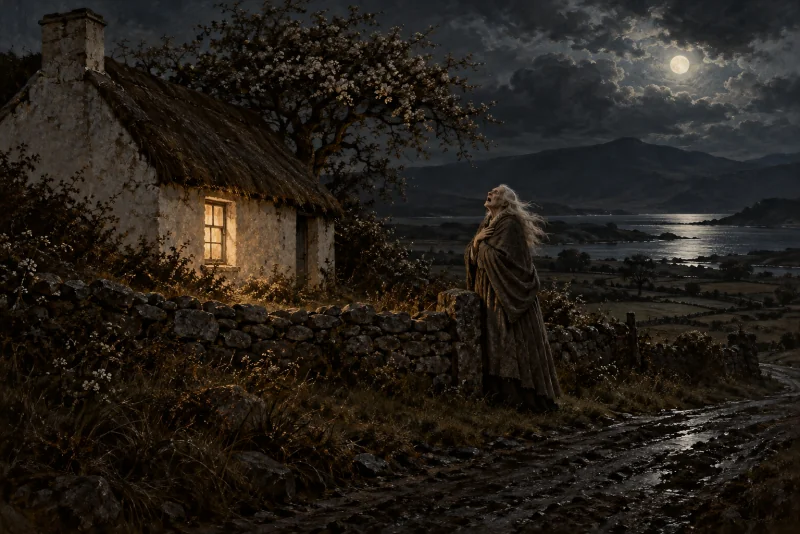
Cover and illustrations: AI-generated images made for Arcana. They are interpretations, not historical artworks.