Horatius at the Bridge: One Man Holds the Sublician Bridge
An Etruscan army reached Rome's wooden bridge, and Horatius Cocles held it while the Romans cut it down behind him. In Livy he swims home to a statue and a gift of land. In Polybius, the oldest account, he leaps into the river and gives up his life.
- Type: legend, a hero of the first years of the Roman Republic
- Culture: ancient Rome
- Earliest texts: Polybius, Histories 6.55, written in Greek in the 2nd century BCE; the classic tellings are Livy’s History of Rome 2.10, begun between 27 and 25 BCE, and Dionysius of Halicarnassus’s Roman Antiquities 5.22–25
- Key figures: Horatius Cocles, Spurius Larcius, Titus Herminius, Lars Porsenna, Gaius Mucius Scaevola, Cloelia
Rome’s oldest bridge was made of wood, and for centuries the Romans kept it that way, without a scrap of iron in it. Pliny the Elder traces the rule to a single day: the bridge had been so hard to pull down “while Horatius Cocles was defending it”. This is the story of that day.
Did Horatius survive? It depends on whom you read. In Livy he swims back across the Tiber in full armour and is rewarded with a statue and land. In Polybius, the oldest account that survives, he leaps into the river in his armour and “deliberately sacrificed his life”, in W. R. Paton’s translation. Livy himself expected his own version to win “more fame than credence with posterity”.
1 The Telling
This is Livy’s version, from book 2 of his History of Rome; chapter numbers are the standard ones, and quotations are from B. O. Foster’s translation (Loeb, 1919). Livy dates it by the consuls of the year, Publius Valerius, for the second time, and Titus Lucretius: by the traditional dating, 508 BCE.
1-1 The King of Clusium
Rome had driven out its last king, Tarquinius Superbus, after his son Sextus’s crime against Lucretia, and now chose two consuls every year (Livy 1.60). The Tarquins fled to Lars Porsenna, king of Clusium in Etruria. They were Etruscans, they told him, of his own blood and name: would he let them live in poverty and exile, and let this new custom of expelling kings go unpunished?
Porsenna judged that a king at Rome would be safe for the Etruscans, and an Etruscan king an honour, and he marched on the city (2.9). “Never before had such fear seized the senate.” The senators feared their own people too, who might let the kings back in for the sake of peace. So they sent to buy grain from the Volsci and from Cumae, took the sale of salt into public hands, and freed the poor from tolls and taxes.
1-2 The Bridge of Piles
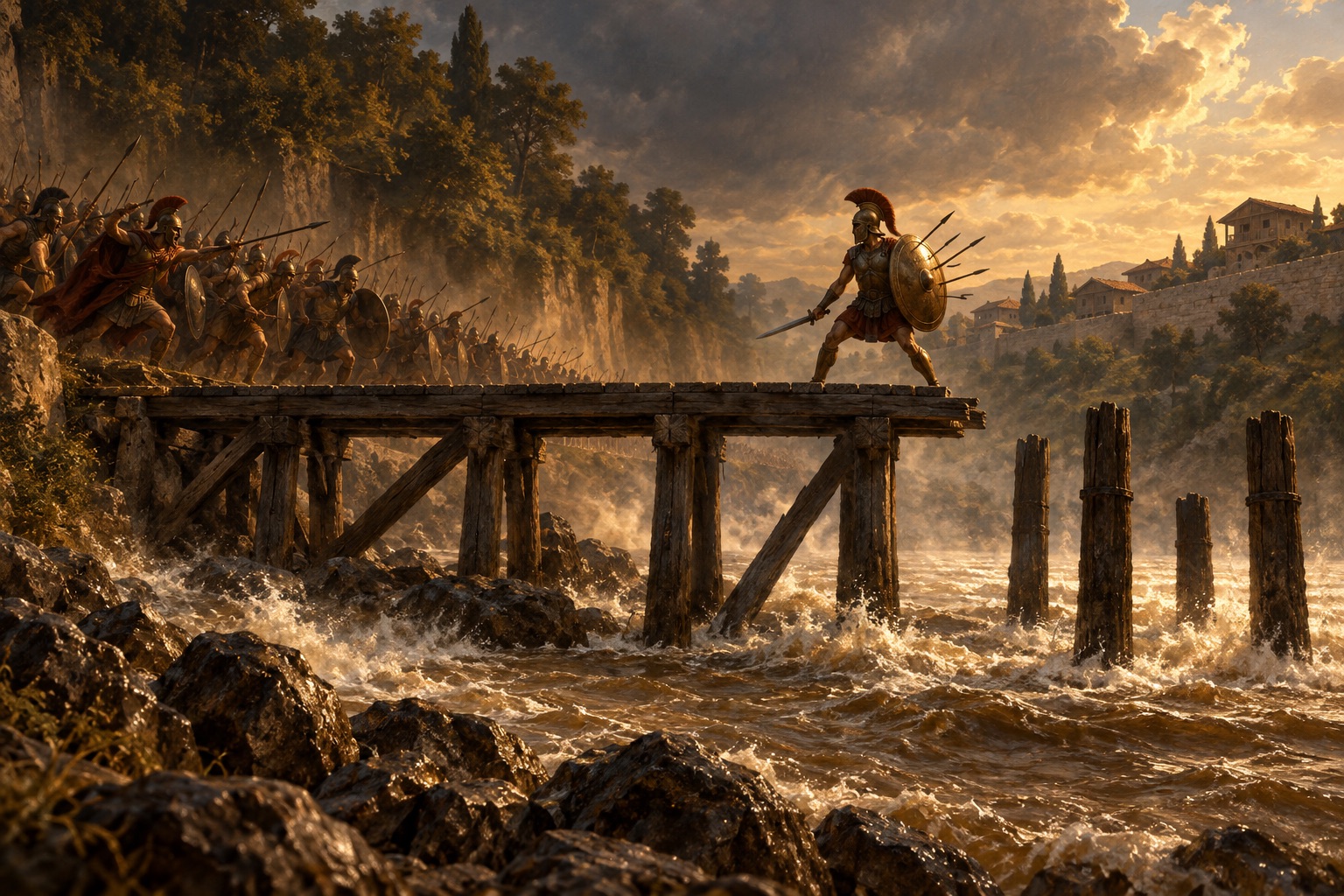
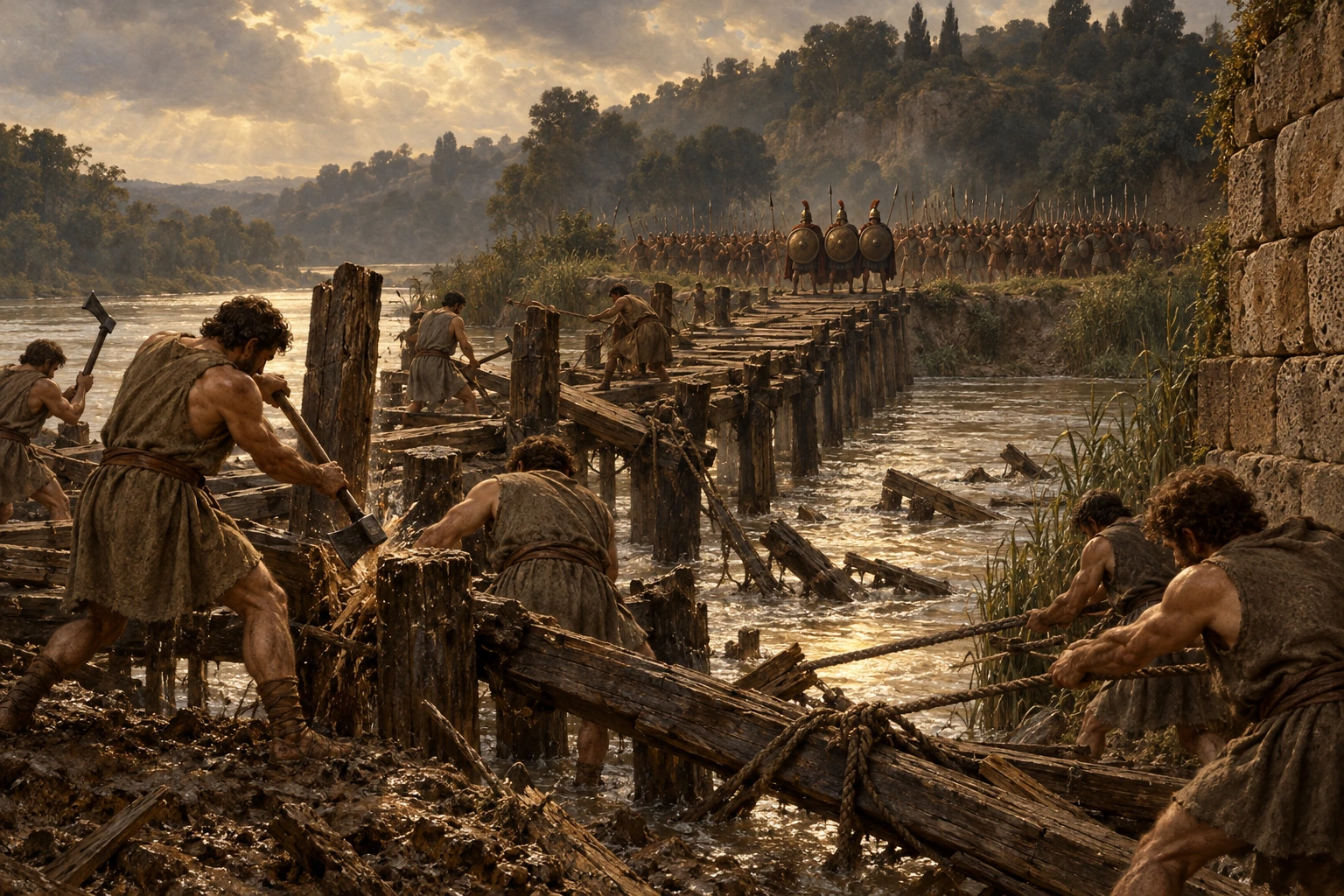
As the enemy came, the country people crowded into the city. The walls protected some parts, the Tiber others. But the Sublician bridge, Foster’s “bridge of piles”, almost gave the enemy a way in, “had it not been for one man, Horatius Cocles” (2.10).
He was on guard at the bridge when the Janiculum, the hill across the river, fell to a sudden attack. He saw the enemy running down from it and his own men throwing away their arms. He caught at them one by one: if they left the bridge open behind them, there would soon be more of the enemy on the Palatine and the Capitol than on the Janiculum. Let them break it down “with steel, with fire, with any instrument at their disposal”. He would meet the attack himself, “so far as it could be withstood by a single body”.
1-3 Three Men, Then One
He strode to the head of the bridge. Two men were kept there by shame, Spurius Larcius and Titus Herminius, “both famous for their birth and their deeds”, and the three of them took the first rush. When little of the bridge was left and the men cutting it called them back, Horatius made the other two go.
Alone, he glared at the Etruscan nobles, challenged them one by one, and called them all “slaves of haughty kings”, come to destroy the liberty of others while heedless of their own. They hesitated, each waiting for another to begin. Then they threw their javelins together, and he caught them all on his shield. They were about to charge him off the bridge when it fell with a crash, and the cheer of the Romans stopped them where they stood.
1-4 “O Father Tiberinus”
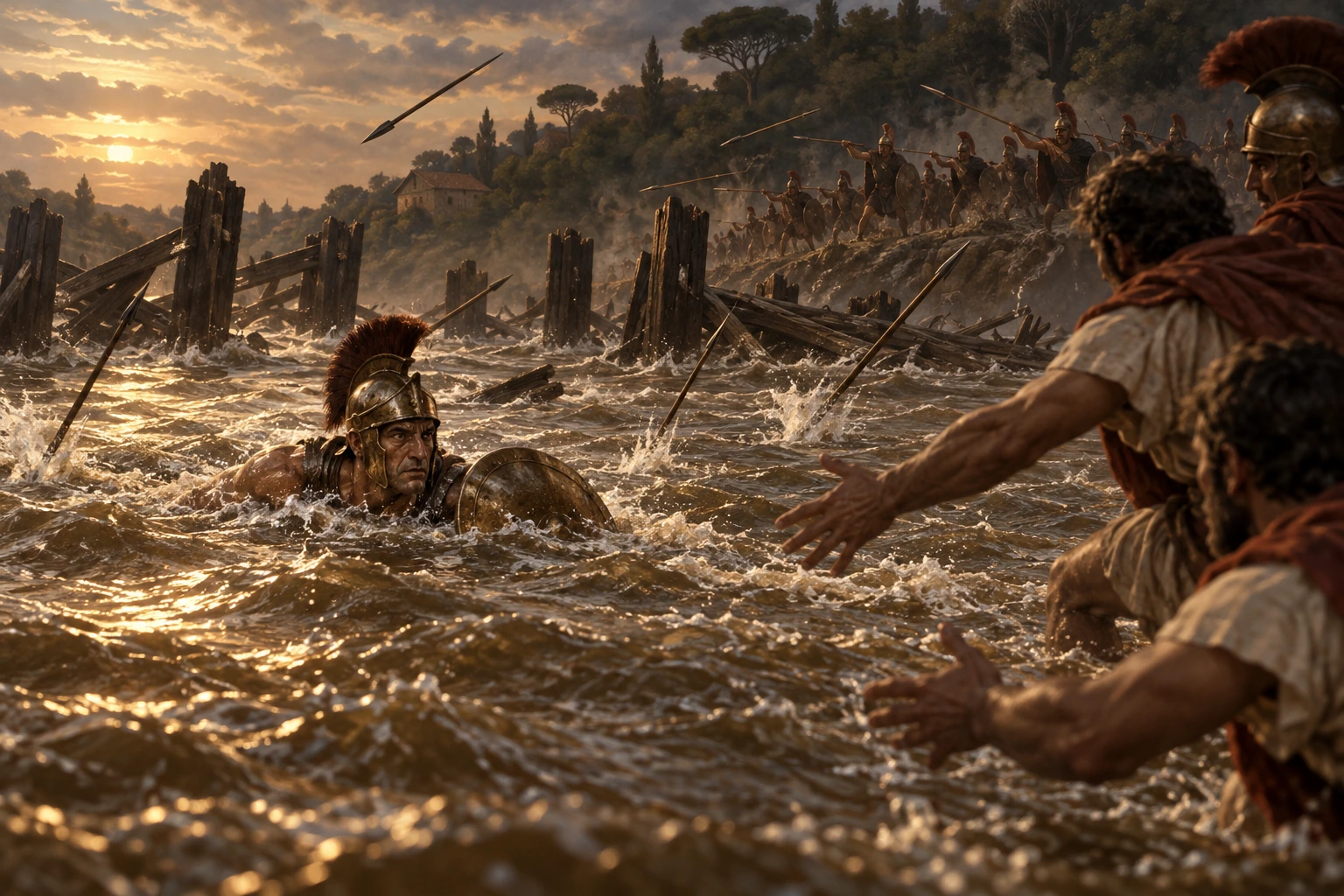
Then Cocles prayed to the river: “O Father Tiberinus, I solemnly invoke thee; receive these arms and this soldier with propitious stream!” Armed as he was, he leaped into the Tiber and, under a shower of missiles, swam across unhurt to his own side. Livy adds a historian’s doubt: Horatius had given “a proof of valour which was destined to obtain more fame than credence with posterity”.
1-5 The Rewards
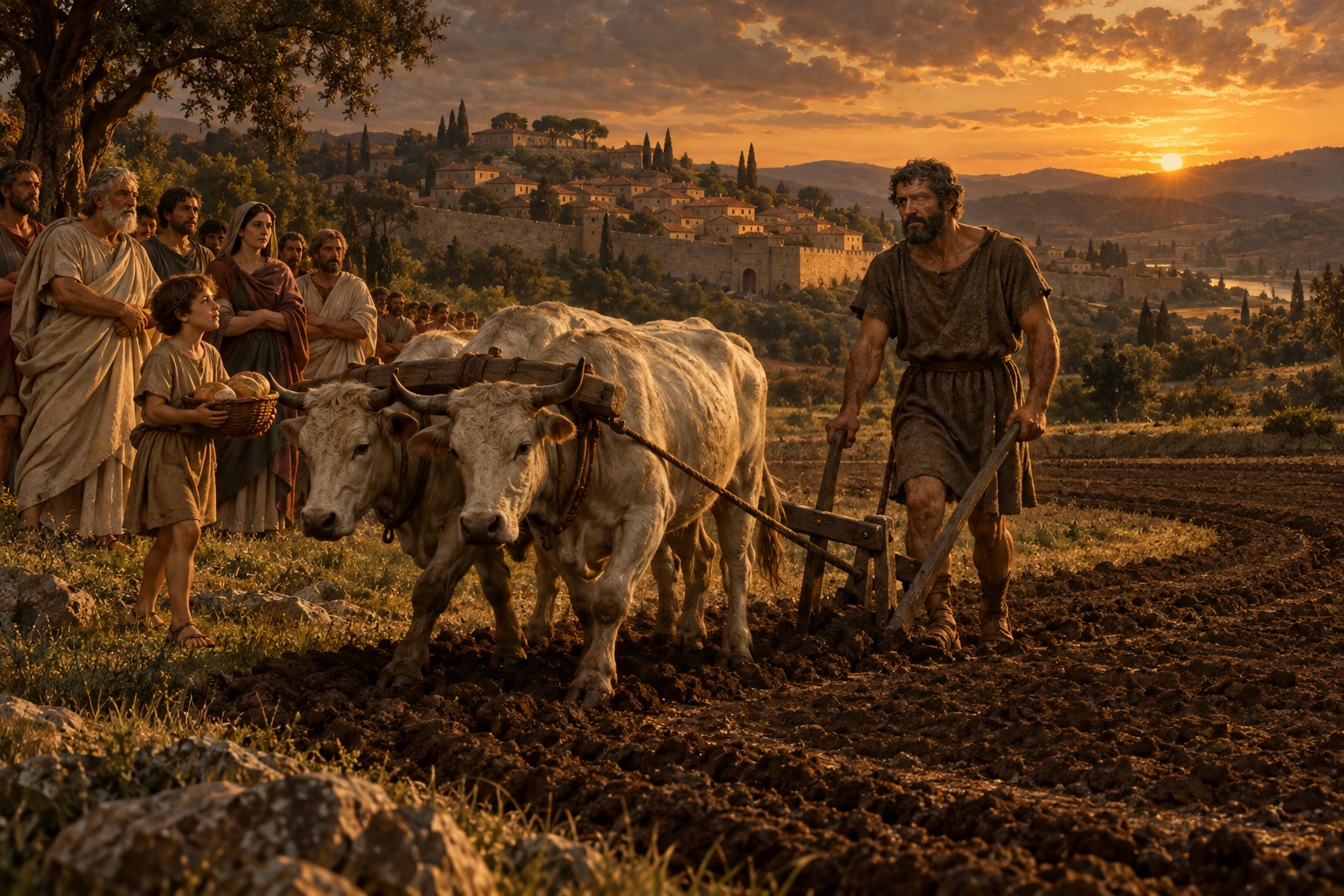
The state set up his statue in the Comitium, the assembly place beside the Forum, and gave him as much land as he could plough round in one day. Private citizens gave too: food was short, yet everyone brought him something, taking it from his own ration.
1-6 Mucius and Cloelia
Porsenna settled down to a siege, and grain ran short. A young noble, Gaius Mucius, crossed the river with the senate’s leave and a sword hidden under his clothes (2.12). In the Etruscan camp the soldiers were being paid, and beside the king sat a secretary dressed much like him. Not daring to ask which was Porsenna, Mucius killed the secretary. Dragged before the king and threatened with fire, he thrust his right hand into a fire lit for a sacrifice and let it burn as if he felt nothing. Porsenna, amazed, set him free, and Mucius told him that three hundred young Romans had sworn to try the same, one after another. He was afterwards called Scaevola, “from the loss of his right hand” (2.13).
Porsenna offered peace. Rome gave hostages, and the land it had taken from Veii was handed back. One of the hostages, the girl Cloelia, slipped past the guards and led a band of girls across the Tiber under the enemy’s darts. Porsenna demanded her back, then, in admiration, declared her deed greater than those of Cocles and Mucius. He sent her home with half the hostages, hers to choose, and she chose the young boys. Rome gave her an honour new for a woman, a statue on horseback at the top of the Sacred Way. In Livy, Porsenna leaves, and his peace with Rome holds (2.15).
2 Where the Story Is Written Down
- Polybius, Histories 6.55. The oldest account that survives, by a Greek historian (about 200 to 120 BCE) who came to Rome as a hostage in 168. It is a digression. At a noble’s funeral, Polybius explains, the speaker went on to recount the exploits of the ancestors whose images were on display (6.54), and Horatius is his one example of the “eager emulation of achieving noble deeds” this bred in the young. He names neither Porsenna nor the Etruscans.
- Livy, History of Rome 2.9–15 (section 1). Livy (59 BCE to 17 CE) began his history between 27 and 25 BCE. Older Latin poetry may have told the story before him, but the historian Gaetano De Sanctis noted in the Enciclopedia Italiana (1935) that no fragment of Ennius’s Annals can be tied to Horatius with certainty.
- Dionysius of Halicarnassus, Roman Antiquities 5.21–25. Dionysius was a Greek who had lived at Rome for twenty-two years, since Augustus ended the civil war (1.7). His is the longest telling, and it differs on many points (section 3).
- Virgil, Aeneid 8.646–651. On the shield that Vulcan makes for Aeneas, Porsenna orders Rome to take Tarquin back: “you could see him like one in anger, like one threatening, because Cocles dared to tear down the bridge and Cloelia broke her bonds and swam the river” (our translation).
- Plutarch, Life of Publicola 16–19, by the Greek biographer of the late 1st and early 2nd century CE.
- Pliny the Elder, Natural History (1st century CE), on the statue, which in his day “survives even now” (34.22), and on the bridge (36.100).
- Aulus Gellius, Attic Nights 4.5 (2nd century CE), on the statue struck by lightning. Gellius found the story in the eleventh book of the Annales Maximi, the priests’ annals, and in Verrius Flaccus.
3 Competing Versions
- Alone, or with two? In Polybius, Horatius is fighting “two of the enemy” at the far end of the bridge when he sees more coming, and shouts to the men behind him to cut it. Livy, Dionysius and Plutarch give him two companions, Larcius and Herminius. De Sanctis thought their names were probably borrowed from the year 506 BCE, when the two were consuls together (Livy has them as consuls too, 2.15).
- Did he live? Polybius: he plunged in his armour and gave up his life by choice. Livy: he swam across unhurt. Dionysius: he swam “with great difficulty”, without losing any of his arms, after a spear had passed “straight through one of his buttocks above the hip-joint”. He was lame for life, and so never became consul or led an army (5.24–25). Plutarch too has the spear wound in the buttocks, and the lameness.
- How did it begin? In Livy the Janiculum falls to a surprise attack. In Dionysius there is a pitched battle in front of the river; the Roman wings break, and the three men hold the bridge until the whole army has crossed. In Plutarch the consul Publicola is badly wounded fighting before the gate.
- Why “Cocles”? The Roman scholar Varro reads the word as if it were ocles, from oculus, “eye”: one “who had one eye” (On the Latin Language 7.71). Dionysius says Horatius lost an eye in battle. Plutarch gives that story and another: his nose was so flat and his eyebrows so joined that people wanted to call him Cyclops, and by a slip of the tongue “Cocles” stuck (Publicola 16).
- His first name is Publius in Dionysius and Marcus in Pliny (34.22). Livy gives none.
- The statue. Livy puts it in the Comitium, Dionysius “in the principal part of the Forum”, in bronze and fully armed, and Plutarch in the temple of Vulcan. Gellius has a story that joins the places. Lightning struck the statue in the Comitium, and soothsayers called from Etruria, out of hatred for Rome, advised moving it down to a spot the sun never reached. They were found out, confessed and were put to death. The statue went up instead to the area of Vulcan, and the boys of Rome chanted “Bad counsel to the giver is most ruinous” (J. C. Rolfe’s translation). De Sanctis argued that the old statue had been a god’s, and that the legend’s lost eye and lameness were read into it. That is a theory, not a finding.
- Mucius and Cloelia. Livy takes “Scaevola” from the lost right hand; Plutarch says it means “Left-handed”, because Mucius took back his sword with his left. Dionysius calls him Gaius Mucius, “surnamed Cordus”. Plutarch says some had Cloelia cross on horseback, and Pliny cites a writer, Annius Fetialis, for whom the statue on horseback was of Valeria, Publicola’s daughter (34.29).
4 History and Tradition
- Did Porsenna take Rome? Two Roman writers let slip another version. Tacitus, on the burning of the Capitol in a civil war of his own century, calls the temple of Jupiter one “which neither Porsenna, when the city was surrendered, nor the Gauls, when they took it, had been able to violate” (Histories 3.72). Pliny found in “the treaty that Porsenna granted the Roman people after the kings were driven out” the express condition that they “should not use iron except in farming” (34.139; both our translations). Livy was troubled by a custom of his own day, the announcing of “the goods of King Porsinna” at sales, which did not fit a peaceful departure, and explained it away as a gift of the king’s camp (2.14). The Treccani Dizionario di Storia (2011) finds the surrender “more likely”, perhaps the memory of an Etruscan rule that the Romans tried to mask.
- The wooden bridge. Livy calls it the first bridge ever built over the Tiber, the work of King Ancus Marcius (1.33). Dionysius says it had to be built “without brass or iron, being held together by its beams alone”; it was held sacred, and the pontiffs offered sacrifices whenever it was repaired (3.45). Plutarch adds wooden pins and an oracle, and reports that most writers took pontifex, “priest”, to mean “bridge-builder”, an explanation he calls absurd (Numa 9). Platner and Ashby’s Topographical Dictionary of Ancient Rome (1929) derives the name from sublica, “a pile”, and has the bridge still standing in the 5th century CE.
- Where was it? Its exact site is disputed. Platner and Ashby thought it crossed from the Forum Boarium, the cattle market, just below the later Pons Aemilius. Nothing of it can be seen today; the modern Ponte Sublicio, built in 1914–1917 further downstream, keeps only the name.
- A kernel of history? De Sanctis held it “beyond doubt” that in the wars between Etruscans and Romans the bridgehead had to be defended and the bridge cut, and thought the wood was probably chosen for that reason, whatever sacred reason was given. He also found it hard to believe that a Horatius in the story was a late invention, since the family vanishes from the lists of consuls after the 5th century BCE. Platner and Ashby, too, allow that iron may have been left out so the bridge could be pulled down fast.
- Macaulay’s “Horatius”. In 1842 Thomas Babington Macaulay published Lays of Ancient Rome, ballads in the manner of the lost songs he believed lay behind Livy. “Horatius”, “a lay made about the year of the city CCCLX”, comes first. It follows Livy, swim and land and all, and gives the hero the lines: “And how can man die better / Than facing fearful odds, / For the ashes of his fathers, / And the temples of his gods” (stanza XXVII). In his preface Macaulay notes Polybius’s version, in which Horatius “defended the bridge alone, and perished in the waters”. At Harrow School the young Winston Churchill won a prize for reciting 1,200 lines of the Lays from memory, the International Churchill Society records.
Horatius at the bridge is not one of the three brothers in Jacques-Louis David’s Oath of the Horatii (1784, Louvre). David painted the Horatii, triplets who fought three Alban brothers, the Curiatii, under Rome’s third king, Tullus Hostilius (Livy 1.24–26), long before there was a Republic. Livy tells of no oath to their father, only of a treaty sworn by priests. The two stories do meet in Dionysius, who makes Cocles a descendant of Marcus Horatius, one of the victorious triplets.
5 Related Stories
- Aeneas: The Trojan Who Became Rome’s Ancestor: Virgil puts Cocles and Cloelia on the shield that Vulcan makes for Aeneas (Aeneid 8.646–651), among the scenes of a Roman history still to come.
- The Capitoline Geese: The Birds That Woke the Capitol: Tacitus names Porsenna and the Gauls in one breath, as the two enemies who took Rome and still never violated Jupiter’s temple. On Virgil’s shield, too, the next scene after Cocles is Manlius on the Capitol and the silver goose (8.652–656).
- Janus: The Two-Faced God of Doorways: the Janiculum, the hill Porsenna seized, was in Virgil’s telling a citadel founded by “father Janus” (Aeneid 8.357–358).
- The Odyssey: Ten Years on the Way Home from Troy: Plutarch says some people wanted to nickname Horatius “Cyclops”, and a note in the Loeb translation of Dionysius suggests cocles may be related to the Greek kyklops. Odysseus blinds the one eye of the Cyclops Polyphemus. We link the two for the name, not for the story.
- Cú Chulainn: The Hound of Ulster: the Irish hero who holds the fords of Ulster alone against an army. Georges Dumézil, in Horace et les Curiaces (1942), compared his first fight, against three brothers, and the cold water that calmed his fury, with the other Horatius of Rome’s legends, the one who killed the three Curiatii.
6 Sources
- Livy, History of Rome 1.24–26, 1.33, 1.60 and 2.9–15, trans. B. O. Foster (Loeb, 1919), and the Latin text: Perseus, The Latin Library
- Polybius, Histories 6.53–55, trans. W. R. Paton (Loeb, 1923), and the Greek text: LacusCurtius, Perseus
- Dionysius of Halicarnassus, Roman Antiquities 1.7, 3.45 and 5.21–25, trans. Earnest Cary (Loeb, 1937–1940): LacusCurtius, LacusCurtius, LacusCurtius
- Plutarch, Life of Publicola 16–19 and Life of Numa 9, trans. Bernadotte Perrin (Loeb, 1914): LacusCurtius, LacusCurtius
- Virgil, Aeneid 8.357–358 and 8.646–656, Latin text: The Latin Library
- Pliny the Elder, Natural History 34.22, 34.28–29, 34.139 and 36.100, Latin text: LacusCurtius, LacusCurtius
- Tacitus, Histories 3.72, Latin text: The Latin Library
- Aulus Gellius, Attic Nights 4.5, trans. J. C. Rolfe (Loeb, 1927): LacusCurtius
- Varro, On the Latin Language 7.71, Latin text: The Latin Library
- Thomas Babington Macaulay, Lays of Ancient Rome (Longman, 1842): archive.org, Project Gutenberg
- Musée du Louvre, Jacques-Louis David, Le serment des Horaces, entre les mains de leur père (INV 3692): collections.louvre.fr
- Gaetano De Sanctis, “Orazio Coclite”, Enciclopedia Italiana (1935); “Porsenna”, Dizionario di Storia (2011); “Tarquinio il Superbo”, “Polibio di Megalopoli” and “Tito Livio”, Enciclopedia on line: Treccani, Treccani, Treccani, Treccani, Treccani
- Samuel Ball Platner and Thomas Ashby, “Pons Sublicius”, A Topographical Dictionary of Ancient Rome (Oxford University Press, 1929): LacusCurtius
- Turismo Roma, “Ponte Sublicio”: turismoroma.it
- International Churchill Society, “Harrow School”: winstonchurchill.org
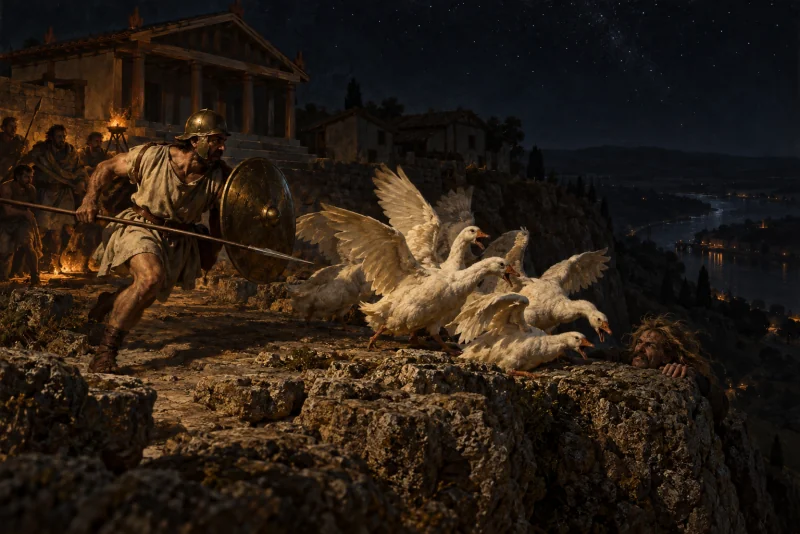
Cover and illustrations: AI-generated images made for Arcana. They are interpretations, not historical artworks.