Janus: The Two-Faced God of Doorways
Janus kept the doors of Rome and of heaven, looked both ways at once and gave his name to January. Ovid tells him that Greece has no god to match him. Yet the Roman year did not always begin in his month.
- Type: god of doorways, passages and beginnings
- Culture: ancient Rome and Latium
- Earliest texts: the oldest surviving work of Latin prose, the farming manual of Cato the Elder (234–149 BCE), already has prayers to “Father Janus”; the fullest account is book 1 of Ovid’s Fasti, in which the god answers the poet’s questions
- Key figures: Janus, Saturn, Titus Tatius, Juno, the nymph Crane (Carna), Numa Pompilius, Augustus
Romans began their prayers with Janus. He was the god of the ianua, the door, and of every way through: the door of a house, the gate of a city or of heaven, the beginning of a year or of a war. He has almost no adventures. His stories explain things instead: why he has two faces, why his doors in the Forum stood open in time of war, why Rome’s old bronze coins carried a ship. “Greece has no god to match you,” Ovid tells him.
Why does Janus have two faces? The Romans gave several answers. Ovid’s Janus says that every door has two fronts, one looking out at the street and one in at the household, and that he, the doorkeeper of heaven, watches east and west at once (Fasti 1.135–140). Macrobius makes him a wise king who knew the past and foresaw the future (Saturnalia 1.7.20). Plutarch thought the faces meant that he had brought people from one way of life into another (Numa 19.6), and the commentator Servius records that they showed the union of two kings, Romulus and Titus Tatius.
1 The Telling
The fullest telling is in book 1 of Ovid’s Fasti, a poem on the Roman calendar that covers January to June. On the first of January the god appears to the poet and answers his questions (1.63–288). Macrobius, a Roman writer active around 400 CE, adds the story of Janus and Saturn (Saturnalia 1.7 and 1.9). Line numbers of Ovid and Virgil follow the Latin text of The Latin Library; translations from Ovid, Virgil, Livy, Cicero and Macrobius are our own.
1-1 The God Who Was Once Chaos
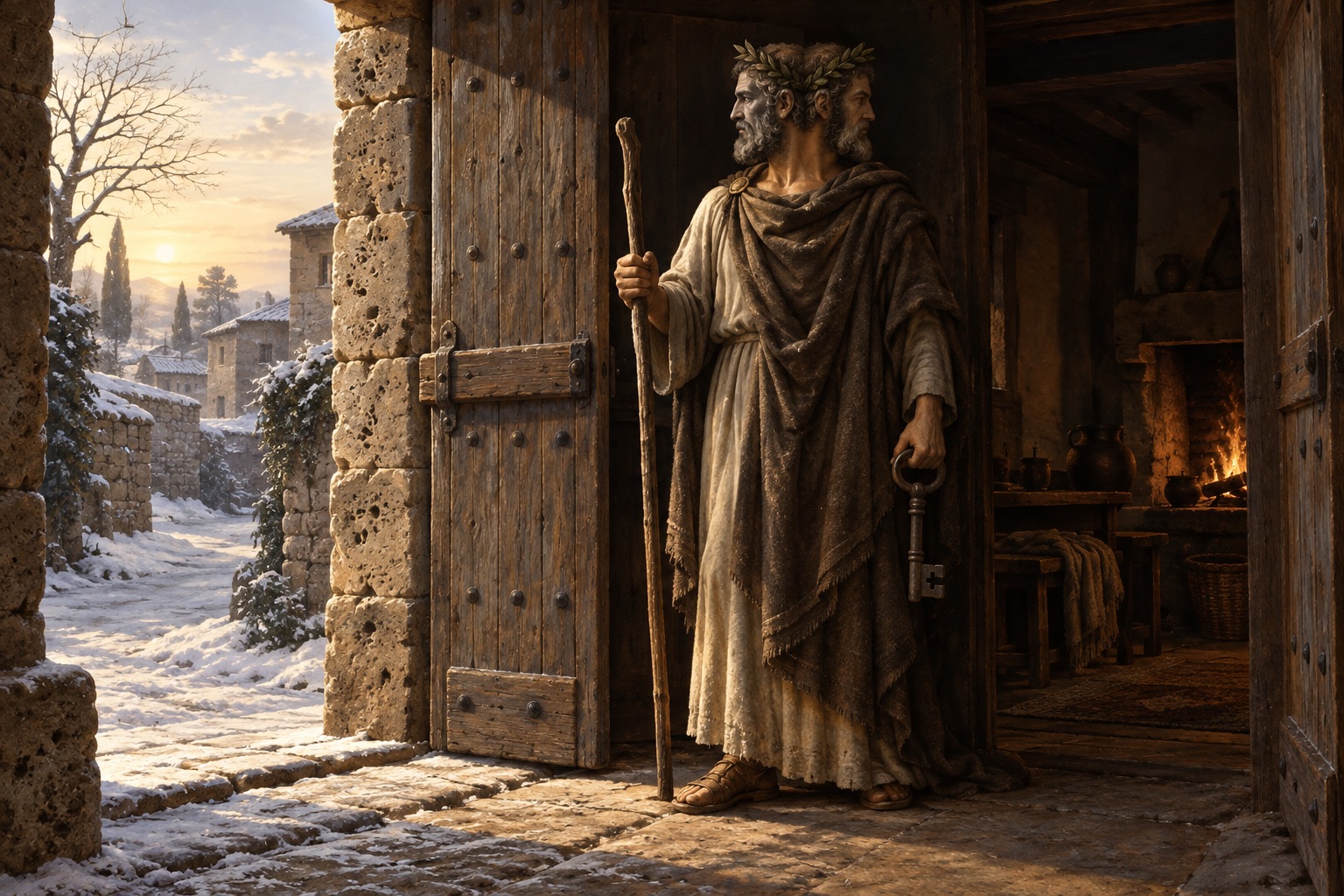
Ovid opens the year with a prayer to “two-headed Janus, beginning of the silently gliding year, the only one of the gods who sees his own back” (1.65–66), and asks what god he is, “for Greece has no god to match you” (1.89–90). As the poet ponders with his writing tablets in hand, the room grows brighter, and Janus is suddenly there, showing his two faces. The poet’s hair stands on end. The god holds a staff in his right hand and a key in his left, and speaks from his front mouth (1.93–100). “The ancients called me Chaos, for I am a thing of old” (1.103). Air, fire, water and earth were once a single heap. When they parted, the shapeless ball that he had been took on a face and limbs fit for a god, and his double look is a small mark of that old confusion (1.105–114).
His office is opening and shutting. Sky, sea, clouds and lands are all opened and closed by his hand, and the right to turn the hinge of the world is his alone. When he pleases he sends Peace out of her quiet house, and the whole world would run with blood if rigid bolts did not keep the Wars shut in. With the gentle Hours he keeps the doors of heaven, and Jupiter himself goes in and out by his service (1.117–126). So the priest at the sacrifice calls him now Patulcius, “the opener”, now Clusius, “the closer” (1.127–130). And the two faces? “Every door has two fronts, this way and that: one looks out at the people, the other in at the household god.” As the porter sitting by the threshold sees who goes out and who comes in, so Janus, the porter of the court of heaven, sees east and west together. Hecate has three faces to watch the crossroads; he has two, so that he need not lose time turning his neck (1.135–144).
1-2 The King Who Welcomed Saturn
Before he was a god, Janus was a king. In Ovid he ruled the land by the sandy Tiber where Rome now stands, when it was uncut forest with grazing for a few cattle, and his citadel was the hill that people now call the Janiculum (1.241–248). In Macrobius he ruled the region now called Italy, at first together with a native named Cameses, so that the land was called Camesene and the town Janiculum (1.7.19). The Janiculum is the long ridge on the right bank of the Tiber; the ancients usually explained its name as “the city of Janus”, but no trace of a cult of the god existed there in historical times (Platner and Ashby, 1929).
Then Saturn came. Driven from his kingdom in heaven by Jupiter, the god with the sickle had wandered the world and arrived by ship at the Tuscan river, and Janus took him in. The land was called Saturnia after him, and Latium, Ovid says, from latere, “to lie hidden”, because the god lay hidden there (1.233–238). Macrobius adds that Saturn taught Janus to farm and that Janus shared his kingdom with him (1.7.21). In Virgil, King Evander shows Aeneas two ruined towns on the site of the future Rome: “Father Janus founded this citadel, Saturn that one; this one was called Janiculum, that one Saturnia” (Aeneid 8.357–358).
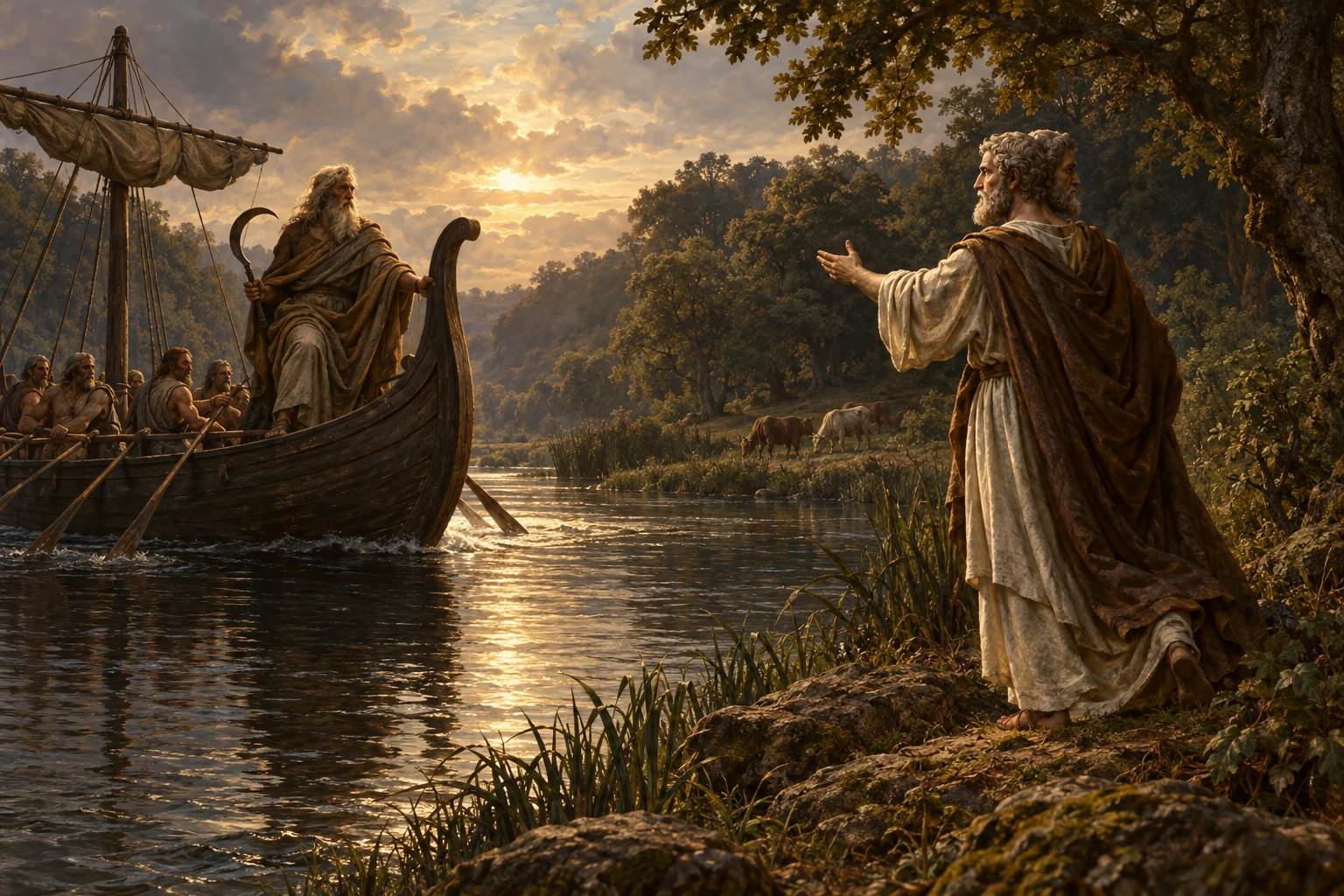
It was a golden age. Gods still mixed with men, Justice had not yet left the earth, and shame ruled the people without force. “I had nothing to do with war,” says Janus. “I guarded peace and doorways,” and, showing his key, “these are the arms I carry” (1.247–254). When Saturn suddenly vanished, Macrobius says, Janus named the whole land Saturnia, set up an altar and rites for him as a god, and called the feast the Saturnalia (1.7.24).
1-3 The Spring That Stopped the Sabines
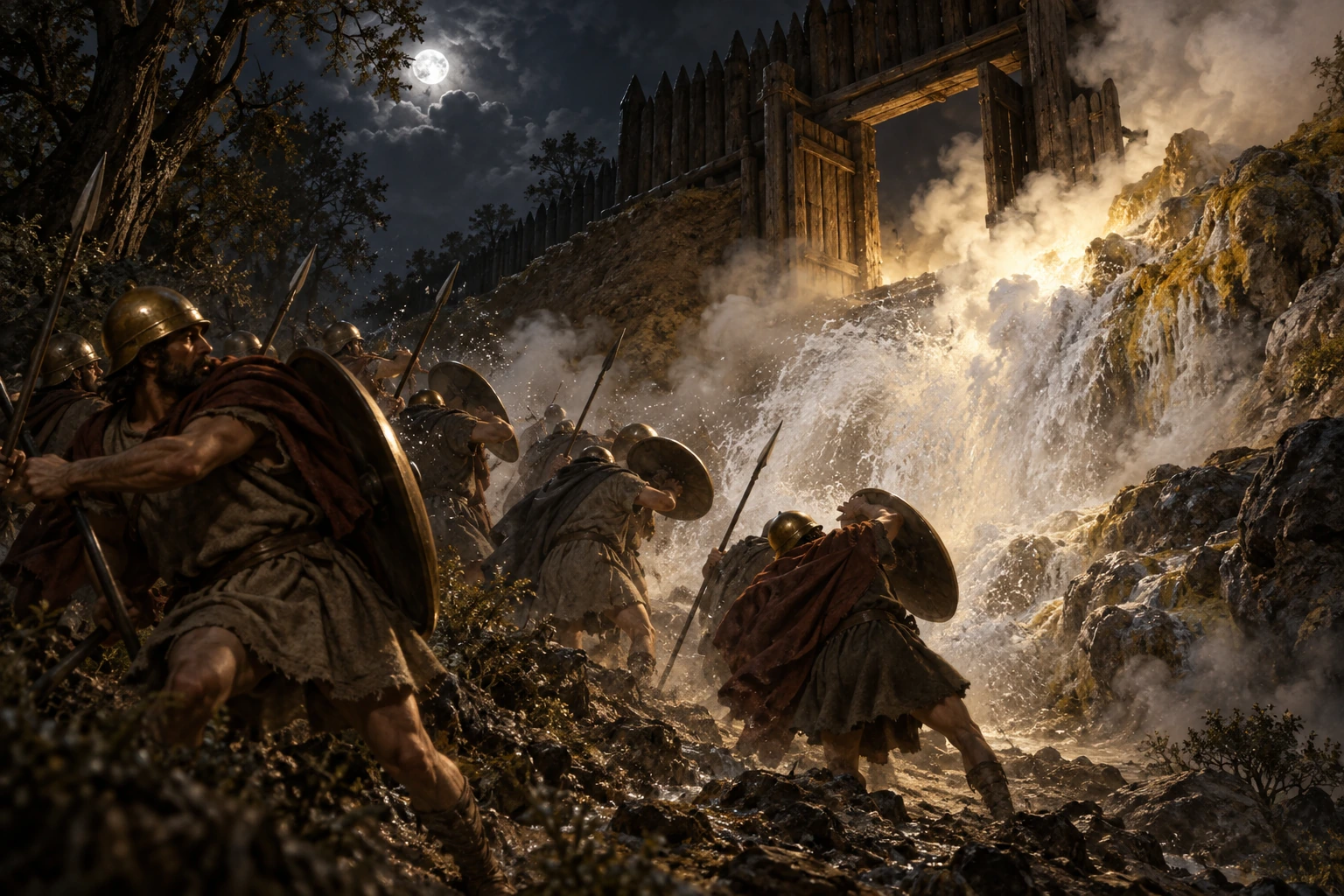
Why, Ovid asks, when Rome has so many iani, arched passages, is the god consecrated in only one, where his shrine stands between two forums (1.257–258)? Janus strokes his beard and tells of the war with Titus Tatius and the Sabines (the Sabine women and Tarpeia belong to Romulus and Remus). A light-minded guard, bought with bracelets, had led the silent Sabines up the path to the citadel. They had already reached the gate, and Juno, who bore Rome a grudge, had drawn back its bars (1.259–266).
Janus did not dare fight so great a goddess. He used his own art instead. He unsealed the mouths of his springs and let out a sudden flood, but first he put sulphur into the wet veins of the earth, so that boiling water would close the road to Tatius. When the Sabines had been driven off and the place was safe, it took back its old shape, and an altar was set up for Janus beside a small shrine (1.267–276).
1-4 The Gates of War
Then why, Ovid asks, does Janus hide in peacetime and open when arms are moved? “So that the way home may lie open to the people when they have gone to war, my whole door stands open with the bar taken away. In peace I shut the doors, so that peace cannot slip out.” Under Caesar, he adds, he will long be shut (1.277–282). Livy credits the custom to Numa, Rome’s second king, whose reign is told under Numa and Egeria. To soften a fierce people by keeping them from arms, Numa made the Janus at the foot of the Argiletum “an index of peace and war”: open, it showed that the city was in arms; shut, that all the peoples around were at peace (1.19).
Virgil makes the custom older than Rome. There are, he says, twin Gates of War, “so they call them”, holy with religion and the dread of savage Mars; a hundred bronze bars and the eternal strength of iron shut them, and Janus, their guardian, never leaves the threshold. When the senators have decided on war, the consul himself, in the Quirinal robe and the toga girded in the Gabine way, unbars the creaking doors (Aeneid 7.601–614). When the Latins want war with the Trojans of Aeneas, King Latinus refuses to touch the doors and hides in the dark. So Juno comes down from the sky, pushes the gates with her own hand, turns them on their hinges and bursts the iron-bound posts of War (7.616–622). In book 1, Jupiter foretells the opposite: when wars are laid aside, the dread Gates of War will be shut, and impious Fury will sit inside on a heap of weapons, his hands bound behind him with a hundred bronze knots (1.291–296).
1-5 Crane and the Hinge
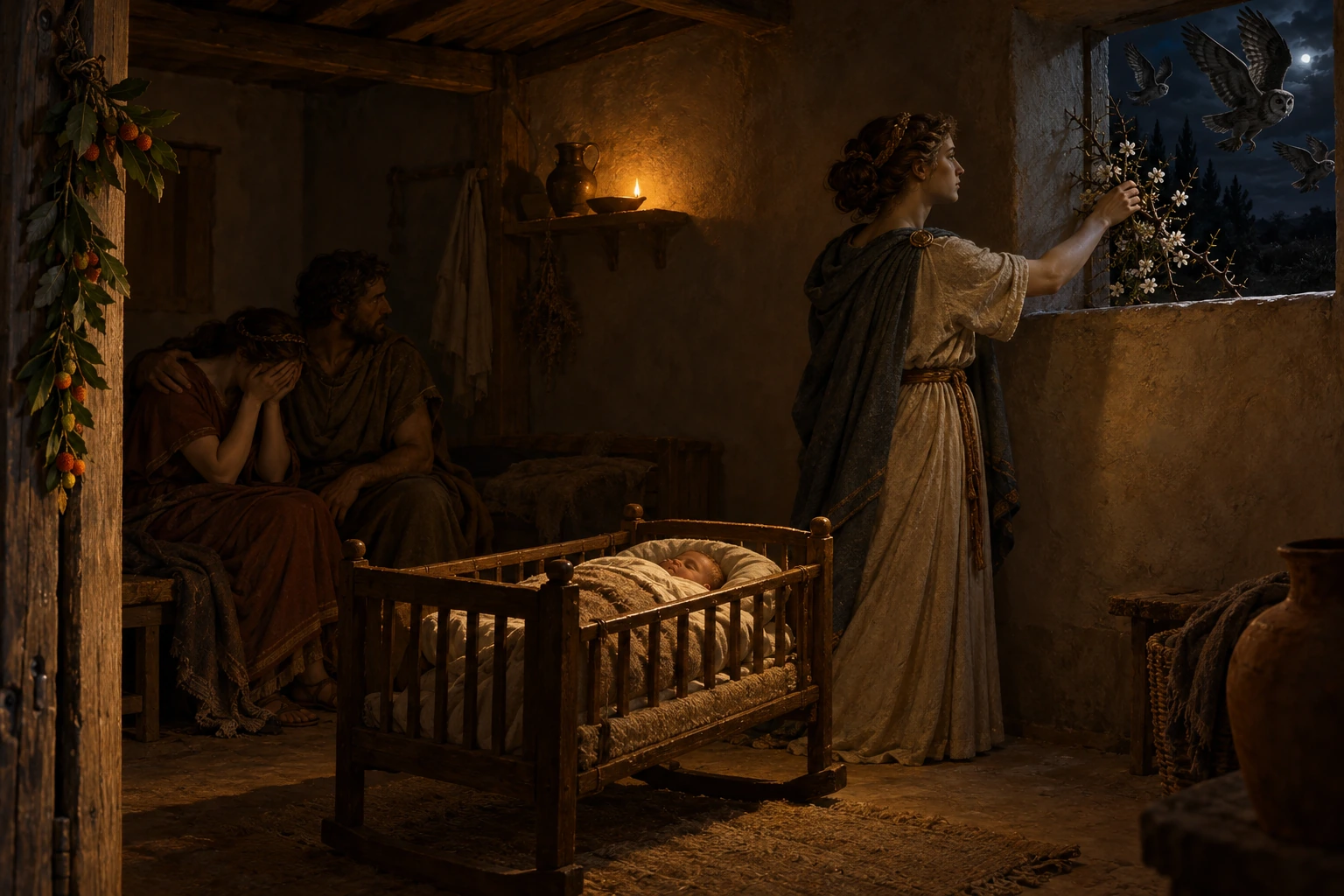
Book 6 of the Fasti tells a darker story of Janus and a nymph. The first of June belongs to Carna, Ovid says, the “goddess of the hinge”: by her power she opens what is shut and shuts what is open (6.101–102). Her power came from Janus. By the Tiber lay the old grove of Alernus, where the pontiffs still brought offerings, and there a nymph was born whom the ancients called Crane. She hunted with javelins, and people took her for Apollo’s sister. When a young man spoke to her of love, she would tell him to lead the way to a more secret cave, then slip into the bushes and never be found (6.105–118). She tried the trick on Janus. “Fool! Janus sees what goes on behind his back.” He seized her where she hid under a rock and forced himself on her. Then he gave her the right of the hinge, “the price of your virginity”, and a branch of whitethorn that could drive harm away from doors (6.123–130).
There are greedy birds, Ovid goes on, with big heads, staring eyes, beaks made for plunder, grey feathers and hooked claws. They fly at night, seek out babies left without a nurse, and are said to tear them in their cradles and drink their blood. Their name, striges, comes from their horrible screech. They came to the room of the infant Proca, who in Livy’s list of the kings of Alba is the father of Numitor and Amulius (Livy 1.3), when he was five days old. His nurse found his cheeks torn and ran to Crane. Crane touched the doorposts three times with leaves of arbutus and three times marked the threshold, sprinkled the entrance with water, and held out the raw entrails of a two-month-old sow: “Birds of the night, spare the child’s entrails: a small victim falls for a small boy. Take heart for heart, I pray.” Last, she set a “rod of Janus” cut from the whitethorn at the little window that lit the room. The birds never touched the cradle again, and the boy’s colour came back (6.131–168).
1-6 Sweet Things for a New Year
Back on the first of January, the poet asks about the day itself. Why does the new year begin in the cold, when spring, with its flowers, buds and swallows, would suit it better? Because, Janus answers, midwinter is the first day of the new sun and the last of the old: the sun and the year begin together (1.149–164). Why are lawsuits heard even on the first day? So that the whole year will not be idle from its start (1.165–170). Why do incense and wine go to Janus first, whatever god one is praying to? “So that through me, who guard the thresholds, you may reach whatever gods you wish” (1.171–174).
“What do the dates mean, and the wrinkled figs, and the white honey given in a snow-white jar?” “The omen: so that the taste may follow what we do, and the year run sweetly on the course it has begun.” And the coins given with them? Janus laughs at an age that thinks money sweeter than honey. Even in Saturn’s reign, he says, he hardly saw a man who did not find gain sweet, and the love of having has grown ever since. When Rome was young and poor, Jupiter’s thunderbolt was made of clay and the Capitol was decked with leaves. “They used to give bronze. Now the omen is better in gold” (1.185–226). Last, Ovid asks why one side of the bronze coin shows a ship and the other a two-headed figure. The head is Janus. The ship is the one that brought Saturn up the Tiber, and “a good posterity shaped a ship on the bronze, to bear witness to the coming of the guest-god” (1.229–240). Macrobius makes Janus himself the first to strike bronze, with his own head on one side and Saturn’s ship on the other, and says that boys still tossed coins in the air and called out capita aut navia, “heads or ships” (1.7.22).
2 Where the Story Is Written Down
- The Salian hymn. In the oldest songs of the Salii, the dancing priests, Janus is sung as “god of gods”, says Macrobius (Saturnalia 1.9.14).
- Cato the Elder, On Agriculture, which the Britannica International Encyclopedia calls the oldest surviving work of Roman prose. Before the harvest the farmer offers incense and wine to Janus, Jupiter and Juno, and cakes first of all to “Father Janus” (134). Before he purifies his land, he pours wine for Janus and Jupiter and then prays to Father Mars (141).
- Cicero, On the Nature of the Gods 2.67. The Stoic speaker Balbus explains that the first and the last have the greatest force in all things, so Janus was made first at every sacrifice. His name comes from ire, “to go”, which is why thoroughfares are called iani and the doors of houses ianuae. Vesta, the keeper of the innermost things, comes last in every prayer.
- Varro, On the Latin Language. The Porta Ianualis, a gate of the oldest town on the Palatine, had a statue of Janus and a rule, set by Numa according to the annalist Piso, that it stand open unless there was no war anywhere (5.165). The month names “count from March, as the ancients arranged them”, and of the two months added to them, the first was named January “from the god who is first in order” (6.33–34, trans. R. G. Kent).
- Livy, on Numa’s Janus (1.19); and the prayer of the consul Decius Mus as he devotes himself to death in battle against the Latins, which begins “Janus, Jupiter, Father Mars, Quirinus, Bellona, Lares” (8.9).
- Virgil, Aeneid: the Gates of War (1.291–296, 7.601–622), the citadels of Janus and Saturn (8.357–358), and Latinus swearing by “two-fronted Janus” (12.198).
- Ovid: the conversation with Janus (Fasti 1.63–288); the Agonalia of 9 January, when the king of sacred rites must appease the god with a ram (1.317–334); Crane and the hinge (6.101–182); and a second version of the Sabine spring (Metamorphoses 14.775–804). After him come Augustus on the closings (Res Gestae 13), Plutarch (Life of Numa 18–20, Roman Questions 19 and 22) and Macrobius (Saturnalia 1.7, 1.9, 1.12–13).
3 Competing Versions
- Other reasons for the two faces. Macrobius says Janus also looks four ways, as a statue brought to Rome from Falerii shows, and quotes Gavius Bassus: two-fronted as the porter of the upper and the lower world, four-formed as master of every region (1.9.13). Plutarch asks whether it was because Janus was a Greek from Perrhaebia who changed his speech and his ways when he settled in Italy, or because he changed the people of Italy from wild plants and lawlessness to farming and settled government (Roman Questions 22).
- A Greek god after all? Ovid says Greece has none to match him (1.90). Against that stand Plutarch’s Greek from Perrhaebia and the scholar Nigidius, who in Macrobius makes Janus Apollo, and Diana “Jana” (1.9.5–8). The name itself is explained from ianua, the door (1.9.7), or, as by Cicero’s Balbus, from ire, “to go”; Cornificius even says that Cicero called the god “Eanus” (1.9.11).
- The hot spring. In the Fasti, Janus himself opens his springs and heats them with sulphur (1.263–276). In the Metamorphoses, Juno opens the gate without a sound, Venus sees it and asks the naiads who live beside the shrine of Janus for help, and they heat their cold spring with sulphur and burning pitch until the doorposts smoke (14.775–798). Macrobius puts it at a gate at the foot of the Viminal hill that would not stay shut and was later called the Porta Ianualis: as the Sabines were about to burst through, a torrent broke out of the temple of Janus and scalded or swept many of them away (1.9.17–18). Servius says only that hot water burst from the spot when Romulus was about to lose (on Aeneid 1.291).
- Who built the shrine? Numa, as an index of peace and war (Livy 1.19; Varro, citing Piso, 5.165; Pliny, Natural History 34.33, of its statue). Romulus and Tatius after their treaty, so that the two faces showed the union of the two kings (Servius on Aeneid 1.291). Or it began with the altar raised after the spring (Fasti 1.275).
- How often was it shut? Livy: twice after Numa, once in the consulship of Titus Manlius after the First Punic War, and once by Augustus after Actium (1.19). Augustus: twice in all since the founding of the city before he was born, and three times while he was the first citizen (Res Gestae 13; so too Suetonius, Augustus 22). The two agree; Livy knew only the first of Augustus’s three. Varro adds that the closing under Manlius was undone the same year (5.165), and Plutarch that it lasted “a short time”, while under Numa the doors stayed shut for forty-three years (Numa 20). Servius places the second closing after the Second Punic War (on Aeneid 1.291).
- Carna or Cardea? Ovid’s Carna is the “goddess of the hinge” (cardo), and the nymph Crane becomes her; Ovid never uses the name Cardea. That name is in Augustine, who mocks the Romans for posting three gods at one door, Forculus for the doors, Cardea for the hinge and Limentinus for the threshold (City of God 4.8; also 6.7). For Macrobius, Carna is the goddess of the body’s vital organs, the liver and the heart, to whom Brutus, the first consul, sacrificed on the first of June. She was offered bean porridge and lard (1.12.31–33), and Ovid too gives her beans and fat bacon (6.169–182).
- When did the year begin? Ovid’s Romulus made a year of ten months with March first, the month of his father Mars (Fasti 1.27–42, 3.75–98), and Numa “put two months in front of the old ones” (1.43–44). In book 2, though, Ovid says February had been the last month of the old year, until the decemvirs moved it up next to January (2.47–54). Plutarch says Numa moved January from eleventh place to first, “but there are many who say” that he added January and February to a ten-month year (Numa 18.3). Elsewhere he reports that January was put first because the first consuls after the kings took office on its first day, but finds the Numa story more credible (Roman Questions 19). Censorinus records that Licinius Macer and Fenestella gave Rome twelve months from the start, while Junius Gracchanus, Fulvius, Varro and Suetonius said ten, and that the two new months came from Numa according to Fulvius, from Tarquin according to Junius (On the Birthday 20.2–4).
4 History and Tradition
- The shrine in the Forum. Livy puts it at the foot of the Argiletum (1.19). Procopius, in the 6th century CE, saw it in front of the senate house: a square shrine entirely of bronze, just large enough to cover a bronze statue “not less than five cubits high”, with two faces, “one of which is turned toward the east and the other toward the west”, and brazen doors before each face (History of the Wars 5.25, trans. H. B. Dewing). Pliny says the statue had been dedicated by Numa, its fingers set to show the number 365, the days of the year (Natural History 34.33). No trace of the building has ever been found (Platner and Ashby). While Justinian’s general Belisarius was holding Rome against the Goths, some Romans tried in secret to force the doors, which had stayed shut, Procopius says, even in war since the Romans became Christians; they moved them only far enough that they no longer closed tight (5.25).
- Augustus’s closings. The senate closed the gates after Actium, in Octavian’s fifth consulship (Cassius Dio 51.20), that is in 29 BCE (Mizutani Tomohiro, Heibonsha World Encyclopedia). Augustus closed them again after his war against the Cantabri and Astures in Spain (Dio 53.26), in 25 BCE; the date of the third closing is not known (F. W. Shipley’s notes to the Res Gestae). Dio records one more decree to close them that was never carried out, because the Dacians crossed the frozen Danube and the Dalmatians revolted (54.36).
- Nero. After crowning Tiridates king of Armenia in Rome, Nero “closed the two doors of the temple of Janus, as a sign that no war was left anywhere” (Suetonius, Nero 13, trans. J. C. Rolfe). His coins show one front of the shrine, a latticed window and closed double doors with a garland across them, and the words PACE P R TERRA MARIQ PARTA IANVM CLVSIT, “having won peace for the Roman people on land and sea, he shut Janus”: a bronze sestertius in the Harvard Art Museums (1979.428.60, 66–68 CE), and a gold aureus in the American Numismatic Society found at Boscoreale (1944.100.39421). The phrase is the one Livy and Augustus use.
- The coins. The bronze as of the Republic has the laureate head of a bearded Janus on one side and a ship’s prow on the other. The Coinage of the Roman Republic Online dates the type from 225–217 BCE (Crawford 35/1); an as of 211 BCE in the American Numismatic Society weighs 37.74 grams (1974.999.47, Crawford 56/2). Mizutani writes that Janus is already shown as a two-faced god on Rome’s oldest bronze coins.
- The Arco di Giano. The four-way marble arch in the Forum Boarium, built in the 4th century CE, is the only honorary arch in Rome with a square plan. Its name is not ancient: the Soprintendenza Speciale di Roma says that it was known in antiquity as the Arcus Divi Constantini and owes “Arch of Janus” to 16th-century scholars, who saw the double nature of the god in its four openings. In Latin, though, ianus was also an ordinary word for an arched or covered passage (Lewis and Short), as Ovid’s “so many iani” shows.
- New Year’s gifts. People of every rank brought Augustus a New Year’s gift on the Capitol on the first of January, even when he was away from Rome (Suetonius, Augustus 57). Tiberius forbade such gifts after the first day of January (Tiberius 34), and Caligula stood at the entrance of the palace to catch the coins that the crowd threw at him (Caligula 42). The Latin word, strena, “meant strictly gifts given for good luck”, Rolfe notes.
“The Roman year always began in January” is a common belief. It did not. The month names from Quintilis, “fifth”, to December, “tenth”, still counted from March, and in Ovid’s day the old laurels at the Regia were replaced and the fire of Vesta renewed on 1 March, the old first day of the year (Fasti 3.135–150). For the state, the year began when the consuls took office, and that day moved: in 217 BCE it was the Ides of March, 15 March (Livy 22.1). Only from 153 BCE did the consuls take office on 1 January (Livy, Periochae 47; Michele Bellomo, 2025). And the Romans themselves disagreed about when, and by whom, January was put first.
5 Related Stories
- Numa and Egeria: The King and the Water Nymph: in Livy, the king who made the Janus an index of peace and war and divided the year into twelve months by the moon (1.19).
- Romulus and Remus: The Twins and the She-Wolf: the war with Titus Tatius and the Sabines that, in Ovid, the hot spring of Janus brought to a halt, and the treason of Tarpeia.
- Vesta: The Hearth Goddess and Her Virgins: Cicero pairs the two, Janus first in every sacrifice and Vesta last (On the Nature of the Gods 2.67). Her fire was renewed on the old New Year’s Day, the first of March.
- Ganesha: How the God of Beginnings Got His Elephant Head: in Hindu worship, too, a god of beginnings must be honoured first. We have not found an ancient author or a scholar who compares the two; we link them for the theme.
6 Sources
- Ovid, Fasti 1, 2, 3 and 6, and Metamorphoses 14, Latin text: The Latin Library, The Latin Library, The Latin Library, The Latin Library, The Latin Library
- Virgil, Aeneid 1, 7, 8 and 12; Livy 1.3, 1.19, 8.9, 22.1 and Periochae 47; Cicero, De natura deorum 2.67; Macrobius, Saturnalia 1.7, 1.9 and 1.12–13 (Latin text of Ludwig von Jan, 1852), Latin texts: The Latin Library, The Latin Library, The Latin Library, The Latin Library, The Latin Library, The Latin Library, The Latin Library, The Latin Library, The Latin Library, LacusCurtius
- Augustus, Res Gestae 13, ed. and trans. Frederick W. Shipley (Loeb, 1924), with his notes; Plutarch, Life of Numa 18–20, trans. Bernadotte Perrin (Loeb, 1914), and Roman Questions 19 and 22, trans. Frank Cole Babbitt (Loeb, 1936): LacusCurtius, LacusCurtius, LacusCurtius
- Varro, On the Latin Language 5.165 and 6.33–34, trans. Roland G. Kent (Loeb, 1938); Cato, On Agriculture 134 and 141, trans. W. D. Hooper and H. B. Ash (Loeb, 1934): ToposText, The Latin Library, LacusCurtius, LacusCurtius
- Censorinus, De die natali 20, Latin text of Ivan Cholodniak (1889); Pliny, Natural History 34.33; Servius on Aeneid 1.291, ed. Georg Thilo; Augustine, De civitate Dei 4.8 and 6.7: LacusCurtius, LacusCurtius, Perseus, The Latin Library, The Latin Library
- Suetonius, Augustus 22 and 57, Tiberius 34, Caligula 42 and Nero 13, trans. J. C. Rolfe (Loeb, 1913–1914); Cassius Dio 51.20, 53.26 and 54.36, trans. Earnest Cary (Loeb, vol. VI, 1917); Procopius, History of the Wars 5.25, trans. H. B. Dewing (Loeb, vol. III, 1919): LacusCurtius, LacusCurtius, LacusCurtius, LacusCurtius, LacusCurtius, LacusCurtius, LacusCurtius, LacusCurtius
- Samuel Ball Platner and Thomas Ashby, A Topographical Dictionary of Ancient Rome (Oxford University Press, 1929), “Ianus Geminus”, “Ianus Quadrifrons” and “Ianiculum”: LacusCurtius, LacusCurtius, LacusCurtius
- Coins: Coinage of the Roman Republic Online, RRC 35/1 and 56/2; American Numismatic Society, 1974.999.47 and 1944.100.39421; Online Coins of the Roman Empire, RIC I² Nero 50; Harvard Art Museums, 1979.428.60: CRRO, CRRO, ANS, ANS, OCRE, Harvard Art Museums
- Soprintendenza Speciale di Roma, “Arco di Giano”; Charlton T. Lewis and Charles Short, A Latin Dictionary (Oxford, 1879), “Jānus”; Michele Bellomo, “Il tempo dei consoli. Alcune riflessioni sull’inizio dell’anno consolare in età mediorepubblicana”, in Federico Russo (ed.), Organizzare il tempo. Fasti e calendari a Roma e nell’Italia romana (Milano University Press, 2025): soprintendenzaspecialeroma.it, Perseus, libri.unimi.it
- Mizutani Tomohiro, “ヤヌス”, and Nomachi Kei, “マクロビウス”, Heibonsha World Encyclopedia; “カトー”, Britannica International Encyclopedia: Kotobank, Kotobank, Kotobank
Cover and illustrations: AI-generated images made for Arcana. They are interpretations, not historical artworks.