Mars: The Father of Rome
Farmers prayed to Father Mars to keep sickness off their land, his shield fell from the sky in the reign of Numa, and Augustus built him a temple as the Avenger. The Romans told only a few stories of their own about him; most of the rest they borrowed from the Greek Ares.
- Type: god of war, father of Romulus and of the Roman people
- Culture: ancient Rome and Italy; many Italian peoples named a month after him
- Earliest texts: the farmer’s prayer to “Father Mars” in On Agriculture by Cato (234–149 BCE); the hymn of the Arval Brothers, in Latin already archaic, cut in stone in 218 CE; his stories in Ovid’s Fasti (early 1st century CE)
- Key figures: Mars, Juno, Flora, Numa Pompilius, Mamurius, the Salii, Anna Perenna, Minerva, Venus, Augustus
Livy wrote that Rome’s renown in war was so great that when she named Mars as “her own and her founder’s father”, the nations of the world accepted it as calmly as they accepted her rule. Yet the Romans told few stories about the god. What they had instead were rites: a prayer, a song, a shield, a month and a field.
Was Mars only a god of war? Not to the farmer. In Cato’s handbook on farming, the landowner asks “Father Mars” to keep away sickness, barrenness, ruin and bad weather, and to let his grain, vines and herds thrive. Whether that makes Mars a god of farming, or a warrior standing guard over the fields, scholars have argued for more than a century (section 3).
1 The Telling
No ancient writer tells Mars’s life from start to finish. Most of what follows comes from Ovid’s Fasti, a poem on the Roman calendar that goes through the year day by day and stops at the end of June. Line numbers follow the Latin text of The Latin Library, and the translations from Ovid are our own.
1-1 The God of Many Names
Poets called him Mavors. The Sabines, says Varro, called him Mamers, and the hymn of the Arval Brothers calls him Marmar. In war he was Gradivus, a name whose meaning is uncertain: Livy says Numa chose twelve Salii “for Mars Gradivus” (1.20.4). The farmer called him Mars Pater, “Father Mars”, and Augustus made him Ultor, “the Avenger”. He had his own priest, the flamen Martialis, one of the three great flamens with those of Jupiter and Quirinus (Livy 1.20.2), and whole peoples took his name: the Marsi, the Marrucini, the Mamertini.
1-2 Born of a Flower
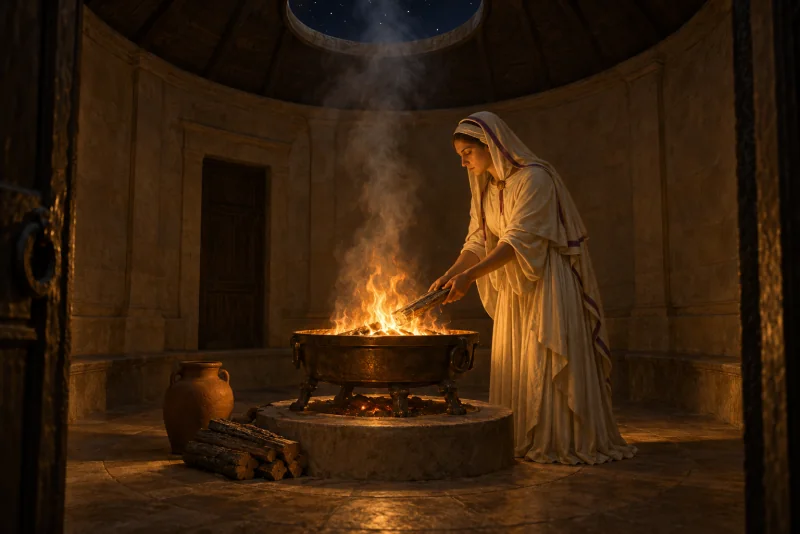
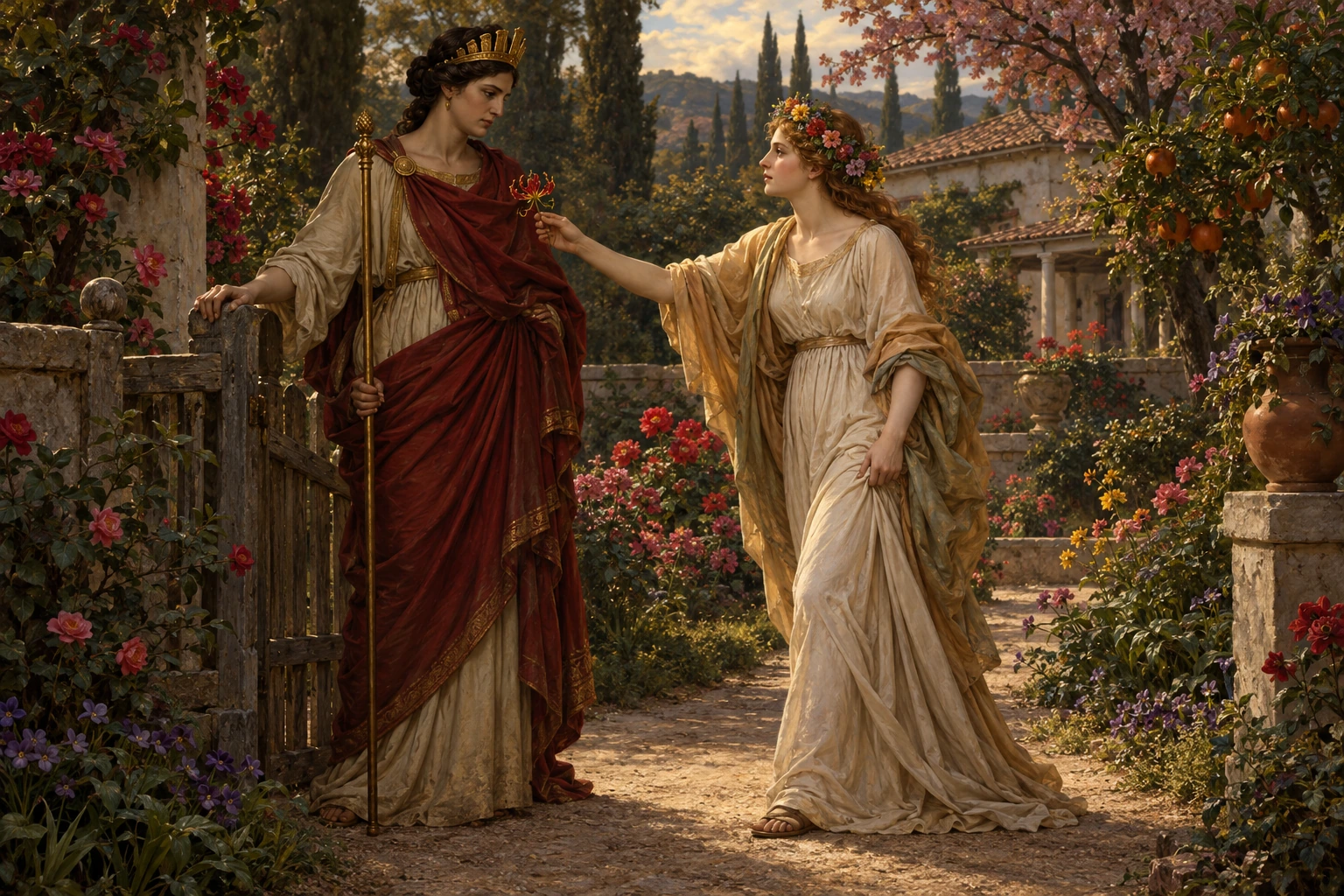
The goddess Flora tells the story in Ovid, and asks that Jupiter never hear it (Fasti 5.229–260). Juno was hurt that Jupiter had produced Minerva without a mother and had not needed her. If he could be a father without a wife, why could she not be a mother without a husband? On her way to complain to Ocean, she stopped, tired, at Flora’s door.
Flora hesitated three times, afraid of Jupiter’s anger. Then she told Juno of a flower, sent to her from the fields of Olenus, the only one of its kind in her garden. The man who gave it had said: “touch a barren heifer with this too, and she will be a mother.” Flora plucked it and touched Juno, and Juno conceived. She went to Thrace and the shores of the Propontis, and Mars was born. Mindful that he owed his birth to Flora, he told her: “you too shall have a place in the city of Romulus.”
1-3 The Father of the Founder
Ovid opens his book on March with Mars finding the Vestal Rhea Silvia asleep by a stream (Fasti 3.11–24). Their twins belong to Romulus and Remus. When the city stood, Romulus turned to his father: “Arbiter of arms, of whose blood I am believed born… from you we begin the Roman year: the first month shall be named after my father” (3.73–76). Mars, says Ovid, was to be revered in Latium “because he presides over arms” (3.85), and other Italian peoples had a month of Mars too: the third at Alba, the fifth at Falerii, the tenth among the Aequiculi. Romulus gave his father the first (3.89–98). Why the old year began in March belongs to Janus.
1-4 The Shield That Fell from Heaven
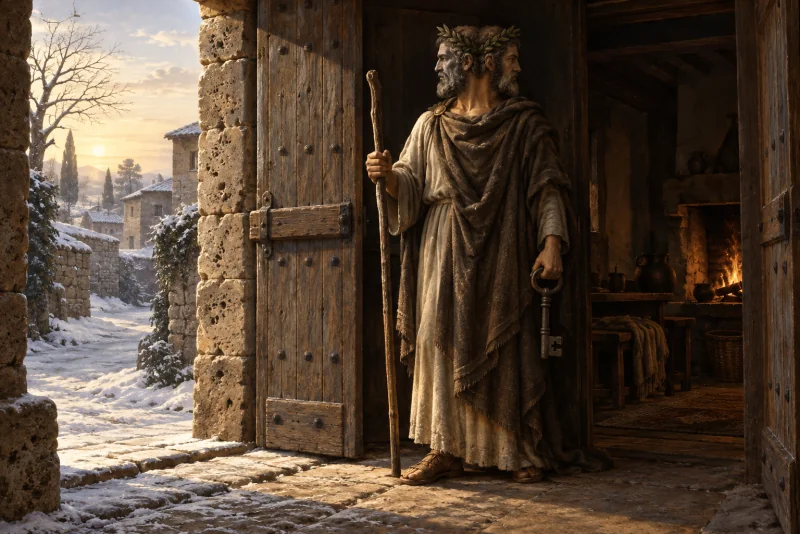
“Who will tell me now,” Ovid asks, “why the Salii carry the heavenly arms of Mars, and sing of Mamurius?” (3.259–260). The answer begins with Numa’s bargain with Jupiter, told in Numa and Egeria, and the god’s promise of a sign of empire at sunrise. At dawn the people crowded at the king’s door, and Numa sat on his maple throne. As the sun cleared the horizon he veiled his head in white and raised his hands. Jupiter thundered three times from a cloudless sky and sent three bolts of lightning. The sky split open in the middle, and a shield fell, turning gently on a light breeze. A shout went up to the stars. Numa sacrificed a heifer that had never borne the yoke, lifted the gift from the ground and called it the ancile, because it is cut away on every side and no corner shows (3.357–378).
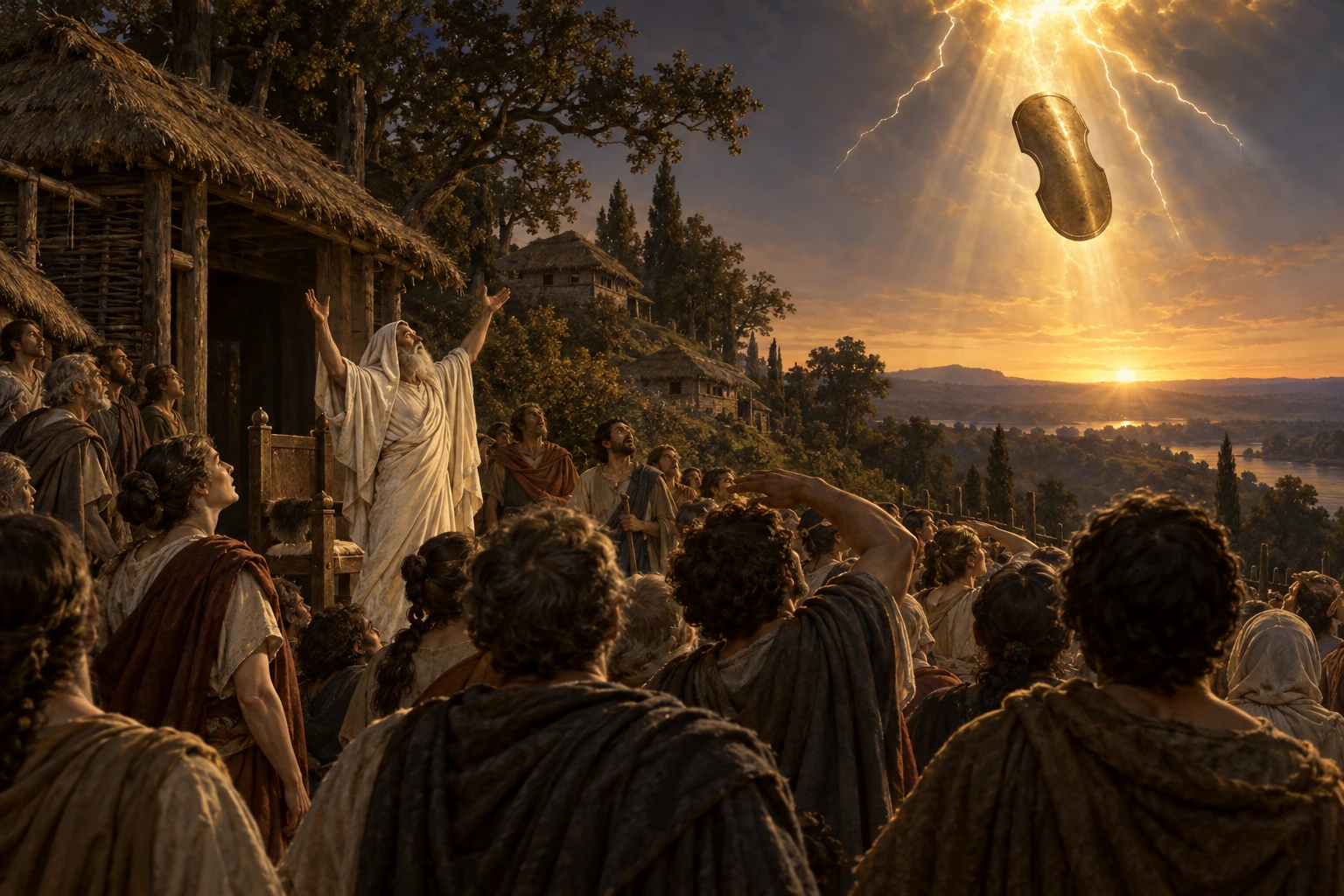
Knowing that the fate of Rome’s power rested on it, Numa had more shields made in the same shape, to confuse the eyes of a thief. The smith Mamurius did the work, and asked one reward: that his name be sung at the end of the Salii’s song. So the priests still call on Mamurius (3.379–392). Plutarch tells it otherwise. In the eighth year of Numa’s reign a plague crossed Italy, and a bronze shield fell from heaven into Numa’s hands. Egeria and the Muses told him it had come to save the city. Veturius Mamurius made eleven copies so exact that not even Numa could tell them apart, and the plague stopped (Numa 13.1–3).
The Salii took their name from leaping, salire (Fasti 3.387; Plutarch, Numa 13.4). Numa chose twelve young patricians, and both their fathers and their mothers had to be living (Dionysius 2.70.1, 2.71.4). In March they carried the shields through the city to the Forum and the Capitol, in embroidered tunics with belts of bronze, the scarlet-striped trabea and a tall conical cap, a sword at the waist and a spear or staff in the right hand. They danced in arms to the flute and sang ancient hymns, striking the shields as they went (2.70.2–5). Ovid advises against marrying while the shields are out: “arms stir up fights, and fighting is no business for husbands” (3.393–396).
1-5 Anna Perenna’s Trick
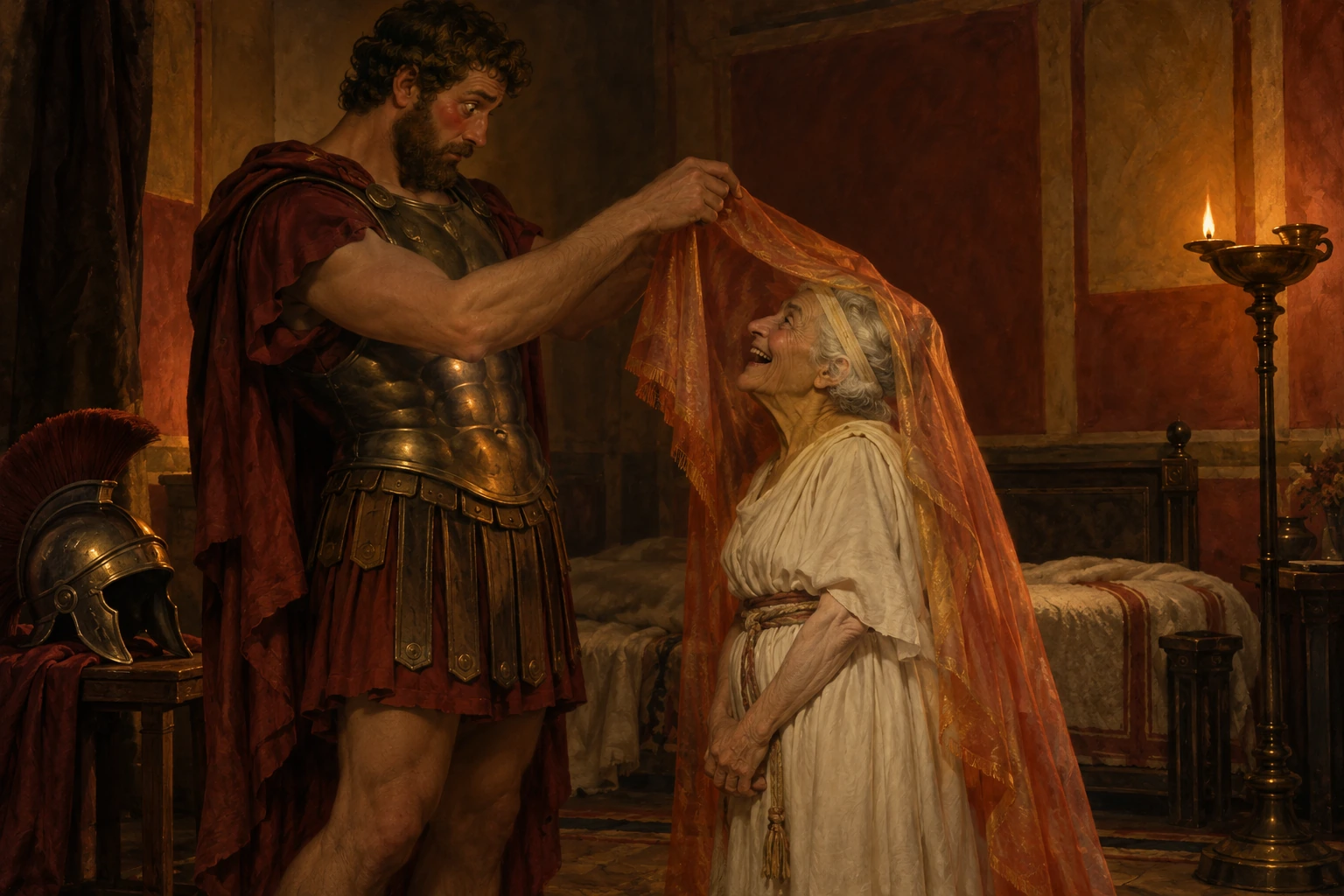
On the Ides of March the common people went out to the banks of the Tiber for the festival of Anna Perenna, drank in the grass under tents of reeds and togas, and prayed for as many years as the cups they drank (3.523–540). The girls sang dirty songs, and Ovid explains why (3.675–696). Anna had just become a goddess when Mars came to her: “you are honoured in my month… I burn with love for armed Minerva.” Would the kindly old woman bring them together? Anna kept him waiting with empty promises and at last said that Minerva had given in. Mars got the bridal chamber ready, and the bride was led in with her face veiled. When he went to kiss her, he saw Anna. The god felt shame, then anger, and the new goddess laughed at Minerva’s lover. Hence, says Ovid, the old jokes and the dirty songs.
1-6 Mars and Venus
Ovid also tells, with Roman names, a Greek story about Ares that Homer had sung. In the Odyssey the bard Demodocus sings “of the love of Ares and Aphrodite”. The Sun saw them, and the smith-god Hephaestus forged bonds “fine as spiders’ webs”, pretended to leave for Lemnos and caught the lovers in bed. The gods came to laugh, Poseidon pledged to pay for Ares’s release, and Ares went to Thrace and Aphrodite to Paphos (8.266–366). In Ovid, “the best-known story in all heaven” becomes Mars and Venus caught by Vulcan’s tricks. “Father Mars, shaken by mad love for Venus, from a terrible general became a lover”, and when Neptune has them set free, “Mars takes Thrace, she Paphos” (Art of Love 2.561–592; also Metamorphoses 4.169–189). The poet Lucretius gives the pair a Roman purpose: Mavors, vanquished “by the everlasting wound of love”, lies in Venus’s lap, and she is to ask him for peace for the Romans (1.31–40).
2 Where the Story Is Written Down
- Cato the Elder (234–149 BCE), On Agriculture 141. His translators call the book “our earliest extant specimen” of connected Latin prose. To purify his land the farmer has a pig, a lamb and a calf led around it, offers wine to Janus and Jupiter, and prays: “Father Mars, I pray and beseech thee that thou be gracious and merciful to me, my house, and my household… that thou keep away, ward off, and remove sickness, seen and unseen, barrenness and destruction, ruin and unseasonable influence; and that thou permit my harvests, my grain, my vineyards, and my plantations to flourish and to come to good issue, preserve in health my shepherds and my flocks”. If the omens are doubtful, he adds a pig: “Father Mars, inasmuch as thou wast not pleased by the offering of that pig, I make atonement with this pig.”
- The hymn of the Arval Brothers. This college of twelve priests sacrificed every May for the fields, in the grove of the goddess Dea Dia outside Rome, and had its minutes cut in stone. The song survives in the record for 218 CE, on a marble slab inscribed on both sides that was dug up in 1778, when the foundations of the Vatican sacristy were laid. The priests, shut in, “took the booklets” and danced to its words: enos Lases iuvate… neve lue rue Marmar sins incurrere in pleoris… satur fu, fere Mars, limen sali, sta berber… enos Marmor iuvato… triumpe. Each line is sung three times, and several words are still disputed. Roughly, in our rendering: “Help us, Lares! Marmar, do not let plague and ruin fall upon the many! Be sated, fierce Mars! Leap the threshold! … Help us, Marmar! Triumph!”
- Livy, writing under Augustus: Rhea Silvia’s claim (1.4.2), Numa’s priests (1.20), the Campus Martius (2.5).
- Greek writers of the Roman Empire: Plutarch and Dionysius of Halicarnassus on the shield and the Salii (Numa 13; Roman Antiquities 2.70–71), Plutarch on the wolf and the woodpecker (Romulus 4) and the October Horse (Roman Questions 97). The October Horse is also in Festus, who abridged the scholar Verrius Flaccus, and in Paulus’s shorter epitome of Festus.
3 Competing Versions
3-1 The Ancient Versions
- Who were his parents? In the Iliad, Zeus tells Ares: “thou art mine offspring, and it was to me that thy mother bare thee” (5.895–896). Ovid’s Juno has him without a husband. The historian of Roman festivals W. Warde Fowler thought the Matronalia, the women’s festival on 1 March, “suggested the motherhood of Juno and the birth of Mars”, and that the festival could not be used “to show that these myths were old and native”.
- How did the shield come? Ovid: from the open sky at sunrise, before the people. Plutarch: into Numa’s hands during a plague. Dionysius: it was found in Numa’s palace, though no one had brought it there (2.71.1). Ovid gives no number of copies, Plutarch eleven, and Livy speaks of the twelve shields the Salii carried.
- Whom do the Salii sing? Ovid and Plutarch: the smith Mamurius. Varro, and “some” in Plutarch (13.7): the words Mamuri Veturi mean memoriam veterem, “the ancient memory”. Fowler adds that Mamurius is “now generally recognized as being only a variant of the name Mars”.
- Whose festivals? Modern handbooks count the Quinquatrus (19 March) and the Tubilustrium, the purifying of the trumpets (23 March), among the feasts of Mars. Ovid gives both to Minerva (Fasti 3.809–814, 3.849–850).
3-2 A God of Farming or of War?
- Mars of the crops. James George Frazer, quoted by Fowler in 1899, wrote that “Mars was originally not a god of war, but of vegetation”. His evidence was the farmer’s prayer, the Arval hymn and the spring month of March. He also read a rite of 14 March, in which a man in skins called Mamurius Veturius was beaten out of the city, as the driving out of “the old Mars”.
- Both at once. Fowler was more careful. He saw the Salii protecting the spirit of the growing crops from “hostile demons”, wrote of “how attributes apparently so distinct as the military and the agricultural should be found united in Mars and his cult”, and now hesitated to endorse Frazer’s conclusions “in their entirety (as I did for many years)”.
- A warrior from the start. Georges Dumézil, in Archaic Roman Religion, studied Mars within an old triad with Jupiter and Quirinus and went through “the dossier of the agrarian Mars”: the October Horse, two rites in Cato and the Arval hymn. Mars, he argued, is “always and everywhere: the actual or virtual fighter”. Whatever he guards, “he is the sentinel who operates at the front, on the threshold”. In Cato’s prayer he stands “drawn up against the enemies”, and those enemies are “personifications of plagues and disasters regarded as assailants”.
- The Romans themselves held both answers at once. Paulus says the October Horse was sacrificed “because of the outcome of the crops” (ob frugum eventum), and that a horse was chosen rather than an ox because the horse is fit for war, the ox for the harvest.
4 History and Tradition
- March and October. Horse races called the Equirria were held for Mars on 27 February and 14 March on the Campus Martius, or on the Caelian hill if the Tiber had flooded the field (Fasti 2.857–860, 3.517–522; Varro, On the Latin Language 6). On 19 October, the Armilustrium, arms were purified. In Fowler’s reading the shields were then put away for the winter, and Mars had no festival again until 1 March.
- The October Horse. On the Ides of October there was a chariot race on the Campus Martius, and the right-hand horse of the winning pair was sacrificed to Mars. Its head was hung with loaves, and the men of the Sacra Via and of the Subura fought for it: the first to fix it on the wall of the Regia, the old king’s house in the Forum, the second on the Mamilian tower. The tail was rushed to the Regia, so that its blood dripped on the hearth (Festus and Paulus). Plutarch puts the rite on the Ides of December, “presumably an error”, says his translator Frank Babbitt. The Greek historian Timaeus said the Romans killed a war-horse on a certain day in memory of Troy, which fell through the wooden horse. Polybius called that “a most childish statement” (12.4b).
- The Field of Mars. When the kings were driven out, “the land of the Tarquins, which lay between the City and the Tiber, was henceforth sacred to Mars and known as the Campus Martius”, and the grain standing on it was cut and thrown into the river (Livy 2.5.2–3). It had an old altar of Mars, and a temple was built beside it in 138 BCE. Another temple stood outside the Porta Capena from 388 BCE.
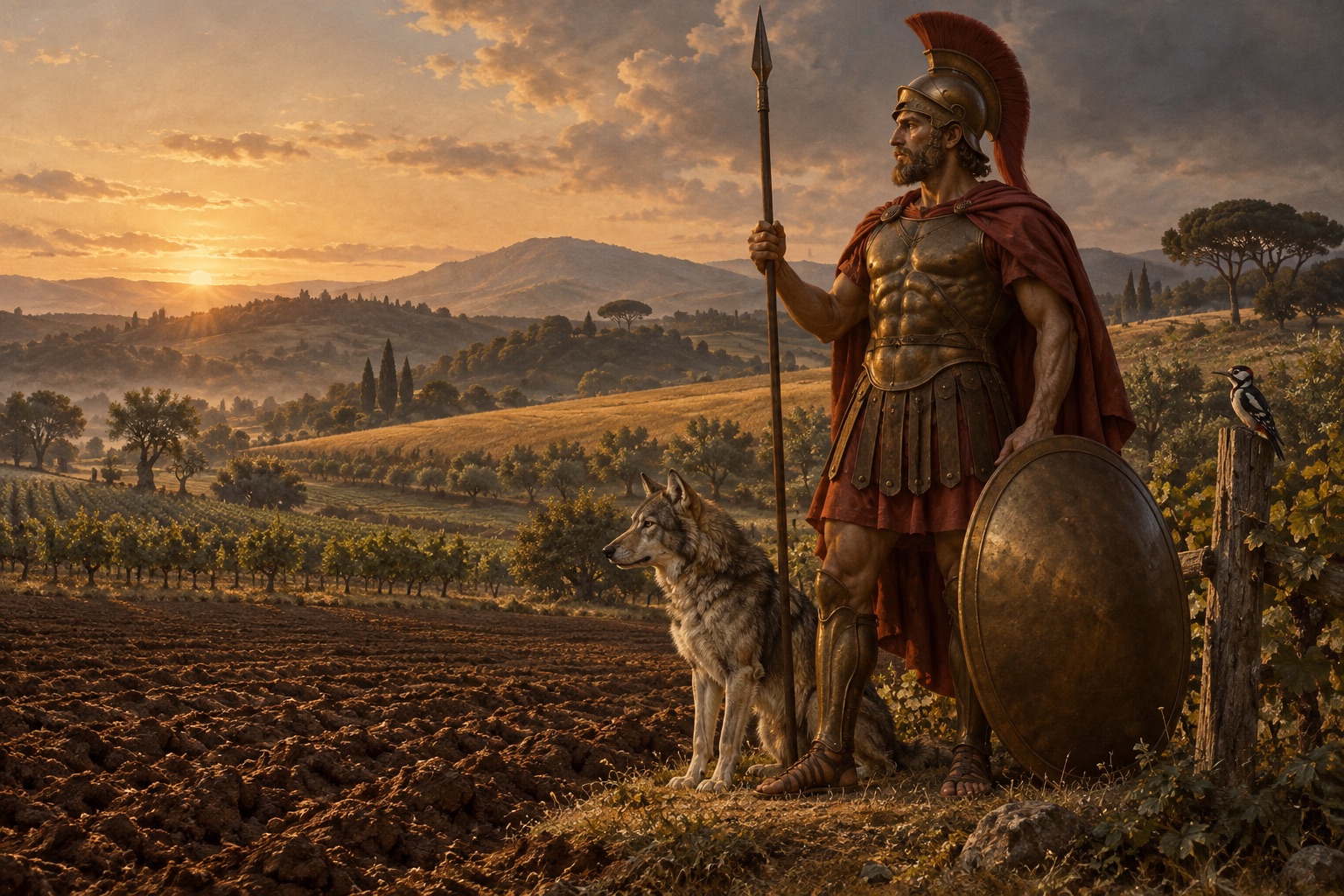
- The wolf and the woodpecker. Both were “sacred to Mars”, says Plutarch, which is why Rhea Silvia was believed (Romulus 4.2), and Ovid calls the woodpecker “the bird of Mars” (Fasti 3.37). At the battle of Sentinum a wolf ran between the Roman ranks, and a soldier cried that the wolf, “whole and unhurt, a creature sacred to Mars, reminds us of our Founder and that we too are of the race of Mars” (Livy 10.27.8–9).
- Mars the Avenger. Octavian “had made a vow to build the temple of Mars in the war of Philippi, which he undertook to avenge his father”, Julius Caesar (Suetonius, Augustus 29.2). He built it “on my own ground… from the spoils of war” (Res Gestae 21) and laid in its inner shrine the Roman standards the Parthians returned (29). It was dedicated in 2 BCE, and the senate debated wars and triumphs there. Inside stood colossal statues of Mars, father of Romulus, and of Venus, mother of Aeneas and ancestor of Augustus’s family, the Julii. Three of its columns still stand in the Forum of Augustus. In the Capitoline Museums, a colossal Mars in helmet and breastplate known as “Pyrrhus”, carved in 110–138 CE, is by recent consensus a copy of its cult statue.
“Mars is just the Roman name for Ares” is half true. Romans did equate them: Ovid retold Homer’s Ares and Aphrodite as Mars and Venus, and in 217 BCE, when the gods were feasted on six couches in pairs, Mars shared his with Venus (Livy 22.10). But Treccani notes that Mars was “far more venerated and popular among the Italic peoples than Ares among the Greeks”, and that his Greek myths were attached to him later. Zeus tells Ares: “Most hateful to me art thou of all gods that hold Olympus” (Iliad 5.890). Rome called Mars father.
5 Related Stories
- Romulus and Remus: The Twins and the She-Wolf: the sons of Mars and Rhea Silvia, fed by his wolf and his woodpecker. Ovid’s Romulus names the first month of the year after his father.
- Numa and Egeria: The King and the Water Nymph: the bargain over lightning that ends, the next morning, with a shield falling from the sky.
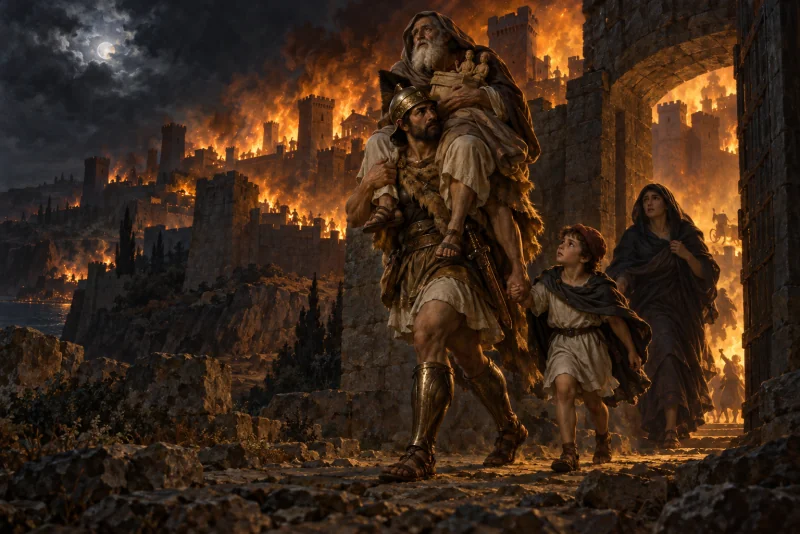
- Aeneas: The Trojan Who Became Rome’s Ancestor: the son of Venus. In Ovid, Mars looks out from his temple on Aeneas carrying his father on one side, and on Romulus carrying an enemy leader’s arms on the other (Fasti 5.563–566).
- The Odyssey: Ten Years on the Way Home from Troy: in Book 8 the bard Demodocus sings of Ares and Aphrodite caught in Hephaestus’s bonds, the song Ovid turned into Mars and Venus.
- Athena: Born from Her Father’s Head: the birth from her father’s head that the Romans told of Minerva. In Ovid’s Fasti it is this motherless birth that sends Juno to Flora’s door.
6 Sources
- Cato, On Agriculture 141, trans. W. D. Hooper and H. B. Ash (Loeb, 1934), with their introduction: LacusCurtius
- Ovid, Fasti 2.857–864, 3.1–396, 3.517–542, 3.675–696, 3.809–850, 5.229–260 and 5.545–598, Latin text: The Latin Library, book 2, book 5; Art of Love 2.561–592 and Metamorphoses 4.169–189: The Latin Library
- Lucretius, On the Nature of Things 1.29–40, Latin text: The Latin Library; Varro, On the Latin Language 5 and 6, Latin text: The Latin Library
- Livy, History of Rome, preface and 1.4, 1.20, 2.5, 10.27, trans. Rev. Canon Roberts (Dutton, 1912): Perseus; 22.10, Latin text: The Latin Library
- Plutarch, Life of Numa 13 and Life of Romulus 4, trans. Bernadotte Perrin (Loeb, 1914): LacusCurtius; Roman Questions 97, trans. Frank Cole Babbitt (Loeb, 1936): LacusCurtius
- Dionysius of Halicarnassus, Roman Antiquities 2.70–71, trans. Earnest Cary (Loeb, 1937): LacusCurtius; Polybius, Histories 12.4b, trans. W. R. Paton (Loeb, 1925): LacusCurtius
- Festus and Paulus, On the Meaning of Words, “October equus” and “Panibus”, ed. Emil Thewrewk de Ponor (1889): Internet Archive
- Homer, Odyssey 8.266–366, trans. A. T. Murray (Loeb, 1919), and Iliad 5.889–898, trans. A. T. Murray (Loeb, 1924): Perseus, Perseus
- Suetonius, Augustus 29, trans. J. C. Rolfe (Loeb, 1913): LacusCurtius; Res Gestae 21, 22 and 29, trans. Frederick W. Shipley (Loeb, 1924), with his notes: LacusCurtius
- Wilhelm Henzen, Acta Fratrum Arvalium quae supersunt (1874), p. CCIV, the record of 218 CE: Internet Archive; “Arval Brothers”, Encyclopædia Britannica, 11th edition (1911): Wikisource
- W. Warde Fowler, The Roman Festivals of the Period of the Republic (1899), pp. 38–50 and 241–251, quoting J. G. Frazer, The Golden Bough: Internet Archive
- Georges Dumézil, Archaic Roman Religion, trans. Philip Krapp (University of Chicago Press, 1970): Internet Archive
- Sovrintendenza Capitolina, “La cella del Tempio” (Forum of Augustus): sovraintendenzaroma.it; Turismo Roma, “Foro di Augusto”: turismoroma.it; Musei Capitolini, “Colossal statue of Mars: Pyrrhus” (S 58): museicapitolini.org
- “Marte”, Enciclopedia Treccani: Treccani; Ogawa Masahiro, “マルス”, Nipponica: Kotobank
Cover and illustrations: AI-generated images made for Arcana. They are interpretations, not historical artworks.