Numa and Egeria: The King and the Water Nymph
Rome's second king was said to take his laws from a goddess who met him by a spring at night, to bargain with Jupiter over the cure for lightning, and to be buried with his own sacred books. The books were dug up and burned in 181 BCE, and the Romans themselves doubted the story that he had studied with Pythagoras.
- Type: founding legend, the king who gave Rome its religion and the goddess who advised him
- Culture: ancient Rome and Latium
- Earliest texts: the annalist Cassius Hemina (2nd century BCE), known only from quotations; Cicero’s On the Republic (54–51 BCE); book 1 of Livy’s History of Rome (begun 27–25 BCE); Ovid’s Fasti and Metamorphoses (begun about 3 CE)
- Key figures: Numa Pompilius, Egeria, the Camenae, Picus, Faunus, Jupiter, Hippolytus (Virbius), Diana
The Romans remembered their first king, Romulus, as a fighter. They remembered the second as his opposite: a Sabine who did not want the throne, kept Rome at peace for his whole reign, gave the city its priests and its calendar, and said that he had them from a goddess who met him at night by a spring.
Did the Romans believe Numa really met a goddess? Many did not. Livy writes that Numa “pretended” to meet Egeria at night, because a rough people would learn to fear the gods only through some marvel (1.19.4–5). Dionysius of Halicarnassus reports the same view (2.61). Plutarch thinks a god might well befriend a good man, but “that an immortal god should take carnal pleasure in a mortal body and its beauty, this, surely, is hard to believe” (Numa 4.3).
1 The Telling
No single ancient writer tells the whole story. The reign follows Livy, History of Rome 1.18–21, in Canon Roberts’s translation (1912); the episodes Livy leaves out come from Ovid and from Plutarch’s Life of Numa, in Bernadotte Perrin’s translation (1914). Lines of Ovid, Virgil, Cicero and Juvenal are our own translations from the Latin, numbered as in The Latin Library’s texts.
1-1 The King from Cures
After Romulus vanished in a storm, the senators took turns at ruling, until the Romans and the Sabines agreed that one people should choose a king from the other (Plutarch, Numa 2–3). The choice fell on Numa Pompilius of Cures, a Sabine town, a man “as conversant as any one in that age could be with all divine and human law” (Livy 1.18.1). Plutarch adds that he was born on 21 April, the day Rome was founded, and had married Tatia, the only daughter of Titus Tatius, the Sabine who had shared the throne with Romulus. After her death he took to wandering alone “in groves of the gods, sacred meadows, and solitudes” (3.4–4.1). He was nearly forty when the envoys came, and at first he refused (5.1–6.1).
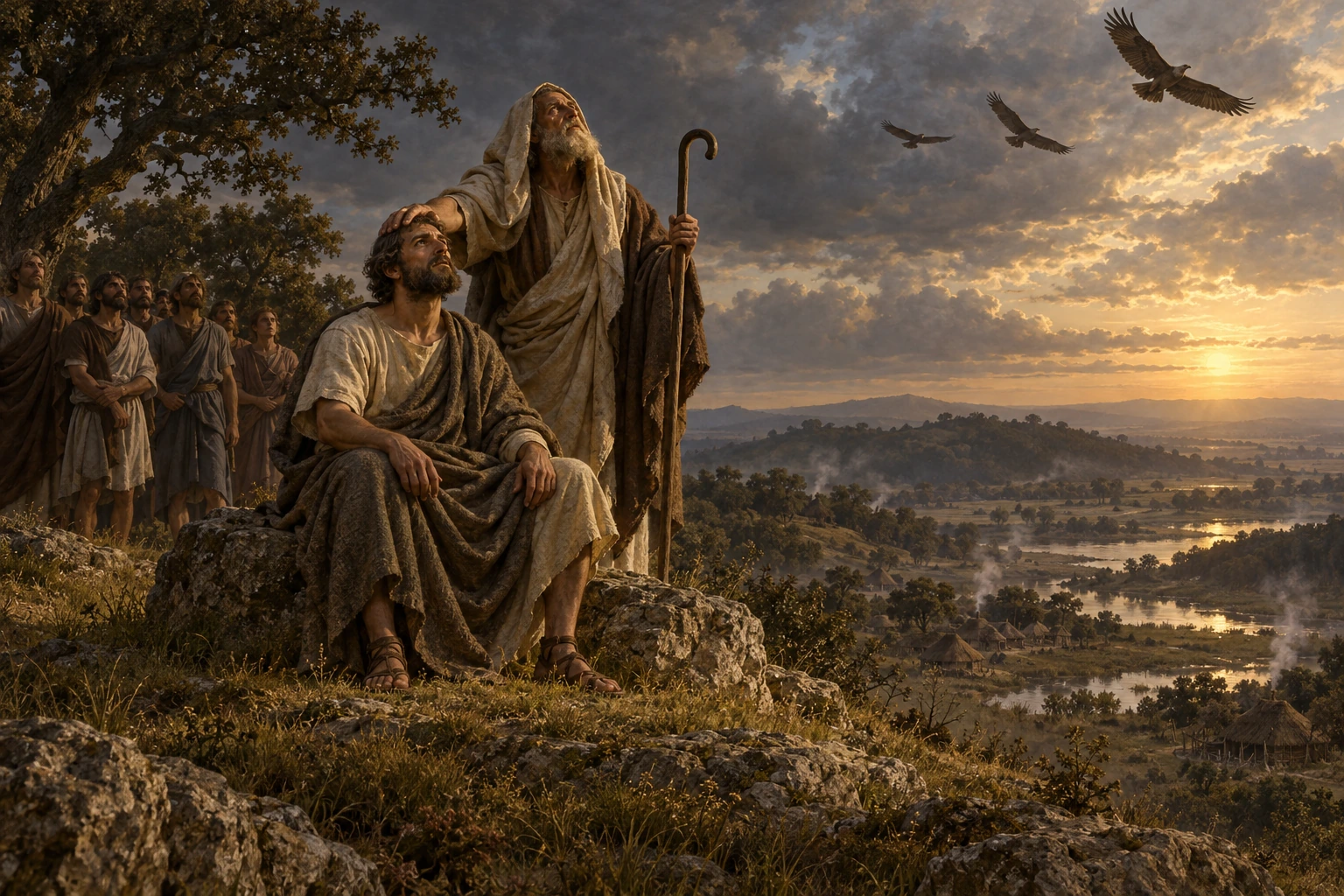
Before he would rule, Numa asked that the gods be consulted, as they had been for Romulus. An augur led him up to the citadel, and he sat on a stone facing south. The augur took his place on Numa’s left, his head covered, holding “a curved staff without any knots, which they called a ‘lituus’”. He marked out the regions of the sky, moved the staff to his left hand, laid his right on Numa’s head and prayed: “Father Jupiter, if it be heaven’s will that this Numa Pompilius, whose head I hold, should be king of Rome, do thou signify it to us by sure signs within those boundaries which I have traced.” The signs came, and Numa went down a king (Livy 1.18.6–10).
1-2 Egeria and the Grove of the Camenae
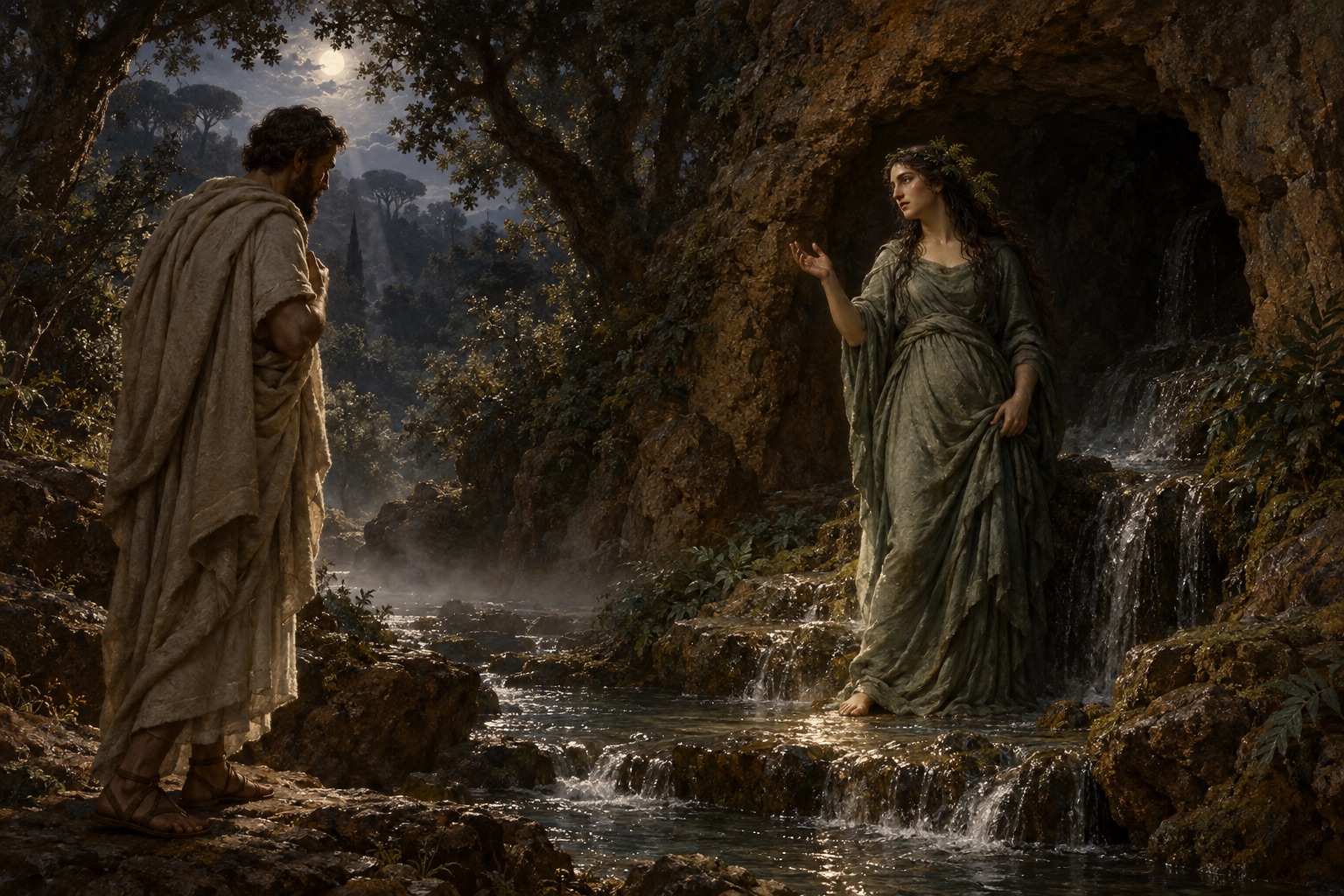
Rome had been founded by arms, and Numa set out to found it again “by laws and customs”. He built the shrine of Janus as a sign of war and peace, made treaties with his neighbours, and then turned to the fear of the gods. That, Livy explains, would not reach a rough people without some claim to a marvel, so “he pretended that he had nocturnal interviews” with Egeria, whom Livy calls a goddess, and said that he set up the rites and the priesthoods on her advice (1.19.1–5). “There was a grove through the midst of which a perennial stream flowed, issuing from a dark cave.” Numa often went there alone, “as if to meet the goddess”, and consecrated the grove to the Camenae, “because it was there that their meetings with his wife Egeria took place” (Livy 1.21.3).
Plutarch tells it as a love story: “the goddess Egeria loved him and bestowed herself upon him”, and her company gave him “a wisdom more than human” (4.2). When people doubted it, he invited many of them to a plain meal in his bare house, then told them the goddess had come to visit, and the room was suddenly full of costly cups and laden tables (15.2). Dionysius tells the same trick and says Egeria told him how to do it (2.60.5–7).
1-3 The Price of Lightning
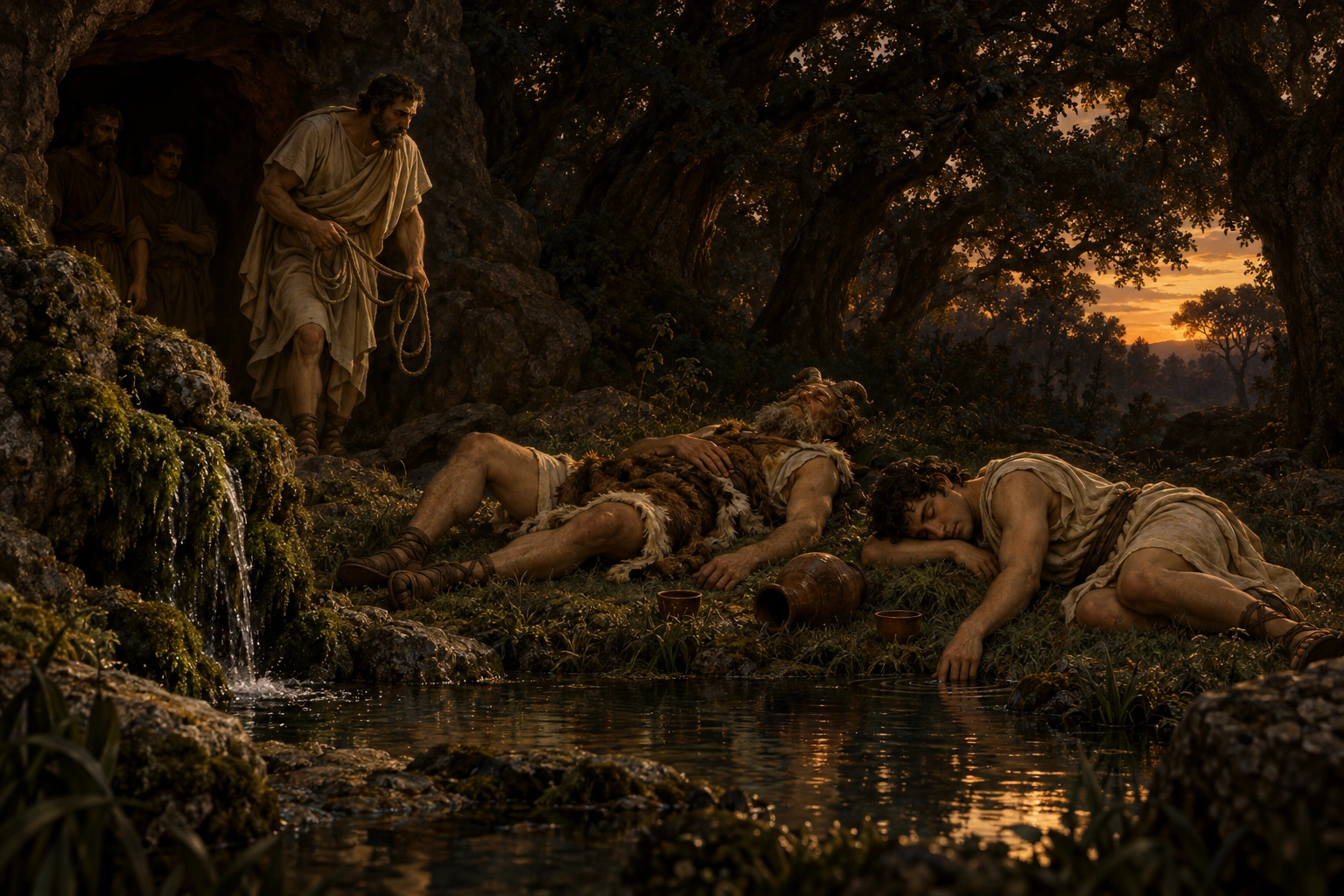
Ovid tells the strangest episode in the Fasti, his poem on the Roman calendar, where he asks why the Salii carry the heavenly arms of Mars in March (3.259–392). Jupiter was hurling fire through the clouds, and king and people were terrified. Egeria told Numa that lightning could be expiated, and that two gods of the Roman soil, Picus and Faunus, knew the rite, but would teach it only if he caught and bound them.
Below the Aventine lay a grove “black with the shade of holm-oak”, with a spring that seeped from a mossy rock. There Numa sacrificed a sheep to the spring, set out cups of wine and hid in the cave with his men. The two gods came to drink as usual, drank the wine and fell asleep, and Numa came out of the cold cave and tied their hands. Faunus, shaking his horns, said that what he asked was beyond them: they were gods of the countryside, and lightning belonged to Jupiter. But untie us, said Picus, and Jupiter will come. What they did next, says Ovid, it is not lawful for a man to know. They drew Jupiter down from the sky, and that is why he is called Elicius, “the one drawn out” (3.295–328).
The Aventine woods shook, the earth sank under his weight, and Numa’s hair stood on end. He asked for a sure remedy. Jupiter nodded, but hid the truth in a riddle. “Cut a head,” he said. “We will obey,” said Numa: “an onion dug from my garden.” “Of a man,” said Jupiter. “You will have hair.” Jupiter asked for a life. “Of a fish,” said Numa. The god laughed, called him a man “not to be kept from talking with the gods”, and promised a sign of empire for the next morning (3.329–348). At sunrise a shield fell from the open sky: that story belongs to Mars and his leaping priests, the Salii (3.349–392).
1-4 Priests, Rites and Peace
Livy credits Numa with the frame of Roman religion: a calendar of twelve lunar months with inserted months to keep it level with the sun; days on which public business was or was not allowed; a priest (flamen) for Jupiter, with a special dress and the royal chair, and flamens for Mars and Quirinus; the Vestal Virgins, a priesthood from Alba; twelve Salii for Mars; a pontiff, Numa Marcius, who kept the written rules of every sacrifice; an altar to Jupiter Elicius on the Aventine; and a yearly rite of Faith (Fides), whose priests worked with their hands wrapped to the fingers (1.19.6–1.21.5). Cicero adds two augurs and five pontiffs (On the Republic 2.26), Plutarch the god of boundaries, Terminus, and guilds of craftsmen (16–17). Above all, says Livy, he kept the peace: Romulus reigned 37 years, Numa 43 (1.21.5–6).
1-5 Two Stone Chests
Numa died of old age, Plutarch says, at a little over eighty. At his own command he was not burned. Two stone coffins were made and buried below the Janiculum: one for his body, the other for the sacred books he had written out himself. He had taught their contents to the priests and wanted the books buried with him, “convinced that such mysteries ought not to be entrusted to the care of lifeless documents” (21.4–22.2).
Then, in 181 BCE, workmen digging deep on the land of Lucius Petilius, a scribe, at the foot of the Janiculum, found two stone chests about eight feet long, their lids sealed with lead. Inscriptions in Latin and Greek said that one held Numa Pompilius, son of Pompo, king of the Romans, and the other his books. The king’s chest was empty, “with no vestige of a human body or of anything else”. The other held two bundles tied with cords steeped in wax, seven books in each, “not only intact but to all appearance new”: seven in Latin on pontifical law, seven in Greek on philosophy. The city praetor, Quintus Petilius, read the main points and judged that most of them “would lead to the break-up of the national religion”. The senate took his oath on it, and the books “were burnt in the comitium in the sight of the people in a fire made by the victimarii”, the attendants at sacrifices (Livy 40.29.2–14).
1-6 Egeria at Aricia
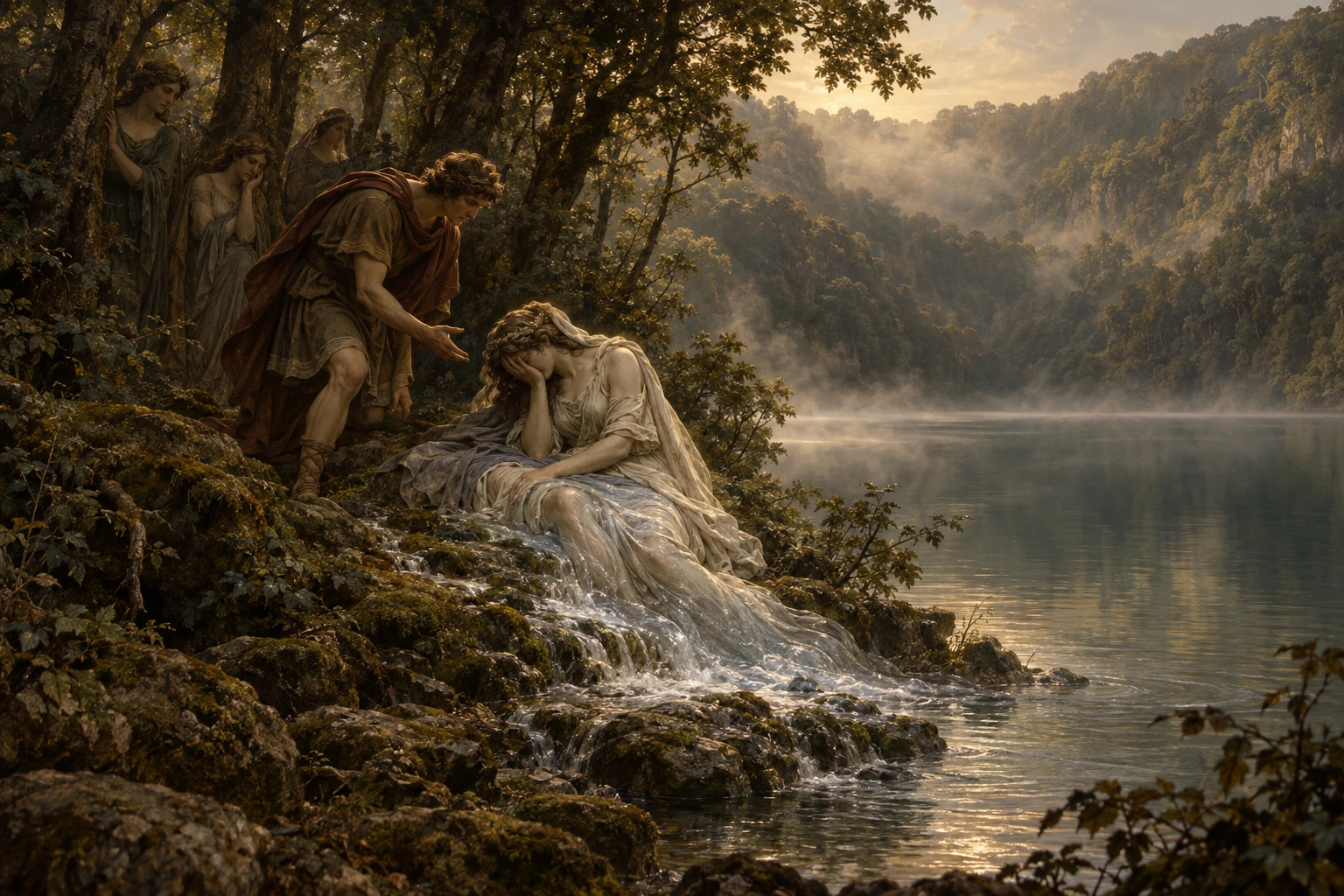
Ovid ends the story in the Metamorphoses (15.479–551). When Numa died, old in years and in his reign, Egeria left Rome. She hid in the thick woods of the valley of Aricia, by the lake of Diana, and disturbed the goddess’s rites with her weeping. The nymphs of the grove and the lake begged her to stop. Hippolytus, son of Theseus, told her his own story to comfort her: falsely accused by his stepmother, cursed by his father, dragged to death by his horses when a bull rose out of the sea, brought back to life by the medicine of Apollo’s son, and hidden by Diana here, in this grove, under a new name, Virbius. But the sorrows of others could not ease hers. Lying at the foot of the mountain, she melted into tears, until Diana, moved by her devotion, made a cool spring of her body and thinned her limbs into everlasting water.
2 Where the Story Is Written Down
- The annalists. Rome’s earliest prose histories survive only in quotations. Pliny the Elder, in his Natural History (13.84–87), quotes Cassius Hemina, an annalist of the 2nd century BCE, on Numa’s books, and adds the versions of Calpurnius Piso, Tuditanus and Valerius Antias. Pliny tells the story in a chapter on papyrus: Hemina had said the books were written on it.
- Cicero, On the Republic 2.25–30, begun in 54 and finished in 51 BCE. Scipio sums up Numa’s reign, and is asked whether Numa was really a pupil of Pythagoras.
- Livy, History of Rome 1.18–21, the fullest account of the reign, and 40.29 on the books. Livy began his history between 27 and 25 BCE; in 1.19.3 he writes that the gates of Janus had been shut after the battle of Actium, in his own generation.
- Dionysius of Halicarnassus, Roman Antiquities 2.57–76, a Greek history of early Rome, with the election, the Pythagoras question, Egeria and the laws.
- Ovid: the Fasti (3.151–154 and 3.259–392) and the Metamorphoses (15.1–11 and 15.479–551), both begun about 3 CE.
- Plutarch, Life of Numa, by a Greek writer of about 46 to after 119 CE, paired with the life of the Spartan lawgiver Lycurgus.
- Later witnesses: Juvenal, Satire 3.10–20, by a satirist of about 55 to after 127 CE, on the grove at the Porta Capena; and Varro, whose book on the worship of the gods Augustine quotes in the City of God (7.34–35), on the books and on Egeria’s name.
3 Competing Versions
- Who was Egeria? A goddess and Numa’s wife in Livy (1.19.5, 1.21.3); “a certain goddess or mountain nymph” in Plutarch (8.6); a nymph, or in other accounts one of the Muses, in Dionysius (2.60.5); in the Fasti, the nymph who supplies the stream at Aricia, “dear to the Camenae”, Numa’s “wife and counsel” (3.275–276). Varro explained her away: Numa practised divination with water, and because he carried water out (egerere) he was said to have married Egeria. “Thus facts are wont to be converted into fables through false colorings,” Augustine quotes him (City of God 7.35, trans. Marcus Dods).
- Where did they meet? Livy gives a grove with a spring from a dark cave but no place (1.21.3). Juvenal puts it at the Porta Capena (3.10–20). Plutarch has the grove where the heavenly shield fell, whose spring gave the Vestals their holy water (13.2). Ovid places Egeria’s stream at Aricia, and Virgil’s Aeneid already has Diana send Hippolytus away “to the nymph Egeria and her grove” there (7.761–777).
- How did Numa learn the charm? In Ovid, Egeria tells him how to catch Picus and Faunus, and they bring down Jupiter. In Plutarch, Numa catches them with wine and honey in their spring; they change into hideous shapes, then either teach him the charm “with onions, hair, and sprats” themselves or call Jupiter down. When Plutarch’s Jupiter begins “with living…”, Numa breaks in with “sprats”, “as he had been taught by Egeria to say” (15.3–6).
- Whose head was covered? In Livy, the augur’s (1.18.7). In Plutarch, the augur turns “the veiled head of Numa” to the south (7.2).
- How long did he reign? Forty-three years in Livy (1.21.6) and Dionysius (2.76.5). Cicero, following the Greek historian Polybius, gives thirty-nine (On the Republic 2.27).
- Who found the books, and how many? Livy: workmen on Lucius Petilius’s land. Hemina, quoted by Pliny: the scribe Gnaeus Terentius, digging his own field. Varro: Terentius’s ploughman, passing close to Numa’s tomb (Augustine 7.34). Plutarch: heavy rains washed the earth away (22.4), though Livy says that year no rain fell for six months (40.29.2). Seven books in Latin and seven in Greek in Livy and in Piso; twelve and twelve in Antias (Pliny 13.87; Plutarch 22.4). Pliny counts 535 years from Numa’s reign to the find; Plutarch says about four hundred.
- What was in them, and why burn them? Pontifical law and philosophy that would undermine religion (Livy); Pythagorean philosophy, burned because it was philosophy (Hemina); Numa’s decrees (Tuditanus); the reasons behind the rites, which the senate preferred to keep unknown (Varro, in Augustine 7.34).
4 History and Tradition
- A real king? The traditional dates of the reign are 715–673 BCE. The Treccani encyclopedia notes that Numa’s religious institutions are much like those of other Latin and Italic peoples, but that “despite the unacceptability of the traditional data, he was probably a historical figure” (our translation).
- The grove at the Porta Capena. In Juvenal’s day the grove of the sacred spring was rented out, “the Camenae evicted”, and the cave lined with marble: how much nearer the spirit of the water would be, he complains, if grass edged it “and marble did not violate the native tufa”. Platner and Ashby’s Topographical Dictionary of Ancient Rome (1929) placed the spring at the foot of the southern end of the Caelian hill, but found it “impossible to identify it certainly”. Tradition gave Numa a small bronze shrine there; struck by lightning, it was moved to the temple of Honos and Virtus, and later to the temple of Hercules of the Muses.
- Aricia and Nemi. The geographer Strabo, describing the lake of Diana near Aricia, says that one of the springs that feed it “is ‘Egeria,’ as it is called from a certain deity” (5.3.12). Ovid says he often drank from it (Fasti 3.274). James George Frazer opened The Golden Bough in this grove and supposed “that the spring which fell into the lake of Nemi was the true original Egeria”, brought to Rome by settlers from the Alban hills. He also guessed that the legend of Numa and Egeria remembered a sacred marriage between the early kings and “a goddess of vegetation and water”. Women with child, Frazer writes, “used to sacrifice to Egeria” at Nemi, and Treccani describes her as an archaic Latin goddess of springs and of childbirth.
- The “Nymphaeum of Egeria”. The grotto now shown under that name in the Caffarella valley is a summer grotto of the estate of Herodes Atticus and his wife Annia Regilla on the Via Appia. Alessio De Cristofaro traces its name to the early 16th century, when the Porta Capena was confused with the Porta San Sebastiano; it was usual by the 1540s, and the Caffarelli family entertained the emperor Charles V there on 5 April 1536. The identification, he writes, “we now know to be wrong”.
- Two kinds of sacred book. In the next breath after Numa’s books, Pliny recalls the three books the Sibyl brought to Tarquin the Proud (13.88); their story is told in The Sibyl of Cumae. Augustine used Varro’s account of Numa’s books to argue that the Roman rites could not bear having their causes known (City of God 7.34–35).
“Numa learned his wisdom from Pythagoras” is a claim the Romans themselves rejected. Ovid’s Metamorphoses sends Numa to Croton to hear him (15.1–11, 479–481), and Valerius Antias called Numa’s books Pythagorean. But Livy notes that Pythagoras taught in southern Italy “more than a century later” (1.18.2), and in Cicero, Scipio calls the story “false, and not only made up but made up ignorantly and absurdly”, since Pythagoras reached Italy some 140 years after Numa’s death (2.28–29). Dionysius adds that Croton itself was founded four years after Numa became king (2.59). Livy even calls Antias’s version a fiction fitted to “the common opinion” (40.29.8). Plutarch, who lists the arguments for it, admits that the matter “is involved in much dispute” (8.10).
5 Related Stories
- Mars: The Father of Rome: the morning after the bargain over lightning, Ovid’s Jupiter keeps his promise and a shield falls from heaven. Numa has copies made, so that no thief can tell the true one, and gives them to the Salii.
- Vesta: The Hearth Goddess and Her Virgins: Livy makes Numa the founder of the Vestal Virgins, and Plutarch has them sprinkle the temple of Vesta every day with water from the spring of the Camenae.
- Janus: The Two-Faced God of Doorways: Numa built the gates of Janus, and Plutarch says that in his 43 years they were never seen open for a single day. He is also said to have put January at the head of the year.
- Zeus: The Youngest Son Who Became King of the Gods: Dionysius writes that those who strip the fables out of history saw Numa imitating Minos of Crete, who claimed to talk with Zeus and brought down his laws from the Dictaean cave, “in which the Cretan legends say that the new-born Zeus was brought up”.
6 Sources
- Livy, History of Rome 1.18–21 and 40.29, trans. Rev. Canon Roberts (E. P. Dutton, 1912): Perseus, Perseus; Latin text: The Latin Library, The Latin Library
- Plutarch, Life of Numa, trans. Bernadotte Perrin (Loeb, 1914): LacusCurtius
- Dionysius of Halicarnassus, Roman Antiquities 2.57–76, trans. Earnest Cary (Loeb, 1937): LacusCurtius
- Ovid, Fasti 3 and Metamorphoses 15, Latin text: The Latin Library, The Latin Library; Metamorphoses, trans. Brookes More (Cornhill, 1922): Perseus
- Cicero, On the Republic 2.25–30, Juvenal, Satire 3, and Virgil, Aeneid 7.761–777, Latin text: The Latin Library, The Latin Library, The Latin Library
- Pliny the Elder, Natural History 13.84–88, Latin text: LacusCurtius; trans. John Bostock and H. T. Riley (Taylor and Francis, 1855): Perseus
- Augustine, City of God 7.34–35, trans. Marcus Dods (1887): New Advent
- Strabo, Geography 5.3.12 (Loeb, 1923): LacusCurtius
- Samuel Ball Platner and Thomas Ashby, A Topographical Dictionary of Ancient Rome (Oxford, 1929), “Camenae”: LacusCurtius
- James George Frazer, The Golden Bough, abridged edition (1922), chapters 1 and 13: Project Gutenberg
- Alessio De Cristofaro, “Baldassare Peruzzi, Carlo V e la ninfa Egeria: il riuso rinascimentale del Ninfeo di Egeria nella valle della Caffarella”, Horti Hesperidum 3 (2013): PDF
- Treccani, Enciclopedia on line: Numa Pompilio, Egeria, Pitagora, Livio, Ovidio, Cicerone, Cassio Emina, Plutarco, Giovenale
- Japanese translations: Livy, Rōma kenkoku irai no rekishi 1, trans. Iwaya Satoshi (Kyoto University Press, 2008); Plutarch, Eiyūden 1, trans. Yaginuma Shigetake (Kyoto University Press, 2007); Ovid, Saireki, trans. Takahashi Hiroyuki (Kokubunsha, 1994), and Henshin monogatari, trans. Nakamura Zen’ya (Iwanami Bunko, 1981–84): CiNii, CiNii, CiNii, CiNii
Cover and illustrations: AI-generated images made for Arcana. They are interpretations, not historical artworks.