The Tuatha Dé Danann: The Gods Who Went into the Hills
They came to Ireland in dark clouds, won it in two battles at Mag Tuired and lost it to the sons of Míl, who left them the half of the island that lies under the ground. The Christian scholars who wrote the story down could not decide whether they had been gods, demons or men.
- Type: myth and medieval pseudo-history; the old gods of Ireland, told as one of the peoples who took the island
- Culture: Gaelic Ireland, written down by Christian scholars in the Middle Ages
- Earliest texts: Lebor Gabála Érenn (The Book of Invasions), compiled in the 11th century, oldest copy in the Book of Leinster (second half of the 12th century); Cath Maige Tuired (The Second Battle of Mag Tuired), a Middle Irish tale known from one manuscript of the early 16th century
- Key figures: Nuada, Bres, Lugh, the Dagda, Dian Cécht, Ogma, Balor, Amairgen, Óengus (the Mac Óc)
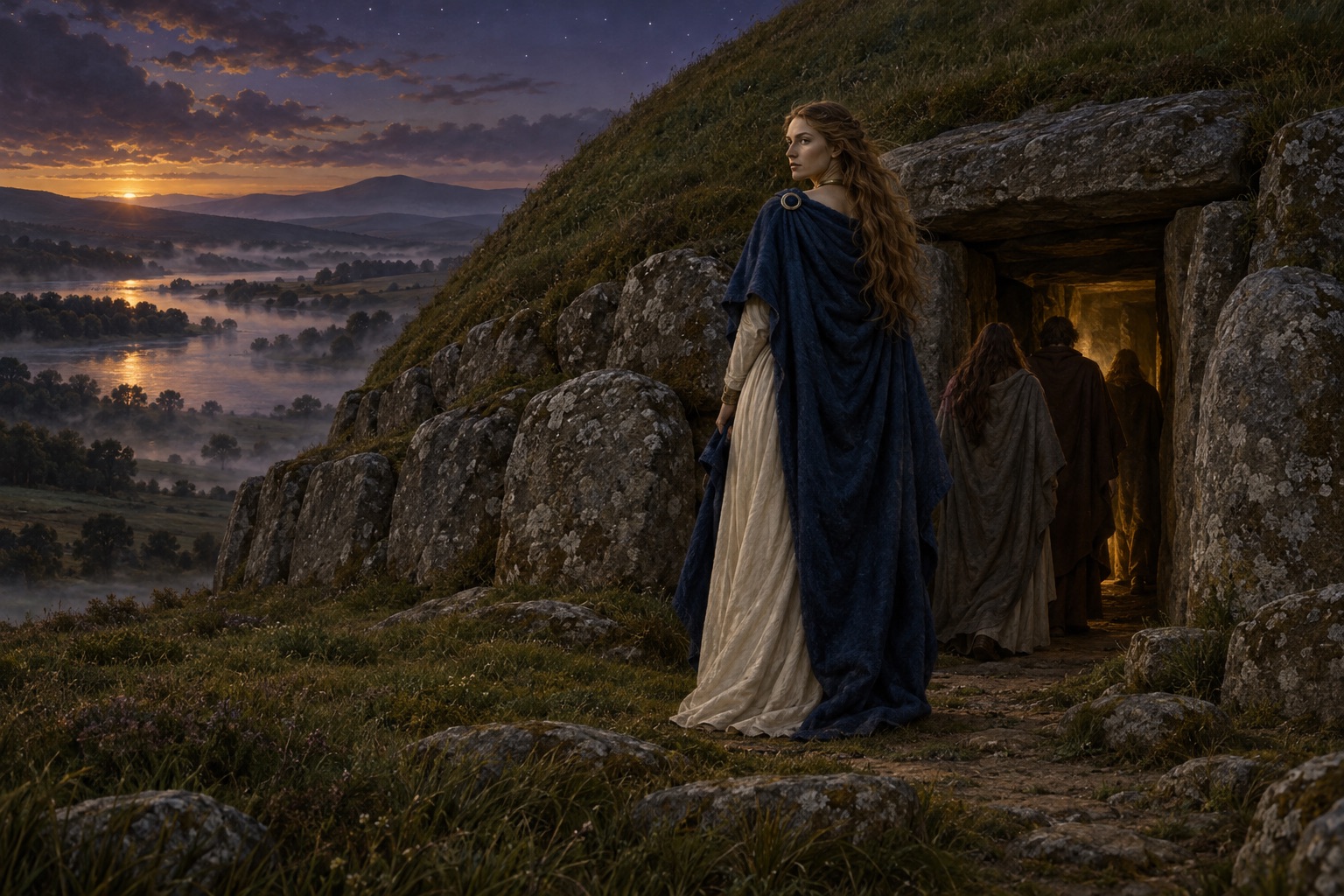
Medieval Irish scholars told the history of their island as a series of takings. Before the Flood came Cessair; after it, Partholón, Nemed and the Fir Bolg; last came the sons of Míl, the ancestors of the Irish. Fifth in the line stand the Tuatha Dé Danann, the “tribes of the gods” of Danann, whom a poem in the Book of Invasions calls “mother of the gods”. They won Ireland in two battles and lost it to the sons of Míl, but they did not leave. In the tales they went into the hills and the great mounds, and that is where later stories keep finding them.
Were the Tuatha Dé gods? The scholars who wrote them down never quite said so, and never quite denied it. The Book of Leinster copy of the Book of Invasions says of them: “gods were their men of arts, non-gods their husbandmen”. The Book of Fermoy copy calls their origin uncertain, “whether they were of demons or of men”, and the second recension insists that they were neither demons nor síd-folk. Modern scholars read them as the old gods retold as a people. “The Tuatha Dé are the old gods,” writes John Carey.
1 The Telling
The frame and the arrival follow the first recension of Lebor Gabála Érenn, as R. A. S. Macalister edited it from the Book of Leinster and the Book of Fermoy; the two battles follow Cath Maige Tuired; the end follows two tales of the Book of Leinster, Mesca Ulad and De Gabáil in t-Sída. Quotations from Cath Maige Tuired are Whitley Stokes’s (1891), from Lebor Gabála Macalister’s, from Mesca Ulad William Hennessy’s (1889); De Gabáil in t-Sída is translated here from the Irish.
1-1 Four Cities, Four Treasures
They began, the Book of Invasions says, as descendants of Nemed in “the northern islands of the world”, learning druidry, knowledge, prophecy and magic “till they were expert in the arts of pagan cunning” (§304). They studied in four cities under four sages, and brought a treasure from each. The list is in the Book of Fermoy copy (§305), and Cath Maige Tuired opens with it:
- from Falias, the Lia Fáil, the Stone of Fál, which stood at Tara and “used to roar under every king that would take (the realm of) Ireland”;
- from Gorias, the spear of Lugh: no battle was ever won against it, or against the man who held it;
- from Findias, the sword of Nuada: once it was drawn from its sheath, no one escaped it;
- from Murias, the cauldron of the Dagda: “No company ever went from it unthankful.”
1-2 Dark Clouds
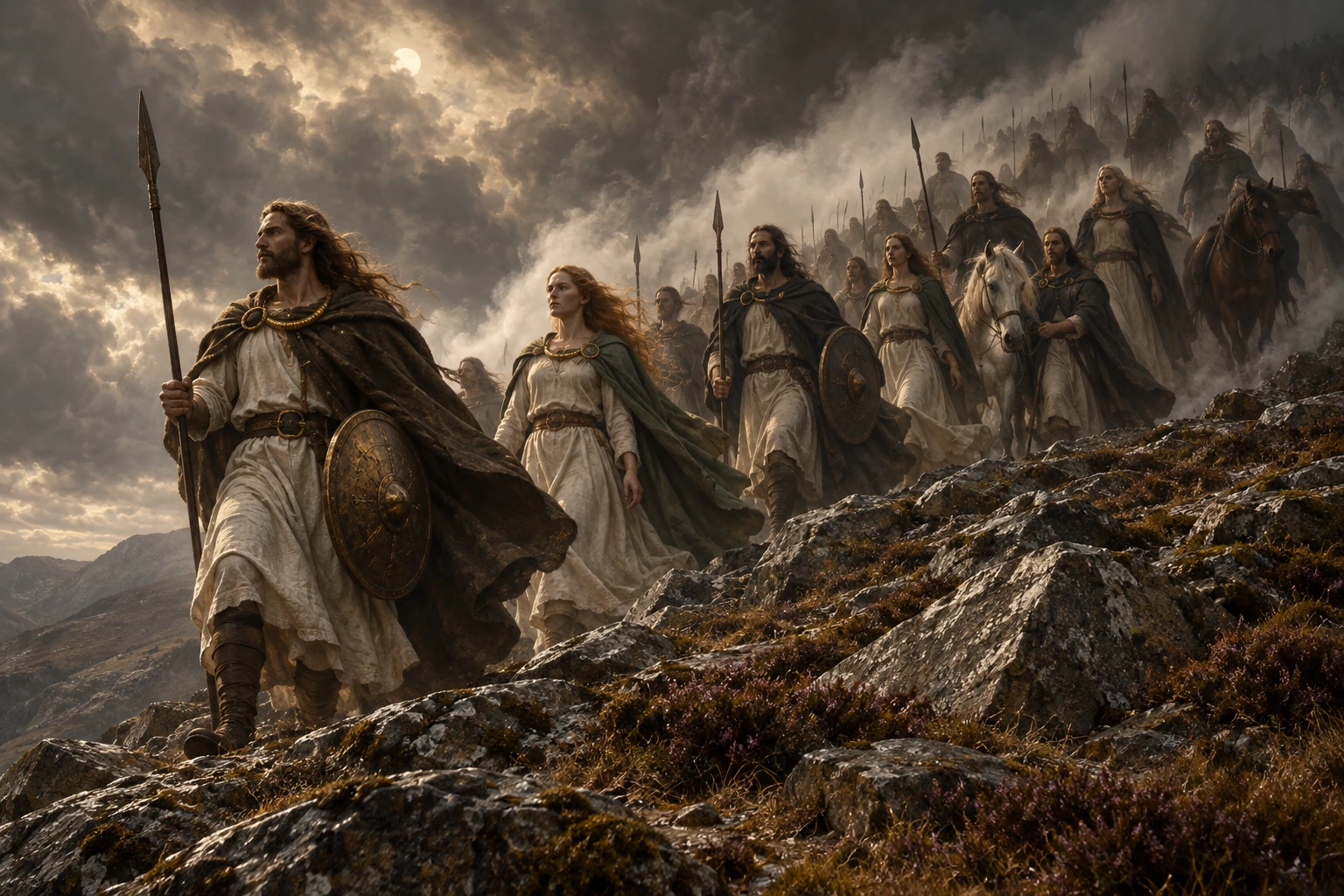
In the Book of Leinster text they came “in dark clouds”, landed on the mountains of Conmaicne Rein in Connacht, “and they brought a darkness over the sun for three days and three nights” (§306). Cath Maige Tuired tells it otherwise. They came with a great fleet and burned their boats as soon as they landed, so that they would not think of retreat, and the smoke filled the land around. “Therefore it was conceived that they had arrived in clouds of mist” (§9).
1-3 The Silver Hand
They asked the Fir Bolg for battle or the kingship, and the first battle of Mag Tuired was fought. The Fir Bolg were routed and their king, Eochaid son of Erc, was killed. In that battle, though, Nuada, king of the Tuatha Dé, lost his hand to the Fir Bolg champion Sreng. The physician Dian Cécht, with the brazier Credne, made him a hand of silver “with the motion of every hand” (§11). It did not save his throne: a king who had lost a hand could not rule.
So the Tuatha Dé gave the kingship to Bres, a beautiful young man whose mother was one of their own and whose father was Elatha, king of the Fomoire, a people from over the sea. It went badly. Under Bres the Fomoire laid a tribute on every house in Ireland; Ogma carried firewood, and the Dagda built the ramparts of the king’s fort. And Bres was mean: “their knives were not greased by him, and however often they visited him their breaths did not smell of ale” (§36). The poet Coirpre, given three small dry cakes in a dark hut with no fire, cursed him in a quatrain as he left. “That is the first satire that was made in Ireland” (§39). The Tuatha Dé took back the kingship, and Bres went to his father’s people for an army.
Meanwhile Dian Cécht’s son Míach did better than his father. He said over Nuada’s own hand, “joint to joint of it and sinew to sinew”, and healed it in nine days (§33). Dian Cécht did not like that cure. He struck his son four times with a sword, and the fourth blow killed him. Three hundred and sixty-five herbs grew from Míach’s grave, one for each of his joints and sinews; his sister Airmed sorted them by their powers, and Dian Cécht mixed them up, “so that no one knows their proper cures” (§35). Nuada was king again.
1-4 The Man of Every Art
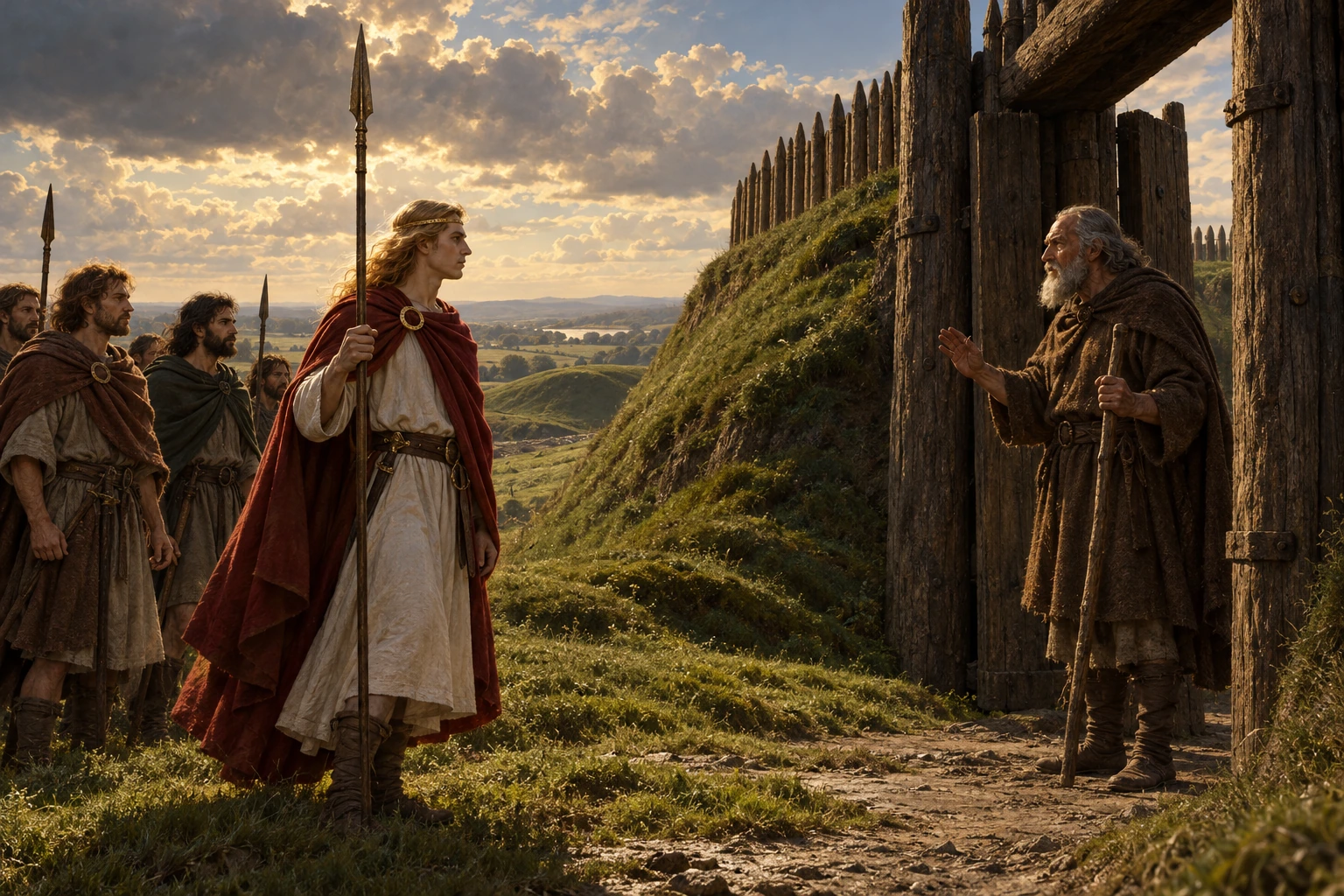
Nuada was holding a feast at Tara when a young warrior came to the gate. “What art dost thou practise?” the doorkeeper asked, “for no one without an art enters Tara” (§56). He was Lugh, son of Cian son of Dian Cécht, and of Ethne, the daughter of Balor of the Fomoire. He offered himself as a wright, a smith, a champion, a harper, a warrior, a poet and historian, a sorcerer, a physician, a cupbearer and a brazier, and each time he was told that Tara had one already. Then let the doorkeeper ask the king, he said, whether he had one man with all these arts; if he had, Lugh would not come in. The doorkeeper went in and announced Samildánach, the man “possessing many arts at the same time” (Stokes’s note). Lugh won every stake on the gaming boards of Tara, threw back into the hall a flagstone that Ogma had hurled through its wall, and played the harp until the company slept, wept and laughed in turn.
Nuada saw that this man could free them from the Fomoire. He gave Lugh his own seat, and “the king rose up before him till thirteen days had ended” (§74). For a year Lugh sat in secret council with the Dagda, Ogma, Goibniu and Dian Cécht, and then he asked every smith, physician, druid and cupbearer what each would do in the battle to come. Before it the Dagda met the Morrígan at a river, and she promised her help; her part in this war is told in her own story.
1-5 The Second Battle of Mag Tuired
Every day the broken weapons of the Tuatha Dé were remade by Goibniu the smith, Luchta the wright and Credne the brazier, and their mortally wounded were thrown into the well of Sláine, where Dian Cécht and his children chanted over them, and came out whole (§§122–123). The Fomoire sent Rúadán, son of Bres and of the Dagda’s daughter Bríg, to kill the smith. He wounded Goibniu and was killed by him.
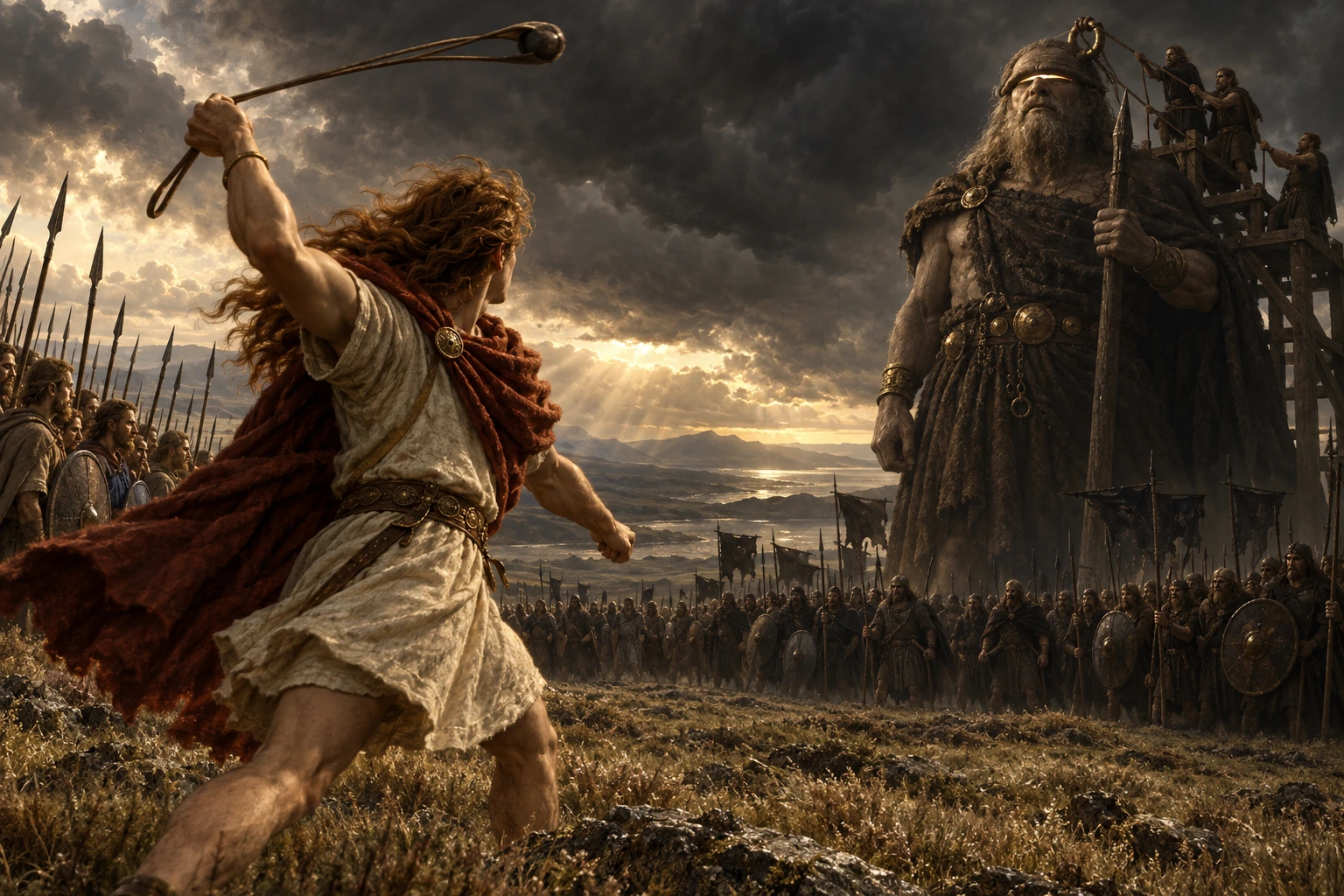
In the great battle Nuada fell at the hands of Balor, and with him Macha, daughter of Ernmas. Balor had an evil eye that was opened only on a battlefield: four men lifted its lid with a polished handle, and an army that looked at it could not stand. “Lift up mine eyelid, my lad,” said Balor, “that I may see the babbler who is conversing with me” (§134). The lid was raised, and Lugh cast a sling-stone that carried the eye through his grandfather’s head, “and so it was his own army that looked (at it)” (§135). Ogma and Indech, king of the Fomoire, killed each other, and the Fomoire were driven back to the sea. Then they found Bres unguarded. He offered cows that would always be in milk, then a harvest in every quarter of the year, and the judge Máeltne turned both down. He was spared at last for telling the Tuatha Dé when to plough, to sow and to reap (§§149–161). Then the Morrígan proclaimed the victory to the hills, the síd-hosts and the rivers of Ireland.
1-6 The Sons of Míl
The Tuatha Dé held Ireland, the Book of Invasions says, under nine kings: Nuada, Bres, Nuada again, Lugh for forty years, the Dagda for eighty, Delbáeth, Fiachu, and last three grandsons of the Dagda, Mac Cuill, Mac Cecht and Mac Gréine, who divided the island into three (§§310–315). Their wives were Banba, Fótla and Ériu. Then the sons of Míl came from Spain to avenge their kinsman Íth. On their way inland they met the three queens one after another, and each asked that the island should bear her name; the poet Amairgen promised it. Ériu welcomed them: “Yours shall be this island for ever” (Part V, §392). At Tara the three kings asked for three days’ grace and put the case to Amairgen himself, warning him that a false judgement would cost him his life. Amairgen judged against his own people: they must go back to their ships and put out “past just nine waves”. “This is the first judgement given in Ireland” (§393). As they sailed out, the druids of Ireland raised a wind against them. Amairgen calmed it with a poem, but Donn, the eldest son of Míl, who had sworn to put all Ireland to the sword, was drowned (§§394–395). The Gaels landed again and beat the Tuatha Dé at Tailtiu, where the three kings and the three queens fell (§469).
1-7 The Half Under the Ground
The Book of Invasions ends there; other tales go on. The Book of Leinster’s Mesca Ulad opens: “When the sons of Miled of Spain reached Erin, their sagacity circumvented the Tuatha De Danaan”. Ireland was left for Amairgen to share, and “he divided Eriu in two parts, and gave the part of Eriu that was under ground to the Tuatha De Danaan, and the other part to the sons of Miled”. The Tuatha Dé “went into hills and fairy places”, and left five of their own in front of every province, to stir up war and strife among the sons of Míl.
De Gabáil in t-Sída, “The Taking of the Síd”, tells how the hills were shared. The Tuatha Dé spoiled the corn and milk of the sons of Míl until these made friends with the Dagda. The Dagda then gave out the síd mounds among his people: Lugh to Síd Rodrubán, Ogma to Síd Aircheltrai, several to himself, and the Brug on the Boyne had been his from the first. Then his son the Mac Óc (Óengus), who had been away in fosterage, came to ask for land. “I have none for you,” said the Dagda. “The sharing is done.” “Then give me a day and a night in your own dwelling.” That was granted. When the time was up, the Dagda told him to go. “It is plain,” said the Mac Óc, “that the whole world is a day and a night, and that is what was given to me.” So the Dagda went out, and the Mac Óc stayed in the Brug, where three trees are always in fruit, one pig is always alive and another always cooked, and a vessel of fine drink never runs dry.
2 Where the Story Is Written Down
- Lebor Gabála Érenn, “the Book of the Taking of Ireland”, usually called the Book of Invasions. John Carey speaks of “the eleventh-century author of Lebar Gabála” and shows that he built on poems by Eochaid ua Flainn, Flann Mainistrech, Tanaide and Gilla Coemáin. The book grew by recensions, and Macalister’s edition (Irish Texts Society, five parts, 1938–1956) prints three. The first is in the Book of Leinster (Trinity College Dublin, MS 1339, written about 1150–1190) and the Book of Fermoy; the second and third are in other manuscripts, among them the Book of Lecan and the Book of Ballymote. The four treasures are missing from the Book of Leinster copy.
- Cath Maige Tuired survives in a single manuscript, British Library Harley 5280 (ff. 63r–70v), written in the early 16th century. Stokes, who first edited it in 1891, found much old language in it, but also Norse loanwords that “can hardly have been naturalised in Ireland before the tenth or eleventh century”. Elizabeth Gray published a new edition and translation for the Irish Texts Society in 1982.
- Cath Muige Tuired Cunga, the First Battle of Mag Tuired, is a separate tale, preserved only in a tract now in Trinity College Dublin (H.2.17, pp. 90–99). J. Fraser, who edited it in 1916, read it as the result of several revisions of a text that may go back in parts to the early Middle Irish period.
- Mesca Ulad (The Intoxication of the Ulstermen) is in the Book of Leinster and in Lebor na hUidre; the opening on the division of Ireland is the Book of Leinster’s. De Gabáil in t-Sída is in the Book of Leinster, folios 245b–246a. Two more tales place the Tuatha Dé in their mounds: Altram Tige Dá Medar (The Fosterage of the House of the Two Milk-Vessels), in the Book of Fermoy, and Tochmarc Étaíne (The Wooing of Étaín), in Lebor na hUidre and the Yellow Book of Lecan.
3 Competing Versions
- How did they come? The Book of Leinster copy: in dark clouds, darkening the sun for three days. The Book of Fermoy copy adds that “another company says” they came by sea and burned their ships, and that the smoke made others speak of fog. Cath Maige Tuired explains the clouds as that smoke. In the First Battle, Bres tells the Fir Bolg champion Sreng that they came “in a cloud of mist and a magic shower”, and a note in the text doubts that they came that way.
- What became of the Fir Bolg? In Cath Maige Tuired and the Book of Invasions, a hundred thousand of them fell with their king, and the survivors fled to Arran, Islay, Man and Rathlin. In the First Battle, Sreng cuts off Nuada’s right arm at the shoulder, and the war ends in a treaty: the Tuatha Dé offer Sreng a province of his choice, and he takes Connacht.
- Nuada’s hand. The Book of Leinster copy knows only the silver hand of Dian Cécht and Credne; the Book of Fermoy copy and Cath Maige Tuired add Míach’s hand of flesh. Macalister thought Míach and his murder “later embellishments of the tale”.
- Whose was the Brug? In the Book of Invasions, the men of Ireland raised “the mound of the Brug” over the Dagda and his three sons (§313). In De Gabáil in t-Sída it is the Dagda’s home, and his son tricks him out of it. In Tochmarc Étaíne it belongs to Elcmar, and Óengus takes it from him at Samain with the same trick of a day and a night, on the Dagda’s advice.
- Who shared out the hills? In Mesca Ulad, Amairgen; in De Gabáil in t-Sída, the Dagda. In Altram Tige Dá Medar it is Manannán mac Lir, who also gives the nobles the féth fíada, a mist that hides them from sight, the Feast of Goibniu that keeps them from age, and pigs that come alive again after they are eaten. Here Lir himself is given Síd Finnachaid.
- Do gods die? In the Book of Invasions they do. Lugh is killed at Uisnech by the three sons of Cermait; the Dagda dies of a wound given him at Mag Tuired, a wound, as Macalister remarked, received “120 years before!”
4 History and Tradition
- Gods turned into a people. Macalister thought this section of the Book of Invasions was “based upon a Theogonia”, but that “the Euhemerist has ‘run amok’ among these ancient deities”. Carey traces how the poets of the 10th and 11th centuries tried “to rationalise the legendary past”. The older Story of Tuán had said that “the learned do not know their origin; but they think it likely that they were some of the exiles who came from heaven”. Eochaid ua Flainn asked whether they were demons or humans; Flann Mainistrech wrote thirty-seven quatrains “demonstrating their mortality by cataloguing the deaths” of as many as he could. After Cú Chulainn struck the Lia Fáil, says the Book of Invasions, it cried out under no king but Conn, and the text explains: “It was no chance which caused it, but Christ’s being born, which is what broke the powers of the idols” (§309). The scribe of Cath Maige Tuired explains that swords spoke in those days because “weapons were worshipped by human beings at that epoch”, and so demons spoke from them (§162).
- Brú na Bóinne. The Brug is Brú na Bóinne, “the palace or mansion of the Boyne”, in County Meath. Its great passage tombs, Newgrange, Knowth and Dowth, were built around 3200 BCE, and it was inscribed on the World Heritage List in 1993. At sunrise around the winter solstice, light enters Newgrange through a small “roof box” above the door and reaches the chamber for 17 minutes; a lottery decides who may stand inside.
- The Lia Fáil at Tara. On the Hill of Tara, a standing stone on the earthwork called the Forradh is shown to visitors as the Lia Fáil, “the great coronation stone and one of the four legendary treasures of the Tuatha Dé Danann”.
- Into the modern imagination. Lady Gregory retold the stories in English in Gods and Fighting Men (1904). Its book on “the Ever-Living Living Ones” begins with Manannán choosing the most beautiful hills and valleys for them and putting “hidden walls about them, that no man could see through”. Mark Williams’s Ireland’s Immortals (Princeton, 2016) is a history of these figures from the early Middle Ages to the present.
“The Tuatha Dé became the fairies, the little people.” Not in the medieval texts. There the people of the síd are full-sized and beautiful: in Tochmarc Étaíne, Midir of Brí Léith appears at Tara as a warrior with golden hair to his shoulders and carries off the queen. The second recension of the Book of Invasions even denies that the Tuatha Dé were síd-folk at all. In 1888 W. B. Yeats recorded the antiquarians’ view that they “dwindled away in the popular imagination, and now are only a few spans high”, but beside it he set the country people’s answer, that the fairies were fallen angels. In his book the leprechaun is a solitary fairy, not one of the trooping host he links to the Tuatha Dé.
5 Related Stories
- The Morrígan: The Phantom Queen of Battle: the goddess who meets the Dagda by the river before Mag Tuired, and after the battle proclaims the victory and foretells the end of the world.
- The Children of Lir: Nine Hundred Years as Swans: Lir is one of the Tuatha Dé, and in Altram Tige Dá Medar he is given Síd Finnachaid as his mound. What became of his children is told there.
- The Banshee: The Woman Who Keens Before a Death: her Irish name, bean sí, joins bean, “woman”, to the word for the mounds where the Tuatha Dé went.
- Fenrir: The Wolf the Gods Bound: the Norse god Týr loses his right hand to the wolf, as Nuada loses his to Sreng; but Týr stays a god of battle, while Nuada loses his throne until a new hand is made. Georges Dumézil, in Mitra-Varuna (1940), set the two in one pattern, in his chapter on “the one-eyed god and the one-handed god”: Týr beside the one-eyed Odin, Nuada beside Lugh, who closes one eye as he chants before the battle.
6 Sources
- Lebor Gabála Érenn: The Book of the Taking of Ireland, ed. and trans. R. A. Stewart Macalister (Irish Texts Society 34, 35, 39, 41, 44; 1938–1956), Part IV, section VII, §§304–318 and 353, and Part V, §§386–395 and 469: archive.org, archive.org; Irish text of the Book of Leinster: CELT; Michael Murphy, introduction to the index of Macalister’s edition (2008): CELT
- Cath Maige Tuired, ed. and trans. Whitley Stokes, “The Second Battle of Moytura”, Revue Celtique 12 (1891) 52–130, §§1–167: archive.org, CELT; ed. and trans. Elizabeth A. Gray, Cath Maige Tuired: The Second Battle of Mag Tuired (Irish Texts Society 52, 1982): CELT; British Library, Harley MS 5280: searcharchives.bl.uk; J. Fraser (ed. and trans.), “The First Battle of Moytura”, Ériu 8 (1916): archive.org
- Mesca Ulad, trans. William M. Hennessy, Todd Lecture Series 1 (Dublin, 1889): archive.org; Irish text ed. J. Carmichael Watson: CELT; De Gabáil in t-Sída, Book of Leinster fo. 245b–246a, in The Book of Leinster, ed. R. I. Best and M. A. O’Brien (first edited by Vernam Hull, Zeitschrift für celtische Philologie 19, 1931): CELT
- Altram Tige Dá Medar, Book of Fermoy, trans. Maighréad Ní C. Dobbs, Zeitschrift für celtische Philologie 18 (1929–30): Celtic Literature Collective; Tochmarc Étaíne, trans. Osborn Bergin and R. I. Best, Ériu 12 (1938): CELT
- John Carey, The Irish National Origin-Legend: Synthetic Pseudohistory (Quiggin Pamphlets 1, Cambridge, 1994): asnc.cam.ac.uk
- W. B. Yeats (ed.), Fairy and Folk Tales of the Irish Peasantry (1888), “The Trooping Fairies”: Project Gutenberg; Lady Gregory, Gods and Fighting Men (John Murray, 1904), Book Four: Project Gutenberg; Mark Williams, Ireland’s Immortals: A History of the Gods of Irish Myth (Princeton University Press, 2016): Publishers Weekly
- Heritage Ireland, “Brú na Bóinne Visitor Centre” and “Hill of Tara”: heritageireland.ie, heritageireland.ie; World Heritage Ireland, “Brú na Bóinne”: worldheritageireland.ie; RTÉ News, “Onlookers observe ‘magical’ Winter Solstice at Newgrange”, 2023: rte.ie
- Georges Dumézil, Mitra-Varuna: An Essay on Two Indo-European Representations of Sovereignty (1940), trans. Derek Coltman, ed. Stuart Elden (HAU Books, 2023), chapter IX, “The One-Eyed God and the One-Handed God”: HAU Books
Cover and illustrations: AI-generated images made for Arcana. They are interpretations, not historical artworks.