The Children of Lir: Nine Hundred Years as Swans
A jealous stepmother turned Lir's four children into swans for nine hundred years, and only a monk's bell released them, as old people on the point of death. The tale is often called an ancient pagan myth, yet the earliest known mention of it is a title in a book list of 1526, and it ends with a baptism.
- Type: tale of transformation and penance, one of the “Three Sorrows of Storytelling”
- Culture: Ireland; a tale in Irish about the Tuatha Dé Danann, the people of the old gods
- Earliest text: Oidheadh Chloinne Lir (“The Fate of the Children of Lir”), Irish prose with verse laments; its title appears in a list of books in 1526, and the oldest copy known is in a 17th-century manuscript now in Edinburgh
- Key figures: Lir, his wives Aobh and Aoife, Bodb Derg, the children Fionnuala, Aodh, Fiachra and Conn, the holy man Mochaomhóg, King Lairgnen and Queen Deoch
The Garden of Remembrance in Dublin is dedicated to all who gave their lives for Irish freedom, and its centrepiece is not a soldier. It is Oisín Kelly’s bronze group The Children of Lir. The story it shows was already “so popular, and so widely known” in 1883, wrote the editor of its Irish text: a stepmother’s spell, nine hundred years on three cold waters, and a bell that ends it.
Do the swans become children again? No. When their feathers fall away, the text says, the three brothers are “three withered, bony old men” and their sister “a lean, withered old woman, without blood or flesh”. Fionnuala asks to be baptized, because their death is near, and the four of them die and are buried in one grave.
1 The Telling
This is the text that Eugene O’Curry put together from several Dublin manuscripts and published with a translation in 1863, as reissued with his notes by Richard J. O’Duffy in 1883. Quotations follow that translation; the section numbers (§) are O’Duffy’s.
1-1 Lir and Bodb Derg
After the battle of Tailtiu, where the sons of Míl won Ireland from them, the Tuatha Dé Danann met to choose one king. Five chiefs were named for it, Lir of Sídh Fionnachaidh among them, and the assembly chose Bodb Derg, son of the Dagda. Lir alone took offence and left without a word. The others wanted to burn his house; Bodb would not allow it (§1–4).
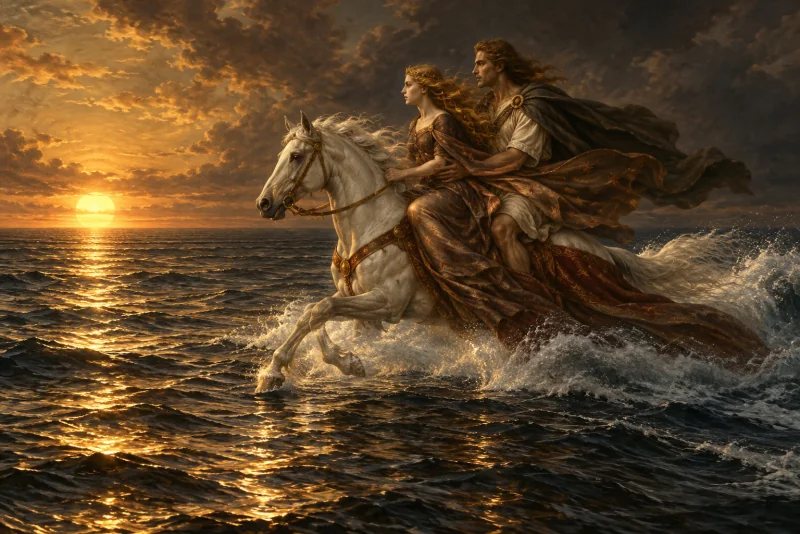
Then Lir’s wife died after an illness of three nights. Bodb offered him one of his three foster-daughters, Aobh, Aoife and Ailbhe, daughters of Ailill of Aran. Lir came with fifty chariots and took the eldest, Aobh. She bore him twins, a girl and a boy, Fionnuala and Aodh, and then two more sons, Fiachra and Conn, and she died at their birth. Bodb gave Lir her sister Aoife. Everyone who saw the four children loved them, and Lir would rise at dawn “and lie down among his children” (§5–13).
1-2 Aoife’s Spell
Jealousy took hold of Aoife. She feigned illness for most of a year. Then she drove the children towards Bodb’s house in her chariot; Fionnuala went unwillingly, having dreamed of treachery. On the way Aoife ordered her people to kill them. They refused, and when she drew a sword herself, she could not do it (§14–16).
At Loch Dairbhreach, the Lake of the Oaks, today Lough Derravaragh in County Westmeath, she told the children to bathe. When they were out on the water, she struck them with a “metamorphosing druidical wand” and turned them into “four beautiful perfectly white swans” (§17).
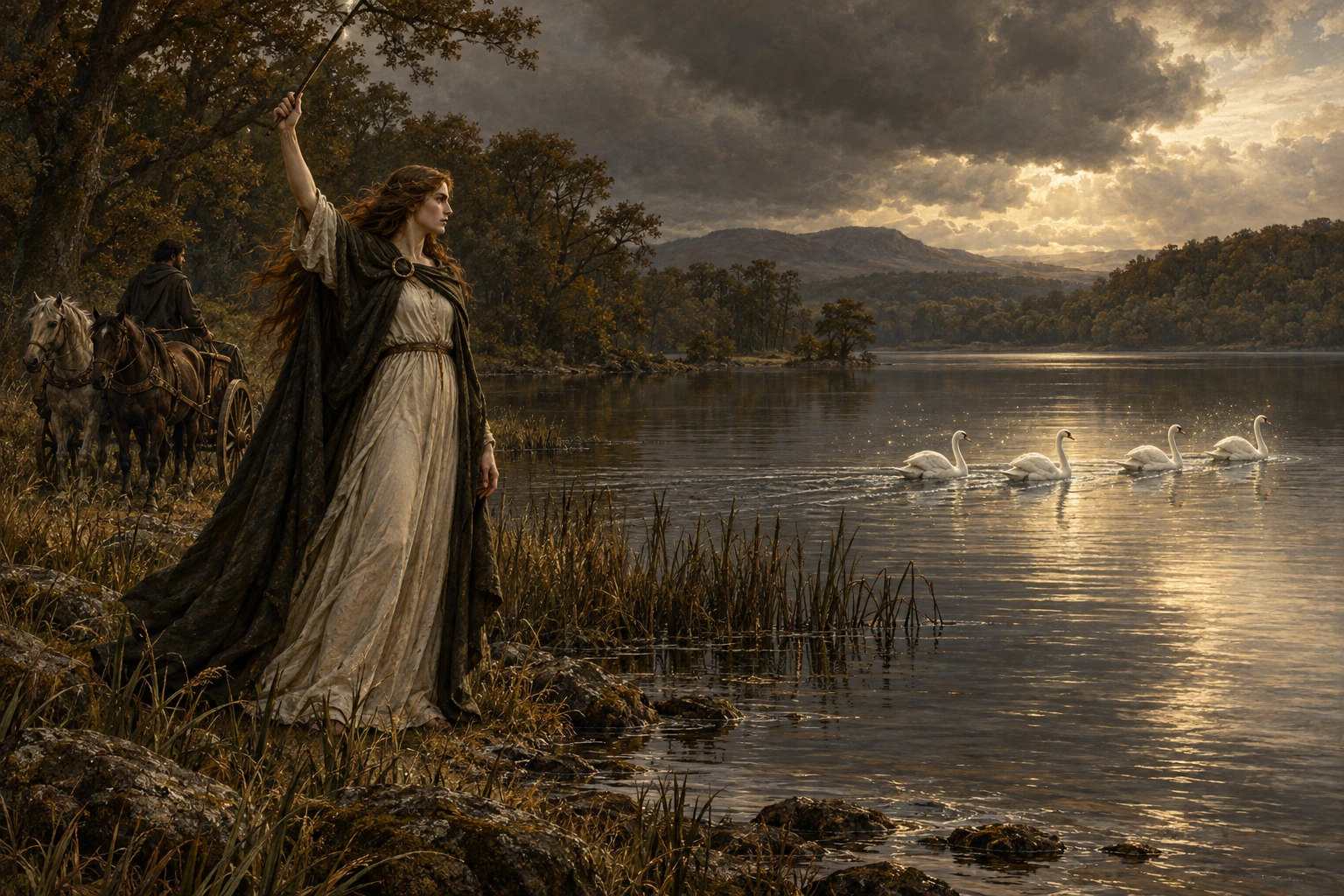
Fionnuala demanded an end to it. Aoife set one: three hundred years on Loch Dairbhreach, three hundred on Sruth na Maoile, the sea “between Erinn and Albain”, and three hundred at Iorras Domnann and Inis Gluaire, in the far west. No power would free them until “the woman from the South and the man from the North are united”: Deoch, daughter of a king of Munster, and Lairgnen of Connacht. Then she relented a little. They would keep their speech, their reason and their dignity, and sing music so sweet that whoever heard it would sleep (§18–20).
Lir found his children on the lake, singing with human voices. Bodb Derg asked Aoife what shape she would think worst of all, and she said “a demon of the air”. He struck her with his own wand, “and she is still a demon of the air, and shall be so for ever” (§24–32).
1-3 Three Hundred Years on the Lake
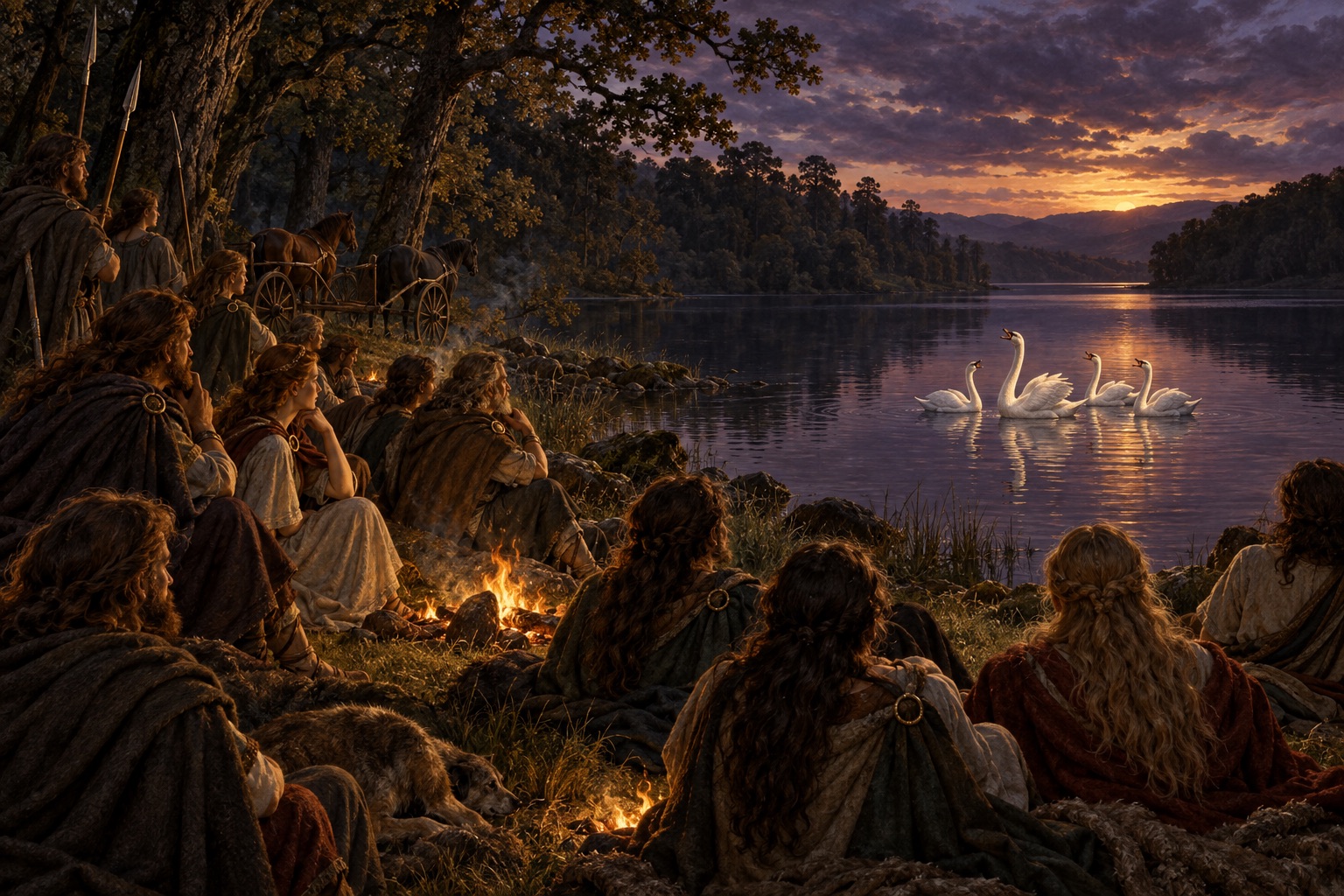
The Tuatha Dé and the sons of Míl alike camped on the shores of the lake to listen. The swans talked with their friends every day, and anyone who heard their music at night slept soundly, whatever illness he had. When the three hundred years were up, they flew north, and the men of Ireland proclaimed “that no swan should be killed” from that day on (§33–36).
1-4 The Sea of Moyle
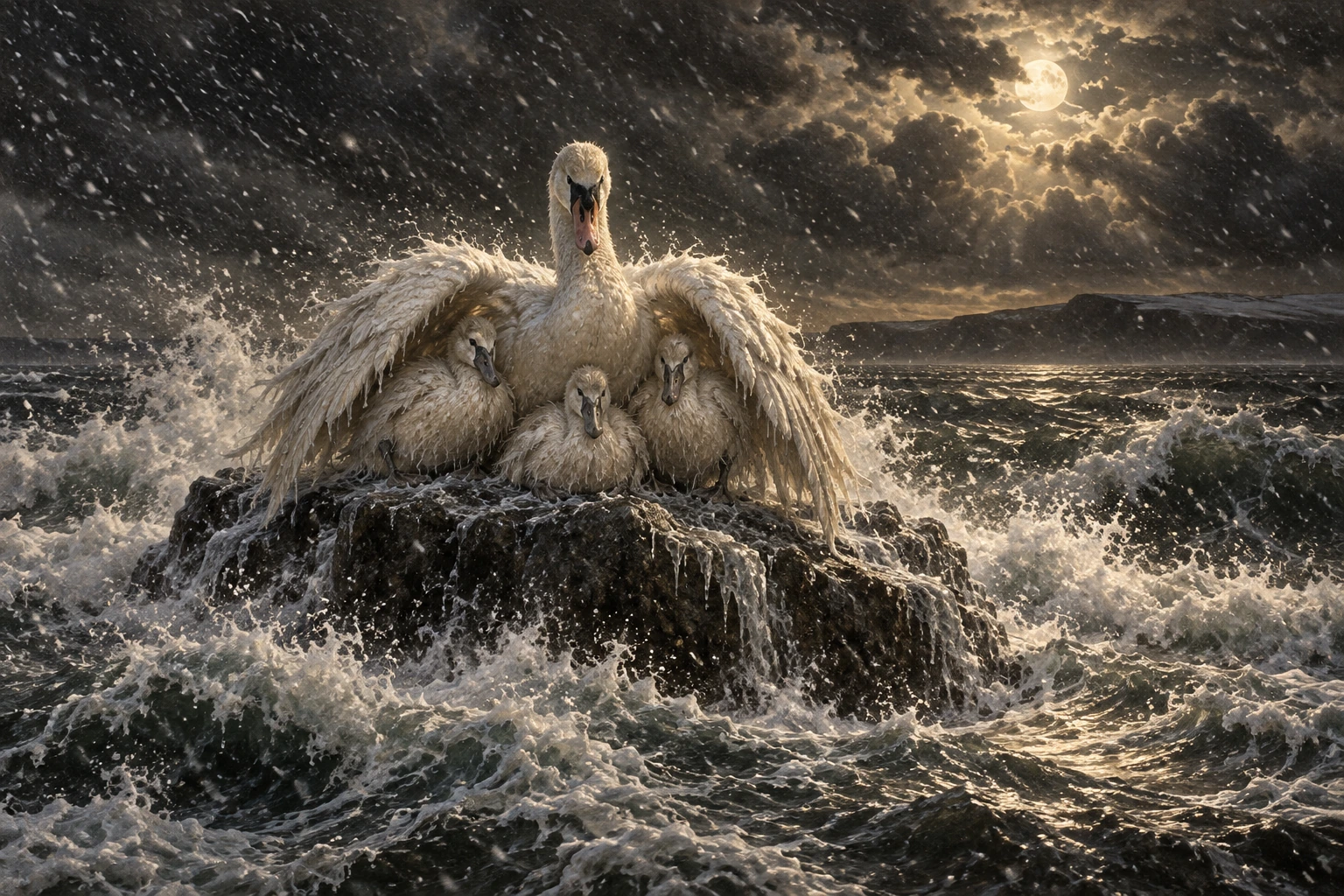
The sea between Ireland and Scotland was the worst of their exiles. A storm scattered them, and Fionnuala spent the night alone on Carraig na Rón, the Seal Rock. At dawn the brothers came back to her, one by one, and she sheltered them: Aodh under her breast, Fiachra under her right wing, Conn under her left (§37–41). One night in January the sea froze, and when they pulled free of the rock they left the skin of their feet and the feathers of their breasts on it (§43).
At the mouth of the Bann they met riders led by two sons of Bodb Derg, who told them that Lir and the Tuatha Dé were feasting at Sídh Fionnachaidh. Fionnuala answered with a lament: their food and wine were now “the white sand and bitter brine”, where once they had drunk hazel mead (§46–49).
1-5 The Empty Home
In the west, at Iorras Domnann, a young man named Aibhric came to love the swans and their singing. The text calls him “the young man who arranged in order and narrated all their adventures” (§52). On a night when the sea froze again, Fionnuala told her brothers to believe in “the truly splendid God of truth, who made Heaven with its clouds, and Earth with its fruits”. They believed, and from then on no storm troubled them (§53–54).
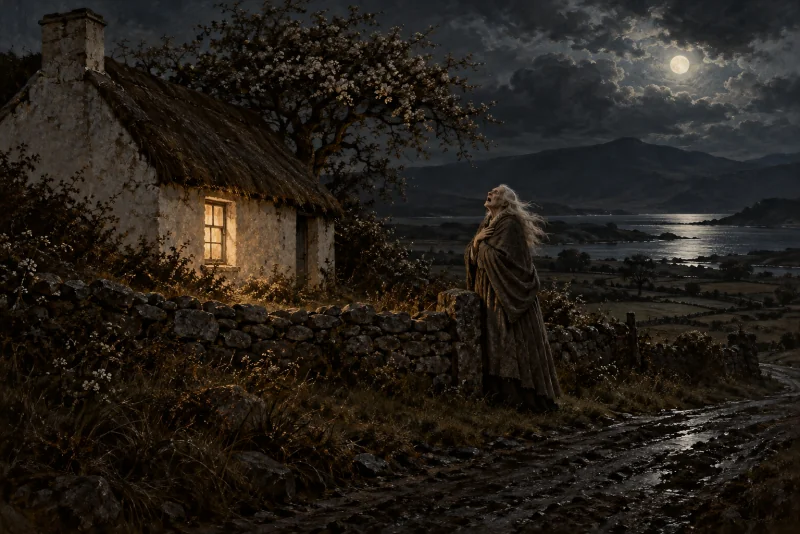
When the last term ended, they flew home to Sídh Fionnachaidh and found nothing but “unroofed green raths, and forests of nettles”, “without a house, without a fire”. “The lord of the house does not live,” Fionnuala sang. They spent one night there and flew on to Inis Gluaire (§55–57).
1-6 The Bell
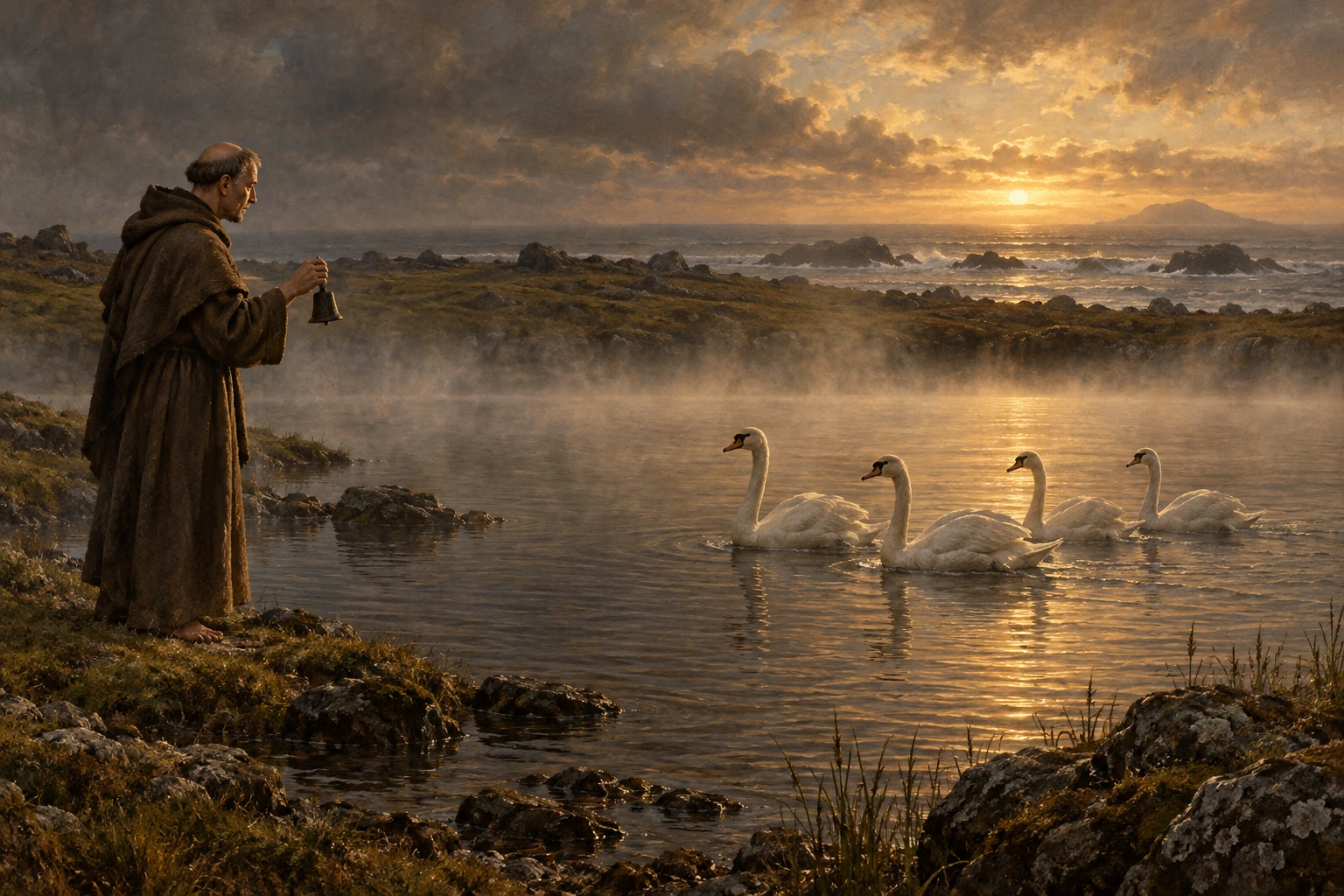
Then Patrick came to Ireland, and the holy man Mochaomhóg came to Inis Gluaire. On his first night there the swans heard his bell ring for matins and leaped up in terror. “That is the voice of the Bell of Mochaomhog,” said Fionnuala, and it would free them. They sang to God, and Mochaomhóg, praying to know who sang, learned that they were the Children of Lir. In the morning he went down to the lake and asked them, “Are ye the Children of Lir?” “We are, indeed” (§58–61). He took them to his church, had a craftsman make chains of bright white silver to join Aodh with Fionnuala and Conn with Fiachra, and the swans heard Mass with him (§62).
The king of Connacht at that time was Lairgnen, and his wife was Deoch, daughter of the king of Munster: the man from the North and the woman from the South. Deoch wanted the wonderful birds. Mochaomhóg refused them, and Lairgnen came himself and snatched them from the altar, two in each hand. At his touch their feathers fell, and they were old (§63–65).
Fionnuala asked the cleric to baptize them, for their death was near, and told him how to make the grave: Conn at her right side, Fiachra at her left, “and Aodh before my face”. They were baptized, died and were buried as she had asked. A stone was raised over them with their names in ogham, “and heaven was obtained for their souls” (§67–68).
2 Where the Story Is Written Down
- Not in the old manuscripts. Eugene O’Curry, who edited the tale, remarked that he had never met any allusion to it in the ancient manuscripts, and Donald Mackinnon wrote in 1912 that it “is not mentioned in the old literature”. Its language is Early Modern Irish, prose broken by the verse laments of Fionnuala, Lir and Aoife.
- A title in 1526. The list of books in the library of Gerald FitzGerald, Earl of Kildare, dated 15 February in the 17th year of Henry VIII, includes among its “Irish Boke” one called “The History of Clane Lyre”: the children of Lir.
- The oldest copy. Adv. MS 72.1.38 in the National Library of Scotland, a paper manuscript of Irish tales, has the tale on pages 155–170; Mackinnon called it the oldest copy then known. Ronald Black’s catalogue dates its paper to the first half of the 17th century and a chronology inside it to 1618. The manuscript later passed through the hands of James Macpherson, the translator of Ossian.
- The 18th century. The oldest copies P. W. Joyce knew in 1879 were by the Clare scribe Andrew Mac Curtin, who lived from about 1680 to 1740, by Richard Tipper in 1718 and by Hugh O’Daly in 1758. In an 18th-century Edinburgh manuscript, Adv. MS 72.2.6, the tale is headed “the second sorrow of the three sorrows of storytelling”.
- Editions. O’Curry printed text and translation in The Atlantis (1863), compiled, as O’Duffy reports, from six Dublin manuscripts that were all incomplete and “rude and defective”. O’Duffy reissued it for schools in 1883. Joyce retold it freely in Old Celtic Romances (1879), Joseph Jacobs abridged it in More Celtic Fairy Tales (1894), and Lady Gregory retold it in Gods and Fighting Men (1904).
3 Competing Versions
- Daughters or foster-daughters? In O’Curry’s text, Aobh and Aoife are daughters of Ailill of Aran and Bodb’s foster-children. Mackinnon’s summary of the copy in Adv. MS 72.2.6 makes them the king’s own daughters.
- When will it end? In O’Curry’s text Aoife names only the marriage of Lairgnen and Deoch; Fionnuala later adds “the time of the Tailginn”, a name for St Patrick, “and of the coming of Faith”. Joyce puts it all in Aoife’s mouth: until the Taillkenn comes and “ye hear the voice of the Christian bell”. Thomas Moore summed it up in 1808: “the first sound of the mass-bell was to be the signal of her release”.
- The saint’s name. Mochaomhóg in O’Curry and Gregory, Kemoc in Joyce, St Kevoc (Caomhag) in Mackinnon. O’Curry could not identify him. In the Edinburgh copy, Mackinnon notes, the saint curses Lairgnen “pretty vigorously”; in Joyce he reproaches him “very bitterly”.
- After death. O’Curry’s text ends with heaven “obtained for their souls”. Joyce adds a vision: Kemoc looks up and sees “four lovely children, with light, silvery wings”, who vanish upwards.
- Where is the Seal Rock? O’Curry did not know. Mackinnon suggested Eilean nan Ròn, a seal island off Oronsay in Scotland.
- An ending set in history. The Annals of Tigernach record the death of Fíngen son of Áed, king of Munster, under the year 618 and of Laidhgnén son of Colmán, king of Connacht, under 655, about two centuries after Patrick. Joyce called Lairgnen and Deoch “well-known historical personages, who flourished in the seventh century”.
4 History and Tradition
- Lir, “the sea”. Lir is a form of the Irish word for the sea. Cormac’s Glossary, about 900 in Joyce’s dating, says the Irish and the Britons called Manannán, a famous navigator, a god of the sea, “i.e. mac lir, ‘son of sea’”. Fionnuala’s lament remembers “the teaching of Manannan”, but O’Curry could not say whether his Lir was this Lir of Sídh Fionnachaidh. Whitley Stokes set Manannán mac Lir beside the Welsh Manawydan son of Llŷr, a figure of the Mabinogi.
- Never kill a swan. O’Curry thought the custom “probably, at least, as old as this story”, and wrote that it was still thought unlucky to kill a swan: a man who shot eleven at night, taking them for wild geese, lost his son, his boats and his wife, and his neighbours blamed the shot. We have found no law that protects swans because of the story: the Wildlife Act 1976 protects wild birds in general and says nothing of it.
- The Three Sorrows of Storytelling. In 1808 Theophilus O’Flanagan called the tale of Deirdre one of the “Three tragic Stories of the Irish”, with the deaths of the children of Tuireann and of Lir, and printed the “old stanzas” that list them. In his 1855–56 lectures O’Curry put all three before the year 1000. Joseph Jacobs disagreed in 1894: there was “no evidence” that Lir was as old as the other two, one of which was as old as the 11th century. Douglas Hyde turned all three into English verse in 1895.
- “Silent, O Moyle”. Thomas Moore’s “Song of Fionnuala”, in the second number of his Irish Melodies (1808), has “Lir’s lonely daughter” tell “to the night-star her tale of woes”. Moore said he found the story among manuscript translations from the Irish made for the Countess of Moira.
- The Garden of Remembrance. The garden on Parnell Square, designed by Dáithí Hanly, opened on the fiftieth anniversary of the 1916 Rising. Its focus is Oisín Kelly’s bronze group The Children of Lir, dated 1971, in front of a poem by Liam Mac Uistín.
- A swan-children tale? Alfred Nutt, quoted by Mackinnon, thought the story might be the Gaelic version of the “Seven Swans” fairy tale.
- The island. O’Curry’s notes place Inis Gluaire, Inishglora, a mile off the coast of Erris in County Mayo: an island sacred to St Brendan, with ruined churches, where, he reports after the Book of Leinster, “the corpses that are carried into it do not rot”.
The Children of Lir is often presented as one of the oldest myths of pagan Ireland. Its characters are old gods, but the story about them is late. O’Curry, who once dated it before the year 1000, found it mentioned in none of the ancient manuscripts; the earliest trace we have found is a title in an earl’s library in 1526, and the oldest copy is of the 17th century. The tale ends not with a god but with a bell, a baptism and a Christian grave.
5 Related Stories
- The Tuatha Dé Danann: The Gods Who Went into the Hills: Lir and Bodb Derg are of this people. The tale opens just after their defeat at Tailtiu, when they choose a king for their life in the hills.
- Oisín and Tír na nÓg: The Land of Youth: Oisín, too, comes back after three hundred years to an Ireland that has become Christian, grows old at once and talks with St Patrick. We have not found a scholar who compares the two tales; we link them for the theme.
- The Banshee: The Woman Who Keens Before a Death: in his note on the swan, O’Curry wrote that it “sings its own dirge at the approach of its natural death, in notes as plaintive and sweet as the Ben-sidhe”.
- Tấm and Cám: The Girl Who Came Back: a stepmother’s household destroys a child, who comes back as a bird with a human voice. A shared theme; we have not found a scholar who compares the two tales.
6 Sources
- Oidhe Chloinne Lir: The Fate of the Children of Lir, text and translation after Eugene O’Curry (The Atlantis 4, 1863), ed. Richard J. O’Duffy (Society for the Preservation of the Irish Language, 1883), with O’Curry’s notes: archive.org; CELT edition and manuscript list: CELT; UCC, Irish Sagas: iso.ucc.ie
- P. W. Joyce, Old Celtic Romances (1879): Project Gutenberg; Lady Gregory, Gods and Fighting Men (1904), book V: Project Gutenberg; Joseph Jacobs, More Celtic Fairy Tales (1894), note XXVII: Wikisource
- Ronald Black, Catalogue of Gaelic Manuscripts in the National Library of Scotland, Adv. MS 72.1.38 and 72.2.6: ISOS, ISOS; Donald Mackinnon, A Descriptive Catalogue of Gaelic Manuscripts (1912), pp. 152, 166–169: archive.org
- “Catalogue of the Earl of Kildare’s Library in 1526”, in the Marquis of Kildare, The Earls of Kildare and Their Ancestors (1858), appendix VI: archive.org
- Eugene O’Curry, Lectures on the Manuscript Materials of Ancient Irish History (1861), lecture X: archive.org
- Theophilus O’Flanagan, “Deirdri”, Transactions of the Gaelic Society of Dublin 1 (1808): archive.org; Douglas Hyde, The Three Sorrows of Story-telling (1895): archive.org
- Sanas Chormaic: Cormac’s Glossary, trans. John O’Donovan, ed. Whitley Stokes (1868), “Manannan mac lir”: archive.org; The Annals of Tigernach, CELT edition: CELT
- Thomas Moore, The Irish Melodies and Other Poems (Dublin, 1846), with his notes: archive.org; “The Song of Fionnuala”: IMSLP
- National Inventory of Architectural Heritage, “Garden of Remembrance” (50010658): buildingsofireland.ie; Heritage Ireland, “Garden of Remembrance”: heritageireland.ie
- Wildlife Act 1976, section 19: Irish Statute Book
Cover and illustrations: AI-generated images made for Arcana. They are interpretations, not historical artworks.